

Explaining Divergent Observations Regarding Osteocalcin/GPRC6A Endocrine Signaling
Open accessThe DOI matches its Crossref record; 88 of the 90 references it cites were found in a registry or an index.
Abstract
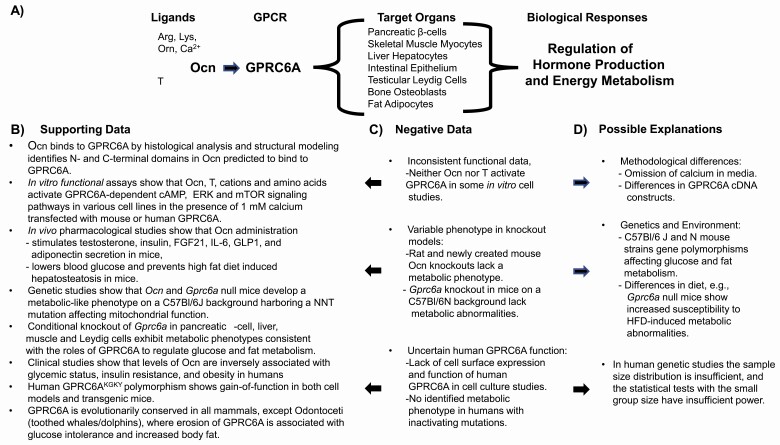
A new schema proposes that the bone-derived osteocalcin (Ocn) peptide hormone activates the G-protein-coupled receptor GPRC6A to directly regulate glucose and fat metabolism in liver, muscle, and fat, and to stimulate the release of metabolism-regulating hormones, including insulin, fibroblast growth factor 21, glucagon-like peptide 1, testosterone, and interleukin 6. Ocn/GPRC6A activation has also been implicated in cancer progression. GPRC6A is activated by cations, amino acids, and testosterone. The multiligand specificity, the regulation of energy metabolism in diverse tissues, and the coordinated release of metabolically active hormones make the GPRC6A endocrine networks unique. Recently, the significance of Ocn/GPRCA has been questioned. There is a lack of metabolic abnormalities in newly created genetically engineered Ocn- and Gprc6a-deficient mouse models. There are also paradoxical observations that GPRC6A may function as a tumor suppressor. In addition, discordant published studies have cast doubt on the function of the most prevalent uniquely human GPRC6A-KGKY polymorphism. Explanations for these divergent findings are elusive. We provide evidence that the metabolic susceptibility of genetically engineered Ocn- and Gprc6a-deficient mice is influenced by environmental challenges and genetic differences in mouse strains. In addition, the GPRC6A-KGKY polymorphism appears to be a gain-of-function variant. Finally, alternatively spliced isoforms of GPRC6A may alter ligand specificity and signaling that modulate oncogenic effects. Thus, genetic, post-translational and environmental factors likely account for the variable results regarding the functions of GPRC6A in animal models. Pending additional information, GPRC6A should remain a potential therapeutic target for regulating energy and fat metabolism, hormone production, and cancer progression.
Overview
The claims and statistics of this paper haven’t been checked yet.
Free: it reads the open-access text and checks the first 5 claims that cite a source we can check. Create a free account to check every claim.
Integrity signals
Registry
Cites
Statistics
Figures
Verification
Claims the paper makes
The claims and statistics of this paper haven’t been checked yet.
Free: it reads the open-access text and checks the first 5 claims that cite a source we can check. Create a free account to check every claim.
Claims other papers make about this one
Each is checked against this paper’s own text: does it say what the citing paper says it does?
In the citing paper
“Uncarboxylated OC can regulate insulin signaling, de novo lipogenesis, and endoplasmic reticulum stress through direct binding to its liver-specific receptor, G protein-coupled receptor family C Group 6 subtype A [138].”
From Emerging role of liver-bone axis in osteoporosis (2024) · cites this paper as [138]
Self-check
Percentages, sums and reported differences re-computed from the paper’s own numbers.
The self-check needs the paper’s full text.
Citations
Cites
Stöckl, S., Göttl, C., Grifka, J., & Grässel, S. (2013) · Cellular Physiology and Biochemistry · doi:10.1159/000350089 · Cited by 4,656
1,500 scientists lift the lid on reproducibility
Baker, M. (2016) · Nature · doi:10.1038/533452a · Cited by 4,209
Raise standards for preclinical cancer research
Begley, C. G., & Ellis, L. M. (2012) · Nature · doi:10.1038/483531a · Cited by 2,979 · cited 1×
“It is estimated that 70% of researchers fail to confirm another scientist’s experiments (59, 60).”
BackgroundEndocrine regulation of energy metabolism by the skeleton
Lee, N. K., Sowa, H., Hinoi, E., Ferron, M., Ahn, J. D., Confavreux, C., Dacquin, R., Mee, P. J., McKee, M. D., Jung, D. Y., et al. (2007) · Cell · doi:10.1016/j.cell.2007.05.047 · Cited by 2,554 · cited 2×
“The concept of an Ocn/GPRC6A endocrine network was originally published in 2007 by Gerard Karsenty and collaborators (6), and was based, in part, on the observations that Ocn null mice, in addition to having increased bone formation (10), had an unexpected metabolic syndrome–like phenotype (6).”
BackgroundIncreased bone formation in osteocalcin-deficient mice
Ducy, P., Desbois, C., Boyce, B., Pinero, G., Story, B., Dunstan, C., Smith, E., Bonadio, J., Goldstein, S., Gundberg, C., et al. (1996) · Nature · doi:10.1038/382448a0 · Cited by 1,725 · cited 4×
“Unlike robust metabolic phenotype in the mice derived by Karsenty’s group, the Ocn knockout mouse made by Komori and Moriishi’s group failed to show a role for Ocn in exerciseinduced bone formation, glucose metabolism, exerciseinduced enhancement of glucose uptake, testosterone synthesis, spermatogenesis, or muscle ma…”
BackgroundInfluentialEndocrine Regulation of Male Fertility by the Skeleton
Oury, F., Sumara, G., Sumara, O., Ferron, M., Chang, H., Smith, C. E., Hermo, L., Suarez, S., Roth, B. L., Ducy, P., et al. (2011) · Cell · doi:10.1016/j.cell.2011.02.004 · Cited by 628
GPCR-G Protein-β-Arrestin Super-Complex Mediates Sustained G Protein Signaling
Thomsen, A. R. B., Plouffe, B., Cahill, T. J., Shukla, A. K., Tarrasch, J. T., Dosey, A. M., Kahsai, A. W., Strachan, R. T., Pani, B., Mahoney, J. P., et al. (2016) · Cell · doi:10.1016/j.cell.2016.07.004 · Cited by 563
A comparative phenotypic and genomic analysis of C57BL/6J and C57BL/6N mouse strains
Simon, M. M., Greenaway, S., White, J. K., Fuchs, H., Gailus-Durner, V., Wells, S., Sorg, T., Wong, K., Bedu, E., Cartwright, E. J., et al. (2013) · Genome Biology · doi:10.1186/gb-2013-14-7-r82 · Cited by 507 · cited 1×
“C57BL/6J and C57BL/6N coding sequences differ in 34 single-nucleotide polymorphisms, as well as have structural variants in 15 genes, including Nnt (which has an in-frame 5-exon deletion in C57BL/6J mice (70).”
BackgroundA genetic and physiological study of impaired glucose homeostasis control in C57BL/6J mice
Toye, A. A., Lippiat, J. D., Proks, P., Shimomura, K., Bentley, L., Hugill, A., Mijat, V., Goldsworthy, M., Moir, L., Haynes, A., et al. (2005) · Diabetologia · doi:10.1007/s00125-005-1680-z · Cited by 443 · cited 1×
“Indeed, C57BL/6 J mice have defective insulin secretion in response to intravenous glucose, decreased ambulation and increased lean mass but lower fat mass, O2 consumption, and heat production than C57BL/6N mice (73-75).”
BackgroundOsteocalcin Signaling in Myofibers Is Necessary and Sufficient for Optimum Adaptation to Exercise
Mera, P., Laue, K., Ferron, M., Confavreux, C., Wei, J., Galán-Díez, M., Lacampagne, A., Mitchell, S. J., Mattison, J. A., Chen, Y., et al. (2016) · Cell Metabolism · doi:10.1016/j.cmet.2016.05.004 · Cited by 426
Research works printed but not linked: 1
- Turakhia Y, Chen H, Marcovitz A, Bejerano G. Loss of critical developmental and human disease-causing genes in 58 mammals. BioRxiv. 2019. https://t.co/dJw7p3JxyE
Cited by
Nowicki, J. K., & Jakubowska‐Pietkiewicz, E. (2024) · Endocrinology and Metabolism · doi:10.3803/enm.2023.1895 · Cited by 60
Bone-derived factors mediate crosstalk between skeletal and extra-skeletal organs
He, T., Qin, L., Chen, S., Huo, S., Li, J., Zhang, F., Yi, W., Mei, Y., & Xiao, G. (2025) · Bone Research · doi:10.1038/s41413-025-00424-1 · Cited by 58
“168 Centrally, blood-brain barrier (BBB)-permeable OCN suppresses γ -aminobutyric acid (GABA)ergic neurotransmission while enhancing catecholamine/serotonin synthesis via selective engagement with neuronal subpopulations in hippocampal, brainstem, and mesencephalic nuclei (Table 2).”
Bone-muscle crosstalk under physiological and pathological conditions
Dong, Y., Yuan, H., Ma, G., & Cao, H. (2024) · Cellular and Molecular Life Sciences · doi:10.1007/s00018-024-05331-y · Cited by 52
“Mice with specific deficiency of GPRC6A exhibit defec - tive glucose intake, fat metabolism and IL6 production, etc. Conversely, the absence of tyrosine phosphatase, which acts as an inhibitor of GPRC6A, led to the opposite phenotype [128].”
BackgroundProtein- and Calcium-Mediated GLP-1 Secretion: A Narrative Review
Watkins, J. D., Koumanov, F., & Gonzalez, J. T. (2021) · Advances in Nutrition · doi:10.1093/advances/nmab078 · Cited by 40
Emerging role of liver-bone axis in osteoporosis
Gao, H., Peng, X., Li, N., Gou, L., Xu, T., Wang, Y., Qin, J., Liang, H., Ma, P., Li, S., et al. (2024) · Journal of Orthopaedic Translation · doi:10.1016/j.jot.2024.07.008 · Cited by 36
“Uncarboxylated OC can regulate insulin signaling, de novo lipogenesis, and endoplasmic reticulum stress through direct binding to its liver-specific receptor, G protein-coupled receptor family C Group 6 subtype A [138].”
Background
Metadata
- Authors
- Pi, M., Nishimoto, S. K., & Darryl Quarles, L.
- Affiliations
- University of Tennessee Health Science Center (US)
- Department of Medicine, University of Tennessee Health Science Center, Memphis, TN, USA
- ORCID
- Pi, Min
- Venue
- Endocrinology
- Publisher
- The Endocrine Society
- Published
- 2021-01-20
- Volume
- 162
- Issue
- 4
- ISSN
- 0013-7227 (ISSN-L)
- 1945-7170
- PMC
- PMC7880225
- OpenAlex
- W3121377741
- Cited by
- 29
- References
- 90
- Citations by year
- 2026: 4 · 2025: 7 · 2024: 9 · 2023: 2 · 2022: 4 · 2021: 3
- FWCI
- 0.47
- Type
- journal article
- Language
- en
- Open access
- hybrid
- doi.org
- Licence
- Locations
- Endocrinology (publishedVersion, cc-by-nc-nd)
- PubMed Central (publishedVersion, cc-by-nc-nd)
- PubMed (publishedVersion)
- Funders
- National Institute of Diabetes and Digestive and Kidney Diseases (1R01DK120567-01)
- National Institutes of Health
- Topics
- Life Sciences › Biochemistry, Genetics and Molecular Biology › Molecular Biology › Bone Metabolism and Diseases
- Life Sciences › Biochemistry, Genetics and Molecular Biology › Molecular Biology › Receptor Mechanisms and Signaling
- Life Sciences › Neuroscience › Endocrine and Autonomic Systems › Regulation of Appetite and Obesity
- Keywords
- osteocalcin, GPRC6A, hormone signaling, glucose metabolism, fat metabolism, energy metabolism, insulin, FGF21, glucagon-like peptide-1, testosterone, interleukin-6, tumor suppressor, tumor progression, gain-of-function mutations, alternative splicing, ligand specificity, mouse strain differences, environmental factors
- MeSH terms
- Animals, Endocrine System, Fibroblast Growth Factors, Humans, Testosterone, Signal Transduction, Osteocalcin, Receptors, G-Protein-Coupled, Glucagon-Like Peptide 1
About these checks
Registry, retraction, Cites and statistics results are computed, not judged, with one exception: a printed reference that no index lists is read once by a model before it counts as a citation error. Claims are extracted by a model and kept only when their quote appears verbatim in the text; each cited source is then checked, with a model’s help, for whether it says what the claim relies on. Those verdicts can be wrong — read the claim’s quote and the cited source before relying on one.
Statistics and arithmetic are recomputed, not judged.
Confidence bands are shown only for fields calibrated on our annotated test set. None is calibrated yet, so no band is shown.
What counts as a claim ›How we measure confidence ›How we check this ›
Are you an author, or do you see a problem with this page? Request a review
How to cite
Cite CoChat for the checks on this page, and the paper for its own findings.
- This page
- CoChat. (2026). Citation check: Explaining Divergent Observations Regarding Osteocalcin/GPRC6A Endocrine Signaling. https://app.cochat.ai/papers/10.1210/endocr/bqab011
- The paper
- Pi, M., Nishimoto, S. K., & Darryl Quarles, L. (2021). Explaining Divergent Observations Regarding Osteocalcin/GPRC6A Endocrine Signaling. Endocrinology. https://doi.org/10.1210/endocr/bqab011
Data sources
Bibliographic data: Semantic Scholar, OpenAlex, Crossref.
Contains information from the Semantic Scholar Academic Graph Datasets, made available under the ODC Attribution License (ODC-BY 1.0).
Semantic Scholar’s data is described in: Kinney, R., et al. (2023). The Semantic Scholar Open Data Platform. arXiv:2301.10140.
