

Explaining Divergent Observations Regarding Osteocalcin/GPRC6A Endocrine Signaling
Open accessThe DOI matches its Crossref record; 88 of the 90 references it cites were found in a registry or an index.
Abstract
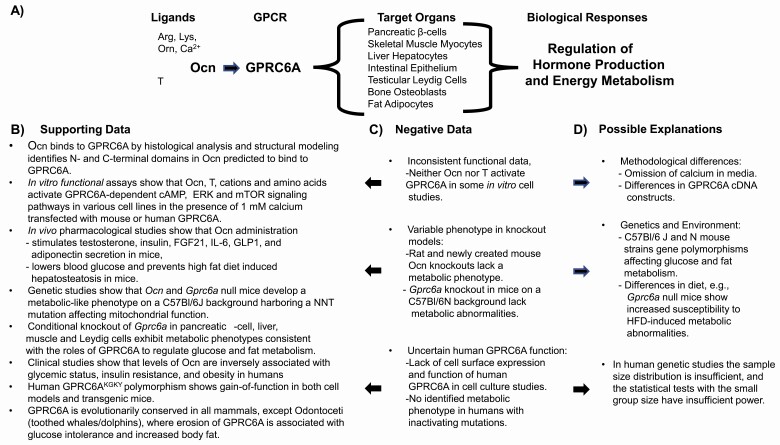
A new schema proposes that the bone-derived osteocalcin (Ocn) peptide hormone activates the G-protein-coupled receptor GPRC6A to directly regulate glucose and fat metabolism in liver, muscle, and fat, and to stimulate the release of metabolism-regulating hormones, including insulin, fibroblast growth factor 21, glucagon-like peptide 1, testosterone, and interleukin 6. Ocn/GPRC6A activation has also been implicated in cancer progression. GPRC6A is activated by cations, amino acids, and testosterone. The multiligand specificity, the regulation of energy metabolism in diverse tissues, and the coordinated release of metabolically active hormones make the GPRC6A endocrine networks unique. Recently, the significance of Ocn/GPRCA has been questioned. There is a lack of metabolic abnormalities in newly created genetically engineered Ocn- and Gprc6a-deficient mouse models. There are also paradoxical observations that GPRC6A may function as a tumor suppressor. In addition, discordant published studies have cast doubt on the function of the most prevalent uniquely human GPRC6A-KGKY polymorphism. Explanations for these divergent findings are elusive. We provide evidence that the metabolic susceptibility of genetically engineered Ocn- and Gprc6a-deficient mice is influenced by environmental challenges and genetic differences in mouse strains. In addition, the GPRC6A-KGKY polymorphism appears to be a gain-of-function variant. Finally, alternatively spliced isoforms of GPRC6A may alter ligand specificity and signaling that modulate oncogenic effects. Thus, genetic, post-translational and environmental factors likely account for the variable results regarding the functions of GPRC6A in animal models. Pending additional information, GPRC6A should remain a potential therapeutic target for regulating energy and fat metabolism, hormone production, and cancer progression.
Overview
The claims and statistics of this paper haven’t been checked yet.
Free: it reads the open-access text and checks the first 5 claims that cite a source we can check. Create a free account to check every claim.
Integrity signals
Registry
Cites
Statistics
Figures
Verification
Claims the paper makes
The claims and statistics of this paper haven’t been checked yet.
Free: it reads the open-access text and checks the first 5 claims that cite a source we can check. Create a free account to check every claim.
Claims other papers make about this one
Each is checked against this paper’s own text: does it say what the citing paper says it does?
In the citing paper
“Uncarboxylated OC can regulate insulin signaling, de novo lipogenesis, and endoplasmic reticulum stress through direct binding to its liver-specific receptor, G protein-coupled receptor family C Group 6 subtype A [138].”
From Emerging role of liver-bone axis in osteoporosis (2024) · cites this paper as [138]
Self-check
Percentages, sums and reported differences re-computed from the paper’s own numbers.
The self-check needs the paper’s full text.
Citations
Cites
Stöckl, S., Göttl, C., Grifka, J., & Grässel, S. (2013) · Cellular Physiology and Biochemistry · doi:10.1159/000350089 · Cited by 4,656
1,500 scientists lift the lid on reproducibility
Baker, M. (2016) · Nature · doi:10.1038/533452a · Cited by 4,209
Raise standards for preclinical cancer research
Begley, C. G., & Ellis, L. M. (2012) · Nature · doi:10.1038/483531a · Cited by 2,979 · cited 1×
“It is estimated that 70% of researchers fail to confirm another scientist’s experiments (59, 60).”
BackgroundEndocrine regulation of energy metabolism by the skeleton
Lee, N. K., Sowa, H., Hinoi, E., Ferron, M., Ahn, J. D., Confavreux, C., Dacquin, R., Mee, P. J., McKee, M. D., Jung, D. Y., et al. (2007) · Cell · doi:10.1016/j.cell.2007.05.047 · Cited by 2,554 · cited 2×
“The concept of an Ocn/GPRC6A endocrine network was originally published in 2007 by Gerard Karsenty and collaborators (6), and was based, in part, on the observations that Ocn null mice, in addition to having increased bone formation (10), had an unexpected metabolic syndrome–like phenotype (6).”
BackgroundIncreased bone formation in osteocalcin-deficient mice
Ducy, P., Desbois, C., Boyce, B., Pinero, G., Story, B., Dunstan, C., Smith, E., Bonadio, J., Goldstein, S., Gundberg, C., et al. (1996) · Nature · doi:10.1038/382448a0 · Cited by 1,725 · cited 4×
“Unlike robust metabolic phenotype in the mice derived by Karsenty’s group, the Ocn knockout mouse made by Komori and Moriishi’s group failed to show a role for Ocn in exerciseinduced bone formation, glucose metabolism, exerciseinduced enhancement of glucose uptake, testosterone synthesis, spermatogenesis, or muscle ma…”
BackgroundInfluentialEndocrine Regulation of Male Fertility by the Skeleton
Oury, F., Sumara, G., Sumara, O., Ferron, M., Chang, H., Smith, C. E., Hermo, L., Suarez, S., Roth, B. L., Ducy, P., et al. (2011) · Cell · doi:10.1016/j.cell.2011.02.004 · Cited by 628
GPCR-G Protein-β-Arrestin Super-Complex Mediates Sustained G Protein Signaling
Thomsen, A. R. B., Plouffe, B., Cahill, T. J., Shukla, A. K., Tarrasch, J. T., Dosey, A. M., Kahsai, A. W., Strachan, R. T., Pani, B., Mahoney, J. P., et al. (2016) · Cell · doi:10.1016/j.cell.2016.07.004 · Cited by 563
A comparative phenotypic and genomic analysis of C57BL/6J and C57BL/6N mouse strains
Simon, M. M., Greenaway, S., White, J. K., Fuchs, H., Gailus-Durner, V., Wells, S., Sorg, T., Wong, K., Bedu, E., Cartwright, E. J., et al. (2013) · Genome Biology · doi:10.1186/gb-2013-14-7-r82 · Cited by 507 · cited 1×
“C57BL/6J and C57BL/6N coding sequences differ in 34 single-nucleotide polymorphisms, as well as have structural variants in 15 genes, including Nnt (which has an in-frame 5-exon deletion in C57BL/6J mice (70).”
BackgroundA genetic and physiological study of impaired glucose homeostasis control in C57BL/6J mice
Toye, A. A., Lippiat, J. D., Proks, P., Shimomura, K., Bentley, L., Hugill, A., Mijat, V., Goldsworthy, M., Moir, L., Haynes, A., et al. (2005) · Diabetologia · doi:10.1007/s00125-005-1680-z · Cited by 443 · cited 1×
“Indeed, C57BL/6 J mice have defective insulin secretion in response to intravenous glucose, decreased ambulation and increased lean mass but lower fat mass, O2 consumption, and heat production than C57BL/6N mice (73-75).”
BackgroundOsteocalcin Signaling in Myofibers Is Necessary and Sufficient for Optimum Adaptation to Exercise
Mera, P., Laue, K., Ferron, M., Confavreux, C., Wei, J., Galán-Díez, M., Lacampagne, A., Mitchell, S. J., Mattison, J. A., Chen, Y., et al. (2016) · Cell Metabolism · doi:10.1016/j.cmet.2016.05.004 · Cited by 426
Ferron, M., McKee, M. D., Levine, R. L., Ducy, P., & Karsenty, G. (2012) · Bone · doi:10.1016/j.bone.2011.04.017 · Cited by 414 · cited 1×
“Of particular note are the pharmacological studies in mice consistently showing that Ocn and GPRC6A regulate glucose and fat metabolism and activation of the Ocn/GPRC6A, which pathway can prevent development of type 2 diabetes (T2D) and nonalcoholic fatty liver disease induced by high-fat diets and glucocorticoid expo…”
BackgroundAssociation between Serum Osteocalcin and Markers of Metabolic Phenotype
Pittas, A. G., Harris, S. S., Eliades, M., Stark, P., & Dawson-Hughes, B. (2009) · The Journal of Clinical Endocrinology & Metabolism · doi:10.1210/jc.2008-1422 · Cited by 406 · cited 1×
“Epidemiological and clinical association studies in humans also show that levels of the GPRC6A ligand, Ocn, are inversely associated with glycemic status and insulin (38), body mass index, fasting glucose and insulin, triglycerides, and leptin, and are positively correlated with adiponectin (39, 40).”
BackgroundRegulation of GLUT1 Gene Transcription by the Serine/Threonine Kinase Akt1
Barthel, A., Okino, S. T., Liao, J., Nakatani, K., Li, J., Whitlock, J. P., & Roth, R. A. (1999) · Journal of Biological Chemistry · doi:10.1074/jbc.274.29.20281 · Cited by 330 · cited 1×
“Indeed, studies in inbreed BXD mouse strains show that the susceptibility to abnormalities in glucose and fat metabolism differ between different mouse strains (65-68).”
BackgroundDeletion of Nicotinamide Nucleotide Transhydrogenase
Freeman, H. C., Hugill, A., Dear, N. T., Ashcroft, F. M., & Cox, R. D. (2006) · Diabetes · doi:10.2337/db06-0358 · Cited by 321
Identification of a Novel Extracellular Cation-sensing G-protein-coupled Receptor
Pi, M., Faber, P., Ekema, G., Jackson, P. D., Ting, A., Wang, N., Fontilla-Poole, M., Mays, R. W., Brunden, K. R., Harrington, J. J., et al. (2005) · Journal of Biological Chemistry · doi:10.1074/jbc.m505186200 · Cited by 316 · cited 3×
“A new schema of regulating energy metabolism and fertility proposes the release into the circulation of the peptide hormone Ocn from bone (3, 6, 7) and its activation of GPRC6A, a member of the Family C G-protein–coupled receptors (8, 9) that is located in various organs (Fig.”
BackgroundResultSelf-citationGpr158 mediates osteocalcin’s regulation of cognition
Khrimian, L., Obri, A., Ramos-Brossier, M., Rousseaud, A., Moriceau, S., Nicot, A.-S., Mera, P., Kosmidis, S., Karnavas, T., Saudou, F., et al. (2017) · Journal of Experimental Medicine · doi:10.1084/jem.20171320 · Cited by 308 · cited 1×
“Finally, there is at least 1 other receptor for Ocn, Gpr158, which is located in the brain (50).”
BackgroundSystems proteomics of liver mitochondria function
Williams, E. G., Wu, Y., Jha, P., Dubuis, S., Blattmann, P., Argmann, C. A., Houten, S. M., Amariuta, T., Wolski, W., Zamboni, N., et al. (2016) · Science · doi:10.1126/science.aad0189 · Cited by 289
Takata, R., Akamatsu, S., Kubo, M., Takahashi, A., Hosono, N., Kawaguchi, T., Tsunoda, T., Inazawa, J., Kamatani, N., Ogawa, O., et al. (2010) · Nature Genetics · doi:10.1038/ng.635 · Cited by 283 · cited 1×
“Ocn polymorphisms have also been linked to human prostate cancer (43-45).”
BackgroundOsteocalcin regulates murine and human fertility through a pancreas-bone-testis axis
Oury, F., Ferron, M., Huizhen, W., Confavreux, C., Xu, L., Lacombe, J., Srinivas, P., Chamouni, A., Lugani, F., Lejeune, H., et al. (2013) · Journal of Clinical Investigation · doi:10.1172/jci65952 · Cited by 280 · cited 4×
“Structural models of Ocn/ GPRC6A interactions, binding studies, and functional assays showed that Ocn is a ligand for GPRC6A (9, 11, 12).”
BackgroundInfluentialGPRC6A Null Mice Exhibit Osteopenia, Feminization and Metabolic Syndrome
Pi, M., Chen, L., Huang, M.-Z., Zhu, W., Ringhofer, B., Luo, J., Christenson, L., Li, B., Zhang, J., Jackson, P. D., et al. (2008) · PLoS ONE · doi:10.1371/journal.pone.0003858 · Cited by 250 · cited 4×
“Interestingly, evolutionary erosion of GPRC6A is found in odontocete cetaceans (dolphins and other toothed whales), marine mammals that have elevated blood glucose and excess body fat in the form of blubber (83), which resembles the elevated glucose levels and increased body fat observed in Gprc6a null mice (13).”
BackgroundMethodInfluentialSelf-citationMultilayered Genetic and Omics Dissection of Mitochondrial Activity in a Mouse Reference Population
Wu, Y., Williams, E. G., Dubuis, S., Mottis, A., Jovaisaite, V., Houten, S. M., Argmann, C. A., Faridi, P., Wolski, W., Kutalik, Z., et al. (2014) · Cell · doi:10.1016/j.cell.2014.07.039 · Cited by 244 · cited 1×
“Indeed, studies in inbreed BXD mouse strains show that the susceptibility to abnormalities in glucose and fat metabolism differ between different mouse strains (65-68).”
BackgroundOsteocalcin is necessary and sufficient to maintain muscle mass in older mice
Mera, P., Laue, K., Wei, J., Berger, J. M., & Karsenty, G. (2016) · Molecular Metabolism · doi:10.1016/j.molmet.2016.07.002 · Cited by 223 · cited 3×
“Indeed, Ocn activation of GPRC6A directly regulates signaling pathways and metabolic processes controlling glucose and fat metabolism in these tissues, as well as stimulates the release of an ensemble of metabolically active hormones, including insulin (18), testosterone (14, 15), fibroblast growth factor 21 (FGF-21)…”
BackgroundStructure of an endosomal signaling GPCR–G protein–β-arrestin megacomplex
Nguyen, A. H., Thomsen, A. R. B., Cahill, T. J., Huang, R., Huang, L.-Y., Marcink, T., Clarke, O. B., Heissel, S., Masoudi, A., Ben-Hail, D., et al. (2019) · Nature Structural & Molecular Biology · doi:10.1038/s41594-019-0330-y · Cited by 220 · cited 1×
“Thus, GPRC6A is analogous to other GPCRs capable sustained signaling from internal compartments (83, 84).”
BackgroundGPRC6A mediates responses to osteocalcin in β-cells in vitro and pancreas in vivo
Pi, M., Wu, Y., & Quarles, L. D. (2011) · Journal of Bone and Mineral Research · doi:10.1002/jbmr.390 · Cited by 215 · cited 2×
“Indeed, Ocn activation of GPRC6A directly regulates signaling pathways and metabolic processes controlling glucose and fat metabolism in these tissues, as well as stimulates the release of an ensemble of metabolically active hormones, including insulin (18), testosterone (14, 15), fibroblast growth factor 21 (FGF-21)…”
BackgroundSelf-citationMoriishi, T., Ozasa, R., Ishimoto, T., Nakano, T., Hasegawa, T., Miyazaki, T., Liu, W., Fukuyama, R., Wang, Y., Komori, H., et al. (2020) · PLOS Genetics · doi:10.1371/journal.pgen.1008586 · Cited by 213 · cited 5×
“There is an ongoing controversy regarding the roles of the nutrient-sensing G-protein–coupled receptor GPRC6A and its putative bone-derived peptide ligand, osteocalcin (Ocn), in regulating glucose and fat metabolism (1-5).”
BackgroundMethodInfluentialGPRC6A Mediates the Non-genomic Effects of Steroids
Pi, M., Parrill, A. L., & Quarles, L. D. (2010) · Journal of Biological Chemistry · doi:10.1074/jbc.m110.158063 · Cited by 186 · cited 4×
“In HEK-293 cells coexpressing both GPRC6A and androgen response element (ARE), R1881-mediated activation of ARE-luciferase activity was significantly attenuated, suggesting potential cross-talk between GPRC6A and AR pathways (27).”
BackgroundInfluentialSelf-citationJoint mouse–human phenome-wide association to test gene function and disease risk
Wang, X., Pandey, A. K., Mulligan, M. K., Williams, E. G., Mozhui, K., Li, Z., Jovaisaite, V., Quarles, L. D., Xiao, Z., Huang, J., et al. (2016) · Nature Communications · doi:10.1038/ncomms10464 · Cited by 147 · cited 1×
“Indeed, studies in inbreed BXD mouse strains show that the susceptibility to abnormalities in glucose and fat metabolism differ between different mouse strains (65-68).”
BackgroundIki, M., Tamaki, J., Fujita, Y., Kouda, K., Yura, A., Kadowaki, E., Sato, Y., Moon, J. S., Tomioka, K., Okamoto, N., et al. (2011) · Osteoporosis International · doi:10.1007/s00198-011-1600-7 · Cited by 146 · cited 1×
“Epidemiological and clinical association studies in humans also show that levels of the GPRC6A ligand, Ocn, are inversely associated with glycemic status and insulin (38), body mass index, fasting glucose and insulin, triglycerides, and leptin, and are positively correlated with adiponectin (39, 40).”
BackgroundWhat is the function of osteocalcin?
Komori, T. (2020) · Journal of Oral Biosciences · doi:10.1016/j.job.2020.05.004 · Cited by 138 · cited 1×
“A new schema of regulating energy metabolism and fertility proposes the release into the circulation of the peptide hormone Ocn from bone (3, 6, 7) and its activation of GPRC6A, a member of the Family C G-protein–coupled receptors (8, 9) that is located in various organs (Fig.”
BackgroundAn osteocalcin-deficient mouse strain without endocrine abnormalities
Diegel, C. R., Hann, S., Ayturk, U. M., Hu, J. C. W., Lim, K.-E., Droscha, C. J., Madaj, Z. B., Foxa, G. E., Izaguirre, I., Transgenics Core, V. V. A., et al. (2020) · PLOS Genetics · doi:10.1371/journal.pgen.1008361 · Cited by 134 · cited 6×
“Bglap 1 and 2 are expressed in bone, whereas Bglap3, which differs by 4 amino acids, is expressed in nonosseous tissues, and does not contribute to circulating Ocn levels (2).”
BackgroundMethodInfluentialThe Genetic Basis of Metabolic Disease
Barroso, I., & McCarthy, M. I. (2019) · Cell · doi:10.1016/j.cell.2019.02.024 · Cited by 124 · cited 5×
“Of these genetic and environmental factors are high on the list to explain the discrepancies in the Ocn and GPRC6A data, given the known importance of genetic modifiers and dietary factors in the pathogenesis of metabolic syndrome and T2D (61).”
BackgroundInfluentialOsteocalcin promotes bone mineralization but is not a hormone
Manolagas, S. C. (2020) · PLoS Genetics · doi:10.1371/journal.pgen.1008714 · Cited by 122 · cited 2×
“Several studies show that Ocn is neither a hormone or ligand for GPRC6A, and that GPRC6A has minimal or no functions, especially in humans (4, 51, 52).”
BackgroundEvidence for Osteocalcin Binding and Activation of GPRC6A in β-Cells
Pi, M., Kapoor, K., Ye, R., Nishimoto, S. K., Smith, J. C., Baudry, J., & Quarles, L. D. (2016) · Endocrinology · doi:10.1210/en.2015-2010 · Cited by 116 · cited 8×
“Three different Gprc6a floxed mice have also been created (9, 11, 14-17, 58).”
BackgroundResultInfluentialSelf-citationSignaling pathway for adiponectin expression in adipocytes by osteocalcin
Otani, T., Mizokami, A., Hayashi, Y., Gao, J., Mori, Y., Nakamura, S., Takeuchi, H., & Hirata, M. (2015) · Cellular Signalling · doi:10.1016/j.cellsig.2014.12.018 · Cited by 107 · cited 1×
“GPRC6A is located in multiple tissues, including liver hepatocytes (15), skeletal muscle (16, 17), pancreatic β-cells (9, 11, 18, 19), and testicular Leydig cells (14), as well as others tissues, such as adipocytes (20-22), gastrointestinal epithelia (23, 24), skin keratinocytes (25), vascular endothelial cells (26),…”
BackgroundThe GPCR, class C, group 6, subtype A (GPRC6A) receptor: from cloning to physiological function
Clemmensen, C., Smajilovic, S., Wellendorph, P., & Bräuner‐Osborne, H. (2014) · British Journal of Pharmacology · doi:10.1111/bph.12365 · Cited by 103 · cited 3×
“Publications also showed that Ocn and T do not activate GPRC6A (51, 52, 64, 79) (Fig.”
BackgroundMizokami, A., Yasutake, Y., Higashi, S., Kawakubo‐Yasukochi, T., Chishaki, S., Takahashi, I., Takeuchi, H., & Hirata, M. (2014) · Bone · doi:10.1016/j.bone.2014.09.006 · Cited by 100 · cited 3×
“Indeed, Ocn activation of GPRC6A directly regulates signaling pathways and metabolic processes controlling glucose and fat metabolism in these tissues, as well as stimulates the release of an ensemble of metabolically active hormones, including insulin (18), testosterone (14, 15), fibroblast growth factor 21 (FGF-21)…”
BackgroundDefective insulin secretory response to intravenous glucose in C57Bl/6J compared to C57Bl/6N mice
Fergusson, G., Éthier, M., Guévremont, M., Chrétien, C., Attané, C., Joly, E., Fioramonti, X., Prentki, M., Poitout, V., & Alquier, T. (2014) · Molecular Metabolism · doi:10.1016/j.molmet.2014.09.006 · Cited by 97 · cited 1×
“Indeed, C57BL/6 J mice have defective insulin secretion in response to intravenous glucose, decreased ambulation and increased lean mass but lower fat mass, O2 consumption, and heat production than C57BL/6N mice (73-75).”
BackgroundLambert, L. J., Challa, A. K., Niu, A., Zhou, L., Tucholski, J., Johnson, M. S., Nagy, T. R., Eberhardt, A. W., Estep, P. N., Kesterson, R. A., et al. (2016) · Disease Models & Mechanisms · doi:10.1242/dmm.025247 · Cited by 96 · cited 4×
“CRISPRCas9 gene editing was also used to delete the single Ocn gene in rats (53) and both Bglap1 and Bglap2 in mice (2).”
BackgroundMethodInfluentialDu, J., Zhang, M., Lu, J., Zhang, X., Xiong, Q., Xu, Y., Bao, Y., & Jia, W. (2016) · Endocrine · doi:10.1007/s12020-016-0926-5 · Cited by 90 · cited 1×
“Of particular note are the pharmacological studies in mice consistently showing that Ocn and GPRC6A regulate glucose and fat metabolism and activation of the Ocn/GPRC6A, which pathway can prevent development of type 2 diabetes (T2D) and nonalcoholic fatty liver disease induced by high-fat diets and glucocorticoid expo…”
BackgroundGPRC6A: Jack of all metabolism (or master of none)
Pi, M., Nishimoto, S. K., & Quarles, L. D. (2017) · Molecular Metabolism · doi:10.1016/j.molmet.2016.12.006 · Cited by 87 · cited 3×
“These direct and indirect actions create multiple positive feedback loops that have net anabolic effects (29).”
BackgroundSelf-citationHo, H.-Y., Lin, Y.-T., Lin, G., Wu, P.-R., & Cheng, M.-L. (2017) · Redox Biology · doi:10.1016/j.redox.2017.04.035 · Cited by 81 · cited 1×
“NNT deletion can have an overriding effect on glucose regulation by elevating the mitochondrial NADH/NAD ratio and leading to changes in activities of the tricarboxylic acid cycle and decreases in glycolysis (72).”
BackgroundGPRC6A regulates prostate cancer progression
Pi, M., & Quarles, L. D. (2011) · The Prostate · doi:10.1002/pros.21442 · Cited by 80
Self-citationHaiman, C. A., Han, Y., Feng, Y., Xia, L. Y., Hsu, C., Sheng, X., Pooler, L., Patel, Y. M., Kolonel, L. N., Carter, E., et al. (2013) · PLoS Genetics · doi:10.1371/journal.pgen.1003419 · Cited by 77 · cited 1×
“Ocn polymorphisms have also been linked to human prostate cancer (43-45).”
BackgroundGPRC6A Mediates the Effects of l-Arginine on Insulin Secretion in Mouse Pancreatic Islets
Pi, M., Wu, Y., Lenchik, N. I., Gerling, I., & Quarles, L. D. (2012) · Endocrinology · doi:10.1210/en.2012-1301 · Cited by 74 · cited 2×
“Three different Gprc6a floxed mice have also been created (9, 11, 14-17, 58).”
BackgroundSelf-citationOsteocalcin effect on human β-cells mass and function
Sabek, O. M., Nishimoto, S. K., Fraga, D., Tejpal, N., Ricordi, C., & Gaber, A. O. (2015) · Endocrinology · doi:10.1210/en.2015-1143 · Cited by 74 · cited 2×
“GPRC6A is located in multiple tissues, including liver hepatocytes (15), skeletal muscle (16, 17), pancreatic β-cells (9, 11, 18, 19), and testicular Leydig cells (14), as well as others tissues, such as adipocytes (20-22), gastrointestinal epithelia (23, 24), skin keratinocytes (25), vascular endothelial cells (26),…”
BackgroundSelf-citationNo evidence for a bone phenotype in GPRC6A knockout mice under normal physiological conditions
Wellendorph, P., Johansen, L. D., Jensen, A. A., Casanova, E., Gassmann, M., Deprez, P., Clément-Lacroix, P., Bettler, B., & Bräuner-Osborne, H. (2009) · Journal of Molecular Endocrinology · doi:10.1677/jme-08-0149 · Cited by 73 · cited 5×
“The fact that some studies do not find a metabolic-like phenotype in Gprc6a deficient mice (55, 56, 64), raises the possibility that GPRC6A effects are modified by dietary factors, particularly dietary fat.”
BackgroundMethodInfluentialOsteocalcin protects against nonalcoholic steatohepatitis in a mouse model of metabolic syndrome
Gupte, A. A., Sabek, O. M., Fraga, D., Minze, L. J., Nishimoto, S. K., Liu, J. Z., Afshar, S., Gaber, L., Lyon, C. J., Gaber, A. O., et al. (2014) · Endocrinology · doi:10.1210/en.2014-1430 · Cited by 70 · cited 1×
“Of particular note are the pharmacological studies in mice consistently showing that Ocn and GPRC6A regulate glucose and fat metabolism and activation of the Ocn/GPRC6A, which pathway can prevent development of type 2 diabetes (T2D) and nonalcoholic fatty liver disease induced by high-fat diets and glucocorticoid expo…”
BackgroundSelf-citationCRISPR/Cas9 targeting of GPRC6A suppresses prostate cancer tumorigenesis in a human xenograft model
Ye, R.-S., Pi, M., Cox, J. V., Nishimoto, S. K., & Quarles, L. D. (2017) · Journal of Experimental & Clinical Cancer Research · doi:10.1186/s13046-017-0561-x · Cited by 70 · cited 3×
“The endogenous hGPRC6A in PC-3 prostate cancer cells is functional and deletion of endogenous GPRC6A by Crispr/CAS9 resulted in loss of T-induced signaling (46).”
BackgroundSelf-citationJacobsen, S. E., Nørskov-Lauritsen, L., Thomsen, A. R. B., Smajilovic, S., Wellendorph, P., Larsson, N., Lehmann, A., Bhatia, V. K., & Bräuner‐Osborne, H. (2013) · Journal of Pharmacology and Experimental Therapeutics · doi:10.1124/jpet.113.206276 · Cited by 69 · cited 2×
“Publications also showed that Ocn and T do not activate GPRC6A (51, 52, 64, 79) (Fig.”
BackgroundLi, X., Li, P., Wang, L., Zhang, M., & Gao, X. (2019) · Journal of Agricultural and Food Chemistry · doi:10.1021/acs.jafc.9b02160 · Cited by 69 · cited 1×
“GPRC6A is located in multiple tissues, including liver hepatocytes (15), skeletal muscle (16, 17), pancreatic β-cells (9, 11, 18, 19), and testicular Leydig cells (14), as well as others tissues, such as adipocytes (20-22), gastrointestinal epithelia (23, 24), skin keratinocytes (25), vascular endothelial cells (26),…”
BackgroundGuedes, J. A. C., Esteves, J. V. D. C., Morais, M., Zorn, T. M. T., & Furuya, D. T. (2017) · Bone · doi:10.1016/j.bone.2017.11.020 · Cited by 68
Structural and Functional Evidence for Testosterone Activation of GPRC6A in Peripheral Tissues
Pi, M., Kapoor, K., Wu, Y., Ye, R.-S., Senogles, S. E., Nishimoto, S. K., Hwang, D., Miller, D. D., Narayanan, R., Smith, J. C., et al. (2015) · Molecular Endocrinology · doi:10.1210/me.2015-1161 · Cited by 66 · cited 2×
“Computational modeling has also defined putative testosterone binding domains in GPRC6A (49).”
BackgroundSelf-citationRendina-Ruedy, E., Hembree, K. D., Sasaki, A., Davis, M. R., Lightfoot, S. A., Clarke, S. L., Lucas, E. A., & Smith, B. J. (2015) · Journal of Nutrition and Metabolism · doi:10.1155/2015/758080 · Cited by 64 · cited 1×
“Indeed, C57BL/6 J mice have defective insulin secretion in response to intravenous glucose, decreased ambulation and increased lean mass but lower fat mass, O2 consumption, and heat production than C57BL/6N mice (73-75).”
BackgroundMurine GPRC6A Mediates Cellular Responses to L-Amino Acids, but Not Osteocalcin Variants
Rueda, P., Harley, E., Lu, Y., Stewart, G. D., Fabb, S., Diepenhorst, N., Cremers, B., Rouillon, M.-H., Wehrle, I., Geant, A., et al. (2016) · PLOS ONE · doi:10.1371/journal.pone.0146846 · Cited by 64 · cited 2×
“Media calcium is an obligate requirement for Ocn and T activation of GPRC6A in cultured cells (64, 80), negative in vitro studies may be due to the omission of calcium from the culture media.”
BackgroundOsteocalcin signaling in myofibers is necessary and sufficient for optimum adaptation to exercise
Mera, P., Laue, K., Ferron, M., Confavreux, C., Wei, J., Galán-Díez, M., Lacampagne, A., Mitchell, S. J., Mattison, J. A., Chen, Y., et al. (2017) · Cell Metabolism · doi:10.1016/j.cmet.2016.12.003 · Cited by 63 · cited 2×
“Three different Gprc6a floxed mice have also been created (9, 11, 14-17, 58).”
Smajilovic, S., Clemmensen, C., Johansen, L. D., Wellendorph, P., Holst, J. J., Thams, P., Ogo, E., & Bräuner‐Osborne, H. (2012) · Amino Acids · doi:10.1007/s00726-012-1341-8 · Cited by 62 · cited 1×
“Various strategies were also used to generate the three existing Gprc6a-deficient mouse models, including homologous recombination to target exon 2 in the extracellular domain (13), exon 6 encoding the 7TM domain of Gprc6a (56, 57), and the entire Gprc6a locus (55).”
MethodBig brains and blood glucose: common ground for diabetes mellitus in humans and healthy dolphins.
Venn-Watson, S. K., & Ridgway, S. H. (2007) · PubMed · Cited by 59
Zhou, B., Li, H., Liu, J., Xu, L., Zang, W., Wu, S., & Sun, H. (2013) · Cell Cycle · doi:10.4161/cc.24929 · Cited by 58
The GPRC6A receptor displays constitutive internalization and sorting to the slow recycling pathway
Jacobsen, S. E., Ammendrup‐Johnsen, I., Jansen, A. M., Gether, U., Madsen, K. L., & Bräuner‐Osborne, H. (2017) · Journal of Biological Chemistry · doi:10.1074/jbc.m116.762385 · Cited by 44 · cited 7×
“The fact that some studies do not find a metabolic-like phenotype in Gprc6a deficient mice (55, 56, 64), raises the possibility that GPRC6A effects are modified by dietary factors, particularly dietary fat.”
BackgroundInfluentialTestosterone Stimulates Duox1 Activity through GPRC6A in Skin Keratinocytes
Ko, E., Choi, H. J., Kim, B., Kim, M., Park, K., Bae, I., Sung, Y. K., Lee, T. R., Shin, D. W., & Bae, Y. S. (2014) · Journal of Biological Chemistry · doi:10.1074/jbc.m114.583450 · Cited by 42 · cited 2×
“GPRC6A is located in multiple tissues, including liver hepatocytes (15), skeletal muscle (16, 17), pancreatic β-cells (9, 11, 18, 19), and testicular Leydig cells (14), as well as others tissues, such as adipocytes (20-22), gastrointestinal epithelia (23, 24), skin keratinocytes (25), vascular endothelial cells (26),…”
BackgroundPolymorphism rs2274911 of GPRC6A as a Novel Risk Factor for Testis Failure
Toni, L. D., Nisio, A. D., Speltra, E., Rocca, M. S., Ghezzi, M., Zuccarello, D., Turiaco, N., Ferlin, A., & Foresta, C. (2016) · The Journal of Clinical Endocrinology & Metabolism · doi:10.1210/jc.2015-3967 · Cited by 41 · cited 1×
“Human association studies also support a metabolic role of Ocn, showing that polymorphisms in Ocn’s target, GPRC6A, correlate with insulin and fertility abnormalities (41, 42).”
Increased susceptibility to diet-induced obesity in GPRC6A receptor knockout mice
Clemmensen, C., Smajilovic, S., Madsen, A. N., Klein, A. B., Holst, B., & Bräuner-Osborne, H. (2013) · Journal of Endocrinology · doi:10.1530/joe-12-0550 · Cited by 39 · cited 1×
“Investigators initially reporting no metabolic abnormalities in Gprc6a null mice, later reported a greater propensity of their Gprc6a knockout mice to develop an abnormal metabolic phenotype when fed a high-fat diet (62).”
BackgroundLin, X., Parker, L., McLennan, E. D., Hayes, A., McConell, G. K., Brennan‐Speranza, T. C., & Levinger, I. (2019) · Journal of Bone and Mineral Research · doi:10.1002/jbmr.3731 · Cited by 39 · cited 1×
“Of particular note are the pharmacological studies in mice consistently showing that Ocn and GPRC6A regulate glucose and fat metabolism and activation of the Ocn/GPRC6A, which pathway can prevent development of type 2 diabetes (T2D) and nonalcoholic fatty liver disease induced by high-fat diets and glucocorticoid expo…”
BackgroundRobust GLP ‐1 secretion by basic L ‐amino acids does not require the GPRC6A receptor
Clemmensen, C., Jørgensen, C. V., Smajilovic, S., & Bräuner‐Osborne, H. (2017) · Diabetes, Obesity and Metabolism · doi:10.1111/dom.12845 · Cited by 38 · cited 2×
“GPRC6A is located in multiple tissues, including liver hepatocytes (15), skeletal muscle (16, 17), pancreatic β-cells (9, 11, 18, 19), and testicular Leydig cells (14), as well as others tissues, such as adipocytes (20-22), gastrointestinal epithelia (23, 24), skin keratinocytes (25), vascular endothelial cells (26),…”
BackgroundLong, Q., Du, Y., Ding, X., Li, X., Song, W., Yong, Y., Zhang, P., Zhou, J.-P., & Liu, X. (2012) · PLoS ONE · doi:10.1371/journal.pone.0037866 · Cited by 37 · cited 1×
“Ocn polymorphisms have also been linked to human prostate cancer (43-45).”
BackgroundYe, R.-S., Pi, M., Nooh, M. M., Bahout, S. W., & Quarles, L. D. (2019) · Molecular Pharmacology · doi:10.1124/mol.118.115014 · Cited by 36 · cited 3×
“GPRC6A is increased in certain forms of human prostate cancer, where it regulates prostate cancer progression through Ocn stimulation of mammalian target of rapamycin (mTOR) pathways (28, 46-48).”
BackgroundSelf-citationYasutake, Y., Mizokami, A., Kawakubo‐Yasukochi, T., Chishaki, S., Takahashi, I., Takeuchi, H., & Hirata, M. (2016) · American Journal of Physiology-Endocrinology and Metabolism · doi:10.1152/ajpendo.00334.2015 · Cited by 35
Teng, B., Huang, C., Cheng, C., Udduttula, A., Yu, X.-F., Liu, C., Li, J., Yao, Z., Long, J., Miao, L., et al. (2020) · Journal of Hepatology · doi:10.1016/j.jhep.2020.02.026 · Cited by 34 · cited 2×
“Structural models of Ocn/ GPRC6A interactions, binding studies, and functional assays showed that Ocn is a ligand for GPRC6A (9, 11, 12).”
BackgroundNisio, A. D., Rocca, M. S., Fadini, G. P., Toni, L. D., Marcuzzo, G., Marescotti, M. C., Sanna, M., Plebani, M., Vettor, R., Avogaro, A., et al. (2016) · Clinical Endocrinology · doi:10.1111/cen.13248 · Cited by 33 · cited 2×
“A unique KGKY polymorphism is present in most humans that replaced the ancestral RKLP sequence in the third intracellular loop of GPRC6A (42, 81).”
BackgroundPharmacology and physiological function of the orphan GPRC6A receptor
Jørgensen, C. V., & Bräuner‐Osborne, H. (2020) · Basic & Clinical Pharmacology & Toxicology · doi:10.1111/bcpt.13397 · Cited by 29 · cited 3×
“Publications also showed that Ocn and T do not activate GPRC6A (51, 52, 64, 79) (Fig.”
BackgroundJørgensen, S., Have, C. T., Underwood, C. R., Johansen, L. D., Wellendorph, P., Gjesing, A. P., Jørgensen, C. V., Quan, S., Rui, G., Inoue, A., et al. (2016) · Journal of Biological Chemistry · doi:10.1074/jbc.m116.756577 · Cited by 28 · cited 2×
“A unique KGKY polymorphism is present in most humans that replaced the ancestral RKLP sequence in the third intracellular loop of GPRC6A (42, 81).”
BackgroundGLP-1 signaling is required for improvement of glucose tolerance by osteocalcin
Mizokami, A., Mukai, S., Gao, J., Kawakubo‐Yasukochi, T., Otani, T., Takeuchi, H., Jimi, E., & Hirata, M. (2019) · Journal of Endocrinology · doi:10.1530/joe-19-0288 · Cited by 27 · cited 3×
“Indeed, Ocn activation of GPRC6A directly regulates signaling pathways and metabolic processes controlling glucose and fat metabolism in these tissues, as well as stimulates the release of an ensemble of metabolically active hormones, including insulin (18), testosterone (14, 15), fibroblast growth factor 21 (FGF-21)…”
BackgroundLin, X., Parker, L., McLennan, E. D., Zhang, X., Hayes, A., McConell, G. K., Brennan‐Speranza, T. C., & Levinger, I. (2018) · Calcified Tissue International · doi:10.1007/s00223-018-0400-x · Cited by 26 · cited 1×
“It is intriguing to speculate that L-arginine sensing by GPRC6A in endosomes and cell surface membranes evolved to provide alternative molecular pathways to the ancestral lysosomal L-arginine sensing pathway present in yeast and all other cells in lysosomes that links mTOR signaling and mitochondrial functions (76).”
BackgroundMetabolic and skeletal homeostasis are maintained in full locus GPRC6A knockout mice
Jørgensen, C. V., Gasparini, S. J., Tu, J., Zhou, H., Seibel, M. J., & Bräuner‐Osborne, H. (2019) · Scientific Reports · doi:10.1038/s41598-019-41921-8 · Cited by 26 · cited 4×
“In contrast, in the Ocn knockout mice generated in Japan (69) and Europe (2) and the 2 Gprc6a knockout mouse models generated in Europe (54-56, 63) were backcrossed for multiple generation on to the C57BL/6N mouse strain.”
BackgroundInfluentialRole of GPRC6A in Regulating Hepatic Energy Metabolism
Pi, M., Xu, F., Ye, R.-S., Nishimoto, S. K., Williams, R. W., Williams, R. W., Lu, L., & Quarles, L. D. (2019) · Scientific Reports · doi:10.1038/s41598-020-64384-8 · Cited by 24 · cited 7×
“Three different Gprc6a floxed mice have also been created (9, 11, 14-17, 58).”
BackgroundInfluentialSelf-citationGPRC6a is not required for the effects of a high‐protein diet on body weight in mice
Kinsey‐Jones, J. S., Alamshah, A., McGavigan, A. K., Spreckley, E., Banks, K., Cereceda Monteoliva, N., Norton, M., Bewick, G. A., & Murphy, K. G. (2015) · Obesity · doi:10.1002/oby.21083 · Cited by 23 · cited 5×
“The fact that some studies do not find a metabolic-like phenotype in Gprc6a deficient mice (55, 56, 64), raises the possibility that GPRC6A effects are modified by dietary factors, particularly dietary fat.”
BackgroundMethodInfluentialAndrogens modulate osteocalcin release by human visceral adipose tissue
Foresta, C., Strapazzon, G., Toni, L. D., Gianesello, L., Bruttocao, A., Scarda, A., Plebani, M., & Garolla, A. (2011) · Clinical Endocrinology · doi:10.1111/j.1365-2265.2011.03997.x · Cited by 21 · cited 1×
“Epidemiological and clinical association studies in humans also show that levels of the GPRC6A ligand, Ocn, are inversely associated with glycemic status and insulin (38), body mass index, fasting glucose and insulin, triglycerides, and leptin, and are positively correlated with adiponectin (39, 40).”
BackgroundThe Effect of Recombinant Undercarboxylated Osteocalcin on Endothelial Dysfunction
Qaradakhi, T., Gadanec, L. K., Tacey, A., Hare, D. L., Buxton, B. F., Apostolopoulos, V., Levinger, I., & Zulli, A. (2019) · Calcified Tissue International · doi:10.1007/s00223-019-00600-6 · Cited by 21 · cited 1×
“GPRC6A is located in multiple tissues, including liver hepatocytes (15), skeletal muscle (16, 17), pancreatic β-cells (9, 11, 18, 19), and testicular Leydig cells (14), as well as others tissues, such as adipocytes (20-22), gastrointestinal epithelia (23, 24), skin keratinocytes (25), vascular endothelial cells (26),…”
BackgroundComputationally identified novel agonists for GPRC6A
Pi, M., Kapoor, K., Ye, R.-S., Hwang, D., Miller, D. D., Smith, J. C., Baudry, J. Y., & Quarles, L. D. (2018) · PLoS ONE · doi:10.1371/journal.pone.0195980 · Cited by 20 · cited 1×
“Of particular note are the pharmacological studies in mice consistently showing that Ocn and GPRC6A regulate glucose and fat metabolism and activation of the Ocn/GPRC6A, which pathway can prevent development of type 2 diabetes (T2D) and nonalcoholic fatty liver disease induced by high-fat diets and glucocorticoid expo…”
BackgroundSelf-citationEnhanced voluntary wheel running in GPRC6A receptor knockout mice
Clemmensen, C., Pehmøller, C. K., Klein, A. B., Ratner, C., Wojtaszewski, J. F. P., & Bräuner‐Osborne, H. (2013) · Physiology & Behavior · doi:10.1016/j.physbeh.2013.05.015 · Cited by 19 · cited 3×
“There were other perturbations that appear to be related to energy metabolism, as there was enhanced voluntary wheel running in Gprc6a null mice (63).”
BackgroundDifferential Roles of Carboxylated and Uncarboxylated Osteocalcin in Prostate Cancer Growth
Hayashi, Y., Kawakubo‐Yasukochi, T., Mizokami, A., Takeuchi, H., Nakamura, S., & Hirata, M. (2016) · Journal of Cancer · doi:10.7150/jca.15523 · Cited by 19 · cited 1×
“GPRC6A is increased in certain forms of human prostate cancer, where it regulates prostate cancer progression through Ocn stimulation of mammalian target of rapamycin (mTOR) pathways (28, 46-48).”
BackgroundNamai, F., Shigemori, S., Sudô, K., Sato, T., Yamamoto, Y., Nigar, S., Ogita, T., & Shimosato, T. (2017) · Current Microbiology · doi:10.1007/s00284-017-1354-3 · Cited by 18 · cited 1×
“GPRC6A is located in multiple tissues, including liver hepatocytes (15), skeletal muscle (16, 17), pancreatic β-cells (9, 11, 18, 19), and testicular Leydig cells (14), as well as others tissues, such as adipocytes (20-22), gastrointestinal epithelia (23, 24), skin keratinocytes (25), vascular endothelial cells (26),…”
BackgroundLack of reproducibility in osteocalcin-deficient mice
Moriishi, T., & Komori, T. (2020) · PLoS Genetics · doi:10.1371/journal.pgen.1008939 · Cited by 18
Humanized GPRC6AKGKY is a gain-of-function polymorphism in mice
Pi, M., Xu, F., Ye, R.-S., Nishimoto, S. K., Kesterson, R. A., Williams, R. W., Lu, L., & Quarles, L. D. (2020) · Scientific Reports · doi:10.1038/s41598-020-68113-z · Cited by 15 · cited 2×
“The same studies showed that the human KGKY variant is constitutively active intracellularly due to omnipresent amino acid ligands and cation agonists, and that the variant is recycled through the plasma membrane through a slow recycling pathway (64, 82).”
BackgroundSelf-citationThe facts of the matter: What is a hormone?
Karsenty, G. (2020) · PLoS Genetics · doi:10.1371/journal.pgen.1008938 · Cited by 14 · cited 4×
“A new schema of regulating energy metabolism and fertility proposes the release into the circulation of the peptide hormone Ocn from bone (3, 6, 7) and its activation of GPRC6A, a member of the Family C G-protein–coupled receptors (8, 9) that is located in various organs (Fig.”
BackgroundInfluentialTurakhia, Y., Chen, H. I., Marcovitz, A., & Bejerano, G. (2020) · Nucleic Acids Research · doi:10.1093/nar/gkaa550 · Cited by 12
Diegel, C. R., Hann, S., Ayturk, U. M., Hu, J. C. W., Lim, K., Droscha, C. J., Madaj, Z., Foxa, G. E., Izaguirre, I., Core, V. V. A. T., et al. (2020) · PLoS Genetics · doi:10.1371/journal.pgen.1008940 · Cited by 6 · cited 1×
“There is an ongoing controversy regarding the roles of the nutrient-sensing G-protein–coupled receptor GPRC6A and its putative bone-derived peptide ligand, osteocalcin (Ocn), in regulating glucose and fat metabolism (1-5).”
BackgroundWithers, H. G., & Gelman, I. H. (2017) · Cancer Research · doi:10.1158/1538-7445.am2017-lb-148 · Cited by 1
Research works printed but not linked: 1
- Turakhia Y, Chen H, Marcovitz A, Bejerano G. Loss of critical developmental and human disease-causing genes in 58 mammals. BioRxiv. 2019. https://t.co/dJw7p3JxyE
Cited by
Nowicki, J. K., & Jakubowska‐Pietkiewicz, E. (2024) · Endocrinology and Metabolism · doi:10.3803/enm.2023.1895 · Cited by 60
Bone-derived factors mediate crosstalk between skeletal and extra-skeletal organs
He, T., Qin, L., Chen, S., Huo, S., Li, J., Zhang, F., Yi, W., Mei, Y., & Xiao, G. (2025) · Bone Research · doi:10.1038/s41413-025-00424-1 · Cited by 58
“168 Centrally, blood-brain barrier (BBB)-permeable OCN suppresses γ -aminobutyric acid (GABA)ergic neurotransmission while enhancing catecholamine/serotonin synthesis via selective engagement with neuronal subpopulations in hippocampal, brainstem, and mesencephalic nuclei (Table 2).”
Bone-muscle crosstalk under physiological and pathological conditions
Dong, Y., Yuan, H., Ma, G., & Cao, H. (2024) · Cellular and Molecular Life Sciences · doi:10.1007/s00018-024-05331-y · Cited by 52
“Mice with specific deficiency of GPRC6A exhibit defec - tive glucose intake, fat metabolism and IL6 production, etc. Conversely, the absence of tyrosine phosphatase, which acts as an inhibitor of GPRC6A, led to the opposite phenotype [128].”
BackgroundProtein- and Calcium-Mediated GLP-1 Secretion: A Narrative Review
Watkins, J. D., Koumanov, F., & Gonzalez, J. T. (2021) · Advances in Nutrition · doi:10.1093/advances/nmab078 · Cited by 40
Emerging role of liver-bone axis in osteoporosis
Gao, H., Peng, X., Li, N., Gou, L., Xu, T., Wang, Y., Qin, J., Liang, H., Ma, P., Li, S., et al. (2024) · Journal of Orthopaedic Translation · doi:10.1016/j.jot.2024.07.008 · Cited by 36
“Uncarboxylated OC can regulate insulin signaling, de novo lipogenesis, and endoplasmic reticulum stress through direct binding to its liver-specific receptor, G protein-coupled receptor family C Group 6 subtype A [138].”
Background
Metadata
- Authors
- Pi, M., Nishimoto, S. K., & Darryl Quarles, L.
- Affiliations
- University of Tennessee Health Science Center (US)
- Department of Medicine, University of Tennessee Health Science Center, Memphis, TN, USA
- ORCID
- Pi, Min
- Venue
- Endocrinology
- Publisher
- The Endocrine Society
- Published
- 2021-01-20
- Volume
- 162
- Issue
- 4
- ISSN
- 0013-7227 (ISSN-L)
- 1945-7170
- PMC
- PMC7880225
- OpenAlex
- W3121377741
- Cited by
- 29
- References
- 90
- Citations by year
- 2026: 4 · 2025: 7 · 2024: 9 · 2023: 2 · 2022: 4 · 2021: 3
- FWCI
- 0.47
- Type
- journal article
- Language
- en
- Open access
- hybrid
- doi.org
- Licence
- Locations
- Endocrinology (publishedVersion, cc-by-nc-nd)
- PubMed Central (publishedVersion, cc-by-nc-nd)
- PubMed (publishedVersion)
- Funders
- National Institute of Diabetes and Digestive and Kidney Diseases (1R01DK120567-01)
- National Institutes of Health
- Topics
- Life Sciences › Biochemistry, Genetics and Molecular Biology › Molecular Biology › Bone Metabolism and Diseases
- Life Sciences › Biochemistry, Genetics and Molecular Biology › Molecular Biology › Receptor Mechanisms and Signaling
- Life Sciences › Neuroscience › Endocrine and Autonomic Systems › Regulation of Appetite and Obesity
- Keywords
- osteocalcin, GPRC6A, hormone signaling, glucose metabolism, fat metabolism, energy metabolism, insulin, FGF21, glucagon-like peptide-1, testosterone, interleukin-6, tumor suppressor, tumor progression, gain-of-function mutations, alternative splicing, ligand specificity, mouse strain differences, environmental factors
- MeSH terms
- Animals, Endocrine System, Fibroblast Growth Factors, Humans, Testosterone, Signal Transduction, Osteocalcin, Receptors, G-Protein-Coupled, Glucagon-Like Peptide 1
About these checks
Registry, retraction, Cites and statistics results are computed, not judged, with one exception: a printed reference that no index lists is read once by a model before it counts as a citation error. Claims are extracted by a model and kept only when their quote appears verbatim in the text; each cited source is then checked, with a model’s help, for whether it says what the claim relies on. Those verdicts can be wrong — read the claim’s quote and the cited source before relying on one.
Statistics and arithmetic are recomputed, not judged.
Confidence bands are shown only for fields calibrated on our annotated test set. None is calibrated yet, so no band is shown.
What counts as a claim ›How we measure confidence ›How we check this ›
Are you an author, or do you see a problem with this page? Request a review
Data sources
Bibliographic data: Semantic Scholar, OpenAlex, Crossref.
Contains information from the Semantic Scholar Academic Graph Datasets, made available under the ODC Attribution License (ODC-BY 1.0).
Semantic Scholar’s data is described in: Kinney, R., et al. (2023). The Semantic Scholar Open Data Platform. arXiv:2301.10140.
