

Bone-muscle crosstalk under physiological and pathological conditions
Open accessThe DOI matches its Crossref record; 187 of the 188 references it cites were found in a registry or an index.
Abstract
Anatomically connected bones and muscles determine movement of the body. Forces exerted on muscles are then turned to bones to promote osteogenesis. The crosstalk between muscle and bone has been identified as mechanotransduction previously. In addition to the mechanical features, bones and muscles are also secretory organs which interact closely with one another through producing myokines and osteokines. Moreover, besides the mechanical features, other factors, such as nutrition metabolism, physiological rhythm, age, etc., also affect bone-muscle crosstalk. What's more, osteogenesis and myogenesis within motor system occur almost in parallel. Pathologically, defective muscles are always detected in bone associated diseases and induce the osteopenia, inflammation and abnormal bone metabolism, etc., through biomechanical or biochemical coupling. Hence, we summarize the study findings of bone-muscle crosstalk and propose potential strategies to improve the skeletal or muscular symptoms of certain diseases. Altogether, functional improvement of bones or muscles is beneficial to each other within motor system.
Overview
The claims and statistics of this paper haven’t been checked yet.
Free: it reads the open-access text and checks the first 5 claims that cite a source we can check. Create a free account to check every claim.
Integrity signals
Registry
Cites
Statistics
Figures
Verification
Claims the paper makes
The claims and statistics of this paper haven’t been checked yet.
Free: it reads the open-access text and checks the first 5 claims that cite a source we can check. Create a free account to check every claim.
Self-check
Percentages, sums and reported differences re-computed from the paper’s own numbers.
The self-check needs the paper’s full text.
Citations
Cites
1 retracted
Chen, J., Shen, J., Yang, X., Tan, H., Yang, R., Mo, C., Wang, Y., Luan, X., Huang, W., Chen, G., et al. (2022) · Oxidative Medicine and Cellular Longevity · doi:10.1155/2022/9774570 · Cited by 4
RetractedAhmed, A., Jorna, T., & Bhandari, S. (2016) · Nephron · doi:10.1159/000447068 · Cited by 11,717
A PGC1-α-dependent myokine that drives brown-fat-like development of white fat and thermogenesis
Boström, P., Wu, J., Jedrychowski, M. P., Korde, A., Ye, L., Lo, J. C., Rasbach, K. A., Boström, E. A., Choi, J. H., Long, J. Z., et al. (2012) · Nature · doi:10.1038/nature10777 · Cited by 4,810
Mesenchymal and haematopoietic stem cells form a unique bone marrow niche
Méndez-Ferrer, S., Michurina, T. V., Ferraro, F., Mazloom, A. R., MacArthur, B. D., Lira, S. A., Scadden, D. T., Ma’ayan, A., Enikolopov, G. N., & Frenette, P. S. (2010) · Nature · doi:10.1038/nature09262 · Cited by 3,374 · cited 1×
“Mesenchymal stem cells (MSCs) and hematopoietic stem cells (HSCs) are produced in bone marrow and differentiate into functional cells [6].”
BackgroundMuscle as an Endocrine Organ: Focus on Muscle-Derived Interleukin-6
Pedersen, B. K., & Febbraio, M. A. (2008) · Physiological Reviews · doi:10.1152/physrev.90100.2007 · Cited by 2,388 · cited 1×
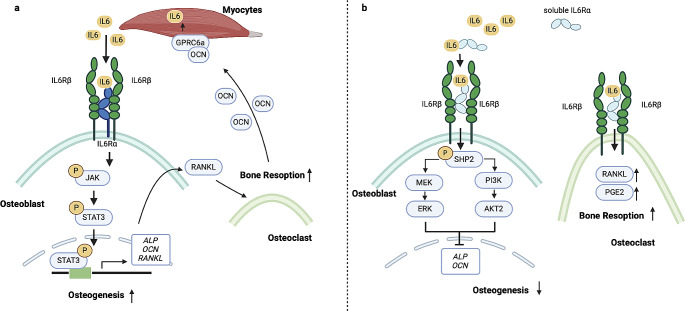
“Excessive exercise results in increased production of IL6, which induces muscle hypertrophy after regeneration of impaired positions [57].”
BackgroundBonewald, L. F. (2011) · Journal of Bone and Mineral Research · doi:10.1002/jbmr.320 · Cited by 2,287 · cited 1×
“Bones, skeletal muscles and joints work in conjunction to protect and accommodate visceral organs [2, 3], while calcium and phosphate found in bone matrix maintain demic homeostasis [4].”
BackgroundFGF23 induces left ventricular hypertrophy
Faul, C., Amaral, A. P., Oskouei, B., Hu, M.-C., Sloan, A., Isakova, T., Gutiérrez, O. M., Aguillon-Prada, R., Lincoln, J., Hare, J. M., et al. (2011) · Journal of Clinical Investigation · doi:10.1172/jci46122 · Cited by 2,027 · cited 1×
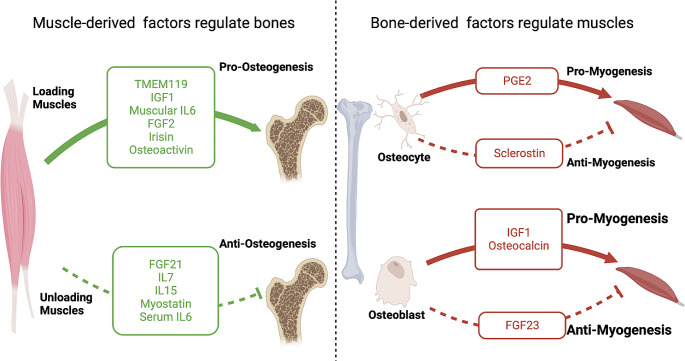
“Specifically, bone-derived FGF23 has a paracrine pattern and induces left ventricular hypertrophy by activating the calcineurin/NFAT signal in cardiomyocytes [122].”
BackgroundExosome and Exosomal MicroRNA: Trafficking, Sorting, and Function
Zhang, J., Li, S., Li, L., Li, M., Guo, C., Yao, J., & Mi, S. (2015) · Genomics, Proteomics & Bioinformatics · doi:10.1016/j.gpb.2015.02.001 · Cited by 1,901 · cited 1×
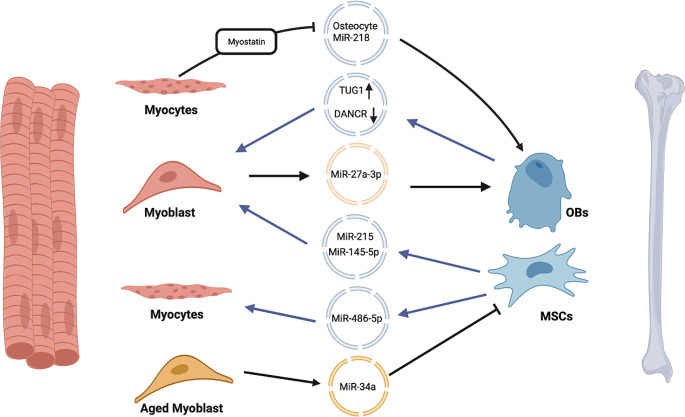
“Due to their cargo of proteins and nucleic acids, exosomes play critical roles in mediating both cell-to-cell and organ-to-organ interactions [136].”
BackgroundInterleukin‐6 myokine signaling in skeletal muscle: a double‐edged sword?
Muñoz‐Cánoves, P., Scheele, C., Pedersen, B. K., & Serrano, A. L. (2013) · The FEBS Journal · doi:10.1111/febs.12338 · Cited by 774 · cited 1×
“However, in muscular tissues, IL6 is produced acutely in response to mechanical activity and is beneficial for anti-inflammation and glucose uptake, making it a myokine [56].”
BackgroundKlein, B., Zhang, X., Jourdan, M., Content, J., Houssiau, F., Aarden, L., Piechaczyk, M., & Bataille, R. (1989) · Blood · doi:10.1182/blood.v73.2.517.517 · Cited by 763 · cited 1×
“IL-6 produced by dendritic cells [49], Fibroblasts [50], Keratinocytes [50], mesangial cells [51], B cells [52], T cells [53] and endothelial cells [54] through paracrine mechanisms.”
Background
Cited by
Zhang, B., Chen, Q., Chen, Q., & Zhang, H. (2025) · Metabolism · doi:10.1016/j.metabol.2025.156333 · Cited by 35
The bone-muscle unit: from mechanical coupling to soluble factors-mediated signaling
Malvandi, A. M., Gerosa, L., Banfi, G., & Lombardi, G. (2025) · Molecular Aspects of Medicine · doi:10.1016/j.mam.2025.101367 · Cited by 28
Zhu, C., Ding, X., Chen, M., Feng, J., Zou, J., & Zhang, L. (2025) · Biomolecules · doi:10.3390/biom15060893 · Cited by 27
Sclerostin's role in bone–muscle crosstalk and osteoporosis pathogenesis
Shahid, H., Morya, V. K., & Noh, K.-C. (2025) · Osteoporosis and Sarcopenia · doi:10.1016/j.afos.2025.06.004 · Cited by 17
“Although significant efforts have been made to understand the role of sclerostin, further studies are needed to elucidate its broader implications, especially in muscle physiology and [170].”
Nutrition and Physical Activity in Musculoskeletal Health
Dominguez, L. J., Veronese, N., Smith, L., Ragusa, F. S., Bella, G. D., Battaglia, G., Bianco, A., & Barbagallo, M. (2025) · Endocrines · doi:10.3390/endocrines6010010 · Cited by 18
“…and maintenance of bone mass are largely dependent on muscle-derived mechanical loads, a concept that has been confirmed for a long time as the effects of mechanotransduction [42], which help explain the detrimental effects of physical inactivity on bone fragility [43] and sarcopenia [44].”
Metadata
- Authors
- Dong, Y., Yuan, H., Ma, G., & Cao, H.
- Affiliations
- Southern University of Science and Technology (CN)
- Corresponding author
- Ma, Guixing
- Cao, Huiling
- Venue
- Cellular and Molecular Life Sciences
- Published
- 2024-07-27
- Volume
- 81
- Issue
- 1
- Pages
- 310-310
- ISSN
- 1420-682X (ISSN-L)
- 1420-9071
- PMC
- PMC11335237
- OpenAlex
- W4401052198
- Cited by
- 52
- References
- 188
- Citations by year
- 2026: 22 · 2025: 28 · 2024: 2
- FWCI
- 2.13
- Type
- journal article
- Language
- en
- Open access
- gold
- doi.org
- Licence
- cc-by
- creativecommons.org/licenses/by/4.0 (tdm)
- creativecommons.org/licenses/by/4.0 (vor)
- Locations
- Cellular and Molecular Life Sciences (publishedVersion, cc-by)
- PubMed Central (publishedVersion, cc-by)
- PubMed (publishedVersion)
- Funders
- National Natural Science Foundation of China (2017B030301018, 82350710800, 2019YFA0906001)
- National Key Research and Development Program of China (2019YFA0906001)
- Topics
- Life Sciences › Biochemistry, Genetics and Molecular Biology › Molecular Biology › Muscle Physiology and Disorders
- Life Sciences › Biochemistry, Genetics and Molecular Biology › Molecular Biology › Bone Metabolism and Diseases
- Health Sciences › Medicine › Orthopedics and Sports Medicine › Bone health and osteoporosis research
- Keywords
- muscle-bone crosstalk, mechanotransduction, myokines, osteokines, bone formation, myogenesis, muscle-bone interaction, osteopenia, bone metabolism, myopathy, bone disease, nutrition and metabolism, circadian rhythm, aging
- MeSH terms
- Animals, Bone and Bones, Humans, Osteogenesis, Muscle, Skeletal, Muscle Development, Mechanotransduction, Cellular
About these checks
Registry, retraction, Cites and statistics results are computed, not judged, with one exception: a printed reference that no index lists is read once by a model before it counts as a citation error. Claims are extracted by a model and kept only when their quote appears verbatim in the text; each cited source is then checked, with a model’s help, for whether it says what the claim relies on. Those verdicts can be wrong — read the claim’s quote and the cited source before relying on one.
Statistics and arithmetic are recomputed, not judged.
Confidence bands are shown only for fields calibrated on our annotated test set. None is calibrated yet, so no band is shown.
What counts as a claim ›How we measure confidence ›How we check this ›
Are you an author, or do you see a problem with this page? Request a review
How to cite
Cite CoChat for the checks on this page, and the paper for its own findings.
- This page
- CoChat. (2026). Citation check: Bone-muscle crosstalk under physiological and pathological conditions. https://app.cochat.ai/papers/10.1007/s00018-024-05331-y
- The paper
- Dong, Y., Yuan, H., Ma, G., & Cao, H. (2024). Bone-muscle crosstalk under physiological and pathological conditions. Cellular and Molecular Life Sciences. https://doi.org/10.1007/s00018-024-05331-y
Data sources
Bibliographic data: Semantic Scholar, OpenAlex, Crossref.
Contains information from the Semantic Scholar Academic Graph Datasets, made available under the ODC Attribution License (ODC-BY 1.0).
Semantic Scholar’s data is described in: Kinney, R., et al. (2023). The Semantic Scholar Open Data Platform. arXiv:2301.10140.
