

The DOI matches its Crossref record; 47 of the 48 references it cites were found in a registry or an index.
AKR1C3-Mediated Adipose Androgen Generation Drives Lipotoxicity in Women With Polycystic Ovary Syndrome
Open accessAbstract
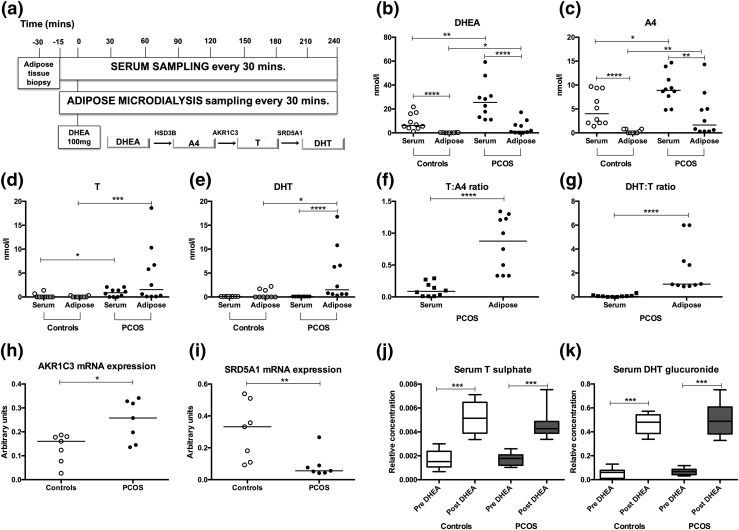
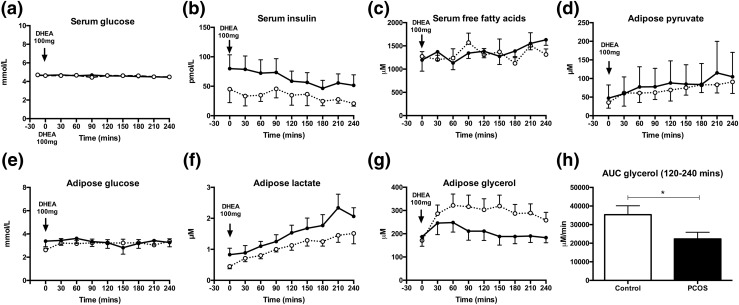
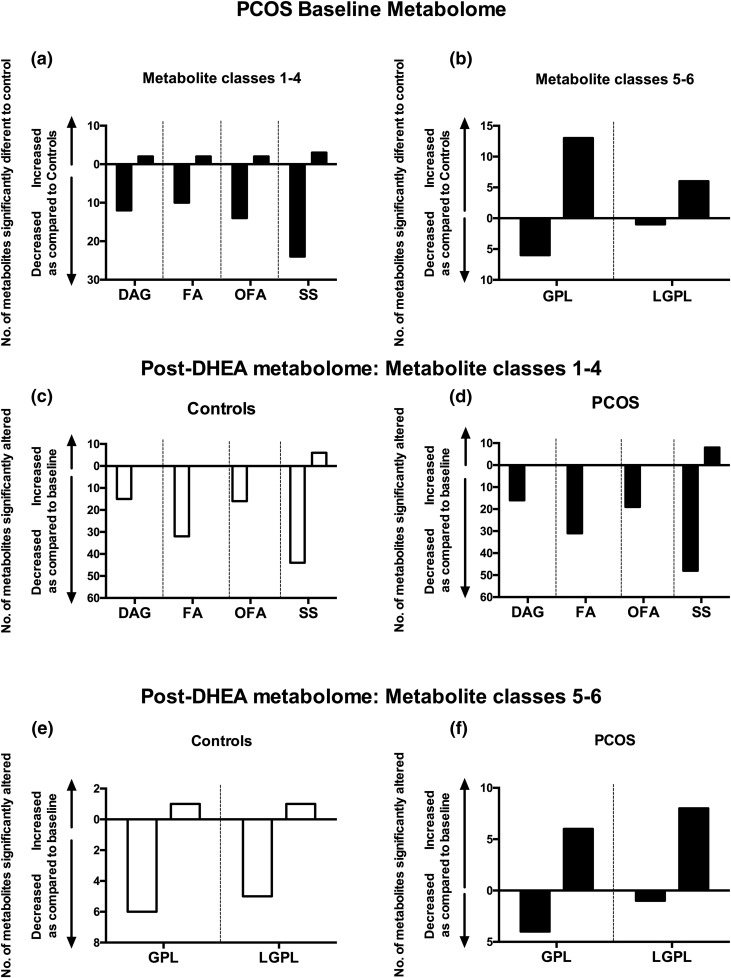
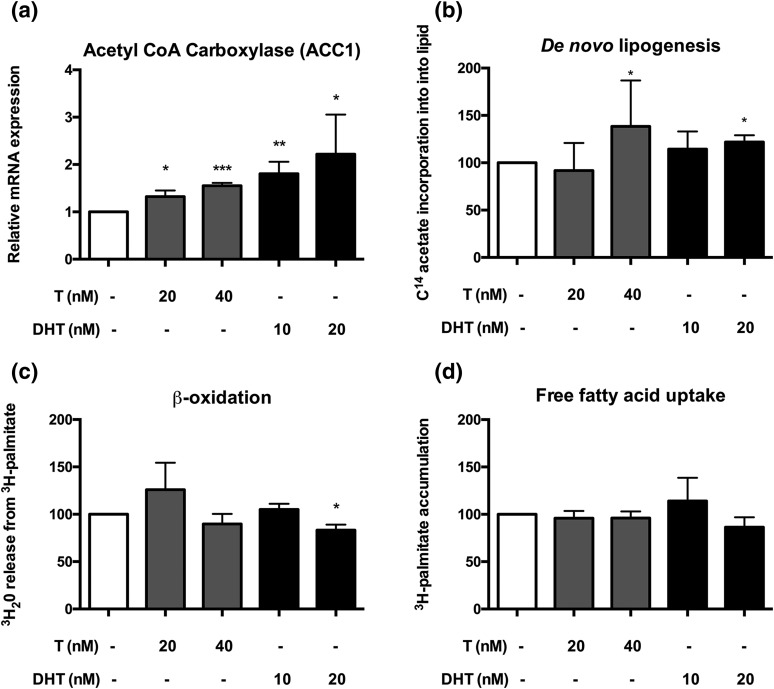
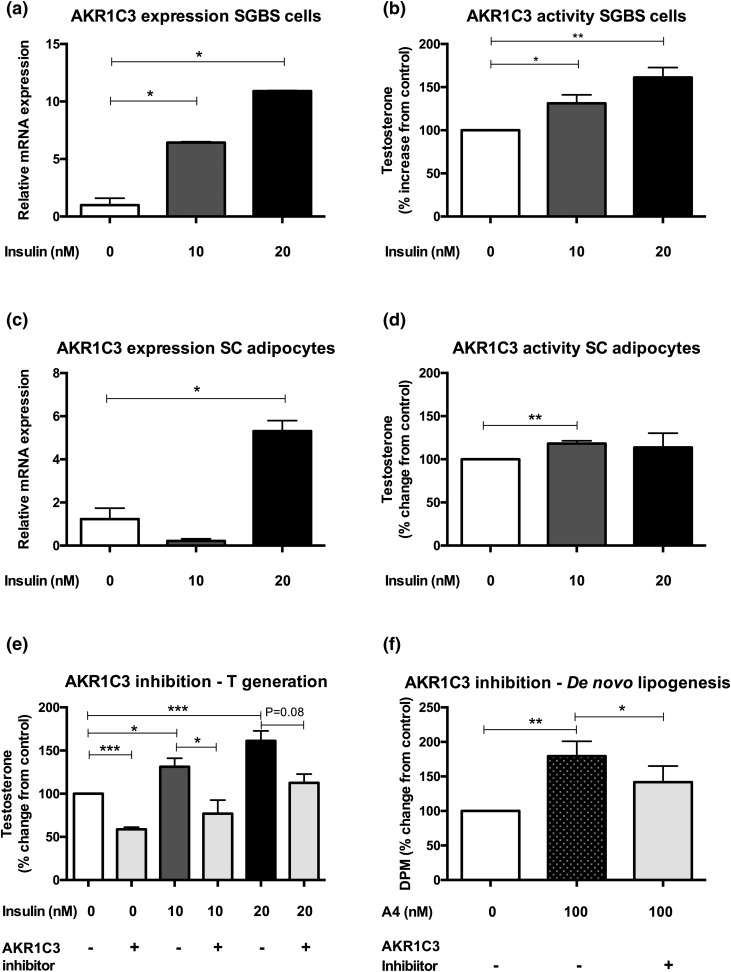
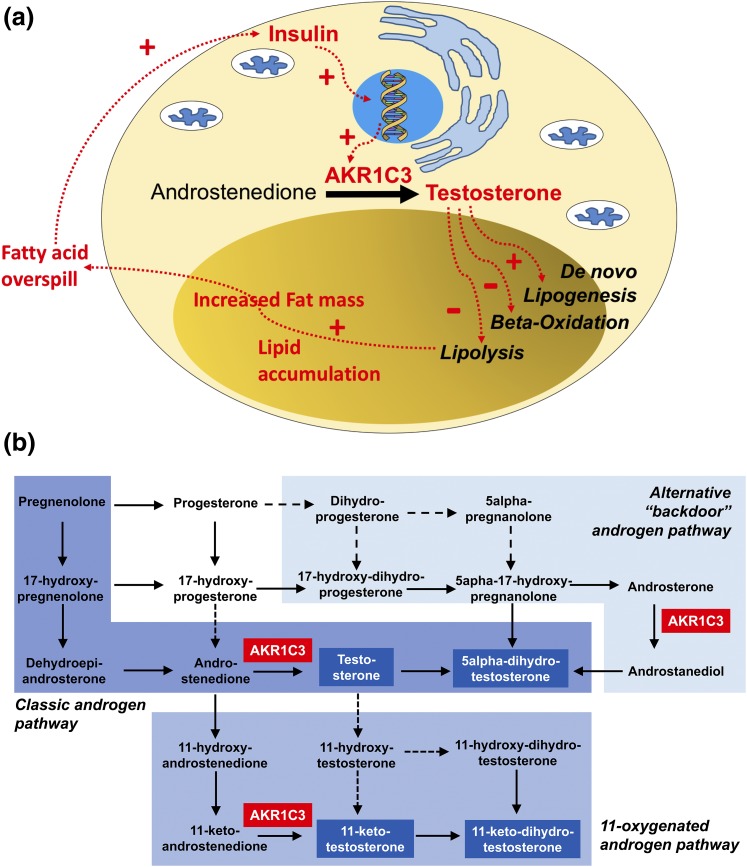
Context: Polycystic ovary syndrome (PCOS) is a prevalent metabolic disorder occurring in up to 10% of women of reproductive age. PCOS is associated with insulin resistance and cardiovascular risk. Androgen excess is a defining feature of PCOS and has been suggested as causally associated with insulin resistance; however, mechanistic evidence linking both is lacking. We hypothesized that adipose tissue is an important site linking androgen activation and metabolic dysfunction in PCOS. Methods: We performed a human deep metabolic in vivo phenotyping study examining the systemic and intra-adipose effects of acute and chronic androgen exposure in 10 PCOS women, in comparison with 10 body mass index-matched healthy controls, complemented by in vitro experiments. Results: PCOS women had increased intra-adipose concentrations of testosterone (P = 0.0006) and dihydrotestosterone (P = 0.01), with increased expression of the androgen-activating enzyme aldo-ketoreductase type 1 C3 (AKR1C3) (P = 0.04) in subcutaneous adipose tissue. Adipose glycerol levels in subcutaneous adipose tissue microdialysate supported in vivo suppression of lipolysis after acute androgen exposure in PCOS (P = 0.04). Mirroring this, nontargeted serum metabolomics revealed prolipogenic effects of androgens in PCOS women only. In vitro studies showed that insulin increased adipose AKR1C3 expression and activity, whereas androgen exposure increased adipocyte de novo lipid synthesis. Pharmacologic AKR1C3 inhibition in vitro decreased de novo lipogenesis. Conclusions: These findings define an intra-adipose mechanism of androgen activation that contributes to adipose remodeling and a systemic lipotoxic metabolome, with intra-adipose androgens driving lipid accumulation and insulin resistance in PCOS. AKR1C3 represents a promising therapeutic target in PCOS.
Overview
The claims and statistics of this paper haven’t been checked yet.
Run the check — free, no account needed. It reads the open-access text and checks the sources it cites.
Integrity signals
Registry
Cites
Statistics
Figures
Verification
Claims the paper makes
The claims and statistics of this paper haven’t been checked yet.
Run the check — free, no account needed. It reads the open-access text and checks the sources it cites.
Claims other papers make about this one
Each is checked against this paper’s own text: does it say what the citing paper says it does?
The source backs part of the claim, not all of it — or backs it for a different population, condition or comparison.
In the citing paper
“Insulin stimulates AKR1C3 expression in the adipose tissue of women with PCOS and its inhibition has been suggested as offering a therapeutic target to reduce the hyperandrogenism that is a feature of this disorder [101].”
From Endometrial Intracrinology: Oestrogens, Androgens and Endometrial Disorders (2018) · cites this paper as [101]
Experimental — accuracy not yet measuredThe cited source says what the claim attributes to it.
In the citing paper
“Using this model system, insulin increased AKR1C3 expression.”
From Polycystic Ovary Syndrome: Pathophysiology, Presentation, and Treatment With Emphasis on Adolescent Girls (2019) · cites this paper as [95]
In the citing paper
“Using a human preadipocyte cell line, both testosterone and DHT increased de novo lipogenesis in the absence of insulin [95], whereas pharmacologic inhibition of AKR1C3 activity prevented androgen-mediated adverse effects on adipocyte lipogenesis.”
From Polycystic Ovary Syndrome: Pathophysiology, Presentation, and Treatment With Emphasis on Adolescent Girls (2019) · cites this paper as [95]
In the citing paper
“A deep in vivo metabolic phenotyping study showed increased AKR1C3 and decreased SRD5A1 mRNA expression in subcutaneous fat of women with PCOS [95].”
From Polycystic Ovary Syndrome: Pathophysiology, Presentation, and Treatment With Emphasis on Adolescent Girls (2019) · cites this paper as [95]
Self-check
Percentages, sums and reported differences re-computed from the paper’s own numbers.
The self-check needs the paper’s full text.
Citations
Cites
(2004) · Fertility and Sterility · doi:10.1016/j.fertnstert.2003.10.004 · Cited by 9,050
The Diagnosis of Polycystic Ovary Syndrome during Adolescence
Witchel, S. F., Oberfield, S., Rosenfield, R. L., Codner, E., Bonny, A., Ibáñez, L., Pena, A., Horikawa, R., Gomez-Lobo, V., Joel, D., et al. (2015) · Hormone Research in Paediatrics · doi:10.1159/000375530 · Cited by 3,113
Insulin Resistance and the Polycystic Ovary Syndrome: Mechanism and Implications for Pathogenesis
Dunaif, A. E. (1997) · Endocrine Reviews · doi:10.1210/edrv.18.6.0318 · Cited by 2,776
Franks, S. (1995) · New England Journal of Medicine · doi:10.1056/nejm199509283331307 · Cited by 2,463
Men at risk: occupation and male infertility.
Claman, P. (2004) · Fertility and Sterility · doi:10.1016/s0015-0282(03)01188-9 · Cited by 2,219
Legro, R. S. (1999) · Journal of Clinical Endocrinology & Metabolism · doi:10.1210/jc.84.1.165 · Cited by 1,743
Gao, X., Wu, G., Gu, X., Fu, L., & Mei, C. (2013) · Kidney & Blood Pressure Research · doi:10.1159/000355743 · Cited by 1,035
Franks, S. (1997) · Archives of Disease in Childhood · doi:10.1136/adc.77.1.89 · Cited by 802
Yildiz, B. O., Bozdag, G., Yapici, Z., Esinler, I., & Yarali, H. (2012) · Human Reproduction · doi:10.1093/humrep/des232 · Cited by 704
Genetic Syndromes of Severe Insulin Resistance
Semple, R. K., Savage, D. B., Cochran, E. K., Görden, P., & O’Rahilly, S. (2011) · Endocrine Reviews · doi:10.1210/er.2010-0020 · Cited by 367
Self-citation
Cited by
Sorted by citations
Items 201–214 of 214
Ostinelli, G., Ramalho, A., Gauthier, M., Julien, F., Biertho, L. D., Vohl, M., & Tchernof, A. (2025) · medRxiv · doi:10.1101/2025.10.10.25337731
Ostinelli, G., Ramalho, A., Gauthier, M., Julien, F., Biertho, L. D., Vohl, M., & Tchernof, A. (2026) · American Journal of Physiology-Endocrinology and Metabolism · doi:10.1152/ajpendo.00512.2024
Nanoparticles in Polycystic Ovary Syndrome Therapy: Unveiling New Horizons in Reproductive Health
Joshi, D., Shukla, P., & Choudhary*, D. N. K. (2025) · International Journal of Newgen Research in Pharmacy & Healthcare · doi:10.61554/ijnrph.v3i2.2025.180
Metabolic aspects of polycystic ovary syndrome
Pappas, D., Kandaraki, E., Kalogirou, A., & Diamanti‐Kandarakis, E. (2026) · Expert Review of Endocrinology & Metabolism · doi:10.1080/17446651.2026.2656240
Case, A. M., Smith, M., Mack, C., & Trippier, P. C. (2026) · Expert Opinion on Therapeutic Patents · doi:10.1080/13543776.2026.2699768
Progress in 17β-HSD5 Inhibitor Discovery: Mechanistic Basis, SAR Trends, and Therapeutic Potential
Torawane, S., Ratre, P., Singh, Y., Mandpe, S., & Kulkarni, S. (2026) · Journal of Molecular Structure · doi:10.1016/j.molstruc.2026.147192
Liu, Y., Li, C., Li, J., Wei, Z., Li, X., Peng, J., Jiang, Z., Liu, B., Liu, Y., Huang, H., et al. (2026) · Reproductive Sciences · doi:10.1007/s43032-026-02146-z
Gao, Y., Liu, C., & He, X. (2026) · Frontiers in Cellular and Infection Microbiology · doi:10.3389/fcimb.2026.1840605
Stener‐Victorin, E., Zhao, H., Azziz, R., & Teede, H. J. (2026) · Cell Metabolism · doi:10.1016/j.cmet.2026.07.018
Li, C., Su, Z., Li, Y., Liu, H., Zheng, M., Zhou, H., Wei, C., Zhou, F., Yang, C., Tang, C., et al. (2026) · Metabolites · doi:10.3390/metabo16090663
Insulin signaling in PCOS/PMOS: molecular insights and clinical implications
Goel, A., Grover, A., & Shekhar, S. (2026) · Frontiers in Endocrinology · doi:10.3389/fendo.2026.1955884
Dempster, N. J., Gade, F. S., Daly, C., Mbasu, R. J., Chen, L., Dong, J., Gangitano, E., Sgromo, B., Gillies, R. S., White, S. J., et al. (2026) · Metabolism · doi:10.1016/j.metabol.2026.156793
Self-citationGüneşli, I., Aksun, M. S., & Yıldız, B. O. (2026) · Journal of Endocrinological Investigation · doi:10.1007/s40618-026-03047-3
Cheng, X., Li, Y., Zhu, M., 蔡亞潔, Wei, N., Liu, Y., & Liu, Y. (2026) · Chinese Herbal Medicines · doi:10.1016/j.chmed.2026.10.002
Metadata
- Authors
- O’Reilly, M. W., Kempegowda, P., Walsh, M., Taylor, A. E., Manolopoulos, K. N., Allwood, J. W., Semple, R. K., Hebenstreit, D., Dunn, W. B., Tomlinson, J. W., & Arlt, W.
- Affiliations
- University of Birmingham (GB)
- University of Warwick (GB)
- University of Cambridge (GB)
- Churchill Hospital (GB)
- NIHR Birmingham Liver Biomedical Research Unit (GB)
- Corresponding author
- Arlt, Wiebke
- ORCID
- Venue
- The Journal of Clinical Endocrinology & Metabolism
- Publisher
- The Endocrine Society
- Published
- 2017-06-22
- Volume
- 102
- Issue
- 9
- Pages
- 3327-3339
- ISSN
- 0021-972X (ISSN-L)
- 1945-7197
- PMC
- PMC5587066
- OpenAlex
- W2684997942
- Cited by
- 215
- References
- 48
- Citations by year
- 2026: 30 · 2025: 36 · 2024: 23 · 2023: 25 · 2022: 21 · 2021: 24 · 2020: 21 · 2019: 20 · 2018: 14 · 2017: 1
- FWCI
- 17.73
- Type
- journal article
- Language
- en
- Open access
- hybrid
- doi.org
- Licence
- cc-by
- Locations
- The Journal of Clinical Endocrinology & Metabolism (publishedVersion, cc-by)
- PubMed Central (publishedVersion, cc-by)
- PubMed (publishedVersion)
- Warwick Research Archive Portal (University of Warwick) (acceptedVersion)
- University of Birmingham Research Portal (University of Birmingham) (submittedVersion, cc-by)
- Edinburgh Research Explorer (University of Edinburgh) (submittedVersion, cc-by)
- Spiral (Imperial College London) (submittedVersion, cc-by)
- Apollo (University of Cambridge) (submittedVersion, cc-by)
- Apollo (cc-by)
- Funders
- Bayer
- Wellcome Trust (099909, 098498/Z/12/Z, 092283, WT098498)
- National Institute for Health and Care Research
- National Institutes of Health
- Directorate for Biological Sciences
- Medical Research Council (MR/M009157/1, MR/P011462/1)
- Biotechnology and Biological Sciences Research Council (BB/L006340/1)
- Topics
- Health Sciences › Medicine › Reproductive Medicine › Ovarian function and disorders
- Health Sciences › Medicine › Endocrinology, Diabetes and Metabolism › Adipokines, Inflammation, and Metabolic Diseases
- Life Sciences › Biochemistry, Genetics and Molecular Biology › Biochemistry › Lipid metabolism and biosynthesis
- Keywords
- polycystic ovary syndrome, AKR1C3, testosterone, dihydrotestosterone, lipotoxicity, insulin resistance, lipolysis, de novo lipogenesis, adipose tissue remodeling, serum metabolomics, insulin signaling
- MeSH terms
- Aldo-Keto Reductase Family 1 Member C3, Adolescent, Adult, Analysis of Variance, Androgens, Cells, Cultured, Dehydroepiandrosterone, Female, Humans, Hydroxyprostaglandin Dehydrogenases, Insulin Resistance, Lipolysis, Polycystic Ovary Syndrome, Reference Values, 3-Hydroxysteroid Dehydrogenases, Biomarkers, Case-Control Studies, Adipocytes, Statistics, Nonparametric, Area Under Curve, Subcutaneous Fat, Lipid Metabolism, Young Adult, Real-Time Polymerase Chain Reaction
About these checks
Registry, retraction, Cites and statistics results are computed, not judged, with one exception: a printed reference that no index lists is read once by a model before it counts as a citation error. Claims are extracted by a model and kept only when their quote appears verbatim in the text; each cited source is then checked, with a model’s help, for whether it says what the claim relies on. Those verdicts can be wrong — read the claim’s quote and the cited source before relying on one.
Statistics and arithmetic are recomputed, not judged.
Confidence bands are shown only for fields calibrated on our annotated test set. None is calibrated yet, so no band is shown.
What counts as a claim ›How we measure confidence ›How we check this ›
Are you an author, or do you see a problem with this page? Request a review
