

The DOI matches its Crossref record; 28 of the 28 references it cites were found in a registry or an index.
Hypothyroidism prevalence in the United States: a retrospective study combining National Health and Nutrition Examination Survey and claims data, 2009-2019.
Open accessAbstract
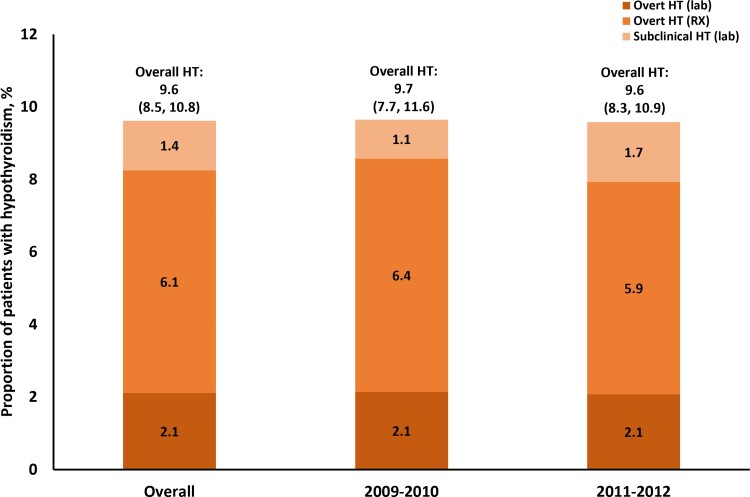
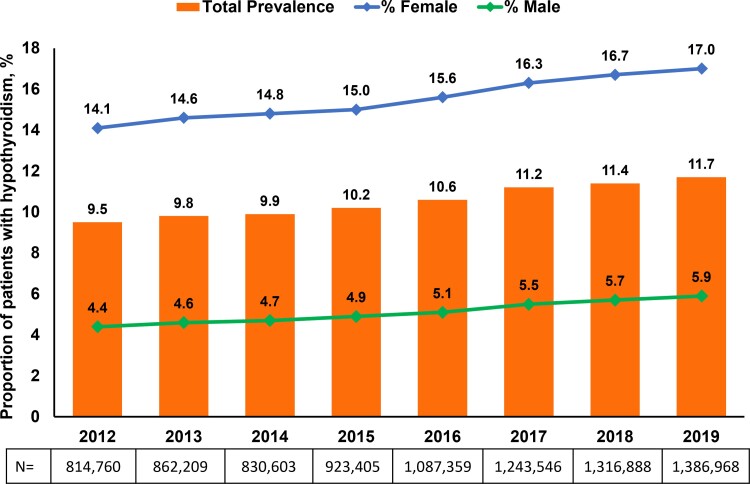
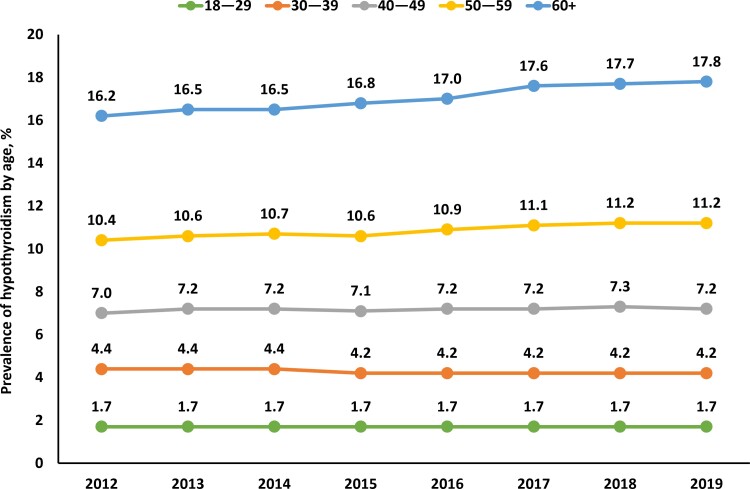
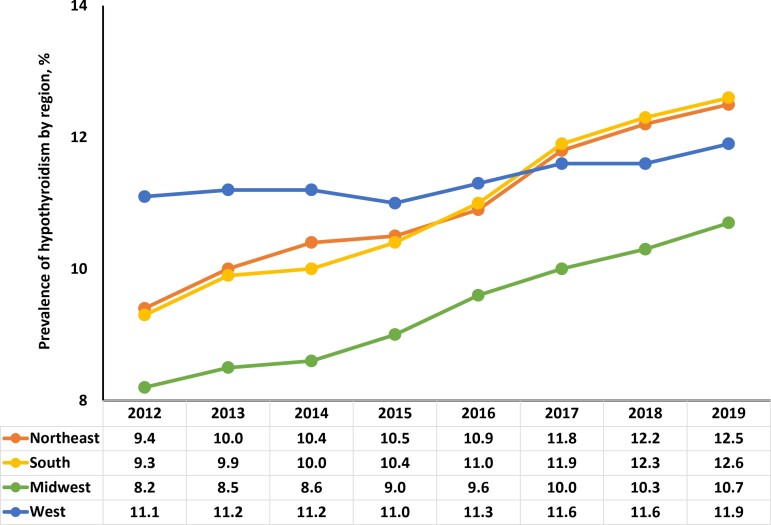
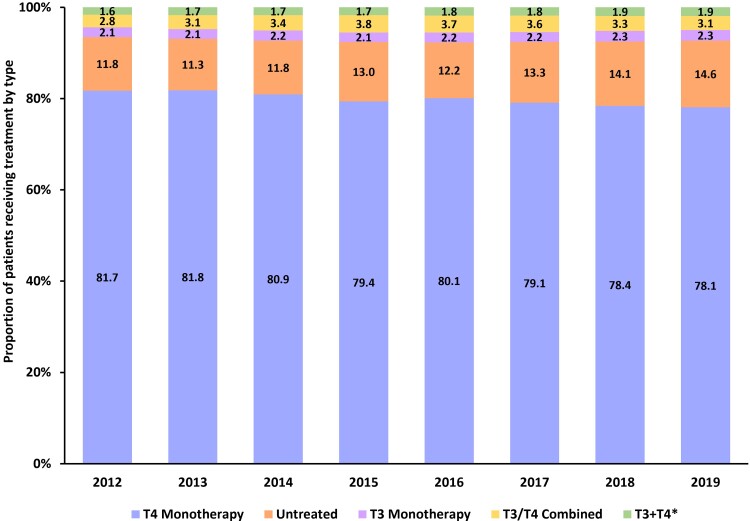
Previous estimates determined prevalence of hypothyroidism (HT) to be 4.6% of the US population. This study aimed to update estimates of HT prevalence in the United States by retrospective analysis of 2 datasets. Data on HT type (overt or subclinical HT) and treatment were collected from the 2009-2010 and 2011-2012 National Health and Nutrition Examination Survey (NHANES) cycles. From the Optum administrative claims database, medical and pharmacy claims were collected between January 1, 2012, and December 31, 2019. Patients were defined as having HT if, per given year, they had >1 prescription for HT treatment, >1 claim indicating an HT diagnosis, or thyroid-stimulating hormone levels >4.0 mIU/L (NHANES arm). For both studies, treatment was defined as any evidence of synthetic or natural thyroid hormone replacement, identified by pharmacy claims or patient surveys. Data are reported as percentage of patients with HT and treatments received. Between 2009 and 2012, HT prevalence remained around 9.6% of the US population. The administrative claims dataset showed that HT prevalence grew from 9.5% in 2012 to 11.7% in 2019 and that >78% of patients received thyroxine (T4) monotherapy. Similarly, the NHANES dataset showed that T4 replacement therapy was the most common treatment for HT. From 2012-2019, patients with untreated HT grew from 11.8% to 14.4%. The prevalence of HT in the United States has steadily increased since 2009. Likewise, the percentage of hypothyroid-diagnosed patients not receiving treatment also increased, suggesting that the increased prevalence may be due to increased cases of subclinical HT.
Overview
The claims and statistics of this paper haven’t been checked yet.
Run the check — free, no account needed. It reads the open-access text and checks the sources it cites.
Integrity signals
Registry
Cites
Statistics
Figures
Verification
Claims the paper makes
The claims and statistics of this paper haven’t been checked yet.
Run the check — free, no account needed. It reads the open-access text and checks the sources it cites.
Claims other papers make about this one
Each is checked against this paper’s own text: does it say what the citing paper says it does?
The source backs part of the claim, not all of it — or backs it for a different population, condition or comparison.
In the citing paper
“Hypothyroidism is more frequent in Asian and White individuals compared with Black individuals, 21,22 whichmaybeduetoenvironmentalfactors(eg,areas with inadequate nutritional iodine levels), genetic factors, or both ( Box ). 22-25”
From Hypothyroidism: A Review (2025) · cites this paper as [21]
Experimental — accuracy not yet measuredIn the citing paper
“prevalence in the USA increased from 9.5% (2012) to 11.7% (2019), with over 78% receiving LT4 alone (9)”
Self-check
Percentages, sums and reported differences re-computed from the paper’s own numbers.
The self-check needs the paper’s full text.
Citations
Cites
Home visits: a strategy to improve newborn survival - Authors' reply
(2008) · Americanae (AECID Library) · doi:10.1016/s0140 · Cited by 22,524
Heart Disease and Stroke Statistics—2021 Update: A Report From the American Heart Association
Virani, S. S., Alonso, A., Aparicio, H. J., Benjamin, E. J., Bittencourt, M. S., Callaway, C. W., Carson, A. P., Chamberlain, A. M., Cheng, S., Delling, F. N., et al. (2021) · Circulation · doi:10.1161/cir.0000000000000950 · Cited by 5,784
Hollowell, J. G., Staehling, N. W., Flanders, W. D., Hannon, W. H., Gunter, E. W., Spencer, C. A., & Braverman, L. E. (2002) · The Journal of Clinical Endocrinology & Metabolism · doi:10.1210/jc.87.2.489 · Cited by 4,279
The incidence of thyroid disorders in the community: a twenty-year follow-up of the Whickham Survey
Vanderpump, M. P. J., Tunbrldge, W. M. G., French, J. M., Appleton, D., Bates, D., Clark, F., Evans, J. G., Hasan, D. M., Rodgers, H., Tunbridge, F., et al. (1995) · Clinical Endocrinology · doi:10.1111/j.1365-2265.1995.tb01894.x · Cited by 2,432 · cited 1×
“A wait-and-see strategy is most common among patients with subclinical HT, as up to 4% of patients may go on to develop overt HT [2, 4, 5].”
BackgroundTransmission of SARS-COV-2 Infections in Households — Tennessee and Wisconsin, April–September 2020
Grijalva, C. G., Rolfes, M. A. R., Zhu, Y., McLean, H. Q., Hanson, K. E., Belongia, E. A., Halasa, N., Kim, A., Reed, C., Fry, A. M., et al. (2020) · MMWR Morbidity and Mortality Weekly Report · doi:10.15585/mmwr.mm6944e1 · Cited by 1,609
Garber, J. R., Cobin, R. H., Gharib, H., Hennessey, J. V., Klein, I., Mechanick, J. I., Pessah-Pollack, R., Singer, P. A., & Woeber, K. A. (2012) · Endocrine Practice · doi:10.4158/ep12280.gl · Cited by 1,567
Chaker, L., Bianco, A. C., Jonklaas, J., & Peeters, R. P. (2017) · The Lancet · doi:10.1016/s0140-6736(17)30703-1 · Cited by 1,159
2013 ETA Guideline: Management of Subclinical Hypothyroidism
Pearce, S. H. S., Brabant, G., Duntas, L. H., Monzani, F., Peeters, R. P., Razvi, S., & Wemeau, J.-L. (2013) · European Thyroid Journal · doi:10.1159/000356507 · Cited by 877
Hypertension Prevalence Among Adults Aged 18 and Over: United States, 2017-2018.
Ostchega, Y., Fryar, C. D., Nwankwo, T., & Nguyễn, D. (2020) · PubMed · Cited by 497
Optimal recall periods for patient-reported outcomes: challenges and potential solutions
Stull, D. E., Leidy, N. K., Parasuraman, B. M., & Chassany, O. (2009) · Current Medical Research and Opinion · doi:10.1185/03007990902774765 · Cited by 415 · cited 1×
“Likewise, data obtained from patient surveys rely on patient perspectives and memory and are, as a result, subject to recall bias, which could affect survey outcomes [31].”
Background
Research works printed but not linked: 2
- [3]Patil N, Rehman A, Jialal I. Hypothyroidism. Accessed August 4, 2021. https://www.ncbi.nlm.nih.gov/books/NBK519536/
- [9]National Institute for Healthcare and Excellence. Thyroid disease: assessment and management. NICE Guideline. 2019. 31829541
Cited by
Sorted by citations
Chaker, L., & Papaleontiou, M. (2025) · JAMA · doi:10.1001/jama.2025.13559 · Cited by 63
Hypothyroidism, lipids, and lipidomics
Jonklaas, J. (2023) · Endocrine · doi:10.1007/s12020-023-03420-9 · Cited by 41
“In a recent study using both NHANES data and the Optum administrative claims database, 1.4% (3,500,678) of survey participants in the United States had untreated subclinical hypothyroidism [12].”
MethodResultInfluentialEpidemiologic changes in thyroid disease
Acosta, G. J., Ospina, N. S., & Brito, J. P. (2024) · Current Opinion in Endocrinology Diabetes and Obesity · doi:10.1097/med.0000000000000877 · Cited by 28
Casula, S., Ettleson, M. D., & Bianco, A. C. (2023) · Endocrine Practice · doi:10.1016/j.eprac.2023.04.003 · Cited by 19
Ahmad, A., Serry, Z. M. H., Elghaffar, H. A. A., Ghazi, H. A., & Elgayar, S. L. (2023) · Complementary Therapies in Clinical Practice · doi:10.1016/j.ctcp.2023.101795 · Cited by 18
Metadata
- Authors
- Wyne, K. L., Nair, L., Schneiderman, C. P., Pinsky, B., Antunez Flores, O., Guo, D., Barger, B., & Tessnow, A. H.
- Affiliations
- The Ohio State University Wexner Medical Center (US)
- AbbVie (United States) (US)
- AbbVie, Inc. , Chicago, IL , USA
- Division of Endocrinology, Diabetes, and Metabolism, University of Texas Southwestern Medical Center , Dallas, TX , USA
- Venue
- Journal of the Endocrine Society
- Publisher
- The Endocrine Society
- Published
- 2022-11-10
- Volume
- 7
- Issue
- 1
- Pages
- bvac172-bvac172
- ISSN
- 2472-1972 (ISSN-L)
- PMC
- PMC9706417
- OpenAlex
- W4308881891
- Cited by
- 111
- References
- 28
- Citations by year
- 2026: 28 · 2025: 34 · 2024: 34 · 2023: 15
- FWCI
- 15.38
- Type
- journal article
- Language
- en
- Open access
- gold
- doi.org
- Licence
- Locations
- Journal of the Endocrine Society (publishedVersion, cc-by-nc-nd)
- PubMed Central (publishedVersion, cc-by-nc-nd)
- PubMed (publishedVersion)
- Funders
- AbbVie
- Topics
- Health Sciences › Medicine › Endocrinology, Diabetes and Metabolism › Thyroid Disorders and Treatments
- Health Sciences › Medicine › Surgery › Thyroid and Parathyroid Surgery
- Health Sciences › Medicine › Endocrinology, Diabetes and Metabolism › Thyroid Cancer Diagnosis and Treatment
- Keywords
- hypothyroidism, prevalence, subclinical hypothyroidism, overt hypothyroidism, thyroid hormone replacement, levothyroxine monotherapy, untreated hypothyroidism, thyroid-stimulating hormone, United States
About these checks
Registry, retraction, Cites and statistics results are computed, not judged, with one exception: a printed reference that no index lists is read once by a model before it counts as a citation error. Claims are extracted by a model and kept only when their quote appears verbatim in the text; each cited source is then checked, with a model’s help, for whether it says what the claim relies on. Those verdicts can be wrong — read the claim’s quote and the cited source before relying on one.
Statistics and arithmetic are recomputed, not judged.
Confidence bands are shown only for fields calibrated on our annotated test set. None is calibrated yet, so no band is shown.
What counts as a claim ›How we measure confidence ›How we check this ›
Are you an author, or do you see a problem with this page? Request a review
