

The DOI matches its Crossref record; 38 of the 38 references it cites were found in a registry or an index.
Autoantibodies to MOG in a distinct subgroup of adult multiple sclerosis
Open accessAbstract
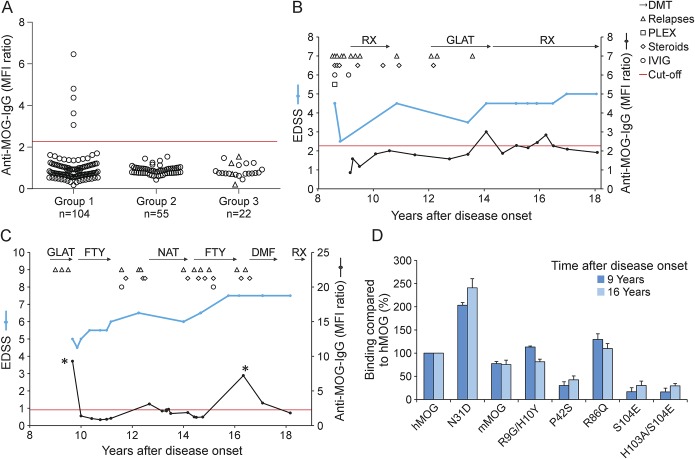
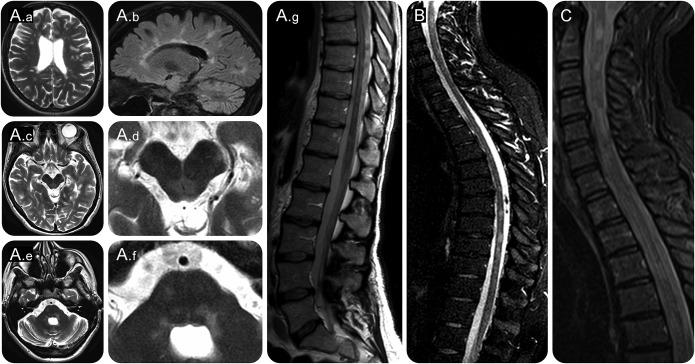
OBJECTIVES: To evaluate the presence of antibodies to conformation-intact myelin oligodendrocyte glycoprotein (MOG) in a subgroup of adult patients with clinically definite multiple sclerosis (MS) preselected for a specific clinical phenotype including severe spinal cord, optic nerve, and brainstem involvement. METHODS: Antibodies to MOG were investigated using a cell-based assay in 3 groups of patients: 104 preselected patients with MS (group 1), 55 age- and sex-matched, otherwise unselected patients with MS (group 2), and in 22 brain-biopsied patients with demyelinating diseases of the CNS (n = 19 with MS), 4 of whom classified as MS type II (group 3). Recognized epitopes were identified with mutated variants of MOG. RESULTS: Antibodies to MOG were found in about 5% (5/104) of preselected adult patients with MS. In contrast, in groups 2 and 3, none of the patients tested positive for MOG antibodies. Patients with MS with antibodies to MOG predominantly manifested with concomitant severe brainstem and spinal cord involvement and had a severe disease course with high relapse rates and failure to several disease-modifying therapies. Three of them had been treated with plasma exchange with a favorable response. All anti-MOG-positive patients with MS showed typical MS lesions on brain MRI. Longitudinal analysis up to 9 years revealed fluctuations and reappearance of anti-MOG reactivity. Epitope mapping indicated interindividual heterogeneity, yet intraindividual stability of the antibody response. CONCLUSIONS: Antibodies to MOG can be found in a distinct subgroup of adult MS with a specific clinical phenotype and may indicate disease heterogeneity.
Overview
The claims and statistics of this paper haven’t been checked yet.
Run the check — free, no account needed. It reads the open-access text and checks the sources it cites.
Integrity signals
Registry
Cites
Statistics
Figures
Verification
Claims the paper makes
The claims and statistics of this paper haven’t been checked yet.
Run the check — free, no account needed. It reads the open-access text and checks the sources it cites.
Self-check
Percentages, sums and reported differences re-computed from the paper’s own numbers.
The self-check needs the paper’s full text.
Citations
Cites
Diagnostic criteria for multiple sclerosis: 2010 revisions to the McDonald criteria
Polman, C. H., Reingold, S. C., Banwell, B., Clanet, M., Cohen, J. A., Filippi, M., Fujihara, K., Havrdova, E., Hutchinson, M., Kappos, L., et al. (2011) · Annals of Neurology · doi:10.1002/ana.22366 · Cited by 9,802
International consensus diagnostic criteria for neuromyelitis optica spectrum disorders
Wingerchuk, D. M., Banwell, B., Bennett, J. L., Cabre, P., Carroll, W., Chitnis, T., de Seze, J., Fujihara, K., Greenberg, B., Jacob, A., et al. (2015) · Neurology · doi:10.1212/wnl.0000000000001729 · Cited by 4,649
New Multiple Sclerosis Phenotypic Classification
LUBLIN, F. D. (2014) · European Neurology · doi:10.1159/000367614 · Cited by 4,277
Ruiter, A. M., Meilof, J. F., Somanje-Bolweg, R. R. J., van Gorsel, E., & Kalkers, N. F. (2017) · Case Reports in Neurology · doi:10.1159/000455942 · Cited by 1,762
von Büdingen, H. ‐., Palanichamy, A., Lehmann‐Horn, K., Michel, B., & Zamvil, S. S. (2015) · European Neurology · doi:10.1159/000377675 · Cited by 1,475
Multiple Sclerosis Severity Score: Using disability and disease duration to rate disease severity
Roxburgh, R. H. S. R., Seaman, S. R., Masterman, T., Hensiek, A. E., Sawcer, S. J., Vukusic, S., Achiti, I., Confavreux, C., Coustans, M., le Page, E., et al. (2005) · Neurology · doi:10.1212/01.wnl.0000156155.19270.f8 · Cited by 963
Overlapping demyelinating syndromes and anti–N‐methyl‐D‐aspartate receptor encephalitis
Titulaer, M. J., Höftberger, R., Iizuka, T., Leypoldt, F., McCracken, L., Cellucci, T., Benson, L. A., Shu, H., Irioka, T., Hirano, M., et al. (2014) · Annals of Neurology · doi:10.1002/ana.24117 · Cited by 518
Mader, S., Gredler, V., Schanda, K., Rostasy, K. M., Dujmović, I., Pfaller, K., Lutterotti, A., Jarius, S., Pauli, F. D., Kuenz, B., et al. (2011) · Journal of Neuroinflammation · doi:10.1186/1742-2094-8-184 · Cited by 449
Myelin-oligodendrocyte glycoprotein antibodies in adults with a neuromyelitis optica phenotype
Kitley, J., Woodhall, M., Waters, P., Leite, M. I., Devenney, E., Craig, J., Palace, J., & Vincent, A. (2012) · Neurology · doi:10.1212/wnl.0b013e31826aac4e · Cited by 445
Self-antigen tetramers discriminate between myelin autoantibodies to native or denatured protein
O’Connor, K. C., McLaughlin, K. A., Jager, P. L. D., Chitnis, T., Bettelli, E., Xu, C., Robinson, W. H., Cherry, S. V., Bar‐Or, A., Banwell, B., et al. (2007) · Nature Medicine · doi:10.1038/nm1488 · Cited by 419
Cited by
Sorted by citations
Items 201–206 of 206
Adivi, A. (2020) · University of North Texas Digital Library (University of North Texas) · doi:10.12794/metadc1752378
Investigation of brain-derived neurotrophic factor and adhesion molecules in multiple sclerosis
Bykova, V. A., Ермоленко, Н. А., Budnevsky, A. V., Шишкина, В. В., Антакова, Л. Н., Олеговна, Х. А., Tkachenko, N. V., Popova, M. V., & Bragina, O. V. (2025) · Russian Medicine · doi:10.17816/medjrf636522
Deza-Ponzio, R., Martins, A. C., & Aschner, M. (2025) · Elsevier eBooks · doi:10.1016/b978-0-323-95488-4.00226-6
Gerhards, R., Pfeffer, L. K., Lorenz, J., Starost, L. J., Nowack, L., Thaler, F., Schlüter, M., Rübsamen, H., Macrini, C., Winklmeier, S., et al. (2020) · Figshare · doi:10.6084/m9.figshare.13311369
Self-citationHarrilal-Maharaj, K., & Nevajda, B. (2025) · Cureus · doi:10.7759/cureus.100005
Clear Positive MOG Antibodies in Adults With Multiple Sclerosis Features
Garcia, J., Shor, N., Boutière, C., Pique, J., de la Motte, M. B., Guillaume, M., Delourme, A., Zéphir, H., Ciron, J., Dalliere, C. C., et al. (2026) · Neurology Neuroimmunology & Neuroinflammation · doi:10.1212/nxi.0000000000200662
Metadata
- Authors
- Spadaro, M., Gerdes, L. A., Krumbholz, M., Ertl-Wagner, B., Thaler, F. S., Schuh, E., Metz, I., Blaschek, A., Dick, A., Brück, W., Hohlfeld, R., Meinl, E., & Kümpfel, T.
- Affiliations
- Universitätsklinikum Tübingen (DE)
- Corresponding author
- Kümpfel, Tania
- ORCID
- Venue
- Neurology Neuroimmunology & Neuroinflammation
- Published
- 2016-10
- Volume
- 3
- Issue
- 5
- Pages
- e257-e257
- ISSN
- 2332-7812 (ISSN-L)
- PMC
- PMC4949775
- OpenAlex
- W2462819126
- Cited by
- 206
- References
- 38
- Citations by year
- 2026: 2 · 2025: 7 · 2024: 9 · 2023: 8 · 2022: 11 · 2021: 18 · 2020: 34 · 2019: 41 · 2018: 35 · 2017: 37 · 2016: 2
- FWCI
- 34.84
- Type
- journal article
- Language
- en
- Open access
- gold
- doi.org
- Licence
- cc-by-nc-nd
- Locations
- Neurology Neuroimmunology & Neuroinflammation (publishedVersion, cc-by-nc-nd)
- PubMed Central (publishedVersion, cc-by-nc-nd)
- PubMed (publishedVersion)
- Open access LMU (Ludwid Maxmilian's Universitat Munchen) (submittedVersion)
- Funders
- Deutsche Forschungsgemeinschaft (TR‐128)
- Gemeinnützige Hertie-Stiftung
- Werner Reichenberger Stiftung
- Topics
- Health Sciences › Medicine › Clinical Neurology › Multiple Sclerosis Research Studies
- Health Sciences › Medicine › Clinical Neurology › Autoimmune Neurological Disorders and Treatments
- Health Sciences › Medicine › Clinical Neurology › Peripheral Neuropathies and Disorders
- Keywords
- myelin oligodendrocyte glycoprotein, anti-MOG antibodies, multiple sclerosis, disease heterogeneity, brainstem involvement, spinal cord involvement, optic nerve involvement, plasma exchange, epitope mapping, relapse
About these checks
Registry, retraction, Cites and statistics results are computed, not judged, with one exception: a printed reference that no index lists is read once by a model before it counts as a citation error. Claims are extracted by a model and kept only when their quote appears verbatim in the text; each cited source is then checked, with a model’s help, for whether it says what the claim relies on. Those verdicts can be wrong — read the claim’s quote and the cited source before relying on one.
Statistics and arithmetic are recomputed, not judged.
Confidence bands are shown only for fields calibrated on our annotated test set. None is calibrated yet, so no band is shown.
What counts as a claim ›How we measure confidence ›How we check this ›
Are you an author, or do you see a problem with this page? Request a review
