

Senescent-like Blood Lymphocytes and Disease Progression in Amyotrophic Lateral Sclerosis
Open accessThe DOI matches its Crossref record; 49 of the 49 references it cites were found in a registry or an index.
Abstract
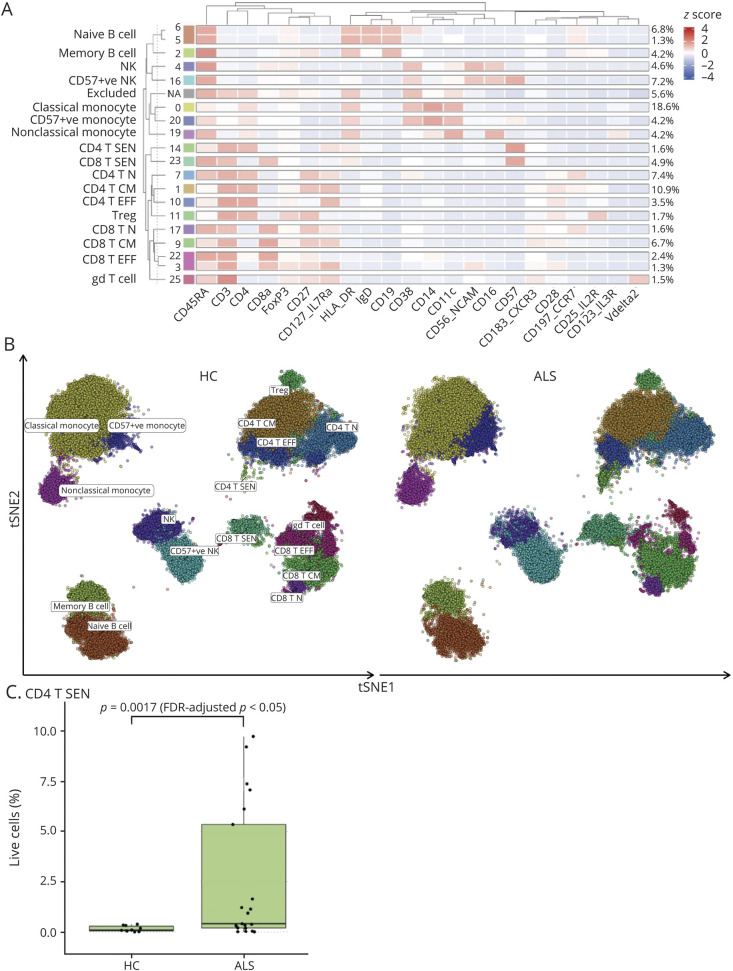
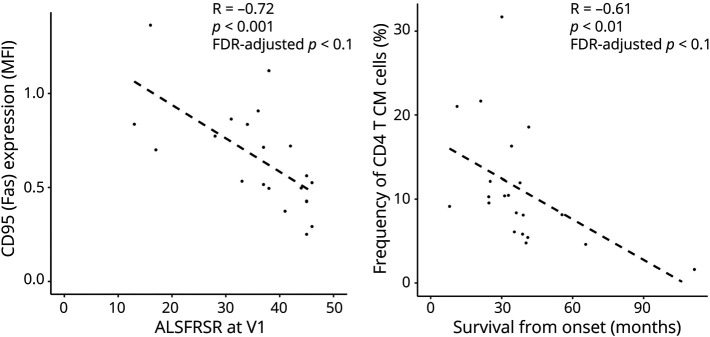
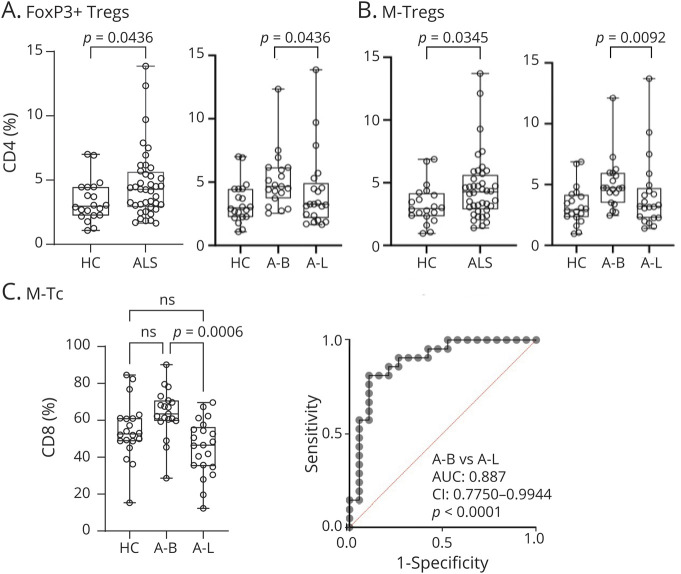
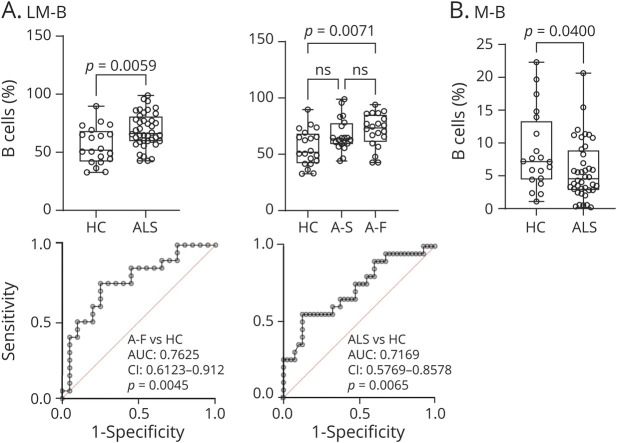
Background and Objectives Aging is known to exacerbate neuroinflammation, and in the neurodegenerative disorder amyotrophic lateral sclerosis (ALS), an older age is associated with a worse prognosis. We have previously shown the activation of cell senescence pathways in the proteome of peripheral blood mononuclear cells and the increase of proinflammatory cytokines in blood from individuals living with ALS. In this single-center, retrospective study, we investigated the expression of senescent-like blood mononuclear cells in ALS. Methods We first applied multidimensional cytometry by time-of-flight (CyTOF) to study the senescent immunophenotype of blood mononuclear cells from 21 patients with ALS and 10 healthy controls (HCs). We then used targeted flow cytometry (FC) to investigate frequencies of senescent blood lymphocytes in 40 patients with ALS and 20 HCs. Longitudinal analysis included 2 additional time points in 17 patients with ALS. Frequencies of senescent-like lymphocytes were analyzed in relation to survival. Results Unsupervised clustering of CyTOF data showed higher frequencies of senescent CD4+CD27−CD57+ T cells in patients with ALS compared with those in HCs (p = 0.0017, false discovery (FDR)-adjusted p = 0.029). Moderate to strong negative correlations were identified between CD4 T central memory–cell frequencies and survival (R = −061, p = 0.01; FDR-adjusted p < 0.1) and between CD95 CD8 cells and ALS functional rating scale revised at baseline (R = −0.72, p = 0.001; FDR-adjusted p < 0.1).Targeted FC analysis showed higher memory T regulatory cells (p = 0.0052) and memory CD8+ T cell (M-Tc; p = 0.0006) in bulbar ALS (A-B) compared with those in limb ALS (A-L), while late memory B cells (LM-B) were also elevated in A-B and fast-progressing ALS (p = 0.0059). Higher M-Tc levels separated A-B from A-L (AUC: 0.887; p < 0.0001). A linear regression model with prespecified clinical independent variables and neurofilament light chain plasma concentration showed that higher frequencies of LM-B predicted a shorter survival (hazard ratio: 1.094, CI: 1.026–1.167; p = 0.006). Discussion Our data suggest that a systemic elevation of senescent and late memory T and B lymphocytes is a feature of faster progressing ALS and of ALS individuals with bulbar involvement. Lymphocyte senescence and their memory state may be central to the immune dysregulation known to drive disease progression in ALS and a target for biomarkers and therapeutics discovery.
Overview
The claims and statistics of this paper haven’t been checked yet.
Free: it reads the open-access text and checks the first 5 claims that cite a source we can check. Create a free account to check every claim.
Integrity signals
Registry
Cites
Statistics
Figures
Verification
Claims the paper makes
The claims and statistics of this paper haven’t been checked yet.
Free: it reads the open-access text and checks the first 5 claims that cite a source we can check. Create a free account to check every claim.
Claims other papers make about this one
Each is checked against this paper’s own text: does it say what the citing paper says it does?
In the citing paper
“Similarly, in a single-centre, retrospective study, increased numbers of senescent and late memory T and B lymphocytes were characteristic of faster progressing ALS.334”
From Antiageing strategy for neurodegenerative diseases: from mechanisms to clinical advances (2025) · cites this paper as [334]
Self-check
Percentages, sums and reported differences re-computed from the paper’s own numbers.
The self-check needs the paper’s full text.
Citations
Cites
R: A Language and Environment for Statistical Computing
R Core Team (2025) · doi:10.32614/r.manuals · Cited by 352,181
Controlling the False Discovery Rate: A Practical and Powerful Approach to Multiple Testing
Benjamini, Y., & Hochberg, Y. (1995) · Journal of the Royal Statistical Society Series B: Statistical Methodology · doi:10.1111/j.2517-6161.1995.tb02031.x · Cited by 109,482
Robinson, M. D., McCarthy, D. J., & Smyth, G. K. (2010) · Bioinformatics · doi:10.1093/bioinformatics/btp616 · Cited by 41,364 · cited 1×
“Owing to its robust performance,(29) differential abundance was analyzed using quasi-likelihood (QL) negative binomial generalized linear models (NB GLM), implemented in the edgeR package.(30) An NB GLM was fitted, and a QL F-test with a specified contrast was performed to calculate p values for each cell type.”
MethodEl Escorial revisited: revised criteria for the diagnosis of amyotrophic lateral sclerosis
Brooks, B. R., Miller, R. G., Swash, M., & Munsat, T. L. (2000) · Amyotrophic Lateral Sclerosis and Other Motor Neuron Disorders · doi:10.1080/146608200300079536 · Cited by 5,433
Cedarbaum, J. M., Stambler, N., Malta, E., Fuller, C., Hilt, D., Thurmond, B., & Nakanishi, A. (1999) · Journal of the Neurological Sciences · doi:10.1016/s0022-510x(99)00210-5 · Cited by 3,307
The role of senescent cells in ageing
van Deursen, J. M. (2014) · Nature · doi:10.1038/nature13193 · Cited by 2,623 · cited 2×
“It has been shown that T andB cells, especially LM-B, can acquire an SASP, stepping up production and secretion of proinflammatory cytokines such as IL-2, IL-6, IL-8, tumor necrosis factor and interferon-γ.(14) We could therefore speculate that senescent lymphocyte may contribute to neuronal degeneration and to diseas…”
BackgroundKiernan, M. C., Vucic, S., Cheah, B. C., Turner, M. R., Eisen, A., Hardiman, O., Burrell, J. R., & Zoing, M. C. (2011) · The Lancet · doi:10.1016/s0140-6736(10)61156-7 · Cited by 2,603
Self-citationImmunosenescence and Inflamm-Aging As Two Sides of the Same Coin: Friends or Foes?
Fulop, T., Larbi, A., Dupuis, G., Le Page, A., Frost, E. H., Cohen, A. A., Witkowski, J. M., & Franceschi, C. (2018) · Frontiers in Immunology · doi:10.3389/fimmu.2017.01960 · Cited by 1,364
The art of using t-SNE for single-cell transcriptomics
Kobak, D., & Berens, P. (2019) · Nature Communications · doi:10.1038/s41467-019-13056-x · Cited by 1,115 · cited 1×
“These were calculated using established methods for optimal hyperparameter selection.(28) Owing to its robust performance,(29) differential abundance was analyzed using quasi-likelihood (QL) negative binomial generalized linear models (NB GLM), implemented in the edgeR package.”
MethodBrenchley, J. M., Karandikar, N. J., Betts, M. R., Ambrozak, D. R., Hill, B. J., Crotty, L. E., Casazza, J. P., Kuruppu, J., Migueles, S. A., Connors, M., et al. (2003) · Blood · doi:10.1182/blood-2002-07-2103 · Cited by 1,073 · cited 1×
“B and T lymphocytes can develop into a state of senescence, which often coexist with downregulated telomerase, shortened telomeres, increased DNA damage response, and increased mitogen-activated protein kinase activity.(36-39) Viral infections, such as cytomegalovirus, especially in older individuals, can also induce…”
BackgroundFast interpolation-based t-SNE for improved visualization of single-cell RNA-seq data
Linderman, G. C., Rachh, M., Hoskins, J. G., Steinerberger, S., & Kluger, Y. (2019) · Nature Methods · doi:10.1038/s41592-018-0308-4 · Cited by 534
Human endogenous retrovirus-K contributes to motor neuron disease
Li, W., Lee, M.-H., Henderson, L., Tyagi, R., Bachani, M., Steiner, J., Campanac, E., Hoffman, D. A., von Geldern, G., Johnson, K., et al. (2015) · Science Translational Medicine · doi:10.1126/scitranslmed.aac8201 · Cited by 482
Inflammation in ALS/FTD pathogenesis
McCauley, M. E., & Baloh, R. H. (2019) · Acta Neuropathologica · doi:10.1007/s00401-018-1933-9 · Cited by 341 · cited 1×
“In addition, changes in the immune response such as the reduction of CD4FOXP3 T regulatory cells (Tregs) is associated with a faster progressing disease.(6-8) Our unbiased proteomic analysis of plasma and peripheral blood mononuclear cells (PBMCs) in blood samples from patients with ALS has shown the activation of mol…”
BackgroundALS Genes in the Genomic Era and their Implications for FTD
Nguyen, H. P., Van Broeckhoven, C., & van der Zee, J. (2018) · Trends in Genetics · doi:10.1016/j.tig.2018.03.001 · Cited by 307 · cited 1×
“Multiple clinical and genetic factors have been identified as prognostic indicators of ALS, including age at onset, clinical features of frontotemporal and bulbar functions impairment, body mass index, male predominance, the diagnostic delay, the A4V mutation of the superoxide dismutase 1 (SOD1) gene, the C9orf72 gene…”
BackgroundBeers, D. R., Zhao, W., Wang, J., Zhang, X., Wen, S., Neal, D., Thonhoff, J. R., Alsuliman, A. S., Shpall, E. J., Rezvani, K., et al. (2017) · JCI Insight · doi:10.1172/jci.insight.89530 · Cited by 254 · cited 1×
“In addition, changes in the immune response such as the reduction of CD4FOXP3 T regulatory cells (Tregs) is associated with a faster progressing disease.(6-8) Our unbiased proteomic analysis of plasma and peripheral blood mononuclear cells (PBMCs) in blood samples from patients with ALS has shown the activation of mol…”
BackgroundTherapeutic B-cell depletion reverses progression of Alzheimer’s disease
Kim, K., Wang, X., Ragonnaud, E., Bodogai, M., Illouz, T., DeLuca, M., McDevitt, R. A., Gusev, F., Okun, E., Rogaev, E., et al. (2021) · Nature Communications · doi:10.1038/s41467-021-22479-4 · Cited by 206 · cited 1×
“In Alzheimer disease, therapeutic depletion of B cells alone in animal models is sufficient to reduce the burden of A-beta plaques and of inflammatory microglia, reversing behavioral and memory deficits and slowing disease progression.(45) Our study shows an increase of LM-B cells in patients with ALS compared with HC…”
Validation of serum neurofilaments as prognostic and potential pharmacodynamic biomarkers for ALS
Benatar, M., Zhang, L., Wang, L., Granit, V., Statland, J., Barohn, R., Swenson, A., Ravits, J., Jackson, C., Burns, T. M., et al. (2020) · Neurology · doi:10.1212/wnl.0000000000009559 · Cited by 204
Self-citationKLRG1—more than a marker for T cell senescence
Henson, S. M., & Akbar, A. N. (2009) · AGE · doi:10.1007/s11357-009-9100-9 · Cited by 191 · cited 1×
“B and T lymphocytes can develop into a state of senescence, which often coexist with downregulated telomerase, shortened telomeres, increased DNA damage response, and increased mitogen-activated protein kinase activity.(36-39) Viral infections, such as cytomegalovirus, especially in older individuals, can also induce…”
BackgroundSelf-citationB Cell Dysfunction Associated With Aging and Autoimmune Diseases
Ma, S., Wang, C., Mao, X., & Hao, Y. (2019) · Frontiers in Immunology · doi:10.3389/fimmu.2019.00318 · Cited by 184 · cited 1×
“B-cell senescence results in a reduced generation of highaffinity, protective antibodies.(20)”
BackgroundHu, Y., Cao, C., Qin, X.-Y., Yu, Y., Yuan, J., Zhao, Y., & Cheng, Y. (2017) · Scientific Reports · doi:10.1038/s41598-017-09097-1 · Cited by 183 · cited 1×
“We and others have also reported an increased blood and CSF concentration of proinflammatory cytokines in individuals with ALS.(10-13) These inflammatory mediators are enumerated within the senescenceassociated secretory phenotype (SASP) and have been described in age-related immune dysregulation.”
BackgroundTesting for differential abundance in mass cytometry data
Lun, A. T. L., Richard, A. C., & Marioni, J. C. (2017) · Nature Methods · doi:10.1038/nmeth.4295 · Cited by 181
Microglia and C9orf72 in neuroinflammation and ALS and frontotemporal dementia
Lall, D., & Baloh, R. H. (2017) · Journal of Clinical Investigation · doi:10.1172/jci90607 · Cited by 175 · cited 1×
“Critically, other alterations observed in aging and senescence are aligned with brain-specific changes seen in ALS, including a disturbed autophagy/ lysosomal protein degradation, altered RNA splicing, and errors in nuclear-cytoplasmic transport.(15-18) We can therefore hypothesize a potential role for cell senescence…”
BackgroundSystemic inflammatory response and neuromuscular involvement in amyotrophic lateral sclerosis
Lu, C.-H., Allen, K., Oei, F., Leoni, E., Kuhle, J., Tree, T., Fratta, P., Sharma, N., Sidle, K., Howard, R., et al. (2016) · Neurology Neuroimmunology & Neuroinflammation · doi:10.1212/nxi.0000000000000244 · Cited by 170 · cited 1×
“We and others have also reported an increased blood and CSF concentration of proinflammatory cytokines in individuals with ALS.(10-13) These inflammatory mediators are enumerated within the senescenceassociated secretory phenotype (SASP) and have been described in age-related immune dysregulation.”
BackgroundSelf-citationA comparison framework and guideline of clustering methods for mass cytometry data
Liu, X., Song, W., Wong, B. Y., Zhang, T., Yu, S., Lin, G. N., & Ding, X. (2019) · Genome Biology · doi:10.1186/s13059-019-1917-7 · Cited by 168 · cited 1×
“ability to detect refined subclusters.(26) Clusters with a frequency of <1% of the analyzed cells were excluded from subsequent analyses.”
BackgroundIrwin, D. J., McMillan, C. T., Brettschneider, J., Libon, D. J., Powers, J., Rascovsky, K., Toledo, J. B., Boller, A., Bekisz, J., Chandrasekaran, K., et al. (2013) · Journal of Neurology, Neurosurgery & Psychiatry · doi:10.1136/jnnp-2012-303507 · Cited by 153 · cited 1×
“Multiple clinical and genetic factors have been identified as prognostic indicators of ALS, including age at onset, clinical features of frontotemporal and bulbar functions impairment, body mass index, male predominance, the diagnostic delay, the A4V mutation of the superoxide dismutase 1 (SOD1) gene, the C9orf72 gene…”
BackgroundJin, M., Günther, R., Akgün, K., Hermann, A., & Ziemssen, T. (2020) · Scientific Reports · doi:10.1038/s41598-020-62756-8 · Cited by 124 · cited 1×
“It has been shown that B-cell depletion does not affect the development of ALS in SOD1 animal models of the disease,(43) while frequencies of B cells in blood, including M-B cells, do not differ between patients with ALS and age-matched controls.(44) However, C9orf72 gene loss-of-function in mice models of ALS leads t…”
BackgroundAgeing as a risk factor for ALS/FTD
Niccoli, T., Partridge, L., & Isaacs, A. M. (2017) · Human Molecular Genetics · doi:10.1093/hmg/ddx247 · Cited by 102 · cited 1×
“Critically, other alterations observed in aging and senescence are aligned with brain-specific changes seen in ALS, including a disturbed autophagy/ lysosomal protein degradation, altered RNA splicing, and errors in nuclear-cytoplasmic transport.(15-18) We can therefore hypothesize a potential role for cell senescence…”
BackgroundDisease origin and progression in amyotrophic lateral sclerosis: an immunology perspective
Malaspina, A., Puentes, F., & Amor, S. (2015) · International Immunology · doi:10.1093/intimm/dxu099 · Cited by 91 · cited 1×
“In addition, changes in the immune response such as the reduction of CD4FOXP3 T regulatory cells (Tregs) is associated with a faster progressing disease.(6-8) Our unbiased proteomic analysis of plasma and peripheral blood mononuclear cells (PBMCs) in blood samples from patients with ALS has shown the activation of mol…”
BackgroundSelf-citationFrasca, D. (2018) · Experimental Gerontology · doi:10.1016/j.exger.2017.07.002 · Cited by 82 · cited 2×
“” They have been implicated in agerelated chronic inflammation and in autoimmunity.(21) Loss of the ability to reign in autoimmunity, a characteristic of senescent B (and T) cells, may cause the rise of potentially pathogenic autoantibodies including those to neural antigens.”
BackgroundDefining pre-symptomatic amyotrophic lateral sclerosis
Benatar, M., Turner, M. R., & Wuu, J. (2019) · Amyotrophic Lateral Sclerosis and Frontotemporal Degeneration · doi:10.1080/21678421.2019.1587634 · Cited by 81
Self-citationNeeland, M. R., Andorf, S., Manohar, M., Dunham, D., Lyu, S., Dang, T. D., Peters, R. L., Perrett, K. P., Tang, M. L. K., Saffery, R., et al. (2020) · Nature Communications · doi:10.1038/s41467-020-14919-4 · Cited by 71 · cited 1×
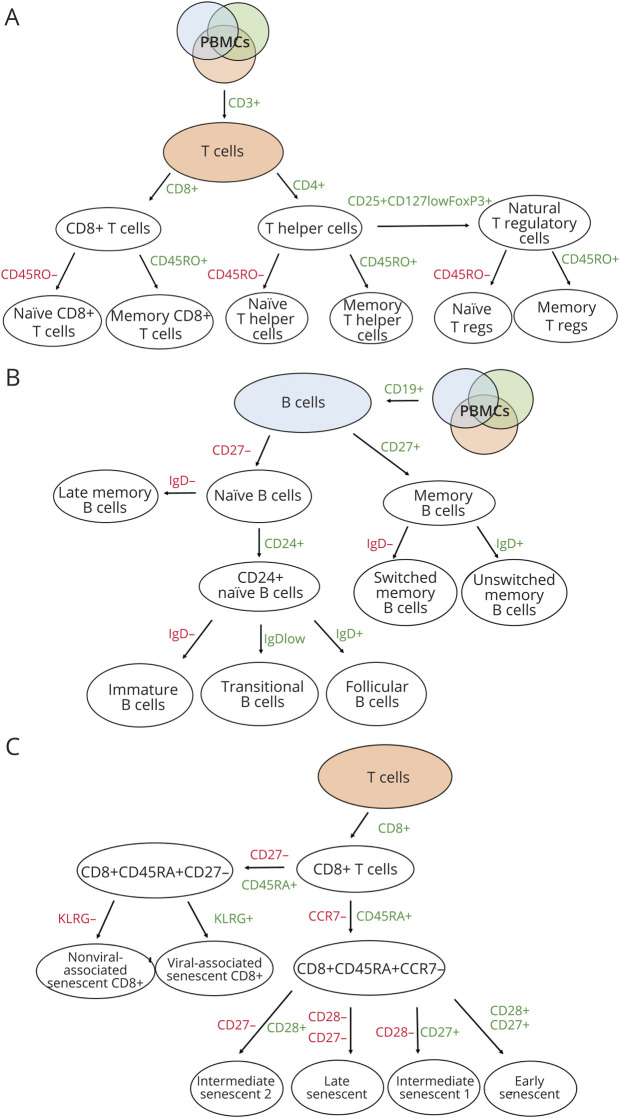
“com/NXI/A750.(33)Unsupervised Figure 3 FC Gating Strategy”
Focus on the heterogeneity of amyotrophic lateral sclerosis
Bendotti, C., Bonetto, V., Pupillo, E., Logroscino, G., Al‐Chalabi, A., Lunetta, C., Riva, N., Mora, G., Lauria, G., Weishaupt, J. H., et al. (2020) · Amyotrophic Lateral Sclerosis and Frontotemporal Degeneration · doi:10.1080/21678421.2020.1779298 · Cited by 68 · cited 1×
“An example of the clinical heterogeneity of ALS is the progression to end-stage disease from onset of symptoms that could be anything from a few months to more than a decade.(2) Uncertainties surrounding prognosis and the pathobiology underpinning the onset and propagation of ALS are the main obstacles for the develop…”
BackgroundSelf-citationImmune reactivity to neurofilament proteins in the clinical staging of amyotrophic lateral sclerosis
Puentes, F., Topping, J., Kuhle, J., van der Star, B. J., Douiri, A., Giovannoni, G., Baker, D., Amor, S., & Malaspina, A. (2014) · Journal of Neurology, Neurosurgery & Psychiatry · doi:10.1136/jnnp-2013-305494 · Cited by 62 · cited 1×
“In ALS, we and other have reported the increase of autoantibodies to proteins linked to ALS risk genes, including TAR DNAbinding protein 43, neurofilaments, and dipeptide repeats, the translation product of the mutated C9orf72 gene.(47-50)”
BackgroundSelf-citationCellular aging and senescence characteristics of human T-lymphocytes
Onyema, O. O., Njemini, R., Bautmans, I., Renmans, W., Waele, M. D., & Mets, T. F. (2011) · Biogerontology · doi:10.1007/s10522-011-9366-z · Cited by 58 · cited 1×
“B and T lymphocytes can develop into a state of senescence, which often coexist with downregulated telomerase, shortened telomeres, increased DNA damage response, and increased mitogen-activated protein kinase activity.(36-39) Viral infections, such as cytomegalovirus, especially in older individuals, can also induce…”
BackgroundInflammatory profiles relate to survival in subtypes of amyotrophic lateral sclerosis
Olesen, M. N., Wuolikainen, A., Nilsson, A. C., Wirenfeldt, M., Forsberg, K., Madsen, J. S., Lillevang, S. T., Brandslund, I., Andersen, P. M., & Asgari, N. (2020) · Neurology Neuroimmunology & Neuroinflammation · doi:10.1212/nxi.0000000000000697 · Cited by 57 · cited 1×
“We and others have also reported an increased blood and CSF concentration of proinflammatory cytokines in individuals with ALS.(10-13) These inflammatory mediators are enumerated within the senescenceassociated secretory phenotype (SASP) and have been described in age-related immune dysregulation.”
BackgroundDevelopment of ALS-like disease in SOD-1 mice deficient of B lymphocytes
Naor, S., Zohar, K., Bronshtein, T., Goren, E., Machluf, M., & Melamed, D. (2009) · Journal of Neurology · doi:10.1007/s00415-009-5097-3 · Cited by 55
Zubiri, I., Lombardi, V., Bremang, M., Mitra, V., Nardo, G., Adiutori, R., Lu, C.-H., Leoni, E., Yip, P., Yildiz, O., et al. (2018) · Molecular Neurodegeneration · doi:10.1186/s13024-018-0292-2 · Cited by 44 · cited 1×
“Our unbiased proteomic analysis of plasma and peripheral blood mononuclear cells (PBMCs) in blood samples from patients with ALS has shown the activation of molecular pathways involved in immunoregulation and cell senescence in faster progressing ALS (A-F) and at a later stage of disease.(9) We and others have also re…”
BackgroundSelf-citationReversal of functional defects in highly differentiated young and old CD8 T cells by PDL blockade
Henson, S. M., Macaulay, R., Franzese, O., & Akbar, A. N. (2012) · Immunology · doi:10.1111/j.1365-2567.2011.03550.x · Cited by 42 · cited 1×
“B and T lymphocytes can develop into a state of senescence, which often coexist with downregulated telomerase, shortened telomeres, increased DNA damage response, and increased mitogen-activated protein kinase activity.(36-39) Viral infections, such as cytomegalovirus, especially in older individuals, can also induce…”
BackgroundSelf-citationCombined Tissue-Fluid Proteomics to Unravel Phenotypic Variability in Amyotrophic Lateral Sclerosis
Leoni, E., Bremang, M., Mitra, V., Zubiri, I., Jung, S., Lu, C.-H., Adiutori, R., Lombardi, V., Russell, C., Koncarevic, S., et al. (2019) · Scientific Reports · doi:10.1038/s41598-019-40632-4 · Cited by 41
Self-citationThe Sec domain protein Scfd1 facilitates trafficking of ECM components during chondrogenesis
Hou, N., Yang, Y., Scott, I. C., & Lou, X. (2016) · Developmental Biology · doi:10.1016/j.ydbio.2016.11.010 · Cited by 39 · cited 1×
“Critically, other alterations observed in aging and senescence are aligned with brain-specific changes seen in ALS, including a disturbed autophagy/ lysosomal protein degradation, altered RNA splicing, and errors in nuclear-cytoplasmic transport.(15-18) We can therefore hypothesize a potential role for cell senescence…”
BackgroundAntibodies from ALS patients inhibit dopamine release mediated by L-type calcium channels
Offen, D., Halevi, S., Orion, D., Galili-Mosberg, R., Stern-Goldberg, H., Melamed, E., & Atlas, D. (1998) · Neurology · doi:10.1212/wnl.51.4.1100 · Cited by 37
Michaelson, N. M., Facciponte, D. N., Bradley, W. G., & Stommel, E. W. (2017) · Cytokine & Growth Factor Reviews · doi:10.1016/j.cytogfr.2017.05.001 · Cited by 37 · cited 1×
“We and others have also reported an increased blood and CSF concentration of proinflammatory cytokines in individuals with ALS.(10-13) These inflammatory mediators are enumerated within the senescenceassociated secretory phenotype (SASP) and have been described in age-related immune dysregulation.”
BackgroundTDP-43 levels in the brain tissue of ALS cases with and without C9ORF72 or ATXN2 gene expansions
Yang, Y., Halliday, G. M., Kiernan, M. C., & Tan, R. H. (2019) · Neurology · doi:10.1212/wnl.0000000000008439 · Cited by 30
FastPG: Fast clustering of millions of single cellsPreprint
Bodenheimer, T., Halappanavar, M. M., Jefferys, S. R., Gibson, R., Liu, S., Mucha, P. J., Stanley, N., Parker, J. S., & Selitsky, S. R. (2020) · bioRxiv (Cold Spring Harbor Laboratory) · doi:10.1101/2020.06.19.159749 · Cited by 28 · cited 1×
“Unsupervised clustering was performed using the phenograph algorithm from the FastPG package.(25) Phenograph was used instead of FowSOM for its superior Table 1 Demographic and Clinical Characteristics of the Population in Study”
MethodAutio, A., Nevalainen, T., Mishra, B. H., Jylhä, M. K., Flinck, H., & Hurme, M. (2020) · Immunity & Ageing · doi:10.1186/s12979-020-00182-0 · Cited by 25 · cited 1×
“Of potential interest, the reactivation in motor cells from patients with ALS and animal models of human endogenous retroviruses (HERVK) has been recently reported, a biological phenomenon conducive of chronic inflammation in ALS and a promising target of antiretroviral drugs.(40-42) Confirming previous observations o…”
ResultHumoral response to neurofilaments and dipeptide repeats in ALS progression
Puentes, F., Lombardi, V., Lu, C., Yildiz, Ö., Fratta, P., Isaacs, A. M., Bobeva, Y., Wuu, J., Benatar, M. G., & Malaspina, A. (2021) · Annals of Clinical and Translational Neurology · doi:10.1002/acn3.51428 · Cited by 16 · cited 1×
“In ALS, we and other have reported the increase of autoantibodies to proteins linked to ALS risk genes, including TAR DNAbinding protein 43, neurofilaments, and dipeptide repeats, the translation product of the mutated C9orf72 gene.(47-50)”
BackgroundSelf-citationLaderoute, M. P. (2015) · PubMed · Cited by 12
Niebrój-Dobosz, I., Janik, P., Jamrozik, Z., & Kwieciński, H. (1999) · European Journal of Neurology · doi:10.1046/j.1468-1331.1999.630335.x · Cited by 6 · cited 1×
“In ALS, we and other have reported the increase of autoantibodies to proteins linked to ALS risk genes, including TAR DNAbinding protein 43, neurofilaments, and dipeptide repeats, the translation product of the mutated C9orf72 gene.(47-50)”
BackgroundLoss of C9orf72 function leads to autoimmunity
Sakkas, L. I., Bogdanos, D. P., & Kousvelari, E. E. (2017) · Annals of Translational Medicine · doi:10.21037/atm.2017.01.33 · Cited by 6 · cited 1×
“However, C9orf72 gene loss-of-function in mice models of ALS leads to a severe state of autoimmunity with loss of tolerance for many nervous system autoantigens.(46) In Alzheimer disease, therapeutic depletion of B cells alone in animal models is sufficient to reduce the burden of A-beta plaques and of inflammatory mi…”
Background
Research works printed but not linked: 1
- Niccoli T, Partridge L, Isaacs AM. Ageing as a risk factor for ALS/FTD. Hum Mol Genet. 2017; 26(R2). R105- R113. 10.1093/hmg/ddx247. 28977441 · DOI · Paper page
Cited by
Antiageing strategy for neurodegenerative diseases: from mechanisms to clinical advances
Jiang, Q., Liu, J., Huang, S., Wang, X.-Y., Chen, X., Liu, G.-H., Ye, K., Song, W., Masters, C. L., Wang, J., et al. (2025) · Signal Transduction and Targeted Therapy · doi:10.1038/s41392-025-02145-7 · Cited by 165
“334 Despite the lack of direct evidence, alterations in immune-regulatory factors, such as elevated levels of interleukin (IL)-6 and monocyte activation, observed in the plasma of early HD patients or even prior to HD onset, provide support for early activation of the immune system in the periphery.”
Emerging insights in senescence: pathways from preclinical models to therapeutic innovations
Mansfield, L., Ramponi, V., Gupta, K., Stevenson, T., Mathew, A. B., Barinda, A. J., Herbstein, F., & Morsli, S. (2024) · npj Aging · doi:10.1038/s41514-024-00181-1 · Cited by 88
IgD−CD27− double negative (DN) B cells: Origins and functions in health and disease
Beckers, L., Somers, V. A., & Fraussen, J. (2023) · Immunology Letters · doi:10.1016/j.imlet.2023.03.003 · Cited by 85
Oxidative stress and cellular senescence: Roles in tumor progression and therapeutic opportunities
Jin, P., Feng, X., Huang, C., Li, J., Wang, H. Z., Wang, X., Li, L., & Ma, L. (2024) · MedComm – Oncology · doi:10.1002/mog2.70007 · Cited by 88
The role of the CD8+ T cell compartment in ageing and neurodegenerative disorders
Terrabuio, E., Zenaro, E., & Constantin, G. (2023) · Frontiers in Immunology · doi:10.3389/fimmu.2023.1233870 · Cited by 56
Metadata
- Authors
- Yildiz, O., Schroth, J., Tree, T., Turner, M. R., Shaw, P. J., Henson, S. M., & Malaspina, A.
- Affiliations
- From the Neuroscience and Trauma Centre (O.Y., A.M.), Blizard Institute, Barts and The London School of Medicine & Dentistry, Queen Mary University of London; Queen Square Motor Neuron Disease Centre (A.M.), Neuromuscular Department, Institute of Neurology, University College London; Translational Medicine and Therapeutics (J.S., S.M.H.), William Harvey Research Institute, Barts and the London, Queen Mary University of London; Department of Immunobiology (T.T.), School of Immunology &...
- Queen Mary University of London (GB)
- Corresponding author
- Malaspina, Andrea
- Venue
- Neurology Neuroimmunology & Neuroinflammation
- Published
- 2023-01
- Volume
- 10
- Issue
- 1
- ISSN
- 2332-7812 (ISSN-L)
- PMC
- PMC9673751
- OpenAlex
- W4308135426
- Cited by
- 39
- References
- 49
- Citations by year
- 2026: 11 · 2025: 9 · 2024: 14 · 2023: 5
- FWCI
- 3.69
- Type
- journal article
- Language
- en
- Open access
- gold
- doi.org
- Licence
- cc-by
- Locations
- Neurology Neuroimmunology & Neuroinflammation (publishedVersion, cc-by)
- PubMed Central (publishedVersion, cc-by)
- PubMed (publishedVersion)
- White Rose Research Online (University of Leeds, The University of Sheffield, University of York) (acceptedVersion)
- Queen Mary Research Online (Queen Mary University of London) (submittedVersion, cc-by)
- Funders
- Barts Charity (MRC0218, G-001960)
- National Institute for Health and Care Research (NF-SI-0617-10077, BRC‐1215‐20017)
- Motor Neurone Disease Association (TURNER/OCT18/989-797, TURNER/OCT15/972-797)
- Topics
- Health Sciences › Medicine › Clinical Neurology › Amyotrophic Lateral Sclerosis Research
- Life Sciences › Biochemistry, Genetics and Molecular Biology › Cell Biology › Telomeres, Telomerase, and Senescence
- Life Sciences › Biochemistry, Genetics and Molecular Biology › Aging › Genetics, Aging, and Longevity in Model Organisms
- Keywords
- amyotrophic lateral sclerosis, cellular senescence, blood mononuclear cells, memory CD8+ T cells, neuroinflammation, disease progression, survival, neurofilament light chain, prognostic factors, Fas
- MeSH terms
- Amyotrophic Lateral Sclerosis, Humans, Leukocytes, Mononuclear, Retrospective Studies, CD4-Positive T-Lymphocytes, Disease Progression
About these checks
Registry, retraction, Cites and statistics results are computed, not judged, with one exception: a printed reference that no index lists is read once by a model before it counts as a citation error. Claims are extracted by a model and kept only when their quote appears verbatim in the text; each cited source is then checked, with a model’s help, for whether it says what the claim relies on. Those verdicts can be wrong — read the claim’s quote and the cited source before relying on one.
Statistics and arithmetic are recomputed, not judged.
Confidence bands are shown only for fields calibrated on our annotated test set. None is calibrated yet, so no band is shown.
What counts as a claim ›How we measure confidence ›How we check this ›
Are you an author, or do you see a problem with this page? Request a review
Data sources
Bibliographic data: Semantic Scholar, OpenAlex, Crossref.
Contains information from the Semantic Scholar Academic Graph Datasets, made available under the ODC Attribution License (ODC-BY 1.0).
Semantic Scholar’s data is described in: Kinney, R., et al. (2023). The Semantic Scholar Open Data Platform. arXiv:2301.10140.
