

The DOI matches its Crossref record; 8 of the 8 references it cites were found in a registry or an index.
Increased CSF biomarkers of angiogenesis in Parkinson disease
Open accessAbstract
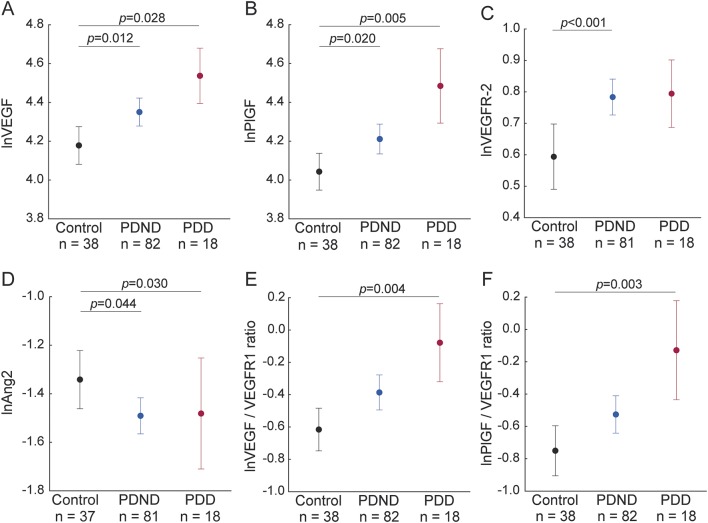
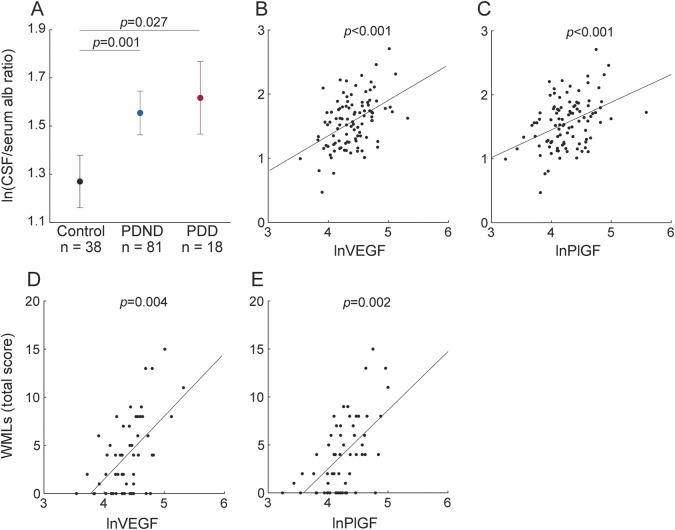
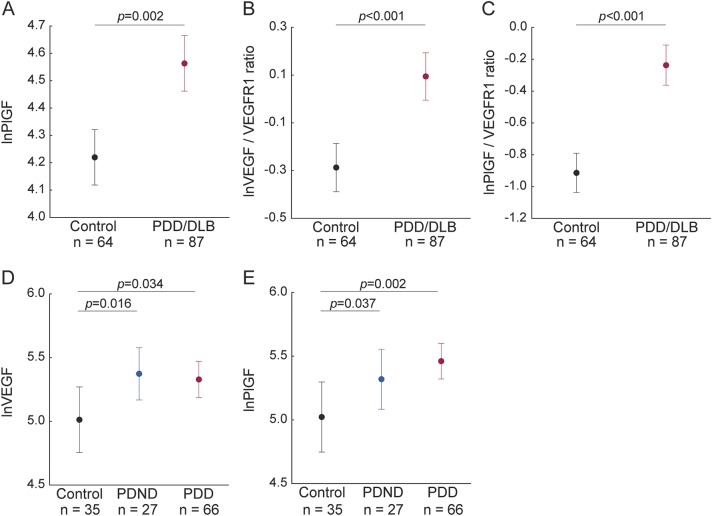
OBJECTIVE: To study biomarkers of angiogenesis in Parkinson disease (PD), and how these are associated with clinical characteristics, blood-brain barrier (BBB) permeability, and cerebrovascular disease. METHODS: In this cross-sectional analysis, 38 elderly controls and 100 patients with PD (82 without dementia and 18 with dementia) were included from the prospective Swedish BioFinder study. CSF samples were analyzed for the angiogenesis biomarkers vascular endothelial growth factor (VEGF); its receptors, VEGFR-1 and VEGFR-2; placental growth factor (PlGF); angiopoietin 2 (Ang2); and interleukin-8. BBB permeability, white matter lesions (WMLs), and cerebral microbleeds (CMB) were assessed. CSF angiogenesis biomarkers were also measured in 2 validation cohorts: (1) 64 controls and 87 patients with PD with dementia; and (2) 35 controls and 93 patients with neuropathologically confirmed diagnosis of PD with and without dementia. RESULTS: Patients with PD without dementia displayed higher CSF levels of VEGF, PlGF, and sVEGFR-2, and lower levels of Ang2, compared to controls. Similar alterations in VEGF, PlGF, and Ang2 levels were observed in patients with PD with dementia. Angiogenesis markers were associated with gait difficulties and orthostatic hypotension as well as with more pronounced BBB permeability, WMLs, and CMB. Moreover, higher levels of VEGF and PlGF levels were associated with increased CSF levels of neurofilament light (a marker of neurodegeneration) and monocyte chemotactic protein-1 (a marker of glial activation). The main results were validated in the 2 additional cohorts. CONCLUSIONS: CSF biomarkers of angiogenesis are increased in PD, and they are associated with gait difficulties, BBB dysfunction, WMLs, and CMB. Abnormal angiogenesis may be important in PD pathogenesis and contribute to dopa-resistant symptoms.
Overview
The claims and statistics of this paper haven’t been checked yet.
Run the check — free, no account needed. It reads the open-access text and checks the sources it cites.
Integrity signals
Registry
Cites
Statistics
Figures
Verification
Claims the paper makes
The claims and statistics of this paper haven’t been checked yet.
Run the check — free, no account needed. It reads the open-access text and checks the sources it cites.
Claims other papers make about this one
Each is checked against this paper’s own text: does it say what the citing paper says it does?
The source backs part of the claim, not all of it — or backs it for a different population, condition or comparison.
In the citing paper
“Cerebral microbleeds reflecting BBB breakdown and deposition of RBC-derived hemosiderin deposits have been detected throughout deep gray matter, cortical, and white matter regions in PD patients using T2*and SWI-MRI (231, 288).”
From Blood-Brain Barrier: From Physiology to Disease and Back (2019) · cites this paper as [288]
Experimental — accuracy not yet measuredThe source backs part of the claim, not all of it — or backs it for a different population, condition or comparison.
In the citing paper
“Increased Qalb (287, 288, 362, 474) and CSF-to-serum IgG ratio (474) are observed early in PD patients before dementia.”
From Blood-Brain Barrier: From Physiology to Disease and Back (2019) · cites this paper as [288]
Experimental — accuracy not yet measuredThe source backs part of the claim, not all of it — or backs it for a different population, condition or comparison.
In the citing paper
“These biomarkers are further altered as patients progress into more advanced PD stages with dementia (288, 474).”
From Blood-Brain Barrier: From Physiology to Disease and Back (2019) · cites this paper as [288]
Experimental — accuracy not yet measuredThe cited source says what the claim attributes to it.
In the citing paper
“CSF angiogenesis biomarkers are altered in PD compared with controls including increased levels of VEGF, placental growth factor (PlGF), and soluble VEGF receptor-2 (sVEGFR-2) and decreased angiopoietin-2 (Ang2) (288).”
From Blood-Brain Barrier: From Physiology to Disease and Back (2019) · cites this paper as [288]
The check wasn’t confident either way, so it gives no verdict — never disputed.
In the citing paper
“they are more prevalent in PD patients with dementia compared with those without dementia and controls, and positively correlate with white matter lesions (231, 288).”
From Blood-Brain Barrier: From Physiology to Disease and Back (2019) · cites this paper as [288]
Experimental — accuracy not yet measured
Self-check
Percentages, sums and reported differences re-computed from the paper’s own numbers.
The self-check needs the paper’s full text.
Citations
Cites
The biology of VEGF and its receptors
Ferrara, N., Gerber, H.-P., & LeCouter, J. (2003) · Nature Medicine · doi:10.1038/nm0603-669 · Cited by 9,591
The Blood-Brain Barrier in Health and Chronic Neurodegenerative Disorders
Zlokovic, B. V. (2008) · Neuron · doi:10.1016/j.neuron.2008.01.003 · Cited by 3,280
Clinical diagnostic criteria for dementia associated with Parkinson’s disease
Emre, M., Aarsland, D., Brown, R., Burn, D. J., Duyckaerts, C., Mizuno, Y., Broe, G. A., Cummings, J., Dickson, D. W., Gauthier, S., et al. (2007) · Movement Disorders · doi:10.1002/mds.21507 · Cited by 3,027
Diagnostic Criteria for Parkinson Disease
Gelb, D. J., Oliver, E., & Gilman, S. (1999) · Archives of Neurology · doi:10.1001/archneur.56.1.33 · Cited by 2,822
Cerebrospinal fluid and plasma biomarkers in Alzheimer disease
Blennow, K., Hampel, H., Weiner, M., & Zetterberg, H. (2010) · Nature Reviews Neurology · doi:10.1038/nrneurol.2010.4 · Cited by 1,863
Self-citationWestin, K., Buchhave, P., Nielsen, H., Minthon, L., Janciauskiene, S., & Hansson, O. (2012) · PLoS ONE · doi:10.1371/journal.pone.0030525 · Cited by 277
Self-citationIncreased blood-cerebrospinal fluid transfer of albumin in advanced Parkinson’s disease
Pisani, V., Stefani, A., Pierantozzi, M., Natoli, S., Stanzione, P., Franciotta, D., & Pisani, A. (2012) · Journal of Neuroinflammation · doi:10.1186/1742-2094-9-188 · Cited by 158
Desai Bradaric, B., Patel, A., Schneider, J. A., Carvey, P. M., & Hendey, B. (2012) · Journal of Neural Transmission · doi:10.1007/s00702-011-0684-8 · Cited by 139
Research works printed but not linked: 31
- 10.1016/S0140-6736(99)00641-8 · DOI
- 10.1097/01.wnr.0000215769.71657.65 · DOI · Paper page
- 10.1007/s00702-004-0256-2 · DOI
- 10.1016/j.it.2006.10.004 · DOI · Paper page
- 10.1007/s00018-011-0677-7 · DOI
- 10.1186/1471-2377-14-64 · DOI
- 10.1016/j.bbi.2013.07.007 · DOI
- 10.1016/j.psychres.2014.03.045 · DOI
- 10.1038/nature05249 · DOI
- 10.1073/pnas.90.22.10705 · DOI
- 10.1073/pnas.1304529110 · DOI
- 10.1212/WNL.0b013e318293e1c7 · DOI
- 10.1016/S1474-4422(02)00190-4 · DOI · Paper page
- 10.1186/alzrt212 · DOI
- 10.1001/archneurol.2012.1654 · DOI · Paper page
- 10.1007/s00018-013-1459-1 · DOI
- 10.1093/brain/awr165 · DOI
- 10.1002/ana.20369 · DOI · Paper page
- 10.1172/JCI60842 · DOI · Paper page
- 10.1038/nature03987 · DOI
- 10.1111/j.1471-4159.2007.04567.x · DOI · Paper page
- 10.1038/jcbfm.2012.178 · DOI
- 10.3389/fneur.2013.00205 · DOI
- 10.1001/archneurol.2012.459 · DOI
- 10.1161/01.STR.29.1.104 · DOI
- 10.1016/j.jns.2006.12.017 · DOI
- 10.1182/blood-2013-09-512749 · DOI
- 10.14802/jmd.13006 · DOI
- 10.1038/nrneurol.2011.21 · DOI
- 10.4049/jimmunol.177.8.5574 · DOI
- 10.1002/ijc.20871 · DOI
Cited by
Sorted by citations
Blood–brain barrier breakdown in Alzheimer disease and other neurodegenerative disorders
Sweeney, M. D., Sagare, A. P., & Zlokovic, B. V. (2018) · Nature Reviews Neurology · doi:10.1038/nrneurol.2017.188 · Cited by 3,076
The Neurovascular Unit Coming of Age: A Journey through Neurovascular Coupling in Health and Disease
Iadecola, C. (2017) · Neuron · doi:10.1016/j.neuron.2017.07.030 · Cited by 2,480
Blood-Brain Barrier: From Physiology to Disease and Back
Sweeney, M. D., Zhao, Z., Montagne, A., Nelson, A. R., & Zlokovic, B. V. (2019) · Physiological Reviews · doi:10.1152/physrev.00050.2017 · Cited by 2,312
A multicentre validation study of the diagnostic value of plasma neurofilament light.
Ashton, N. J., Janelidze, S., Al Khleifat, A., Leuzy, A., van der Ende, E. L., Karikari, T. K., Benedet, A. L., Pascoal, T. A., Lleó, A., Parnetti, L., et al. (2021) · Nature Communications · doi:10.1038/s41467-021-23620-z · Cited by 545
Self-citationBlood-based NfL: A biomarker for differential diagnosis of parkinsonian disorder
Hansson, O., Janelidze, S., Hall, S., Magdalinou, N., Lees, A. J., Andreasson, U., Norgren, N., Linder, J., Forsgren, L., Constantinescu, R., et al. (2017) · Neurology · doi:10.1212/wnl.0000000000003680 · Cited by 506
Self-citation
Metadata
- Authors
- Janelidze, S., Lindqvist, D., Francardo, V., Hall, S., Zetterberg, H., Blennow, K., Adler, C. H., Beach, T. G., Serrano, G. E., van Westen, D., Londos, E., Cenci, M. A., & Hansson, O.
- Affiliations
- Mayo Clinic (US)
- Corresponding author
- Lindqvist, Daniel
- ORCID
- Venue
- Neurology
- Published
- 2015-11-24
- Volume
- 85
- Issue
- 21
- Pages
- 1834-1842
- ISSN
- 0028-3878 (ISSN-L)
- 1526-632X
- PMC
- PMC4662706
- OpenAlex
- W2173706022
- Cited by
- 150
- References
- 8
- Citations by year
- 2026: 7 · 2025: 13 · 2024: 22 · 2023: 15 · 2022: 9 · 2021: 21 · 2020: 17 · 2019: 12 · 2018: 12 · 2017: 11 · 2016: 10 · 2015: 1
- FWCI
- 7.99
- Type
- journal article
- Language
- en
- Open access
- hybrid
- doi.org
- Licence
- cc-by-nc-nd
- Locations
- Neurology (publishedVersion, cc-by-nc-nd)
- Europe PMC (PubMed Central) (publishedVersion, cc-by-nc-nd)
- PubMed Central (publishedVersion, cc-by-nc-nd)
- PubMed (publishedVersion)
- UCL Discovery (University College London) (submittedVersion)
- Lund University Publications (Lund University) (submittedVersion)
- Funders
- Lunds Universitet
- Vetenskapsrådet
- National Institute on Aging (P30-AG-19610, P30AG019610)
- National Institute of Neurological Disorders and Stroke (U24NS072026)
- Topics
- Health Sciences › Medicine › Clinical Neurology › Parkinson's Disease Mechanisms and Treatments
- Life Sciences › Neuroscience › Neurology › Neurological Disease Mechanisms and Treatments
- Life Sciences › Neuroscience › Neurology › Neuroinflammation and Neurodegeneration Mechanisms
- Keywords
- Parkinson's disease, angiogenic biomarkers, cerebrospinal fluid, vascular endothelial growth factor, placental growth factor, angiopoietin-2, VEGFR2, blood-brain barrier permeability, white matter lesions, cerebral microbleeds, Parkinson's disease dementia, gait disturbance, orthostatic hypotension, neurofilament light chain, MCP-1
- MeSH terms
- Aged, Cross-Sectional Studies, Female, Humans, Male, Middle Aged, Neovascularization, Pathologic, Parkinson Disease, Prospective Studies, Reproducibility of Results, Cohort Studies, Biomarkers, Angiogenesis Inducing Agents
About these checks
Registry, retraction, Cites and statistics results are computed, not judged, with one exception: a printed reference that no index lists is read once by a model before it counts as a citation error. Claims are extracted by a model and kept only when their quote appears verbatim in the text; each cited source is then checked, with a model’s help, for whether it says what the claim relies on. Those verdicts can be wrong — read the claim’s quote and the cited source before relying on one.
Statistics and arithmetic are recomputed, not judged.
Confidence bands are shown only for fields calibrated on our annotated test set. None is calibrated yet, so no band is shown.
What counts as a claim ›How we measure confidence ›How we check this ›
Are you an author, or do you see a problem with this page? Request a review
