

Plasma tau in Alzheimer disease
Open accessThe DOI matches its Crossref record; 25 of the 25 references it cites were found in a registry or an index.
Abstract
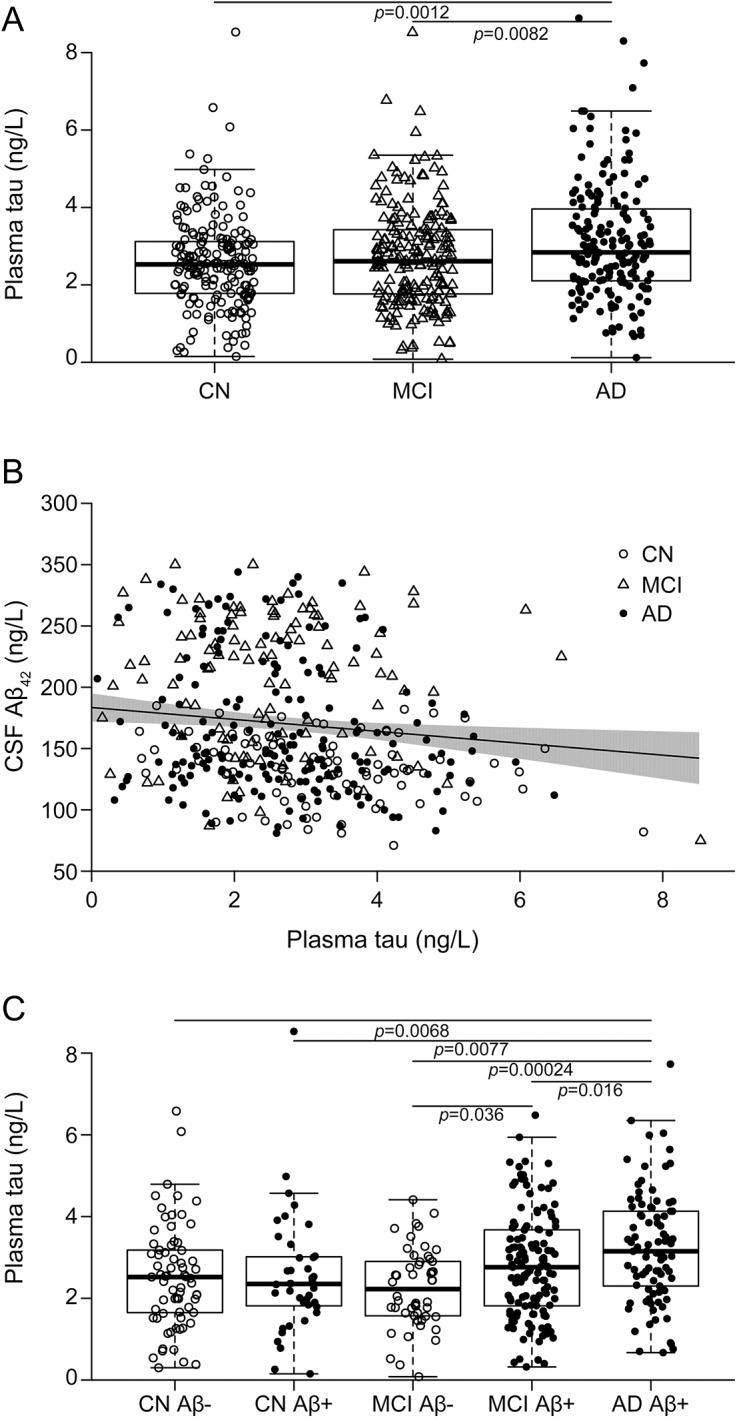
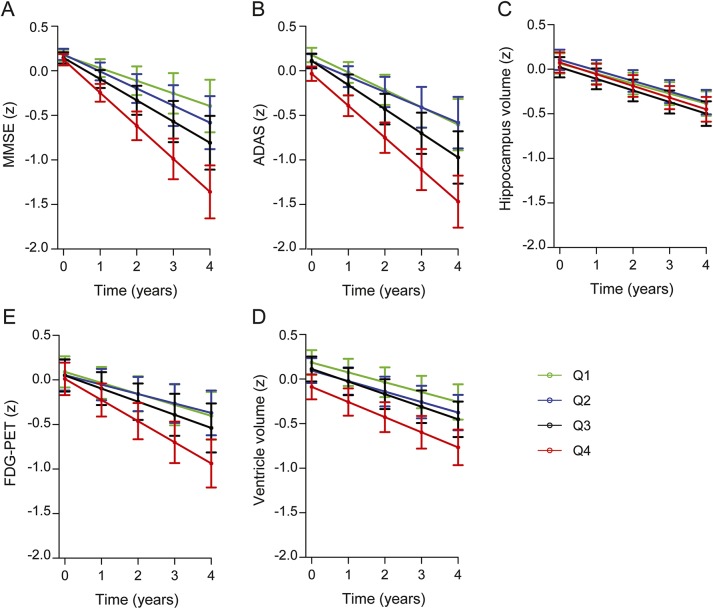
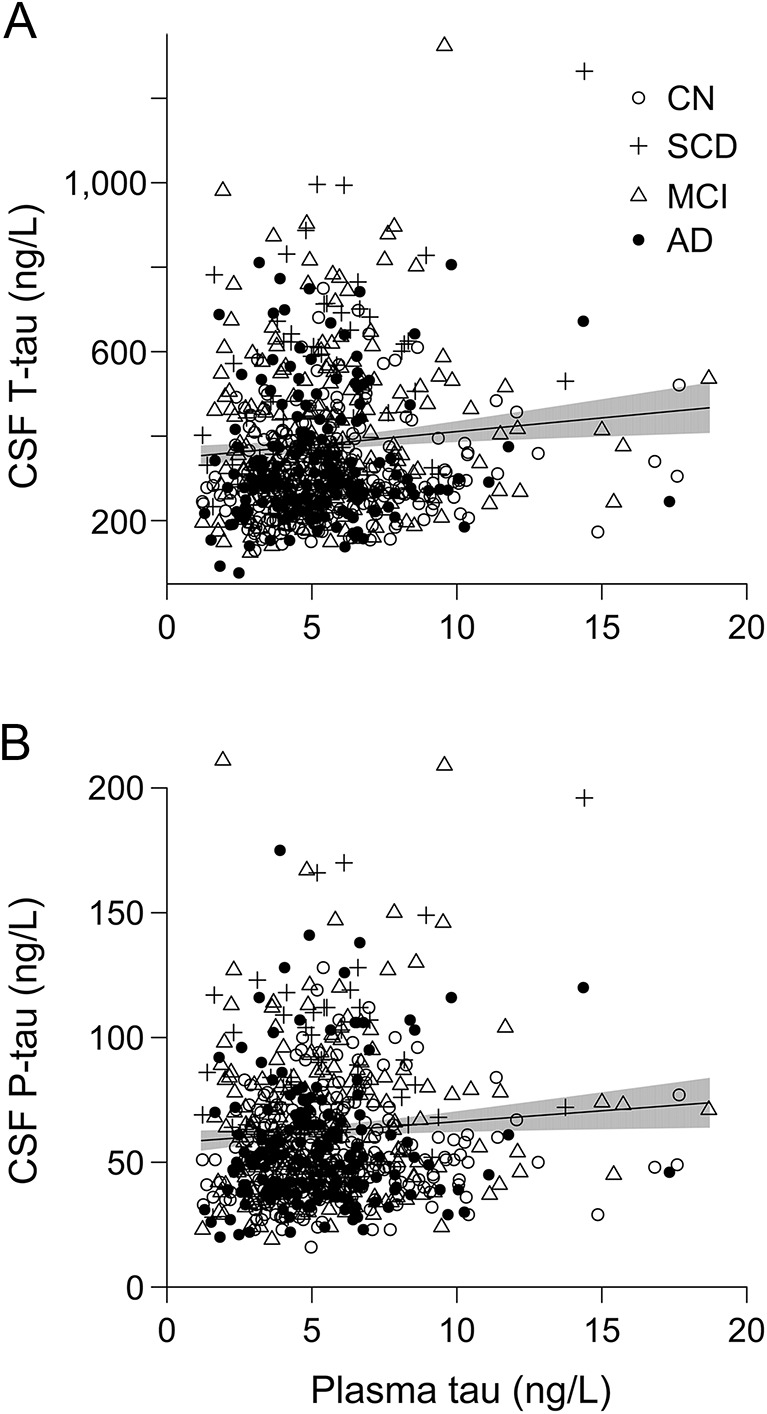
Objective:To test whether plasma tau is altered in Alzheimer disease (AD) and whether it is related to changes in cognition, CSF biomarkers of AD pathology (including β-amyloid [Aβ] and tau), brain atrophy, and brain metabolism. Methods:This was a study of plasma tau in prospectively followed patients with AD (n = 179), patients with mild cognitive impairment (n = 195), and cognitive healthy controls (n = 189) from the Alzheimer's Disease Neuroimaging Initiative (ADNI) and cross-sectionally studied patients with AD (n = 61), mild cognitive impairment (n = 212), and subjective cognitive decline (n = 174) and controls (n = 274) from the Biomarkers for Identifying Neurodegenerative Disorders Early and Reliably (BioFINDER) study at Lund University, Sweden. A total of 1284 participants were studied. Associations were tested between plasma tau and diagnosis, CSF biomarkers, MRI measures, 18fluorodeoxyglucose-PET, and cognition. Results:Higher plasma tau was associated with AD dementia, higher CSF tau, and lower CSF Aβ42, but the correlations were weak and differed between ADNI and BioFINDER. Longitudinal analysis in ADNI showed significant associations between plasma tau and worse cognition, more atrophy, and more hypometabolism during follow-up. Conclusions:Plasma tau partly reflects AD pathology, but the overlap between normal aging and AD is large, especially in patients without dementia. Despite group-level differences, these results do not support plasma tau as an AD biomarker in individual people. Future studies may test longitudinal plasma tau measurements in AD.
Overview
The claims and statistics of this paper haven’t been checked yet.
Free: it reads the open-access text and checks the first 5 claims that cite a source we can check. Create a free account to check every claim.
Integrity signals
Registry
Cites
Statistics
Figures
Verification
Claims the paper makes
The claims and statistics of this paper haven’t been checked yet.
Free: it reads the open-access text and checks the first 5 claims that cite a source we can check. Create a free account to check every claim.
Claims other papers make about this one
Each is checked against this paper’s own text: does it say what the citing paper says it does?
The cited source doesn’t support the claim as written.
In the citing paper
“Studies of plasma t-tau in AD and FTLD, including the present one, have found no relationship between plasma and CSF t-tau.13”
From Plasma Tau and Neurofilament Light in Frontotemporal Lobar Degeneration and Alzheimer Disease (2021) · cites this paper as [13]
Checked by a reasoning model — may be wrong.
Experimental — accuracy not yet measuredThe source backs part of the claim, not all of it — or backs it for a different population, condition or comparison.
In the citing paper
“Also in agreement with the present results are those from 2 large AD cohorts, in which plasma t-tau was associated with faster clinical decline.13”
From Plasma Tau and Neurofilament Light in Frontotemporal Lobar Degeneration and Alzheimer Disease (2021) · cites this paper as [13]
Experimental — accuracy not yet measuredThe source backs part of the claim, not all of it — or backs it for a different population, condition or comparison.
In the citing paper
“Whereas blood t-tau shows no diagnostic potential for AD, 13 NfL in blood shows a clear increase in AD, 4 and also tracks neurofibrillary tangle load and cognitive decline.14,15”
From Plasma Tau and Neurofilament Light in Frontotemporal Lobar Degeneration and Alzheimer Disease (2021) · cites this paper as [13]
Experimental — accuracy not yet measuredThe cited source says what the claim attributes to it.
In the citing paper
“Plasma t-tau was weakly elevated and correlated with more severe longitudinal hypometabolism in patients with AD compared to controls.13”
From Plasma Tau and Neurofilament Light in Frontotemporal Lobar Degeneration and Alzheimer Disease (2021) · cites this paper as [13]
The cited source says what the claim attributes to it.
In the citing paper
“Many candidate blood biomarkers have failed in replication studies,7,8 but somewhat promising results have been seen for plasma tau, neurofilament light chain (NFL), and combinations of Aβ42 and Aβ40.9,10,11,12,13,14,15,16,17”
From Performance of Fully Automated Plasma Assays as Screening Tests for Alzheimer Disease–Related β-Amyloid Status (2019) · cites this paper as [16]
Self-check
Percentages, sums and reported differences re-computed from the paper’s own numbers.
The self-check needs the paper’s full text.
Citations
Cites
McKhann, G., Drachman, D., Folstein, M., Katzman, R., Price, D., & Stadlan, E. M. (1984) · Neurology · doi:10.1212/wnl.34.7.939 · Cited by 27,915
Statistical Analysis With Missing Data
Lahiff, M., Little, R. J. A., & Rubin, D. B. (1989) · Journal of the American Statistical Association · doi:10.2307/2289883 · Cited by 17,265
Statistical Analysis with Missing Data
Little, R. J. A., & Rubin, D. B. (2002) · Wiley Series in Probability and Statistics · doi:10.1002/9781119013563 · Cited by 8,473
The Alzheimer’s disease neuroimaging initiative (ADNI): MRI methods
Jack, C. R., Bernstein, M. A., Fox, N. C., Thompson, P., Alexander, G., Harvey, D., Borowski, B., Britson, P. J., L. Whitwell, J., Ward, C., et al. (2008) · Journal of Magnetic Resonance Imaging · doi:10.1002/jmri.21049 · Cited by 4,347 · cited 2×
“FreeSurfer was used for quantification of volumes.(14) Right and left hippocampi were averaged.”
MethodSelf-citationAlzheimer's Disease Neuroimaging Initiative (ADNI): Clinical characterization
Petersen, R. C., Aisen, P. S., Beckett, L. A., Donohue, M. C., Gamst, A. C., Harvey, D. J., Jack, C. R., Jagust, W. J., Shaw, L. M., Toga, A. W., et al. (2010) · Neurology · doi:10.1212/wnl.0b013e3181cb3e25 · Cited by 3,060
Self-citationCerebrospinal fluid biomarker signature in Alzheimer's disease neuroimaging initiative subjects
Shaw, L. M., Vanderstichele, H., Knapik‐Czajka, M., Clark, C. M., Aisen, P. S., Petersen, R. C., Blennow, K., Soares, H., Simon, A., Lewczuk, P., et al. (2009) · Annals of Neurology · doi:10.1002/ana.21610 · Cited by 2,065 · cited 2×
“Several of the ADNI procedures have been described previously.(12,13) CSF Ab42, T-tau, and P-tau were measured with the multiplex xMAP Luminex platform (Luminex Corp, Austin, TX) with the INNOBIA AlzBio3 kit (Fujirebio, Ghent, Belgium).”
MethodSelf-citationCerebrospinal fluid and plasma biomarkers in Alzheimer disease
Blennow, K., Hampel, H., Weiner, M., & Zetterberg, H. (2010) · Nature Reviews Neurology · doi:10.1038/nrneurol.2010.4 · Cited by 1,863
Self-citationDiagnostic and Statistical Manual of Mental Disorders (DSM-III-R)
Spitzer, R. L., & Williams, J. (1987) · Cited by 1,823
Amyloid deposition, hypometabolism, and longitudinal cognitive decline
Landau, S. M., Mintun, M. A., Joshi, A. D., Koeppe, R. A., Petersen, R. C., Aisen, P. S., Weiner, M. W., Jagust, W. J., & Initiative, F. T. A. D. N. (2012) · Annals of Neurology · doi:10.1002/ana.23650 · Cited by 727 · cited 1×
“(18)Fluorodeoxyglucose (FDG)PET image data were acquired (at screening and 6, 12, 18, 24, 36 and 48 months; n: CNs, 86, 80, 73, 0, 71, 61, and 51; MCI, 96, 90, 88, 80, 72, 57, and 29; AD, 91, 83, 71, 1, 55, 1, and 1) as described previously.(15) For FDG-PET, we averaged counts of the lateral and medial frontal, anteri…”
Self-citationAmyloid biomarkers in Alzheimer's disease
Blennow, K., Mattsson, N., Schöll, M., Hansson, O., & Zetterberg, H. (2015) · Trends in Pharmacological Sciences · doi:10.1016/j.tips.2015.03.002 · Cited by 470 · cited 1×
“Brain accumulation of b-amyloid (Ab) and phosphorylated tau (P-tau) in Alzheimer disease (AD) may be monitored by CSF and PET biomarkers.(1) These technologies have revolutionized clinical research and trials and are rapidly transforming clinical practice.”
BackgroundSelf-citation
Cited by
Items 501–542 of 542
Jiao, H., Downie, L. E., Huang, X., Wu, M., Oberrauch, S., Keenan, R. J., Jacobson, L. H., & Chinnery, H. R. (2020) · Figshare · doi:10.6084/m9.figshare.12212003
Mengel, D., Liu, W., Glynn, R. J., Selkoe, D. J., Strydom, A., Lai, F., Rosas, H. D., Torres, A., Patsiogiannis, V., Skotko, B. G., et al. (2020) · Figshare · doi:10.6084/m9.figshare.12010614
Zerr, I., Villar‐Piqué, A., Hermann, P., Schmitz, M., Varges, D., Ferrer, I., Riggert, J., Zetterberg, H., Blennow, K., & Llorens, F. (2021) · Figshare · doi:10.6084/m9.figshare.14462590
Self-citationZerr, I., Villar‐Piqué, A., Hermann, P., Schmitz, M., Varges, D., Ferrer, I., Riggert, J., Zetterberg, H., Blennow, K., & Llorens, F. (2021) · Figshare · doi:10.6084/m9.figshare.14462596
Self-citationJiao, H., Downie, L. E., Huang, X., Wu, M., Oberrauch, S., Keenan, R. J., Jacobson, L. H., & Chinnery, H. R. (2020) · Figshare · doi:10.6084/m9.figshare.12211994
Ding, X., Zhang, S., Jiang, L., Wang, L., Li, T., & Lei, P. (2021) · Figshare · doi:10.6084/m9.figshare.14211689
Ding, X., Zhang, S., Jiang, L., Wang, L., Li, T., & Lei, P. (2021) · Figshare · doi:10.6084/m9.figshare.14211686
Developing Novel Supersensitive Fluid Biomarker Assays for Neurodegenerative Diseases
Alawode, D. O. T. (2024) · UCL Discovery (University College London)
TAGLIOLI, A. (2022) · Electronic Theses and Dissertations Repository (University of Pisa)
Emeršič, A. (2024) · Repository of the University of Ljubljana (University of Ljubljana)
Najm, L. (2023) · MacSphere (McMaster University) · doi:10.71548/20994
Gerards, M. (2024) · Kölner Universitäts PublikationsServer (Universität zu Köln)
Marin, N. F., Sarasa Barrio, J. M., & Pesini Ruíz, P. (2019) · LA Referencia (Red Federada de Repositorios Institucionales de Publicaciones Científicas)
Beta-amiloide, Tau e Alfa-sinucleina eritrocitari: biomarcatori della Malattia di Alzheimer
Lucarini, F. (2018) · Electronic Theses and Dissertations Repository (University of Pisa)
Jeste, D., & Maglione, J. E. (2023) · eScholarship (California Digital Library)
CASALI, E. (2018) · Electronic Theses and Dissertations Repository (University of Pisa)
Huang, X. (2024) · IUScholarWorks (Indiana University) · doi:10.7912/zjrk-jj82
Marcatori biologici delle malattie neurodegenerative
Vrillon, A., Aveneau, C., & Paquet, C. (2025) · EMC - Neurologia · doi:10.1016/s1634-7072(25)51074-7
Hoang, N. D. H. (2025) · Neurology and Neurosurgery · doi:10.15761/nns.1000147
Sheng, D., Wang, S., Xiao, Z., Liu, W., Xiao, B., & Zhou, L. (2026) · European Archives of Psychiatry and Clinical Neuroscience · doi:10.1007/s00406-025-02184-9
Guo, L., Mao, T., Qin, F., Xiao, Y., Ai, F., Wang, J., Song, Q., Yan, X., & Li, H. (2026) · ChemRxiv · doi:10.26434/chemrxiv-2024-19rj6/v7
Acute Management of Head Injuries : A Clinical Study Focused on Blood-Based Biomarkers
Keski-Pukkila, M. (2023) · Tampere University Institutional Repository (Tampere University)
Marqueurs périphériques de l'inflammation et déclin cognitif au cours de la maladie d'Alzheimer
Julian, A. (2018) · theses.fr (ABES) · doi:10.70675/0f58e0a1z28d9z40b7z886fz752caf42c261
Tomadesso, C. (2018) · theses.fr (ABES) · doi:10.70675/7fad6418zff81z49c7z984dz63aa2e44d7fc
Abdelouahab, O. B. (2021) · theses.fr (ABES) · doi:10.70675/97f4885fz3f5cz4234zb8e2ze3fa7c4e3d41
Implication des polynucléaires neutrophiles au cours de la maladie d’Alzheimer et des tauopathies
Dong, Y. (2018) · theses.fr (ABES) · doi:10.70675/0542df04zd02ez4a58za844z605f237e8f0b
Abnormal Amyloidogenesis Identified in Plasma of Patients with Spinocerebellar Ataxia Type 12
Banerjee, R., Sengupta, S., Rungta, J., Ansari, S., Banerjee, S., Biswas, B., Pal, R., Chattarji, S., Choudhury, S., & Kumar, H. (2026) · The Cerebellum · doi:10.1007/s12311-026-02015-0
“Despite evidences supporting for a peripheral contribution of blood tau in plasma, the reliability of plasma tau as a biomarker in neurodegeneration has been questioned [19 ].”
Optical Conductivity as a Stage-Sensitive Imaging Biomarker for Alzheimer’s DiseasePreprint
Yang, H., Jiang, S., & Jiang, H. (2026) · bioRxiv (Cold Spring Harbor Laboratory) · doi:10.64898/2026.06.02.729558
Validations of Plasma Biomarker Tests
Yang, C. S.-Y., & Sabbagh, M. N. (2026) · Springer eBooks · doi:10.1007/978-3-032-23863-4_4
Plasma Biomarkers Differentiate Cognitive Impairment in Postmenopausal Women with Insomnia Disorder
Wang, D., Chen, B., Jin, K., Cheng, S., Qin, B., Tian, Y., Lü, J., & Chu, K. (2026) · Psychiatry and Clinical Psychopharmacology · doi:10.65801/pcp.3463
Zerrouki, H., & Azzaz-Rahmani, S. (2026) · Research Square · doi:10.21203/rs.3.rs-10462750/v1
Acute Temporal Dynamics of Brain Injury Plasma Biomarkers following Controlled Football HeadingPreprint
Muqtadir, S. A., Aston, T., Reid, K. R., Lember, L.-M., Virgilio, T. G. D., Keith, G. A., Hunt, D. P. J., Teixeira-Dias, F., Binkofski, F., Moran, C. N., et al. (2026) · bioRxiv (Cold Spring Harbor Laboratory) · doi:10.64898/2026.09.09.749919
“22,56,57 While the current findings cannot be directly compared to existing t-tau findings in the football heading literature, it appears that despite its CNS specificity, BD-tau did not show any measurable changes after 10 controlled headers.”
Liu, S. (2026) · eScholarship (California Digital Library)
Jääskeläinen, O. (2022) · UEF eRepo (University of Eastern Finland)
Brain-derived tau in plasma and cerebrospinal fluid after surgery: a prospective cohort substudy
Thorsson, M., Eriksson, L. I., Danielson, M., Wiklund, A., Hergès, H. O., Nellgård, B., Zetterberg, H., Schening, A., Granström, A., Ricksten, S., et al. (2026) · British Journal of Anaesthesia · doi:10.1016/j.bja.2026.08.055
Self-citationDual‐Validation Single‐Molecule Detection of Tau Oligomers in Solid‐State Nanonet
Wang, Y., Wang, J., Wang, H., Huang, B., Zhang, Z., & Zhai, Y. (2026) · Angewandte Chemie · doi:10.1002/ange.6556052
Dual‐Validation Single‐Molecule Detection of Tau Oligomers in Solid‐State Nanonet
Wang, Y., Wang, J., Wang, H., Huang, B., Zhang, Z., & Zhai, Y. (2026) · Angewandte Chemie International Edition · doi:10.1002/anie.6556052
Serum brain-derived tau distinguishes acute neurotrauma diagnosesPreprint
Shi, R., Svirsky, S. E., Balogun, W. G., Zeng, X., Fedak, J. D., Nafash, M. N., Brodman, S. T., Okonkwo, D. O., Puccio, A. M., & Karikari, T. K. (2026) · medRxiv · doi:10.64898/2026.11.08.26365143
Chen, L., Niu, X., Wang, Y., Lv, S., Zhou, X., Yang, Z., & Peng, D. (2022) · doi:10.3389/fnagi.2022.942629.s001
Lingyu Zhang, Danhua Wang, Dai, Y., Xuchu Wang, Cao, Y., Liu, W., & Tao, Z. (2023) · doi:10.3389/fnagi.2022.863673.s001
Iverson, G. L., Minkkinen, M., Karr, J. E., Berghem, K., Zetterberg, H., Blennow, K., Posti, J. P., & Luoto, T. M. (2023) · doi:10.3389/fneur.2022.960741.s001
Self-citation
Metadata
- Authors
- Mattsson, N., Zetterberg, H., Janelidze, S., Insel, P. S., Andreasson, U., Stomrud, E., Palmqvist, S., Baker, D., Tan Hehir, C. A., Jeromin, A., Hanlon, D., Song, L., Shaw, L. M., Trojanowski, J. Q., Weiner, M. W., Hansson, O., & Blennow, K.
- Affiliations
- United States Department of Veterans Affairs (US)
- From the Clinical Memory Research Unit (N.M., S.J., P.S.I., E.S., S.P., O.H.), Department of Clinical Sciences, Malmö, Lund University; Department of Neurology (N.M., E.S., O.H., S.P.), Skåne University Hospital, Lund; Clinical Neurochemistry Laboratory (H.Z., U.A., K.B.), Institute of Neuroscience and Physiology, Department of Psychiatry and Neurochemistry, Sahlgrenska Academy at the University of Gothenburg, Mölndal Canpus, Sahlgrenska University Hospital, Mölndal, Sweden; Department of Molecular...
- Corresponding author
- Mattsson, Niklas
- ORCID
- Venue
- Neurology
- Published
- 2016-10-25
- Volume
- 87
- Issue
- 17
- Pages
- 1827-1835
- ISSN
- 0028-3878 (ISSN-L)
- 1526-632X
- PMC
- PMC5089525
- OpenAlex
- W2525940741
- Semantic Scholar
- 613822f1e882f63138a9aab1f85429ac42b1e141
- Cited by
- 502
- References
- 25
- Citations by year
- 2026: 20 · 2025: 46 · 2024: 52 · 2023: 47 · 2022: 56 · 2021: 75 · 2020: 73 · 2019: 60 · 2018: 44 · 2017: 28
- FWCI
- 39.09
- Type
- journal article
- Language
- en
- Open access
- hybrid
- doi.org
- Licence
- cc-by-nc-nd
- Locations
- Neurology (publishedVersion, cc-by-nc-nd)
- PubMed Central (publishedVersion, cc-by-nc-nd)
- PubMed (publishedVersion)
- UCL Discovery (University College London) (submittedVersion)
- eScholarship (California Digital Library) (submittedVersion, cc-by-nc-nd)
- Lund University Publications (Lund University) (submittedVersion)
- Funders
- U.S. Department of Defense (AG024904)
- U.S. Department of Veterans Affairs
- Bristol-Myers Squibb
- Eli Lilly and Company (AG024904)
- Pfizer (AG024904)
- Sanofi
- Biogen (AG024904)
- University of Pennsylvania
- F. Hoffmann-La Roche
- Medpace
- Meso Scale Diagnostics
- Synarc
- Harvard University
- Torsten Söderbergs Stiftelse
- BioClinica
- Danone
- Novartis Pharmaceuticals Corporation
- Australian Government
- Royal Swedish Academy of Sciences
- Lunds Universitet
- Eisai
- Knut och Alice Wallenbergs Stiftelse
- Vetenskapsrådet
- Göteborgs Universitet
- Greta och Johan Kocks stiftelser
- Servier
- IXICO
- National Institutes of Health (5u01ag024904-10, AG024904)
- Genentech
- University of California, Los Angeles
- Canadian Institutes of Health Research
- National Institute on Aging (U01-AG-024904, AG 024904, P30AG010124)
- Topics
- Health Sciences › Medicine › Psychiatry and Mental health › Dementia and Cognitive Impairment Research
- Life Sciences › Neuroscience › Cellular and Molecular Neuroscience › Alzheimer's disease research and treatments
- Health Sciences › Medicine › Oncology › Cancer-related cognitive impairment studies
- Keywords
- plasma tau, Alzheimer's disease, mild cognitive impairment, subjective cognitive decline, cerebrospinal fluid biomarkers, amyloid-beta, CSF tau, brain atrophy, brain hypometabolism, cognitive decline, plasma biomarkers, normal aging
- MeSH terms
- Aged, Aged, 80 and over, Alzheimer Disease, Brain, Cognition Disorders, Female, Humans, Male, Neuropsychological Tests, Psychiatric Status Rating Scales, Cohort Studies, Amyloid beta-Peptides, tau Proteins, Fluorodeoxyglucose F18, Positron-Emission Tomography
About these checks
Registry, retraction, Cites and statistics results are computed, not judged, with one exception: a printed reference that no index lists is read once by a model before it counts as a citation error. Claims are extracted by a model and kept only when their quote appears verbatim in the text; each cited source is then checked, with a model’s help, for whether it says what the claim relies on. Those verdicts can be wrong — read the claim’s quote and the cited source before relying on one.
Statistics and arithmetic are recomputed, not judged.
Confidence bands are shown only for fields calibrated on our annotated test set. None is calibrated yet, so no band is shown.
What counts as a claim ›How we measure confidence ›How we check this ›
Are you an author, or do you see a problem with this page? Request a review
Data sources
Bibliographic data: Semantic Scholar, OpenAlex, Crossref.
Contains information from the Semantic Scholar Academic Graph Datasets, made available under the ODC Attribution License (ODC-BY 1.0).
Semantic Scholar’s data is described in: Kinney, R., et al. (2023). The Semantic Scholar Open Data Platform. arXiv:2301.10140.
