

The DOI matches its Crossref record; 33 of the 33 references it cites were found in a registry or an index.
Autopsy validation of 123 I-FP-CIT dopaminergic neuroimaging for the diagnosis of DLB
Open accessAbstract
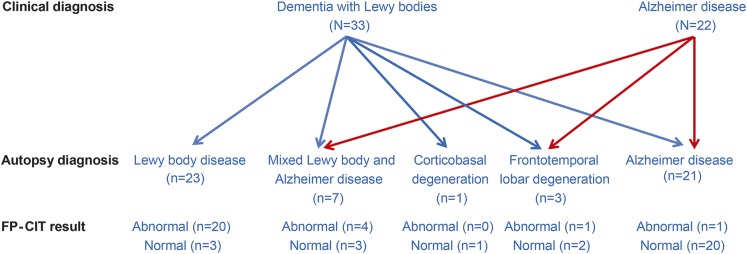
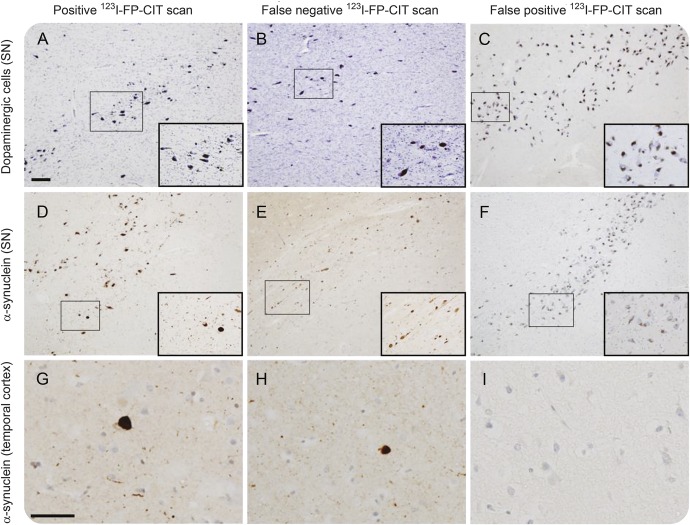
Objective: To conduct a validation study of 123I-N-fluoropropyl-2b-carbomethoxy-3b-(4-iodophenyl) nortropane (123I-FP-CIT) SPECT dopaminergic imaging in the clinical diagnosis of dementia with Lewy bodies (DLB) with autopsy as the gold standard. Methods: Patients >60 years of age with dementia who had undergone 123I-FP-CIT imaging in research studies and who had donated their brain tissue to the Newcastle Brain Tissue Resource were included. All had structured clinical research assessments, and clinical diagnoses were applied by consensus panels using international diagnostic criteria. All underwent 123I-FP-CIT imaging at baseline, and scans were rated as normal or abnormal by blinded raters. Patients were reviewed in prospective studies and after death underwent detailed autopsy assessment, and neuropathologic diagnoses were applied with the use of standard international criteria. Results: Fifty-five patients (33 with DLB and 22 with Alzheimer disease) were included. Against autopsy diagnosis, 123I-FP-CIT had a balanced diagnostic accuracy of 86% (sensitivity 80%, specificity 92%) compared with clinical diagnosis, which had an accuracy of 79% (sensitivity 87%, specificity 72%). Among patients with DLB, 10% (3 patients) met pathologic criteria for Lewy body disease but had normal 123I-FP-CIT imaging. Conclusions: This large autopsy analysis of 123I-FP-CIT imaging in dementia demonstrates that it is a valid and accurate biomarker for DLB, and the high specificity compared with clinical diagnosis (20% higher) is clinically important. The results need to be replicated with patients recruited from a wider range of settings, including movement disorder clinics and general practice. While an abnormal 123I-FP-CIT scan strongly supports Lewy body disease, a normal scan does not exclude DLB with minimal brainstem involvement. Classification of evidence: This study provides Class I evidence that 123I-FP-CIT dopaminergic neuroimaging accurately identifies patients with DLB.
Overview
The claims and statistics of this paper haven’t been checked yet.
Run the check — free, no account needed. It reads the open-access text and checks the sources it cites.
Integrity signals
Registry
Cites
Statistics
Figures
Verification
Claims the paper makes
The claims and statistics of this paper haven’t been checked yet.
Run the check — free, no account needed. It reads the open-access text and checks the sources it cites.
Claims other papers make about this one
Each is checked against this paper’s own text: does it say what the citing paper says it does?
The source backs part of the claim, not all of it — or backs it for a different population, condition or comparison.
In the citing paper
“Brain dopamine transporter imaging using 123I-Ioflupane (FP-CIT) SPECT and cardiac sympathetic nerve imaging using 131I-Metaiodobenzylguanidine myocardial scintigraphy (MIBG) are well established markers for the diagnosis of DLB with high sensitivity and specificity and both are indicative biomarkers as part of the current International Consensus diagnostic criteria for DLB [21, 144–146].”
From The use of neuroimaging techniques in the early and differential diagnosis of dementia (2023) · cites this paper as [145]
Experimental — accuracy not yet measuredThe source backs part of the claim, not all of it — or backs it for a different population, condition or comparison.
In the citing paper
“Brain dopamine transporter imaging using 123I-Ioflupane (FP-CIT) SPECT and cardiac sympathetic nerve imaging using 131I-Metaiodobenzylguanidine myocardial scintigraphy (MIBG) are well established markers for the diagnosis of DLB with high sensitivity and specificity and both are indicative biomarkers as part of the current International Consensus diagnostic criteria for DLB [21, 144–146].”
From The use of neuroimaging techniques in the early and differential diagnosis of dementia (2023) · cites this paper as [145]
Experimental — accuracy not yet measuredThe cited source says what the claim attributes to it.
In the citing paper
“A large multi-site study showed that FP-CIT SPECT differentiated DLB from AD with 78% sensitivity and 91% specificity while a further autopsy study showed that FP-CIT has accuracy of 86% (sensitivity 80%, specificity 92%) compared to neuropathological diagnosis of DLB [145, 147].”
From The use of neuroimaging techniques in the early and differential diagnosis of dementia (2023) · cites this paper as [145]
The cited source says what the claim attributes to it.
In the citing paper
“A large multi-site study showed that FP-CIT SPECT differentiated DLB from AD with 78% sensitivity and 91% specificity while a further autopsy study showed that FP-CIT has accuracy of 86% (sensitivity 80%, specificity 92%) compared to neuropathological diagnosis of DLB [145, 147].”
From The use of neuroimaging techniques in the early and differential diagnosis of dementia (2023) · cites this paper as [145]
Self-check
Percentages, sums and reported differences re-computed from the paper’s own numbers.
The self-check needs the paper’s full text.
Citations
Cites
Folstein, M. F., Folstein, S. E., & McHugh, P. R. (1975) · Journal of Psychiatric Research · doi:10.1016/0022-3956(75)90026-6 · Cited by 88,282
McKhann, G., Drachman, D., Folstein, M., Katzman, R., Price, D., & Stadlan, E. M. (1984) · Neurology · doi:10.1212/wnl.34.7.939 · Cited by 27,915
Hirono, N., Mori, E., Ikejiri, Y., Imamura, T., Shimomura, T., Hashimoto, M., Yamashita, H., & Ikeda, M. (1997) · PubMed · Cited by 21,012
Kok, J. S., Berg, I. J., & Scherder, E. J. A. (2013) · Dementia and Geriatric Cognitive Disorders Extra · doi:10.1159/000353441 · Cited by 20,589
Older Adults' Reasons for Using Technology while Aging in Place
Peek, S. T. M., Luijkx, K. G., Rijnaard, M. D., Nieboer, M. E., van der Voort, C. S., Aarts, S., van Hoof, J., Vrijhoef, H. J., & Wouters, E. (2015) · Gerontology · doi:10.1159/000430949 · Cited by 19,852
Sensitivity and False Alarm Rate of a Fall Sensor in Long-Term Fall Detection in the Elderly
Kangas, M., Korpelainen, R., Vikman, I., Nyberg, L., & Jämsä, T. J. (2014) · Gerontology · doi:10.1159/000362720 · Cited by 19,007
Neuropathological stageing of Alzheimer-related changes.
Braak, H., & Braak, E. (1991) · Acta Neuropathologica · doi:10.1007/bf00308809 · Cited by 16,123
MDS clinical diagnostic criteria for Parkinson’s disease
Postuma, R. B., Berg, D., Stern, M., Poewe, W., Olanow, C. W., Oertel, W., Obeso, J., Marek, K., Litvan, I., Lang, A. E., et al. (2015) · Movement Disorders · doi:10.1002/mds.26424 · Cited by 7,653
Sperling, R. A., Aisen, P. S., Beckett, L. A., Bennett, D. A., Craft, S., Fagan, A. M., Iwatsubo, T., Jack, C. R., Kaye, J., Montine, T. J., et al. (2011) · Alzheimer's & Dementia · doi:10.1016/j.jalz.2011.03.003 · Cited by 7,155
Diagnosis and management of dementia with Lewy bodies: Third report of the DLB consortium
McKeith, I. G., Dickson, D. W., Lowe, J., Emre, M., O'Brien, J. T., Feldman, H., Cummings, J., Duda, J. E., Lippa, C., Perry, E. K., et al. (2005) · Neurology · doi:10.1212/01.wnl.0000187889.17253.b1 · Cited by 5,069
Self-citation
Research works printed but not linked: 1
- Kane J, Barker S, Surendranathan A, et al. Clinical diagnosis of dementia with Lewy bodies in routine secondary care clinical services: results from the DIAMOND-Lewy study. Am J Neurodegenerative Dis 2015;4(suppl 1):178.
Cited by
Sorted by citations
Simuni, T., Chahine, L. M., Poston, K. L., Brumm, M. C., Buracchio, T., Campbell, M., Chowdhury, S., Coffey, C. S., Concha‐Marambio, L., Dam, T., et al. (2024) · The Lancet Neurology · doi:10.1016/s1474-4422(23)00405-2 · Cited by 685
A clinicopathological approach to the diagnosis of dementia
Elahi, F. M., & Miller, B. L. (2017) · Nature Reviews Neurology · doi:10.1038/nrneurol.2017.96 · Cited by 425
Dementia with Lewy bodies: an update and outlook
Outeiro, T. F., Koss, D. J., Erskine, D., Walker, L., Kurzawa-Akanbi, M., Burn, D., Donaghy, P., Morris, C., Taylor, J.-P., Thomas, A., et al. (2019) · Molecular Neurodegeneration · doi:10.1186/s13024-019-0306-8 · Cited by 381
Self-citationMorbelli, S. D., Esposito, G., Arbizu, J., Barthel, H., Boellaard, R., Bohnen, N. I., Brooks, D. J., Darcourt, J., Dickson, J. C., Douglas, D., et al. (2020) · European Journal of Nuclear Medicine and Molecular Imaging · doi:10.1007/s00259-020-04817-8 · Cited by 294
Dementia with Lewy bodies and Parkinson’s disease-dementia: current concepts and controversies
Jellinger, K. A. (2017) · Journal of Neural Transmission · doi:10.1007/s00702-017-1821-9 · Cited by 277
Metadata
- Authors
- Thomas, A. J., Attems, J., Colloby, S. J., O'Brien, J. T., McKeith, I., Walker, R., Lee, L., Burn, D., Lett, D. J., & Walker, Z.
- Affiliations
- Barts Health NHS Trust (GB)
- Corresponding author
- Thomas, Alan J.
- ORCID
- Venue
- Neurology
- Published
- 2017-01-17
- Volume
- 88
- Issue
- 3
- Pages
- 276-283
- ISSN
- 0028-3878 (ISSN-L)
- 1526-632X
- PMC
- PMC5272795
- OpenAlex
- W2559951892
- Cited by
- 165
- References
- 33
- Citations by year
- 2026: 6 · 2025: 23 · 2024: 21 · 2023: 15 · 2022: 9 · 2021: 12 · 2020: 22 · 2019: 25 · 2018: 21 · 2017: 11
- FWCI
- 16.88
- Type
- journal article
- Language
- en
- Open access
- hybrid
- doi.org
- Licence
- cc-by-nc-nd
- Locations
- Neurology (publishedVersion, cc-by-nc-nd)
- PubMed Central (publishedVersion, cc-by-nc-nd)
- PubMed (publishedVersion)
- UCL Discovery (University College London) (submittedVersion)
- Apollo (University of Cambridge) (submittedVersion, cc-by-nc-nd)
- Apollo
- Newcastle University ePrints (Newcastle Univesity) (cc-by-nc-nd)
- Funders
- Alzheimer's Society
- National Institute for Health and Care Research (NF-SI-0611-10048)
- Newcastle University (G0400074)
- Cambridge University Hospitals
- Newcastle upon Tyne Hospitals NHS Foundation Trust
- Medical Research Council (G0400074)
- Topics
- Health Sciences › Medicine › Psychiatry and Mental health › Dementia and Cognitive Impairment Research
- Health Sciences › Medicine › Clinical Neurology › Parkinson's Disease Mechanisms and Treatments
- Health Sciences › Medicine › Radiology, Nuclear Medicine and Imaging › Medical Imaging Techniques and Applications
- Keywords
- dementia with Lewy bodies, 123I-FP-CIT, diagnostic accuracy, Lewy body disease, Alzheimer's disease, biomarkers, brainstem involvement
- MeSH terms
- Aged, Aged, 80 and over, Alzheimer Disease, Autopsy, Female, Humans, Male, Middle Aged, Neurologic Examination, Psychiatric Status Rating Scales, Tropanes, Reproducibility of Results, Tomography, Emission-Computed, Single-Photon, Chi-Square Distribution, Lewy Body Disease
About these checks
Registry, retraction, Cites and statistics results are computed, not judged, with one exception: a printed reference that no index lists is read once by a model before it counts as a citation error. Claims are extracted by a model and kept only when their quote appears verbatim in the text; each cited source is then checked, with a model’s help, for whether it says what the claim relies on. Those verdicts can be wrong — read the claim’s quote and the cited source before relying on one.
Statistics and arithmetic are recomputed, not judged.
Confidence bands are shown only for fields calibrated on our annotated test set. None is calibrated yet, so no band is shown.
What counts as a claim ›How we measure confidence ›How we check this ›
Are you an author, or do you see a problem with this page? Request a review
