

The DOI matches its Crossref record; 50 of the 51 references it cites were found in a registry or an index.
Prognostic factors for chronic headache: A systematic review
Open accessAbstract
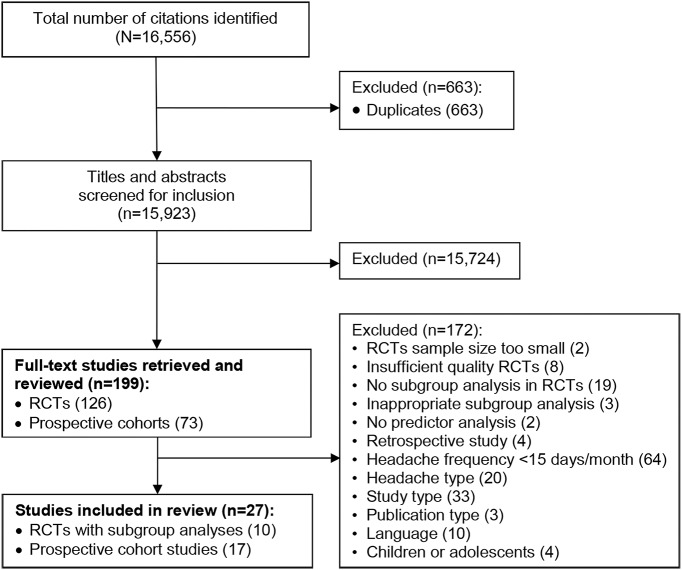
OBJECTIVE: To identify predictors of prognosis and trial outcomes in prospective studies of people with chronic headache. METHODS: We included (1) randomized controlled trials (RCTs) of interventions for chronic headache that reported subgroup analyses and (2) prospective cohort studies, published in English, since 1980. Participants included adults with chronic headache (including chronic headache, chronic migraine, and chronic tension-type headache with or without medication overuse headache). We searched key databases using free text and MeSH terms. Two reviewers independently extracted data and assessed the methodologic quality of studies and overall quality of evidence identified using appropriate published checklists. RESULTS: We identified 16,556 titles, removed 663 duplicates, and reviewed 199 articles, of which 27 were included in the review-17 prospective cohorts and 10 RCTs with subgroup analyses reported. There was moderate-quality evidence indicating that depression, anxiety, poor sleep and stress, medication overuse, and poor self-efficacy for managing headaches are potential prognostic factors for poor prognosis and unfavorable outcomes from preventive treatment in chronic headache. There was inconclusive evidence about treatment expectations, age, age at onset, body mass index, employment, and several headache features. CONCLUSIONS: This review identified several potential predictors of poor prognosis and worse outcome postinterventions in people with chronic headache. The majority of these are modifiable. The findings also highlight the need for more longitudinal high-quality research of prognostic factors in chronic headache.
Overview
The claims and statistics of this paper haven’t been checked yet.
Run the check — free, no account needed. It reads the open-access text and checks the sources it cites.
Integrity signals
Registry
Cites
Statistics
Figures
Verification
Claims the paper makes
The claims and statistics of this paper haven’t been checked yet.
Run the check — free, no account needed. It reads the open-access text and checks the sources it cites.
Claims other papers make about this one
Each is checked against this paper’s own text: does it say what the citing paper says it does?
The cited source says what the claim attributes to it.
In the citing paper
“Depression, anxiety, poor sleep, stress and poor self-efficacy for managing headaches are prognostic markers for a poor outcome in chronic headache disorders.12”
Self-check
Percentages, sums and reported differences re-computed from the paper’s own numbers.
The self-check needs the paper’s full text.
Citations
Cites
Cochrane Handbook for Systematic Reviews of Interventions: Cochrane Book Series
(2008) · doi:10.1002/9780470712184 · Cited by 25,048
The International Classification of Headache Disorders, 3rd edition (beta version)
Headache Classification Committee of the International Headache Society (IHS) (2013) · Cephalalgia · doi:10.1177/0333102413485658 · Cited by 8,229
Mediators and Moderators of Treatment Effects in Randomized Clinical Trials
Kraemer, H. C., Wilson, G. T., Fairburn, C. G., & Agras, W. S. (2002) · Archives of General Psychiatry · doi:10.1001/archpsyc.59.10.877 · Cited by 2,562 · cited 1×
“Factors can be differentiated between predictors of prognosis and moderators or mediators of treatment outcome.(9) Specifically; predictors are factors, measured at baseline, that affect outcome but do not interact with the intervention; moderators are factors, measured at baseline, that interact with the treatment to…”
BackgroundEvaluation of the Quality of Prognosis Studies in Systematic Reviews
Hayden, J. A., Côté, P., & Bombardier, C. (2006) · Annals of Internal Medicine · doi:10.7326/0003-4819-144-6-200603210-00010 · Cited by 1,452
Epidemiology of Tension-Type Headache
Schwartz, B. S. (1998) · JAMA · doi:10.1001/jama.279.5.381 · Cited by 762
Global prevalence of chronic migraine: A systematic review
Natoli, J. L., Manack, A., Dean, B. B., Butler, Q. R., Turkel, C., Stovner, L., & Lipton, R. B. (2009) · Cephalalgia · doi:10.1111/j.1468-2982.2009.01941.x · Cited by 693
Observational and interventional study design types; an overview
Thiese, M. S. (2014) · Biochemia Medica · doi:10.11613/bm.2014.022 · Cited by 615
Buse, D. C., Manack, A. N., Fanning, K. M., Serrano, D., Reed, M. L., Turkel, C. C., & Lipton, R. B. (2012) · Headache: The Journal of Head and Face Pain · doi:10.1111/j.1526-4610.2012.02223.x · Cited by 549
Huguet, A., Hayden, J. A., Stinson, J., McGrath, P. J., Chambers, C. T., Tougas, M. E., & Wozney, L. (2013) · Systematic Reviews · doi:10.1186/2046-4053-2-71 · Cited by 531
Sharma, L., Cahue, S., Song, J., Hayes, K. W., Pai, Y., & Dunlop, D. D. (2003) · Arthritis & Rheumatism · doi:10.1002/art.11420 · Cited by 486
Research works printed but not linked: 1
- Smitherman TA, Penzien DB, Rains JC, Nicholson RA, Houle TT. Headache. Göttingen: Hogrefe; 2015.
Cited by
Sorted by citations
Diagnosis and management of migraine in ten steps
Eigenbrodt, A. K., Ashina, H., Khan, S., Diener, H., Mitsikostas, D. D., Sinclair, A. J., Pozo‐Rosich, P., Martelletti, P., Ducros, A., Lantéri‐Minet, M., et al. (2021) · Nature Reviews Neurology · doi:10.1038/s41582-021-00509-5 · Cited by 643
Medication-overuse headache: a widely recognized entity amidst ongoing debate
Vandenbussche, N., Laterza, D., Martinez, M. L., Lloyd, J. O., Lupi, C., Tischler, H., Toom, K., Vandervorst, F., Quintana, S., Paemeleire, K., et al. (2018) · The Journal of Headache and Pain · doi:10.1186/s10194-018-0875-x · Cited by 204
Silberstein, S. D., Cohen, J. M., Seminerio, M. J., Yang, R., Ashina, S., & Katsarava, Z. (2020) · The Journal of Headache and Pain · doi:10.1186/s10194-020-01173-8 · Cited by 133
Sleep and Migraine: Assessment and Treatment of Comorbid Sleep Disorders
Rains, J. C. (2018) · Headache The Journal of Head and Face Pain · doi:10.1111/head.13357 · Cited by 122
Côté, P., Yu, H., Shearer, H. M., Randhawa, K. A., Wong, J. J., Mior, S. A., Ameis, A., Carroll, L., Nordin, M. C., Varatharajan, S., et al. (2019) · European Journal of Pain · doi:10.1002/ejp.1374 · Cited by 111
Metadata
- Authors
- Probyn, K., Bowers, H., Caldwell, F., Mistry, D., Underwood, M., Matharu, M., Pincus, T., & On behalf of the CHESS Team
- Affiliations
- Royal Holloway University of London (GB)
- Corresponding author
- Probyn, Katrin
- Venue
- Neurology
- Published
- 2017-07-18
- Volume
- 89
- Issue
- 3
- Pages
- 291-301
- ISSN
- 0028-3878 (ISSN-L)
- 1526-632X
- PMC
- PMC5513814
- OpenAlex
- W2626090714
- Cited by
- 129
- References
- 51
- Citations by year
- 2026: 5 · 2025: 6 · 2024: 13 · 2023: 10 · 2022: 23 · 2021: 23 · 2020: 17 · 2019: 16 · 2018: 12 · 2017: 4
- FWCI
- 2.03
- Type
- journal article
- Language
- en
- Open access
- hybrid
- doi.org
- Licence
- cc-by-nc-nd
- Locations
- Neurology (publishedVersion, cc-by-nc-nd)
- PubMed Central (publishedVersion, cc-by-nc-nd)
- PubMed (publishedVersion)
- Warwick Research Archive Portal (University of Warwick) (acceptedVersion)
- ePrints Soton (University of Southampton) (acceptedVersion)
- Funders
- National Institute for Health and Care Excellence
- National Institute for Health and Care Research (RP-PG-1212-20018, NF-SI-0512-10103, NF-SI-0616-10043)
- University of Warwick
- Programme Grants for Applied Research (RP-PG-1212-20018)
- Topics
- Health Sciences › Medicine › Clinical Neurology › Migraine and Headache Studies
- Health Sciences › Dentistry › Oral Surgery › Temporomandibular Joint Disorders
- Health Sciences › Medicine › Clinical Neurology › Traumatic Brain Injury Research
- Keywords
- chronic headache, prognostic factors, chronic migraine, chronic tension-type headache, medication overuse headache, depression, anxiety, sleep quality, stress, self-efficacy, treatment expectations
- MeSH terms
- Humans, Prognosis, Headache Disorders
About these checks
Registry, retraction, Cites and statistics results are computed, not judged, with one exception: a printed reference that no index lists is read once by a model before it counts as a citation error. Claims are extracted by a model and kept only when their quote appears verbatim in the text; each cited source is then checked, with a model’s help, for whether it says what the claim relies on. Those verdicts can be wrong — read the claim’s quote and the cited source before relying on one.
Statistics and arithmetic are recomputed, not judged.
Confidence bands are shown only for fields calibrated on our annotated test set. None is calibrated yet, so no band is shown.
What counts as a claim ›How we measure confidence ›How we check this ›
Are you an author, or do you see a problem with this page? Request a review
