

Survival time tool to guide care planning in people with dementia
Open accessThe DOI matches its Crossref record; 36 of the 36 references it cites were found in a registry or an index.
Abstract
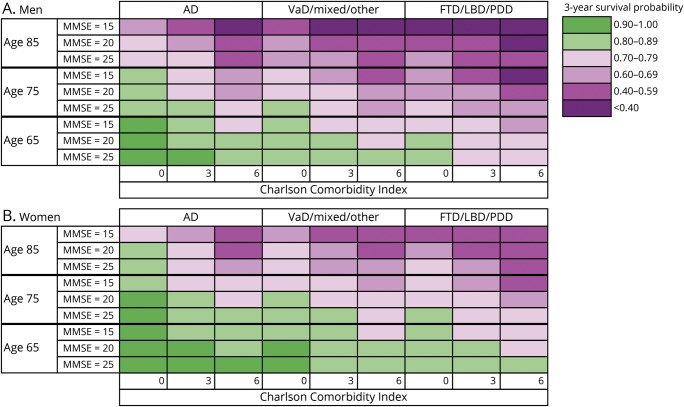
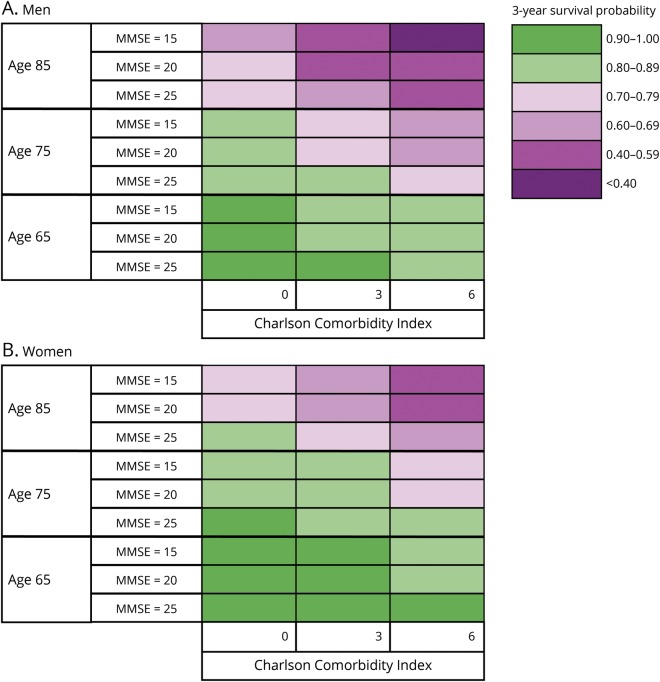
OBJECTIVE: To develop survival prediction tables to inform physicians and patients about survival probabilities after the diagnosis of dementia and to determine whether survival after dementia diagnosis can be predicted with good accuracy. METHODS: We conducted a nationwide registry-linkage study including 829 health centers, i.e., all memory clinics and ≈75% of primary care facilities, across Sweden. Data including cognitive function from 50,076 people with incident dementia diagnoses ≥65 years of age and registered with the Swedish Dementia Register in 2007 to 2015 were used, with a maximum follow-up of 9.7 years for survival until 2016. Sociodemographic factors, comorbidity burden, medication use, and dates of death were obtained from nationwide registries. Cox proportional hazards regression models were used to create tables depicting 3-year survival probabilities for different risk factor profiles. RESULTS: By August 2016, 20,828 (41.6%) patients in our cohort had died. Median survival time from diagnosis of dementia was 5.1 (interquartile range 2.9-8.0) years for women and 4.3 (interquartile range 2.3-7.0) years for men. Predictors of mortality were higher age, male sex, increased comorbidity burden and lower cognitive function at diagnosis, a diagnosis of non-Alzheimer dementia, living alone, and using more medications. The developed prediction tables yielded c indexes of 0.70 (95% confidence interval [CI] 0.69-0.71) to 0.72 (95% CI 0.71-0.73) and showed good calibration. CONCLUSIONS: Three-year survival after dementia diagnosis can be predicted with good accuracy. The survival prediction tables developed in this study may aid clinicians and patients in shared decision-making and advance care planning.
Overview
The claims and statistics of this paper haven’t been checked yet.
Free: it reads the open-access text and checks the first 5 claims that cite a source we can check. Create a free account to check every claim.
Integrity signals
Registry
Cites
Statistics
Figures
Verification
Claims the paper makes
The claims and statistics of this paper haven’t been checked yet.
Free: it reads the open-access text and checks the first 5 claims that cite a source we can check. Create a free account to check every claim.
Claims other papers make about this one
Each is checked against this paper’s own text: does it say what the citing paper says it does?
The source backs part of the claim, not all of it — or backs it for a different population, condition or comparison.
In the citing paper
“Most dementia survival prediction studies utilize traditional nonparametric estimator and regression models, such as Kaplan–Meier estimator curves and Cox proportional hazards models21,22, rather than advanced machine-learning models.”
From Machine learning models identify predictive features of patient mortality across dementia types (2024) · cites this paper as [22]
Experimental — accuracy not yet measured
Self-check
Percentages, sums and reported differences re-computed from the paper’s own numbers.
The self-check needs the paper’s full text.
Citations
Cites
Folstein, M. F., Folstein, S. E., & McHugh, P. R. (1975) · Journal of Psychiatric Research · doi:10.1016/0022-3956(75)90026-6 · Cited by 88,282
Charlson, M. E., Pompei, P., Ales, K. L., & MacKenzie, C. R. (1987) · Journal of Chronic Diseases · doi:10.1016/0021-9681(87)90171-8 · Cited by 49,742 · cited 1×
“The medical diagnoses up until the moment of dementia diagnosis were selected from the Swedish National Patient Register and used to calculate the Charlson Comorbidity Index (CCI) score (range 0–16).(14)”
MethodKok, J. S., Berg, I. J., & Scherder, E. J. A. (2013) · Dementia and Geriatric Cognitive Disorders Extra · doi:10.1159/000353441 · Cited by 20,589
Older Adults' Reasons for Using Technology while Aging in Place
Peek, S. T. M., Luijkx, K. G., Rijnaard, M. D., Nieboer, M. E., van der Voort, C. S., Aarts, S., van Hoof, J., Vrijhoef, H. J. M., & Wouters, E. J. M. (2016) · Gerontology · doi:10.1159/000430949 · Cited by 19,690
Sensitivity and False Alarm Rate of a Fall Sensor in Long-Term Fall Detection in the Elderly
Kangas, M., Korpelainen, R., Vikman, I., Nyberg, L., & Jämsä, T. (2015) · Gerontology · doi:10.1159/000362720 · Cited by 18,909
Dementia prevention, intervention, and care
Livingston, G., Sommerlad, A., Orgeta, V., Costafreda, S. G., Huntley, J., Ames, D., Ballard, C., Banerjee, S., Burns, A., Cohen-Mansfield, J., et al. (2017) · The Lancet · doi:10.1016/s0140-6736(17)31363-6 · Cited by 6,072
External review and validation of the Swedish national inpatient register
Ludvigsson, J. F., Andersson, E., Ekbom, A., Feychting, M., Kim, J.-L., Reuterwall, C., Heurgren, M., & Olausson, P. O. (2011) · BMC Public Health · doi:10.1186/1471-2458-11-450 · Cited by 5,055 · cited 1×
“Both the National Patient Register and the Prescribed Drug Register are maintained by the National Board of Health andWelfare; together, they cover >99% of all inpatient medical diagnoses and expedited drugs.(11,12)”
MethodWettermark, B., Hammar, N., MichaelFored, C., Leimanis, A., Otterblad Olausson, P., Bergman, U., Persson, I., Sundström, A., Westerholm, B., & Rosén, M. (2007) · Pharmacoepidemiology and Drug Safety · doi:10.1002/pds.1294 · Cited by 1,887
Registers of the Swedish total population and their use in medical research
Ludvigsson, J. F., Almqvist, C., Bonamy, A.-K. E., Ljung, R., Michaëlsson, K., Neovius, M., Stephansson, O., & Ye, W. (2016) · European Journal of Epidemiology · doi:10.1007/s10654-016-0117-y · Cited by 1,674 · cited 8×
“Although our study population accurately reflects the Swedish population with a clinical diagnosis of dementia, it should be noted that dementia is generally known to be severely underdiagnosed.21 According to population-based studies, SveDem is estimated to cover ≈38% of the entire population with dementia in Sweden.…”
MethodInfluentialSurvival analysis part II: multivariate data analysis – an introduction to concepts and methods
Bradburn, M. J., Clark, T. G., Love, S. B., & Altman, D. G. (2003) · British Journal of Cancer · doi:10.1038/sj.bjc.6601119 · Cited by 741 · cited 1×
“Cox proportional hazards models were used to calculate hazard ratios (HRs) with 95% confidence intervals (CIs) for mortality.(15) The assumption of proportionality was verified by examining log minus log plots and Schoenfeld residuals.”
Method
Research works printed but not linked: 2
- World Health Organization. The ICD-10 Classification of Mental and Behavioural Disorders: Diagnostic Criteria for Research. Geneva, Switzerland: World Health Organization; 1993.
- Svenska Demensregistret. Årsrapport [annual report]. Stockholm, Sweden: Svenska Demensregistret; [Swedish Dementia Registry]; 2015. Available at: https://www.ucr.uu.se/svedem/om-svedem/arsrapporter/svedem-arsrapport2015/download.
Cited by
Items 101–110 of 110
Barber, A. J., del Genio, C. L., Swain, A. B., Pizzi, E. M., Watson, S. C., Tapiavala, V. N., Zanazzi, G. J., & Gaur, A. B. (2024) · Figshare · doi:10.6084/m9.figshare.26737986
Buawangpong, N., Phinyo, P., Angkurawaranon, C., Soontornpun, A., Jiraporncharoen, W., Sirikul, W., & Pinyopornpanish, K. (2024) · Figshare · doi:10.6084/m9.figshare.26759309
Att vårda patienter med demenssjukdom inom akutsjukvården : En allmän litteraturöversikt
Rosenqvist, H., & Hansson, G. (2025) · Diva portal (Dalarna University Library)
Franzén, S., & Strinnlund, E. (2023) · Sophiahemmet University Library (Sophiahemmet University)
Digitaalisten avustavien teknologioiden soveltuvuus muistisairaiden itsenäisyyden ylläpitämiseen
Aalto-Halme, M. (2025) · Tampere University Institutional Repository (Tampere University)
Villars, H. (2022) · theses.fr (ABES) · doi:10.70675/5db3c0dez77bcz44c9z942dzf31b9d80c4e8 · Cited by 2
Even schizophrenics fear Alzheimer's disease
Summers, W. K. (2026) · Journal of Alzheimer s Disease · doi:10.1177/13872877261441567
King, R., Warren, S., Vass, E., Sharpe, B. T., Beaumont, K., Seymour, S., Bell, S., Pacella, R., & Pereira, A. (2026) · Cost Effectiveness and Resource Allocation · doi:10.1186/s12962-026-00782-5
“Dementia is a progressive neurodegenerative condition requiring long-term care, with a median survival time estimated at approximately 5 years [29].”
When to stop breast cancer screening in dementia? Perspectives from patients and care partners
Schoenborn, N. L., Massare, J., Yaşar, S., Nagler, R. H., Schonberg, M. A., Pollack, C. E., Xue, Q.-L., Boyd, C. M., & Gollust, S. E. (2026) · Alzheimer s & Dementia Behavior & Socioeconomics of Aging · doi:10.1002/bsa3.70118
Cognitive impairment: Delirium and dementia for oncologists
Hearne, S., Conic, J. Z., Huang, L.-W., Koll, T. T., Prem, N. N., & Lane, H. P. (2026) · Journal of Geriatric Oncology · doi:10.1016/j.jgo.2026.104679
Metadata
- Authors
- Haaksma, M. L., Eriksdotter, M., Rizzuto, D., Leoutsakos, J.-M. S., Olde Rikkert, M. G. M., Melis, R. J. F., & Garcia-Ptacek, S.
- Affiliations
- Karolinska University Hospital (SE)
- From the Department of Geriatric Medicine (M.L.H., M.G.M.O.R., R.J.F.M.), Radboudumc Alzheimer Center, Radboud Institute for Health Sciences, Radboud University Medical Center, Nijmegen, the Netherlands; Aging Research Center (M.L.H., D.R.), Department of Neurobiology, Care Sciences and Society, Karolinska Institutet, Solna; Division of Clinical Geriatrics (M.E., S.G.-P.), Department of Neurobiology, Care Sciences and Society, Karolinska Institutet; Theme Aging (M.E., S.G.-P.), Karolinska University...
- Corresponding author
- Melis, René J.F.
- ORCID
- Venue
- Neurology
- Published
- 2020-02-04
- Volume
- 94
- Issue
- 5
- Pages
- e538-e548
- ISSN
- 0028-3878 (ISSN-L)
- 1526-632X
- PMC
- PMC7080282
- OpenAlex
- W2995913682
- Semantic Scholar
- f2747a32e679ef9850117da9ba4f12a1cc9c80c1
- Cited by
- 95
- References
- 36
- Citations by year
- 2026: 4 · 2025: 17 · 2024: 28 · 2023: 11 · 2022: 20 · 2021: 12 · 2020: 2
- FWCI
- 6.97
- Type
- journal article
- Language
- en
- Open access
- hybrid
- doi.org
- Licence
- cc-by
- Locations
- Neurology (publishedVersion, cc-by)
- PubMed Central (publishedVersion, cc-by)
- PubMed (publishedVersion)
- Leiden Repository (Leiden University) (submittedVersion, cc-by)
- Radboud Repository (Radboud University) (submittedVersion)
- Radboud Repository (Radboud University) (submittedVersion, other-oa)
- Funders
- Svenska Sällskapet för Medicinsk Forskning
- Karolinska Institutet
- Stockholms Läns Landsting
- Vetenskapsrådet
- Forskningsrådet om Hälsa, Arbetsliv och Välfärd
- Alzheimer Nederland
- National Institute on Aging (P30AG066507)
- Topics
- Health Sciences › Medicine › Psychiatry and Mental health › Dementia and Cognitive Impairment Research
- Health Sciences › Medicine › Public Health, Environmental and Occupational Health › Palliative Care and End-of-Life Issues
- Social Sciences › Demography › Insurance, Mortality, Demography, Risk Management
- Keywords
- dementia, survival prediction, mortality, advance care planning, shared decision-making, comorbidities, cognitive function, medication use, living alone, sex differences, non-Alzheimer's dementia
- MeSH terms
- Decision Making, Shared, Age Factors, Aged, Aged, 80 and over, Alzheimer Disease, Dementia, Female, Humans, Male, Patient Care Planning, Prognosis, Residence Characteristics, Sex Factors, Sweden, Comorbidity, Survival Rate, Proportional Hazards Models, Advance Care Planning
About these checks
Registry, retraction, Cites and statistics results are computed, not judged, with one exception: a printed reference that no index lists is read once by a model before it counts as a citation error. Claims are extracted by a model and kept only when their quote appears verbatim in the text; each cited source is then checked, with a model’s help, for whether it says what the claim relies on. Those verdicts can be wrong — read the claim’s quote and the cited source before relying on one.
Statistics and arithmetic are recomputed, not judged.
Confidence bands are shown only for fields calibrated on our annotated test set. None is calibrated yet, so no band is shown.
What counts as a claim ›How we measure confidence ›How we check this ›
Are you an author, or do you see a problem with this page? Request a review
Data sources
Bibliographic data: Semantic Scholar, OpenAlex, Crossref.
Contains information from the Semantic Scholar Academic Graph Datasets, made available under the ODC Attribution License (ODC-BY 1.0).
Semantic Scholar’s data is described in: Kinney, R., et al. (2023). The Semantic Scholar Open Data Platform. arXiv:2301.10140.
