

The DOI matches its Crossref record; 9 of the 9 references it cites were found in a registry or an index.
Long-term Effects of Cholinesterase Inhibitors on Cognitive Decline and Mortality
Open accessAbstract
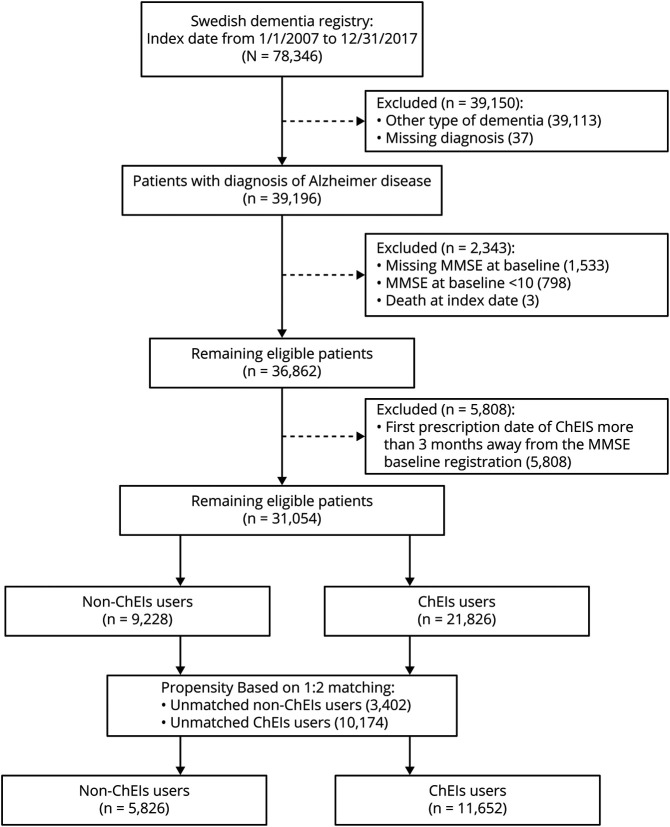
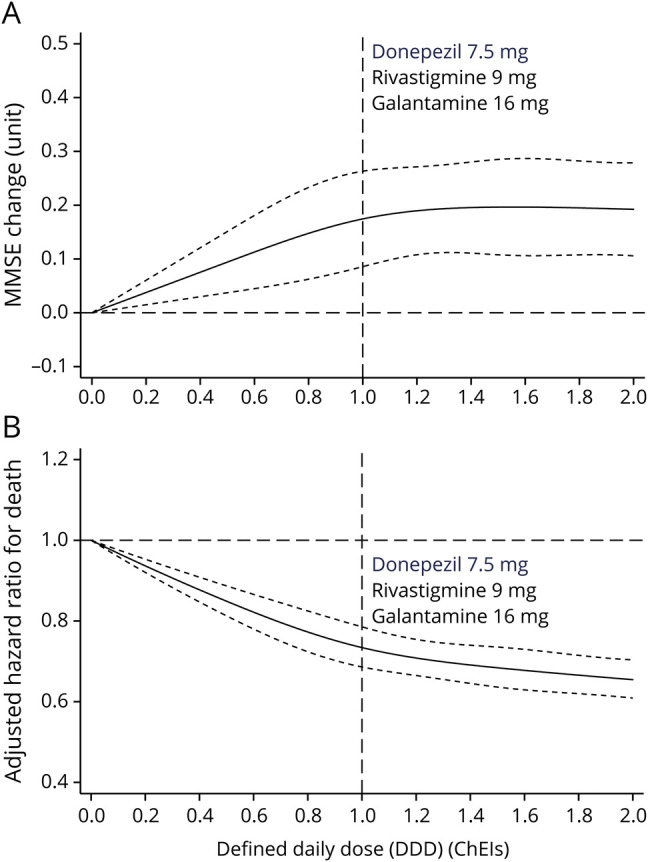
OBJECTIVE: To investigate whether cholinesterase inhibitors (ChEIs) are associated with slower cognitive decline in Alzheimer dementia and decreased risk of severe dementia or death. METHODS: Patients with Alzheimer dementia from the Swedish Dementia Registry starting on ChEIs within 3 months of the dementia diagnosis were included and compared to nontreated patients with Alzheimer dementia. In a propensity score-matched cohort, the association between ChEI use and cognitive trajectories assessed by Mini-Mental State Examination (MMSE) scores was examined with a mixed model, and severe dementia (MMSE score <10) or death as an outcome was assessed with Cox proportional hazards models. RESULTS: The matched cohort included 11,652 ChEI users and 5,826 nonusers. During an average of 5 years of follow-up, 255 cases developed severe dementia, and 6,055 (35%) died. ChEI use was associated with higher MMSE score at each visit (0.13 MMSE points per year; 95% confidence interval [CI] 0.06-0.20). ChEI users had a 27% lower risk of death (0.73, 95% CI 0.69-0.77) compared with nonusers. Galantamine was associated with lower risk of death (0.71, 95% CI 0.65-0.76) and lower risk of severe dementia (0.69, 95% CI 0.47-1.00) and had the strongest effect on cognitive decline of all the ChEIs (0.18 MMSE points per year, 95% CI 0.07-0.28). CONCLUSIONS: ChEIs are associated with cognitive benefits that are modest but persist over time and with reduced mortality risk, which could be explained partly by their cognitive effects. Galantamine was the only ChEI demonstrating a significant reduction in the risk of developing severe dementia. CLASSIFICATION OF EVIDENCE: This study provides Class III evidence that for patients with Alzheimer dementia ChEIs decrease long-term cognitive decline and risk of death and that galantamine decreases the risk of severe dementia.
Overview
The claims and statistics of this paper haven’t been checked yet.
Run the check — free, no account needed. It reads the open-access text and checks the sources it cites.
Integrity signals
Registry
Cites
Statistics
Figures
Verification
Claims the paper makes
The claims and statistics of this paper haven’t been checked yet.
Run the check — free, no account needed. It reads the open-access text and checks the sources it cites.
Claims other papers make about this one
Each is checked against this paper’s own text: does it say what the citing paper says it does?
The source backs part of the claim, not all of it — or backs it for a different population, condition or comparison.
In the citing paper
“These include a study demonstrating that 11,652 Swedish propensity-matched patients with AD who took ChEIs, compared to 5,826 who did not, performed slightly and persistently better during mean 5-years follow-up (MMSE 0.13; 0.06 -0.20 points per year better), with a doseresponse effect.(494)”
From Dementia prevention, intervention, and care: 2024 report of the Lancet standing Commission (2024) · cites this paper as [494]
Experimental — accuracy not yet measuredThe cited source says what the claim attributes to it.
In the citing paper
“When multiple dispensations were used, their DDD were added [36].”
From Antidepressant use and cognitive decline in patients with dementia: a national cohort study (2025) · cites this paper as [36]
Self-check
Percentages, sums and reported differences re-computed from the paper’s own numbers.
The self-check needs the paper’s full text.
Citations
Cites
External review and validation of the Swedish national inpatient register
Ludvigsson, J. F., Andersson, E., Ekbom, A., Feychting, M., Kim, J.-L., Reuterwall, C., Heurgren, M., & Olausson, P. O. (2011) · BMC Public Health · doi:10.1186/1471-2458-11-450 · Cited by 5,055
Nichols, E., Szoeke, C. E. I., Vollset, S. E., Abbasi, N., Abd-Allah, F., Abdela, J., Aichour, M. T. E., Akinyemi, R. O., Alahdab, F., Asgedom, S. W., et al. (2019) · The Lancet Neurology · doi:10.1016/s1474-4422(18)30403-4 · Cited by 2,412 · cited 1×
“The acetylcholinesterase inhibitors (ChEIs) and the NMDA receptor antagonist memantine are hitherto the only specific pharmacologic treatments approved for Alzheimer dementia, the most common type of dementia.(1) Although their benefit appears to be modest,(2,3) a significant body of evidence supports their effectiven…”
BackgroundBartus, R. T. (2000) · Experimental Neurology · doi:10.1006/exnr.2000.7397 · Cited by 829
Donepezil and memantine for moderate-to-severe Alzheimer's disease
Howard, R., McShane, R., Lindesay, J., Ritchie, C., Baldwin, A., Barber, R., Burns, A., Dening, T., Findlay, D., Holmes, C., et al. (2012) · New England Journal of Medicine · doi:10.1056/nejmoa1106668 · Cited by 782
Rivastigmine for Alzheimer’s disease.
Birks, J. S., Chong, L.-Y., & Grimley Evans, J. (2015) · Cochrane Database of Systematic Reviews · doi:10.1002/14651858.cd001191.pub4 · Cited by 534
Farlow, M., Anand, R., Messina Jr, J., Hartman, R., & Veach, J. (2000) · European Neurology · doi:10.1159/000008243 · Cited by 332
Porsteinsson, A., Grossberg, G., Mintzer, J., & Olin, J. (2008) · Current Alzheimer Research · doi:10.2174/156720508783884576 · Cited by 272
Wallin, Å. K., Andreasen, N., Eriksson, S., Båtsman, S., Näsman, B., Ekdahl, A., Kilander, L., Grut, M., Rydén, M., Wallin, A., et al. (2007) · Dementia and Geriatric Cognitive Disorders · doi:10.1159/000098052 · Cited by 84
Progression of Alzheimer disease in Europe: data from the European ICTUS study
Vellas, B., Hausner, L., Frolich, L., Cantet, C., Gardette, V., Reynish, E., Gillette, S., Aguera-Morales, E., Auriacombe, S., Boada, M., et al. (2012) · Current Alzheimer Research · doi:10.2174/156720512803251066 · Cited by 50
Self-citation
Research works printed but not linked: 41
- Birks JS, Harvey RJ. Donepezil for dementia due to Alzheimer's disease. Cochrane Database Syst Rev 2018;6:CD001190.
- 10.1038/nrneurol.2015.237 · DOI
- 10.1185/03007990903236731 · DOI
- 10.1016/S0140-6736(06)68350-5 · DOI
- 10.1111/ene.12707 · DOI · Paper page
- 10.1001/jama.291.3.317 · DOI · Paper page
- 10.1007/s40263-013-0077-7 · DOI
- 10.1371/journal.pone.0116538 · DOI
- 10.1101/lm.69204 · DOI · Paper page
- 10.3389/fnmol.2018.00051 · DOI
- 10.3389/fneur.2018.00642 · DOI
- 10.3389/fnins.2019.00472 · DOI
- 10.1212/WNL.57.3.489 · DOI
- 10.1212/WNL.57.3.481 · DOI
- 10.1016/S0140-6736(04)16499-4 · DOI · Paper page
- 10.1159/000080972 · DOI
- 10.1159/000437050 · DOI
- 10.2174/1567205015666180507105326 · DOI
- 10.1016/j.jalz.2018.02.011 · DOI
- 10.1093/eurheartj/eht182 · DOI
- 10.1038/srep29266 · DOI
- 10.1186/s12883-014-0173-4 · DOI
- 10.3233/JAD-131856 · DOI · Paper page
- Garcia-Ptacek S, Modeer IN, Kareholt I, et al. Differences in diagnostic process, treatment and social Support for Alzheimer's dementia between primary and specialist care: results from the Swedish Dementia Registry. Age Ageing 2017;46:314–319.
- National Board of Health and Welfare. Nationella riktlinjer för vård och omsorg vid demenssjukdom: stöd för styrning och ledning (National guidelines for health and social care of dementia diseases: support for organization and governance). Åtta.45 Tryckeri AB; 2017.
- World Health Organization. Defined Daily Dose: Essential Medicines and Health Products: ATC/DDD Toolkit[online]. Available at: who.int/medicines/regulation/medicines-safety/toolkit_ddd/en/. Accessed April 8, 2020.
- National Institute for Health and Care Excellence. National Institute for Health and Care Excellence: Clinical Guidelines: Dementia: Assessment, Management and Support for People Living With Dementia and Their Carers. National Institute for Health and Care Excellence; 2018.
- 10.1002/alz.12050 · DOI · Paper page
- 10.1007/s00228-019-02742-w · DOI
- 10.1002/gps.4893 · DOI
- 10.3233/JAD-180353 · DOI
- 10.1111/joim.12588 · DOI
- 10.2174/1567205015666181002134155 · DOI
- 10.1016/j.jamda.2017.08.014 · DOI
- 10.3233/JAD-170575 · DOI
- 10.1016/j.jagp.2019.06.008 · DOI
- 10.1016/S1474-4422(15)00258-6 · DOI
- 10.1002/gps.4583 · DOI
- 10.2174/156720510790274455 · DOI
- 10.1254/jphs.11R01CR · DOI
- SveDem. Svenska Demensregistret-Årsrapport 2018 (Swedish Dementia Registry-Yearly Report 2018). SveDem; 2018.
Cited by
Sorted by citations
Dementia prevention, intervention, and care: 2024 report of the Lancet standing Commission
Livingston, G., Huntley, J., Liu, K. Y., Costafreda, S. G., Selbæk, G., Alladi, S., Ames, D., Banerjee, S., Burns, A., Brayne, C., et al. (2024) · The Lancet · doi:10.1016/s0140-6736(24)01296-0 · Cited by 3,860
Reimagining cholinergic therapy for Alzheimer’s disease
Giacobini, E., Cuello, A. C., & Fisher, A. (2022) · Brain · doi:10.1093/brain/awac096 · Cited by 187
The role of astrocytic α7 nicotinic acetylcholine receptors in Alzheimer disease
Fontana, I. C., Kumar, A., & Nordberg, A. (2023) · Nature Reviews Neurology · doi:10.1038/s41582-023-00792-4 · Cited by 86
Zuin, M., Cherubini, A., Volpato, S., Ferrucci, L., & Zuliani, G. (2022) · Scientific Reports · doi:10.1038/s41598-022-16476-w · Cited by 72
Petek, B., Häbel, H., Xu, H., Villa-Lopez, M., Kalar, I., Hoang, M. T., Maioli, S., Pereira, J. B., Mostafaei, S., Winblad, B., et al. (2023) · Alzheimer's Research & Therapy · doi:10.1186/s13195-023-01360-0 · Cited by 65
Self-citationAntidepressant use and cognitive decline in patients with dementia: a national cohort study
Mo, M., Abzhandadze, T., Hoang, M. T., Sacuiu, S., Jurado, P. G., Pereira, J. B., Naia, L., Kele, J., Maioli, S., Xu, H., et al. (2025) · BMC Medicine · doi:10.1186/s12916-025-03851-3 · Cited by 45
Self-citationYaghmaei, E., Lu, H., Ehwerhemuepha, L., Zheng, J., Danioko, S., Rezaie, A., Sajjadi, S. A., & Rakovski, C. (2024) · Communications Medicine · doi:10.1038/s43856-024-00527-6 · Cited by 47
Dahlström, M., Madjid, N., Nordvall, G., Halldin, M. M., Vazquez-Juarez, E., Lindskog, M., Sandin, J., Winblad, B., Eriksdotter, M., & Forsell, P. (2021) · Cells · doi:10.3390/cells10081871 · Cited by 33
Self-citationTeixeira, A. L., Rocha, N. P., & Gatchel, J. (2023) · Arquivos de Neuro-Psiquiatria · doi:10.1055/s-0043-1777774 · Cited by 33
Fitzgerald, G. S., Chuchta, T. G., & McNay, E. C. (2023) · CNS Neuroscience & Therapeutics · doi:10.1111/cns.14160 · Cited by 22
Metadata
- Authors
- Xu, H., Garcia-Ptacek, S., Jönsson, L., Wimo, A., Nordström, P., & Eriksdotter, M.
- Affiliations
- Karolinska University Hospital (SE)
- From the Division of Clinical Geriatrics (H.X., S.G.-P., M.E.), Division of Neurogeriatrics (L.J., A.W.), Department of Neurobiology, Care Sciences and Society, and Department of Medical Epidemiology and Biostatistics (H.X.), Karolinska Institutet; Department of Internal Medicine (S.G.-P.), Neurology Section, Södersjukhuset, Stockholm, Sweden; H. Lundbeck A/S (L.J.), Copenhagen, Denmark; Department of Community Medicine and Rehabilitation (P.N.), Geriatric Medicine, Umeå University; and Theme Aging ...
- Corresponding author
- Xu, Hong
- Venue
- Neurology
- Published
- 2021-04-27
- Volume
- 96
- Issue
- 17
- Pages
- e2220-e2230
- ISSN
- 0028-3878 (ISSN-L)
- 1526-632X
- PMC
- PMC8166426
- OpenAlex
- W3138811377
- Cited by
- 182
- References
- 9
- Citations by year
- 2026: 23 · 2025: 32 · 2024: 26 · 2023: 35 · 2022: 49 · 2021: 16
- FWCI
- 22.60
- Type
- journal article
- Language
- en
- Open access
- hybrid
- doi.org
- Licence
- cc-by
- Locations
- Neurology (publishedVersion, cc-by)
- PubMed Central (publishedVersion, cc-by)
- PubMed (publishedVersion)
- DiVA at Umeå University (Umeå University) (submittedVersion, other-oa)
- Funders
- Svenska Sällskapet för Medicinsk Forskning
- Karolinska Institutet
- Stockholms Läns Landsting
- Umeå Universitet
- Forskningsrådet om Hälsa, Arbetsliv och Välfärd
- Topics
- Health Sciences › Medicine › Psychiatry and Mental health › Dementia and Cognitive Impairment Research
- Health Sciences › Medicine › Pharmacology (medical) › Cholinesterase and Neurodegenerative Diseases
- Life Sciences › Neuroscience › Cellular and Molecular Neuroscience › Alzheimer's disease research and treatments
- Keywords
- cholinesterase inhibitors, Alzheimer's disease, cognitive decline, mortality, galantamine, advanced dementia, Mini-Mental State Examination, long-term treatment outcomes
- MeSH terms
- Mental Status and Dementia Tests, Aged, Aged, 80 and over, Alzheimer Disease, Cholinesterase Inhibitors, Female, Humans, Male, Time, Cohort Studies, Proportional Hazards Models, Cognitive Dysfunction
About these checks
Registry, retraction, Cites and statistics results are computed, not judged, with one exception: a printed reference that no index lists is read once by a model before it counts as a citation error. Claims are extracted by a model and kept only when their quote appears verbatim in the text; each cited source is then checked, with a model’s help, for whether it says what the claim relies on. Those verdicts can be wrong — read the claim’s quote and the cited source before relying on one.
Statistics and arithmetic are recomputed, not judged.
Confidence bands are shown only for fields calibrated on our annotated test set. None is calibrated yet, so no band is shown.
What counts as a claim ›How we measure confidence ›How we check this ›
Are you an author, or do you see a problem with this page? Request a review
