

The DOI matches its Crossref record; 27 of the 27 references it cites were found in a registry or an index.
Safety of AADC Gene Therapy for Moderately Advanced Parkinson Disease: Three-Year Outcomes From the PD-1101 Trial
Open accessAbstract
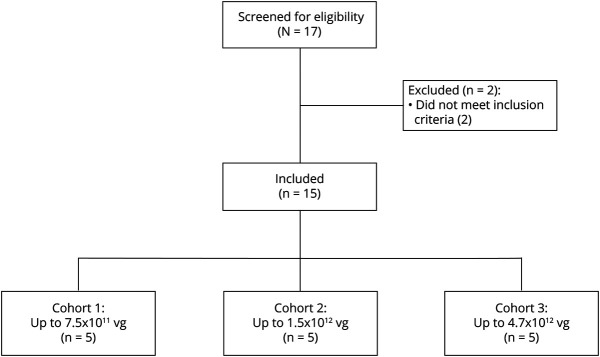
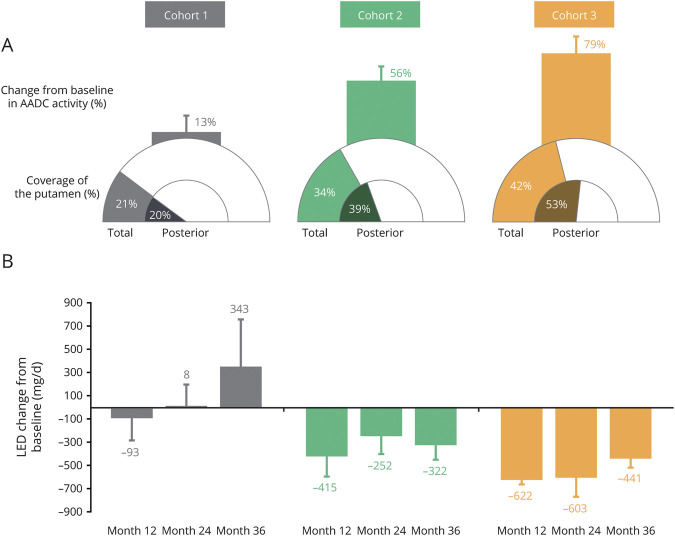
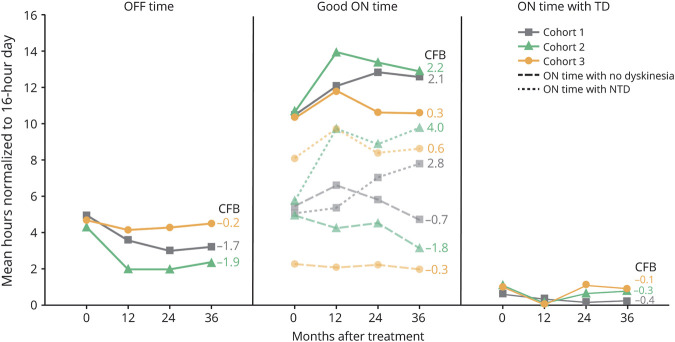
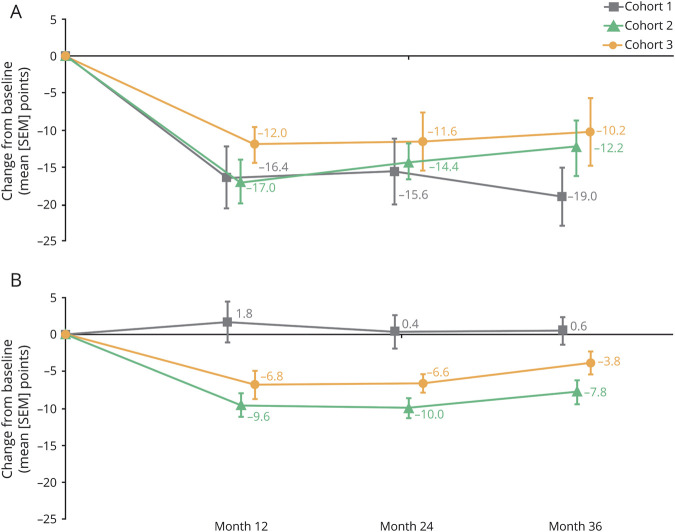
Background and Objectives To report final, 36-month safety and clinical outcomes from the PD-1101 trial of NBIb-1817 (VY-AADC01) in participants with moderately advanced Parkinson disease (PD) and motor fluctuations. Methods PD-1101 was a phase 1b, open-label, dose escalation trial of VY-AADC01, an experimental AAV2 gene therapy encoding the human aromatic l-amino acid decarboxylase (AADC) enzyme. VY-AADC01 was delivered via bilateral, intraoperative MRI-guided putaminal infusions to 3 cohorts (n = 5 participants per cohort): cohort 1, ≤7.5 × 10¹¹ vector genomes (vg); cohort 2, ≤1.5 × 10¹² vg; cohort 3, ≤4.7 × 10¹² vg. Results No serious adverse events (SAEs) attributed to VY-AADC01 were reported. All 4 non-vector–related SAEs (atrial fibrillation and pulmonary embolism in 1 participant and 2 events of small bowel obstruction in another participant) resolved. Requirements for PD medications were reduced by 21%–30% in the 2 highest dose cohorts at 36 months. Standard measures of motor function (PD diary, Unified Parkinson9s Disease Rating Scale III “off”-medication and “on”-medication scores), global impressions of improvement (Clinical Global Impression of Improvement, Patient Global Impression of Improvement), and quality of life (39-item Parkinson9s Disease Questionnaire) were stable or improved compared with baseline at 12, 24, and 36 months following VY-AADC01 administration across cohorts. Discussions VY-AADC01 and the surgical administration procedure were well-tolerated and resulted in stable or improved motor function and quality of life across cohorts, as well as reduced PD medication requirements in cohorts 2 and 3 over 3 years. Trial Registration Information NCT01973543. Classification of Evidence This study provides Class IV evidence that, in patients with moderately advanced PD and motor fluctuations, putaminal infusion of VY-AADC01 is well tolerated and may improve motor function.
Overview
The claims and statistics of this paper haven’t been checked yet.
Run the check — free, no account needed. It reads the open-access text and checks the sources it cites.
Integrity signals
Registry
Cites
Statistics
Figures
Verification
Claims the paper makes
The claims and statistics of this paper haven’t been checked yet.
Run the check — free, no account needed. It reads the open-access text and checks the sources it cites.
Claims other papers make about this one
Each is checked against this paper’s own text: does it say what the citing paper says it does?
The source backs part of the claim, not all of it — or backs it for a different population, condition or comparison.
In the citing paper
“Increasing dopamine production by AAV-mediated expression of the L-aromatic acid decarboxylase (AADC) enzyme, conferring benefits to some PD patients with moderately motor improvement [161]”
From Designing and optimizing AAV-mediated gene therapy for neurodegenerative diseases: from bench to bedside (2024) · cites this paper as [161]
Experimental — accuracy not yet measured
Self-check
Percentages, sums and reported differences re-computed from the paper’s own numbers.
The self-check needs the paper’s full text.
Citations
Cites
Systematic review of levodopa dose equivalency reporting in Parkinson's disease
Tomlinson, C. L., Stowe, R. L., Patel, S., Rick, C., Gray, R. G., & Clarke, C. E. (2010) · Movement Disorders · doi:10.1002/mds.23429 · Cited by 4,310
Levodopa and the Progression of Parkinson's Disease
The Parkinson Study Group (2004) · New England Journal of Medicine · doi:10.1056/nejmoa033447 · Cited by 1,844
Disease duration and the integrity of the nigrostriatal system in Parkinson’s disease
Kordower, J. H., Olanow, C. W., Dodiya, H. B., Chu, Y., Beach, T. G., Adler, C. H., Halliday, G. M., & Bartus, R. T. (2013) · Brain · doi:10.1093/brain/awt192 · Cited by 1,326
Marks, W. J., Bartus, R. T., Siffert, J. O., Davis, C. S., Lozano, A. M., Boulis, N. M., Vitek, J. L., Stacy, M. A., Turner, D. A., Verhagen, L., et al. (2010) · The Lancet Neurology · doi:10.1016/s1474-4422(10)70254-4 · Cited by 703
Self-citationLeWitt, P. A., Rezai, A. R., Leehey, M. A., Ojemann, S. G., Flaherty, A. W., Eskandar, E. N., Kostyk, S. K., Thomas, K., Sarkar, A., Siddiqui, M. S., et al. (2011) · The Lancet Neurology · doi:10.1016/s1474-4422(11)70039-4 · Cited by 681
Palfi, S., Gurruchaga, J. M., Ralph, G. S., Lepetit, H., Lavisse, S., Buttery, P. C., Watts, C., Miskin, J., Kelleher, M., Deeley, S., et al. (2014) · The Lancet · doi:10.1016/s0140-6736(13)61939-x · Cited by 484
Randomized trial of deep brain stimulation for Parkinson disease
Weaver, F. M., Follett, K. A., Stern, M., Luo, P., Harris, C. L., Hur, K., Marks, W. J., ROTHLIND, J. C., Sagher, O., Moy, C. S., et al. (2012) · Neurology · doi:10.1212/wnl.0b013e31825dcdc1 · Cited by 452
Safety and tolerability of putaminal AADC gene therapy for Parkinson disease
Christine, C. W., Starr, P. A., Larson, P. S., Eberling, J. L., Jagust, W. J., Hawkins, R. A., VanBrocklin, H. F., Wright, J. F., Bankiewicz, K. S., & Aminoff, M. J. (2009) · Neurology · doi:10.1212/wnl.0b013e3181c29356 · Cited by 445
Self-citationBankiewicz, K. S., Eberling, J. L., Kohutnicka, M., Jagust, W. J., Pivirotto, P., Bringas, J., Cunningham, J., Budinger, T. F., & Harvey-White, J. D. (2000) · Experimental Neurology · doi:10.1006/exnr.2000.7408 · Cited by 410
Self-citationA phase I study of aromatic L-amino acid decarboxylase gene therapy for Parkinson’s disease
Muramatsu, S.-I., Fujimoto, K.-I., Kato, S., Mizukami, H., Asari, S., Ikeguchi, K., Kawakami, T., Urabe, M., Kume, A., Sato, T., et al. (2010) · Molecular Therapy · doi:10.1038/mt.2010.135 · Cited by 344
Long-Term Evaluation of a Phase 1 Study of AADC Gene Therapy for Parkinson's Disease
Mittermeyer, G., Christine, C. W., Rosenbluth, K. H., Baker, S. L., Starr, P. A., Larson, P., Kaplan, P. L., Forsayeth, J., Aminoff, M. J., & Bankiewicz, K. S. (2012) · Human Gene Therapy · doi:10.1089/hum.2011.220 · Cited by 303
Self-citationHauser, R. A., Friedlander, J., Zesiewicz, T., Adler, C. H., Seeberger, L., O’Brien, C. F., Molho, E., & Factor, S. A. (2000) · Clinical Neuropharmacology · doi:10.1097/00002826-200003000-00003 · Cited by 302
Olanow, C. W., Bartus, R. T., Baumann, T. L., Factor, S. A., Boulis, N. M., Stacy, M. A., Turner, D. A., Marks, W. J., Larson, P., Starr, P. A., et al. (2015) · Annals of Neurology · doi:10.1002/ana.24436 · Cited by 293
Self-citationOh, M., Kim, J. S., Kim, J. Y., Shin, K.-H., Park, S. H., Kim, H. O., Moon, D. H., Oh, S. J., Chung, S. J., & Lee, C. S. (2012) · Journal of Nuclear Medicine · doi:10.2967/jnumed.111.095224 · Cited by 276
Gene Therapy for Neurodegenerative Diseases
Sudhakar, V., & Richardson, R. M. (2019) · Neurotherapeutics · doi:10.1007/s13311-018-00694-0 · Cited by 212
Self-citationChristine, C. W., Bankiewicz, K. S., Van Laar, A. D., Richardson, R. M., Ravina, B., Kells, A. P., Boot, B., Martin, A. J., Nutt, J., Thompson, M. E., et al. (2019) · Annals of Neurology · doi:10.1002/ana.25450 · Cited by 167
Self-citationPalfi, S., Gurruchaga, J. M., Lepetit, H., Howard, K., Ralph, G. S., Mason, S., Gouello, G., Domenech, P., Buttery, P. C., Hantraye, P., et al. (2018) · Human Gene Therapy Clinical Development · doi:10.1089/humc.2018.081 · Cited by 158
Eight Years of Clinical Improvement in MPTP-Lesioned Primates After Gene Therapy With AAV2-hAADC
Hadaczek, P., Eberling, J. L., Pivirotto, P., Bringas, J., Forsayeth, J., & Bankiewicz, K. S. (2010) · Molecular Therapy · doi:10.1038/mt.2010.106 · Cited by 158
Self-citationTrial of magnetic resonance–guided putaminal gene therapy for advanced Parkinson's disease
Heiss, J. D., Lungu, C., Hammoud, D. A., Herscovitch, P., Ehrlich, D. J., Argersinger, D. P., Sinharay, S., Scott, G. C., Wu, T., Federoff, H. J., et al. (2019) · Movement Disorders · doi:10.1002/mds.27724 · Cited by 130
Self-citationLong‐term safety and efficacy of levodopa‐carbidopa intestinal gel in advanced Parkinson's disease
Fernandez, H. H., Boyd, J. T., Fung, V. S. C., Lew, M., Rodriguez, R. L., Slevin, J. T., Standaert, D. G., Zadikoff, C., Vanagunas, A. D., Chatamra, K., et al. (2018) · Movement Disorders · doi:10.1002/mds.27338 · Cited by 100
Su, X., Kells, A. P., Salegio, E. A., Richardson, R. M., Hadaczek, P., Beyer, J., Bringas, J., Pivirotto, P., Forsayeth, J., & Bankiewicz, K. S. (2010) · Molecular Therapy · doi:10.1038/mt.2010.114 · Cited by 82
Self-citationLeWitt, P. A., Boroojerdi, B., Surmann, E., & Poewe, W. H. (2012) · Journal of Neural Transmission · doi:10.1007/s00702-012-0925-5 · Cited by 57
Aromatic L‐Amino Acid Decarboxylase Gene Therapy Enhances Levodopa Response in Parkinson's Disease
Nutt, J. G., Curtze, C., Hiller, A., Anderson, S., Larson, P., Laar, A. D. V., Richardson, R. M., Thompson, M. E., Sedkov, A., Leinonen, M., et al. (2020) · Movement Disorders · doi:10.1002/mds.27993 · Cited by 57
Self-citationData-driven evolution of neurosurgical gene therapy delivery in Parkinson’s disease
Richardson, R. M., Bankiewicz, K. S., Christine, C. W., Laar, A. D. V., Gross, R. E., Lonser, R. R., Factor, S. A., Kostyk, S. K., Kells, A. P., Ravina, B. M., et al. (2020) · Journal of Neurology Neurosurgery & Psychiatry · doi:10.1136/jnnp-2020-322904 · Cited by 48
Self-citationCiesielska, A., Samaranch, L., Sebastián, W. S., Dickson, D. W., Goldman, S. M., Forsayeth, J., & Bankiewicz, K. S. (2017) · PLoS ONE · doi:10.1371/journal.pone.0169965 · Cited by 39
Self-citationStewart, H. J., Ralph, G. S., Fong-Wong, L., Strickland, I. T., McCloskey, L., Barnes, L., Blount, I., Wells, O. S., Truran, C. J. M., Kingsman, A. J., et al. (2016) · Human Gene Therapy Clinical Development · doi:10.1089/humc.2016.056 · Cited by 31
Optimizing extended-release carbidopa/levodopa in Parkinson disease
Espay, A. J., Pagán, F., Walter, B. L., Morgan, J. C., Elmer, L. W., Waters, C., Agarwal, P., Dhall, R., Ondo, W. G., Klos, K. J., et al. (2017) · Neurology Clinical Practice · doi:10.1212/cpj.0000000000000316 · Cited by 26
Research works printed but not linked: 1
- Factor S, Van Laar A, Richardson R, et al. AADC gene therapy administered via a posterior approach: 18-month results from the PD-1102 trial in advanced Parkinson's disease. Mov Disord. 2020;35(suppl 1); Abstract 889.
Cited by
Sorted by citations
AAV-based in vivo gene therapy for neurological disorders
Ling, Q., Herstine, J. A., Bradbury, A. M., & Gray, S. J. (2023) · Nature Reviews Drug Discovery · doi:10.1038/s41573-023-00766-7 · Cited by 223
Deuschl, G., Antonini, A., Costa, J. N., Śmiłowska, K., Berg, D., Corvol, J., Fabbrini, G., Ferreira, J. J., Foltynie, T., Mir, P., et al. (2022) · Movement Disorders · doi:10.1002/mds.29066 · Cited by 197
Darehbagh, R. R., Seyedoshohadaei, S. A., Ramezani, R., & Rezaei, N. (2024) · European journal of medical research · doi:10.1186/s40001-024-01987-1 · Cited by 188
AAV vectors applied to the treatment of CNS disorders: Clinical status and challenges
Kang, L., Jin, S., Wang, J., Lv, Z., Xin, C., Tan, C., Zhao, M., Wang, L., & Liu, J. (2023) · Journal of Controlled Release · doi:10.1016/j.jconrel.2023.01.067 · Cited by 131
Deuschl, G., Antonini, A., Costa, J. N., Śmiłowska, K., Berg, D., Corvol, J., Fabbrini, G., Ferreira, J. J., Foltynie, T., Mir, P., et al. (2022) · European Journal of Neurology · doi:10.1111/ene.15386 · Cited by 118
Metadata
- Authors
- Christine, C. W., Richardson, R. M., Van Laar, A. D., Thompson, M. E., Fine, E. M., Khwaja, O. S., Li, C., Liang, G. S., Meier, A., Roberts, E. W., Pfau, M. L., Rodman, J. R., Bankiewicz, K. S., & Larson, P. S.
- Affiliations
- Harvard University (US)
- From the Departments of Neurology (C.W.C.) and Neurological Surgery (M.E.T., K.S.B., P.S.L.), University of California, San Francisco; Department of Neurosurgery (R.M.R.), Massachusetts General Hospital; Harvard Medical School (R.M.R.), Boston, MA; Department of Neurology (A.D.V.L.), University of Pittsburgh Medical Center, PA; Brain Neurotherapy Bio (A.D.V.L.), Inc., Columbus, OH; Voyager Therapeutics, Inc. (E.M.F., O.S.K., C.L., A.M.), Cambridge, MA; Neurocrine Biosciences, Inc. (G.S.L., E.W.R.),...
- Corresponding author
- Christine, Chadwick W.
- ORCID
- Venue
- Neurology
- Published
- 2022-01-04
- Volume
- 98
- Issue
- 1
- Pages
- e40-e50
- ISSN
- 0028-3878 (ISSN-L)
- 1526-632X
- PMC
- PMC8726573
- OpenAlex
- W3206548941
- Cited by
- 89
- References
- 27
- Citations by year
- 2026: 15 · 2025: 18 · 2024: 28 · 2023: 14 · 2022: 14
- FWCI
- 6.70
- Type
- journal article
- Language
- en
- Open access
- hybrid
- doi.org
- Licence
- cc-by-nc-nd
- Locations
- Neurology (publishedVersion, cc-by-nc-nd)
- PubMed Central (publishedVersion, cc-by-nc-nd)
- PubMed (publishedVersion)
- eScholarship (California Digital Library) (submittedVersion, cc-by-nc-nd)
- Topics
- Health Sciences › Medicine › Clinical Neurology › Parkinson's Disease Mechanisms and Treatments
- Life Sciences › Biochemistry, Genetics and Molecular Biology › Genetics › Virus-based gene therapy research
- Health Sciences › Medicine › Clinical Neurology › Deep Brain Stimulation and Movement Disorders
- Keywords
- Parkinson's disease, gene therapy, AAV2 vector, motor fluctuations, dose escalation, safety, motor function, quality of life
- MeSH terms
- Amino Acids, Antiparkinson Agents, Carboxy-Lyases, Humans, Parkinson Disease, Quality of Life, Genetic Therapy, Treatment Outcome
About these checks
Registry, retraction, Cites and statistics results are computed, not judged, with one exception: a printed reference that no index lists is read once by a model before it counts as a citation error. Claims are extracted by a model and kept only when their quote appears verbatim in the text; each cited source is then checked, with a model’s help, for whether it says what the claim relies on. Those verdicts can be wrong — read the claim’s quote and the cited source before relying on one.
Statistics and arithmetic are recomputed, not judged.
Confidence bands are shown only for fields calibrated on our annotated test set. None is calibrated yet, so no band is shown.
What counts as a claim ›How we measure confidence ›How we check this ›
Are you an author, or do you see a problem with this page? Request a review
