

The DOI matches its Crossref record; 40 of the 40 references it cites were found in a registry or an index; 10 of the 57 sources its claims cite were checked for support.
International Recommendations for the Diagnosis and Management of Patients With Adrenoleukodystrophy
Open accessAbstract
gene cause adrenoleukodystrophy (ALD), a progressive metabolic disorder characterized by 3 core clinical syndromes: a slowly progressive myeloneuropathy, a rapidly progressive inflammatory leukodystrophy (cerebral ALD), and primary adrenal insufficiency. These syndromes are not present in all individuals and are not related to genotype. Cerebral ALD and adrenal insufficiency require early detection and intervention and warrant clinical surveillance because of variable penetrance and age at onset. Newborn screening has increased the number of presymptomatic individuals under observation, but clinical surveillance protocols vary. We used a consensus-based modified Delphi approach among 28 international ALD experts to develop best-practice recommendations for diagnosis, clinical surveillance, and treatment of patients with ALD. We identified 39 discrete areas of consensus. Regular monitoring to detect the onset of adrenal failure and conversion to cerebral ALD is recommended in all male patients. Hematopoietic cell transplant (HCT) is the treatment of choice for cerebral ALD. This guideline addresses a clinical need in the ALD community worldwide as the number of overall diagnoses and presymptomatic individuals is increasing because of newborn screening and greater availability of next-generation sequencing. The poor ability to predict the disease course informs current monitoring intervals but remains subject to change as more data emerge. This knowledge gap should direct future research and illustrates once again that international collaboration among physicians, researchers, and patients is essential to improving care.
Overview
AI snapshot
Written from the paper’s full text.
TL;DR
This international modified Delphi consensus provides best-practice recommendations for diagnosis, clinical surveillance, and treatment of adrenoleukodystrophy (ALD), covering cerebral ALD, myeloneuropathy, adrenal insufficiency, and related management. It recommends regular monitoring in all male patients for adrenal failure and conversion to cerebral ALD, with hematopoietic cell transplant (HCT) as the treatment of choice for cerebral ALD.
Key findings
- Consensus was reached on 39 discrete areas among 28 international ALD experts. Recommendations include considering cerebral ALD in boys and men with white matter abnormalities on brain MRI suggestive of ALD; ALD-related myelopathy in adult men and women with chronic myelopathy and a normal MRI; and ALD-related adrenal insufficiency in boys and men with primary adrenal insufficiency without detectable steroid-21-hydroxylase or other organ-specific antibodies.
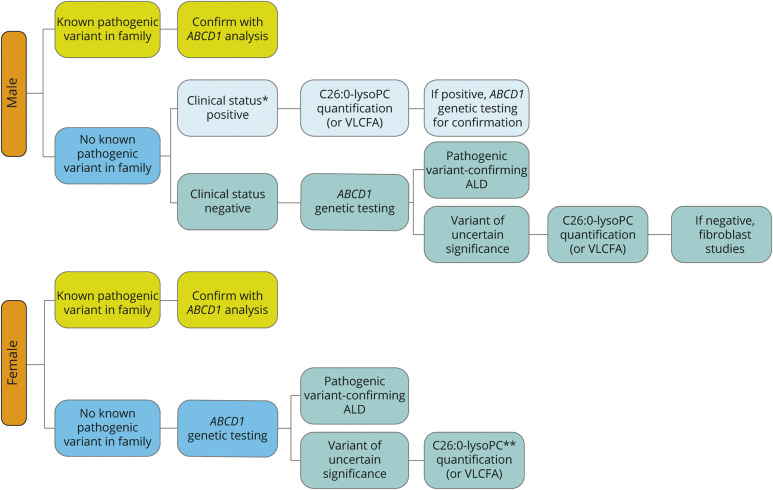
- Diagnostic testing: *ABCD1* genetic testing is the gold standard; plasma C26:0-lysophosphatidylcholine (C26:0-lysoPC) has superior diagnostic performance, and if unavailable, fasting plasma very-long-chain fatty acids (VLCFAs) should be obtained. In women, VLCFA sensitivity is 85%, whereas C26:0-lysoPC sensitivity is >99%.
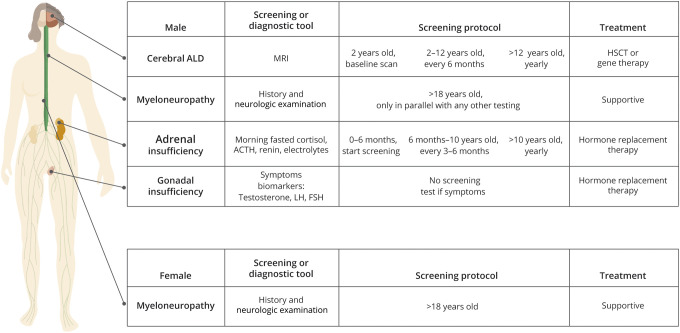
- Surveillance: all boys and men should be screened for cerebral ALD with baseline MRI at age 2 years, every 6 months between ages 2 and 12 years, and yearly from age 12 years; routine cerebral ALD screening is not recommended in girls and women. All boys and men should be screened for adrenal insufficiency with early morning cortisol and ACTH starting in the first 6 months of life, every 3–6 months before age 10 years, and yearly thereafter, with mineralocorticoid deficiency screening using plasma renin and serum electrolytes.
- Treatment: allogeneic HCT is the standard treatment for cerebral ALD and can halt progression; eligibility should be determined by an ALD transplantation expert. In general, boys are considered eligible with gadolinium-enhancing demyelination, Loes score ≤9, and neurologic function score 0 or 1; adult men with enhancing lesions and no or few neurocognitive impairments. Gene therapy should be considered in boys if allogeneic donor options are poor. Myeloneuropathy treatment is supportive; adrenal insufficiency is treated with glucocorticoid replacement; data supporting Lorenzo’s oil as disease-modifying are insufficient.
Methods
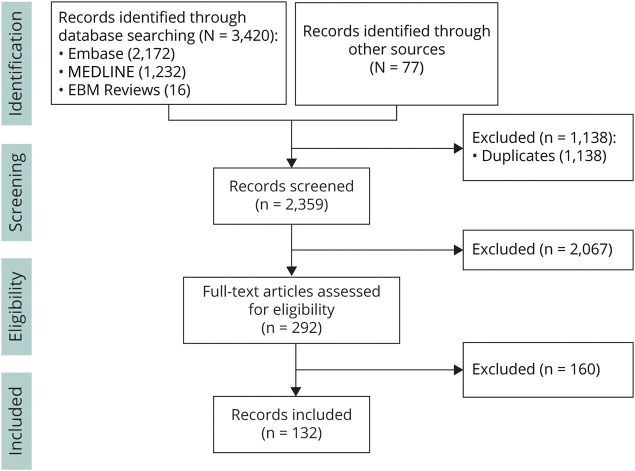
- Three ALD centers of excellence initiated the project; 30 professionals were invited, and 28 international ALD experts participated. Patient advocacy groups provided written comments, and a literature review identified 132 relevant articles, mostly small retrospective and observational studies.
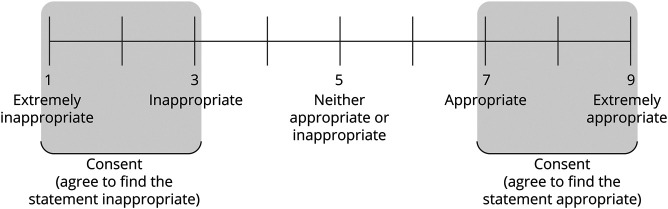
- A modified Delphi approach was used with 2 questionnaire rounds and 1 consensus meeting. Experts rated agreement on a 9-point scale; consensus was defined as >80% rating agreement between 7 and 9 or disagreement between 1 and 3. Twenty-eight experts participated in round 1, 26 in round 2, and 20 in the consensus meeting; all 28 agreed to the final recommendations.
- The literature search covered Embase, MEDLINE, and Evidence-Based Medicine Reviews for publications from 1990 to 2019, limited to English full-text and human studies, with gray literature and snowballing; study quality was assessed with the Newcastle-Ottawa Scale.
Limitations
- Stated: the consensus approach is at risk for bias because of panelist selection and repeat review; the panel is small, clinical experience varied, and no correction was applied for differences in experience. Consensus was defined as >80% agreement, so some panelists did not agree with specific recommendations.
- Stated: some topics did not reach consensus, including the exact timing of adrenal testing in the first year of life, invasive spasticity treatments, urinary incontinence, neuropsychological testing as a screening tool, and bone health evaluation in men. The poor ability to predict disease course informs current monitoring intervals but remains subject to change as more data emerge.
- Evident from the text: recommendations are consensus-based because the literature was mostly small retrospective and observational studies, with a lack of prospective natural history studies and controlled clinical trials. Long-term safety data for ex vivo gene therapy are not yet available, and data on HCT effects on myeloneuropathy or adrenal insufficiency are limited.
Model-written summary. Check it against the paper before relying on it.
Integrity signals
Registry
Cites
Statistics
Figures
Verification
Claims the paper makes
20 Own method · 19 Sources not found · 15 No basis given · 9 No full text of the sources · 7 Own interpretation · 5 Partly supported · 3 Not checked yet · 3 Own result · 1 Supported · accuracy not yet measured
Every source the paper cites for this claim was checked and supports it.
In the paper
“For biochemical testing, plasma C26:0-lysophosphatidylcholine (C26:0-lysoPC) has superior diagnostic performance.18”
§ International Recommendations for the Diagnosis and Management of Patients With Adrenoleukodystrophy > Results > Diagnostic Tests
What the sources say
- Supportedcites [18] Jaspers YRJ, Ferdinandusse S, Dijkstra IME, et al. Comparison of the diagnostic performance of C26:0-lysophosphatidylcholine and very long-chain fatty acids analysis for peroxisomal disorders. Front Cell Dev Biol. 2020; 8: 690. 32903870 PMC7438929 source
The Discussion (Comparison of C26:0-LPC and VLCFA; page unavailable) states that C26:0-LPC analysis in plasma or dried blood spots has superior diagnostic performance to the VLCFA markers C26:0 and C26:0/C22:0 for ALD and ZSD patients. This supports the claim about plasma C26:0-lysoPC in that diagnostic context. (LLM, conf=0.93)
plaincorrelational- Asserted: passes — The authors put it forward as true.
- Checkable: passes — It can be checked against evidence.
- Load-bearing: passes — The paper’s conclusions depend on it.
- Based: passes — The paper gives a reason why it holds.
- Supported
None of the sources cited for this claim have been checked yet.
In the paper
“Gadolinium enhancement just behind the leading edge of the lesion indicates active disease.25-27”
§ International Recommendations for the Diagnosis and Management of Patients With Adrenoleukodystrophy > Results > Cerebral ALD
What the sources say
- Not checked — no full text of the sourcecites [25] Melhem ER, Loes DJ, Georgiades CS, Raymond GV, Moser HW. X-linked adrenoleukodystrophy: the role of contrast-enhanced MR imaging in predicting disease progression. AJNR Am J Neuroradiol. 2000; 21(5): 839- 844. 10815658 PMC7976769
- Not matchedcites [26] Van der Knaap MSV, J. Resonance of Myelination and Myelin Disorders. In: Heilmann U, ed.: Springer; 2005: 176- 190.
Couldn’t be matched to a paper in Crossref, so it can’t be checked.
- Not checked — no full text of the sourcecites [27] Powers JM, Liu Y, Moser AB, Moser HW. The inflammatory myelinopathy of adreno-leukodystrophy: cells, effector molecules, and pathogenetic implications. J Neuropathol Exp Neurol. 1992; 51(6): 630- 643. 1362438 source
hedgedcorrelational- Asserted: passes — The authors put it forward as true.
- Checkable: passes — It can be checked against evidence.
- Load-bearing: passes — The paper’s conclusions depend on it.
- Based: passes — The paper gives a reason why it holds.
In the paper
“Differentiating active from arrested white matter lesions can be challenging.13,25,39,40,e1”
§ International Recommendations for the Diagnosis and Management of Patients With Adrenoleukodystrophy > Results > Alternative Methods for Screening and Diagnosis of Cerebral Disease
What the sources say
- Not matchedcites 13,25,39,40,e1
Couldn’t be matched to a paper in Crossref, so it can’t be checked.
plain- Asserted: passes — The authors put it forward as true.
- Checkable: passes — It can be checked against evidence.
- Load-bearing: passes — The paper’s conclusions depend on it.
- Based: passes — The paper gives a reason why it holds.
- Not matched
In the paper
“The use of standardized clinimetric tests and electrophysiologic testing remains restricted to research settings.7,14,16,17,31,e24,e26,e27”
§ International Recommendations for the Diagnosis and Management of Patients With Adrenoleukodystrophy > Results > Non–Cerebral-Related Treatment Effects of Transplantation on Myeloneuropathy and Adrenal Insufficiency
What the sources say
- Not matchedcites 7,14,16,17,31,e24,e26,e27
Couldn’t be matched to a paper in Crossref, so it can’t be checked.
plain- Asserted: passes — The authors put it forward as true.
- Checkable: passes — It can be checked against evidence.
- Load-bearing: unclear — It is unclear whether the paper’s conclusions depend on it.
- Based: passes — The paper gives a reason why it holds.
- Not matched
In the paper
“Severe head trauma has been reported as possible trigger for cerebral ALD.e20-e22”
§ International Recommendations for the Diagnosis and Management of Patients With Adrenoleukodystrophy > Results > Non–Cerebral-Related Treatment Effects of Transplantation on Myeloneuropathy and Adrenal Insufficiency
What the sources say
- Not matchedcites e20-e22
Couldn’t be matched to a paper in Crossref, so it can’t be checked.
hedgedconditional- Asserted: passes — The authors put it forward as true.
- Checkable: passes — It can be checked against evidence.
- Load-bearing: passes — The paper’s conclusions depend on it.
- Based: passes — The paper gives a reason why it holds.
- Not matched
The paper states this without a source or data behind it here, so there is nothing to check it against. The quote shows it is in the paper.
In the paper
“Data to support the efficacy of Lorenzo's oil as a disease-modifying treatment in patients with ALD are insufficient.”
§ International Recommendations for the Diagnosis and Management of Patients With Adrenoleukodystrophy > Discussion > Dietary Therapy
plain- Asserted: passes — The authors put it forward as true.
- Checkable: passes — It can be checked against evidence.
- Load-bearing: passes — The paper’s conclusions depend on it.
- Based: unclear — It is unclear why the paper says it holds.
In the paper
“In boys, autologous hematopoietic stem cell transplantation after ex vivo lentiviral gene therapy has been studied as a safer alternative.”
§ International Recommendations for the Diagnosis and Management of Patients With Adrenoleukodystrophy > Results > Cerebral ALD Treatment
What the sources say
- Not matchedcites e15-e17
Couldn’t be matched to a paper in Crossref, so it can’t be checked.
plainconditional- Asserted: passes — The authors put it forward as true.
- Checkable: passes — It can be checked against evidence.
- Load-bearing: unclear — It is unclear whether the paper’s conclusions depend on it.
- Based: passes — The paper gives a reason why it holds.
- Not matched
The paper states this without a source or data behind it here, so there is nothing to check it against. The quote shows it is in the paper.
In the paper
“Currently, this therapy is not available for routine care.”
§ International Recommendations for the Diagnosis and Management of Patients With Adrenoleukodystrophy > Results > Cerebral ALD Treatment
plain- Asserted: passes — The authors put it forward as true.
- Checkable: passes — It can be checked against evidence.
- Load-bearing: passes — The paper’s conclusions depend on it.
- Based: passes — The paper gives a reason why it holds.
In the paper
“Several biomarkers (i.e., plasma neurofilament light, chitotriosidase and cytokine levels) have been studied for this purpose but require additional validation.e2-e5”
§ International Recommendations for the Diagnosis and Management of Patients With Adrenoleukodystrophy > Results > Alternative Methods for Screening and Diagnosis of Cerebral Disease
What the sources say
- Not matchedcites e2-e5
Couldn’t be matched to a paper in Crossref, so it can’t be checked.
plaincorrelational- Asserted: passes — The authors put it forward as true.
- Checkable: passes — It can be checked against evidence.
- Load-bearing: unclear — It is unclear whether the paper’s conclusions depend on it.
- Based: passes — The paper gives a reason why it holds.
- Not matched
In the paper
“Neuropsychological changes may precede MRI changes,e6,e7”
§ International Recommendations for the Diagnosis and Management of Patients With Adrenoleukodystrophy > Results > Alternative Methods for Screening and Diagnosis of Cerebral Disease
What the sources say
- Not matchedcites e6,e7
Couldn’t be matched to a paper in Crossref, so it can’t be checked.
hedgedconditional- Asserted: passes — The authors put it forward as true.
- Checkable: passes — It can be checked against evidence.
- Load-bearing: passes — The paper’s conclusions depend on it.
- Based: passes — The paper gives a reason why it holds.
- Not matched
- It may state two separate claims as one. 24
- Probably not a substantial claim. 31
The cited sources support only part of this claim — read each source’s verdict below.
In the paper
“The risk of developing cerebral disease is highest in childhood but remains present throughout life.1,29,33-39”
§ International Recommendations for the Diagnosis and Management of Patients With Adrenoleukodystrophy > Results > Screening for Cerebral ALD
What the sources say
- Not checked — no full text of the sourcecites [1] Kemp S, Huffnagel IC, Linthorst GE, Wanders RJ, Engelen M. Adrenoleukodystrophy - neuroendocrine pathogenesis and redefinition of natural history. Nat Rev Endocrinol. 2016; 12(10): 606- 615. 27312864 source
- Partly supportedcites [29] Mallack EJ, Turk BR, Yan H, et al. MRI surveillance of boys with X-linked adrenoleukodystrophy identified by newborn screening: Meta-analysis and consensus guidelines. J Inherit Metab Dis. 2021; 44(3): 728- 739. 33373467 PMC8113077 sourceExperimental — accuracy not yet measured
The Results (Surveillance guidelines; page unavailable) say the risk peaks at ages 3–12 and declines during the teenage years. The Methods exclude studies focused solely on adults, so this paper does not establish that the risk remains present throughout life. (LLM, conf=0.87)
- Not checked — no full text of the sourcecites [33] Huffnagel IC, Laheji FK, Aziz-Bose R, et al. The natural history of adrenal insufficiency in X-linked adrenoleukodystrophy: an international collaboration. J Clin Endocrinol Metab. 2019; 104(1): 118- 126. 30252065 source
- Not checked — no full text of the sourcecites [34] Baumann M, Korenke GC, Weddige-Diedrichs A, et al. Haematopoietic stem cell transplantation in 12 patients with cerebral X-linked adrenoleukodystrophy. Eur J Pediatr. 2003; 162(1): 6- 14. 12486501 source
- Supportedcites [35] Kuhl JS, Suarez F, Gillett GT, et al. Long-term outcomes of allogeneic haematopoietic stem cell transplantation for adult cerebral X-linked adrenoleukodystrophy. Brain. 2017; 140(4): 953- 966. 28375456 source
The Introduction (page unavailable) says cerebral X-linked adrenoleukodystrophy affects about a third of males in childhood, while primary cerebral disease in adolescence or adulthood is uncommon. It also reports secondary cerebral demyelination in adult males with adrenomyeloneuropathy, supporting the point that cerebral disease can develop beyond childhood. (LLM, conf=0.85)
- Not checked — no full text of the sourcecites [36] Mahmood A, Raymond GV, Dubey P, Peters C, Moser HW. Survival analysis of haematopoietic cell transplantation for childhood cerebral X-linked adrenoleukodystrophy: a comparison study. Lancet Neurol. 2007; 6(8): 687- 692. 17618834 source
- Partly supportedcites [37] Vargas CR, Coelho DD, Barschak AG, et al. X-linked adrenoleukodystrophy: clinical and laboratory findings in 15 Brazilian patients. Genet Mol Biol. 2000; 23(2): 261- 264. sourceExperimental — accuracy not yet measured
The Introduction (page unavailable) says childhood X-ALD usually develops symptoms at ages four to eight, including demyelination and leukodystrophy. The Results and Discussion table (page unavailable) reports leukodystrophy in 10 of 11 childhood X-ALD patients and 2 of 4 adult-onset AMN patients. This supports cerebral involvement in childhood and adulthood, but the small case series does not establish that the risk is highest in childhood or persists throughout life. (LLM, conf=0.82)
- Not checked — no full text of the sourcecites [38] Raymond GV, Aubourg P, Paker A, et al. Survival and functional outcomes in boys with cerebral adrenoleukodystrophy with and without hematopoietic stem cell transplantation. Biol Blood Marrow Transpl. 2019; 25(3): 538- 548. 30292747 source
- Not checked — no full text of the sourcecites [39] Liberato AP, Mallack EJ, Aziz-Bose R, et al. MRI brain lesions in asymptomatic boys with X-linked adrenoleukodystrophy. Neurology. 2019; 92(15): e1698- e708. 30902905 PMC6511088 source
plaincorrelational- Asserted: passes — The authors put it forward as true.
- Checkable: passes — It can be checked against evidence.
- Load-bearing: passes — The paper’s conclusions depend on it.
- Based: passes — The paper gives a reason why it holds.
It may state two separate claims as one.
The cited sources support only part of this claim — read each source’s verdict below.
In the paper
“Women develop myeloneuropathy; men can develop all 3 syndromes.7-9”
§ International Recommendations for the Diagnosis and Management of Patients With Adrenoleukodystrophy > Abstract
What the sources say
- Not checked — no full text of the sourcecites [7] Engelen M, Barbier M, Dijkstra IM, et al. X-linked adrenoleukodystrophy in women: a cross-sectional cohort study. Brain. 2014; 137(Pt 3): 693- 706. 24480483 source
- Supportedcites [8] Huffnagel IC, Dijkgraaf MGW, Janssens GE, et al. Disease progression in women with X-linked adrenoleukodystrophy is slow. Orphanet J Rare Dis. 2019; 14(1): 30. 30732635 PMC6367840 source
The Background states that more than 80% of women with ALD eventually develop progressive spinal cord disease. It also lists spinal cord disease, primary adrenal insufficiency, and cerebral inflammatory disease in the clinical spectrum for men. The paper notes that adrenal insufficiency and cerebral disease can occur in women too, but the citing sentence does not say they cannot. (LLM, conf=0.93)
- Partly supportedcites [9] Habekost CT, Schestatsky P, Torres VF, et al. Neurological impairment among heterozygote women for X-linked Adrenoleukodystrophy: a case control study on a clinical, neurophysiological and biochemical characteristics. Orphanet J Rare Dis. 2014; 9: 6. 24410807 PMC3896743 sourceExperimental — accuracy not yet measured
The Background reports that some women with X-ALD develop myeloneuropathy resembling adrenomyeloneuropathy. It also names cerebral ALD and adrenomyeloneuropathy as male phenotypes, but does not identify three core syndromes or state that men can develop all three. The indexed copy provides no page numbers for these passages. (LLM, conf=0.86)
plain- Asserted: passes — The authors put it forward as true.
- Checkable: passes — It can be checked against evidence.
- Load-bearing: unclear — It is unclear whether the paper’s conclusions depend on it.
- Based: passes — The paper gives a reason why it holds.
It may state two separate claims as one.
The cited sources support only part of this claim — read each source’s verdict below.
In the paper
“In women, the sensitivity of VLCFAs analysis is 85%, whereas C26:0-lysoPC has a sensitivity of >99%.18,19,22”
§ International Recommendations for the Diagnosis and Management of Patients With Adrenoleukodystrophy > Results > Diagnostic Tests
What the sources say
- Partly supportedcites [18] Jaspers YRJ, Ferdinandusse S, Dijkstra IME, et al. Comparison of the diagnostic performance of C26:0-lysophosphatidylcholine and very long-chain fatty acids analysis for peroxisomal disorders. Front Cell Dev Biol. 2020; 8: 690. 32903870 PMC7438929 sourceExperimental — accuracy not yet measured
The Discussion (page not available) reports that plasma VLCFA analysis gives false negatives in approximately 15–20% of women with ALD, consistent with roughly 80–85% sensitivity. The Results report elevated C26:0-LPC in all 19 women with ALD studied, but that small cohort does not establish a general sensitivity greater than 99% in women. (LLM, conf=0.84)
- Not checked — no full text of the sourcecites [19] Huffnagel IC, van de Beek MC, Showers AL, et al. Comparison of C26:0-carnitine and C26:0-lysophosphatidylcholine as diagnostic markers in dried blood spots from newborns and patients with adrenoleukodystrophy. Mol Genet Metab. 2017; 122(4): 209- 215. 29089175 source
- Not checked — no full text of the sourcecites [22] Moser AB, Kreiter N, Bezman L, et al. Plasma very long chain fatty acids in 3,000 peroxisome disease patients and 29,000 controls. Ann Neurol. 1999; 45(1): 100- 110. 9894883 source
plain- Asserted: passes — The authors put it forward as true.
- Checkable: passes — It can be checked against evidence.
- Load-bearing: passes — The paper’s conclusions depend on it.
- Based: passes — The paper gives a reason why it holds.
It may state two separate claims as one.
- Partly supported
The cited sources support only part of this claim — read each source’s verdict below.
In the paper
“ALD has a birth prevalence of 1:15,000 (male patients and female patients).10”
§ International Recommendations for the Diagnosis and Management of Patients With Adrenoleukodystrophy > Abstract
What the sources say
- Partly supportedcites [10] Moser A, Jones RO, Hubbard WC, et al. Newborn screening for X-linked adrenoleukodystrophy. Int J Neonatal Screen. 2016; 2(4): 1- 5. PMC6715319 31467997 sourceExperimental — accuracy not yet measured
The Introduction reports an estimated minimum birth incidence of about 1 in 17,000 for males and females combined in the United States. The Discussion reports approximately 1 in 14,700 positive newborn screens in New York, close to the claimed 1 in 15,000, but does not present that figure as the overall birth prevalence for males and females. (LLM, conf=0.87)
plain- Asserted: passes — The authors put it forward as true.
- Checkable: passes — It can be checked against evidence.
- Load-bearing: fails — The paper’s conclusions may not depend on it.
- Based: passes — The paper gives a reason why it holds.
Probably not a substantial claim. The paper’s conclusions may not depend on it.
- Partly supported
The cited sources support only part of this claim — read each source’s verdict below.
In the paper
“Peripheral neuropathy is a common feature of ALD but is rarely the presenting symptom.7,14-16”
§ International Recommendations for the Diagnosis and Management of Patients With Adrenoleukodystrophy > Results > Diagnosis
What the sources say
- Not checked — no full text of the sourcecites [7] Engelen M, Barbier M, Dijkstra IM, et al. X-linked adrenoleukodystrophy in women: a cross-sectional cohort study. Brain. 2014; 137(Pt 3): 693- 706. 24480483 source
- Not checked — no full text of the sourcecites [14] Horn MA, Nilsen KB, Jorum E, Mellgren SI, Tallaksen CM. Small nerve fiber involvement is frequent in X-linked adrenoleukodystrophy. Neurology. 2014; 82(19): 1678- 1683. 24719486 source
- Partly supportedcites [15] Rattay TW, Just J, Roben B, et al. Nerve ultrasound characterizes AMN polyneuropathy as inhomogeneous and focal hypertrophic. Orphanet J Rare Dis. 2018; 13(1): 194. 30390710 PMC6215661 sourceExperimental — accuracy not yet measured
The Results (page unavailable) say clinical signs of potential peripheral neuropathy were common in the studied AMN patients, supporting that part of the claim for this ALD phenotype. The Background describes AMN in adults with ALD, but neither it nor the retrieved passages say that neuropathy is rarely the presenting symptom of ALD. (LLM, conf=0.85)
- Partly supportedcites [16] van Geel BM, Assies J, Haverkort EB, et al. Progression of abnormalities in adrenomyeloneuropathy and neurologically asymptomatic X-linked adrenoleukodystrophy despite treatment with "Lorenzo's oil". J Neurol Neurosurg Psychiatry. 1999; 67(3): 290- 299. 10449548 PMC1736534 sourceExperimental — accuracy not yet measured
The ELECTRONEUROGRAPHY section (page not specified) reports nerve-conduction abnormalities in 12 of 16 neurologically symptomatic patients, most often compatible with sensorimotor polyneuropathy. This supports peripheral neuropathy as a common feature in the studied symptomatic patients, but the paper does not establish that it is rarely the presenting symptom. (LLM, conf=0.85)
plaincorrelational- Asserted: passes — The authors put it forward as true.
- Checkable: passes — It can be checked against evidence.
- Load-bearing: unclear — It is unclear whether the paper’s conclusions depend on it.
- Based: passes — The paper gives a reason why it holds.
It may state two separate claims as one.
The paper states this without a source or data behind it here, so there is nothing to check it against. The quote shows it is in the paper.
In the paper
“The interval between gadolinium administration and postcontrast T1-weighted image acquisition can influence study interpretation where shorter intervals can yield a false-negative result.”
§ International Recommendations for the Diagnosis and Management of Patients With Adrenoleukodystrophy > Results > Cerebral ALD
plaindirect- Asserted: passes — The authors put it forward as true.
- Checkable: passes — It can be checked against evidence.
- Load-bearing: passes — The paper’s conclusions depend on it.
- Based: fails — The paper may give no reason why it holds.
Probably not a substantial claim. The paper may give no reason why it holds. It may state two separate claims as one.
A result the paper reports from its own data — it cites no other source for it, so there is none to check. The quote shows it is in the paper.
In the paper
“Twenty-eight of the 30 invited experts participated in the first questionnaire round, 26 in the second questionnaire round, and 20 in the consensus meeting.”
§ International Recommendations for the Diagnosis and Management of Patients With Adrenoleukodystrophy > Methods
plain- Asserted: passes — The authors put it forward as true.
- Checkable: passes — It can be checked against evidence.
- Load-bearing: fails — The paper’s conclusions may not depend on it.
- Based: passes — The paper gives a reason why it holds.
Probably not a substantial claim. The paper’s conclusions may not depend on it. It may state two separate claims as one.
A claim is checked only against the cited paper’s full text, never its abstract, and none is available for its sources.
In the paper
“Female patients with ALD remain asymptomatic in childhood and adolescence, while in adulthood, myeloneuropathy symptoms can arise.7,14”
§ International Recommendations for the Diagnosis and Management of Patients With Adrenoleukodystrophy > Results > Diagnosis
What the sources say
- Not checked — no full text of the sourcecites [7] Engelen M, Barbier M, Dijkstra IM, et al. X-linked adrenoleukodystrophy in women: a cross-sectional cohort study. Brain. 2014; 137(Pt 3): 693- 706. 24480483 source
- Not checked — no full text of the sourcecites [14] Horn MA, Nilsen KB, Jorum E, Mellgren SI, Tallaksen CM. Small nerve fiber involvement is frequent in X-linked adrenoleukodystrophy. Neurology. 2014; 82(19): 1678- 1683. 24719486 source
plain- Asserted: passes — The authors put it forward as true.
- Checkable: passes — It can be checked against evidence.
- Load-bearing: unclear — It is unclear whether the paper’s conclusions depend on it.
- Based: passes — The paper gives a reason why it holds.
It may state two separate claims as one.
None of the sources cited for this claim have been checked yet.
In the paper
“Cerebral ALD and primary adrenal insufficiency are extremely rare in women.”
§ International Recommendations for the Diagnosis and Management of Patients With Adrenoleukodystrophy > Results > Diagnosis
plain- Asserted: passes — The authors put it forward as true.
- Checkable: passes — It can be checked against evidence.
- Load-bearing: unclear — It is unclear whether the paper’s conclusions depend on it.
- Based: passes — The paper gives a reason why it holds.
It may state two separate claims as one.
A result the paper reports from its own data — it cites no other source for it, so there is none to check. The quote shows it is in the paper.
In the paper
“First, a literature review (Figure 1) identified 132 relevant articles, which were mostly (small) retrospective and observational studies and thus insufficient for an isolated evidence-based approach.”
§ International Recommendations for the Diagnosis and Management of Patients With Adrenoleukodystrophy > Methods
plaindirect- Asserted: passes — The authors put it forward as true.
- Checkable: passes — It can be checked against evidence.
- Load-bearing: passes — The paper’s conclusions depend on it.
- Based: passes — The paper gives a reason why it holds.
It may state two separate claims as one.
The paper states this without a source or data behind it here, so there is nothing to check it against. The quote shows it is in the paper.
In the paper
“The age for the baseline MRI was set at 2 years because cerebral ALD before the age of 3 years is rare, and MRI scans obtained before the age of 2 years are difficult to interpret because of incomplete myelination.”
§ International Recommendations for the Diagnosis and Management of Patients With Adrenoleukodystrophy > Results > Screening for Cerebral ALD
plain- Asserted: passes — The authors put it forward as true.
- Checkable: passes — It can be checked against evidence.
- Load-bearing: passes — The paper’s conclusions depend on it.
- Based: fails — The paper may give no reason why it holds.
Probably not a substantial claim. The paper may give no reason why it holds.
In the paper
“Allogeneic hematopoietic cell transplantation (HCT) is the standard treatment for cerebral ALD and can halt progression.34-36,38,e8-e13”
§ International Recommendations for the Diagnosis and Management of Patients With Adrenoleukodystrophy > Results > Cerebral ALD Treatment
What the sources say
- Not matchedcites 34-36,38,e8-e13
Couldn’t be matched to a paper in Crossref, so it can’t be checked.
plaindirect- Asserted: passes — The authors put it forward as true.
- Checkable: passes — It can be checked against evidence.
- Load-bearing: passes — The paper’s conclusions depend on it.
- Based: passes — The paper gives a reason why it holds.
It may state two separate claims as one.
- Not matched
The paper states this without a source or data behind it here, so there is nothing to check it against. The quote shows it is in the paper.
In the paper
“No consensus was reached on the implementation of neuropsychological testing as a screening tool for cerebral ALD.”
§ International Recommendations for the Diagnosis and Management of Patients With Adrenoleukodystrophy > Results > Alternative Methods for Screening and Diagnosis of Cerebral Disease
plain- Asserted: passes — The authors put it forward as true.
- Checkable: passes — It can be checked against evidence.
- Load-bearing: passes — The paper’s conclusions depend on it.
- Based: passes — The paper gives a reason why it holds.
Probably not a substantial claim.
In the paper
“Virtually all men and most women with ALD eventually develop symptoms and signs of myeloneuropathy.8,33,e23-e25”
§ International Recommendations for the Diagnosis and Management of Patients With Adrenoleukodystrophy > Results > Non–Cerebral-Related Treatment Effects of Transplantation on Myeloneuropathy and Adrenal Insufficiency
What the sources say
- Not matchedcites 8,33,e23-e25
Couldn’t be matched to a paper in Crossref, so it can’t be checked.
plain- Asserted: passes — The authors put it forward as true.
- Checkable: passes — It can be checked against evidence.
- Load-bearing: unclear — It is unclear whether the paper’s conclusions depend on it.
- Based: passes — The paper gives a reason why it holds.
It may state two separate claims as one.
- Not matched
In the paper
“HCT is unlikely to affect myeloneuropathy or adrenal insufficiency, but data are limited.e18,e19”
§ International Recommendations for the Diagnosis and Management of Patients With Adrenoleukodystrophy > Results > Non–Cerebral-Related Treatment Effects of Transplantation on Myeloneuropathy and Adrenal Insufficiency
What the sources say
- Not matchedcites e18,e19
Couldn’t be matched to a paper in Crossref, so it can’t be checked.
hedged- Asserted: passes — The authors put it forward as true.
- Checkable: passes — It can be checked against evidence.
- Load-bearing: unclear — It is unclear whether the paper’s conclusions depend on it.
- Based: passes — The paper gives a reason why it holds.
It may state two separate claims as one.
- Not matched
The paper states this without a source or data behind it here, so there is nothing to check it against. The quote shows it is in the paper.
In the paper
“For the very new ex vivo gene-corrected autologous transplantation approach, there are no data.”
§ International Recommendations for the Diagnosis and Management of Patients With Adrenoleukodystrophy > Results > Non–Cerebral-Related Treatment Effects of Transplantation on Myeloneuropathy and Adrenal Insufficiency
plain- Asserted: passes — The authors put it forward as true.
- Checkable: passes — It can be checked against evidence.
- Load-bearing: fails — The paper’s conclusions may not depend on it.
- Based: passes — The paper gives a reason why it holds.
Probably not a substantial claim. The paper’s conclusions may not depend on it.
A result the paper reports from its own data — it cites no other source for it, so there is none to check. The quote shows it is in the paper.
In the paper
“We identified 39 discrete areas of consensus.”
§ International Recommendations for the Diagnosis and Management of Patients With Adrenoleukodystrophy > Abstract
plain- Asserted: passes — The authors put it forward as true.
- Checkable: passes — It can be checked against evidence.
- Load-bearing: fails — The paper’s conclusions may not depend on it.
- Based: passes — The paper gives a reason why it holds.
Probably not a substantial claim. The paper’s conclusions may not depend on it.
In the paper
“The extent of brain involvement on MRI can be quantified with the MR severity scoring system (Loes score), ranging from 0 (no abnormalities) to 34 (severely abnormal).28”
§ International Recommendations for the Diagnosis and Management of Patients With Adrenoleukodystrophy > Results > Cerebral ALD
What the sources say
- Not checked — no full text of the sourcecites [28] Loes DJ, Hite S, Moser H, et al. Adrenoleukodystrophy: a scoring method for brain MR observations. AJNR Am J Neuroradiol. 1994; 15(9): 1761- 1766. 7847225 PMC8333737
plain- Asserted: passes — The authors put it forward as true.
- Checkable: passes — It can be checked against evidence.
- Load-bearing: fails — The paper’s conclusions may not depend on it.
- Based: passes — The paper gives a reason why it holds.
Probably not a substantial claim. The paper’s conclusions may not depend on it.
What the paper did — it cites no source for this, so there is none to check. The quote shows it is in the paper.
In the paper
“All 28 experts agreed to the final version of the recommendations.”
§ International Recommendations for the Diagnosis and Management of Patients With Adrenoleukodystrophy > Methods
plain- Asserted: passes — The authors put it forward as true.
- Checkable: passes — It can be checked against evidence.
- Load-bearing: fails — The paper’s conclusions may not depend on it.
- Based: passes — The paper gives a reason why it holds.
Probably not a substantial claim. The paper’s conclusions may not depend on it.
In the paper
“Cerebral ALD causes severe disability and death.1”
§ International Recommendations for the Diagnosis and Management of Patients With Adrenoleukodystrophy > Results > Cerebral ALD
What the sources say
- Not checked — no full text of the sourcecites [1] Kemp S, Huffnagel IC, Linthorst GE, Wanders RJ, Engelen M. Adrenoleukodystrophy - neuroendocrine pathogenesis and redefinition of natural history. Nat Rev Endocrinol. 2016; 12(10): 606- 615. 27312864 source
plaindirect- Asserted: passes — The authors put it forward as true.
- Checkable: passes — It can be checked against evidence.
- Load-bearing: unclear — It is unclear whether the paper’s conclusions depend on it.
- Based: passes — The paper gives a reason why it holds.
It may state two separate claims as one.
The paper states this without a source or data behind it here, so there is nothing to check it against. The quote shows it is in the paper.
In the paper
“There are 3 core clinical syndromes: a slowly progressive myeloneuropathy (adrenomyeloneuropathy), a rapidly progressive leukodystrophy (cerebral ALD), and primary adrenal insufficiency.”
§ International Recommendations for the Diagnosis and Management of Patients With Adrenoleukodystrophy > Abstract
plain- Asserted: passes — The authors put it forward as true.
- Checkable: passes — It can be checked against evidence.
- Load-bearing: passes — The paper’s conclusions depend on it.
- Based: passes — The paper gives a reason why it holds.
It may state two separate claims as one.
The paper states this without a source or data behind it here, so there is nothing to check it against. The quote shows it is in the paper.
In the paper
“De novo pathogenic variants and variants of uncertain significance (VUS) are common.”
§ International Recommendations for the Diagnosis and Management of Patients With Adrenoleukodystrophy > Results > Diagnostic Tests
plain- Asserted: passes — The authors put it forward as true.
- Checkable: passes — It can be checked against evidence.
- Load-bearing: passes — The paper’s conclusions depend on it.
- Based: unclear — It is unclear why the paper says it holds.
It may state two separate claims as one.
What the paper did — it cites no source for this, so there is none to check. The quote shows it is in the paper.
In the paper
“Two reviewers of Adelphi Values (A.V.) independently screened all abstracts and where applicable concomitant full text for their eligibility.”
§ International Recommendations for the Diagnosis and Management of Patients With Adrenoleukodystrophy > Discussion > Panel 1: Search Strategy and Selection Criteria
plain- Asserted: passes — The authors put it forward as true.
- Checkable: passes — It can be checked against evidence.
- Load-bearing: fails — The paper’s conclusions may not depend on it.
- Based: passes — The paper gives a reason why it holds.
Probably not a substantial claim. The paper’s conclusions may not depend on it.
What the paper did — it cites no source for this, so there is none to check. The quote shows it is in the paper.
In the paper
“The screening protocol for cerebral ALD and lifestyle management are examples of topics that remain subject of discussion.”
§ International Recommendations for the Diagnosis and Management of Patients With Adrenoleukodystrophy > Discussion
plain- Asserted: passes — The authors put it forward as true.
- Checkable: passes — It can be checked against evidence.
- Load-bearing: fails — The paper’s conclusions may not depend on it.
- Based: passes — The paper gives a reason why it holds.
Probably not a substantial claim. The paper’s conclusions may not depend on it. It may state two separate claims as one.
What the paper did — it cites no source for this, so there is none to check. The quote shows it is in the paper.
In the paper
“No medical librarian was involved.”
§ International Recommendations for the Diagnosis and Management of Patients With Adrenoleukodystrophy > Discussion > Panel 1: Search Strategy and Selection Criteria
plain- Asserted: passes — The authors put it forward as true.
- Checkable: passes — It can be checked against evidence.
- Load-bearing: fails — The paper’s conclusions may not depend on it.
- Based: passes — The paper gives a reason why it holds.
Probably not a substantial claim. The paper’s conclusions may not depend on it.
What the paper did — it cites no source for this, so there is none to check. The quote shows it is in the paper.
In the paper
“No consensus was reached on the evaluation of bone health in men.”
§ International Recommendations for the Diagnosis and Management of Patients With Adrenoleukodystrophy > Results > Treatment of Adrenal Insufficiency
plain- Asserted: passes — The authors put it forward as true.
- Checkable: passes — It can be checked against evidence.
- Load-bearing: fails — The paper’s conclusions may not depend on it.
- Based: passes — The paper gives a reason why it holds.
Probably not a substantial claim. The paper’s conclusions may not depend on it.
What the paper did — it cites no source for this, so there is none to check. The quote shows it is in the paper.
In the paper
“In addition, we conducted a gray literature search of internet-based sources and extended the search with snowballing.”
§ International Recommendations for the Diagnosis and Management of Patients With Adrenoleukodystrophy > Discussion > Panel 1: Search Strategy and Selection Criteria
plain- Asserted: passes — The authors put it forward as true.
- Checkable: passes — It can be checked against evidence.
- Load-bearing: fails — The paper’s conclusions may not depend on it.
- Based: passes — The paper gives a reason why it holds.
Probably not a substantial claim. The paper’s conclusions may not depend on it. It may state two separate claims as one.
What the paper did — it cites no source for this, so there is none to check. The quote shows it is in the paper.
In the paper
“We aimed to include all relevant specialists with experience in the field of ALD, but this group is small, and the clinical experience of panelists varied from smaller regional to larger international cohorts with more than 100 patients.”
§ International Recommendations for the Diagnosis and Management of Patients With Adrenoleukodystrophy > Discussion
plainn = 100- Asserted: passes — The authors put it forward as true.
- Checkable: passes — It can be checked against evidence.
- Load-bearing: fails — The paper’s conclusions may not depend on it.
- Based: passes — The paper gives a reason why it holds.
Probably not a substantial claim. The paper’s conclusions may not depend on it.
What the paper did — it cites no source for this, so there is none to check. The quote shows it is in the paper.
In the paper
“All articles on ALD involving human participants were included, and nonhuman (animal) studies were excluded.”
§ International Recommendations for the Diagnosis and Management of Patients With Adrenoleukodystrophy > Discussion > Panel 1: Search Strategy and Selection Criteria
plain- Asserted: passes — The authors put it forward as true.
- Checkable: passes — It can be checked against evidence.
- Load-bearing: passes — The paper’s conclusions depend on it.
- Based: passes — The paper gives a reason why it holds.
Probably not a substantial claim. It may state two separate claims as one.
What the paper did — it cites no source for this, so there is none to check. The quote shows it is in the paper.
In the paper
“The gray literature search included GeneReviews, UpToDate, ClinicalKey, The International Leukodystrophy Association (or Global Leukodystrophy Initiative), ALD.info, and the Society for the Study of Inborn Errors of Metabolism.”
§ International Recommendations for the Diagnosis and Management of Patients With Adrenoleukodystrophy > Discussion > Panel 1: Search Strategy and Selection Criteria
plain- Asserted: passes — The authors put it forward as true.
- Checkable: passes — It can be checked against evidence.
- Load-bearing: fails — The paper’s conclusions may not depend on it.
- Based: passes — The paper gives a reason why it holds.
Probably not a substantial claim. The paper’s conclusions may not depend on it.
What the paper did — it cites no source for this, so there is none to check. The quote shows it is in the paper.
In the paper
“The search terms used were “adrenoleukodystrophy” or “x-linked adrenoleukodystrophy” or “X-ALD.””
§ International Recommendations for the Diagnosis and Management of Patients With Adrenoleukodystrophy > Discussion > Panel 1: Search Strategy and Selection Criteria
plain- Asserted: passes — The authors put it forward as true.
- Checkable: passes — It can be checked against evidence.
- Load-bearing: fails — The paper’s conclusions may not depend on it.
- Based: passes — The paper gives a reason why it holds.
Probably not a substantial claim. The paper’s conclusions may not depend on it.
A conclusion the paper draws from its own results — it cites no other source for it, so there is none to check. The quote shows it is in the paper.
In the paper
“Nonetheless, this guideline addresses a need in the ALD community because of the worldwide increase in diagnoses and the number of presymptomatic individuals because of newborn screening and improved diagnostic procedures.”
§ International Recommendations for the Diagnosis and Management of Patients With Adrenoleukodystrophy > Discussion
plaindirect- Asserted: passes — The authors put it forward as true.
- Checkable: passes — It can be checked against evidence.
- Load-bearing: passes — The paper’s conclusions depend on it.
- Based: passes — The paper gives a reason why it holds.
Probably not a substantial claim. It may state two separate claims as one.
A claim is checked only against the cited paper’s full text, never its abstract, and none is available for its sources.
In the paper
“Adrenal insufficiency is characterized by low or normal early morning cortisol levels with high levels of ACTH.1,33”
§ International Recommendations for the Diagnosis and Management of Patients With Adrenoleukodystrophy > Results > Adrenal Insufficiency
What the sources say
- Not checked — no full text of the sourcecites [1] Kemp S, Huffnagel IC, Linthorst GE, Wanders RJ, Engelen M. Adrenoleukodystrophy - neuroendocrine pathogenesis and redefinition of natural history. Nat Rev Endocrinol. 2016; 12(10): 606- 615. 27312864 source
- Not checked — no full text of the sourcecites [33] Huffnagel IC, Laheji FK, Aziz-Bose R, et al. The natural history of adrenal insufficiency in X-linked adrenoleukodystrophy: an international collaboration. J Clin Endocrinol Metab. 2019; 104(1): 118- 126. 30252065 source
plaincorrelational- Asserted: passes — The authors put it forward as true.
- Checkable: passes — It can be checked against evidence.
- Load-bearing: passes — The paper’s conclusions depend on it.
- Based: passes — The paper gives a reason why it holds.
Probably not a substantial claim.
What the paper did — it cites no source for this, so there is none to check. The quote shows it is in the paper.
In the paper
“The search was limited to full-text availability in English and a publication date between 1990 to the year 2019.”
§ International Recommendations for the Diagnosis and Management of Patients With Adrenoleukodystrophy > Discussion > Panel 1: Search Strategy and Selection Criteria
plain- Asserted: passes — The authors put it forward as true.
- Checkable: passes — It can be checked against evidence.
- Load-bearing: passes — The paper’s conclusions depend on it.
- Based: passes — The paper gives a reason why it holds.
Probably not a substantial claim. It may state two separate claims as one.
A conclusion the paper draws from its own results — it cites no other source for it, so there is none to check. The quote shows it is in the paper.
In the paper
“The poor ability to predict the disease course informs current monitoring intervals but remains subject to change as more data emerge.”
§ International Recommendations for the Diagnosis and Management of Patients With Adrenoleukodystrophy > Abstract
plaindirect- Asserted: passes — The authors put it forward as true.
- Checkable: passes — It can be checked against evidence.
- Load-bearing: passes — The paper’s conclusions depend on it.
- Based: fails — The paper may give no reason why it holds.
Probably not a substantial claim. The paper may give no reason why it holds. It may state two separate claims as one.
What the paper did — it cites no source for this, so there is none to check. The quote shows it is in the paper.
In the paper
“The study quality was assessed using the Newcastle-Ottawa Scale for Assessing the Quality of Nonrandomized Studies in Meta-analysis, and the results are available as eTable 1 (links.lww.com/WNL/C366).”
§ International Recommendations for the Diagnosis and Management of Patients With Adrenoleukodystrophy > Discussion > Panel 1: Search Strategy and Selection Criteria
plain- Asserted: passes — The authors put it forward as true.
- Checkable: passes — It can be checked against evidence.
- Load-bearing: fails — The paper’s conclusions may not depend on it.
- Based: passes — The paper gives a reason why it holds.
Probably not a substantial claim. The paper’s conclusions may not depend on it.
What the paper did — it cites no source for this, so there is none to check. The quote shows it is in the paper.
In the paper
“Furthermore, this approach is at risk for bias because of panelist selection and repeat review.”
§ International Recommendations for the Diagnosis and Management of Patients With Adrenoleukodystrophy > Discussion
plaindirect- Asserted: passes — The authors put it forward as true.
- Checkable: passes — It can be checked against evidence.
- Load-bearing: fails — The paper’s conclusions may not depend on it.
- Based: passes — The paper gives a reason why it holds.
Probably not a substantial claim. The paper’s conclusions may not depend on it.
In the paper
“For instance, erectile dysfunction may reflect primary gonadal insufficiency or can be caused by spinal cord disease.1”
§ International Recommendations for the Diagnosis and Management of Patients With Adrenoleukodystrophy > Results > Gonadal Insufficiency
What the sources say
- Not checked — no full text of the sourcecites [1] Kemp S, Huffnagel IC, Linthorst GE, Wanders RJ, Engelen M. Adrenoleukodystrophy - neuroendocrine pathogenesis and redefinition of natural history. Nat Rev Endocrinol. 2016; 12(10): 606- 615. 27312864 source
hedgedconditional- Asserted: passes — The authors put it forward as true.
- Checkable: passes — It can be checked against evidence.
- Load-bearing: fails — The paper’s conclusions may not depend on it.
- Based: passes — The paper gives a reason why it holds.
Probably not a substantial claim. The paper’s conclusions may not depend on it. It may state two separate claims as one.
A conclusion the paper draws from its own results — it cites no other source for it, so there is none to check. The quote shows it is in the paper.
In the paper
“Therefore, some panelists did not agree with specific recommendations although consensus was reached.”
§ International Recommendations for the Diagnosis and Management of Patients With Adrenoleukodystrophy > Discussion
plain- Asserted: passes — The authors put it forward as true.
- Checkable: passes — It can be checked against evidence.
- Load-bearing: fails — The paper’s conclusions may not depend on it.
- Based: passes — The paper gives a reason why it holds.
Probably not a substantial claim. The paper’s conclusions may not depend on it.
What the paper did — it cites no source for this, so there is none to check. The quote shows it is in the paper.
In the paper
“Experts were instructed to withhold from voting on recommendations outside their field of expertise, but no additional correction was applied for differences in clinical experience.”
§ International Recommendations for the Diagnosis and Management of Patients With Adrenoleukodystrophy > Discussion
plain- Asserted: passes — The authors put it forward as true.
- Checkable: passes — It can be checked against evidence.
- Load-bearing: fails — The paper’s conclusions may not depend on it.
- Based: passes — The paper gives a reason why it holds.
Probably not a substantial claim. The paper’s conclusions may not depend on it.
What the paper did — it cites no source for this, so there is none to check. The quote shows it is in the paper.
In the paper
“After completion, the results were reviewed and compared by a third senior reviewer (A.V.), to resolve discrepancies and reach consensus on inclusion in the literature review.”
§ International Recommendations for the Diagnosis and Management of Patients With Adrenoleukodystrophy > Discussion > Panel 1: Search Strategy and Selection Criteria
plain- Asserted: passes — The authors put it forward as true.
- Checkable: passes — It can be checked against evidence.
- Load-bearing: fails — The paper’s conclusions may not depend on it.
- Based: passes — The paper gives a reason why it holds.
Probably not a substantial claim. The paper’s conclusions may not depend on it.
What the paper did — it cites no source for this, so there is none to check. The quote shows it is in the paper.
In the paper
“No consensus was reached on recommendations for invasive spasticity treatments (i.e., intrathecal baclofen therapy, selective dorsal rhizotomy) or urinary incontinence.”
§ International Recommendations for the Diagnosis and Management of Patients With Adrenoleukodystrophy > Results > Treatment of Myeloneuropathy
plain- Asserted: passes — The authors put it forward as true.
- Checkable: passes — It can be checked against evidence.
- Load-bearing: passes — The paper’s conclusions depend on it.
- Based: passes — The paper gives a reason why it holds.
Probably not a substantial claim. It may state two separate claims as one.
What the paper did — it cites no source for this, so there is none to check. The quote shows it is in the paper.
In the paper
“Still, on some topics, consensus could not be reached (for instance, the exact timing of adrenal testing in the first year of life).”
§ International Recommendations for the Diagnosis and Management of Patients With Adrenoleukodystrophy > Discussion
hedged- Asserted: passes — The authors put it forward as true.
- Checkable: passes — It can be checked against evidence.
- Load-bearing: fails — The paper’s conclusions may not depend on it.
- Based: passes — The paper gives a reason why it holds.
Probably not a substantial claim. The paper’s conclusions may not depend on it.
What the paper did — it cites no source for this, so there is none to check. The quote shows it is in the paper.
In the paper
“Experts were instructed to withhold from voting on recommendations outside their field of expertise, but no additional correction was applied for differences in clinical experience.”
§ International Recommendations for the Diagnosis and Management of Patients With Adrenoleukodystrophy > Discussion
plain- Asserted: passes — The authors put it forward as true.
- Checkable: passes — It can be checked against evidence.
- Load-bearing: fails — The paper’s conclusions may not depend on it.
- Based: passes — The paper gives a reason why it holds.
Probably not a substantial claim. The paper’s conclusions may not depend on it.
What the paper did — it cites no source for this, so there is none to check. The quote shows it is in the paper.
In the paper
“Our consensus-based approach among ALD experts across the world allowed us to formulate recommendations despite limited scientific evidence.”
§ International Recommendations for the Diagnosis and Management of Patients With Adrenoleukodystrophy > Discussion
plaindirect- Asserted: passes — The authors put it forward as true.
- Checkable: passes — It can be checked against evidence.
- Load-bearing: passes — The paper’s conclusions depend on it.
- Based: passes — The paper gives a reason why it holds.
It may state two separate claims as one.
The paper relies on this without support.
The three core ALD syndromes are not present in all individuals and are not related to genotype.
“These syndromes are not present in all individuals and are not related to genotype.”
The paper relies on this without support.
Newborn screening has increased the number of presymptomatic individuals under observation, but clinical surveillance protocols vary.
“Newborn screening has increased the number of presymptomatic individuals under observation, but clinical surveillance protocols vary.”
The paper relies on this without support.
Management of patients with ALD varies between centers because of a lack of prospective natural history studies and controlled clinical trials.
“Management of patients with ALD varies between centers because of a lack of prospective natural history studies and controlled clinical trials.”
The paper relies on this without support.
Clinical practice recommendations are needed to optimize outcomes in ALD.
“Clinical practice recommendations are needed to optimize outcomes.”
The paper relies on this without support.
A consensus-based modified Delphi approach among international ALD experts yields best-practice recommendations for diagnosis, clinical surveillance, and treatment.
“We used a consensus-based modified Delphi approach among 28 international ALD experts to develop best-practice recommendations for diagnosis, clinical surveillance, and treatment of patients with ALD.”
Claims other papers make about this one
Each is checked against this paper’s own text: does it say what the citing paper says it does?
The source backs part of the claim, not all of it — or backs it for a different population, condition or comparison.
In the citing paper
“As the adrenal zona glomerulosa can be spared from disruption, plasma renin and aldosterone levels and serum electrolyte should be always checked before considering the initiation of mineralocorticoid replacement therapy (37).”
From X-linked adrenoleukodystrophy and primary adrenal insufficiency (2023) · cites this paper as [37]
Experimental — accuracy not yet measuredThe source backs part of the claim, not all of it — or backs it for a different population, condition or comparison.
In the citing paper
“However, the effectiveness of this therapeutic approach has been met with skepticism, as Lorenzo’s oil fails to halt the progression of pre-existing neurological symptoms, so that hitherto it is not routinely recommended by X-ALD guidelines (37).”
From X-linked adrenoleukodystrophy and primary adrenal insufficiency (2023) · cites this paper as [37]
Experimental — accuracy not yet measuredThe cited source says what the claim attributes to it.
In the citing paper
“However, the effectiveness of this therapeutic approach has been met with skepticism, as Lorenzo’s oil fails to halt the progression of pre-existing neurological symptoms, so that hitherto it is not routinely recommended by X-ALD guidelines (37).”
From X-linked adrenoleukodystrophy and primary adrenal insufficiency (2023) · cites this paper as [37]
Citations
Cites
Richards, S., Aziz, N., Bale, S., Bick, D., Das, S., Gastier-Foster, J., Grody, W. W., Hegde, M., Lyon, E., Spector, E., et al. (2015) · Genetics in Medicine · doi:10.1038/gim.2015.30 · Cited by 32,594 · cited 1×
“That is why only in boys, men, and symptomatic women with elevated biomarkers (C26:0-lysoPC or VLCFAs), a new variant in the ABCD1 gene is considered (likely) pathogenic.(23)”
BackgroundThe Delphi technique: myths and realities
Powell, C. (2003) · Journal of Advanced Nursing · doi:10.1046/j.1365-2648.2003.02537.x · Cited by 2,611 · cited 1×
“We used an evidence-based and consensus-based modified Delphi approach to reach consensus among the experts.(11,12) First, a literature review (Figure 1) identified 132 relevant articles, which were mostly (small) retrospective and observational studies and thus insufficient for an isolated evidencebased approach.”
MethodConsensus methods: characteristics and guidelines for use
Fink, A., Kosecoff, J., Chassin, M., & Brook, R. H. (1984) · American Journal of Public Health · doi:10.2105/ajph.74.9.979 · Cited by 2,089 · cited 1×
“We used an evidence-based and consensus-based modified Delphi approach to reach consensus among the experts.(11,12) First, a literature review (Figure 1) identified 132 relevant articles, which were mostly (small) retrospective and observational studies and thus insufficient for an isolated evidencebased approach.”
MethodPutative X-linked adrenoleukodystrophy gene shares unexpected homology with ABC transporters
Mosser, J., Douar, A.-M., Sarde, C.-O., Kioschis, P., Feil, R., Moser, H., Poustka, A.-M., Mandel, J.-L., & Aubourg, P. (1993) · Nature · doi:10.1038/361726a0 · Cited by 1,202 · cited 1×
“Therefore, our panel recommends to restrict gadolinium use to characterize newly identified or questionable lesions with two exceptions: (1) if sedation is required, to prevent the need for additional anesthesia exposure associated with a repeat scan (2) if real-time review of MR imaging is unavailable and the logisti…”
BackgroundQualitative alteration in substrate specificity of mitochondrial monoamine oxidase in brain
Moskvitina, T. A., Kamyshanskaya, N. S., Kaverina, L. P., & Gorkin, V. Z. (1976) · Journal of Neurochemistry · doi:10.1111/j.1471-4159.1976.tb04462.x · Cited by 440
Moser, H. (1981) · doi:10.1212/wnl.31.10.1241 · Cited by 396
Self-citationAdrenoleukodystrophy: a scoring method for brain MR observations.
(1994) · PubMed Central · Cited by 321
Adrenoleukodystrophy—Neuroendocrine pathogenesis and redefinition of natural history
Kemp, S., Huffnagel, I. C., Linthorst, G. E., Wanders, R. J., & Engelen, M. (2016) · Nature Reviews Endocrinology · doi:10.1038/nrendo.2016.90 · Cited by 275 · cited 8×
“The risk of developing cerebral disease is highest in childhood but remains present throughout life.(1,29,33-39) The age for the baseline MRI was set at 2 years because cerebral ALD before the age of 3 years is rare, and MRI scans obtained before the age of 2 years are difficult to interpret because of incomplete myel…”
BackgroundInfluentialSelf-citationPOWERS, J. M., LIU, Y., MOSER, A. B., & MOSER, H. W. (1992) · Journal of Neuropathology and Experimental Neurology · doi:10.1097/00005072-199211000-00007 · Cited by 265
Self-citationA Two-Year Trial of Oleic and Erucic Acids (“Lorenzo's Oil”) as Treatment for Adrenomyeloneuropathy
Aubourg, P., Adamsbaum, C., Lavallard-Rousseau, M.-C., Rocchiccioli, F., Cartier, N., Jambaque, I., Jakobezak, C., Lemaitre, A., Boureau, F., Wolf, C., et al. (1993) · New England Journal of Medicine · doi:10.1056/nejm199309093291101 · Cited by 242
Research works printed but not linked: 1
- Agency EM. EMA's Final Opinion Confirms Restrictions on Use of Linear Gadolinium Agents in Body Scans Recommendations Conclude EMA's Scientific Review of Gadolinium Deposition in Brain and Other Tissues;2017.
Cited by
Sorted by citations
Lipidomic biomarkers in plasma correlate with disease severity in adrenoleukodystrophy
Jaspers, Y. R. J., Yska, H. A. F., Bergner, C. G., Dijkstra, I. M. E., Huffnagel, I. C., Voermans, M. M. C., Wever, E. J. M., Salomons, G. S., Vaz, F. M., Jongejan, A., et al. (2024) · Communications Medicine · doi:10.1038/s43856-024-00605-9 · Cited by 49
“Therefore,alldiagnosedboysfollowarigorousprotocolthat includesadrenalfunctiontestingstartingat3monthsofageandfrequent brainMRIscansstartingatage2years 12 .”
BackgroundInfluentialSelf-citationBiomarker-based risk prediction for the onset of neuroinflammation in X-linked adrenoleukodystrophy
Weinhofer, I., Rommer, P. S., Gleiß, A., Ponleitner, M., Zierfuss, B., Waidhofer‐Söllner, P., Fourcade, S., Grabmeier‐Pfistershammer, K., Reinert, M., Göpfert, J. C., et al. (2023) · EBioMedicine · doi:10.1016/j.ebiom.2023.104781 · Cited by 35
Self-citationX-linked adrenoleukodystrophy and primary adrenal insufficiency
Cappa, M., Todisco, T., & Bizzarri, C. (2023) · Frontiers in Endocrinology · doi:10.3389/fendo.2023.1309053 · Cited by 28
Bonaventura, E., Alberti, L., Lucchi, S., Cappelletti, L., Fazzone, S., Cattaneo, E., Bellini, M., Izzo, G., Parazzini, C., Bosetti, A., et al. (2023) · Frontiers in Neurology · doi:10.3389/fneur.2022.1072256 · Cited by 27
VUS: Variant of uncertain significance or very unclear situation?
Kemp, S., Orsini, J. J., Ebberink, M. S., Engelen, M., & Lund, T. C. (2023) · Molecular Genetics and Metabolism · doi:10.1016/j.ymgme.2023.107678 · Cited by 28
Self-citation
Metadata
- Authors
- Engelen, M., van Ballegoij, W. J. C., Mallack, E. J., Van Haren, K. P., Köhler, W., Salsano, E., van Trotsenburg, A. S. P., Mochel, F., Sevin, C., Regelmann, M. O., Tritos, N. A., Halper, A., Lachmann, R. H., Davison, J., Raymond, G. V., Lund, T. C., Orchard, P. J., Kuehl, J.-S., Lindemans, C. A., Caruso, P., Turk, B. R., Moser, A. B., Vaz, F. M., Ferdinandusse, S., Kemp, S., Fatemi, A., Eichler, F. S., & Huffnagel, I. C.
- Affiliations
- Lucile Packard Children's Hospital (US)
- From the Department of Pediatric Neurology/Emma Children's Hospital (M.E., W.J.C.B., I.C.H.), Amsterdam UMC, Amsterdam Leukodystrophy Center, University of Amsterdam, the Netherlands; Division of Child Neurology (E.J.M.), Department of Pediatrics, Weill Cornell Medicine/NewYork-Presbyterian Hospital, NY; Department of Neurology & Pediatrics/Lucile Packard Children's Hospital (K.P.V.H.), Stanford University School of Medicine, Palo Alto, CA 4. Department of Neurology, Leukodystrophy Clinic,...
- ORCID
- Engelen, Marc
- van Ballegoij, Wouter J.C.
- Mallack, Eric James
- Van Haren, Keith P.
- Köhler, Wolfgang
- Salsano, Ettore
- Mochel, Fanny
- Sevin, Caroline
- Regelmann, Molly O.
- Tritos, Nicholas A.
- Lachmann, Robin H.
- Davison, James
- Raymond, Gerald V.
- Lund, Troy C.
- Orchard, Paul J.
- Lindemans, Caroline A.
- Caruso, Paul
- Turk, Bela Rui
- Moser, Ann B.
- Vaz, Frédéric M.
- Ferdinandusse, Sacha
- Kemp, Stephan
- Fatemi, Ali
- Eichler, Florian S.
- Huffnagel, Irene C.
- Venue
- Neurology
- Published
- 2022-11-22
- Volume
- 99
- Issue
- 21
- Pages
- 940-951
- ISSN
- 0028-3878 (ISSN-L)
- 1526-632X
- PMC
- PMC9687408
- OpenAlex
- W4297989795
- Semantic Scholar
- b2c10c8d07da275266244e8a4539d8dc7c600304
- Cited by
- 156
- References
- 40
- Citations by year
- 2026: 34 · 2025: 62 · 2024: 41 · 2023: 17 · 2022: 2
- FWCI
- 15.30
- Type
- journal article
- Language
- en
- Open access
- hybrid
- doi.org
- Licence
- cc-by
- Locations
- Neurology (publishedVersion, cc-by)
- PubMed Central (publishedVersion, cc-by)
- PubMed (publishedVersion)
- Pure Amsterdam UMC (publishedVersion, cc-by)
- Data Archiving and Networked Services (DANS) (submittedVersion, other-oa)
- HAL (Le Centre pour la Communication Scientifique Directe) (submittedVersion, cc-by)
- BOA (University of Milano-Bicocca) (submittedVersion)
- Amsterdam UMC (VU Amsterdam) - Institutional Repository (submittedVersion, other-oa)
- Funders
- Pfizer
- Sanofi
- Alexion Pharmaceuticals
- Celgene
- bluebird bio
- Novo Nordisk
- Association Européenne contre les Leucodystrophies
- Ipsen
- Grifols
- MedDay Pharmaceuticals
- National Institutes of Health
- Sanofi Genzyme
- National Institute of Neurological Disorders and Stroke (K23NS118044, U54 NS115052)
- Topics
- Life Sciences › Biochemistry, Genetics and Molecular Biology › Clinical Biochemistry › Metabolism and Genetic Disorders
- Health Sciences › Medicine › Genetics (clinical) › Lysosomal Storage Disorders Research
- Health Sciences › Medicine › Endocrinology, Diabetes and Metabolism › Adrenal Hormones and Disorders
- Keywords
- adrenoleukodystrophy, cerebral adrenoleukodystrophy, Addison's disease, myeloneuropathy, clinical surveillance, hematopoietic stem cell transplantation, newborn screening, disease progression prediction, diagnostic criteria, treatment guidelines
- MeSH terms
- Adrenal Insufficiency, Adrenoleukodystrophy, Humans, Infant, Newborn, Male, Neonatal Screening, Hematopoietic Stem Cell Transplantation, Consensus
About these checks
Registry, retraction, Cites and statistics results are computed, not judged, with one exception: a printed reference that no index lists is read once by a model before it counts as a citation error. Claims are extracted by a model and kept only when their quote appears verbatim in the text; each cited source is then checked, with a model’s help, for whether it says what the claim relies on. Those verdicts can be wrong — read the claim’s quote and the cited source before relying on one.
A language model drew the claims from the paper on 2026-10-20, under version 3 of the claim definition (model deepseek-v4.1-flash, prompt extract-v3).
A second model labelled each claim on 2026-10-20 (model jev-1.13-20260917, definition revision gold-guideline-v0.2).
Cited sources are checked with a language model’s help (gpt-6-sol).
Statistics and arithmetic are recomputed, not judged.
Confidence bands are shown only for fields calibrated on our annotated test set. None is calibrated yet, so no band is shown.
What counts as a claim ›How we measure confidence ›How we check this ›
Are you an author, or do you see a problem with this page? Request a review
