

A generalized back-door criterion
Open accessThe DOI matches its Crossref record; 39 of the 40 references it cites were found in a registry or an index; 2 of the 24 sources its claims cite were checked for support.
Abstract
We generalize Pearl’s back-door criterion for directed acyclic graphs (DAGs) to more general types of graphs that describe Markov equivalence classes of DAGs and/or allow for arbitrarily many hidden variables. We also give easily checkable necessary and sufficient graphical criteria for the existence of a set of variables that satisfies our generalized back-door criterion, when considering a single intervention and a single outcome variable. Moreover, if such a set exists, we provide an explicit set that fulfills the criterion. We illustrate the results in several examples. R-code is available in the R-package pcalg.
Overview
CoChat Summary
TL;DR
The paper generalizes Pearl’s back-door criterion from DAGs to CPDAGs, MAGs, and PAGs, allowing adjustment-based causal effect identification with hidden variables and/or only equivalence-class graphs. It also gives necessary and sufficient graphical conditions for when such an adjustment set exists for a single intervention and a single outcome, plus an explicit set when it does.
Key findings
- The generalized back-door criterion (Definition 3.7) is sufficient for adjustment: if a set \(W\) satisfies it relative to \((X,Y)\) and \(G\), then it satisfies the adjustment criterion (Theorem 3.1).
- For a single intervention and single outcome, there is a generalized back-door set relative to \((X,Y)\) and \(G\) iff \(Y \notin \mathrm{adj}(X, R_X)\) and \(D\text{-}\mathrm{SEP}(X,Y,R_X)\cap \mathrm{possibleDe}(X,G)=\emptyset\) (Theorem 4.1).
- When such a set exists, \(D\text{-}\mathrm{SEP}(X,Y,R_X)\) is an explicit valid choice; for DAGs this reduces to the parent set \(pa(X,D)\), and for CPDAGs and MAGs the paper gives corresponding corollaries (Corollaries 4.1–4.3).
- For DAGs with multiple interventions, the generalized criterion can be weaker than Pearl’s original back-door criterion; Example 1 shows \(W=\emptyset\) works for a multi-intervention setting where Pearl’s criterion fails.
Methods
- The paper is theoretical/mathematical, developing graphical criteria for causal adjustment across DAGs, CPDAGs, MAGs, and PAGs.
- It introduces an invariance criterion, proves it implies the adjustment criterion, and then shows the generalized back-door criterion is equivalent to that invariance criterion (Theorems 7.1 and 7.3).
- The main existence result is proved using graph-theoretic constructions involving \(R^*\), \(R_X\), \(D\text{-}\mathrm{SEP}\), possible descendants, and m-separation; examples are used to illustrate DAG, CPDAG, MAG, and PAG cases. R code is available in the R-package `pcalg`.
Limitations
- The paper states that its main existence result is for a single intervention variable and a single outcome variable; extending it to sets \(X\) and \(Y\) is left for future work.
- It does not allow selection variables (“unmeasured variables that determine whether a unit is included in the sample”), only hidden/unmeasured variables.
- Evident from the text: the generalized back-door criterion identifies only a subset of all identifiable causal effects, and the explicit set it returns is not necessarily minimal.
Model-written summary. Check it against the paper before relying on it.
Integrity signals
Registry
Cites
Statistics
Figures
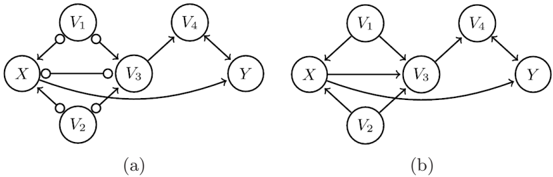
Verification
Claims the paper makes
2 Valid · 0 Not valid · 14 Not checked · 34 Own results and interpretations
In the paper
“If W satisfies the generalized back-door criterion relative to ( X , Y ) and G (Definition 3.7), then it satisfies the adjustment criterion relative to ( X , Y ) and G (Definition 3.6).”
What the sources say
- Not matchedcites Zhang (2008a)
More than one paper fits this citation.
plain- Asserted: passes — The authors put it forward as true.
- Checkable: passes — It can be checked against evidence.
- Load-bearing: passes — The paper’s conclusions depend on it.
- Based: passes — The paper gives a reason why it holds.
- Rests on 2 assumptions not shown here.
- Not matched
A result the paper states — it cites no source for it, so there is none to check. The quote shows it is in the paper.
In the paper
“This shows that applying Theorem 4.1 with R ′ X instead of R X leads to incorrect results.”
boostedstates a cause- Asserted: passes — The authors put it forward as true.
- Checkable: passes — It can be checked against evidence.
- Load-bearing: passes — The paper’s conclusions depend on it.
- Based: passes — The paper gives a reason why it holds.
In the paper
“For a DAG with multiple interventions, any set that satisfies Pearl's back-door criterion also satisfies the generalized back-door criterion, but not necessarily the other way around.”
What the sources say
- Not matchedcites Pearl (1993, 2000)
A range of references, not one source.
plain- Asserted: passes — The authors put it forward as true.
- Checkable: passes — It can be checked against evidence.
- Load-bearing: passes — The paper’s conclusions depend on it.
- Based: passes — The paper gives a reason why it holds.
- Not matched
None of the sources cited for this claim have been checked yet.
In the paper
“On the other hand, f ( y | do( x 1 , x 2 )) = ∫ f ( z | x 1 ) f ( y | x 2 , z ) dz for any density f compatible with D , by the g-formula.”
plainstates a cause- Asserted: passes — The authors put it forward as true.
- Checkable: passes — It can be checked against evidence.
- Load-bearing: passes — The paper’s conclusions depend on it.
- Based: passes — The paper gives a reason why it holds.
A result the paper states — it cites no source for it, so there is none to check. The quote shows it is in the paper.
In the paper
“In Section 4, we give necessary and sufficient criteria for the existence of a set that satisfies the generalized back-door criterion relative to a pair of variables ( X,Y ) and a DAG, MAG, CPDAG or PAG.”
plain- Asserted: passes — The authors put it forward as true.
- Checkable: passes — It can be checked against evidence.
- Load-bearing: passes — The paper’s conclusions depend on it.
- Based: passes — The paper gives a reason why it holds.
24 more claims
Create a free account to see all 50 claims and to verify the 3 references still open.
- Probably not a substantial claim. 9
- It may state two separate claims as one. 12
Citations
Cites
Causality: Models, Reasoning, and Inference
Pearl, J. (2009) · doi:10.1017/cbo9780511803161 · Cited by 11,653
Causation, Prediction, and Search
Spirtes, P., Glymour, C., & Scheines, R. (1993) · Lecture Notes in Statistics · doi:10.1007/978-1-4612-2748-9 · Cited by 4,617
Causation, Prediction, and Search
Spirtes, P., Glymour, C., & Scheines, R. (2001) · doi:10.7551/mitpress/1754.001.0001 · Cited by 4,521
Robins, J. (1986) · Mathematical Modelling · doi:10.1016/0270-0255(86)90088-6 · Cited by 2,451 · cited 2×
“This is known as the truncated factorization formula, see, e.g., Pearl (2000); Robins (1986); Spirtes et al. (1993).”
BackgroundCausal diagrams for empirical research
PEARL, J. (1995) · Biometrika · doi:10.1093/biomet/82.4.669 · Cited by 2,355 · cited 1×
“Causal Bayesian networks are widely used for causal reasoning (e.g., Glymour et al. (1987); Koller and Friedman (2009); Pearl (1995, 2000, 2009); Spirtes et al. (1993, 2000)).”
Algorithmic graph theory and perfect graphs
Golumbic, M. C. (1980) · doi:10.1016/c2013-0-10739-8 · Cited by 2,329
Estimating high-dimensional directed acyclic graphs with the PC-algorithm
Kalisch, M., & Bühlmann, P. (2005) · arXiv (Cornell University) · doi:10.48550/arxiv.math/0510436 · Cited by 591 · cited 2×
“These algorithms have been shown to be consistent, even in certain sparse high-dimensional settings (Colombo et al., 2012; Kalisch and Bühlmann, 2007).”
MethodRichardson, T., & Spirtes, P. (2002) · The Annals of Statistics · doi:10.1214/aos/1031689015 · Cited by 545 · cited 5×
“Moreover, combining our results for CPDAGs and PAGs with fast causal structure learning algorithms such as the PC algorithm (Spirtes et al. (2000)) or the FCI algorithm (Claassen et al.”
BackgroundMethodInfluentialCausal Inference Using Graphical Models with the R Package pcalg
Kalisch, M., Mächler, M., Colombo, D., Maathuis, M. H., & Bühlmann, P. (2012) · Journal of Statistical Software · doi:10.18637/jss.v047.i11 · Cited by 520
Self-citationA New Criterion for Confounder Selection
VanderWeele, T. J., & Shpitser, I. (2011) · Biometrics · doi:10.1111/j.1541-0420.2011.01619.x · Cited by 434 · cited 2×
“variables that can be used for covariate adjustment (De Luna et al., 2011; Entner et al., 2013; VanderWeele and Shpitser, 2011)).”
Background
Research works printed but not linked: 5
- Pearl, J. (2000). Causality: Models, Reasoning, and Inference . Cambridge Univ. Press, Cambridge. MR1744773
- Borboudakis, G. , Triantafillou, S. and Tsamardinos, I. (2012). Tools and algorithms for causally interpreting directed edges in maximal ancestral graphs. In Proceedings of the 6th European Workshop on Probabilistic Graphical Models (PGM 2012) 35-42. DECSAI, Univ. Granada.
- Glymour, C. , Scheines, R. , Spirtes, P. and Kelly, K. (1987). Discovering Causal Structure: Artificial Intelligence, Philosophy of Science, and Statistical Modeling. Academic Press, San Diego, CA.
- Koller, D. and Friedman, N. (2009). Probabilistic Graphical Models: Principles and Techniques . MIT Press, Cambridge, MA. MR2778120
- Zhang, J. (2006). Causal inference and reasoning in causally insufficient systems. Ph.D. thesis, Carnegie Mellon Univ., Pittsburgh, PA.
Cited by
Causal inference for time series
Runge, J., Gerhardus, A., Varando, G., Eyring, V., & Camps-Valls, G. (2023) · Nature Reviews Earth & Environment · doi:10.1038/s43017-023-00431-y · Cited by 288
Structural Intervention Distance for Evaluating Causal Graphs
Peters, J., & Bühlmann, P. (2015) · Neural Computation · doi:10.1162/neco_a_00708 · Cited by 100
“There exists a generalized back-door criterion for MAGs and a way to construct a set satisfying the generalized back-door criterion; some identifiable effects, however, may not be identifiable via the generalized backdoor criterion (Maathuis & Colombo, 2013).”
BackgroundGraphical Criteria for Efficient Total Effect Estimation Via Adjustment in Causal Linear Models
Henckel, L., Perković, E., & Maathuis, M. H. (2022) · Journal of the Royal Statistical Society Series B (Statistical Methodology) · doi:10.1111/rssb.12451 · Cited by 140
Self-citationNandy, P., Maathuis, M. H., & Richardson, T. S. (2014) · Cited by 60
Self-citationConstructing separators and adjustment sets in ancestral graphs
van der Zander, B., Liśkiewicz, M., & Textor, J. C. (2014) · Uncertainty in Artificial Intelligence · Cited by 91
Liu, Y., Du, Q., Wang, Q., Yu, H., Liu, J., Tian, Y., Chang, C., & Lei, J. (2017) · Environmental Pollution · doi:10.1016/j.envpol.2017.03.019 · Cited by 52
A Unified Survey of Treatment Effect Heterogeneity Modelling and Uplift Modelling
Zhang, W., Li, J., & Liu, L. (2021) · ACM Computing Surveys · doi:10.1145/3466818 · Cited by 127
Data-Driven Causal Effect Estimation Based on Graphical Causal Modelling: A Survey
Cheng, D., Li, J., Liu, L., Liu, J., & Le, T. D. (2024) · ACM Computing Surveys · doi:10.1145/3636423 · Cited by 79
“One focus of this survey is to review the data-driven confounding adjustment methods which are based on the back-door criterion or variations [83, 97, 103, 130] without requiring a given causal graph.”
BackgroundMethodInfluentialZhong, Y., Li, S., Liang, X., & Guan, Q. (2024) · Sustainable Cities and Society · doi:10.1016/j.scs.2024.105850 · Cited by 55
Causal discovery for the microbiome
Corander, J., Hanage, W. P., & Pensar, J. (2022) · The Lancet Microbe · doi:10.1016/s2666-5247(22)00186-0 · Cited by 59
How Mega Is the Mega? Exploring the Spillover Effects of WeChat Using Graphical Model
Zheng, J., Qi, Z., Dou, Y., & Tan, Y. (2016) · Information Systems Research · doi:10.1287/isre.2019.0865 · Cited by 50
A Complete Generalized Adjustment CriterionPreprint
Perković, E., Textor, J. C., Kalisch, M., & Maathuis, M. H. (2015) · arXiv (Cornell University) · doi:10.48550/arxiv.1507.01524 · Cited by 73
Self-citationSeparators and adjustment sets in causal graphs: Complete criteria and an algorithmic framework
van der Zander, B., Liśkiewicz, M., & Textor, J. C. (2019) · Artificial Intelligence · doi:10.1016/j.artint.2018.12.006 · Cited by 54
“We now extend the concept of adjustment to MAGs in the usual way [17].”
BackgroundMethodInfluentialCausal Structure Learning and Inference: A Selective Review
Kalisch, M., & Bühlmann, P. (2014) · Quality Technology & Quantitative Management · doi:10.1080/16843703.2014.11673322 · Cited by 50
“If the true causal structure is given in the form of a MAG or PAG, the generalized backdoor criterion (Maathuis and Colombo, 2013) offers a sufficient (but not necessary) criterion for transforming the interventional distribution into an expression involving standard statistical distributions.”
BackgroundPerković, E., Textor, J. C., Kalisch, M., et al. (2016) · arXiv (Cornell University) · doi:10.48550/arxiv.1606.06903 · Cited by 32
Self-citationDo-calculus when the true graph is unknown
Hyttinen, A., Eberhardt, F., & Järvisalo, M. (2015) · Cited by 31
Causal discovery in machine learning: Theories and applications
Nogueira, A. R., da Gama, J. M. P., & Ferreira, C. A. (2021) · Journal of Dynamics and Games · doi:10.3934/jdg.2021008 · Cited by 51
Computing integrated information
Krohn, S., & Ostwald, D. (2017) · Neuroscience of Consciousness · doi:10.1093/nc/nix017 · Cited by 24
Toward Unique and Unbiased Causal Effect Estimation From Data With Hidden Variables
Cheng, D., Li, J., Liu, L., Yu, K., Le, T. D., & Liu, J. (2022) · IEEE Transactions on Neural Networks and Learning Systems · doi:10.1109/tnnls.2021.3133337 · Cited by 50
Modifying AI, Enhancing Essays: How Active Engagement with Generative AI Boosts Writing Quality
Yang, K., Raković, M., Liang, Z., Yan, L., Zeng, Z., Fan, Y., Gašević, D., & Chen, G. (2025) · Proceedings of the 15th International Learning Analytics and Knowledge Conference · doi:10.1145/3706468.3706544 · Cited by 26
Causal Effect Identification by Adjustment under Confounding and Selection Biases
Correa, J. D., & Bareinboim, E. (2017) · Proceedings of the AAAI Conference on Artificial Intelligence · doi:10.1609/aaai.v31i1.11060 · Cited by 43
Estimating bounds on causal effects in high-dimensional and possibly confounded systems
Malinsky, D., & Spirtes, P. (2017) · International Journal of Approximate Reasoning · doi:10.1016/j.ijar.2017.06.005 · Cited by 42
Müller, F., Wijayanto, F., Abrahams, H. J. G., Gielissen, M. F. M., Prinsen, H., Braamse, A. M. J., van Laarhoven, H. W. M., Groot, P., Heskes, T., & Knoop, H. (2021) · Psycho-Oncology · doi:10.1002/pon.5710 · Cited by 30
Sufficient dimension reduction for average causal effect estimation
Cheng, D., Li, J., Liu, L., Le, T. D., Liu, J., & Yu, K. (2022) · Data Mining and Knowledge Discovery · doi:10.1007/s10618-022-00832-5 · Cited by 29
Local Search for Efficient Causal Effect Estimation
Cheng, D., Li, J., Liu, L., Zhang, J., Liu, J., & Le, T. D. (2022) · IEEE Transactions on Knowledge and Data Engineering · doi:10.1109/tkde.2022.3218131 · Cited by 28
Estimating Individualized Causal Effect with Confounded Instruments
Wang, H., Yang, W., Yang, L., Wu, A., Xu, L., Ren, J., Wu, F. Q., & Kuang, K. (2022) · ACM SIGKDD Conference on Knowledge Discovery and Data Mining (KDD) · doi:10.1145/3534678.3539335 · Cited by 17
Discovering Ancestral Instrumental Variables for Causal Inference From Observational Data
Cheng, D., Li, J., Liu, L., Yu, K., Le, T. D., & Liu, J. (2023) · IEEE Transactions on Neural Networks and Learning Systems · doi:10.1109/tnnls.2023.3262848 · Cited by 26
Causal Effect Identification from Multiple Incomplete Data Sources: A General Search-Based Approach
Tikka, S., Hyttinen, A., & Karvanen, J. (2021) · Journal of Statistical Software · doi:10.18637/jss.v099.i05 · Cited by 18
“The generalized back-door criterion (Maathuis and Colombo 2015) is also available in the pcalg R package.”
MethodCausality measures and analysis: A rough set framework
Yao, N., Miao, D., Pedrycz, W., Zhang, H., & Zhang, Z. (2019) · Expert Systems with Applications · doi:10.1016/j.eswa.2019.06.004 · Cited by 14
A local method for identifying causal relations under Markov equivalence
Fang, Z., Liu, Y., Geng, Z., Zhu, S., & He, Y. (2022) · Artificial Intelligence · doi:10.1016/j.artint.2022.103669 · Cited by 22
“Based on Maathuis and Colombo (2015, Lemma 7.2) and Perković et al. (2017, Lemma B.1), this implies that there is a directed path from”
BackgroundInfluentialNandy, P., Maathuis, M. H., & Richardson, T. S. (2017) · The Annals of Statistics · doi:10.1214/16-aos1462 · Cited by 64
Self-citationRotnitzky, A. G., & Smucler, E. (2019) · arXiv (Cornell University) · doi:10.48550/arxiv.1912.00306 · Cited by 21
Towards a Causal Decision-Making Framework for Recommender Systems
Cavenaghi, E., Zanga, A., Stella, F. A., & Zanker, M. (2024) · ACM Transactions on Recommender Systems · doi:10.1145/3629169 · Cited by 17
Causal Query in Observational Data with Hidden Variables
Cheng, D., Li, J., Liu, L., Liu, J., Yu, K., & Le, T. D. (2020) · Frontiers in artificial intelligence and applications · doi:10.3233/faia200390 · Cited by 12
Structural Intervention Distance (SID) for Evaluating Causal GraphsPreprint
Peters, J., & Bühlmann, P. (2013) · arXiv (Cornell University) · doi:10.48550/arxiv.1306.1043 · Cited by 8
“Maathuis and Colombo (2013) introduce a generalized backdoor criterion that can be used to characterize identifiability of intervention distributions.”
BackgroundA Graphical Criterion for Effect Identification in Equivalence Classes of Causal Diagrams
Jaber, A., Zhang, J., & Bareinboim, E. (2018) · International Joint Conference on Artificial Intelligence · doi:10.24963/ijcai.2018/697 · Cited by 11
Ancestral Instrument Method for Causal Inference without Complete Knowledge
Cheng, D., Li, J., Liu, L., Zhang, J., Le, T. D., & Liu, J. (2022) · International Joint Conference on Artificial Intelligence · doi:10.24963/ijcai.2022/671 · Cited by 12
A note on efficient minimum cost adjustment sets in causal graphical models
Smucler, E., & Rotnitzky, A. G. (2022) · Journal of Causal Inference · doi:10.1515/jci-2022-0015 · Cited by 6
Efficient adjustment sets in causal graphical models with hidden variables
Smucler, E., Sapienza, F., & Rotnitzky, A. G. (2021) · Biometrika · doi:10.1093/biomet/asab018 · Cited by 36
“3 Adjustment sets Shpitser et al. (2010) and Maathuis and Colombo (2015) gave the following definition of adjustment set for static regime.”
Quantifying interventional causality by knockoff operation
Zhang, X., & Chen, L. (2025) · Science Advances · doi:10.1126/sciadv.adu6464 · Cited by 5
Wong, J. J., Urquhart, O., Carrasco‐Labra, A., Schisterman, E. F., & Glick, M. (2025) · Journal of Dental Research · doi:10.1177/00220345251387660 · Cited by 9
Ribeiro, A. H., Crnkovic, M., Pereira, J. L., Fisberg, R. M., Sarti, F. M., Rogero, M. M., Heider, D., & Cerqueira, A. (2024) · Frontiers in Genetics · doi:10.3389/fgene.2024.1436947 · Cited by 8
The variance of causal effect estimators for binary v-structures
Kuipers, J., & Moffa, G. (2022) · Journal of Causal Inference · doi:10.1515/jci-2021-0025 · Cited by 7
Discussion of “Data-driven Confounder Selection via Markov and Bayesian Networks” By Häggström
Richardson, T. S., Robins, J. M., & Wang, L. (2017) · Biometrics · doi:10.1111/biom.12784 · Cited by 7
Efficient least squares for estimating total effects under linearity and causal sufficiencyPreprint
Guo, F. R., & Perković, E. (2020) · arXiv (Cornell University) · doi:10.48550/arxiv.2008.03481 · Cited by 9
Deoxys: A Causal Inference Engine for Unhealthy Node Mitigation in Large-scale Cloud Infrastructure
Zhang, C., Yao, R., Qin, S., Li, Z., Agrawal, S. S., Mishra, B. R., Tran, T. M., Ma, M., Lin, Q., Chintalapati, M., et al. (2024) · ACM Symposium on Cloud Computing (SoCC) · doi:10.1145/3698038.3698534 · Cited by 8
Raisi, A., Zerbini, V., MYERS, J. N., Piva, T., Menegatti, E., Grazzi, G., Mazzoni, G., & Mandini, S. (2025) · European Journal of Preventive Cardiology · doi:10.1093/eurjpc/zwaf347 · Cited by 6
Kuroki, M., & Nanmo, H. (2020) · AStA Advances in Statistical Analysis · doi:10.1007/s10182-020-00372-7 · Cited by 4
Cui, J., Li, W., Lim, E., Wu, X., & Lim, C. E. D. (2026) · JMIR Formative Research · doi:10.2196/80294 · Cited by 8
“All the selected confounding factors satisfy the backdoor criterion [18].”
Characterization of causal ancestral graphs for time series with latent confounders
Gerhardus, A. (2024) · The Annals of Statistics · doi:10.1214/23-aos2325 · Cited by 10
An Empirical Study of one of the Simplest Causal Prediction Algorithms
Mooij, J. M., Cremers, J., Silva, R., Shpitser, I., Evans, R. J., Peters, J., & Claassen, T. (2015) · UvA-DARE (University of Amsterdam) · Cited by 6
IDA with Background Knowledge.
Fang, Z., & He, Y. (2020) · Uncertainty in Artificial Intelligence · Cited by 25
Improving Data-driven Heterogeneous Treatment Effect Estimation Under Structure Uncertainty
Tran, C., & Zheleva, E. (2022) · ACM SIGKDD Conference on Knowledge Discovery and Data Mining (KDD) · doi:10.1145/3534678.3539444 · Cited by 4
A review of some recent advances in causal inferencePreprint
Maathuis, M. H., & Nandy, P. (2015) · arXiv (Cornell University) · doi:10.48550/arxiv.1506.07669 · Cited by 3
Self-citationHow Mega Is the Mega? Measuring the Spillover Effects of WeChat by Machine Learning and EconometricsPreprint
Zheng, J., Qi, Z., & Tan, Y. (2016) · SSRN Electronic Journal · doi:10.2139/ssrn.2842138 · Cited by 3
Bias Correction For Paid Search In Media Mix ModelingPreprint
Chen, A., Chan, D. X., Perry, M., Jin, Y., Sun, Y., Wang, Y., & Koehler, J. (2018) · arXiv · doi:10.48550/arxiv.1807.03292 · Cited by 12
Identifying causal effects in maximally oriented partially directed acyclic graphsPreprint
Perković, E. (2019) · arXiv (Cornell University) · doi:10.48550/arxiv.1910.02997 · Cited by 13
I-SPEC: An End-to-End Framework for Learning Transportable, Shift-Stable ModelsPreprint
Subbaswamy, A., & Saria, S. (2020) · arXiv (Cornell University) · doi:10.48550/arxiv.2002.08948 · Cited by 12
A unified survey of treatment effect heterogeneity modeling and uplift modelingPreprint
Zhang, W., Li, J., & Liu, L. (2020) · arXiv (Cornell University) · doi:10.48550/arxiv.2007.12769 · Cited by 4
Fehse, L., Ribeiro, A. H., Winter, N. R., et al. (2024) · medRxiv · doi:10.1101/2024.12.05.24318549 · Cited by 3
Raisi, A., Piva, T., MYERS, J. N., Zerbini, V., Menegatti, E., Lembo, M., Michelon, S., Meneghini, I., Grazzi, G., Mazzoni, G., et al. (2025) · Journal of Clinical Medicine · doi:10.3390/jcm14134583 · Cited by 2
“Based on the assumptions described in the diagram (Supplementary Figure S1), the minimal adjustment set was identified following the backdoor criterion [31].”
Fekete, T., Petrone, I. M., & Wicaksono, H. (2025) · International Journal of Production Research · doi:10.1080/00207543.2025.2580541 · Cited by 5
Tezuka, T., & Kuroki, M. (2023) · Journal of Multivariate Analysis · doi:10.1016/j.jmva.2023.105201 · Cited by 3
Liu, D. H., & Raftery, A. E. (2024) · The Annals of Applied Statistics · doi:10.1214/23-aoas1793 · Cited by 5
Collapsible IDA: Collapsing Parental Sets for Locally Estimating Possible Causal Effects
Liu, Y., Fang, Z., He, Y., & Geng, Z. (2020) · Uncertainty in Artificial Intelligence · Cited by 11
Piva, T., Zerbini, V., Panteleimon Ekkekakis, A., Vazou, S., Murri, M. B., Raisi, A., Menegatti, E., Grazzi, G., Mazzoni, G., & Mandini, S. (2025) · Journal of Sports Sciences · doi:10.1080/02640414.2025.2500768 · Cited by 2
Estimating possible causal effects with latent variables via adjustment and novel rule orientation
Wang, T.-Z., Tao, L., Qin, T., & Zhou, Z. (2025) · Artificial Intelligence · doi:10.1016/j.artint.2025.104387 · Cited by 4
Quantifying hydrogen technology acceptance: Insights from Bayesian networks
Herr, D. Z., Scovell, M., Kinaev, N. N., & Vaisman, R. (2025) · Energy and Climate Change · doi:10.1016/j.egycc.2025.100201 · Cited by 1
Methods for Graphical Models and Causal Inference
Kalisch, M., Hauser, A., & Maechler, M. (2015) · Cited by 1
Knowledge Representation for Causal Calculi on Internet of Things
Bradford, P. G., Saha, H. N., & Tanque, M. (2021) · Elsevier eBooks · doi:10.1016/b978-0-12-818576-6.00007-1 · Cited by 1
Kuroki, M., & Tezuka, T. (2023) · Statistical Papers · doi:10.1007/s00362-023-01401-8 · Cited by 1
Deconfounded Opponent Intention Inference for Football Multi-Player Policy Learning
Wang, S., Pan, Y. F., Pu, Z., Liu, B., & Yi, J. (2023) · IEEE/RSJ International Conference on Intelligent Robots and Systems (IROS) · doi:10.1109/iros55552.2023.10341469 · Cited by 1
Practically effective adjustment variable selection in causal inference
Noda, A., & Isozaki, T. (2025) · Journal of Physics Complexity · doi:10.1088/2632-072x/ada861 · Cited by 1
Nanmo, H., & Kuroki, M. (2021) · Journal of Multivariate Analysis · doi:10.1016/j.jmva.2021.104766 · Cited by 3
Towards precise causal effect estimation from data with hidden variables.Preprint
Cheng, D., Li, J., Liu, L., Yu, K., Le, T. D., & Liu, J. (2020) · arXiv (Cornell University) · Cited by 1
Towards unique and unbiased causal effect estimation from data with hidden variablesPreprint
Cheng, D., Li, J., Liu, L., et al. (2020) · arXiv (Cornell University) · doi:10.48550/arxiv.2002.10091 · Cited by 1
Causal inference in high-dimensional systems
Colombo, D. (2013) · Repository for Publications and Research Data (ETH Zurich) · doi:10.3929/ethz-a-010025947 · Cited by 1
“This chapter is based on Maathuis and Colombo (2013) and the remainder is organized as follows.Our generalized backdoor criterion for DAGs, CPDAGs, MAGs and PAGs is given in Section 5.3, see especially Definition 5.3.7 and Theorem 5.3.1. These results are derived by first formulating invariance conditions that are suf…”
MethodInfluentialSelf-citationUAI 2014 Workshop Causal Inference: Learning and Prediction
Mooij, J. M., Janzing, D., Peters, J., Claassen, T., & Hyttinen, A. (2014)
Rejoinder to Discussions On: Data-driven Confounder Selection via Markov and Bayesian Networks
Häggström, J. (2017) · Biometrics · doi:10.1111/biom.12783
Causality and Robust OptimizationPreprint
Yabe, A. (2020) · arXiv (Cornell University) · doi:10.48550/arxiv.2002.12626
Local search for efficient causal effect estimationPreprint
Cheng, D., Li, J., Liu, L., et al. (2020) · arXiv (Cornell University) · doi:10.48550/arxiv.2007.10014
Variable Selection for Estimating Optimal Sequential Treatment Decisions Using Bayesian Networks
Persson, J. (2020) · Lund University Publications Student Papers (Lund University)
Feature Selection for High Dimensional Causal Inference
Lü, R. (2020) · doi:10.7916/d8-52mk-ft68 · Cited by 1
Ranking the causal impact of recommendations under collider bias in k-spots recommender systems
de Villa, A. R., Sottocornola, G., Çoba, L., Lucchesi, F., & Skorulski, B. (2024) · ACM Transactions on Recommender Systems · doi:10.1145/3643139 · Cited by 1
REGRESSION ANALYSIS AND CAUSAL MODELS (REVIEW)
Balabanov, O. S. (2026) · Kibernetyka ta Systemnyi Analiz · doi:10.34229/kca2522-9664.26.4.1
Regression Analysis and Causal Models: An Overview
Balabanov, O. S. (2026) · Cybernetics and Systems Analysis · doi:10.1007/s10559-026-00890-3
Fehse, L., Ribeiro, A. H., Winter, N. R., Thanarajah, S. E., Fisch, L., Welzel, M., Bang, C., Meinert, S., Flinkenflügel, K., Borgers, T., et al. (2026) · Gut Microbes · doi:10.1080/19490976.2026.2718589 · Cited by 4
Metadata
- Authors
- Maathuis, M. H., & Colombo, D.
- ORCID
- Maathuis, Marloes H.
- Venue
- The Annals of Statistics
- Publisher
- Institute of Mathematical Statistics
- Published
- 2015-06-01
- Volume
- 43
- Issue
- 3
- Pages
- 1060-1088
- ISSN
- 0090-5364 (ISSN-L)
- OpenAlex
- W34433402
- Cited by
- 88
- References
- 31
- Citations by year
- 2026: 4 · 2025: 10 · 2024: 8 · 2023: 7 · 2022: 12 · 2021: 8 · 2020: 12 · 2019: 5 · 2018: 2 · 2017: 7 · 2016: 1 · 2015: 6
- FWCI
- 5.23
- Type
- journal article
- Language
- en
- Open access
- green
- arxiv.org
- Locations
- The Annals of Statistics (publishedVersion)
- arXiv (Cornell University) (submittedVersion)
- Project Euclid (Cornell University) (submittedVersion)
- arXiv (Cornell University)
- Topics
- Physical Sciences › Computer Science › Artificial Intelligence › Bayesian Modeling and Causal Inference
- Physical Sciences › Mathematics › Statistics and Probability › Advanced Causal Inference Techniques
- Physical Sciences › Mathematics › Statistics and Probability › Statistical Methods and Inference
- Keywords
- directed acyclic graphs, Markov equivalence classes, hidden variables, causal inference, graphical criteria, intervention, confounding
About these checks
Registry, retraction, Cites and statistics results are computed, not judged, with one exception: a printed reference that no index lists is read once by a model before it counts as a citation error. Claims are extracted by a model and kept only when their quote appears verbatim in the text; each cited source is then checked, with a model’s help, for whether it says what the claim relies on. Those verdicts can be wrong — read the claim’s quote and the cited source before relying on one.
A language model drew the claims from the paper on 2026-10-10, under version 3 of the claim definition (model deepseek-v4.1-flash, prompt extract-v3).
A second model labelled each claim on 2026-10-10 (model jev-1.13-20260917, definition revision gold-guideline-v0.2).
Statistics and arithmetic are recomputed, not judged.
Confidence bands are shown only for fields calibrated on our annotated test set. None is calibrated yet, so no band is shown.
What counts as a claim ›How we measure confidence ›How we check this ›
Are you an author, or do you see a problem with this page? Request a review
Data sources
Bibliographic data: Semantic Scholar, OpenAlex, Crossref.
Contains information from the Semantic Scholar Academic Graph Datasets, made available under the ODC Attribution License (ODC-BY 1.0).
Semantic Scholar’s data is described in: Kinney, R., et al. (2023). The Semantic Scholar Open Data Platform. arXiv:2301.10140.
