

The RNA exosome and RNA exosome-linked disease
Open accessThe DOI matches its Crossref record; 123 of the 123 references it cites were found in a registry or an index.
Abstract
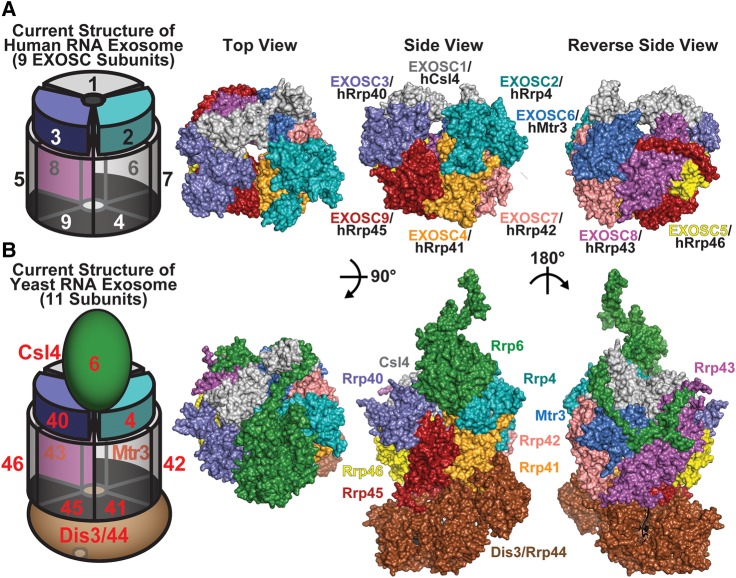
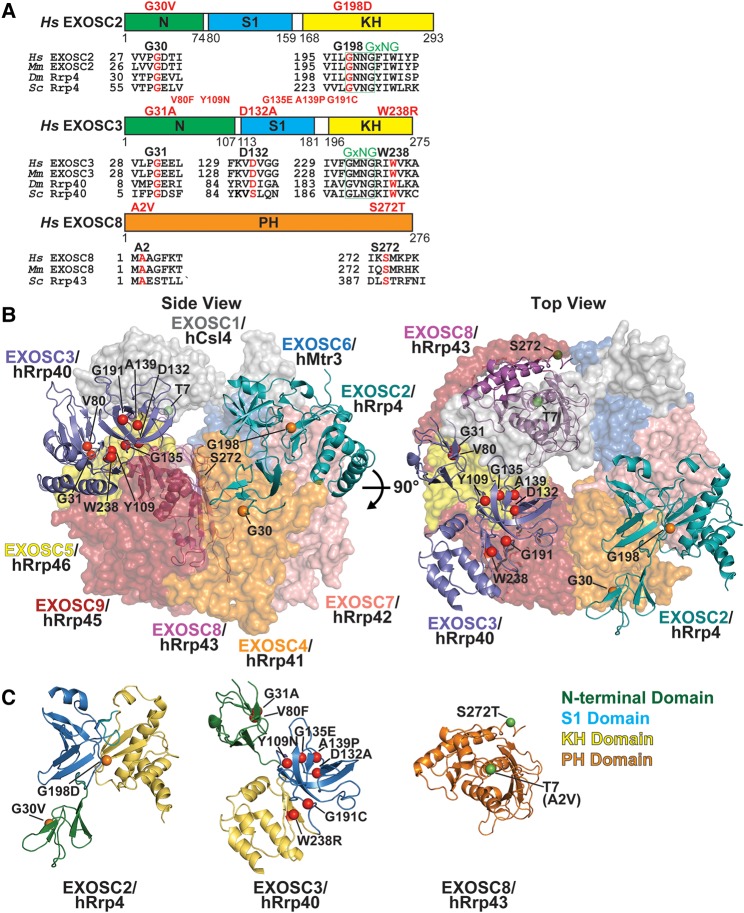
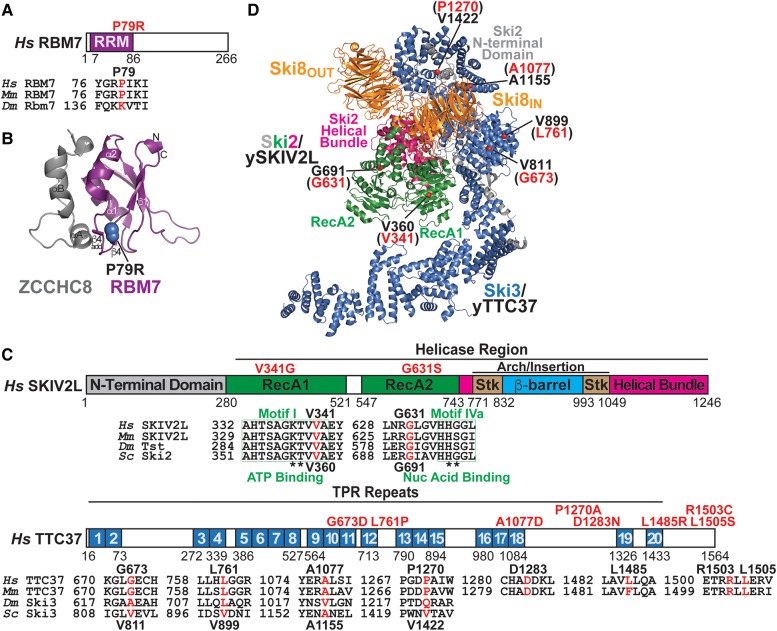
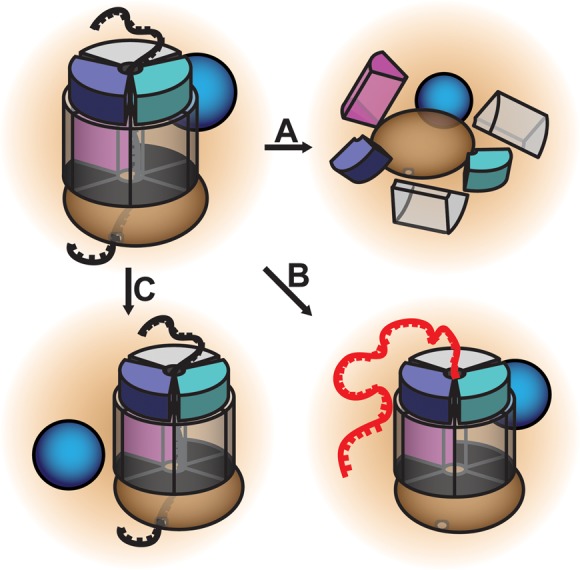
The RNA exosome is an evolutionarily conserved, ribonuclease complex that is critical for both processing and degradation of a variety of RNAs. Cofactors that associate with the RNA exosome likely dictate substrate specificity for this complex. Recently, mutations in genes encoding both structural subunits of the RNA exosome and its cofactors have been linked to human disease. Mutations in the RNA exosome genes EXOSC3 and EXOSC8 cause pontocerebellar hypoplasia type 1b (PCH1b) and type 1c (PCH1c), respectively, which are similar autosomal-recessive, neurodegenerative diseases. Mutations in the RNA exosome gene EXOSC2 cause a distinct syndrome with various tissue-specific phenotypes including retinitis pigmentosa and mild intellectual disability. Mutations in genes that encode RNA exosome cofactors also cause tissue-specific diseases with complex phenotypes. How mutations in these genes give rise to distinct, tissue-specific diseases is not clear. In this review, we discuss the role of the RNA exosome complex and its cofactors in human disease, consider the amino acid changes that have been implicated in disease, and speculate on the mechanisms by which exosome gene mutations could underlie dysfunction and disease.
Overview
The claims and statistics of this paper haven’t been checked yet.
Free: it reads the open-access text and checks the first 5 claims that cite a source we can check. Create a free account to check every claim.
Integrity signals
Registry
Cites
Statistics
Figures
Verification
Claims the paper makes
The claims and statistics of this paper haven’t been checked yet.
Free: it reads the open-access text and checks the first 5 claims that cite a source we can check. Create a free account to check every claim.
Claims other papers make about this one
Each is checked against this paper’s own text: does it say what the citing paper says it does?
In the citing paper
“Recessive mutations in genes encoding the evolutionarily conserved RNA exosome, an RNase complex, cause syndromic neurodevelopmental disorders, such as pontocerebellar hypoplasia type 1b (PCH1b), characterized by progressive neurodegeneration.”
From The RNA exosome maintains cellular RNA homeostasis by controlling transcript abundance in the brain (2026) · cites this paper as [20]
In the citing paper
“Consistent with the critical function of the RNA exosome in the processing and decay of numerous cellular RNAs, all structural subunits and the DIS3 catalytic base are essential in all organisms analyzed thus far (3,17).”
From Biallelic variants in the RNA exosome gene EXOSC5 are associated with developmental delays, short stature, cerebellar hypoplasia and motor weakness (2020) · cites this paper as [3]
In the citing paper
“In addition, the clinical phenotypes show variability among the different genes and among variants that are predicted to affect related amino acids and subunit interactions across different proteins (3).”
From Biallelic variants in the RNA exosome gene EXOSC5 are associated with developmental delays, short stature, cerebellar hypoplasia and motor weakness (2020) · cites this paper as [3]
In the citing paper
“Pathogenic variants in the genes encoding the structural subunits of the RNA exosome, including EXOSC5, cause phenotypes that affect specific tissues, such as the brain, despite the ubiquitous expression patterns of these genes (3).”
From Biallelic variants in the RNA exosome gene EXOSC5 are associated with developmental delays, short stature, cerebellar hypoplasia and motor weakness (2020) · cites this paper as [3]
In the citing paper
“The RNA exosome plays a pivotal role in the processing, degradation, and surveillance of nearly every class of RNA in both the nucleus and cytoplasm (Schneider and Tollervey 2013; Kilchert et al. 2016; Morton et al. 2018).”
From Comparative analyses of disease-linked missense mutations in the RNA exosome modeled in budding yeast reveal distinct functional consequences in translation (2025) · cites this paper as Morton et al. 2018
2 more claims about this paper
Create a free account to see every claim other papers make about this one.
Self-check
Percentages, sums and reported differences re-computed from the paper’s own numbers.
The self-check needs the paper’s full text.
Citations
Cites
Tissue-based map of the human proteome
Uhlén, M., Fagerberg, L., Hallström, B. M., Lindskog, C., Oksvold, P., Mardinoglu, A., Sivertsson, Å., Kampf, C., Sjöstedt, E., Asplund, A., et al. (2015) · Science · doi:10.1126/science.1260419 · Cited by 15,286
SF1 and SF2 helicases: family matters
Fairman-Williams, M. E., Guenther, U.-P., & Jankowsky, E. (2010) · Current Opinion in Structural Biology · doi:10.1016/j.sbi.2010.03.011 · Cited by 981
Mitchell, P., Petfalski, E., Shevchenko, A., Mann, M., & Tollervey, D. (1997) · Cell · doi:10.1016/s0092-8674(00)80432-8 · Cited by 954
RNA Degradation by the Exosome Is Promoted by a Nuclear Polyadenylation Complex
LaCava, J., Houseley, J., Saveanu, C., Petfalski, E., Thompson, E., Jacquier, A., & Tollervey, D. (2005) · Cell · doi:10.1016/j.cell.2005.04.029 · Cited by 879
Wyers, F., Rougemaille, M., Badis, G., Rousselle, J.-C., Dufour, M.-E., Boulay, J., Régnault, B., Devaux, F., Namane, A., Séraphin, B., et al. (2005) · Cell · doi:10.1016/j.cell.2005.04.030 · Cited by 843
RNA Exosome Depletion Reveals Transcription Upstream of Active Human Promoters
Preker, P., Nielsen, J., Kammler, S., Lykke-Andersen, S., Christensen, M. S., Mapendano, C. K., Schierup, M. H., & Jensen, T. H. (2008) · Science · doi:10.1126/science.1164096 · Cited by 791
Analysis of a genome-wide set of gene deletions in the fission yeast Schizosaccharomyces pombe
Kim, D.-U., Hayles, J., Kim, D., Wood, V., Park, H.-O., Won, M., Yoo, H.-S., Duhig, T., Nam, M., Palmer, G., et al. (2010) · Nature Biotechnology · doi:10.1038/nbt.1628 · Cited by 742
Anderson, J. S. J. (1998) · The EMBO Journal · doi:10.1093/emboj/17.5.1497 · Cited by 650
RNA-quality control by the exosome
Houseley, J., LaCava, J., & Tollervey, D. (2006) · Nature Reviews Molecular Cell Biology · doi:10.1038/nrm1964 · Cited by 644
Functions of the exosome in rRNA, snoRNA and snRNA synthesis
Allmang, C. (1999) · The EMBO Journal · doi:10.1093/emboj/18.19.5399 · Cited by 618
Cited by
Regulation of long non-coding RNAs and genome dynamics by the RNA surveillance machinery
Nair, L., Chung, H., & Basu, U. (2020) · Nature Reviews Molecular Cell Biology · doi:10.1038/s41580-019-0209-0 · Cited by 203
Post-transcriptional regulation of gene expression and human disease
Corbett, A. H. (2018) · Current Opinion in Cell Biology · doi:10.1016/j.ceb.2018.02.011 · Cited by 189
Self-citationFanale, D., Taverna, S., Russo, A., & Bazan, V. (2018) · Advances in Experimental Medicine and Biology · doi:10.1007/978-981-13-1426-1_9 · Cited by 172
Controlling nuclear RNA levels
Schmid, M., & Jensen, T. H. (2018) · Nature Reviews Genetics · doi:10.1038/s41576-018-0013-2 · Cited by 164
Cellular RNA surveillance in health and disease
Wolin, S. L., & Maquat, L. E. (2019) · Science · doi:10.1126/science.aax2957 · Cited by 156
Metadata
- Authors
- Morton, D. J., Kuiper, E. G., Jones, S. K., Leung, S. W., Corbett, A. H., & Fasken, M. B.
- Venue
- RNA
- Publisher
- Cold Spring Harbor Laboratory
- Published
- 2017-11-01
- Volume
- 24
- Issue
- 2
- Pages
- 127-142
- ISSN
- 1355-8382 (ISSN-L)
- 1469-9001
- PMC
- PMC5769741
- OpenAlex
- W2766291327
- Cited by
- 143
- References
- 123
- FWCI
- 5.05
- Type
- journal article
- Language
- en
- Open access
- hybrid
- Funders
- National Institutes of Health (GM058728, AG054206, GM125350)
- Burroughs Wellcome Fund
About these checks
Registry, retraction, Cites and statistics results are computed, not judged, with one exception: a printed reference that no index lists is read once by a model before it counts as a citation error. Claims are extracted by a model and kept only when their quote appears verbatim in the text; each cited source is then checked, with a model’s help, for whether it says what the claim relies on. Those verdicts can be wrong — read the claim’s quote and the cited source before relying on one.
Statistics and arithmetic are recomputed, not judged.
Confidence bands are shown only for fields calibrated on our annotated test set. None is calibrated yet, so no band is shown.
What counts as a claim ›How we measure confidence ›How we check this ›
Are you an author, or do you see a problem with this page? Request a review
Data sources
Bibliographic data: Semantic Scholar, OpenAlex, Crossref.
Contains information from the Semantic Scholar Academic Graph Datasets, made available under the ODC Attribution License (ODC-BY 1.0).
Semantic Scholar’s data is described in: Kinney, R., et al. (2023). The Semantic Scholar Open Data Platform. arXiv:2301.10140.
