

The DOI matches its Crossref record; 53 of the 53 references it cites were found in a registry or an index.
Influence of Prenatal Lead Exposure on Genomic Methylation of Cord Blood DNA
Open accessAbstract
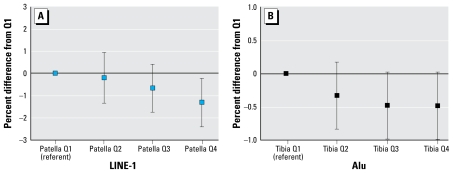
Background: Fetal lead exposure is associated with adverse pregnancy outcomes and developmental and cognitive deficits; however, the mechanism(s) by which lead-induced toxicity occurs remains unknown. Epigenetic fetal programming via DNA methylation may provide a pathway by which environmental lead exposure can influence disease susceptibility. Objective: This study was designed to determine whether prenatal lead exposure is associated with alterations in genomic methylation of leukocyte DNA levels from umbilical cord samples. Methods: We measured genomic DNA methylation, as assessed by Alu and LINE-1 (long interspersed nuclear element-1) methylation via pyrosequencing, on 103 umbilical cord blood samples from the biorepository of the Early Life Exposures in Mexico to Environmental Toxicants (ELEMENT) study group. Prenatal lead exposure had been assessed by measuring maternal bone lead levels at the mid-tibial shaft and the patella using a spot-source 109Cd K-shell X-ray fluorescence instrument. Results: We found an inverse dose–response relationship in which quartiles of patella lead correlated with cord LINE-1 methylation (p for trend = 0.01) and and tibia lead correlated with Alu methylation (p for trend = 0.05). In mixed effects regression models, maternal tibia lead was negatively associated with umbilical cord genomic DNA methylation of Alu (β= −0.027; p = 0.01). We found no associations between cord blood lead and cord genomic DNA methylation. Conclusions: Prenatal lead exposure is inversely associated with genomic DNA methylation in cord blood. These data suggest that the epigenome of the developing fetus can be influenced by maternal cumulative lead burden, which may influence long-term epigenetic programming and disease susceptibility throughout the life course.
Overview
The claims and statistics of this paper haven’t been checked yet.
Run the check — free, no account needed. It reads the open-access text and checks the sources it cites.
Integrity signals
Registry
Cites
Statistics
Figures
Verification
Claims the paper makes
The claims and statistics of this paper haven’t been checked yet.
Run the check — free, no account needed. It reads the open-access text and checks the sources it cites.
Claims other papers make about this one
Each is checked against this paper’s own text: does it say what the citing paper says it does?
In the citing paper
“Similarly, maternal lead levels are inversely correlated with genomic DNA methylation of the LINE-1 element in umbilical cord blood [ 45 ].”
From DNA methylation: a mechanism linking environmental chemical exposures to risk of autism spectrum disorders? (2016) · cites this paper as [45]
Self-check
Percentages, sums and reported differences re-computed from the paper’s own numbers.
The self-check needs the paper’s full text.
Citations
Cites
1 retracted
Chang, H., Anway, M. D., Rekow, S. S., & Skinner, M. K. (2006) · Endocrinology · doi:10.1210/en.2006-0987 · Cited by 148
RetractedWEIGHT IN INFANCY AND DEATH FROM ISCHAEMIC HEART DISEASE
Barker, D. J. P., Osmond, C., Winter, P. D., Margetts, B., & Simmonds, S. J. (1989) · The Lancet · doi:10.1016/s0140-6736(89)90710-1 · Cited by 3,574
Environmental epigenomics and disease susceptibility
Jirtle, R. L., & Skinner, M. K. (2007) · Nature Reviews Genetics · doi:10.1038/nrg2045 · Cited by 2,492
Lanphear, B. P., Hornung, R., Khoury, J., Yolton, K., Baghurst, P., Bellinger, D. C., Canfield, R. L., Dietrich, K. N., Bornschein, R., Greene, T., et al. (2005) · Environmental Health Perspectives · doi:10.1289/ehp.7688 · Cited by 2,205
Intellectual Impairment in Children with Blood Lead Concentrations below 10 μg per Deciliter
Canfield, R. L., Henderson, C. R., Cory-Slechta, D. A., Cox, C., Jusko, T. A., & Lanphear, B. P. (2003) · New England Journal of Medicine · doi:10.1056/nejmoa022848 · Cited by 2,081
Transposable elements: targets for early nutritional effects on epigenetic gene regulation
Waterland, R. A., & Jirtle, R. L. (2003) · Molecular and Cellular Biology · doi:10.1128/mcb.23.15.5293-5300.2003 · Cited by 2,019
Mobile Elements: Drivers of Genome Evolution
Kazazian, H. H. (2004) · Science · doi:10.1126/science.1089670 · Cited by 1,922
Dolinoy, D. C., Huang, D., & Jirtle, R. L. (2007) · Proceedings of the National Academy of Sciences · doi:10.1073/pnas.0703739104 · Cited by 1,369
Percentage Points for a Generalized ESD Many-Outlier Procedure
ROSNER, B. A. (1983) · Technometrics · doi:10.1080/00401706.1983.10487848 · Cited by 1,287
Calvert, H., Horwich, A., Newlands, E. S., Beǵent, R. H. J., Rustin, G. J. S., Kaye, S. B., Harris, A. L., Williams, C. J., & Slevin, M. L. (1988) · The Lancet · doi:10.1016/s0140-6736(88)92709-2 · Cited by 1,183
Cited by
Sorted by citations
Environmental chemical exposures and human epigenetics
Hou, L., Zhang, X., Wang, D., & Baccarelli, A. (2011) · International Journal of Epidemiology · doi:10.1093/ije/dyr154 · Cited by 502
Zhang, F. F., Cardarelli, R., Carroll, J. F., Fulda, K. G., Kaur, M., González, K., Vishwanatha, J. K., Santella, R. M., & Morabia, A. (2011) · Epigenetics · doi:10.4161/epi.6.5.15335 · Cited by 402
Clinical and molecular aspects of lead toxicity: An update
Mitra, P., Sharma, S., Purohit, P., & Sharma, P. (2017) · Critical Reviews in Clinical Laboratory Sciences · doi:10.1080/10408363.2017.1408562 · Cited by 402
Developmental Neurotoxicants in E-Waste: An Emerging Health Concern
Chen, A., Dietrich, K. N., Huo, X., & Ho, S. (2010) · Environmental Health Perspectives · doi:10.1289/ehp.1002452 · Cited by 362
Teh, A. L., Pan, H., Chen, L., Ong, M.-L., Dogra, S., Wong, J., MacIsaac, J. L., Mah, S. M., McEwen, L. M., Saw, S.-M., et al. (2014) · Genome Research · doi:10.1101/gr.171439.113 · Cited by 352
Metadata
- Authors
- Pilsner, J. R., Hu, H., Ettinger, A., Sánchez, B. N., Wright, R. O., Cantonwine, D., Lazarus, A., Lamadrid-Figueroa, H., Mercado-García, A., Téllez-Rojo, M. M., & Hernández-Avila, M.
- Affiliations
- University of Michigan (US)
- Brigham and Women's Hospital (US)
- Department of Epidemiology, University of Michigan School of Public Health, Ann Arbor, Michigan, USA
- Division of Program Evaluation and Biostatistics, Center for Evaluation Research and Surveys, National Institute of Public Health, Cuernavaca, Morelos, Mexico
- Division of Environmental Health, Center for Population Health Research, National Institute of Public Health, Mexico City, Mexico
- Ministry of Health, Mexico City, Mexico
- Corresponding author
- Pilsner, J. Richard
- ORCID
- Venue
- Environmental Health Perspectives
- Publisher
- American Chemical Society (ACS)
- Published
- 2009-03-25
- Volume
- 117
- Issue
- 9
- Pages
- 1466-1471
- ISSN
- 0091-6765 (ISSN-L)
- 1552-9924
- PMC
- PMC2737027
- OpenAlex
- W2088501324
- Cited by
- 275
- References
- 53
- Citations by year
- 2026: 5 · 2025: 7 · 2024: 5 · 2023: 12 · 2022: 15 · 2021: 18 · 2020: 14 · 2019: 22 · 2018: 18 · 2017: 15 · 2016: 14 · 2015: 25 · 2014: 26 · 2013: 17 · 2012: 23
- FWCI
- 14.22
- Type
- journal article
- Language
- en
- Open access
- gold
- doi.org
- Licence
- public-domain
- creativecommons.org/licenses/by/4.0/ (vor, 3201 d)
- Locations
- Environmental Health Perspectives (publishedVersion, public-domain)
- PubMed Central (publishedVersion, public-domain)
- PubMed (publishedVersion)
- Digital Access to Scholarship at Harvard (DASH) (Harvard University) (submittedVersion, cc-by)
- Funders
- U.S. Environmental Protection Agency (R01 ES013744, P42 ES05947, P01 ES012874, 83172501, R01 ES007821, R01 ES014930, RD-83172501)
- Consejo Nacional de Ciencia y Tecnología (P01 ES012874, P42 ES05947, R01 ES007821, R01 ES014930, RD-83172501, 4150M9405, R01 ES013744)
- National Institutes of Health (ES-00002)
- National Institute of Environmental Health Sciences (P 42-ES05947, K23ES000381, R01ES014930, ES05947, P01ES012874, R01ES007821, ES014930, ES013744, ES 007821, P42ES005947, P30ES000002, K01ES014907, R01ES020268, P30-ES00002, ES 00002, RD-83172501, R01ES013744)
- Topics
- Physical Sciences › Environmental Science › Health, Toxicology and Mutagenesis › Heavy Metal Exposure and Toxicity
- Life Sciences › Biochemistry, Genetics and Molecular Biology › Molecular Biology › Epigenetics and DNA Methylation
- Health Sciences › Medicine › Pediatrics, Perinatology and Child Health › Birth, Development, and Health
- Keywords
- prenatal lead exposure, DNA methylation, umbilical cord blood, LINE-1 methylation, fetal programming, epigenetic programming, environmental toxins, developmental toxicity
- MeSH terms
- Base Sequence, Environmental Pollutants, Female, Fetal Blood, Humans, Lead, Mexico, Polymerase Chain Reaction, DNA Primers, Maternal Exposure, DNA Methylation
About these checks
Registry, retraction, Cites and statistics results are computed, not judged, with one exception: a printed reference that no index lists is read once by a model before it counts as a citation error. Claims are extracted by a model and kept only when their quote appears verbatim in the text; each cited source is then checked, with a model’s help, for whether it says what the claim relies on. Those verdicts can be wrong — read the claim’s quote and the cited source before relying on one.
Statistics and arithmetic are recomputed, not judged.
Confidence bands are shown only for fields calibrated on our annotated test set. None is calibrated yet, so no band is shown.
What counts as a claim ›How we measure confidence ›How we check this ›
Are you an author, or do you see a problem with this page? Request a review
