

The DOI matches its Crossref record.
Efficient Elimination of Inhaled Nanoparticles from the Alveolar Region: Evidence for Interstitial Uptake and Subsequent Reentrainment onto Airways Epithelium
Abstract
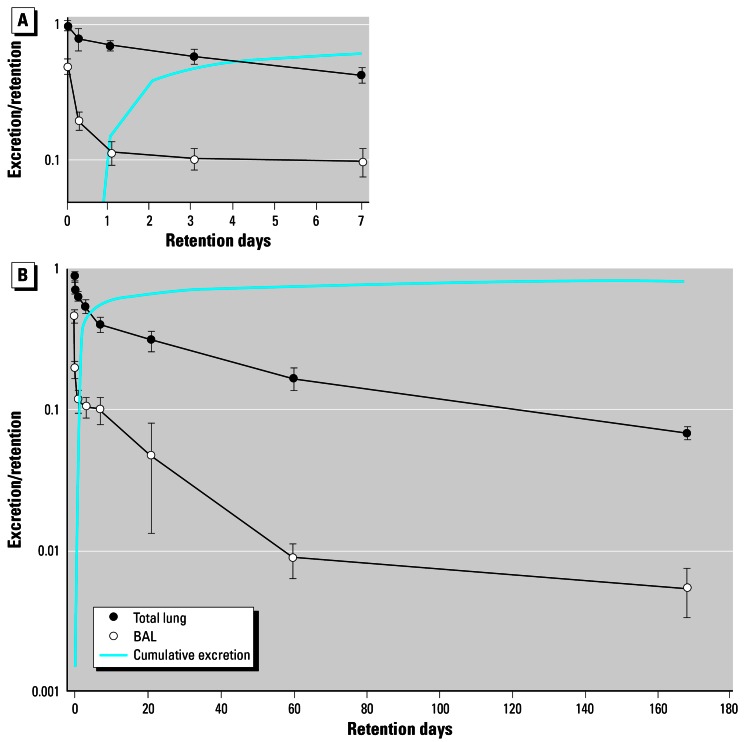
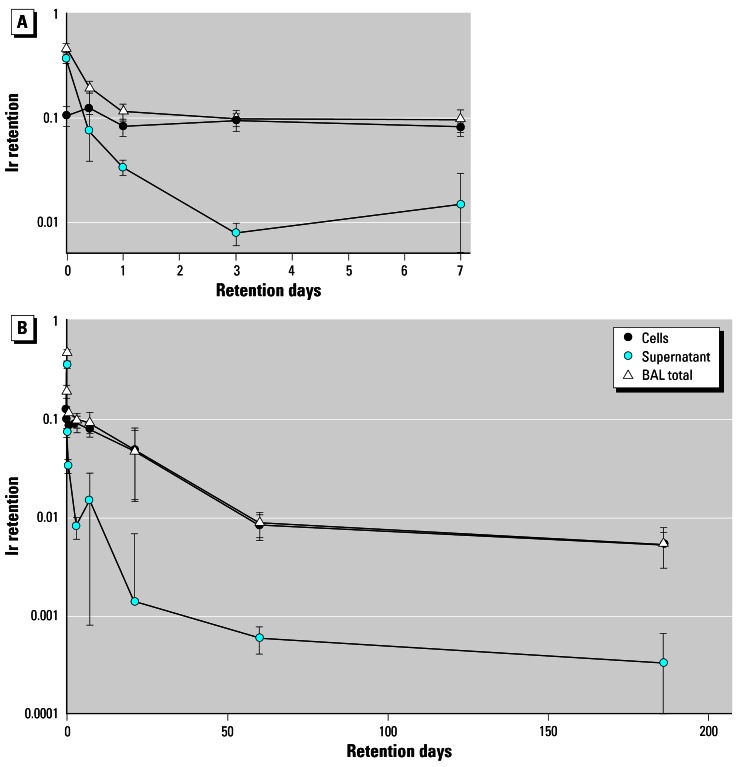
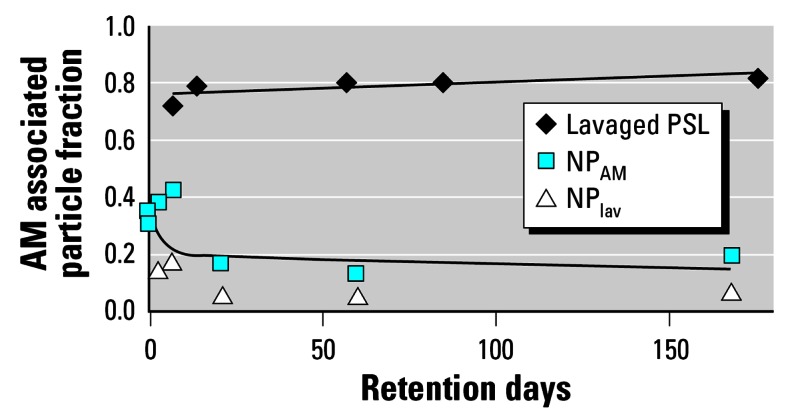
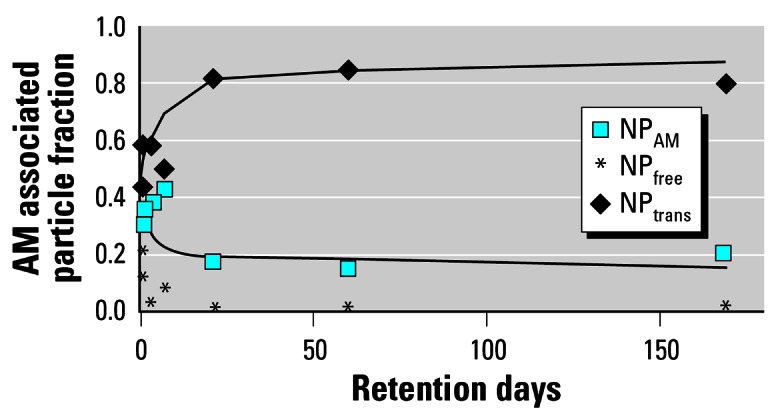
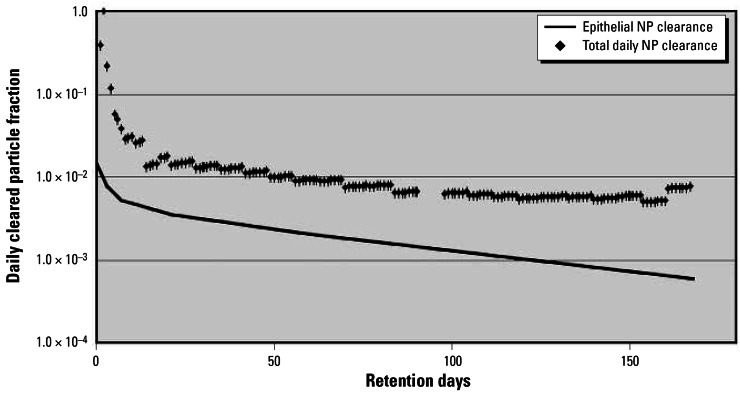
Background: There is ongoing discussion that inhaled nanoparticles (NPs, < 100 nm) may translocate from epithelial deposition sites of the lungs to systemic circulation. Objectives and Methods: We studied the disappearance of NPs from the epithelium by sequential lung retention and clearance and bronchoalveolar lavage (BAL) measurements in healthy adult Wistar Kyoto (WKY) rats at various times over 6 months after administration of a single 60- to 100-min intratracheal inhalation of iridium-192 (192Ir)–radiolabeled NPs. A complete 192Ir balance of all organs, tissues, excretion, remaining carcass, and BAL was performed at each time point. Results: Directly after inhalation we found free NPs in the BAL; later, NPs were predominantly associated with alveolar macropages (AMs). After 3 weeks, lavageable NP fractions decreased to 0.06 of the actual NP lung burden. This is in stark contrast to the AM-associated fraction of micron-sized particles reported in the literature. These particles remained constant at about 0.8 throughout a 6-month period. Three weeks after inhalation, 80% of the retained Ir NPs was translocated into epithelium and interstitium. Conclusion: There is a strong size-selective difference in particle immobilization. Furthermore, AM-mediated NP transport to the larynx originates not only from the NP fraction retained on the epithelium but also from NPs being reentrained from the interstitium to the luminal side of epithelium. We conclude that NPs are much less phagocytized by AMs than large particles but are effectively removed from the lung surface into the interstitium. Even from these interstitial sites, they undergo AM-mediated long-term NP clearance to the larynx.
Overview
The claims and statistics of this paper haven’t been checked yet.
Run the check — free, no account needed. It reads the open-access text and checks the sources it cites.
Integrity signals
Registry
Cites
Statistics
Figures
Verification
Claims the paper makes
The claims and statistics of this paper haven’t been checked yet.
Run the check — free, no account needed. It reads the open-access text and checks the sources it cites.
Claims other papers make about this one
Each is checked against this paper’s own text: does it say what the citing paper says it does?
In the citing paper
“In contrast, only 20% of 20-nm-sized NPs and about 30% of 70-nm-sized NP deposited during inhalation or instillation can be lavaged – see Fig. 2 [54–59].”
From Particle toxicology and health - where are we? (2019) · cites this paper as [56]
Self-check
Percentages, sums and reported differences re-computed from the paper’s own numbers.
The self-check needs the paper’s full text.
Citations
Cites
No references could be resolved yet.
Research works printed but not linked: 20
- Brundelet, 1965, Experimental study of the dust-clearance mechanism of the lung. I. Histological study in rats of the intra-pulmonary bronchial route of elimination, Acta Path Microbiol Scand, 175, 1
- Ellender, 1992, Effect of bronchopulmonary lavage on lung retention and clearance of particulate material in hamsters, Environ Health Perspect, 97, 209, 10.1289/ehp.9297209 · DOI · Paper page
- Ferin, 1992, Translocation of particles from the pulmonary alveoli into the interstitium, J Aerosol Med, 5, 179, 10.1089/jam.1992.5.179 · DOI
- Ferin, 1992, Pulmonary retention of ultrafine and fine particles in rats, Am J Respir Cell Mol Biol, 6, 535, 10.1165/ajrcmb/6.5.535 · DOI
- Geiser, 2005, Ultrafine particles cross cellular membranes by nonphagocytic mechanisms in lungs and in cultured cells, Environ Health Perspect, 113, 1555, 10.1289/ehp.8006 · DOI
- Green, 1973, Alveolobronchiolar transport mechanisms, Arch Intern Med, 131, 109, 10.1001/archinte.1973.00320070105012 · DOI
- Ibald-Mulli, 2002, Epidemiological evidence on health effects of ultrafine particles, J Aerosol Med, 15, 189, 10.1089/089426802320282310 · DOI
- Kreyling, 1990, Aerosol particle parameters maintaining lung clearance by intracellular dissolution and translocation, J Aerosol Sci, 21, 371, 10.1016/0021-8502(90)90061-2 · DOI
- Kreyling, 1993, Lung clearance in Long-Evans rats after inhalation of porous, mono-disperse cobalt oxide particles, Exp Lung Res, 19, 445, 10.3109/01902149309064357 · DOI
- Kreyling, 2002, Translocation of ultrafine insoluble iridium particles from lung epithelium to extrapulmonary organs is size dependent but very low, J Toxicol Environ Health, 65A, 1513, 10.1080/00984100290071649 · DOI · Paper page
- Lehnert, 1989, Alveolar macrophage-particle relationships during lung clearance, Am J Respir Cell Mol Biol, 1, 145, 10.1165/ajrcmb/1.2.145 · DOI · Paper page
- Oberdörster, 1994, Correlation between particle size, in vivo particle persistence, and lung injury, Environ Health Perspect, 102, 173
- Oberdörster, 2000, Acute pulmonary effects of ultrafine particles in rats and mice, Res Rep Health Eff Inst, 96, 5
- Oberdörster, 2005, Nano-toxicology: an emerging discipline evolving from studies of ultrafine particles, Environ Health Perspect, 113, 823, 10.1289/ehp.7339 · DOI · Paper page
- Osier, 1997, Intratracheal inhalation vs intratracheal instillation: differences in particle effects, Fundam Appl Toxicol, 40, 220, 10.1006/faat.1997.2390 · DOI
- Semmler, 2004, Long-term clearance kinetics of inhaled ultrafine insoluble iridium particles from the rat lung, including transient translocation into secondary organs, Inhal Toxicol, 16, 453, 10.1080/08958370490439650 · DOI · Paper page
- Takenaka, 2006, Distribution pattern of inhaled ultra-fine gold particles in the rat lung, Inhal Toxicol, 18, 733, 10.1080/08958370600748281 · DOI
- Tucker, 1973, Clearance of inhaled particles from alveoli by normal interstitial drainage pathways, J Appl Physiol, 35, 719, 10.1152/jappl.1973.35.5.719 · DOI
- Wichmann, 2000, Epidemiological evidence of the effects of ultrafine particle exposure, Philos Trans R Soc Lond A, 358, 2751, 10.1098/rsta.2000.0682 · DOI
- Wichmann, 2000, Daily mortality and fine and ultrafine particles in Erfurt, Germany. Part I: Role of particle number and particle mass, Res Rep Health Eff Inst, 98, 5
Cited by
Sorted by citations
Deposition and biokinetics of inhaled nanoparticles
Geiser, M., & Kreyling, W. G. (2010) · Particle and Fibre Toxicology · doi:10.1186/1743-8977-7-2 · Cited by 747
Self-citationParticle toxicology and health - where are we?
Riediker, M., Zink, D., Kreyling, W., Oberdörster, G., Elder, A., Graham, U., Lynch, I., Duschl, A., Ichihara, G., Ichihara, S., et al. (2019) · Particle and Fibre Toxicology · doi:10.1186/s12989-019-0302-8 · Cited by 237
Self-citationWiemann, M., Vennemann, A., Sauer, U. G., Wiench, K., Ma-Hock, L., & Landsiedel, R. (2016) · Journal of Nanobiotechnology · doi:10.1186/s12951-016-0164-2 · Cited by 152
Toxicity and bio-accumulation of inhaled cerium oxide nanoparticles in CD1 mice
Aalapati, S., Ganapathy, S., Manapuram, S., Anumolu, G., & Prakya, B. M. (2013) · Nanotoxicology · doi:10.3109/17435390.2013.829877 · Cited by 141
Metformin targets mitochondrial electron transport to reduce air-pollution-induced thrombosis
Soberanes, S., Misharin, A. V., Jairaman, A., Morales-Nebreda, L., McQuattie-Pimentel, A. C., Cho, T., Hamanaka, R. B., Meliton, A. Y., Reyfman, P. A., Walter, J. M., et al. (2019) · Cell Metabolism · doi:10.1016/j.cmet.2018.09.019 · Cited by 131
Thevenot, P. T., Saravia, J., Jin, N., Giaimo, J. D., Chustz, R. E., Mahne, S., Kelley, M. A., Hebert, V. Y., Dellinger, B., Dugas, T. R., et al. (2013) · American Journal of Respiratory Cell and Molecular Biology · doi:10.1165/rcmb.2012-0052oc · Cited by 110
Zhong, Q., Bielski, E. R., Rodrigues, L. S., Brown, M. R., Reineke, J. J., & da Rocha, S. R. P. (2016) · Molecular Pharmaceutics · doi:10.1021/acs.molpharmaceut.6b00126 · Cited by 88
Metadata
- Authors
- Semmler-Behnke, M., Takenaka, S., Fertsch, S., Wenk, A., Seitz, J., Mayer, P., Oberdörster, G., & Kreyling, W. G.
- Venue
- Environmental Health Perspectives
- Publisher
- American Chemical Society (ACS)
- Published
- 2007-02-06
- Volume
- 115
- Issue
- 5
- Pages
- 728-733
- ISSN
- 0091-6765
- 1552-9924
- PMC
- PMC1867986
- Cited by
- 262
- References
- 0
- Language
- en
About these checks
Registry, retraction, Cites and statistics results are computed, not judged, with one exception: a printed reference that no index lists is read once by a model before it counts as a citation error. Claims are extracted by a model and kept only when their quote appears verbatim in the text; each cited source is then checked, with a model’s help, for whether it says what the claim relies on. Those verdicts can be wrong — read the claim’s quote and the cited source before relying on one.
Statistics and arithmetic are recomputed, not judged.
Confidence bands are shown only for fields calibrated on our annotated test set. None is calibrated yet, so no band is shown.
What counts as a claim ›How we measure confidence ›How we check this ›
Are you an author, or do you see a problem with this page? Request a review
