

Grandiose narcissism and performance in organizations: mediating role of subjective wellbeing
Open accessThe DOI matches its Crossref record; 94 of the 94 references it cites were found in a registry or an index; 2 of the 84 sources its claims cite were checked for support.
Abstract
Narcissism is imbued with emotional dynamism and there is a strong need to assess the linkages with outcomes by analyzing their fusion. The present study examined the relationship between grandiose narcissism and performance through analyzing the mediating role of subjective wellbeing (positive affect, negative affect and life satisfaction). The wholesome assessment of performance was done by considering task performance, team-work and cognitive motivational effectiveness among 293 senior-level Indian employees of a big public sector organization. Data were analyzed by using SPSS 22 and Smart PLS 2.0. The correlation results showed that grandiose narcissism was negatively related to performance, life satisfaction and positively related to negative affect. The indirect pathways (through mediation analyses) revealed that negative affect and life satisfaction mediated the relationship between grandiose narcissism and performance. The study effectively contributes to the narcissism and performance literature by presenting clearer pathways of grandiose narcissism (through self-regulated emotions and subjective wellbeing). Practical implications were also highlighted beside the theoretical concerns.
Overview
CoChat Summary
TL;DR
In 293 senior-level Indian public-sector power-generation managers, grandiose narcissism was negatively related to all three performance dimensions and to life satisfaction, while its indirect relationship with performance was partially mediated by negative affect and life satisfaction, not positive affect. The authors conclude that subjective wellbeing pathways help clarify inconsistent narcissism–performance links.
Key findings
- Grandiose narcissism mean was 7.39 (moderate). It was negatively related to task performance (r = −0.24), teamwork (r = −0.32), and cognitive motivational effectiveness (CME; r = −0.13), all p < 0.01; it was related to positive affect (r = 0.30, p < 0.01), negative affect (r = −0.14, p < 0.05), and satisfaction with life (r = −0.16, p < 0.01). The paper’s abstract/conclusion describe narcissism as positively related to negative affect, while the correlation table and results text report an inverse relationship.
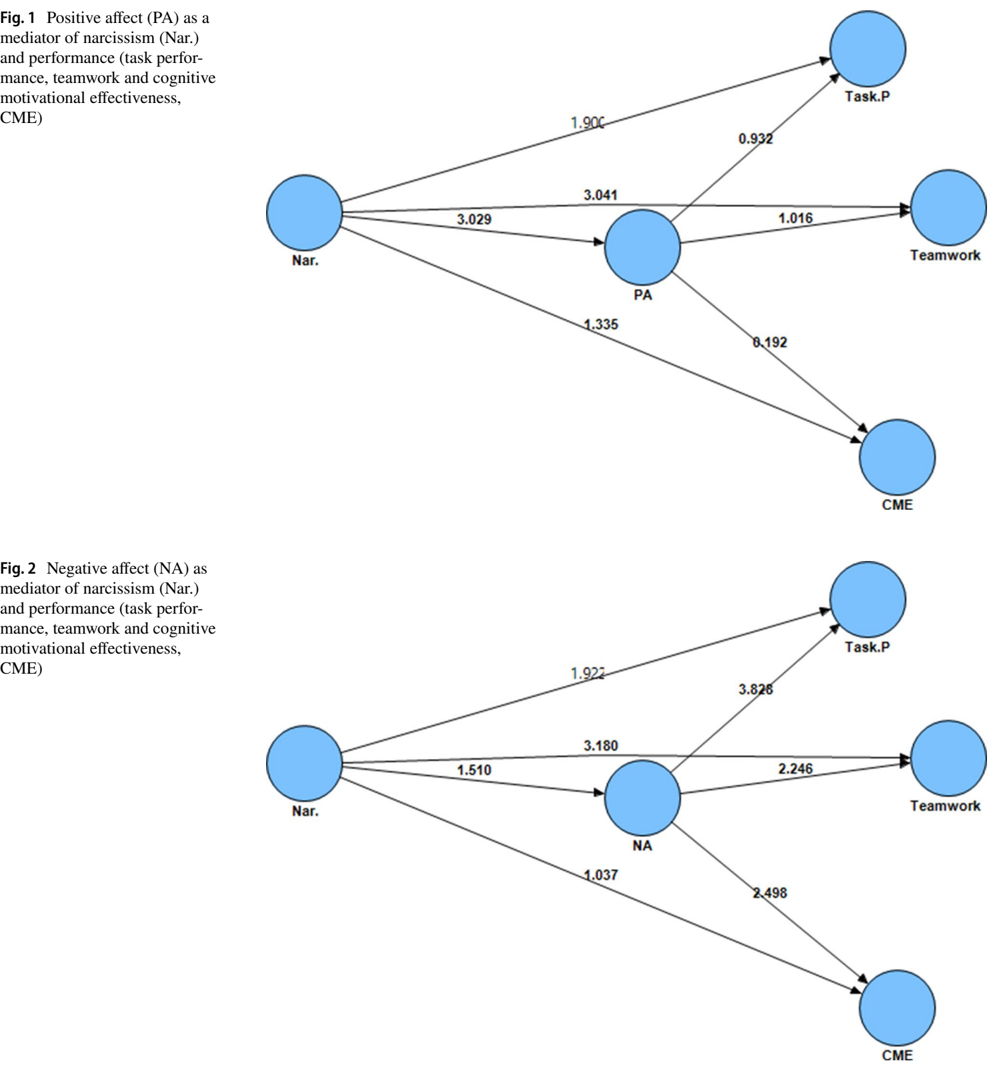
- Positive affect did not mediate narcissism–performance: indirect effects were task performance β = −0.08, t = 0.93; teamwork β = −0.10, t = 1.01; CME β = −0.02, t = 0.19; VAF values .18, .19, and .03. Hypothesis 2 was rejected.
- Negative affect partially mediated all three performance dimensions: task performance β = 0.35, t = 3.82; teamwork β = 0.22, t = 2.24; CME β = 0.27, t = 2.49; VAF values .64, .44, and .75. Hypothesis 3 was supported.
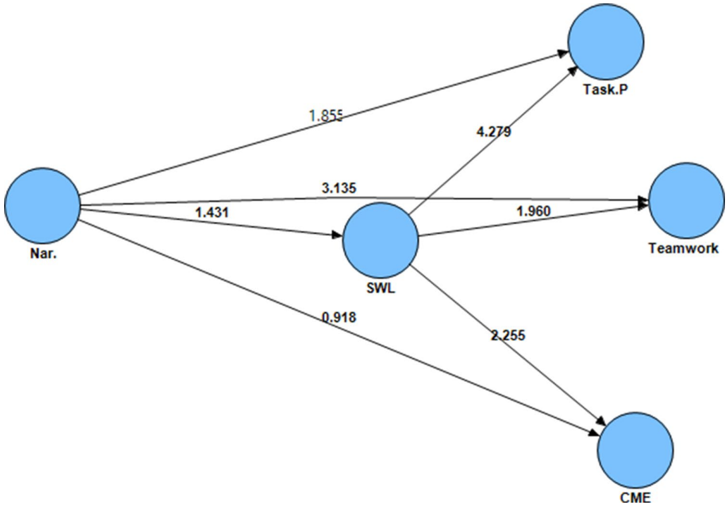
- Satisfaction with life partially mediated all three performance dimensions: task performance β = 0.34, t = 4.27; teamwork β = 0.18, t = 1.96; CME β = 0.25, t = 2.25; VAF values .79, .59, and .73. Hypothesis 4 was supported; Hypothesis 1 was partially accepted.
Methods
- Sample: 293 senior-level managers from the power generation sector (public sector undertakings, India), with 10–16 years of experience; 148 males and 145 females; age range 34–46 years, mean age 37.3 years. Data were collected through purposive and snowball techniques.
- Measures: Narcissistic Personality Inventory (NPI-16) for grandiose narcissism (Cronbach alpha = 0.62); Satisfaction with Life Scale (5 items, alpha = 0.75); PANAS-X (20 adjectives; positive affect alpha = 0.89, negative affect alpha = 0.77); 12-item Greene-Shortridge performance scale with task performance (4 items, alpha = 0.93), teamwork/co-worker support (3 items, alpha = 0.90), and cognitive-motivational effectiveness (5 items, alpha = 0.91).
- Analysis: SPSS 22 and Smart PLS 2.0; correlations and mediation/path analysis using bootstrapping; variance accounted for (VAF) values used to classify mediation.
Limitations
- Stated: only grandiose narcissism was examined, so findings should not be generalized to all forms of narcissism; no specified tool with clearer dimensions has been developed or used; organizational and other personality/situational moderators were not explored; self-reported data raise social desirability and common method bias concerns.
- Evident: the cross-sectional self-report design cannot establish causality; the sample is restricted to senior managers in Indian public-sector power generation, limiting generalizability; the NPI-16 alpha was modest (0.62); the paper reports inconsistent direction for the narcissism–negative affect relationship across its abstract/conclusion and its correlation table/results text.
Model-written summary. Check it against the paper before relying on it.
Integrity signals
Registry
Cites
Statistics
Figures
Verification
Claims the paper makes
1 Valid · 1 Not valid · 47 Not checked · 48 Own results and interpretations
Every source the paper cites for this claim was checked and supports it.
In the paper
“Another reason for greater wellbeing is that narcissism is closely related to self-esteem (Gornik-Durose 2020; Sedikides et al. 2004).”
§ Grandiose narcissism and performance in organizations: mediating role of subjective wellbeing > 3 Subjective wellbeing (SWB)
What the sources say
- Supportedcites Gornik-Durose 2020 matched to “Materialism and Well-Being Revisited: The Impact of Personality” (2020) source
Section 1.3 'Neuroticism, Narcissism and Well-Being' states that 'narcissism is associated with well-being due to its overlap with self-esteem (Rose 2002; Sedikides et al. 2004; Zuckerman and O'Loughlin 2009)', which presupposes and asserts the narcissism–self-esteem relation the citing sentence attributes. The Discussion (p. 3) reinforces this, describing the 'high self-esteem, demonstrated by narcissists' and their immunity to low self-esteem, treating the link as established background the paper itself relies on rather than merely crediting elsewhere. The co-citation of Sedikides et al. (2004) in the citing sentence matches the works our copy names for this point. (LLM, conf=0.85)
- Supportedcites Sedikides et al. 2004 matched to “Are normal narcissists psychologically healthy?: Self-esteem matters.” (2004) source
The source's 'Self-Esteem Matters' section (p. 6) states that self-esteem 'has been found to be consistently and positively related to normal narcissism,' calling it 'a key component of normal narcissism' and noting this 'strong and persistent relation.' The General Discussion (p. 35) reaffirms that 'High narcissists have elevated levels of self-esteem' and that narcissism's psychological-health benefits stem from 'its overlap with self-esteem.' The only narrowing relative to the citing sentence is scope: the paper concerns normal (non-clinical, NPI-measured) narcissism rather than narcissism in all forms, but the relation asserted is exactly the one attributed. (LLM, conf=0.90)
plainstates an association- Asserted: passes — The authors put it forward as true.
- Checkable: passes — It can be checked against evidence.
- Load-bearing: unclear — It is unclear whether the paper’s conclusions depend on it.
- Based: passes — The paper gives a reason why it holds.
- Supported
A result the paper reports from its own data — it cites no other source for it, so there is none to check. The quote shows it is in the paper.
In the paper
“Satisfaction with life is significantly related with task performance, teamwork and cognitive motivation effectiveness (p < 0.01).”
§ Grandiose narcissism and performance in organizations: mediating role of subjective wellbeing > 8 Results and interpretation
plainstates an association- Asserted: passes — The authors put it forward as true.
- Checkable: passes — It can be checked against evidence.
- Load-bearing: passes — The paper’s conclusions depend on it.
- Based: passes — The paper gives a reason why it holds.
A result the paper reports from its own data — it cites no other source for it, so there is none to check. The quote shows it is in the paper.
In the paper
“inversely related to negative affect (r = -0.14, p < 0.05)”
§ Grandiose narcissism and performance in organizations: mediating role of subjective wellbeing > 8 Results and interpretation
plainstates an association- Asserted: passes — The authors put it forward as true.
- Checkable: passes — It can be checked against evidence.
- Load-bearing: unclear — It is unclear whether the paper’s conclusions depend on it.
- Based: passes — The paper gives a reason why it holds.
A result the paper reports from its own data — it cites no other source for it, so there is none to check. The quote shows it is in the paper.
In the paper
“The correlation results showed that grandiose narcissism was negatively related to performance, life satisfaction and positively related to negative affect.”
§ Grandiose narcissism and performance in organizations: mediating role of subjective wellbeing > Abstract
plainstates an association- Asserted: passes — The authors put it forward as true.
- Checkable: passes — It can be checked against evidence.
- Load-bearing: passes — The paper’s conclusions depend on it.
- Based: passes — The paper gives a reason why it holds.
A result the paper reports from its own data — it cites no other source for it, so there is none to check. The quote shows it is in the paper.
In the paper
“and positively with CME (p < 0.01)”
§ Grandiose narcissism and performance in organizations: mediating role of subjective wellbeing > 8 Results and interpretation
plainstates an association- Asserted: passes — The authors put it forward as true.
- Checkable: passes — It can be checked against evidence.
- Load-bearing: passes — The paper’s conclusions depend on it.
- Based: passes — The paper gives a reason why it holds.
44 more claims
Create a free account to see all 97 claims and to verify the 82 references still open.
- Probably not a substantial claim. 38
- It may state two separate claims as one. 31
Self-check
Percentages, sums and reported differences re-computed from the paper’s own numbers.
Each contradiction between two passages listed here was confirmed by an independent check.
Rated major: it would touch a result — a value a result rests on, reported and recomputed p-values on opposite sides of the significance level, two passages that conflict with no sign which is right, or a cited work retracted before this paper was published.
In the paper
§ Grandiose narcissism and performance in organizations: mediating role of subjective wellbeing > 10 Conclusion, implications and limitations
“Correlation results also showed that grandiose narcissism is positively and significantly related to negative affect but negatively to positive affect and life satisfaction.”
§ Grandiose narcissism and performance in organizations: mediating role of subjective wellbeing > 8 Results and interpretation
“1.Narcissism 7.39 3.61 1 2. PA 29.56 9.57 0.30** 1 3. NA 34.61 8.16 -0.14*”
Rated minor: it would not touch a result — a value no result rests on, a p-value that stays on the same side of the significance level, or a conflict that is clerical, resolved elsewhere in the paper, or outside its own findings.
In the paper
§ Grandiose narcissism and performance in organizations: mediating role of subjective wellbeing > 8 Results and interpretation
“Narcissism personality trait is negatively and significantly related to all three dimensions of performance (p < 0.01).”
§ Grandiose narcissism and performance in organizations: mediating role of subjective wellbeing > 8 Results and interpretation
“7. Cognitive Motivational effectiveness 19.71 3.94 -0.13* -0.02 0.29** 0.26** 0.46** 0.49** 1”
Rated minor: it would not touch a result — a value no result rests on, a p-value that stays on the same side of the significance level, or a conflict that is clerical, resolved elsewhere in the paper, or outside its own findings.
In the paper
§ Grandiose narcissism and performance in organizations: mediating role of subjective wellbeing > 8 Results and interpretation
“positive affect is significantly related to task performance teamwork and CME (p < 0.01)”
§ Grandiose narcissism and performance in organizations: mediating role of subjective wellbeing > 8 Results and interpretation
“7. Cognitive Motivational effectiveness 19.71 3.94 -0.13* -0.02 0.29** 0.26** 0.46** 0.49** 1”
Citations
Cites
Preacher, K. J., & Hayes, A. F. (2008) · Behavior Research Methods · doi:10.3758/brm.40.3.879 · Cited by 34,117 · cited 1×
“For indirect effect, Preacher and Hayes (2004, 2008) interpretation was used and for mediation to be significant, the indirect must not straddle a ‘0’ Fig.”
MethodDevelopment and validation of brief measures of positive and negative affect: The PANAS scales.
Watson, D., Clark, L. A., & Tellegen, A. (1988) · Journal of Personality and Social Psychology · doi:10.1037/0022-3514.54.6.1063 · Cited by 32,433
The satisfaction with life scale
Diener, E., Emmons, R. A., Larsen, R. J., & Griffin, S. (1985) · Journal of Personality Assessment · doi:10.1207/s15327752jpa4901_13 · Cited by 31,768 · cited 3×
“The subjective wellbeing was assessed using two scales namely Satisfaction with Life Scale (Diener et al.”
MethodInfluentialSPSS and SAS procedures for estimating indirect effects in simple mediation models
Preacher, K. J., & Hayes, A. F. (2004) · Behavior Research Methods, Instruments, & Computers · doi:10.3758/bf03206553 · Cited by 17,383 · cited 1×
“For indirect effect, Preacher and Hayes (2004, 2008) interpretation was used and for mediation to be significant, the indirect must not straddle a ‘0’ Fig.”
MethodThe Job Demands‐Resources model: state of the art
Bakker, A. B., & Demerouti, E. (2007) · Journal of Managerial Psychology · doi:10.1108/02683940710733115 · Cited by 12,996 · cited 2×
“Negative affect may also construe over-engagement or tiredness which have proved a significant relationship with performance (Niessen et al. 2012; Bakker and Demerouti 2007).”
Background(2014) · DigitalCommons - Kennesaw State University (Kennesaw State University) · Cited by 12,785
Research in Organizational Behavior
Hammer, E. R., Cummings, L. L., & Staw, B. M. (1984) · The Academy of Management Review · doi:10.2307/258300 · Cited by 11,175
Diagnostic and Statistical Manual of Mental Disorders, Fourth Edition, Text Revision (DSM-IV-TR)
American Psychiatric Association (2000) · doi:10.1176/appi.books.9780890423349 · Cited by 11,069
Subjective well-being. The science of happiness and a proposal for a national index
Diener, E. (2000) · American Psychologist · doi:10.1037/0003-066x.55.1.34 · Cited by 7,121 · cited 1×
“These two components of SWB: balancing of positive and negative affective states (moods and emotions) and cognitive evaluation of life depicts SWB index (Diener 2000) are the core constituents of SWB.”
Self-determination theory: A macrotheory of human motivation, development, and health
Deci, E. L., & Ryan, R. M. (2008) · Canadian Psychology / Psychologie canadienne · doi:10.1037/a0012801 · Cited by 6,664 · cited 1×
“SWB is operationalized as a combination of higher life satisfaction, high levels of positive affect and low negative affect (Deci and Ryan 2008).”
Background
Research works printed but not linked: 3
- Greene Shortridge TM (2008) Proximal and longitudinal outcome of person-environment fit: a positive psychological approach. UMI Microform, Proquest LLC, USA, p 3316391
- Rosenthal S (2010) Narcissism and leadership: a review and research agenda, Centre for Public Leadership, Harvard University. Retrieved from https ://dspac e.mit.edu/handl e/1721.1/55948 on 10, August, 2019
- Uji M, Yukihiro T, Adachi K (2014) Narcissistic grandiose self: its defensive function against depressive mood and the damage it causes in the context of negative interpersonal life events. In: Besser A (ed) Psychology of emotions, motivations and actions. Handbook of the psychology of narcissism: diverse perspectives. Nova Science Publishers, New York, pp 215-226
Cited by
The Mediating Role of Gaming Disorder in the Effect of Narcissism on Happiness in Children
Çevık, O., Koçak, O., Younis, M. Z., & Çevik, E. (2021) · International Journal of Environmental Research and Public Health · doi:10.3390/ijerph18137137 · Cited by 19
“However, some studies found a positive relationship between unhealthy narcissism and happiness [48,52].”
BackgroundResultQueiri, A., & Alhejji, H. (2025) · International journal of organizational analysis · doi:10.1108/ijoa-07-2024-4654 · Cited by 16
Yousif, M. B. Z., & Loukil, T. (2022) · Academic Journal of Interdisciplinary Studies · doi:10.36941/ajis-2022-0134 · Cited by 13
The relationship between narcissism and creativity: A chain/serial mediation model
Chang, L., & Gong, Z. (2023) · Personality and Individual Differences · doi:10.1016/j.paid.2022.112070 · Cited by 9
Faeq, D. K. (2025) · BMC Nursing · doi:10.1186/s12912-025-03479-x · Cited by 6
“…leadership, as a detrimental leadership style, manifests in diverse environments including hospitality, banking, and the public sector [7, 11, 12]. individuals who recognize pronounced indicators of narcissistic leadership in the workplace engage in work-place bullying; bullying is intrinsic…”
Metadata
- Authors
- Sakkar Sudha, K., & Shahnawaz, M. G.
- Affiliations
- Jamia Millia Islamia (IN)
- Corresponding author
- Shahnawaz, M. Ghazi
- Venue
- Leadership, Education, Personality: An Interdisciplinary Journal
- Publisher
- Springer Fachmedien Wiesbaden GmbH
- Published
- 2020-12
- Volume
- 2
- Issue
- 2
- Pages
- 101-111
- ISSN
- 2524-6178 (ISSN-L)
- OpenAlex
- W3108747034
- Semantic Scholar
- 4d2e4a67d5d7402802bfe9a9683c034dfa211582
- Cited by
- 7
- References
- 94
- Citations by year
- 2025: 2 · 2023: 2 · 2022: 1 · 2021: 2
- FWCI
- 0.50
- Type
- journal article
- Language
- en
- Open access
- hybrid
- doi.org
- Licence
- cc-by
- creativecommons.org/licenses/by/4.0/ (tdm)
- creativecommons.org/licenses/by/4.0/ (vor, 2 d)
- Locations
- Leadership Education Personality An Interdisciplinary Journal (publishedVersion, cc-by)
- Econstor (Econstor) (submittedVersion, cc-by)
- Topics
- Social Sciences › Psychology › Clinical Psychology › Personality Traits and Psychology
- Social Sciences › Business, Management and Accounting › Organizational Behavior and Human Resource Management › Job Satisfaction and Organizational Behavior
- Social Sciences › Psychology › Social Psychology › Psychological Well-being and Life Satisfaction
- Keywords
- grandiose narcissism, organizational performance, subjective well-being, negative affect, life satisfaction, positive affect, task performance, teamwork, cognitive motivation, public sector employees
About these checks
Registry, retraction, Cites and statistics results are computed, not judged, with one exception: a printed reference that no index lists is read once by a model before it counts as a citation error. Claims are extracted by a model and kept only when their quote appears verbatim in the text; each cited source is then checked, with a model’s help, for whether it says what the claim relies on. Those verdicts can be wrong — read the claim’s quote and the cited source before relying on one.
A language model drew the claims from the paper on 2026-10-08, under version 3 of the claim definition (model deepseek-v4.1-flash, prompt extract-v3).
A second model labelled each claim on 2026-10-08 (model jev-1.13-20260917, definition revision gold-guideline-v0.2).
Cited sources are checked with a language model’s help (qwen3.8-omni-flash).
Statistics and arithmetic are recomputed, not judged.
Confidence bands are shown only for fields calibrated on our annotated test set. None is calibrated yet, so no band is shown.
What counts as a claim ›How we measure confidence ›How we check this ›
Are you an author, or do you see a problem with this page? Request a review
How to cite
Cite CoChat for the checks on this page, and the paper for its own findings.
- This page
- CoChat. (2026). Citation check: Grandiose narcissism and performance in organizations: mediating role of subjective wellbeing. https://app.cochat.ai/papers/10.1365/s42681-020-00015-0
- The paper
- Sakkar Sudha, K., & Shahnawaz, M. G. (2020). Grandiose narcissism and performance in organizations: mediating role of subjective wellbeing. Leadership, Education, Personality: An Interdisciplinary Journal. https://doi.org/10.1365/s42681-020-00015-0
Data sources
Bibliographic data: Semantic Scholar, OpenAlex, Crossref.
Contains information from the Semantic Scholar Academic Graph Datasets, made available under the ODC Attribution License (ODC-BY 1.0).
Semantic Scholar’s data is described in: Kinney, R., et al. (2023). The Semantic Scholar Open Data Platform. arXiv:2301.10140.
