

Grandiose narcissism and performance in organizations: mediating role of subjective wellbeing
Open accessThe DOI matches its Crossref record; 93 of the 94 references it cites were found in a registry or an index; 2 of the 84 sources its claims cite were checked for support.
Abstract
Narcissism is imbued with emotional dynamism and there is a strong need to assess the linkages with outcomes by analyzing their fusion. The present study examined the relationship between grandiose narcissism and performance through analyzing the mediating role of subjective wellbeing (positive affect, negative affect and life satisfaction). The wholesome assessment of performance was done by considering task performance, team-work and cognitive motivational effectiveness among 293 senior-level Indian employees of a big public sector organization. Data were analyzed by using SPSS 22 and Smart PLS 2.0. The correlation results showed that grandiose narcissism was negatively related to performance, life satisfaction and positively related to negative affect. The indirect pathways (through mediation analyses) revealed that negative affect and life satisfaction mediated the relationship between grandiose narcissism and performance. The study effectively contributes to the narcissism and performance literature by presenting clearer pathways of grandiose narcissism (through self-regulated emotions and subjective wellbeing). Practical implications were also highlighted beside the theoretical concerns.
Overview
CoChat Summary
TL;DR
In 293 senior-level Indian public-sector power-generation managers, grandiose narcissism was negatively related to all three performance dimensions and to life satisfaction, while its indirect relationship with performance was partially mediated by negative affect and life satisfaction, not positive affect. The authors conclude that subjective wellbeing pathways help clarify inconsistent narcissism–performance links.
Key findings
- Grandiose narcissism mean was 7.39 (moderate). It was negatively related to task performance (r = −0.24), teamwork (r = −0.32), and cognitive motivational effectiveness (CME; r = −0.13), all p < 0.01; it was related to positive affect (r = 0.30, p < 0.01), negative affect (r = −0.14, p < 0.05), and satisfaction with life (r = −0.16, p < 0.01). The paper’s abstract/conclusion describe narcissism as positively related to negative affect, while the correlation table and results text report an inverse relationship.
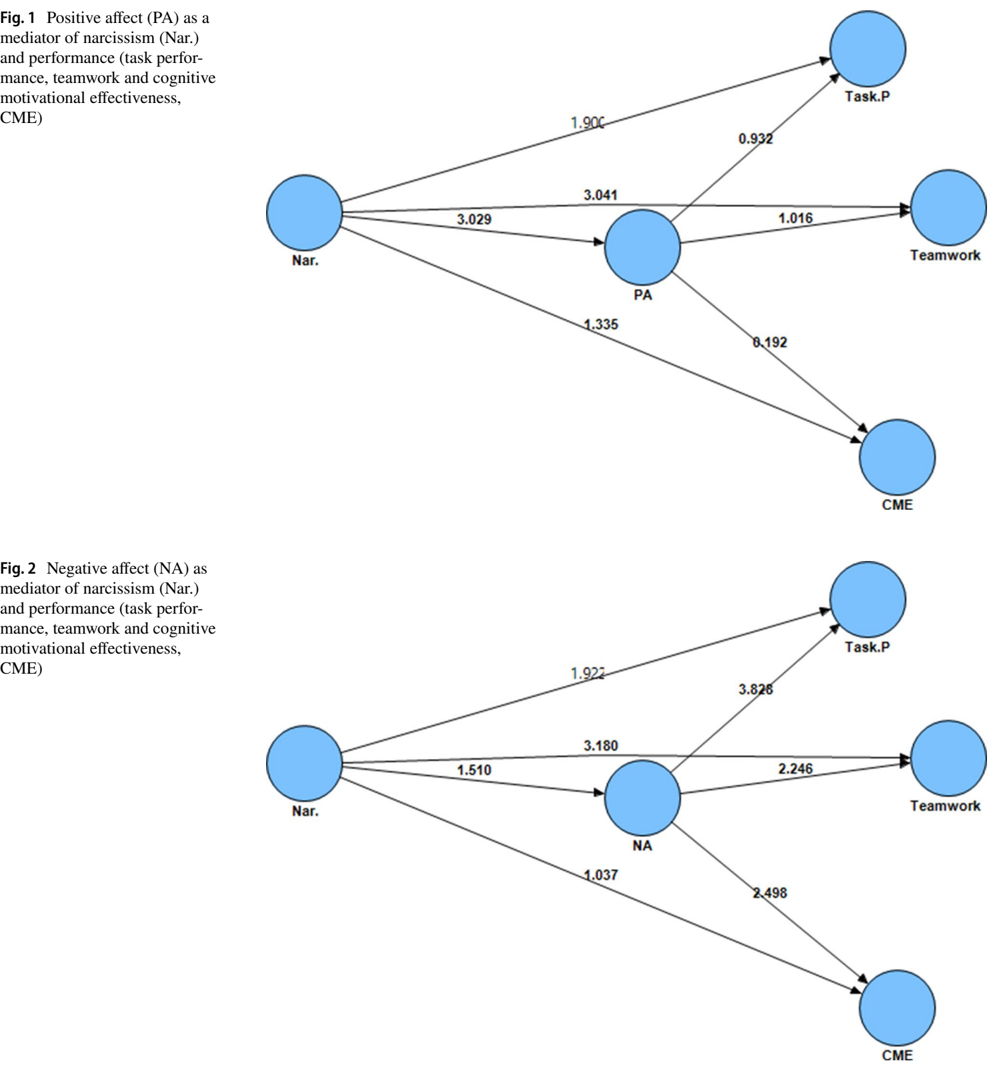
- Positive affect did not mediate narcissism–performance: indirect effects were task performance β = −0.08, t = 0.93; teamwork β = −0.10, t = 1.01; CME β = −0.02, t = 0.19; VAF values .18, .19, and .03. Hypothesis 2 was rejected.
- Negative affect partially mediated all three performance dimensions: task performance β = 0.35, t = 3.82; teamwork β = 0.22, t = 2.24; CME β = 0.27, t = 2.49; VAF values .64, .44, and .75. Hypothesis 3 was supported.
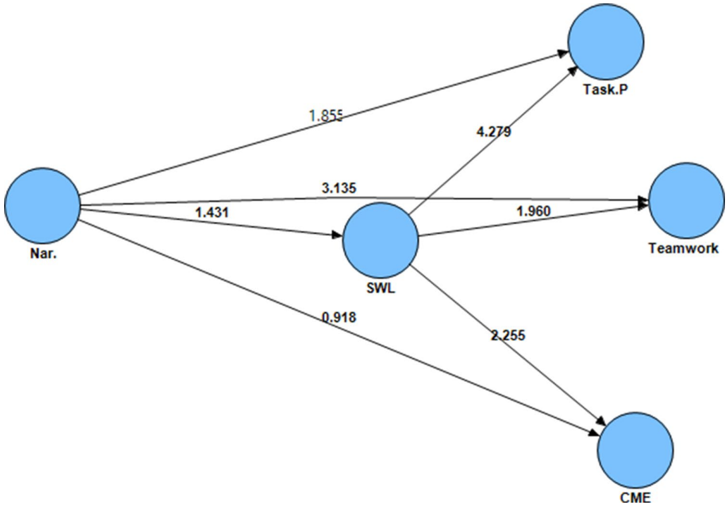
- Satisfaction with life partially mediated all three performance dimensions: task performance β = 0.34, t = 4.27; teamwork β = 0.18, t = 1.96; CME β = 0.25, t = 2.25; VAF values .79, .59, and .73. Hypothesis 4 was supported; Hypothesis 1 was partially accepted.
Methods
- Sample: 293 senior-level managers from the power generation sector (public sector undertakings, India), with 10–16 years of experience; 148 males and 145 females; age range 34–46 years, mean age 37.3 years. Data were collected through purposive and snowball techniques.
- Measures: Narcissistic Personality Inventory (NPI-16) for grandiose narcissism (Cronbach alpha = 0.62); Satisfaction with Life Scale (5 items, alpha = 0.75); PANAS-X (20 adjectives; positive affect alpha = 0.89, negative affect alpha = 0.77); 12-item Greene-Shortridge performance scale with task performance (4 items, alpha = 0.93), teamwork/co-worker support (3 items, alpha = 0.90), and cognitive-motivational effectiveness (5 items, alpha = 0.91).
- Analysis: SPSS 22 and Smart PLS 2.0; correlations and mediation/path analysis using bootstrapping; variance accounted for (VAF) values used to classify mediation.
Limitations
- Stated: only grandiose narcissism was examined, so findings should not be generalized to all forms of narcissism; no specified tool with clearer dimensions has been developed or used; organizational and other personality/situational moderators were not explored; self-reported data raise social desirability and common method bias concerns.
- Evident: the cross-sectional self-report design cannot establish causality; the sample is restricted to senior managers in Indian public-sector power generation, limiting generalizability; the NPI-16 alpha was modest (0.62); the paper reports inconsistent direction for the narcissism–negative affect relationship across its abstract/conclusion and its correlation table/results text.
Model-written summary. Check it against the paper before relying on it.
Integrity signals
Registry
Cites
Statistics
Figures
Verification
Claims the paper makes
1 Valid · 1 Not valid · 47 Not checked · 48 Own results and interpretations
Every source the paper cites for this claim was checked and supports it.
In the paper
“Another reason for greater wellbeing is that narcissism is closely related to self-esteem (Gornik-Durose 2020; Sedikides et al. 2004).”
§ Grandiose narcissism and performance in organizations: mediating role of subjective wellbeing > 3 Subjective wellbeing (SWB)
What the sources say
- Supportedcites Gornik-Durose 2020 matched to “Materialism and Well-Being Revisited: The Impact of Personality” (2020) source
Section 1.3 'Neuroticism, Narcissism and Well-Being' states that 'narcissism is associated with well-being due to its overlap with self-esteem (Rose 2002; Sedikides et al. 2004; Zuckerman and O'Loughlin 2009)', which presupposes and asserts the narcissism–self-esteem relation the citing sentence attributes. The Discussion (p. 3) reinforces this, describing the 'high self-esteem, demonstrated by narcissists' and their immunity to low self-esteem, treating the link as established background the paper itself relies on rather than merely crediting elsewhere. The co-citation of Sedikides et al. (2004) in the citing sentence matches the works our copy names for this point. (LLM, conf=0.85)
- Supportedcites Sedikides et al. 2004 matched to “Are normal narcissists psychologically healthy?: Self-esteem matters.” (2004) source
The source's 'Self-Esteem Matters' section (p. 6) states that self-esteem 'has been found to be consistently and positively related to normal narcissism,' calling it 'a key component of normal narcissism' and noting this 'strong and persistent relation.' The General Discussion (p. 35) reaffirms that 'High narcissists have elevated levels of self-esteem' and that narcissism's psychological-health benefits stem from 'its overlap with self-esteem.' The only narrowing relative to the citing sentence is scope: the paper concerns normal (non-clinical, NPI-measured) narcissism rather than narcissism in all forms, but the relation asserted is exactly the one attributed. (LLM, conf=0.90)
plainstates an association- Asserted: passes — The authors put it forward as true.
- Checkable: passes — It can be checked against evidence.
- Load-bearing: unclear — It is unclear whether the paper’s conclusions depend on it.
- Based: passes — The paper gives a reason why it holds.
- Supported
A result the paper reports from its own data — it cites no other source for it, so there is none to check. The quote shows it is in the paper.
In the paper
“Satisfaction with life is significantly related with task performance, teamwork and cognitive motivation effectiveness (p < 0.01).”
§ Grandiose narcissism and performance in organizations: mediating role of subjective wellbeing > 8 Results and interpretation
plainstates an association- Asserted: passes — The authors put it forward as true.
- Checkable: passes — It can be checked against evidence.
- Load-bearing: passes — The paper’s conclusions depend on it.
- Based: passes — The paper gives a reason why it holds.
A result the paper reports from its own data — it cites no other source for it, so there is none to check. The quote shows it is in the paper.
In the paper
“inversely related to negative affect (r = -0.14, p < 0.05)”
§ Grandiose narcissism and performance in organizations: mediating role of subjective wellbeing > 8 Results and interpretation
plainstates an association- Asserted: passes — The authors put it forward as true.
- Checkable: passes — It can be checked against evidence.
- Load-bearing: unclear — It is unclear whether the paper’s conclusions depend on it.
- Based: passes — The paper gives a reason why it holds.
A result the paper reports from its own data — it cites no other source for it, so there is none to check. The quote shows it is in the paper.
In the paper
“The correlation results showed that grandiose narcissism was negatively related to performance, life satisfaction and positively related to negative affect.”
§ Grandiose narcissism and performance in organizations: mediating role of subjective wellbeing > Abstract
plainstates an association- Asserted: passes — The authors put it forward as true.
- Checkable: passes — It can be checked against evidence.
- Load-bearing: passes — The paper’s conclusions depend on it.
- Based: passes — The paper gives a reason why it holds.
A result the paper reports from its own data — it cites no other source for it, so there is none to check. The quote shows it is in the paper.
In the paper
“and positively with CME (p < 0.01)”
§ Grandiose narcissism and performance in organizations: mediating role of subjective wellbeing > 8 Results and interpretation
plainstates an association- Asserted: passes — The authors put it forward as true.
- Checkable: passes — It can be checked against evidence.
- Load-bearing: passes — The paper’s conclusions depend on it.
- Based: passes — The paper gives a reason why it holds.
44 more claims
Create a free account to see all 97 claims and to verify the 82 references still open.
- Probably not a substantial claim. 38
- It may state two separate claims as one. 31
Self-check
Percentages, sums and reported differences re-computed from the paper’s own numbers.
Each contradiction between two passages listed here was confirmed by an independent check.
Rated major: it would touch a result — a value a result rests on, reported and recomputed p-values on opposite sides of the significance level, two passages that conflict with no sign which is right, or a cited work retracted before this paper was published.
In the paper
§ Grandiose narcissism and performance in organizations: mediating role of subjective wellbeing > 10 Conclusion, implications and limitations
“Correlation results also showed that grandiose narcissism is positively and significantly related to negative affect but negatively to positive affect and life satisfaction.”
§ Grandiose narcissism and performance in organizations: mediating role of subjective wellbeing > 8 Results and interpretation
“1.Narcissism 7.39 3.61 1 2. PA 29.56 9.57 0.30** 1 3. NA 34.61 8.16 -0.14*”
Rated minor: it would not touch a result — a value no result rests on, a p-value that stays on the same side of the significance level, or a conflict that is clerical, resolved elsewhere in the paper, or outside its own findings.
In the paper
§ Grandiose narcissism and performance in organizations: mediating role of subjective wellbeing > 8 Results and interpretation
“Narcissism personality trait is negatively and significantly related to all three dimensions of performance (p < 0.01).”
§ Grandiose narcissism and performance in organizations: mediating role of subjective wellbeing > 8 Results and interpretation
“7. Cognitive Motivational effectiveness 19.71 3.94 -0.13* -0.02 0.29** 0.26** 0.46** 0.49** 1”
Rated minor: it would not touch a result — a value no result rests on, a p-value that stays on the same side of the significance level, or a conflict that is clerical, resolved elsewhere in the paper, or outside its own findings.
In the paper
§ Grandiose narcissism and performance in organizations: mediating role of subjective wellbeing > 8 Results and interpretation
“positive affect is significantly related to task performance teamwork and CME (p < 0.01)”
§ Grandiose narcissism and performance in organizations: mediating role of subjective wellbeing > 8 Results and interpretation
“7. Cognitive Motivational effectiveness 19.71 3.94 -0.13* -0.02 0.29** 0.26** 0.46** 0.49** 1”
Citations
Cites
Preacher, K. J., & Hayes, A. F. (2008) · Behavior Research Methods · doi:10.3758/brm.40.3.879 · Cited by 34,117 · cited 1×
“For indirect effect, Preacher and Hayes (2004, 2008) interpretation was used and for mediation to be significant, the indirect must not straddle a ‘0’ Fig.”
MethodDevelopment and validation of brief measures of positive and negative affect: The PANAS scales.
Watson, D., Clark, L. A., & Tellegen, A. (1988) · Journal of Personality and Social Psychology · doi:10.1037/0022-3514.54.6.1063 · Cited by 32,433
The satisfaction with life scale
Diener, E., Emmons, R. A., Larsen, R. J., & Griffin, S. (1985) · Journal of Personality Assessment · doi:10.1207/s15327752jpa4901_13 · Cited by 31,768 · cited 3×
“The subjective wellbeing was assessed using two scales namely Satisfaction with Life Scale (Diener et al.”
MethodInfluentialSPSS and SAS procedures for estimating indirect effects in simple mediation models
Preacher, K. J., & Hayes, A. F. (2004) · Behavior Research Methods, Instruments, & Computers · doi:10.3758/bf03206553 · Cited by 17,383 · cited 1×
“For indirect effect, Preacher and Hayes (2004, 2008) interpretation was used and for mediation to be significant, the indirect must not straddle a ‘0’ Fig.”
MethodThe Job Demands‐Resources model: state of the art
Bakker, A. B., & Demerouti, E. (2007) · Journal of Managerial Psychology · doi:10.1108/02683940710733115 · Cited by 12,996 · cited 2×
“Negative affect may also construe over-engagement or tiredness which have proved a significant relationship with performance (Niessen et al. 2012; Bakker and Demerouti 2007).”
Background(2014) · DigitalCommons - Kennesaw State University (Kennesaw State University) · Cited by 12,785
Research in Organizational Behavior
Hammer, E. R., Cummings, L. L., & Staw, B. M. (1984) · The Academy of Management Review · doi:10.2307/258300 · Cited by 11,175
Diagnostic and Statistical Manual of Mental Disorders, Fourth Edition, Text Revision (DSM-IV-TR)
American Psychiatric Association (2000) · doi:10.1176/appi.books.9780890423349 · Cited by 11,069
Subjective well-being. The science of happiness and a proposal for a national index
Diener, E. (2000) · American Psychologist · doi:10.1037/0003-066x.55.1.34 · Cited by 7,121 · cited 1×
“These two components of SWB: balancing of positive and negative affective states (moods and emotions) and cognitive evaluation of life depicts SWB index (Diener 2000) are the core constituents of SWB.”
Self-determination theory: A macrotheory of human motivation, development, and health
Deci, E. L., & Ryan, R. M. (2008) · Canadian Psychology / Psychologie canadienne · doi:10.1037/a0012801 · Cited by 6,664 · cited 1×
“SWB is operationalized as a combination of higher life satisfaction, high levels of positive affect and low negative affect (Deci and Ryan 2008).”
BackgroundInternational Review of Industrial and Organizational Psychology: Contents of Previous Volumes
(2003) · International Review of Industrial and Organizational Psychology 2004 · doi:10.1002/0470013311.oth1 · Cited by 2,762
Raskin, R., & Terry, H. (1988) · Journal of Personality and Social Psychology · doi:10.1037/0022-3514.54.5.890 · Cited by 2,273 · cited 2×
“The Narcissism personality inventory (Raskin and Terry 1988) and NPI -16 (Ames et al.”
A personality trait-based interactionist model of job performance
Tett, R. P., & Burnett, D. D. (2003) · Journal of Applied Psychology · doi:10.1037/0021-9010.88.3.500 · Cited by 2,241 · cited 1×
“CME is a contingent aspect of performing which aids in understanding how well an individual manages cognition, motivations and emotions at work (Tett and Burnett 2003; McCrae 2000).”
BackgroundUnraveling the Paradoxes of Narcissism: A Dynamic Self-Regulatory Processing Model
Morf, C. C., & Rhodewalt, F. (2001) · Psychological Inquiry · doi:10.1207/s15327965pli1204_1 · Cited by 2,215 · cited 4×
“The interpersonal strategies are used to regulate emotions by both vulnerable and grandiose narcissism (Morf and Rhodewalt 2001) and can have varying intrapersonal and interpersonal effects.”
BackgroundInfluentialChatterjee, A., & Hambrick, D. C. (2007) · Administrative Science Quarterly · doi:10.2189/asqu.52.3.351 · Cited by 2,074 · cited 1×
“2010; Chatterjee and Hambrick 2007).”
The NPI-16 as a short measure of narcissism.
Ames, D. R., Rose, P., & Anderson, C. P. (2006) · Journal of Research in Personality · doi:10.1016/j.jrp.2005.03.002 · Cited by 1,349 · cited 3×
“Narcissism was measured using Narcissistic Personality Inventory (NPI 16) (Ames et al. 2006).”
BackgroundMethodInfluentialHarrison, D. A., Newman, D. A., & Roth, P. L. (2006) · Academy of Management Journal · doi:10.5465/amj.2006.20786077 · Cited by 1,245 · cited 1×
“Organizational performance is a multifaceted construct and it comprises of in-role performance, contextual performance, and attitudinal dimensions of performance (Harrison et al. 2006).”
BackgroundDiscovering Statistics Using IBM SPSS Statistics: And Sex and Drugs and Rock “N” Roll
(2014) · Pflege · doi:10.1024/1012-5302/a000397 · Cited by 1,224
Pathological narcissism and narcissistic personality disorder
Pincus, A. L., & Lukowitsky, M. R. (2010) · Annual Review of Clinical Psychology · doi:10.1146/annurev.clinpsy.121208.131215 · Cited by 1,082 · cited 2×
“2012; Pincus and Lukowitsky 2010), grandiose narcissism is typically seen as adaptive and referred to as normal narcissism (Miller et al.”
BackgroundOswald, A. J., Proto, E., & Sgroi, D. (2015) · Journal of Labor Economics · doi:10.1086/681096 · Cited by 1,008 · cited 1×
“Extant research has been done in the area of narcissism and wellbeing (Wirtz and Riggotti 2020); wellbeing and performance (Bryson et al. 2017; Oswald et al. 2015; Imran and Shahnawaz 2020; Sakkar Sudha and Shahnawaz 2020) and narcissism and performance (Grijalva et al.”
BackgroundRosenthal, S. A., & Pittinsky, T. L. (2006) · The Leadership Quarterly · doi:10.1016/j.leaqua.2006.10.005 · Cited by 937
Evolutionary explanations of emotions
Nesse, R. M. (1990) · Human Nature · doi:10.1007/bf02733986 · Cited by 884 · cited 1×
“The manifestation of emotions prepare individuals to respond optimally when situations are risky (negative affect) or opportunistic (positive affect) (Nesse 1990).”
BackgroundNarcissism, confidence, and risk attitude
Campbell, W. K., Goodie, A. S., & Foster, J. D. (2004) · Journal of Behavioral Decision Making · doi:10.1002/bdm.475 · Cited by 854 · cited 1×
“Narcissistic tend to exhibit desirable behaviors (Foster and Trimm 2008), often fantasize (coping mechanism) to present themselves as happy in various domains of life (Raskin and Novacek 1991) and may project themselves as goal achievers (Watts et al. 2013; Campbell et al. 2004).”
BackgroundThe Narcissism Spectrum Model: A Synthetic View of Narcissistic Personality
Krizan, Z., & Herlache, A. D. (2018) · Personality and Social Psychology Review · doi:10.1177/1088868316685018 · Cited by 807 · cited 2×
“1 3 inflated self-esteem, entitlement, extraversion and strong admiration needs whereas vulnerable narcissist is propped by fragile affective states, hostility, low self-esteem and inversely related most characteristics of grandiosity (Krizan and Herlache 2018; Miller et al. 2012).”
BackgroundJudge, T. A., & Zapata, C. P. (2015) · Academy of Management Journal · doi:10.5465/amj.2010.0837 · Cited by 738 · cited 2×
“2016; Judge and Zapata 2015) and different indicators of performance used by different researchers (e.g., Ames and Kammrath 2004; Meier and Semmer 2013).”
BackgroundAre normal narcissists psychologically healthy?: Self-esteem matters.
Sedikides, C., Rudich, E. A., Gregg, A. P., Kumashiro, M., & Rusbult, C. (2004) · Journal of Personality and Social Psychology · doi:10.1037/0022-3514.87.3.400 · Cited by 735 · cited 3×
“Another reason for greater wellbeing is that narcissism is closely related to self-esteem (Gornik-Durose 2020; Sedikides et al. 2004).”
BackgroundThe performance of narcissists rises and falls with perceived opportunity for glory.
Wallace, H. M., & Baumeister, R. F. (2002) · Journal of Personality and Social Psychology · doi:10.1037/0022-3514.82.5.819 · Cited by 678 · cited 2×
“Moreover, the relationship between narcissism and performance has been fairly inconsistent (Wallace and Baumister 2002) and is likely to be moderated by many contextual factors (Nevicka et al.”
BackgroundChatterjee, A., & Hambrick, D. C. (2011) · Administrative Science Quarterly · doi:10.1177/0001839211427534 · Cited by 636
Individual differences and behavior in organizations
Murphy, K. R. (1996) · Cited by 596
Miller, J. D., Lynam, D. R., Hyatt, C. S., & Campbell, W. K. (2017) · Annual Review of Clinical Psychology · doi:10.1146/annurev-clinpsy-032816-045244 · Cited by 572 · cited 1×
“There is no conclusive agreement to date over adaptive and maladaptive consequences of all these abovelisted categories (Miller et al. 2017).”
BackgroundNarcissism and Leadership: A Meta‐Analytic Review of Linear and Nonlinear Relationships
Grijalva, E., Harms, P. D., Newman, D. A., Gaddis, B. H., & Fraley, R. C. (2015) · Personnel Psychology · doi:10.1111/peps.12072 · Cited by 572
Leader narcissism and follower outcomes: the counterbalancing effect of leader humility.
Owens, B. P., Wallace, A. S., & Waldman, D. A. (2015) · Journal of Applied Psychology · doi:10.1037/a0038698 · Cited by 407
Narcissism and Comparative Self-Enhancement Strategies
Campbell, W. K., Reeder, G. D., Sedikides, C., & Elliot, A. J. (2000) · Journal of Research in Personality · doi:10.1006/jrpe.2000.2282 · Cited by 403
Gentile, B., Miller, J. D., Hoffman, B. J., Reidy, D. E., Zeichner, A., & Campbell, W. K. (2013) · Psychological Assessment · doi:10.1037/a0033192 · Cited by 398 · cited 1×
“2018) with remarkable psychometric properties (Gentile et al. 2013) which has also been used in the current study.”
MethodThe happy and unhappy faces of narcissism
Rose, P. (2002) · Personality and Individual Differences · doi:10.1016/s0191-8869(01)00162-3 · Cited by 361 · cited 3×
“2015) and positive consequences (Rose 2002).”
BackgroundCampbell, W. K., & Campbell, S. M. (2009) · Self and Identity · doi:10.1080/15298860802505129 · Cited by 355 · cited 2×
“Therefore, SWB would also be influenced by narcissism (Campbell and Campbell 2009).”
BackgroundGable, P., & Harmon-Jones, E. (2010) · Psychological Science · doi:10.1177/0956797609359622 · Cited by 332 · cited 2×
“The emotional, cognitive and motivational self-regulation if compatible with the work situation might prove productive even if the negative affect is high (Gable and Harmon-Jones 2010).”
BackgroundMaccoby, M. (2017) · Leadership Perspectives · doi:10.4324/9781315250601-4 · Cited by 328 · cited 2×
“On the other hand, narcissists are excellent communicators, power influencers and have an enchanting demeanor where they can captivate people and involve them in their vision (Reijman 2017; Montalvo et al. 2015; Maccoby 2004).”
BackgroundThriving at work—A diary study
Niessen, C., Sonnentag, S., & Sach, F. (2012) · Journal of Organizational Behavior · doi:10.1002/job.763 · Cited by 315 · cited 1×
“Negative affect may also construe over-engagement or tiredness which have proved a significant relationship with performance (Niessen et al. 2012; Bakker and Demerouti 2007).”
BackgroundOn Being Eager and Uninhibited: Narcissism and Approach–Avoidance Motivation
Foster, J. D., & Trimm, R. F. (2008) · Personality and Social Psychology Bulletin · doi:10.1177/0146167208316688 · Cited by 314 · cited 1×
“Narcissistic tend to exhibit desirable behaviors (Foster and Trimm 2008), often fantasize (coping mechanism) to present themselves as happy in various domains of life (Raskin and Novacek 1991) and may project themselves as goal achievers (Watts et al.”
BackgroundCross-Cultural Correlates of Life Satisfaction and Self-Esteem
Diener, E., & Diener, M. (2009) · Social Indicators Research Series · doi:10.1007/978-90-481-2352-0_4 · Cited by 313 · cited 1×
“The primary reasons for higher life satisfaction can be attributed to streaming positive emotions, higher self-esteem, self-enhancement disposition of narcissistic 1 3 individuals (Hill and Roberts 2012; Diener & Diener 2009).”
BackgroundThe "Why" and "How" of Narcissism: A Process Model of Narcissistic Status Pursuit
Grapsas, S., Brummelman, E., Back, M. D., & Denissen, J. J. A. (2020) · Perspectives on Psychological Science · doi:10.1177/1745691619873350 · Cited by 312 · cited 1×
“Recent literature on narcissism has suggested that there is a need to assess self-regulatory processes such as wellbeing which might affect behaviors of narcissistic leaders in a social and organizational setting (Grapsas et al. 2020).”
BackgroundTeamwork in multi-person systems: a review and analysis
Paris, C. R., Salas, E., & Cannon-Bowers, J. A. (2000) · Ergonomics · doi:10.1080/00140130050084879 · Cited by 308
Determinants of organizational performance: a proposed framework
Almatrooshi, B., Singh, S. K., & Farouk, S. (2016) · International Journal of Productivity and Performance Management · doi:10.1108/ijppm-02-2016-0038 · Cited by 300 · cited 1×
“The varying effect on performance is because of myriad reasons such as cognitive, affective and motivation competencies, inter group relations, type of tasks, ability to handle the tasks (Bashaer et al. 2016; Judge and Zapata 2015) and different indicators of performance used by different researchers (e.”
BackgroundThe long-term organizational impact of destructively narcissistic managers
Lubit, R. (2002) · Academy of Management Perspectives · doi:10.5465/ame.2002.6640218 · Cited by 260 · cited 1×
“Originally narcissism was considered as negative (Lubit 2002) but lately, narcissism construct has been broadened and is considered as both positive and negative (Czarna and Nevicka 2019).”
BackgroundWork motivation: New directions in theory and research.
Kanfer, R. (1994) · Cited by 243
Mind-Reading and Metacognition: Narcissism, not Actual Competence, Predicts Self-Estimated Ability
Ames, D. R., & Kammrath, L. K. (2004) · Journal of Nonverbal Behavior · doi:10.1023/b:jonb.0000039649.20015.0e · Cited by 238 · cited 1×
“2016; Judge and Zapata 2015) and different indicators of performance used by different researchers (e.g., Ames and Kammrath 2004; Meier and Semmer 2013).”
BackgroundBraun, S. (2017) · Frontiers in Psychology · doi:10.3389/fpsyg.2017.00773 · Cited by 229 · cited 1×
“On the contrary, narcissistic leaders also perform poorly (Braun 2017; Rosenthal 2010) due to poor decision making, incomprehensible goals and haphazard ways of functioning and may also falter over time (Rosenthal and Pittinksky 2006).”
BackgroundReality at Odds With Perceptions: Narcissistic Leaders and Group Performance
Nevicka, B., Ten Velden, F. S., De Hoogh, A. H. B., & Van Vianen, A. E. M. (2011) · Psychological Science · doi:10.1177/0956797611417259 · Cited by 228
Does employees’ subjective well-being affect workplace performance?
Bryson, A., Forth, J., & Stokes, L. (2017) · Human Relations · doi:10.1177/0018726717693073 · Cited by 215
GALVIN, B. M., WALDMAN, D. A., & BALTHAZARD, P. (2010) · Personnel Psychology · doi:10.1111/j.1744-6570.2010.01179.x · Cited by 212 · cited 3×
“There is contrary evidence that grandiose narcissism and performance are positively related to each other (Galvin et al. 2010; Chatterjee and Hambrick 2007).”
BackgroundWatts, A. L., Lilienfeld, S. O., Smith, S. F., Miller, J. D., Campbell, W. K., Waldman, I. D., Rubenzer, S. J., & Faschingbauer, T. J. (2013) · Psychological Science · doi:10.1177/0956797613491970 · Cited by 206
Miller, J. D., McCain, J., Lynam, D. R., Few, L. R., Gentile, B., MacKillop, J., & Campbell, W. K. (2014) · Psychological Assessment · doi:10.1037/a0036613 · Cited by 200
Narcissistic Personality Inventory Factors, Splitting, and Self-Consciousness
Watson, P. J., & Biderman, M. D. (1993) · Journal of Personality Assessment · doi:10.1207/s15327752jpa6101_4 · Cited by 167 · cited 1×
“It would be interesting to report that narcissism and negative affect were both inversely correlated with depression, anxiety or other maladaptive aspects (Watson and Biderman 1993).”
BackgroundEmotional intelligence from the perspective of the five-factor model of personality.
McCrae, R. R. (2000) · Cited by 155
Grandiose and Vulnerable Narcissism and the DSM–5 Pathological Personality Trait Model
Miller, J. D., Gentile, B., Wilson, L., & Campbell, W. K. (2013) · Journal of Personality Assessment · doi:10.1080/00223891.2012.685907 · Cited by 145 · cited 1×
“Researches in the past have emphasized working on grandiose and vulnerable narcissism separately for more pronounced results (Aradhye and Vonk 2014; Miller et al. 2013).”
Thriving at work: A diary study
Niessen, C., Sonnentag, S., & Sach, F. (2010) · PsycEXTRA Dataset · doi:10.1037/e518392013-197 · Cited by 144
Narcissistic Force Meets Systemic Resistance: The Energy Clash Model
Sedikides, C., & Campbell, W. K. (2017) · Perspectives on Psychological Science · doi:10.1177/1745691617692105 · Cited by 143 · cited 2×
“The growing literature on narcissism has indicated the ambivalent nature of the construct but generally, narcissist has an affective and cognitive preoccupation with oneself (Westen 1990) and most of the study focused on vagaries of narcissism as an idiosyncratic trait (Chen et al. 2019; Sedikides and Campbell 2017).”
BackgroundDark Leadership: The Role of Leaders’ Dark Triad Personality Traits
Furtner, M. R., Maran, T. K., & Rauthmann, J. F. (2017) · Springer eBooks · doi:10.1007/978-3-319-64740-1_4 · Cited by 143 · cited 1×
“Extant literature on narcissistic leaders found both productive and counterproductive outcomes (Czarna and Nevicka 2019; Furtner et al. 2017).”
BackgroundMeier, L. L., & Semmer, N. K. (2013) · European Journal of Work and Organizational Psychology · doi:10.1080/1359432x.2012.654605 · Cited by 140 · cited 1×
“2016; Judge and Zapata 2015) and different indicators of performance used by different researchers (e.g., Ames and Kammrath 2004; Meier and Semmer 2013).”
BackgroundAn Integrative Approach to the Assessment of Narcissism
Roche, M. J., Pincus, A. L., Lukowitsky, M. R., Ménard, K. S., & Conroy, D. E. (2013) · Journal of Personality Assessment · doi:10.1080/00223891.2013.770400 · Cited by 133 · cited 1×
“The reasons for their affective overestimation is attributed to momentary reactions to unfulfilled narcissistic needs of admiration and recognition (Roche et al. 2013).”
BackgroundMiller, J. D., Price, J., & Campbell, W. K. (2012) · Assessment · doi:10.1177/1073191111429390 · Cited by 127 · cited 1×
“1 3 inflated self-esteem, entitlement, extraversion and strong admiration needs whereas vulnerable narcissist is propped by fragile affective states, hostility, low self-esteem and inversely related most characteristics of grandiosity (Krizan and Herlache 2018; Miller et al. 2012).”
BackgroundScarnati, J. T. (2001) · Team Performance Management: An International Journal · doi:10.1108/13527590110389501 · Cited by 116
Narcissism, Bullying, and Social Dominance in Youth: A Longitudinal Analysis
Reijntjes, A., Vermande, M., Thomaes, S., Goossens, F., Olthof, T., Aleva, L., & Van der Meulen, M. (2016) · Journal of Abnormal Child Psychology · doi:10.1007/s10802-015-9974-1 · Cited by 113 · cited 1×
“However, narcissists also have incomprehensible goals, weak presence of mind and are intimidating because of which they poorly perform (Reijntjes et al. 2016; Chatterjee & Hambrick 2011).”
BackgroundManaging effectively through teams
Harris, P. R., & Harris, K. G. (1996) · Team Performance Management: An International Journal · doi:10.1108/13527599610126247 · Cited by 109 · cited 1×
“…to work coherently with the team reflects on the interpersonal ability of an individual as organizations have team-based goals and it is crucial to performance on how effectively coworkers identify with the shared tasks and support each other to perform (Scarnati 2001; Harris and Harris 1996).”
BackgroundNarcissists’ social pain seen only in the brain
Cascio, C. N., Konrath, S. H., & Falk, E. B. (2015) · Social Cognitive and Affective Neuroscience · doi:10.1093/scan/nsu072 · Cited by 104 · cited 1×
“Grandiose narcissism and negative affect may not be directly related to each other but the self-processing of narcissism is accompanied by emotional conflicts as well (Cascio et al. 2015).”
BackgroundWesten, D. (1990) · Psychoanalysis and contemporary thought · Cited by 87
Optimism, pessimism, and the complexity of narcissism
Hickman, S. E., Watson, P. J., & Morris, R. J. (1996) · Personality and Individual Differences · doi:10.1016/0191-8869(95)00223-5 · Cited by 84 · cited 1×
“There are ample characterizations of narcissism as an impulsive trait having fluctuating emotions and wellbeing (Rose 2002; Hickman et al. 1996; Czarna et al. 2016).”
BackgroundRohmann, E., Hanke, S., & Bierhoff, H.-W. (2019) · Journal of Individual Differences · doi:10.1027/1614-0001/a000292 · Cited by 77 · cited 1×
“Grandiose narcissism and life satisfaction are positively related to each other (Rohmann et al. 2019; Sedikides et al. 2004).”
BackgroundCzarna, A. Z., Leifeld, P., Śmieja, M., Dufner, M., & Salovey, P. (2016) · Personality and Social Psychology Bulletin · doi:10.1177/0146167216666265 · Cited by 76 · cited 1×
“There are ample characterizations of narcissism as an impulsive trait having fluctuating emotions and wellbeing (Rose 2002; Hickman et al. 1996; Czarna et al. 2016).”
BackgroundMaterialism and Well-Being Revisited: The Impact of Personality
Górnik-Durose, M. E. (2020) · Journal of Happiness Studies · doi:10.1007/s10902-019-00089-8 · Cited by 69 · cited 2×
“Another reason for greater wellbeing is that narcissism is closely related to self-esteem (Gornik-Durose 2020; Sedikides et al.”
BackgroundCheng, J. T., Tracy, J. L., & Miller, G. E. (2013) · Emotion · doi:10.1037/a0034410 · Cited by 64 · cited 1×
“2011; Rosenthal and Pittinsky2006) and affective states (Cheng et al. 2013) leading to positive or negative outcomes.”
BackgroundNarcissism, Well-Being, and Observer-Rated Personality Across the Lifespan
Hill, P. L., & Roberts, B. W. (2012) · Social Psychological and Personality Science · doi:10.1177/1948550611415867 · Cited by 61 · cited 1×
“The primary reasons for higher life satisfaction can be attributed to streaming positive emotions, higher self-esteem, self-enhancement disposition of narcissistic 1 3 individuals (Hill and Roberts 2012; Diener & Diener 2009).”
BackgroundWhen grandiose meets vulnerable: narcissism and well-being in the organizational context
Wirtz, N., & Rigotti, T. (2020) · European Journal of Work and Organizational Psychology · doi:10.1080/1359432x.2020.1731474 · Cited by 55
Jauk, E., Freudenthaler, H. H., & Neubauer, A. C. (2016) · Journal of Individual Differences · doi:10.1027/1614-0001/a000195 · Cited by 49 · cited 1×
“Narcissism is associated with emotion regulation difficulties (Jauk et al. 2016) and is highly correlated with negative affect (Jauk et al.”
BackgroundThe View From the Looking Glass: How Are Narcissistic Individuals Perceived by Others?
Malkin, M. L., Zeigler‐Hill, V., Barry, C. T., & Southard, A. C. (2013) · Journal of Personality · doi:10.1111/j.1467-6494.2013.00780.x · Cited by 37 · cited 1×
“Hence, with conflation over what constitutes the features of grandiose narcissism, vulnerable and normal narcissism is due to no clear thresholds (Malkin et al. 2012; Pincus and Lukowitsky 2010), grandiose narcissism is typically seen as adaptive and referred to as normal narcissism (Miller et al.”
BackgroundSandage, S. J., Jankowski, P. J., Bissonette, C. D., & Paine, D. R. (2017) · Psychoanalytic Psychology · doi:10.1037/pap0000042 · Cited by 36 · cited 1×
“Grandiose narcissists generally experience high wellbeing and positive affect unlike vulnerable narcissism (Sandage et al. 2016), i.”
BackgroundPilch, I. (2020) · PLoS ONE · doi:10.1371/journal.pone.0229625 · Cited by 35 · cited 7×
“Narcissism and SWB have already been discussed in the earlier section of the paper.”
BackgroundInfluentialKrusemark, E. A., Campbell, W. K., Crowe, M. L., & Miller, J. D. (2018) · Psychological Assessment · doi:10.1037/pas0000579 · Cited by 33
PsyCap and Performance: Wellbeing at Work as a Mediator
Imran, M., & Shahnawaz, M. G. (2020) · Asia-Pacific Journal of Management Research and Innovation · doi:10.1177/2319510x20915999 · Cited by 33 · cited 10×
“2015; Imran and Shahnawaz 2020; Sakkar Sudha and Shahnawaz 2020) and narcissism and performance (Grijalva et al.”
BackgroundInfluentialSelf-citationSakkar Sudha, K., & Shahnawaz, M. G. (2020) · Leadership & Organization Development Journal · doi:10.1108/lodj-09-2019-0399 · Cited by 32 · cited 5×
“2015; Imran and Shahnawaz 2020; Sakkar Sudha and Shahnawaz 2020) and narcissism and performance (Grijalva et al.”
BackgroundInfluentialSelf-citationReis, H. T., & Sprecher, S. (2009) · Encyclopedia of Human Relationships · doi:10.4135/9781412958479.n123 · Cited by 25
Is Narcissism Inversely Related to Satisfaction? An Examination of Data From Two U.S. Samples
Kopelman, R. E., & Mullins, L. S. (1992) · The Journal of Psychology · doi:10.1080/00223980.1992.10543346 · Cited by 24 · cited 1×
“2017) and has less satisfaction with life (Kopelman and Mullins 2012) which is also evident in the correlation results above.”
ResultMiller, J. D., Widiger, T. A., & Campbell, W. K. (2014) · Personality Disorders: Theory, Research, and Treatment · doi:10.1037/per0000083 · Cited by 21
State and trait narcissism predict everyday helping
Chen, S., Friesdorf, R., & Jordan, C. H. (2021) · Self and Identity · doi:10.1080/15298868.2019.1598892 · Cited by 14 · cited 3×
“Narcissistic leaders experience high positive affect as well as wellbeing (GornikDurose 2020) and their behavior is also regulated by state and affect/emotions (Chen et al. 2019) but this contingency is still evolving.”
BackgroundThrough rose-coloured glasses: An empirical test of narcissistic overestimation
Lobbestael, J., de Bruin, A., Kok, E., & Voncken, M. (2016) · Personality and Mental Health · doi:10.1002/pmh.1347 · Cited by 13
Well-Being (Including Life Satisfaction)
Fernández-Ballesteros, R. (2003) · Encyclopedia of Psychological Assessment · doi:10.4135/9780857025753.n232 · Cited by 11
Czarna, A. Z., & Nevicka, B. (2019) · Springer eBooks · doi:10.1007/978-3-319-28099-8_2334-1 · Cited by 8
Theory of mind in vulnerable and grandiose narcissism.
Aradhye, C., & Vonk, J. M. (2014) · Cited by 7
Krusemark, E. A., Campbell, W. K., Crowe, M. L., et al. (2018) · doi:10.31234/osf.io/g9jtx · Cited by 4
Drake, A. K. (2001) · Human Resource Development Quarterly · doi:10.1002/hrdq.9 · Cited by 2
Grapsas,Brummelman,Back,Denissen - A Process Model of Narcissistic Status Pursuit - In Press
Grapsas, S., Brummelman, E., Back, M. D., & Denissen, J. J. A. (2019) · doi:10.31234/osf.io/sy9fn · Cited by 1
Hart (1991) · doi:10.1002/1097-4679(199107)47:4
Research works printed but not linked: 3
- Greene Shortridge TM (2008) Proximal and longitudinal outcome of person-environment fit: a positive psychological approach. UMI Microform, Proquest LLC, USA, p 3316391
- Rosenthal S (2010) Narcissism and leadership: a review and research agenda, Centre for Public Leadership, Harvard University. Retrieved from https ://dspac e.mit.edu/handl e/1721.1/55948 on 10, August, 2019
- Uji M, Yukihiro T, Adachi K (2014) Narcissistic grandiose self: its defensive function against depressive mood and the damage it causes in the context of negative interpersonal life events. In: Besser A (ed) Psychology of emotions, motivations and actions. Handbook of the psychology of narcissism: diverse perspectives. Nova Science Publishers, New York, pp 215-226
Cited by
The Mediating Role of Gaming Disorder in the Effect of Narcissism on Happiness in Children
Çevık, O., Koçak, O., Younis, M. Z., & Çevik, E. (2021) · International Journal of Environmental Research and Public Health · doi:10.3390/ijerph18137137 · Cited by 19
“However, some studies found a positive relationship between unhealthy narcissism and happiness [48,52].”
BackgroundResultQueiri, A., & Alhejji, H. (2025) · International journal of organizational analysis · doi:10.1108/ijoa-07-2024-4654 · Cited by 16
Yousif, M. B. Z., & Loukil, T. (2022) · Academic Journal of Interdisciplinary Studies · doi:10.36941/ajis-2022-0134 · Cited by 13
The relationship between narcissism and creativity: A chain/serial mediation model
Chang, L., & Gong, Z. (2023) · Personality and Individual Differences · doi:10.1016/j.paid.2022.112070 · Cited by 9
Faeq, D. K. (2025) · BMC Nursing · doi:10.1186/s12912-025-03479-x · Cited by 6
“…leadership, as a detrimental leadership style, manifests in diverse environments including hospitality, banking, and the public sector [7, 11, 12]. individuals who recognize pronounced indicators of narcissistic leadership in the workplace engage in work-place bullying; bullying is intrinsic…”
Metadata
- Authors
- Sakkar Sudha, K., & Shahnawaz, M. G.
- Affiliations
- Jamia Millia Islamia (IN)
- Corresponding author
- Shahnawaz, M. Ghazi
- Venue
- Leadership, Education, Personality: An Interdisciplinary Journal
- Publisher
- Springer Fachmedien Wiesbaden GmbH
- Published
- 2020-12
- Volume
- 2
- Issue
- 2
- Pages
- 101-111
- ISSN
- 2524-6178 (ISSN-L)
- OpenAlex
- W3108747034
- Semantic Scholar
- 4d2e4a67d5d7402802bfe9a9683c034dfa211582
- Cited by
- 7
- References
- 94
- Citations by year
- 2025: 2 · 2023: 2 · 2022: 1 · 2021: 2
- FWCI
- 0.50
- Type
- journal article
- Language
- en
- Open access
- hybrid
- doi.org
- Licence
- cc-by
- creativecommons.org/licenses/by/4.0/ (tdm)
- creativecommons.org/licenses/by/4.0/ (vor, 2 d)
- Locations
- Leadership Education Personality An Interdisciplinary Journal (publishedVersion, cc-by)
- Econstor (Econstor) (submittedVersion, cc-by)
- Topics
- Social Sciences › Psychology › Clinical Psychology › Personality Traits and Psychology
- Social Sciences › Business, Management and Accounting › Organizational Behavior and Human Resource Management › Job Satisfaction and Organizational Behavior
- Social Sciences › Psychology › Social Psychology › Psychological Well-being and Life Satisfaction
- Keywords
- grandiose narcissism, organizational performance, subjective well-being, negative affect, life satisfaction, positive affect, task performance, teamwork, cognitive motivation, public sector employees
About these checks
Registry, retraction, Cites and statistics results are computed, not judged, with one exception: a printed reference that no index lists is read once by a model before it counts as a citation error. Claims are extracted by a model and kept only when their quote appears verbatim in the text; each cited source is then checked, with a model’s help, for whether it says what the claim relies on. Those verdicts can be wrong — read the claim’s quote and the cited source before relying on one.
A language model drew the claims from the paper on 2026-10-08, under version 3 of the claim definition (model deepseek-v4.1-flash, prompt extract-v3).
A second model labelled each claim on 2026-10-08 (model jev-1.13-20260917, definition revision gold-guideline-v0.2).
Cited sources are checked with a language model’s help (qwen3.8-omni-flash).
Statistics and arithmetic are recomputed, not judged.
Confidence bands are shown only for fields calibrated on our annotated test set. None is calibrated yet, so no band is shown.
What counts as a claim ›How we measure confidence ›How we check this ›
Are you an author, or do you see a problem with this page? Request a review
Data sources
Bibliographic data: Semantic Scholar, OpenAlex, Crossref.
Contains information from the Semantic Scholar Academic Graph Datasets, made available under the ODC Attribution License (ODC-BY 1.0).
Semantic Scholar’s data is described in: Kinney, R., et al. (2023). The Semantic Scholar Open Data Platform. arXiv:2301.10140.
