

The DOI matches its Crossref record; 56 of the 56 references it cites were found in a registry or an index.
The Prevalence of Sexual Violence among Female Refugees in Complex Humanitarian Emergencies: a Systematic Review and Meta-analysis
Open accessAbstract
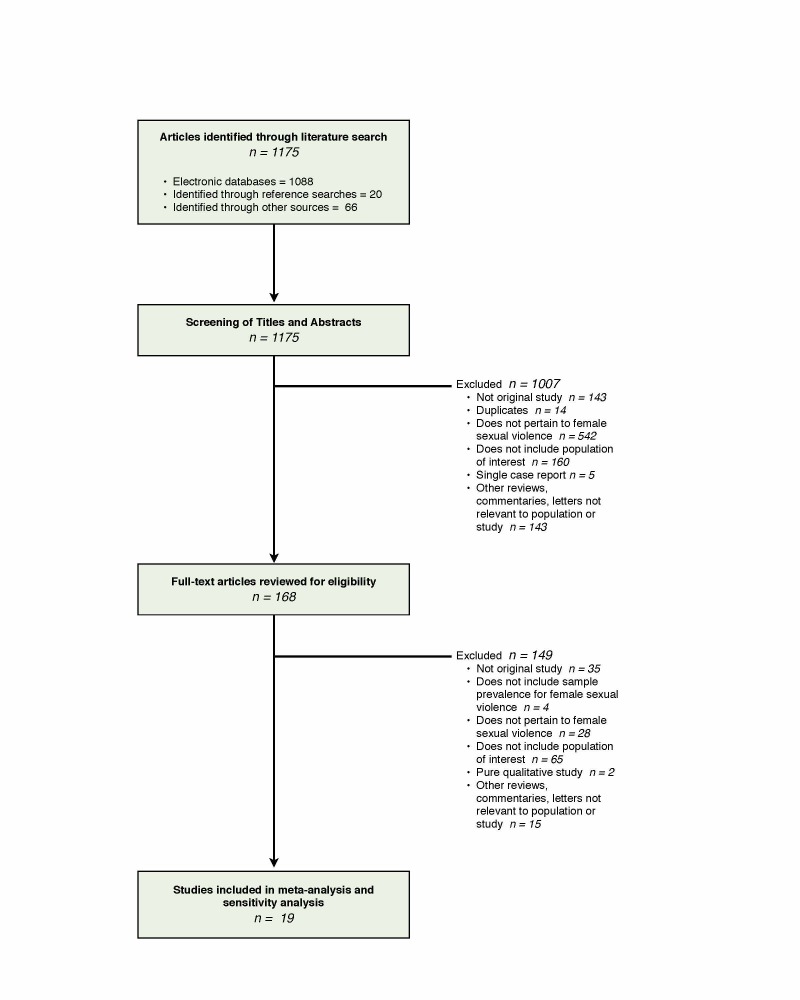
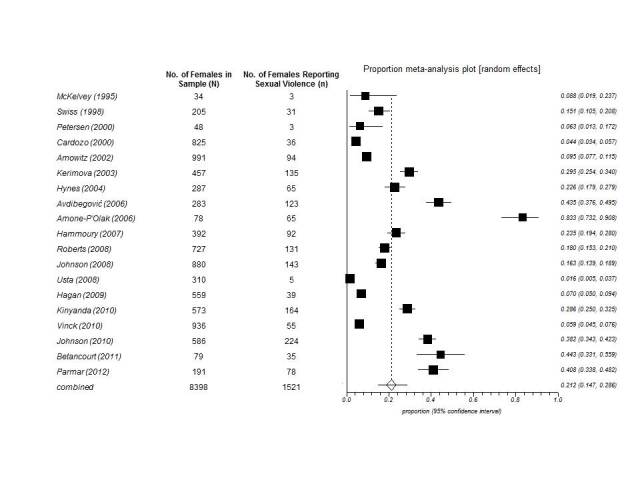
IMPORTANCE: Refugees and internally displaced persons are highly vulnerable to sexual violence during conflict and subsequent displacement. However, accurate estimates of the prevalence of sexual violence among in these populations remain uncertain. OBJECTIVE: Our objective was to estimate the prevalence of sexual violence among refugees and displaced persons in complex humanitarian emergencies. DATA SOURCE: We conducted systematic review of relevant literature in multiple databases (EMBASE, CINAHL, and MEDLINE) through February 2013 to identify studies. We also reviewed reference lists of included articles to identify any missing sources. STUDY SELECTION: Inclusion criteria required identification of sexual violence among refugees and internally displaced persons or those displaced by conflict in complex humanitarian settings. Studies were excluded if they did not provide female sexual violence prevalence, or that included only single case reports, anecdotes, and those that focused on displacement associated with natural disasters. After a review of 1175 citations 19 unique studies were selected. DATA EXTRACTION: Two reviewers worked independently to identify final selection and a third reviewer adjudicated any differences. Descriptive and quantitative information was extracted; prevalence estimates were synthesized. Heterogeneity was assessed using I2. MAIN OUTCOMES: The main outcome of interest was sexual violence among female refugees and internally displaced persons in complex humanitarian settings. RESULTS: The prevalence of sexual violence was estimated at 21.4% (95% CI, 14.9-28.7; I2=98.3%), using a random effects model. Statistical heterogeneity was noted with studies using probability sampling designs reporting lower prevalence of sexual violence (21.0%, 95% CI, 13.2-30.1; I2=98.6%), compared to lower quality studies (21.7%, 95% CI, 11.5-34.2; I2=97.4%). We could not rule out the presence of publication bias. CONCLUSIONS: The findings suggest that approximately one in five refugees or displaced women in complex humanitarian settings experienced sexual violence. However, this is likely an underestimation of the true prevalence given the multiple existing barriers associated with disclosure. The long-term health and social consequences of sexual violence for women and their families necessitate strategies to improve identification of survivors of sexual violence and increase prevention and response interventions in these complex settings.
Overview
The claims and statistics of this paper haven’t been checked yet.
Run the check — free, no account needed. It reads the open-access text and checks the sources it cites.
Integrity signals
Registry
Cites
Statistics
Figures
Verification
Claims the paper makes
The claims and statistics of this paper haven’t been checked yet.
Run the check — free, no account needed. It reads the open-access text and checks the sources it cites.
Claims other papers make about this one
Each is checked against this paper’s own text: does it say what the citing paper says it does?
The cited source says what the claim attributes to it.
In the citing paper
“the risk of GBV often grows more acute in humanitarian contexts [6]”
Self-check
Percentages, sums and reported differences re-computed from the paper’s own numbers.
The self-check needs the paper’s full text.
Citations
Cites
Preferred Reporting Items for Systematic Reviews and Meta-Analyses: the PRISMA statement
Moher, D., Liberati, A., Tetzlaff, J., Altman, D. G., & for the PRISMA Group (2009) · BMJ · doi:10.1136/bmj.b2535 · Cited by 83,823
Preferred Reporting Items for Systematic Reviews and Meta-Analyses: The PRISMA Statement
Moher, D., Liberati, A., Tetzlaff, J., Altman, D. G., & The PRISMA Group (2009) · PLoS Medicine · doi:10.1371/journal.pmed.1000097 · Cited by 64,042
Preferred reporting items for systematic reviews and meta-analyses: the PRISMA Statement.
(2009) · PubMed Central · Cited by 44,859
Ellsberg, M., Jansen, H. A., Heise, L., Watts, C. H., & Garcia-Moreno, C. (2008) · The Lancet · doi:10.1016/s0140-6736(08)60522-x · Cited by 1,820
García‐Moreno, C., Jansen, H. A. F. M., Ellsberg, M. C., Heise, L., & Watts, C. H. (2005) · Cited by 1,730
Mollica, R. F., Caspi-Yavin, Y., Bollini, P., Truong, T., Tor, S., & Lavelle, J. (1992) · PubMed · Cited by 1,551
MOLLICA, R. F., CASPI-YAVIN, Y., BOLLINI, P., TRUONG, T., TOR, S., & LAVELLE, J. (1992) · The Journal of Nervous and Mental Disease · doi:10.1097/00005053-199202000-00008 · Cited by 1,489
Intimate Partner Violence and Physical Health Consequences
Campbell, J. C., Jones, A. S., Dienemann, J. A., Kub, J. E., Schollenberger, J., O'Campo, P. J., GIELEN, A. C., & Wynne, C. (2002) · Archives of Internal Medicine · doi:10.1001/archinte.162.10.1157 · Cited by 1,060
Much ado about nothing: a comparison of the performance of meta-analytical methods with rare events
Bradburn, M. J., Deeks, J. J., Berlin, J. A., & Russell Localio, A. (2007) · Statistics in Medicine · doi:10.1002/sim.2528 · Cited by 938
Tjaden, P., & Thoennes, N. (1998) · PsycEXTRA Dataset · doi:10.1037/e330452004-001 · Cited by 927
Cited by
Sorted by citations
Items 301–301 of 301
Understanding the Complex Linkages Between Climate Change and Gender-Based Violence Globally
Anariba, S. E. B., Thiede, B. C., & Sexsmith, K. (2026) · Violence Against Women · doi:10.1177/10778012261498904
Metadata
- Authors
- Vu, A., Adam, A., Wirtz, A., Pham, K., Rubenstein, L., Glass, N., Beyrer, C., & Singh, S.
- Affiliations
- Johns Hopkins University (US)
- Venue
- PLoS Currents
- Publisher
- Public Library of Science (PLoS)
- Published
- 2014
- Volume
- 6
- ISSN
- 2157-3999 (ISSN-L)
- PMC
- PMC4012695
- OpenAlex
- W2052504169
- Semantic Scholar
- 7a2a2142edd6f41908001da60ce923cb63aa1803
- Cited by
- 300
- References
- 54
- Citations by year
- 2026: 16 · 2025: 33 · 2024: 39 · 2023: 25 · 2022: 32 · 2021: 34 · 2020: 26 · 2019: 26 · 2018: 21 · 2017: 12 · 2016: 24 · 2015: 6 · 2014: 5
- FWCI
- 37.24
- Type
- journal article
- Language
- en
- Open access
- green
- www.ncbi.nlm.nih.gov
- Licence
- cc-by
- Locations
- PLoS Currents (publishedVersion)
- Europe PMC (PubMed Central) (publishedVersion, cc-by)
- PubMed Central (publishedVersion, cc-by)
- PubMed (publishedVersion)
- Funders
- National Institutes of Health (KL2TR001077)
- National Center for Advancing Translational Sciences
- Topics
- Social Sciences › Gender Studies › Gender, Security, and Conflict
- Health Sciences › Health Professions › General Health Professions › Health and Conflict Studies
- Social Sciences › Sociology and Political Science › Sex work and related issues
- Keywords
- sexual violence, refugee women, internally displaced persons, complex emergencies, prevalence, sexual violence in armed conflict, barriers to disclosure, sexual violence prevention
About these checks
Registry, retraction, Cites and statistics results are computed, not judged, with one exception: a printed reference that no index lists is read once by a model before it counts as a citation error. Claims are extracted by a model and kept only when their quote appears verbatim in the text; each cited source is then checked, with a model’s help, for whether it says what the claim relies on. Those verdicts can be wrong — read the claim’s quote and the cited source before relying on one.
Statistics and arithmetic are recomputed, not judged.
Confidence bands are shown only for fields calibrated on our annotated test set. None is calibrated yet, so no band is shown.
What counts as a claim ›How we measure confidence ›How we check this ›
Are you an author, or do you see a problem with this page? Request a review
