

Spatial Pattern Enhances Ecosystem Functioning in an African Savanna
Open accessThe DOI matches its Crossref record; 53 of the 53 references it cites were found in a registry or an index; none of the 22 sources its claims cite is checked for support yet.
Abstract
Termites indirectly enhance plant and animal productivity near their mounds, and the uniform spatial patterning of these mounds enhances the overall productivity of the entire landscape.
Overview
CoChat Summary
TL;DR
Termite mounds in an African savanna are evenly spaced, and this spatial pattern creates parallel patterning in tree-dwelling arthropods and geckos, increasing landscape-level productivity. The authors combine field surveys, experiments, and null-model simulations to argue that uniform mound spacing enhances ecosystem functioning across trophic levels.
Key findings
- Termite mounds were significantly over-dispersed at spatial scales <100 m, based on Ripley’s K analysis of mapped mounds.
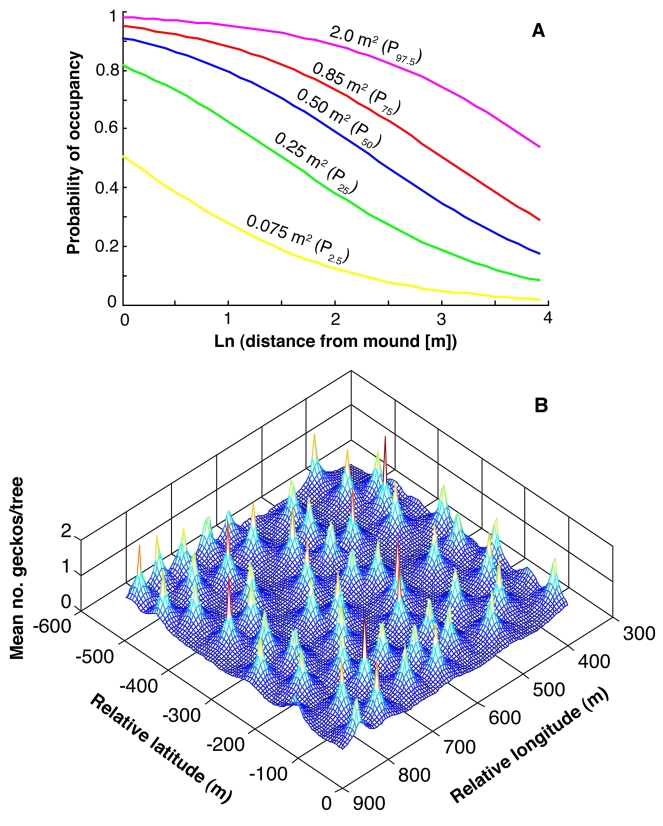
- Aerial arthropods were more abundant at 10 m than 30 m from mounds, and trap sides facing mounds captured nearly 40% more arthropods than away-facing sides. Arboreal arthropod abundance and biomass, especially predatory taxa, decreased with distance from mound centers.
- Geckos were more likely to occupy trees closer to mounds: occupied trees had median distance 18.3 m (IQR 12.6–26.3) versus 26.4 m (IQR 15.4–31.4) for unoccupied trees (Wilcoxon Z = −3.6, p = 0.0003). Experimental prey supplementation nearly equalized gecko occupation at 10 m (0.799±0.064 geckos/post) and 30 m (0.771±0.046 geckos/post).
- Spider fecundity decreased with distance from mounds, and landscape simulations showed that the real over-dispersed mound landscape produced mean values for all response variables above the >99.9th percentile of 1,000 simulated random-mound landscapes.
Methods
- Fieldwork was conducted from June 2006 to August 2009 at Mpala Research Centre in central Kenya, in a wooded grassland on vertisol soils dominated by Acacia drepanolobium.
- The authors mapped termite mounds using Quickbird satellite imagery and Ripley’s K; sampled aerial arthropods with sticky traps and arboreal arthropods by insecticide spraying; surveyed geckos on 180 trees in 2006 and 477 trees in 2009; and reared egg masses from 110 female Cyclosa spiders.
- They used AICc-ranked regression models, ordinal logistic regression, repeated-measures MANOVA, and a null-model approach comparing the real over-dispersed mound landscape with 1,000 simulated random-mound landscapes.
Limitations
- The paper states that a direct field test of landscape-scale effects was not feasible because there were no control regions without patterned mounds and because eliminating termites would not remove mound structures for decades.
- The null-model simulations assume that multiple mounds do not have additive effects; the authors tested this by adding second-nearest mound distance, which did not improve the gecko model. They also assume trees are equally likely anywhere, but report that tree-density effects were weak and inconsistent, and weighted simulations gave qualitatively identical results.
- Evident from the text: several key results are observational or correlational, and the authors note that arthropod trophic categorization may miscategorize about 5% of insects; gecko reproductive output was difficult to measure because the species has a fixed clutch size.
Model-written summary. Check it against the paper before relying on it.
Integrity signals
Registry
Cites
Statistics
Figures



Verification
Claims the paper makes
0 Valid · 0 Not valid · 14 Not checked · 75 Own results and interpretations
A result the paper reports from its own data — it cites no other source for it, so there is none to check. The quote shows it is in the paper.
In the paper
“More than 96% (824 of 858) predatory arthropods in our samples were spiders, so our conclusions about predatory arthropods in general are also true for spiders in particular.”
§ Spatial Pattern Enhances Ecosystem Functioning in an African Savanna > Results/Discussion
plain- Asserted: passes — The authors put it forward as true.
- Checkable: passes — It can be checked against evidence.
- Load-bearing: passes — The paper’s conclusions depend on it.
- Based: passes — The paper gives a reason why it holds.
A result the paper reports from its own data — it cites no other source for it, so there is none to check. The quote shows it is in the paper.
In the paper
“Aerial arthropods (N = 3,277; 42% Hemiptera, 32% Diptera, 11% Coleoptera, 15% others) were significantly more abundant in sticky traps at 10 m than at 30 m from termite mounds (Figure 1B).”
§ Spatial Pattern Enhances Ecosystem Functioning in an African Savanna > Results/Discussion
plainstates an associationn = 3,277- Asserted: passes — The authors put it forward as true.
- Checkable: passes — It can be checked against evidence.
- Load-bearing: passes — The paper’s conclusions depend on it.
- Based: passes — The paper gives a reason why it holds.
A result the paper reports from its own data — it cites no other source for it, so there is none to check. The quote shows it is in the paper.
In the paper
“In fact, the response of tree density to mound proximity is weak and inconsistent, and a separate set of landscape simulations in which we accounted for these effects (see Materials and Methods) produced qualitatively identical results (Figure S5).”
§ Spatial Pattern Enhances Ecosystem Functioning in an African Savanna > Results/Discussion
plain- Asserted: passes — The authors put it forward as true.
- Checkable: passes — It can be checked against evidence.
- Load-bearing: passes — The paper’s conclusions depend on it.
- Based: passes — The paper gives a reason why it holds.
- Rests on an assumption not shown here.
A result the paper reports from its own data — it cites no other source for it, so there is none to check. The quote shows it is in the paper.
In the paper
“The log-transformed mound-proximity term was a better predictor of gecko abundance than the linear form.”
§ Spatial Pattern Enhances Ecosystem Functioning in an African Savanna > Materials and Methods > Regression Modeling of Response Variables
plainstates an association- Asserted: passes — The authors put it forward as true.
- Checkable: passes — It can be checked against evidence.
- Load-bearing: unclear — It is unclear whether the paper’s conclusions depend on it.
- Based: passes — The paper gives a reason why it holds.
In the paper
“Ranking these models using the sample-size-corrected Akaike Information Criterion (AICc) [29] revealed that the number of geckos on a tree was principally a function of the tree's size (estimated surface area of the main stem) and its proximity to the nearest termite mound (Table S1).”
§ Spatial Pattern Enhances Ecosystem Functioning in an African Savanna > Results/Discussion
What the sources say
- Not checked — no full text of the sourcecites [29] K. P Burnham, 2002, Model selection and multimodel inference: a practical information-theoretic approach. source
plainstates an associationn = 180- Asserted: passes — The authors put it forward as true.
- Checkable: passes — It can be checked against evidence.
- Load-bearing: passes — The paper’s conclusions depend on it.
- Based: passes — The paper gives a reason why it holds.
53 more claims
Create a free account to see all 89 claims and every source verdict.
- Probably not a substantial claim. 22
- The quote only partly states this claim. 1
- It may state two separate claims as one. 12
Statistics recomputed
Every reported test result, recomputed from its test statistic and degrees of freedom. A result shows as not adding up only once an independent check has confirmed it.
- Consistentz = -3.6reported p = .0003 · recomputed p < .001
“Z = −3.6, p = .0003”
Self-check
Percentages, sums and reported differences re-computed from the paper’s own numbers.
Each contradiction between two passages listed here was confirmed by an independent check.
Rated minor: it would not touch a result — a value no result rests on, a p-value that stays on the same side of the significance level, or a conflict that is clerical, resolved elsewhere in the paper, or outside its own findings.
In the paper
§ Spatial Pattern Enhances Ecosystem Functioning in an African Savanna > Materials and Methods > Gecko Surveys
“From July–August 2007, Pringle and two assistants exhaustively searched all trees for geckos”
§ Spatial Pattern Enhances Ecosystem Functioning in an African Savanna > Materials and Methods > Regression Modeling of Response Variables
“the original 180-tree dataset from 2006”
Citations
Cites
Model selection and multimodel inference: a practical information-theoretic approach.
Guthery, F. S., Burnham, K. P., & Anderson, D. R. (2003) · The Journal of Wildlife Management · doi:10.2307/3802723 · Cited by 41,495 · cited 2×
“Our notation and interpretation follow Burnham and Anderson [29].”
MethodSpatial Tessellations: Concepts and Applications of Voronoi Diagrams
Okabe, A., Boots, B. N., & Sugihara, K. (1992) · Cited by 3,546
Model selection and multimodel inference : a practical information-theoretic approach
Burnham, K. P., Anderson, D. R., & Burnham, K. P. (2002) · Thammasat University Digital Collections · Cited by 2,907
Ripley, B. D. (1977) · Journal of the Royal Statistical Society Series B: Statistical Methodology · doi:10.1111/j.2517-6161.1977.tb01615.x · Cited by 2,511 · cited 2×
“We quantitatively evaluated mound patterning at different spatial scales using Ripley’s K function [28].”
MethodSelf-Organized Patchiness and Catastrophic Shifts in Ecosystems
Rietkerk, M., Dekker, S. C., de Ruiter, P. C., & van de Koppel, J. (2004) · Science · doi:10.1126/science.1101867 · Cited by 1,413 · cited 1×
“range of ecosystems [7–10].”
Rings, circles and null models for point pattern analysis in ecology.
Wiegand, T., & A. Moloney, K. (2004) · Oikos · doi:10.1111/j.0030-1299.2004.12497.x · Cited by 1,157 · cited 2×
“coordinates of these mounds using Programita [40], establishing that the spacing of mounds is significantly uniform at spatial scales,100 m (Figure S2).”
MethodRegular and Irregular Patterns in Semiarid Vegetation
Klausmeier, C. A. (1999) · Science · doi:10.1126/science.284.5421.1826 · Cited by 993 · cited 1×
“Over the past decade, however, multiple studies have shown that regular patterns are both common and persistent across a range of ecosystems”
BackgroundRegular pattern formation in real ecosystems
Rietkerk, M., & van de Koppel, J. (2008) · Trends in Ecology & Evolution · doi:10.1016/j.tree.2007.10.013 · Cited by 894 · cited 1×
“unanswered [11].”
Spatial structure and chaos in insect population dynamics
Hassell, M. P., Comins, H. N., & Mayt, R. M. (1991) · Nature · doi:10.1038/353255a0 · Cited by 854 · cited 1×
“alone [1–3], with potentially profound implications for the maintenance of biodiversity and ecological stability [4,5].”
Background
Cited by
Items 101–200 of 243
Dryland Social-Ecological Systems in Changing Environments
Fu, B., & Stafford‐Smith, M. (2024) · Springer eBooks · doi:10.1007/978-981-99-9375-8 · Cited by 26
Arboreal ant abundance tracks primary productivity in an Amazonian whitewater river system
Pringle, E. G., Santos, T. F. D., Gonçalves, M. S., Hawes, J. E., Peres, C. A., & Baccaro, F. B. (2019) · Ecosphere · doi:10.1002/ecs2.2902 · Cited by 19
Zardi, G. I., Nicastro, K. R., McQuaid, C. D., de Jager, M., van de Koppel, J., & Seuront, L. (2021) · The American Naturalist · doi:10.1086/713738 · Cited by 19
Okullo, P., Greve, P. M. K., & Moe, S. R. (2013) · Ecosystems · doi:10.1007/s10021-013-9663-2 · Cited by 21
Mettrop, I. S., Cammeraat, E., & Verbeeten, E. (2012) · Ecohydrology · doi:10.1002/eco.1271 · Cited by 18
McAuliffe, J. R., Hoffman, M. T., McFadden, L. D., et al. (2019) · Journal of Arid Environments · doi:10.1016/j.jaridenv.2018.11.012 · Cited by 18
Soil fauna and its potential use in the ecological restoration of dryland ecosystems
Morales-Márquez, J. A., & Meloni, F. (2022) · Restoration Ecology · doi:10.1111/rec.13686 · Cited by 25
Benthic pattern formation in shallow tropical reefscapes: does grazing explain grazing halos?
Bilodeau, S. M., Layman, C. A., & Silman, M. R. (2021) · Landscape Ecology · doi:10.1007/s10980-021-01239-1 · Cited by 20
Ecosystem spatial self-organization: Free order for nothing?
Dong, X., & Fisher, S. G. (2019) · Ecological Complexity · doi:10.1016/j.ecocom.2019.01.002 · Cited by 17
Seasonal variation in the relative dominance of herbivore guilds in an African savanna
Davies, A. B., van Rensburg, B. J., Robertson, M. P., Levick, S. R., Asner, G. P., & Parr, C. L. (2016) · Ecology · doi:10.1890/15-1905.1 · Cited by 16
Effects of crack morphology on soil carbon flux dynamics in a dryland vertisol
DeCarlo, K. F., & Caylor, K. K. (2020) · Geoderma · doi:10.1016/j.geoderma.2020.114478 · Cited by 17
Resource availability and heterogeneity shape the self‐organisation of regular spatial patterning
Vardaro, J. A. C., Bonachela, J. A., Baker, C. C. M., Pinsky, M. L., Doak, D. F., Pringle, R. M., & Tarnita, C. E. (2021) · Ecology Letters · doi:10.1111/ele.13822 · Cited by 14
Self-citationMuvengwi, J., Mbiba, M., Ndagurwa, H. G. T., & Kabvuratsiye, N. (2016) · CATENA · doi:10.1016/j.catena.2016.05.009 · Cited by 17
Overdispersed Spatial Patterning of Dominant Bunchgrasses in Southeastern Pine Savannas
Hovanes, K. A., Harms, K. E., Gagnon, P. R., Myers, J. A., & Elderd, B. D. (2018) · The American Naturalist · doi:10.1086/696834 · Cited by 16
Discovery of Four Novel Circular Single-Stranded DNA Viruses in Fungus-Farming Termites
Kerr, M., Rosario, K., Baker, C. C. M., et al. (2018) · Genome Announcements · doi:10.1128/genomea.00318-18 · Cited by 16
How do muskratsOndatra zibethicusaffect ecosystems? A review of evidence
Bomske, C. M., & Ahlers, A. A. (2020) · Mammal Review · doi:10.1111/mam.12218 · Cited by 17
Distribution of endemic bark beetle attacks and their physiological consequences on Pinus halepensis
Davi, H., Durand-Gillmann, M., Damesin, C., et al. (2020) · Forest Ecology and Management · doi:10.1016/j.foreco.2020.118187 · Cited by 16
Mertl, A. L., Traniello, J. F. A., Wilkie, K. T. R., & Constantino, R. (2012) · Psyche A Journal of Entomology · doi:10.1155/2012/312054 · Cited by 15
“Plant growth tends to be improved on or near termite mounds due to soil modification [22] and higher nutrient content and water availability [23, 24].”
Risch, A. C., Anderson, T. M., & Schütz, M. (2012) · Ecosystems · doi:10.1007/s10021-012-9571-x · Cited by 16
Influence of plant defenses and nutrients on trophic control of ecosystems
Burghardt, K. T., & Schmitz, O. J. (2015) · Cambridge University Press eBooks · doi:10.1017/cbo9781139924856.009 · Cited by 21
Liu, Q., Weerman, E. J., Gupta, R., Herman, P. M. J., Olff, H., & van de Koppel, J. (2014) · Journal of The Royal Society Interface · doi:10.1098/rsif.2014.0089 · Cited by 17
Wildermuth, B., Oldeland, J., Arning, C., Gunter, F., Strohbach, B. J., & Juergens, N. (2022) · Ecography · doi:10.1111/ecog.06306 · Cited by 15
A phylogenetic community approach for studying termite communities in a West African savannah
Hausberger, B., & Korb, J. (2015) · Biology Letters · doi:10.1098/rsbl.2015.0625 · Cited by 14
Loss of spatial structure after temporary herbivore absence in a high‐productivity reed marsh
Reijers, V. C., Cruijsen, P. M. J. M., Hoetjes, S. C. S., van den Akker, M., Heusinkveld, J. H. T., van de Koppel, J., Lamers, L. P. M., Olff, H., & van der Heide, T. (2019) · Journal of Applied Ecology · doi:10.1111/1365-2664.13394 · Cited by 15
Ord, T. J. (2023) · Functional Ecology · doi:10.1111/1365-2435.14383 · Cited by 13
Garg, A., Gadi, V. K., Zhu, H., et al. (2023) · The Science of The Total Environment · doi:10.1016/j.scitotenv.2023.164864 · Cited by 13
“Termite mounds are foremost land scape features in grass lands (Pringle et al., 2010).”
Neoh, K., Bong, L., Muhammad, A. A. A., Itoh, M., Kozan, O., Takematsu, Y., & Yoshimura, T. (2016) · Environmental Entomology · doi:10.1093/ee/nvw116 · Cited by 15
Wood decomposition is more rapid on than off termite mounds in an African savanna
Acanakwo, E. F., Sheil, D., & Moe, S. R. (2019) · Ecosphere · doi:10.1002/ecs2.2554 · Cited by 14
Zhou, Y., Boutton, T. W., & Wu, X. B. (2019) · Soil Systems · doi:10.3390/soilsystems3040073 · Cited by 13
Identification of approximate symmetries in biological development
Gandhi, P., Ciocanel, M.-V., Niklas, K. J., & Dawes, A. T. (2021) · Philosophical Transactions of the Royal Society A Mathematical Physical and Engineering Sciences · doi:10.1098/rsta.2020.0273 · Cited by 15
Landscapes and Landforms of the Chobe Enclave, Northern Botswana
Mokatse, T., Diaz, N., Shemang, E., et al. (2022) · World geomorphological landscapes · doi:10.1007/978-3-030-86102-5_6 · Cited by 13
Microplastic leachates inhibit small-scale self-organization in mussel beds
Zardi, G. I., Nicastro, K. R., Lau‐Truong, S., Decorse, P., Nozak, S., Chevillot‐Biraud, A., Froneman, P. W., Akoueson, F., Duflos, G., & Seuront, L. (2024) · The Science of The Total Environment · doi:10.1016/j.scitotenv.2023.169816 · Cited by 13
Gosling, C. M., Schrama, M. J. J., van Erk, A., Olff, H., & Cromsigt, J. P. G. M. (2016) · Biotropica · doi:10.1111/btp.12337 · Cited by 14
Spatial Dynamics and Ecosystem Functioning
Schmitz, O. J. (2010) · PLoS Biology · doi:10.1371/journal.pbio.1000378 · Cited by 16
Schyra, J., Gbenyedji, J. N. B. K., & Korb, J. (2019) · PLoS ONE · doi:10.1371/journal.pone.0216986 · Cited by 13
Multifractal growth in periphyton communities
Saravia, L. A., Giorgi, A., & Momo, F. (2012) · Oikos · doi:10.1111/j.1600-0706.2011.20423.x · Cited by 12
Termite mound cover and abundance respond to herbivore‐mediated biotic changes in a Kenyan savanna
Charles, G. K., Riginos, C., Veblen, K. E., Kimuyu, D. M., & Young, T. P. (2021) · Ecology and Evolution · doi:10.1002/ece3.7445 · Cited by 11
Bait station preferences in two Macrotermes species
Iqbal, N., Wijedasa, L. S., & Evans, T. A. (2016) · Journal of Pest Science · doi:10.1007/s10340-016-0778-z · Cited by 12
Litter type and termites regulate root decomposition across contrasting savanna land‐uses
Smith, S. W., Speed, J. D. M., Bukombe, J. K., Hassan, S. N., Lyamuya, R. D., Mtweve, P. J., Sundsdal, A., & GRAAE, B. J. (2018) · Oikos · doi:10.1111/oik.05697 · Cited by 12
Organism-substrate interactions and astrobiology: Potential, models and methods
Baucon, A., de Carvalho, C. N., Barbieri, R., Bernardini, F., Cavalazzi, B., Celani, A., Felletti, F., Ferretti, A., Schönlaub, H. P., Todaro, M. A., et al. (2017) · Earth-Science Reviews · doi:10.1016/j.earscirev.2017.05.009 · Cited by 12
Fine‐scale spatial distribution of murundus structures in the semi‐arid region of Brazil
de Souza, H. J., & Delabie, J. H. C. (2017) · Austral Ecology · doi:10.1111/aec.12562 · Cited by 12
Bergstrom, B. J., Sensenig, R. L., Augustine, D. J., & Young, T. P. (2018) · Ecosphere · doi:10.1002/ecs2.2519 · Cited by 15
Termites and ungulates affect arbuscular mycorrhizal richness and infectivity in a semiarid savanna
Petipas, R. H., & Brody, A. K. (2014) · Botany · doi:10.1139/cjb-2013-0223 · Cited by 13
Self-citationEssential dryland ecosystem variables
Wu, B., Zeng, H., Lü, N., Wang, Y., Fu, B., & Xu, Z. H. (2020) · Current Opinion in Environmental Sustainability · doi:10.1016/j.cosust.2020.10.007 · Cited by 14
Top‐down network analysis characterizes hidden termite–termite interactions
Campbell, C., Russo, L., Marins, A., et al. (2016) · Ecology and Evolution · doi:10.1002/ece3.2313 · Cited by 11
Seymour, C. L., Korb, J., Joseph, G. S., Hassall, R. M. J., & Coetzee, B. W. T. (2023) · Philosophical Transactions of the Royal Society B Biological Sciences · doi:10.1098/rstb.2022.0152 · Cited by 9
“Among the most important of these is the creation of habitat heterogeneity on which many other species depend [3,4,44,48], with impacts on species diversity.”
BackgroundAlmeida, C. S., Cristaldo, P. F., Florencio, D. F., et al. (2016) · Brazilian Journal of Biology · doi:10.1590/1519-6984.17815 · Cited by 10
Litter Quality Affects Termite Sheeting Production and Water Infiltration in the Soil
Shanbhag, R. R., Harit, A. K., Cheik, S., Chaudhary, E., Bottinelli, N., Sundararaj, R., & Pascal Jouquet, B. (2019) · Sociobiology · doi:10.13102/sociobiology.v66i3.3741 · Cited by 10
A positive association between ants and spiders and potential mechanisms driving the pattern
Marín, L., Jackson, D., & Perfecto, I. (2014) · Oikos · doi:10.1111/oik.01913 · Cited by 10
Termite mounds create heterogeneity in invertebrate communities across a savanna rainfall gradient
Leitner, M., Davies, A. B., Robertson, M. P., Parr, C. L., & van Rensburg, B. J. (2020) · Biodiversity and Conservation · doi:10.1007/s10531-020-01943-5 · Cited by 12
Land use effects on termite assemblages in Kenya
Kanyi, N. C., Karuri, H. W., Nyasani, J. O., & Mwangi, B. (2021) · Heliyon · doi:10.1016/j.heliyon.2021.e08588 · Cited by 14
Dryland Dynamics and Driving Forces
Wu, B., Smith, W. K., & Zeng, H. (2024) · Springer eBooks · doi:10.1007/978-981-99-9375-8_2 · Cited by 17
Causes and consequences of disordered hyperuniformity in global drylands
Hu, W., Cui, L., Delgado‐Baquerizo, M., Solé, R. V., Kéfi, S., Berdugo, M., Xu, N., Wang, B., Liu, Q., & Xu, C. (2025) · Proceedings of the National Academy of Sciences · doi:10.1073/pnas.2504496122 · Cited by 9
“There is an increasing suggestion that spatial self - organization can enhance key aspects of ecosystem functioning (2, 19–21 , 23 ).”
Arms races between selfish genetic elements and their host defence in termites
Qiu, B., Elsner, D., & Korb, J. (2026) · Nature Communications · doi:10.1038/s41467-026-69550-6 · Cited by 9
Regular patterns link individual behavior to population persistence
Guichard, F. (2017) · Proceedings of the National Academy of Sciences · doi:10.1073/pnas.1709063114 · Cited by 9
Territorial ants depress plant growth through cascading non‐trophic effects in an alpine meadow
Zhao, C., Wu, X., Griffin, J. N., Xi, X., & Sun, S. (2013) · Oikos · doi:10.1111/j.1600-0706.2013.00815.x · Cited by 11
Marquart, A., Goldbach, L., & Blaum, N. (2020) · Ecohydrology · doi:10.1002/eco.2249 · Cited by 9
Newmark, W. D., & Stanley, T. R. (2016) · Ostrich · doi:10.2989/00306525.2016.1216903 · Cited by 12
Stomatal density distribution patterns in leaves of the Jatobá (Hymenaea courbaril L.)
Martins, G., Soares, Â. M., Barbosa, J. P. R. A. D., et al. (2011) · Trees · doi:10.1007/s00468-011-0620-4 · Cited by 8
Hagan, J. G., du Toit, J., & Cramer, M. D. (2017) · African Journal of Range and Forage Science · doi:10.2989/10220119.2017.1314981 · Cited by 8
Jiao, L., Zhang, Y., Sun, T., Yang, W., Shao, D., Zhang, P., & Liu, Q. (2021) · Sustainability · doi:10.3390/su13158291 · Cited by 8
Marins, A., Cristaldo, P. F., Paiva, L. R., et al. (2021) · Brazilian Journal of Biology · doi:10.1590/1519-6984.03316 · Cited by 8
Elevational environmental stress modulating species cohabitation in nests of a social insect
Junior, A. B. V., Mitraud, P., Dáttilo, W., et al. (2020) · Ecological Entomology · doi:10.1111/een.12939 · Cited by 8
Unravelling the spatial structure of regular dryland vegetation patterns
Kästner, K., van de Vijsel, R. C., Caviedes‐Voullième, D., Frechen, N., & Hinz, C. (2024) · CATENA · doi:10.1016/j.catena.2024.108442 · Cited by 10
Regulatory mechanisms of group distributions in a gregarious arthropod
Broly, P., Mullier, R., Devigne, C., & Deneubourg, J. (2015) · Royal Society Open Science · doi:10.1098/rsos.150428 · Cited by 8
Termites and large herbivores influence seed removal rates in an African savanna
Acanakwo, E. F., Sheil, D., & Moe, S. R. (2017) · Ecology · doi:10.1002/ecy.2038 · Cited by 8
Role of Soil Fauna: En Route to Ecosystem Services and Its Effect on Soil Health
Mishra, A., & Singh, D. (2020) · Springer eBooks · doi:10.1007/978-981-15-3151-4_5 · Cited by 12
Termite Damage in Agriculture Areas and Implanted Forests: An Ecological Approach
Junqueira, L. K., & Florencio, D. F. (2017) · Springer eBooks · doi:10.1007/978-3-319-68726-1_2 · Cited by 7
Chemistry of the Secondary Metabolites of Termites
Gössinger, E. (2019) · Fortschritte der Chemie Organischer Naturstoffe/Fortschritte der Chemie organischer Naturstoffe/Progress in the chemistry of organic natural products · doi:10.1007/978-3-030-12858-6_1 · Cited by 9
Spatial point pattern of the baobab (Adansonia digitata) in semi-arid savanna, Southeast Zimbabwe
Khosa, A., Ndagurwa, H. G. T., Witkowski, E. T. F., Mutematemi, S. A., Mrewa, A. T., Zisadza, J., & Muvengwi, J. (2023) · Trees Forests and People · doi:10.1016/j.tfp.2023.100452 · Cited by 6
A New Species of Afrotropical Ants in the GenusBothroponera(Hymenoptera: Formicidae: Ponerinae)
Joma, A. M. A., & Mackay, W. P. (2013) · Psyche A Journal of Entomology · doi:10.1155/2013/917847 · Cited by 6
Role of Termite Mounds on the Distribution of Spiders in Miombo Woodland of South-Western Burundi
Nduwarugira, D., Jocque, R. C. A. M., Havyarimana, F., et al. (2016) · Arachnology · doi:10.13156/arac.2006.17.1.28 · Cited by 6
Self-citationMilligan, P. D., Prior, K. M., & Palmer, T. M. (2016) · Ecosphere · doi:10.1002/ecs2.1502 · Cited by 9
Self-citationMoe, S. R., Eldegard, K., Rannestad, O. T., Okullo, P., Lindtjørn, O., Støen, O., & Dale, S. (2017) · Ecology and Evolution · doi:10.1002/ece3.3513 · Cited by 11
Netshifhefhe, S. R., Duncan, F. D., & Kunjeku, E. C. (2020) · African Journal of Ecology · doi:10.1111/aje.12737 · Cited by 6
Salazar-Díaz, R., & Tixier, P. (2021) · European Journal of Agronomy · doi:10.1016/j.eja.2021.126295 · Cited by 6
Muvengwi, J., Parrini, F., Witkowski, E. T. F., & Davies, A. B. (2018) · Ecosystems · doi:10.1007/s10021-018-0257-x · Cited by 7
More than the sum of its parts: Self-organized patterns and emergent properties of ecosystems
Ge, Z., & Liu, Q. (2020) · Biodiversity Science · doi:10.17520/biods.2020225 · Cited by 6
Franz, T. E., Nolan, J., Nordbotten, J. M., Caylor, K. K., & Slater, L. D. (2011) · Vadose Zone Journal · doi:10.2136/vzj2010.0031 · Cited by 6
Schaefer, C. E. G. R., Marins, A., Corrêa, G. R., et al. (2016) · Springer eBooks · doi:10.1007/978-3-319-29808-5_16 · Cited by 5
Cattle select African savanna termite mound patches less when sharing habitat with wild herbivores
Odadi, W. O., Charles, G. K., & Young, T. P. (2018) · Ecology and Evolution · doi:10.1002/ece3.4452 · Cited by 3
Chakraborty, J. S., & Singh, S. (2020) · Ecoscience · doi:10.1080/11956860.2020.1772610 · Cited by 6
Palmer, T. M., & Young, T. P. (2017) · Cambridge University Press eBooks · doi:10.1017/9781316671825.011 · Cited by 5
Self-citationSpatial structure of rainforest termites: Two matched pioneering cross‐continental case studies
Scholtz, O., Knight, M. E., & Eggleton, P. (2021) · Biotropica · doi:10.1111/btp.12959 · Cited by 4
“Research on termite spatial ecology and ecosystem functions is biased toward grassy biomes (Bonachela et al., 2015; Gosling et al., 2016; Korb & Linsenmair, 2001; Pringle et al., 2010).”
BackgroundHockridge, E. G., Singh, J., Boucher, P. B., & Davies, A. B. (2022) · Journal of Animal Ecology · doi:10.1111/1365-2656.13830 · Cited by 6
Bukari, Y., Avicor, S. W., Awudzi, G. K., Ainooson, M. K., Asare, E. K., & Amoako‐Attah, I. (2022) · Cogent Food & Agriculture · doi:10.1080/23311932.2022.2147474 · Cited by 5
Yin, M., Zheng, X., Liu, J., et al. (2021) · Polish Journal of Environmental Studies · doi:10.15244/pjoes/134090 · Cited by 4
“Heuweltjies” – the “Little Hills” of western South Africa
Desert Botanical Garden, P., & McAuliffe, J. R. (2022) · Biodiversity & Ecology · doi:10.7809/b-e.00372 · Cited by 6
Spatiotemporal patterns of lion (Panthera leo) space use in a human–wildlife system
Burak, M. K., Broekhuis, F., Dickman, A., Ekwanga, S., Elliot, N. B., Frank, L. G., Cotterill, A., Williams, T. M., Wilmers, C. C., & Schmitz, O. J. (2023) · Ecological Solutions and Evidence · doi:10.1002/2688-8319.12276 · Cited by 4
Remote sensing for ecosystem:Definition and prospects
Wu, B., Zeng, Y., Yan, N., Zeng, H., Zhao, D., & Zhang, M. (2020) · National Remote Sensing Bulletin · doi:10.11834/jrs.20209247 · Cited by 9
Refuge in architecture: mounds and diversity of termite species from a Sahel and Sudan savannah
Aiki, I. P., Yusuf, A. A., & Pirk, C. W. W. (2020) · International Journal of Tropical Insect Science · doi:10.1007/s42690-020-00330-5 · Cited by 3
Conservation management and termites: a case study from central Côte d’Ivoire (West Africa)
Silué, K. S., Koné, N. A., Konaté, S., Roisin, Y., & Korb, J. (2022) · Journal of Tropical Ecology · doi:10.1017/s0266467422000207 · Cited by 4
Henry, L. P., Tokita, C. K., Misra, M., Forrow, A. B., & Rubenstein, D. I. (2018) · Biotropica · doi:10.1111/btp.12572 · Cited by 3
Biotic Versus Abiotic Control of Primary Production Identified in a Common Garden Experiment
Belovsky, G. E., & Slade, J. B. (2019) · Scientific Reports · doi:10.1038/s41598-019-48512-7 · Cited by 4
Iqbal, N., Alvi, A. M., Hussain, M., et al. (2020) · Bulletin of Entomological Research · doi:10.1017/s0007485320000693 · Cited by 3
Dong, X. (2023) · Proceedings of the National Academy of Sciences · doi:10.1073/pnas.2314908120 · Cited by 3
“Theoretical models predict that spatial self - organization can mediate ecosystem functions, such as biodiversity and stability (3, 4).”
BackgroundHernández‐Agüero, J. A., Ruiz‐Tapiador, I., Cosio, E. G., Garibaldi, L. A., Kozlov, M. V., Nacif, M. E., Salinas, N., Zverev, V., Zvereva, E. L., & Cayuela, L. (2023) · Global Ecology and Conservation · doi:10.1016/j.gecco.2023.e02780 · Cited by 4
Li, Y., & Liu, X. (2024) · Scientia Sinica Vitae · doi:10.1360/ssv-2023-0193 · Cited by 3
Yamashina, C., & Hara, M. (2018) · Ecosystems · doi:10.1007/s10021-018-0283-8 · Cited by 3
Ecosystem structure and function
Schowalter, T. D. (2022) · Elsevier eBooks · doi:10.1016/b978-0-323-85673-7.00004-6 · Cited by 4
Metadata
- Authors
- Pringle, R. M., Doak, D. F., Brody, A. K., Jocqué, R., & Palmer, T. M.
- Affiliations
- Harvard University (US)
- University of Wyoming (US)
- University of Vermont (US)
- Royal Museum for Central Africa (BE)
- University of Florida (US)
- Corresponding author
- Pringle, Robert M.
- Venue
- PLoS Biology
- Publisher
- Public Library of Science (PLoS)
- Published
- 2010-05-25
- Volume
- 8
- Issue
- 5
- Pages
- e1000377
- ISSN
- 1544-9173 (ISSN-L)
- 1545-7885
- PMC
- PMC2876046
- OpenAlex
- W2121038964
- Semantic Scholar
- 52d7a522cb3c373afffe5a4bf1c85114e6ca803c
- Cited by
- 245
- References
- 53
- Citations by year
- 2026: 8 · 2025: 11 · 2024: 10 · 2023: 10 · 2022: 16 · 2021: 17 · 2020: 21 · 2019: 19 · 2018: 17 · 2017: 20 · 2016: 24 · 2015: 12 · 2014: 13 · 2013: 14 · 2012: 15
- FWCI
- 8.44
- Type
- journal article
- Language
- en
- Open access
- gold
- doi.org
- Locations
- PLoS Biology (publishedVersion, cc-by)
- PubMed Central (publishedVersion, cc-by)
- PubMed (publishedVersion)
- Digital Access to Scholarship at Harvard (DASH) (Harvard University) (submittedVersion, cc-by)
- DOAJ (DOAJ: Directory of Open Access Journals) (submittedVersion)
- Figshare (submittedVersion, cc-by)
- Greater South Information System
- Funders
- National Science Foundation (0444071, 0709880, 0852961, 0519223)
- Government of the Republic of Kenya
- National Commission for Science and Technology
- Office of International Science and Engineering
- Topics
- Life Sciences › Agricultural and Biological Sciences › Insect Science › Insect and Arachnid Ecology and Behavior
- Physical Sciences › Environmental Science › Nature and Landscape Conservation › Ecology and Vegetation Dynamics Studies
- Physical Sciences › Environmental Science › Global and Planetary Change › Ecosystem dynamics and resilience
- Keywords
- spatial patterns, ecosystem functioning, termite mounds, savanna, primary productivity, secondary production, insect abundance, trophic levels, nearest neighbor distance, null models, arid ecosystems, habitat restoration, ecosystem services
- MeSH terms
- Acacia, Africa, Animals, Ants, Arthropods, Feeding Behavior, Poaceae, Insecta, Kenya, Lizards, Population Dynamics, Predatory Behavior, Spiders, Ecosystem, Isoptera
About these checks
Registry, retraction, Cites and statistics results are computed, not judged, with one exception: a printed reference that no index lists is read once by a model before it counts as a citation error. Claims are extracted by a model and kept only when their quote appears verbatim in the text; each cited source is then checked, with a model’s help, for whether it says what the claim relies on. Those verdicts can be wrong — read the claim’s quote and the cited source before relying on one.
A language model drew the claims from the paper on 2026-10-10, under version 3 of the claim definition (model deepseek-v4.1-flash, prompt extract-v3).
A second model labelled each claim on 2026-10-10 (model jev-1.13-20260917, definition revision gold-guideline-v0.2).
Statistics and arithmetic are recomputed, not judged.
Confidence bands are shown only for fields calibrated on our annotated test set. None is calibrated yet, so no band is shown.
What counts as a claim ›How we measure confidence ›How we check this ›
Are you an author, or do you see a problem with this page? Request a review
Data sources
Bibliographic data: Semantic Scholar, OpenAlex, Crossref.
Contains information from the Semantic Scholar Academic Graph Datasets, made available under the ODC Attribution License (ODC-BY 1.0).
Semantic Scholar’s data is described in: Kinney, R., et al. (2023). The Semantic Scholar Open Data Platform. arXiv:2301.10140.
