

From Dinosaurs to Modern Bird Diversity: Extending the Time Scale of Adaptive Radiation
Open accessThe DOI matches its Crossref record; 33 of the 34 references it cites were found in a registry or an index.
Abstract
What explains why some groups of organisms, like birds, are so species rich? And what explains their extraordinary ecological diversity, ranging from large, flightless birds to small migratory species that fly thousand of kilometers every year? These and similar questions have spurred great interest in adaptive radiation, the diversification of ecological traits in a rapidly speciating group of organisms. Although the initial formulation of modern concepts of adaptive radiation arose from consideration of the fossil record, rigorous attempts to identify adaptive radiation in the fossil record are still uncommon. Moreover, most studies of adaptive radiation concern groups that are less than 50 million years old. Thus, it is unclear how important adaptive radiation is over temporal scales that span much larger portions of the history of life. In this issue, Benson et al. test the idea of a "deep-time" adaptive radiation in dinosaurs, compiling and using one of the most comprehensive phylogenetic and body-size datasets for fossils. Using recent phylogenetic statistical methods, they find that in most clades of dinosaurs there is a strong signal of an "early burst" in body-size evolution, a predicted pattern of adaptive radiation in which rapid trait evolution happens early in a group's history and then slows down. They also find that body-size evolution did not slow down in the lineage leading to birds, hinting at why birds survived to the present day and diversified. This paper represents one of the most convincing attempts at understanding deep-time adaptive radiations.
Overview
The claims and statistics of this paper haven’t been checked yet.
Free: it reads the open-access text and checks the first 5 claims that cite a source we can check. Create a free account to check every claim.
Integrity signals
Registry
Cites
Statistics
Figures
Verification
Claims the paper makes
The claims and statistics of this paper haven’t been checked yet.
Free: it reads the open-access text and checks the first 5 claims that cite a source we can check. Create a free account to check every claim.
Claims other papers make about this one
Each is checked against this paper’s own text: does it say what the citing paper says it does?
The cited source says what the claim attributes to it.
In the citing paper
“There are alternative explanations for this result: it could reflect difficulties in testing ‘early burst’ models, or it could suggest that adaptive radiations among small clades studied by ecologists today may not scale up to those found in the fossil record [38,39].”
From Novelty and Innovation in the History of Life (2015) · cites this paper as [38]
Self-check
Percentages, sums and reported differences re-computed from the paper’s own numbers.
The self-check needs the paper’s full text.
Citations
Cites
The Ecology of Adaptive Radiation
Schluter, D. (2000) · doi:10.1093/oso/9780198505235.001.0001 · Cited by 4,974
THE MAJOR FEATURES OF EVOLUTION
Olson, E. C. (1954) · Evolution · doi:10.1111/j.1558-5646.1954.tb00114.x · Cited by 2,026
The Major Features of Evolution
Simpson, G. G. (1953) · Columbia University Press eBooks · doi:10.7312/simp93764 · Cited by 2,008
Analyzing Body Size as a Factor in Ecology and Evolution
LaBarbera, M. (1989) · Annual Review of Ecology and Systematics · doi:10.1146/annurev.es.20.110189.000525 · Cited by 860 · cited 1×
“Consequently, evolutionary change in body size can result not only from the competition that drives adaptive radiation, but also from predation pressure, reproductive character displacement, and physiological advantages of particular body sizes in a given environment, among other reasons [27].”
BackgroundHarmon, L. J., Losos, J. B., Jonathan Davies, T., Gillespie, R. G., Gittleman, J. L., Bryan Jennings, W., Kozak, K. H., McPeek, M. A., Moreno-Roark, F., Near, T. J., et al. (2010) · Evolution · doi:10.1111/j.1558-5646.2010.01025.x · Cited by 834 · cited 2×
“[17], as well as an additional less commonly used test that estimates whether differences between estimated body size at adjacent phylogenetic nodes decreases over time.”
BackgroundTempo and Mode of Evolutionary Radiation in Iguanian Lizards
Harmon, L. J., Schulte, J. A., Larson, A., & Losos, J. B. (2003) · Science · doi:10.1126/science.1084786 · Cited by 718 · cited 2×
“for this prediction in both birds [14,15] and lizards [5,16].”
BackgroundStadler, T., Kühnert, D., Bonhoeffer, S., & Drummond, A. J. (2013) · Proceedings of the National Academy of Sciences · doi:10.1073/pnas.1207965110 · Cited by 541 · cited 1×
“While new approaches are becoming available to study diversification with phylogenies containing extinct species [28,29] or with incomplete fossil data [30], these approaches are limited when many taxa are known from only single occurrences.”
BackgroundSampling-through-time in birth–death trees
Stadler, T. (2010) · Journal of Theoretical Biology · doi:10.1016/j.jtbi.2010.09.010 · Cited by 539 · cited 1×
“While new approaches are becoming available to study diversification with phylogenies containing extinct species [28,29] or with incomplete fossil data [30], these approaches are limited when many taxa are known from only single occurrences.”
BackgroundCampione, N. E., & Evans, D. C. (2012) · BMC Biology · doi:10.1186/1741-7007-10-60 · Cited by 475 · cited 1×
“The authors estimated body mass from fossils by using measurements of the circumference of the stylopodium shaft (the largest bone of the arm or leg, such as the femur), which shows a consistent scaling relationship with body mass in extant reptiles and mammals [23].”
BackgroundMahler, D. L., Revell, L. J., Glor, R. E., & Losos, J. B. (2010) · Evolution · doi:10.1111/j.1558-5646.2010.01026.x · Cited by 464 · cited 3×
“evolution will decrease as species diversity increases in a group, not just over time [14,16].”
BackgroundBenson, R. B. J., Campione, N. E., Carrano, M. T., Mannion, P. D., Sullivan, C., Upchurch, P., & Evans, D. C. (2014) · PLoS Biology · doi:10.1371/journal.pbio.1001853 · Cited by 457 · cited 6×
“[22] bring to Simpson’s original question of the importance of adaptive radiation for explaining diversity on earth? The authors present an intriguing and unconventional link between adaptive radiation and the diversity of modern-day birds.”
BackgroundInfluentialDensity-dependent diversification in North American wood warblers
Rabosky, D. L., & Lovette, I. J. (2008) · Proceedings of the Royal Society B: Biological Sciences · doi:10.1098/rspb.2008.0630 · Cited by 415 · cited 1×
“, [10]).”
EXPLOSIVE EVOLUTIONARY RADIATIONS: DECREASING SPECIATION OR INCREASING EXTINCTION THROUGH TIME?
Rabosky, D. L., & Lovette, I. J. (2008) · Evolution · doi:10.1111/j.1558-5646.2008.00409.x · Cited by 385
Evolution since Darwin: the first 150 years
(2011) · Choice Reviews Online · doi:10.5860/choice.48-5062 · Cited by 375
(2002) · doi:10.1126/science.1065522 · Cited by 367
DISPARITY: MORPHOLOGICAL PATTERN AND DEVELOPMENTAL CONTEXT
ERWIN, D. H. (2007) · Palaeontology · doi:10.1111/j.1475-4983.2006.00614.x · Cited by 363
Phylogenetic Insights on Adaptive Radiation
Glor, R. E. (2010) · Annual Review of Ecology, Evolution, and Systematics · doi:10.1146/annurev.ecolsys.39.110707.173447 · Cited by 353
Slater, G. J., Harmon, L. J., & Alfaro, M. E. (2012) · Evolution · doi:10.1111/j.1558-5646.2012.01723.x · Cited by 334 · cited 1×
“[31] developed an approach to include fossil information in analyses of phenotypic evolution.”
BackgroundWhy does diversification slow down?
Moen, D., & Morlon, H. (2014) · Trends in Ecology & Evolution · doi:10.1016/j.tree.2014.01.010 · Cited by 317 · cited 2×
“radiation [2,12].”
Self-citationDiversity versus disparity and the radiation of modern cetaceans
Slater, G. J., Price, S. A., Santini, F., & Alfaro, M. E. (2010) · Proceedings of the Royal Society B: Biological Sciences · doi:10.1098/rspb.2010.0408 · Cited by 312 · cited 1×
“may be more robust to extinction [13] and they test the”
BackgroundDiversity-dependence, ecological speciation, and the role of competition in macroevolution
Rabosky, D. L. (2013) · Annual Review of Ecology Evolution and Systematics · doi:10.1146/annurev-ecolsys-110512-135800 · Cited by 268 · cited 1×
“So there may be an inherent difference between what unfolds over the relatively short time scales emphasized by Schluter [2] and what one sees at macroevolutionary time scales (see [21] for an in-depth discussion of this idea as it relates to speciation).”
BackgroundFoote, M. (1994) · Paleobiology · doi:10.1017/s009483730001280x · Cited by 238 · cited 1×
“[8] to terrestrial mammals [9].”
Bayesian Estimation of Speciation and Extinction from Incomplete Fossil Occurrence Data
Silvestro, D., Schnitzler, J., Liow, L. H., Antonelli, A., & Salamin, N. (2014) · Systematic Biology · doi:10.1093/sysbio/syu006 · Cited by 210
On the Origin of Darwin's Finches
Sato, A., Tichy, H., O'hUigin, C., Grant, P. R., Grant, B. R., & Klein, J. (2001) · Molecular Biology and Evolution · doi:10.1093/oxfordjournals.molbev.a003806 · Cited by 201 · cited 1×
“3 million years old [myr]; [19]) and Lake Malawi and Victoria cichlids (2.”
BackgroundMolecular and fossil evidence place the origin of cichlid fishes long after Gondwanan rifting
Friedman, M., Keck, B. P., Dornburg, A., Eytan, R. I., Martin, C. H., Hulsey, C. D., Wainwright, P. C., & Near, T. J. (2013) · Proceedings of the Royal Society B: Biological Sciences · doi:10.1098/rspb.2013.1733 · Cited by 200 · cited 1×
“3 myr; [20]), whereas most groups that are examined for early bursts in phenotypic evolution are much older (e.”
BackgroundEcological and evolutionary determinants for the adaptive radiation of the Madagascan vangas
Jønsson, K. A., Fabre, P.-H., Fritz, S. A., Etienne, R. S., Ricklefs, R. E., Jørgensen, T. B., Fjeldså, J., Rahbek, C., Ericson, P. G. P., Woog, F., et al. (2012) · Proceedings of the National Academy of Sciences · doi:10.1073/pnas.1115835109 · Cited by 190 · cited 2×
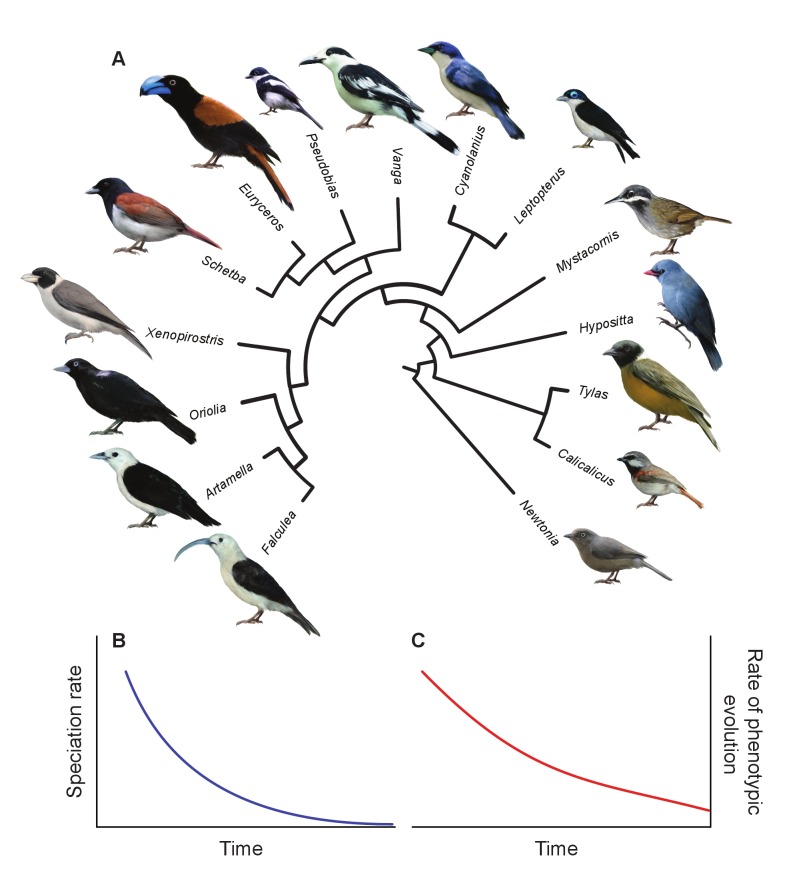
“(a) The adaptive radiation of the modern bird clade Vanginae, which shows early rapid speciation, morphological diversity, and diversity in foraging behavior and diet [15,32].”
BackgroundThe morphological diversification of carnivores in North America
Wesley-Hunt, G. D. (2005) · Paleobiology · doi:10.1666/0094-8373(2005)031<0035:tmdoci>2.0.co;2 · Cited by 133
Diversification and the adaptive radiation of the vangas of Madagascar
Reddy, S., Driskell, A. C., Rabosky, D. L., Hackett, S. J., & Schulenberg, T. S. (2012) · Proceedings of the Royal Society B Biological Sciences · doi:10.1098/rspb.2011.2380 · Cited by 118 · cited 2×
“(a) The adaptive radiation of the modern bird clade Vanginae, which shows early rapid speciation, morphological diversity, and diversity in foraging behavior and diet [15,32].”
BackgroundSlater, G. J., & Pennell, M. W. (2014) · Systematic Biology · doi:10.1093/sysbio/syt066 · Cited by 117
Evaluating hypotheses for the early diversification of dinosaurs
Irmis, R. B. (2010) · Earth and Environmental Science Transactions of the Royal Society of Edinburgh · doi:10.1017/s1755691011020068 · Cited by 112 · cited 1×
“This early burst began in the Triassic period, indicating that diversification in body size in dinosaurs began before the Triassic-Jurassic mass extinction event would have opened competition-free ecological space (as commonly hypothesized; [24,25]).”
BackgroundWeir, J. T., & Mursleen, S. (2013) · Evolution · doi:10.1111/j.1558-5646.2012.01786.x · Cited by 60 · cited 3×
“evolution will decrease as species diversity increases in a group, not just over time [14,16].”
BackgroundThe Structure, Development and Evolution of Reptiles
Russell, A. P., & Ferguson, M. W. J. (1986) · Copeia · doi:10.2307/1444977 · Cited by 53
Adaptive radiation in the fossil record: a case study among J urassic ammonoids
Neige, P., Dera, G., & Dommergues, J. (2013) · Palaeontology · doi:10.1111/pala.12062 · Cited by 25 · cited 1×
“adaptive radiation (but see [6]), but they often have found rapid”
Background
Cited by
Multilocus Species Trees Show the Recent Adaptive Radiation of the Mimetic Heliconius Butterflies
Kozak, K. M., Wahlberg, N., Neild, A. F. E., Dasmahapatra, K. K., Mallet, J., & Jiggins, C. D. (2015) · Systematic Biology · doi:10.1093/sysbio/syv007 · Cited by 224
“2007), Heliconius has not undergone a rapid adaptive radiation involving an explosive growth in the number of lineages, followed by a dramatic slowdown, as might be expected due to a sudden availability and filling of ecological niches (Pybus and Harvey 2000; Glor 2010; Moen and Morlon 2014).”
Novelty and Innovation in the History of Life
Erwin, D. H. (2015) · Current Biology · doi:10.1016/j.cub.2015.08.019 · Cited by 211
“The importance of changes in body size for adaptive diversification is unclear as many other factors can drive size changes [38,99].”
Incomplete lineage sorting and phenotypic evolution in marsupials
Feng, S., Bai, M., Rivas-González, I., Li, C., Liu, S., Tong, Y., Yang, H., Chen, G., Xie, D., Sears, K. E., et al. (2022) · Cell · doi:10.1016/j.cell.2022.03.034 · Cited by 178
On the complexity of triggering evolutionary radiations
Bouchenak‐Khelladi, Y., Onstein, R. E., Xing, Y., Schwery, O., & Linder, H. P. (2015) · New Phytologist · doi:10.1111/nph.13331 · Cited by 129
“…New Phytologist 2015 New Phytologist Trust New Phytologist (2015) 207: 313–326 313 www.newphytologist.com Research change needed to occupy this zone, and the interplay between them, have dominated recent thinking about and explanations of radiations (Moore & Donoghue, 2007; Drummond et al., 2012a).”
BackgroundAccelerated body size evolution during cold climatic periods in the Cenozoic
Clavel, J., & Morlon, H. (2017) · Proceedings of the National Academy of Sciences · doi:10.1073/pnas.1606868114 · Cited by 90
“Testing these hypotheses will require analyzing extinct (fossil) data along with phenotypes of extant taxa (29), and our framework—not limited to ultrametric trees—can be used to do so.”
BackgroundSelf-citation
Metadata
- Authors
- Moen, D., & Morlon, H.
- Affiliations
- École Normale Supérieure - PSL (FR)
- Corresponding author
- Moen, Daniel
- Venue
- PLoS Biology
- Publisher
- Public Library of Science (PLoS)
- Published
- 2014-05-06
- Volume
- 12
- Issue
- 5
- Pages
- e1001854
- ISSN
- 1544-9173 (ISSN-L)
- 1545-7885
- PMC
- PMC4011673
- OpenAlex
- W2038530957
- Cited by
- 31
- References
- 34
- Citations by year
- 2026: 1 · 2025: 2 · 2024: 4 · 2023: 2 · 2022: 3 · 2021: 1 · 2020: 3 · 2019: 2 · 2018: 2 · 2017: 2 · 2016: 5 · 2015: 4
- FWCI
- 2.68
- Type
- journal article
- Language
- en
- Open access
- gold
- doi.org
- Locations
- PLoS Biology (publishedVersion, cc-by)
- Europe PMC (PubMed Central) (publishedVersion, cc-by)
- PubMed Central (publishedVersion, cc-by)
- PubMed (publishedVersion)
- DOAJ (DOAJ: Directory of Open Access Journals) (submittedVersion)
- Funders
- Agence Nationale de la Recherche (ECOEVOBIO-CHEX2011)
- Centre National de la Recherche Scientifique
- Topics
- Physical Sciences › Earth and Planetary Sciences › Paleontology › Evolution and Paleontology Studies
- Physical Sciences › Earth and Planetary Sciences › Paleontology › Paleontology and Evolutionary Biology
- Life Sciences › Agricultural and Biological Sciences › Ecology, Evolution, Behavior and Systematics › Plant Diversity and Evolution
- Keywords
- adaptive radiation, dinosaurs, birds, body size evolution, fossil record, dinosaur-bird transition, ecological diversity, speciation
- MeSH terms
- Adaptation, Physiological, Animals, Birds, Fossils, Phylogeny, Time Factors, Dinosaurs, Biodiversity, Body Size, Genetic Speciation, Extinction, Biological, Animal Distribution
About these checks
Registry, retraction, Cites and statistics results are computed, not judged, with one exception: a printed reference that no index lists is read once by a model before it counts as a citation error. Claims are extracted by a model and kept only when their quote appears verbatim in the text; each cited source is then checked, with a model’s help, for whether it says what the claim relies on. Those verdicts can be wrong — read the claim’s quote and the cited source before relying on one.
Statistics and arithmetic are recomputed, not judged.
Confidence bands are shown only for fields calibrated on our annotated test set. None is calibrated yet, so no band is shown.
What counts as a claim ›How we measure confidence ›How we check this ›
Are you an author, or do you see a problem with this page? Request a review
Data sources
Bibliographic data: Semantic Scholar, OpenAlex, Crossref.
Contains information from the Semantic Scholar Academic Graph Datasets, made available under the ODC Attribution License (ODC-BY 1.0).
Semantic Scholar’s data is described in: Kinney, R., et al. (2023). The Semantic Scholar Open Data Platform. arXiv:2301.10140.
