

The DOI matches its Crossref record; 94 of the 102 references it cites were found in a registry or an index; 10 of the 81 sources its claims cite were checked for support.
Hierarchical Models in the Brain
Open accessAbstract
This paper describes a general model that subsumes many parametric models for continuous data. The model comprises hidden layers of state-space or dynamic causal models, arranged so that the output of one provides input to another. The ensuing hierarchy furnishes a model for many types of data, of arbitrary complexity. Special cases range from the general linear model for static data to generalised convolution models, with system noise, for nonlinear time-series analysis. Crucially, all of these models can be inverted using exactly the same scheme, namely, dynamic expectation maximization. This means that a single model and optimisation scheme can be used to invert a wide range of models. We present the model and a brief review of its inversion to disclose the relationships among, apparently, diverse generative models of empirical data. We then show that this inversion can be formulated as a simple neural network and may provide a useful metaphor for inference and learning in the brain.
Overview
CoChat Summary
## TL;DR
This paper presents hierarchical dynamic models (HDMs) as a very general framework that contains many familiar static and dynamic statistical models as special cases, all invertible with the same dynamic expectation maximization (DEM) scheme. It argues that the same inversion can be written as a simple neural network and may serve as a metaphor for inference and learning in the brain.
## Key findings
- HDMs “subsum[e] many parametric models for continuous data,” ranging from the general linear model for static data to generalized convolution models with system noise for nonlinear time-series analysis.
- The paper claims that these diverse models can all be inverted using the same scheme, dynamic expectation maximization (DEM), under a Laplace/mean-field variational approximation.
- In the results, the author shows that HDMs encompass standard tools including the general linear model, expectation maximization (EM), restricted maximum likelihood (ReML), covariance component estimation, Gaussian process models, PCA, factor analysis, ICA, sparse coding, deconvolution, and state-space filtering.
- A worked example is described in which DEM converged in “about sixteen iterations” using embedding order “n = 6” and roughness hyperparameter “γ = 4,” with the text stating that the recovered states, parameters, and hyperparameters closely matched the true values and that the true values lay largely within the 90% confidence intervals.
## Methods
- The paper develops a hierarchical dynamic model in generalized coordinates of motion, with hidden states and causes organized across levels; the model includes Gaussian priors and Gaussian assumptions about fluctuations, and uses prediction errors at each level.
- Inversion is based on variational Bayes under mean-field and Laplace approximations, optimizing free energy / variational action with a dynamic expectation maximization scheme that separates D-step (states), E-step (parameters), and M-step (hyperparameters).
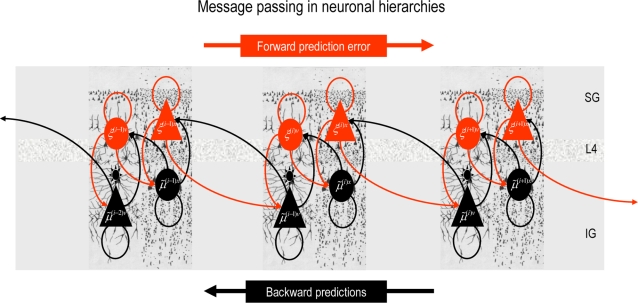
- The paper then maps this inversion scheme onto a neural-network-like message-passing architecture and illustrates the framework with analytic special cases and a simulation example.
## Limitations
- The paper states that the Laplace/Gaussian approximation “restrict[s] recognition to unimodal probabilistic representations,” though it frames this as a practical simplification.
- The text makes evident that many claims are theoretical and illustrative rather than empirically validated in this paper; it says the neuronal implementation “calls for an enormous amount of empirical verification and hypothesis testing” (evident in the text).
- The paper also makes evident that the examples and special-case derivations cover only a “partial list” of possible models, so the treatment is not exhaustive (evident in the text).
Model-written summary. Check it against the paper before relying on it.
Integrity signals
Registry
Cites
Statistics
Figures



Verification
Claims the paper makes
9 Valid · 2 Not valid · 48 Not checked · 185 Own results and interpretations
The cited sources support only part of this claim — read each source’s verdict below.
In the paper
“There is a key functional asymmetry between forward and backward connections that renders backward connections more modulatory or nonlinear in their effects on neuronal responses (e.g., [44]; see also Hupe et al. [47]).”
§ Hierarchical Models in the Brain > Results > Neuronal Implementation
What the sources say
- Partly supportedcites [44] SM Sherman, 1998, On the actions that one nerve cell can have on another: distinguishing “drivers” from “modulators”., Proc Natl Acad Sci U S A sourceExperimental — accuracy not yet measured
In the paper’s discussion of lateral geniculate inputs (indexed as Abstract; page unavailable), retinal inputs are treated as drivers, while inputs from cortex are described as modulators. That supports a forward-versus-backward distinction for this thalamic relay, but the Conclusions say that classifying corticocortical pathways remains largely untested; the paper does not establish the claimed general asymmetry or characterize backward effects as nonlinear. (LLM, conf=0.84)
- Not checked — no full text of the sourcecites Hupe et al. [47] JM Hupe, 1998, Cortical feedback improves discrimination between figure and background by V1, V2 and V3 neurons., Nature source
plainstates a cause- Asserted: passes — The authors put it forward as true.
- Checkable: passes — It can be checked against evidence.
- Load-bearing: passes — The paper’s conclusions depend on it.
- Based: passes — The paper gives a reason why it holds.
- Partly supported
The sources with a verdict support this claim; the rest weren’t checked yet, have no full text we could read, or their verdicts aren’t rated yet.
In the paper
“This selective modulation of afferents mirrors the gain-control mechanisms invoked for attention; e.g., [58],[59].”
§ Hierarchical Models in the Brain > Results > Neuronal Implementation
What the sources say
- Not checked — no full text of the sourcecites [58] S Treue, 1996, Attentional modulation of visual motion processing in cortical areas MT and MST., Nature source
- Supportedcites [59] JC Martinez-Trujillo, 2004, Feature-based attention increases the selectivity of population responses in primate visual cortex., Curr Biol source
The Conclusions (page unavailable) state that feature-based attention multiplicatively modulates neuronal responses in line with a feature-similarity gain model. This supports the cited comparison to attentional gain control; the sentence does not attribute the modulation of afferents themselves to this paper. (LLM, conf=0.88)
plainstates an association- Asserted: passes — The authors put it forward as true.
- Checkable: passes — It can be checked against evidence.
- Load-bearing: passes — The paper’s conclusions depend on it.
- Based: passes — The paper gives a reason why it holds.
The cited sources support only part of this claim — read each source’s verdict below.
In the paper
“Functional asymmetries in forwards (linear) and backwards (nonlinear) connections may reflect their distinct roles in recognition (c.f., [44]).”
§ Hierarchical Models in the Brain > Results > Neuronal Implementation
What the sources say
- Partly supportedcites [44] SM Sherman, 1998, On the actions that one nerve cell can have on another: distinguishing “drivers” from “modulators”., Proc Natl Acad Sci U S A sourceExperimental — accuracy not yet measured
The paper distinguishes driver inputs, which transmit receptive-field properties, from modulator inputs, which alter transmission (Abstract; page unavailable). It also discusses different possible roles for thalamocortical and corticothalamic pathways. It does not characterize forward connections as linear or backward connections as nonlinear, or link those properties to recognition; the Conclusions say corticocortical pathway classifications remain largely untested. (LLM, conf=0.76)
hedgedstates a possible cause- Asserted: passes — The authors put it forward as true.
- Checkable: passes — It can be checked against evidence.
- Load-bearing: unclear — It is unclear whether the paper’s conclusions depend on it.
- Based: passes — The paper gives a reason why it holds.
- Partly supported
Every source the paper cites for this claim was checked and supports it.
In the paper
“Arguments like this suggest that free-form approximations and their attending sampling schemes are not really viable in a neuronal context (although they have been considered; see [86] and above)”
§ Hierarchical Models in the Brain > Discussion
What the sources say
- Supportedcites [86] TS Lee, 2003, Hierarchical Bayesian inference in the visual cortex., J Opt Soc Am A source
The citation is attached to the parenthetical point that sampling-based approximations have been considered in a neuronal context, not to the citing authors’ conclusion that they are unviable. In “Particle Filtering and Bayesian Belief Propagation,” Lee and Mumford discuss weighted samples as an approximation to perceptual probability distributions; the Introduction proposes particle filtering as a possible cortical algorithm. The source does not endorse the unviability conclusion. (LLM, conf=0.92)
hedgedstates a cause- Asserted: passes — The authors put it forward as true.
- Checkable: passes — It can be checked against evidence.
- Load-bearing: passes — The paper’s conclusions depend on it.
- Based: passes — The paper gives a reason why it holds.
- Supported
The cited sources that could be checked couldn’t confirm or dispute this claim.
In the paper
“Lateral interactions may encode the relative precision of prediction errors and change in a way that is consistent with classical neuromodulation (c.f., [63],[71]).”
§ Hierarchical Models in the Brain > Results > Neuronal Implementation
What the sources say
- Not checked — no full text of the sourcecites [63] AJ Yu, 2005, Uncertainty, neuromodulation and attention., Neuron source
- Could not verifycites [71] Y Niv, 2005, Dopamine, uncertainty and TD learning., Behav Brain Funct sourceExperimental — accuracy not yet measured
The Discussion (page unavailable) addresses asymmetric dopamine coding of prediction errors and mentions a possible opponent neurotransmitter. Searches for lateral interactions, relative precision, and neuromodulation found no passage saying that lateral interactions encode precision or change in the claimed way. (LLM, conf=0.76)
hedgedstates a possible cause- Asserted: passes — The authors put it forward as true.
- Checkable: passes — It can be checked against evidence.
- Load-bearing: passes — The paper’s conclusions depend on it.
- Based: passes — The paper gives a reason why it holds.
122 more claims · 1 with their cited sources checked
Create a free account to see all 244 claims and to verify the 3 references still open.
- Probably not a substantial claim. 65
- It may state two separate claims as one. 65
- The quote only partly states this claim. 1
Claims other papers make about this one
Each is checked against this paper’s own text: does it say what the citing paper says it does?
The source backs part of the claim, not all of it — or backs it for a different population, condition or comparison.
In the citing paper
“This equation says that the contribution of any (angular) frequency ω in the prediction errors (encoded by superficial pyramidal cells) to the expectations (encoded by the deep pyramidal cells) is suppressed in proportion to that frequency (Friston 2008). In other words, high frequencies should be attenuated when passing from superficial to deep pyramidal cells.”
From Canonical Microcircuits for Predictive Coding (2012) · cites this paper as Friston 2008
Experimental — accuracy not yet measuredThe source backs part of the claim, not all of it — or backs it for a different population, condition or comparison.
In the citing paper
“and lies in the integrity of neuromodulatory function (2).”
From A more precise look at context in autism (2015) · cites this paper as [2]
Experimental — accuracy not yet measuredThe source backs part of the claim, not all of it — or backs it for a different population, condition or comparison.
In the citing paper
“its solutions grandfather nearly every known statistical estimation scheme, under parametric assumptions about additive or multiplicative noise (Friston, 2008)”
From The Computational Anatomy of Psychosis (2013) · cites this paper as Friston, 2008
Experimental — accuracy not yet measuredThe source backs part of the claim, not all of it — or backs it for a different population, condition or comparison.
In the citing paper
“Predictive coding is a process theory with a biologically plausible back story and a considerable amount of empirical support [21,22].”
From Active interoceptive inference and the emotional brain (2016) · cites this paper as [21]
Experimental — accuracy not yet measuredThe source backs part of the claim, not all of it — or backs it for a different population, condition or comparison.
In the citing paper
“Cortical bias or gain control is mediated by intrinsic inhibitory connections within cortical sources, which rescale prediction errors, in proportion to their precision, so that as precision increases intrinsic recurrent inhibition decreases (Abbott et al., 1997, Friston, 2008).”
From The functional anatomy of schizophrenia: A dynamic causal modeling study of predictive coding (2014) · cites this paper as Friston, 2008
Experimental — accuracy not yet measured
18 more claims about this paper
Create a free account to see every claim other papers make about this one.
Citations
Cites
Maximum Likelihood from Incomplete Data Via the EM Algorithm
Dempster, A. P., Laird, N. M., & Rubin, D. B. (1977) · Journal of the Royal Statistical Society Series B: Statistical Methodology · doi:10.1111/j.2517-6161.1977.tb01600.x · Cited by 50,444 · cited 1×
“We have discussed static cases of this fixed-form scheme previously and how it reduces to expectation maximisation ( EM ; [17]) and restricted maximum likelihood ( ReML ; [18]) for linear models [15].”
BackgroundA New Approach to Linear Filtering and Prediction Problems
Kalman, R. E. (1960) · Journal of Basic Engineering · doi:10.1115/1.3662552 · Cited by 31,751 · cited 1×
“The conventional approach to online Bayesian tracking of nonlinear or non-Gaussian systems employs extended Kalman filtering [30] or sequential Monte Carlo methods such as particle filtering.”
MethodLearning Internal Representations by Error Propagation
Rumelhart, D. E., Hinton, G. E., & Williams, R. J. (1985) · doi:10.21236/ada164453 · Cited by 16,172
An Information-Maximization Approach to Blind Separation and Blind Deconvolution
Bell, A. J., & Sejnowski, T. J. (1995) · Neural Computation · doi:10.1162/neco.1995.7.6.1129 · Cited by 8,986 · cited 1×
“) decomposes the observed response into a linear mixture of non-Gaussian causes”
Neural Mechanisms of Selective Visual Attention
Desimone, R., & Duncan, J. (1995) · Annual Review of Neuroscience · doi:10.1146/annurev.ne.18.030195.001205 · Cited by 8,388
Distributed hierarchical processing in the primate cerebral cortex
Felleman, D. J., & Van Essen, D. C. (1991) · Cerebral Cortex · doi:10.1093/cercor/1.1.1 · Cited by 7,783 · cited 2×
“This means we would expect to see connections reciprocated in the brain, which is generally the case [39,40].”
BackgroundStochastic Processes and Filtering Theory
(1970) · Mathematics in Science and Engineering · doi:10.1016/s0076-5392(09)x6022-4 · Cited by 7,302
Emergence of simple-cell receptive field properties by learning a sparse code for natural images
Olshausen, B. A., & Field, D. J. (1996) · Nature · doi:10.1038/381607a0 · Cited by 5,694 · cited 1×
“In the same way that factor analysis is a generalisation of PCA to non-Gaussian causes, ICA can be extended to form sparse-coding models of the sort proposed by Olshausen and Fields [37] by allowing observation error.”
MethodRao, R. P. N., & Ballard, D. H. (1999) · Nature Neuroscience · doi:10.1038/4580 · Cited by 5,483 · cited 2×
“The mean-field approximation q ( W )= q ( u ( t )) q ( h ) q ( l ) enables inference about perceptual states, causal regularities and context, without representing the joint distribution explicitly; c.f., [64].”
BackgroundA theory of cortical responses.
Friston, K. (2005) · Philosophical Transactions of the Royal Society B: Biological Sciences · doi:10.1098/rstb.2005.1622 · Cited by 4,578 · cited 2×
“We have laid out the neurobiological and psycho-physical motivation for the neuronal implementation of DEM in [3] and [4].”
MethodSelf-citation
Research works printed but not linked: 4
- DJC MacKay, 1995, Free-energy minimisation algorithm for decoding and cryptoanalysis., Electron Lett, 31, 445
- T Ozaki, 1992, A bridge between nonlinear time-series models and nonlinear stochastic dynamical systems: A local linearization approach., Stat Sin, 2, 113
- ME Tipping, 2001, Sparse Bayesian learning and the Relevance Vector Machine., J Mach Learn Res, 1, 211
- CE Rasmussen, 1996, Evaluation of Gaussian Processes and Other Methods for Nonlinear Regression [PhD thesis]. Toronto, Canada: Department of Computer Science, University of Toronto.
Cited by
The free-energy principle: a unified brain theory?
Friston, K. (2010) · Nature Reviews Neuroscience · doi:10.1038/nrn2787 · Cited by 8,120
Self-citationWhatever next? Predictive brains, situated agents, and the future of cognitive science
Clark, A. (2013) · Behavioral and Brain Sciences · doi:10.1017/s0140525x12000477 · Cited by 5,924
“This might hold the key, as Fletcher and Frith (2009) suggest, to a better understanding of the origins of hallucinations and delusion (the two “positive symptoms”) in schizophrenia. These two symptoms are often thought to involve two mechanisms and hence two breakdowns, one in “perception” (leading to the hallucinati…”
BackgroundInfluentialCanonical Microcircuits for Predictive Coding
Bastos, A. M., Usrey, W. M., Adams, R. A., Mangun, G. R., Fries, P., & Friston, K. J. (2012) · Neuron · doi:10.1016/j.neuron.2012.10.038 · Cited by 2,421
“Forward (driving) and backward (driving and modulatory) connections mediate the (linear) influence of prediction errors and the (linear and nonlinear) construction of predictions (Friston, 2008, 2010).”
InfluentialSelf-citationThe free-energy principle: a rough guide to the brain?
Friston, K. (2009) · Trends in Cognitive Sciences · doi:10.1016/j.tics.2009.04.005 · Cited by 1,831
Self-citationPredictive coding under the free-energy principle
Friston, K., & Kiebel, S. (2009) · Philosophical Transactions of the Royal Society B: Biological Sciences · doi:10.1098/rstb.2008.0300 · Cited by 1,579
Self-citation
Metadata
- Authors
- Friston, K.
- Affiliations
- Wellcome Centre for Human Neuroimaging (GB)
- Corresponding author
- Friston, Karl
- ORCID
- Friston, Karl
- Venue
- PLoS Computational Biology
- Publisher
- Public Library of Science (PLoS)
- Published
- 2008-11-07
- Volume
- 4
- Issue
- 11
- Pages
- e1000211
- ISSN
- 1553-734X (ISSN-L)
- 1553-7358
- PMC
- PMC2570625
- OpenAlex
- W1977628053
- Cited by
- 952
- References
- 102
- Citations by year
- 2026: 53 · 2025: 71 · 2024: 58 · 2023: 79 · 2022: 66 · 2021: 84 · 2020: 106 · 2019: 60 · 2018: 57 · 2017: 55 · 2016: 52 · 2015: 46 · 2014: 38 · 2013: 35 · 2012: 32
- FWCI
- 31.65
- Type
- journal article
- Language
- en
- Open access
- gold
- doi.org
- Licence
- cc-by
- Locations
- PLoS Computational Biology (publishedVersion, cc-by)
- PubMed Central (publishedVersion, cc-by)
- PubMed (publishedVersion)
- RePEc: Research Papers in Economics (submittedVersion)
- DOAJ (DOAJ: Directory of Open Access Journals) (submittedVersion, cc-by-sa)
- UCL Discovery (University College London) (submittedVersion)
- Funders
- Wellcome Trust (088130)
- Topics
- Physical Sciences › Computer Science › Artificial Intelligence › Bayesian Modeling and Causal Inference
- Physical Sciences › Computer Science › Artificial Intelligence › Gaussian Processes and Bayesian Inference
- Physical Sciences › Computer Science › Artificial Intelligence › Neural Networks and Applications
- Keywords
- hierarchical models, state-space model, dynamic causal modeling, model inversion, nonlinear time series analysis, general linear model, neural network inversion, brain learning
- MeSH terms
- Algorithms, Animals, Brain, Humans, Mental Processes, Models, Neurological, Nerve Net, Probability, Linear Models, Neural Networks, Computer, Nonlinear Dynamics
About these checks
Registry, retraction, Cites and statistics results are computed, not judged, with one exception: a printed reference that no index lists is read once by a model before it counts as a citation error. Claims are extracted by a model and kept only when their quote appears verbatim in the text; each cited source is then checked, with a model’s help, for whether it says what the claim relies on. Those verdicts can be wrong — read the claim’s quote and the cited source before relying on one.
The claim verdicts this report counts are experimental: their accuracy is not yet measured.
A language model drew the claims from the paper on 2026-10-10, under version 3 of the claim definition (model deepseek-v4.1-flash, prompt extract-v3).
A second model labelled each claim on 2026-10-10 (model jev-1.13-20260917, definition revision gold-guideline-v0.2).
Cited sources are checked with a language model’s help (gpt-6-sol).
Statistics and arithmetic are recomputed, not judged.
Confidence bands are shown only for fields calibrated on our annotated test set. None is calibrated yet, so no band is shown.
What counts as a claim ›How we measure confidence ›How we check this ›
Are you an author, or do you see a problem with this page? Request a review
How to cite
Cite CoChat for the checks on this page, and the paper for its own findings.
- This page
- CoChat. (2026). Citation check: Hierarchical Models in the Brain. https://app.cochat.ai/papers/10.1371/journal.pcbi.1000211
- The paper
- Friston, K. (2008). Hierarchical Models in the Brain. PLoS Computational Biology. https://doi.org/10.1371/journal.pcbi.1000211
Data sources
Bibliographic data: Semantic Scholar, OpenAlex, Crossref.
Contains information from the Semantic Scholar Academic Graph Datasets, made available under the ODC Attribution License (ODC-BY 1.0).
Semantic Scholar’s data is described in: Kinney, R., et al. (2023). The Semantic Scholar Open Data Platform. arXiv:2301.10140.
