

The DOI matches its Crossref record; 53 of the 53 references it cites were found in a registry or an index.
Broadband Criticality of Human Brain Network Synchronization
Open accessAbstract
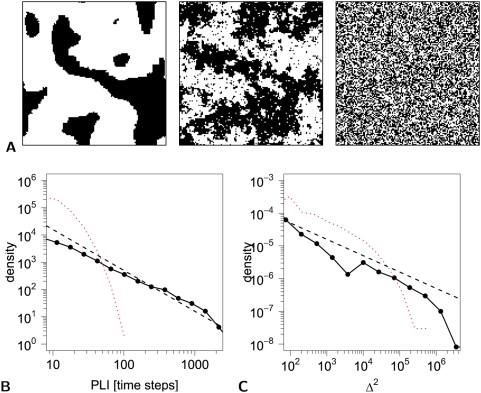
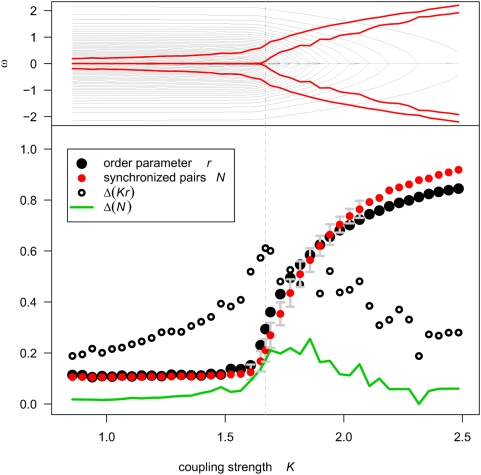
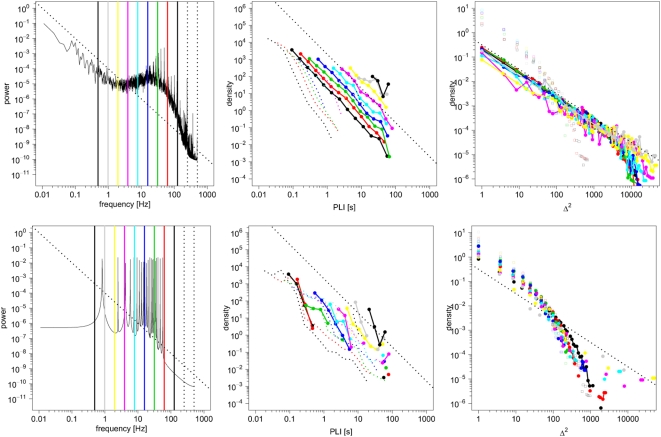
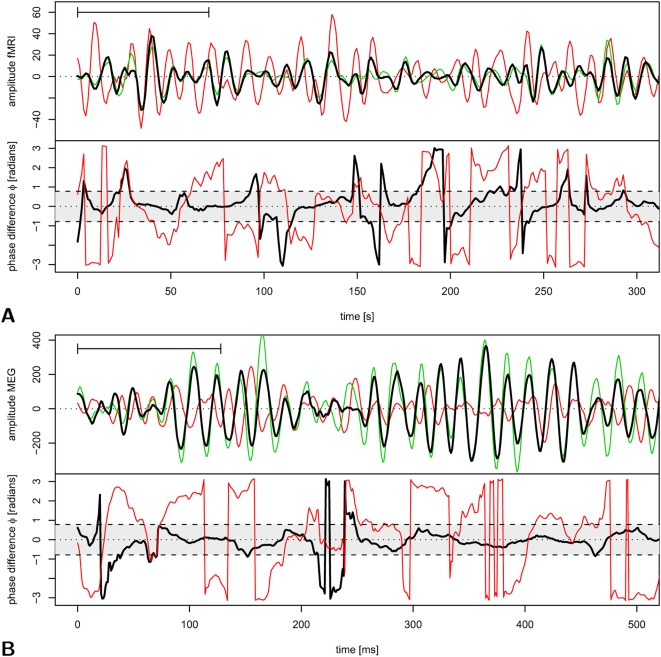
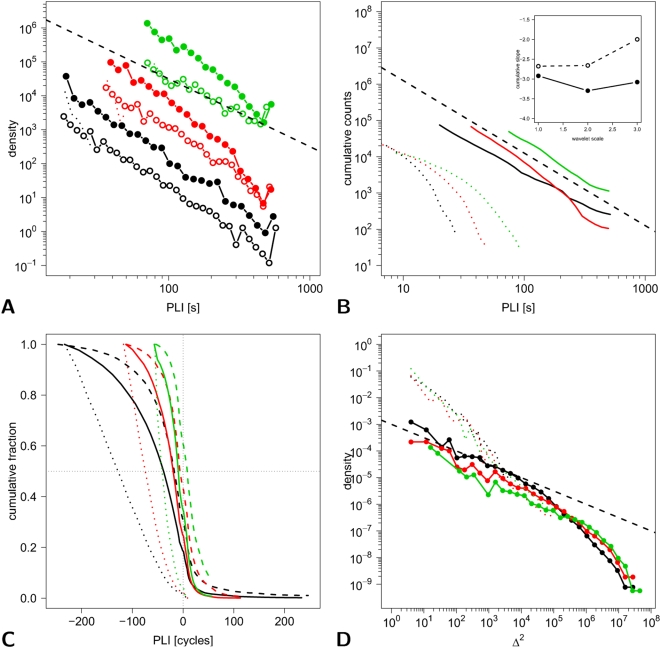
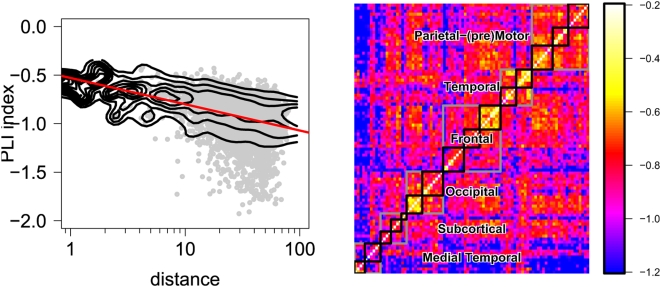
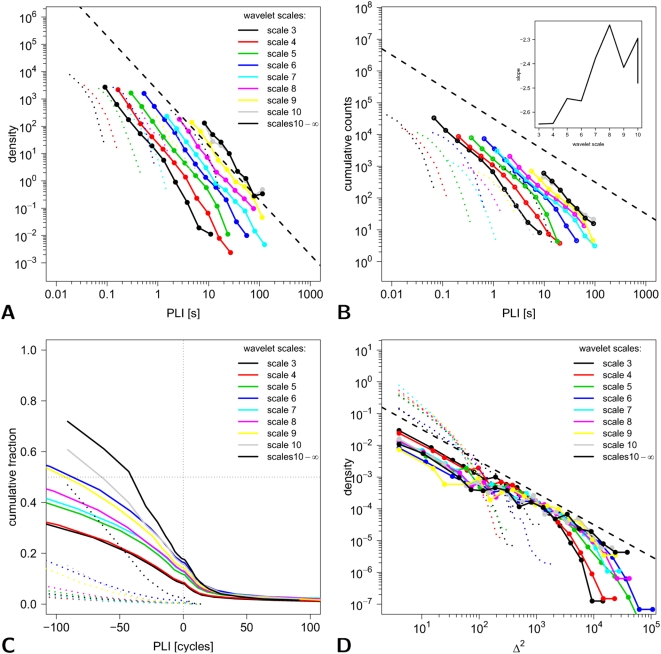
Self-organized criticality is an attractive model for human brain dynamics, but there has been little direct evidence for its existence in large-scale systems measured by neuroimaging. In general, critical systems are associated with fractal or power law scaling, long-range correlations in space and time, and rapid reconfiguration in response to external inputs. Here, we consider two measures of phase synchronization: the phase-lock interval, or duration of coupling between a pair of (neurophysiological) processes, and the lability of global synchronization of a (brain functional) network. Using computational simulations of two mechanistically distinct systems displaying complex dynamics, the Ising model and the Kuramoto model, we show that both synchronization metrics have power law probability distributions specifically when these systems are in a critical state. We then demonstrate power law scaling of both pairwise and global synchronization metrics in functional MRI and magnetoencephalographic data recorded from normal volunteers under resting conditions. These results strongly suggest that human brain functional systems exist in an endogenous state of dynamical criticality, characterized by a greater than random probability of both prolonged periods of phase-locking and occurrence of large rapid changes in the state of global synchronization, analogous to the neuronal "avalanches" previously described in cellular systems. Moreover, evidence for critical dynamics was identified consistently in neurophysiological systems operating at frequency intervals ranging from 0.05-0.11 to 62.5-125 Hz, confirming that criticality is a property of human brain functional network organization at all frequency intervals in the brain's physiological bandwidth.
Overview
The claims and statistics of this paper haven’t been checked yet.
Run the check — free, no account needed. It reads the open-access text and checks the sources it cites.
Integrity signals
Registry
Cites
Statistics
Figures
Verification
Claims the paper makes
The claims and statistics of this paper haven’t been checked yet.
Run the check — free, no account needed. It reads the open-access text and checks the sources it cites.
Claims other papers make about this one
Each is checked against this paper’s own text: does it say what the citing paper says it does?
The source backs part of the claim, not all of it — or backs it for a different population, condition or comparison.
In the citing paper
“Several lines of evidence point to fractal-like (1/f) self-similarity over different spatio-temporal scales in brain dynamics and structure [76,77].”
From Consciousness in the universe (2014) · cites this paper as [77]
Experimental — accuracy not yet measuredThe cited source says what the claim attributes to it.
In the citing paper
“there does appear to be evidence for some kind of scale-invariance in neurophysiological processes (Section 3.2 [76,77]).”
From Consciousness in the universe (2014) · cites this paper as [77]
Self-check
Percentages, sums and reported differences re-computed from the paper’s own numbers.
The self-check needs the paper’s full text.
Citations
Cites
Collective dynamics of ‘small-world’ networks
Watts, D. J., & Strogatz, S. H. (1998) · Nature · doi:10.1038/30918 · Cited by 43,060
Tzourio-Mazoyer, N., Landeau, B., Papathanassiou, D., Crivello, F., Etard, O., Delcroix, N., Mazoyer, B., & Joliot, M. (2002) · NeuroImage · doi:10.1006/nimg.2001.0978 · Cited by 16,319
Multimodel Inference: Understanding AIC and BIC in Model Selection
Burnham, K. P., & Anderson, D. R. (2004) · Sociological Methods & Research · doi:10.1177/0049124104268644 · Cited by 11,648
PIKOVSKY, A. S., Rosenblum, M., & Kurths, J. (2001) · Cambridge University Press eBooks · doi:10.1017/cbo9780511755743 · Cited by 8,250
Chemical Oscillations, Waves, and Turbulence
Kuramoto, Y. (1984) · Springer series in synergetics · doi:10.1007/978-3-642-69689-3 · Cited by 7,242
Crystal Statistics. I. A Two-Dimensional Model with an Order-Disorder Transition
Onsager, L. (1944) · Physical Review · doi:10.1103/physrev.65.117 · Cited by 6,634
Synchronization a universal concept in nonlinear sciences
PIKOVSKY, A. S., Rosenblum, M. G., & Kurths, J. (2001) · Cited by 5,640
A mechanism for cognitive dynamics: neuronal communication through neuronal coherence.
Fries, P. (2005) · Trends in Cognitive Sciences · doi:10.1016/j.tics.2005.08.011 · Cited by 4,284
Gray, C. M., König, P., Engel, A. K., & Singer, W. (1989) · Nature · doi:10.1038/338334a0 · Cited by 4,183
Beitrag zur Theorie des Ferromagnetismus
Ising, E. (1925) · Zeitschrift für Physik · doi:10.1007/bf02980577 · Cited by 3,871
Cited by
Sorted by citations
Complex brain networks: graph theoretical analysis of structural and functional systems
Bullmore, E., & Sporns, O. (2009) · Nature Reviews Neuroscience · doi:10.1038/nrn2575 · Cited by 11,820
Self-citationThe free-energy principle: a unified brain theory?
Friston, K. (2010) · Nature Reviews Neuroscience · doi:10.1038/nrn2787 · Cited by 8,120
Functional and Effective Connectivity: A Review
Friston, K. J. (2011) · Brain Connectivity · doi:10.1089/brain.2011.0008 · Cited by 3,415
The economy of brain network organization
Bullmore, E., & Sporns, O. (2012) · Nature Reviews Neuroscience · doi:10.1038/nrn3214 · Cited by 3,284
Self-citationThe role of the posterior cingulate cortex in cognition and disease
Leech, R., & Sharp, D. J. (2014) · Brain · doi:10.1093/brain/awt162 · Cited by 2,247
Metadata
- Authors
- Kitzbichler, M. G., Smith, M. L., Christensen, S. R., & Bullmore, E.
- Affiliations
- University of Cambridge (GB)
- MRC Cognition and Brain Sciences Unit (GB)
- GlaxoSmithKline (United Kingdom) (GB)
- Venue
- PLoS Computational Biology
- Publisher
- Public Library of Science (PLoS)
- Published
- 2009-03-20
- Volume
- 5
- Issue
- 3
- Pages
- e1000314
- ISSN
- 1553-734X (ISSN-L)
- 1553-7358
- PMC
- PMC2647739
- OpenAlex
- W2115990221
- Cited by
- 527
- References
- 52
- Citations by year
- 2026: 10 · 2025: 16 · 2024: 14 · 2023: 28 · 2022: 28 · 2021: 31 · 2020: 25 · 2019: 38 · 2018: 37 · 2017: 37 · 2016: 24 · 2015: 24 · 2014: 39 · 2013: 44 · 2012: 54
- FWCI
- 21.21
- Type
- journal article
- Language
- en
- Open access
- gold
- doi.org
- Locations
- PLoS Computational Biology (publishedVersion, cc-by)
- PubMed Central (publishedVersion, cc-by)
- PubMed (publishedVersion)
- BIROn (Birkbeck, University of London) (acceptedVersion)
- RePEc: Research Papers in Economics (submittedVersion)
- DOAJ (DOAJ: Directory of Open Access Journals) (submittedVersion, cc-by-sa)
- Apollo (University of Cambridge) (submittedVersion, cc-by)
- Apollo (cc-by)
- Funders
- GlaxoSmithKline
- Wellcome Trust
- Medical Research Council
- National Institute of Mental Health
- Topics
- Life Sciences › Neuroscience › Cognitive Neuroscience › Neural dynamics and brain function
- Physical Sciences › Physics and Astronomy › Condensed Matter Physics › Theoretical and Computational Physics
- Life Sciences › Neuroscience › Cognitive Neuroscience › Functional Brain Connectivity Studies
- Keywords
- self-organized criticality, functional brain networks, phase synchronization, power-law scaling, neuronal avalanches, Ising model, Kuramoto model, resting-state brain dynamics, functional MRI, magnetoencephalography
- MeSH terms
- Action Potentials, Animals, Biological Clocks, Brain, Computer Simulation, Cortical Synchronization, Humans, Models, Neurological, Nerve Net, Synaptic Transmission, Neurons
About these checks
Registry, retraction, Cites and statistics results are computed, not judged, with one exception: a printed reference that no index lists is read once by a model before it counts as a citation error. Claims are extracted by a model and kept only when their quote appears verbatim in the text; each cited source is then checked, with a model’s help, for whether it says what the claim relies on. Those verdicts can be wrong — read the claim’s quote and the cited source before relying on one.
Statistics and arithmetic are recomputed, not judged.
Confidence bands are shown only for fields calibrated on our annotated test set. None is calibrated yet, so no band is shown.
What counts as a claim ›How we measure confidence ›How we check this ›
Are you an author, or do you see a problem with this page? Request a review
