

The DOI matches its Crossref record; 99 of the 99 references it cites were found in a registry or an index.
A Neural Computational Model of Incentive Salience
Open accessAbstract
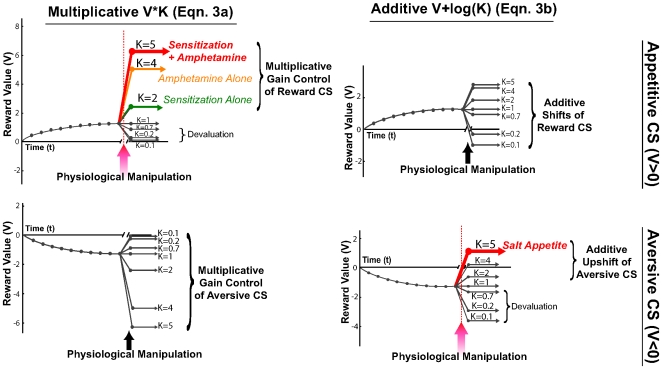
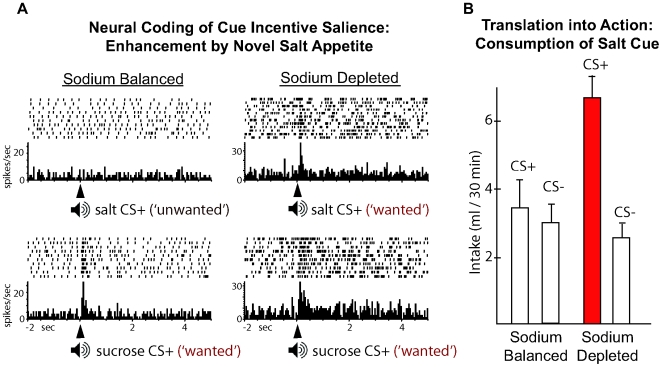
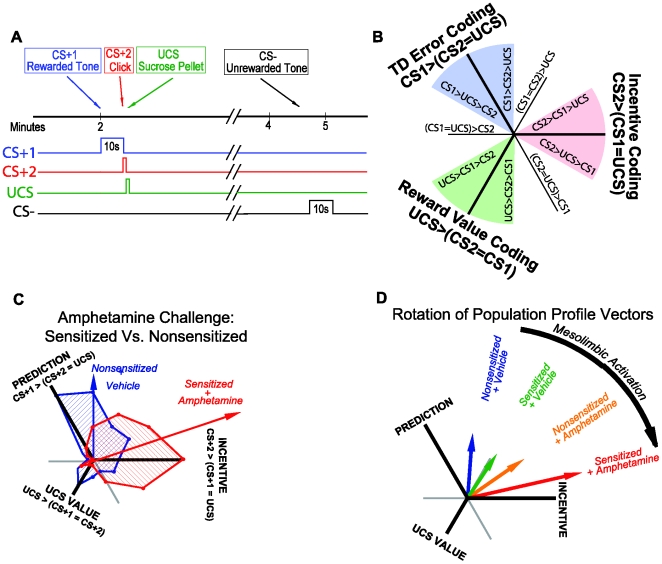
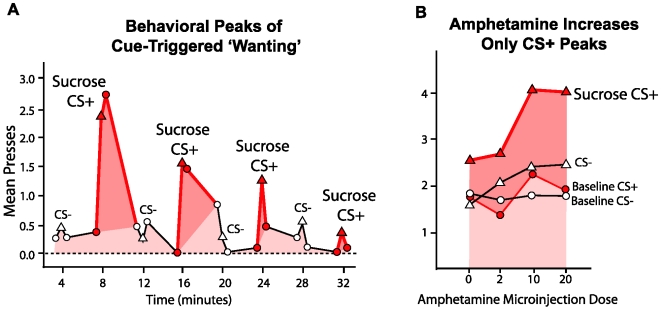
Incentive salience is a motivational property with 'magnet-like' qualities. When attributed to reward-predicting stimuli (cues), incentive salience triggers a pulse of 'wanting' and an individual is pulled toward the cues and reward. A key computational question is how incentive salience is generated during a cue re-encounter, which combines both learning and the state of limbic brain mechanisms. Learning processes, such as temporal-difference models, provide one way for stimuli to acquire cached predictive values of rewards. However, empirical data show that subsequent incentive values are also modulated on the fly by dynamic fluctuation in physiological states, altering cached values in ways requiring additional motivation mechanisms. Dynamic modulation of incentive salience for a Pavlovian conditioned stimulus (CS or cue) occurs during certain states, without necessarily requiring (re)learning about the cue. In some cases, dynamic modulation of cue value occurs during states that are quite novel, never having been experienced before, and even prior to experience of the associated unconditioned reward in the new state. Such cases can include novel drug-induced mesolimbic activation and addictive incentive-sensitization, as well as natural appetite states such as salt appetite. Dynamic enhancement specifically raises the incentive salience of an appropriate CS, without necessarily changing that of other CSs. Here we suggest a new computational model that modulates incentive salience by integrating changing physiological states with prior learning. We support the model with behavioral and neurobiological data from empirical tests that demonstrate dynamic elevations in cue-triggered motivation (involving natural salt appetite, and drug-induced intoxication and sensitization). Our data call for a dynamic model of incentive salience, such as presented here. Computational models can adequately capture fluctuations in cue-triggered 'wanting' only by incorporating modulation of previously learned values by natural appetite and addiction-related states.
Overview
The claims and statistics of this paper haven’t been checked yet.
Run the check — free, no account needed. It reads the open-access text and checks the sources it cites.
Integrity signals
Registry
Cites
Statistics
Figures
Verification
Claims the paper makes
The claims and statistics of this paper haven’t been checked yet.
Run the check — free, no account needed. It reads the open-access text and checks the sources it cites.
Claims other papers make about this one
Each is checked against this paper’s own text: does it say what the citing paper says it does?
In the citing paper
“These results are consistent with the incentive salience theory, however, and highlight the dissociation that can occur between the predictive value of a cue, driven by cue learning (cue-reward association), and the attribution of cue ‘wanting’ (T. E. Robinson & Flagel, 2009; Zhang, Berridge, Tindell, Smith, & Aldridge, 2009).”
From Cued for Risk: Evidence for an Incentive Sensitization Framework to Explain the Interplay between Stress and Anxiety, Substance Abuse, and Reward Uncertainty in Disordered Gambling Behavior (2019) · cites this paper as Zhang, Berridge, Tindell, Smith, & Aldridge, 2009
In the citing paper
“The attribution of incentive salience is the product of previous experience (i.e., learned associations) interacting with an individual’s genetic propensity and neurobiological state 16,24–27.”
From A selective role for dopamine in stimulus-reward learning (2011) · cites this paper as [27]
Self-check
Percentages, sums and reported differences re-computed from the paper’s own numbers.
The self-check needs the paper’s full text.
Citations
Cites
A neural substrate of prediction and reward
Schultz, W., Dayan, P., & Montague, P. R. (1997) · Science · doi:10.1126/science.275.5306.1593 · Cited by 9,388 · cited 2×
“The estimate is based on summed values from reward prediction errors – the discrepancy between the reward expected from a stimulus (technically, a state) and the reward actually received [20,23–29].”
BackgroundThe neural basis of drug craving: An incentive-sensitization theory of addiction
Robinson, T. (1993) · Brain Research Reviews · doi:10.1016/0165-0173(93)90013-p · Cited by 7,346 · cited 4×
“In addicts, amplified motivation may maladaptively pull the addict like a magnet towards compulsively ‘wanted’ drugs, and so make it harder to escape from the addiction [8,13,98].”
BackgroundInfluentialRescorla, R. A. (1972) · Medical Entomology and Zoology · Cited by 7,268
Golden eggs and hyperbolic discounting
Laibson, D. (1997) · The Quarterly Journal of Economics · doi:10.1162/003355397555253 · Cited by 6,122 · cited 1×
“(4) is an expression of what is known as the ‘‘quasi-hyperbolic’’ discounting model encountered in economics literature [56,57].”
BackgroundTime Discounting and Time Preference: A Critical Review
Frederick, S., Loewenstein, G., & O’Donoghue, T. (2002) · Journal of Economic Literature · doi:10.1257/002205102320161311 · Cited by 6,106 · cited 1×
“(4) is an expression of what is known as the ‘‘quasi-hyperbolic’’ discounting model encountered in economics literature [56,57].”
BackgroundPuterman, M. L. (1994) · Wiley series in probability and statistics · doi:10.1002/9780470316887 · Cited by 6,057
Classical conditioning II: Current research and theory.
Black, A. H., & Prokasy, W. F. (1972) · Appleton-Century-Crofts eBooks · Cited by 4,449
What is the role of dopamine in reward: hedonic impact, reward learning, or incentive salience?
Berridge, K. C., & Robinson, T. E. (1998) · Brain Research Reviews · doi:10.1016/s0165-0173(98)00019-8 · Cited by 4,127
Self-citationTime Discounting and Time Preference: A Critical Review
Frederick, S. W., Loewenstein, G. F., & O’Donoghue, T. (2002) · Journal of Economic Literature · doi:10.1257/jel.40.2.351 · Cited by 4,116
Neural systems of reinforcement for drug addiction: from actions to habits to compulsion
Everitt, B. J., & Robbins, T. W. (2005) · Nature Neuroscience · doi:10.1038/nn1579 · Cited by 3,785
Cited by
Sorted by citations
A selective role for dopamine in stimulus-reward learning
Flagel, S. B., Clark, J. J., Robinson, T. E., Mayo, L., Czuj, A., Willuhn, I., Akers, C. A., Clinton, S. M., Phillips, P. E. M., & Akil, H. (2011) · Nature · doi:10.1038/nature09588 · Cited by 1,026
The tempted brain eats: Pleasure and desire circuits in obesity and eating disorders
Berridge, K. C., Ho, C.-Y., Richard, J. M., & DiFeliceantonio, A. G. (2010) · Brain Research · doi:10.1016/j.brainres.2010.04.003 · Cited by 873
“But together in the right combinations they are motivationally compelling in a synergy that is greater than the sum of the parts (Zhang et al., 2009).”
Self-citationFrom prediction error to incentive salience: mesolimbic computation of reward motivation.
Berridge, K. C. (2012) · European Journal of Neuroscience · doi:10.1111/j.1460-9568.2012.07990.x · Cited by 700
“The first form, which is usually applicable, is multiplicative (A; equation 3a in Zhang et al., 2009): A : ~rðrt; jÞ ¼ j rt: This form applies to the amplification of ‘wanting’ for a reward by addictive drug administration or by permanent drug-induced neural sensitization.”
BackgroundInfluentialSelf-citationDisentangling pleasure from incentive salience and learning signals in brain reward circuitry
Smith, K. S., Berridge, K. C., & Aldridge, J. W. (2011) · Proceedings of the National Academy of Sciences · doi:10.1073/pnas.1101920108 · Cited by 464
“Separate animals (n = 10) were used to calculate spread of microinjection using Fos plume measurements used to guide functional mapping (SI Materials and Methods and SI Results).”
BackgroundInfluentialSelf-citationCollins, A. G. E., & Frank, M. J. (2014) · Psychological Review · doi:10.1037/a0037015 · Cited by 403
“These findings support the observations that motivational state at the time of choice can impact an animal's behavior to approach an action which had been preferentially associated with negative outcomes during learning (Zhang et al., 2009).”
Result
Metadata
- Authors
- Zhang, J., Berridge, K. C., Tindell, A. J., Smith, K. S., & Aldridge, J. W.
- Affiliations
- University of Michigan (US)
- McGovern Institute for Brain Research (US)
- Corresponding author
- Berridge, Kent C.
- Venue
- PLoS Computational Biology
- Publisher
- Public Library of Science (PLoS)
- Published
- 2009-07-17
- Volume
- 5
- Issue
- 7
- Pages
- e1000437
- ISSN
- 1553-734X (ISSN-L)
- 1553-7358
- PMC
- PMC2703828
- OpenAlex
- W2097552217
- Cited by
- 299
- References
- 98
- Citations by year
- 2026: 7 · 2025: 8 · 2024: 5 · 2023: 12 · 2022: 15 · 2021: 19 · 2020: 57 · 2019: 53 · 2018: 17 · 2017: 11 · 2016: 11 · 2015: 11 · 2014: 15 · 2013: 23 · 2012: 17
- FWCI
- 4.84
- Type
- journal article
- Language
- en
- Open access
- gold
- doi.org
- Licence
- Locations
- PLoS Computational Biology (publishedVersion, public-domain)
- PubMed Central (publishedVersion, public-domain)
- PubMed (publishedVersion)
- DOAJ (DOAJ: Directory of Open Access Journals) (submittedVersion)
- DSpace@MIT (Massachusetts Institute of Technology) (submittedVersion, cc-by-nc)
- PLoS eBooks
- Funders
- National Institutes of Health
- National Institute of Mental Health (MH-63649, R01MH063649)
- National Institute on Drug Abuse (R01DA017752, DA-017752, DA015188, R01DA015188)
- Air Force Office of Scientific Research
- Topics
- Life Sciences › Neuroscience › Cellular and Molecular Neuroscience › Neurotransmitter Receptor Influence on Behavior
- Life Sciences › Neuroscience › Cognitive Neuroscience › Neural and Behavioral Psychology Studies
- Life Sciences › Neuroscience › Cognitive Neuroscience › Memory and Neural Mechanisms
- Keywords
- incentive salience, computational model, want, physiological state, temporal difference learning, predictive value, addiction, salt appetite, motivation
- MeSH terms
- Algorithms, Animals, Appetite, Behavior, Animal, Brain, Conditioning, Classical, Dopamine, Learning, Limbic System, Models, Neurological, Motivation, Reward, Rats
About these checks
Registry, retraction, Cites and statistics results are computed, not judged, with one exception: a printed reference that no index lists is read once by a model before it counts as a citation error. Claims are extracted by a model and kept only when their quote appears verbatim in the text; each cited source is then checked, with a model’s help, for whether it says what the claim relies on. Those verdicts can be wrong — read the claim’s quote and the cited source before relying on one.
Statistics and arithmetic are recomputed, not judged.
Confidence bands are shown only for fields calibrated on our annotated test set. None is calibrated yet, so no band is shown.
What counts as a claim ›How we measure confidence ›How we check this ›
Are you an author, or do you see a problem with this page? Request a review
