

A whole-body model for glycogen regulation reveals a critical role for substrate cycling in maintaining blood glucose homeostasis.
Open accessThe DOI matches its Crossref record; 67 of the 69 references it cites were found in a registry or an index.
Abstract
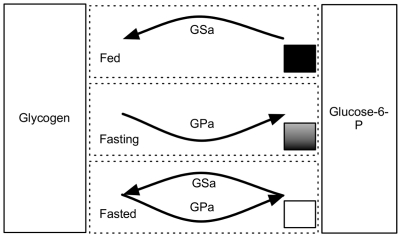
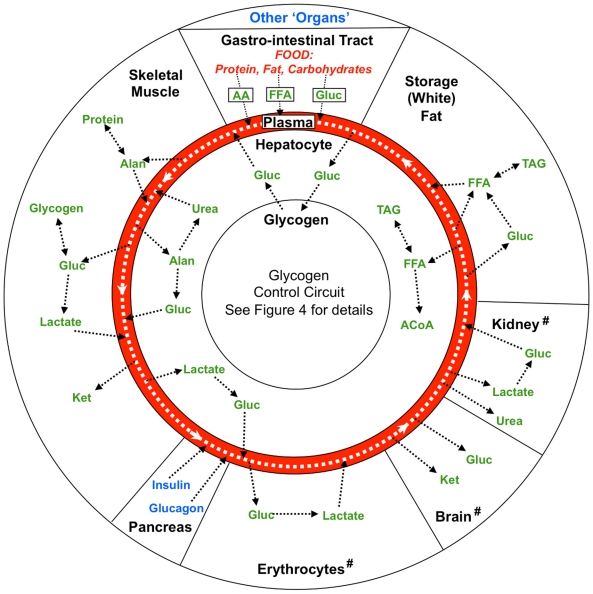
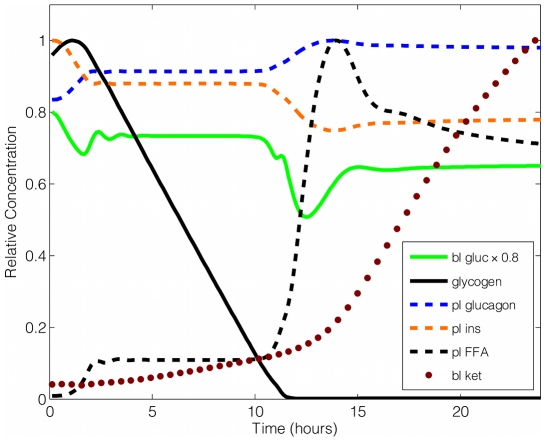
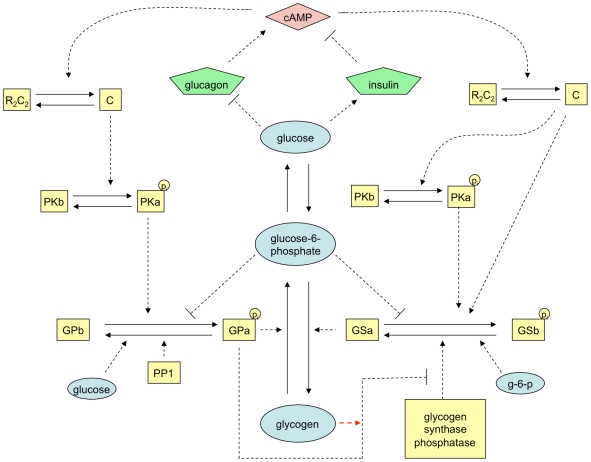
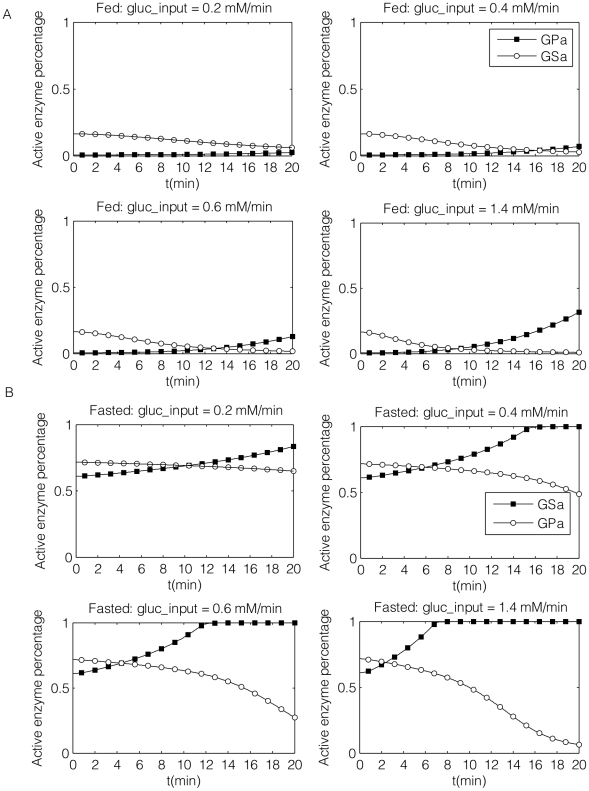
Timely, and sometimes rapid, metabolic adaptation to changes in food supply is critical for survival as an organism moves from the fasted to the fed state, and vice versa. These transitions necessitate major metabolic changes to maintain energy homeostasis as the source of blood glucose moves away from ingested carbohydrates, through hepatic glycogen stores, towards gluconeogenesis. The integration of hepatic glycogen regulation with extra-hepatic energetics is a key aspect of these adaptive mechanisms. Here we use computational modeling to explore hepatic glycogen regulation under fed and fasting conditions in the context of a whole-body model. The model was validated against previous experimental results concerning glycogen phosphorylase a (active) and glycogen synthase a dynamics. The model qualitatively reproduced physiological changes that occur during transition from the fed to the fasted state. Analysis of the model reveals a critical role for the inhibition of glycogen synthase phosphatase by glycogen phosphorylase a. This negative regulation leads to high levels of glycogen synthase activity during fasting conditions, which in turn increases substrate (futile) cycling, priming the system for a rapid response once an external source of glucose is restored. This work demonstrates that a mechanistic understanding of the design principles used by metabolic control circuits to maintain homeostasis can benefit from the incorporation of mathematical descriptions of these networks into "whole-body" contextual models that mimic in vivo conditions.
Overview
The claims and statistics of this paper haven’t been checked yet.
Free: it reads the open-access text and checks the first 5 claims that cite a source we can check. Create a free account to check every claim.
Integrity signals
Registry
Cites
Statistics
Figures
Verification
Claims the paper makes
The claims and statistics of this paper haven’t been checked yet.
Free: it reads the open-access text and checks the first 5 claims that cite a source we can check. Create a free account to check every claim.
Claims other papers make about this one
Each is checked against this paper’s own text: does it say what the citing paper says it does?
The cited source says what the claim attributes to it.
In the citing paper
“Taken together, metabolic regulation via phosphorylation/dephosphorylation of key enzymes in combination with futile cycles plays a key role in our model, in line with the results presented by Xu et al. [34].”
From Quantifying the Contribution of the Liver to Glucose Homeostasis: A Detailed Kinetic Model of Human Hepatic Glucose Metabolism (2012) · cites this paper as [34]
Self-check
Percentages, sums and reported differences re-computed from the paper’s own numbers.
The self-check needs the paper’s full text.
Citations
Cites
What is flux balance analysis?
Orth, J. D., Thiele, I., & Palsson, B. Ø. (2010) · Nature Biotechnology · doi:10.1038/nbt.1614 · Cited by 3,903
An Introduction to Systems Biology: Design Principles of Biological Circuits
Alon, U. (2006) · doi:10.1201/9781420011432 · Cited by 2,825
Structure and function of the feed-forward loop network motif
Mangan, S., & Alon, U. (2003) · Proceedings of the National Academy of Sciences · doi:10.1073/pnas.2133841100 · Cited by 1,827 · cited 1×
“feedback and feed forward control loops described in [30–33] for maintaining glucose homeostasis under different fed-fasting conditions.”
BackgroundGlobal reconstruction of the human metabolic network based on genomic and bibliomic data
Duarte, N. C., Becker, S. A., Jamshidi, N., Thiele, I., Mo, M. L., Vo, T. D., Srivas, R., & Palsson, B. Ø. (2007) · Proceedings of the National Academy of Sciences · doi:10.1073/pnas.0610772104 · Cited by 1,374 · cited 1×
“In addition, large-scale reconstructions of metabolism, typically based on flux or constraint-based models, have recently been developed for multiple organ systems including the liver [17–21].”
BackgroundCahill, G. F. (2006) · Annual Review of Nutrition · doi:10.1146/annurev.nutr.26.061505.111258 · Cited by 1,319 · cited 1×
“The dynamics of these substrates and enzymes are described in [25–27], while the whole body energetics have been reviewed in [26,28,29].”
BackgroundHarper's Illustrated Biochemistry
Murray, R. K. (1988) · Repository of the University of Ljubljana (University of Ljubljana) · Cited by 1,227
Design principles of biochemical oscillators
Novák, B., & Tyson, J. J. (2008) · Nature Reviews Molecular Cell Biology · doi:10.1038/nrm2530 · Cited by 1,137 · cited 1×
“Such internally generated oscillations are responsible in large part for circadian rhythms and the cell cycle [55], which are intimately linked to the subject of feedfasting cycles in the present work.”
BackgroundEnergy System Interaction and Relative Contribution During Maximal Exercise
Gastin, P. B. (2001) · Sports Medicine · doi:10.2165/00007256-200131100-00003 · Cited by 1,013 · cited 1×
“The number of mathematical models of hepatic energy metabolism, as it relates to hepatic glycogen storage, has been slowly increasing in response to interest in the impact of exercise on energetics in the case of diabetes [14], diet [15] and athletic training [16].”
BackgroundDynamics of the p53-Mdm2 feedback loop in individual cells
Lahav, G., Rosenfeld, N., Sigal, A., Geva-Zatorsky, N., Levine, A. J., Elowitz, M. B., & Alon, U. (2004) · Nature Genetics · doi:10.1038/ng1293 · Cited by 1,013 · cited 1×
“feedback and feed forward control loops described in [30–33] for maintaining glucose homeostasis under different fed-fasting conditions.”
BackgroundEdwards, J. S., Ibarra, R. U., & Palsson, B. O. (2001) · Nature Biotechnology · doi:10.1038/84379 · Cited by 939 · cited 1×
“. These stochiometry-based approaches can be used to analyze the relevant biological network solely based upon systemic mass-balance and reaction capacity constraints when kinetic information is missing”
Background
Cited by
Physiology of Proglucagon Peptides: Role of Glucagon and GLP-1 in Health and Disease
Sandoval, D. A., & D'Alessio, D. A. (2015) · Physiological Reviews · doi:10.1152/physrev.00013.2014 · Cited by 498
Mechanisms of muscle insulin resistance and the cross‐talk with liver and adipose tissue
Silva Rosa, S. C., Nayak, N., Caymo, A. M., & Gordon, J. W. (2020) · Physiological Reports · doi:10.14814/phy2.14607 · Cited by 240
“Key examples of this cross-talk include the Cori cycle (lactate-glucose cycle), the Cahill cycle (glucose-alanine cycle), as well as gluconeogenic consumption of glycerol and glutamine (Sharma et al., 2019; Xu et al., 2011).”
BackgroundKönig, M., Bulik, S., & Holzhütter, H.-G. (2012) · PLoS Computational Biology · doi:10.1371/journal.pcbi.1002577 · Cited by 202
Glucose-6 Phosphate, a Central Hub for Liver Carbohydrate Metabolism
Rajas, F., Gautier‐Stein, A., & Mithieux, G. (2019) · Metabolites · doi:10.3390/metabo9120282 · Cited by 173
“Indeed, hepatic glycogen stores are depleted after a 12h-fasting in mice and an overnight fasting period in Humans [12,13].”
BackgroundInsulin: a review of analytical methods
Shen, Y., Prinyawiwatkul, W., & Xu, Z. (2019) · The Analyst · doi:10.1039/c9an00112c · Cited by 108
Metadata
- Authors
- Xu, K., Morgan, K. T., Todd Gehris, A., Elston, T. C., & Gomez, S. M.
- Affiliations
- University of North Carolina at Chapel Hill (US)
- Corresponding author
- Elston, Timothy C.
- Gomez, Shawn M.
- Venue
- PLoS Computational Biology
- Publisher
- Public Library of Science (PLoS)
- Published
- 2011-12-01
- Volume
- 7
- Issue
- 12
- Pages
- e1002272
- ISSN
- 1553-734X (ISSN-L)
- 1553-7358
- PMC
- PMC3233304
- OpenAlex
- W2032920633
- Cited by
- 34
- References
- 69
- Citations by year
- 2025: 1 · 2024: 3 · 2023: 1 · 2022: 2 · 2021: 3 · 2020: 3 · 2019: 5 · 2018: 2 · 2017: 2 · 2016: 3 · 2015: 3 · 2014: 3 · 2013: 1 · 2012: 2
- FWCI
- 0.78
- Type
- journal article
- Language
- en
- Open access
- gold
- doi.org
- Locations
- PLoS Computational Biology (publishedVersion, cc-by)
- Europe PMC (PubMed Central) (publishedVersion, cc-by)
- PubMed Central (publishedVersion, cc-by)
- PubMed (publishedVersion)
- Carolina Digital Repository (University of North Carolina at Chapel Hill) (submittedVersion)
- DOAJ (DOAJ: Directory of Open Access Journals) (submittedVersion, cc-by-sa)
- Figshare (submittedVersion, cc-by)
- UNC Libraries
- Funders
- U.S. Environmental Protection Agency
- Topics
- Life Sciences › Biochemistry, Genetics and Molecular Biology › Molecular Biology › Metabolism, Diabetes, and Cancer
- Life Sciences › Biochemistry, Genetics and Molecular Biology › Molecular Biology › Gene Regulatory Network Analysis
- Life Sciences › Biochemistry, Genetics and Molecular Biology › Biochemistry › Glycogen Storage Diseases and Myoclonus
- Keywords
- blood glucose homeostasis, glycogen phosphorylase a, glycogen synthase phosphatase, substrate cycling, futile cycling, gluconeogenesis, energy homeostasis
- MeSH terms
- Blood Glucose, Computer Simulation, Glycogen Synthase, Homeostasis, Liver Glycogen, Substrate Cycling, Glycogen Phosphorylase
About these checks
Registry, retraction, Cites and statistics results are computed, not judged, with one exception: a printed reference that no index lists is read once by a model before it counts as a citation error. Claims are extracted by a model and kept only when their quote appears verbatim in the text; each cited source is then checked, with a model’s help, for whether it says what the claim relies on. Those verdicts can be wrong — read the claim’s quote and the cited source before relying on one.
Statistics and arithmetic are recomputed, not judged.
Confidence bands are shown only for fields calibrated on our annotated test set. None is calibrated yet, so no band is shown.
What counts as a claim ›How we measure confidence ›How we check this ›
Are you an author, or do you see a problem with this page? Request a review
Data sources
Bibliographic data: Semantic Scholar, OpenAlex, Crossref.
Contains information from the Semantic Scholar Academic Graph Datasets, made available under the ODC Attribution License (ODC-BY 1.0).
Semantic Scholar’s data is described in: Kinney, R., et al. (2023). The Semantic Scholar Open Data Platform. arXiv:2301.10140.
