

A whole-body model for glycogen regulation reveals a critical role for substrate cycling in maintaining blood glucose homeostasis.
Open accessThe DOI matches its Crossref record; 67 of the 69 references it cites were found in a registry or an index.
Abstract
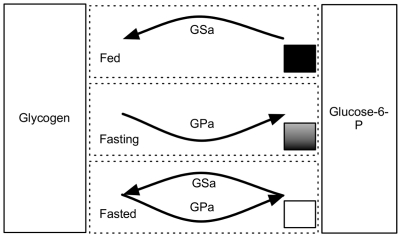
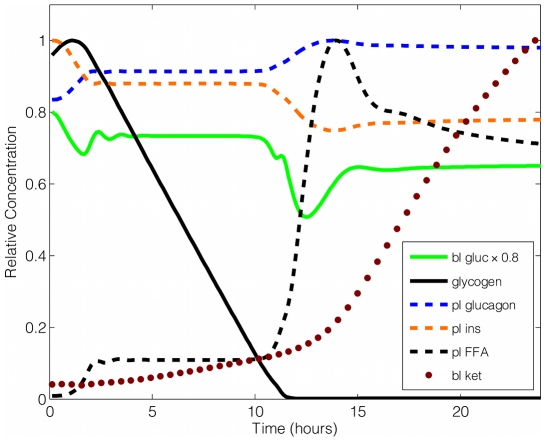
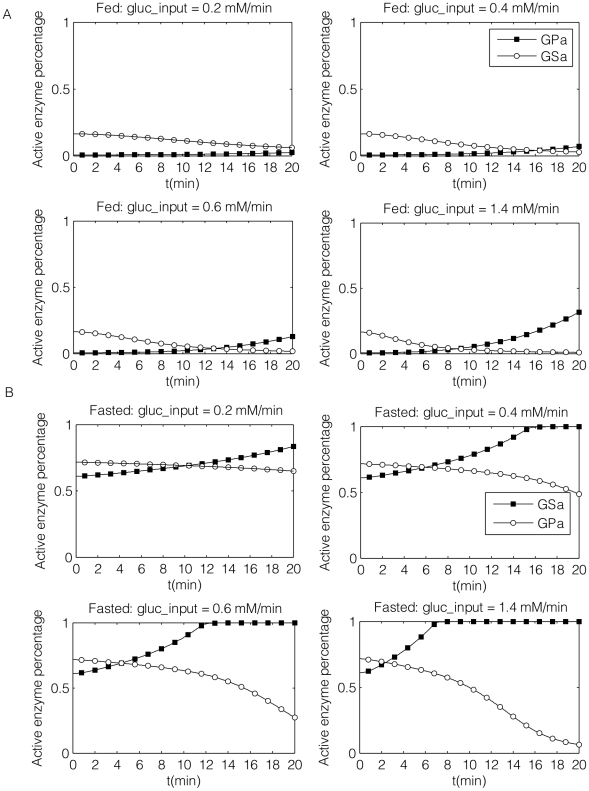
Timely, and sometimes rapid, metabolic adaptation to changes in food supply is critical for survival as an organism moves from the fasted to the fed state, and vice versa. These transitions necessitate major metabolic changes to maintain energy homeostasis as the source of blood glucose moves away from ingested carbohydrates, through hepatic glycogen stores, towards gluconeogenesis. The integration of hepatic glycogen regulation with extra-hepatic energetics is a key aspect of these adaptive mechanisms. Here we use computational modeling to explore hepatic glycogen regulation under fed and fasting conditions in the context of a whole-body model. The model was validated against previous experimental results concerning glycogen phosphorylase a (active) and glycogen synthase a dynamics. The model qualitatively reproduced physiological changes that occur during transition from the fed to the fasted state. Analysis of the model reveals a critical role for the inhibition of glycogen synthase phosphatase by glycogen phosphorylase a. This negative regulation leads to high levels of glycogen synthase activity during fasting conditions, which in turn increases substrate (futile) cycling, priming the system for a rapid response once an external source of glucose is restored. This work demonstrates that a mechanistic understanding of the design principles used by metabolic control circuits to maintain homeostasis can benefit from the incorporation of mathematical descriptions of these networks into "whole-body" contextual models that mimic in vivo conditions.
Overview
The claims and statistics of this paper haven’t been checked yet.
Free: it reads the open-access text and checks the first 5 claims that cite a source we can check. Create a free account to check every claim.
Integrity signals
Registry
Cites
Statistics
Figures
Verification
Claims the paper makes
The claims and statistics of this paper haven’t been checked yet.
Free: it reads the open-access text and checks the first 5 claims that cite a source we can check. Create a free account to check every claim.
Claims other papers make about this one
Each is checked against this paper’s own text: does it say what the citing paper says it does?
The cited source says what the claim attributes to it.
In the citing paper
“Taken together, metabolic regulation via phosphorylation/dephosphorylation of key enzymes in combination with futile cycles plays a key role in our model, in line with the results presented by Xu et al. [34].”
From Quantifying the Contribution of the Liver to Glucose Homeostasis: A Detailed Kinetic Model of Human Hepatic Glucose Metabolism (2012) · cites this paper as [34]
Self-check
Percentages, sums and reported differences re-computed from the paper’s own numbers.
The self-check needs the paper’s full text.
Citations
Cites
What is flux balance analysis?
Orth, J. D., Thiele, I., & Palsson, B. Ø. (2010) · Nature Biotechnology · doi:10.1038/nbt.1614 · Cited by 3,903
An Introduction to Systems Biology: Design Principles of Biological Circuits
Alon, U. (2006) · doi:10.1201/9781420011432 · Cited by 2,825
Structure and function of the feed-forward loop network motif
Mangan, S., & Alon, U. (2003) · Proceedings of the National Academy of Sciences · doi:10.1073/pnas.2133841100 · Cited by 1,827 · cited 1×
“feedback and feed forward control loops described in [30–33] for maintaining glucose homeostasis under different fed-fasting conditions.”
BackgroundGlobal reconstruction of the human metabolic network based on genomic and bibliomic data
Duarte, N. C., Becker, S. A., Jamshidi, N., Thiele, I., Mo, M. L., Vo, T. D., Srivas, R., & Palsson, B. Ø. (2007) · Proceedings of the National Academy of Sciences · doi:10.1073/pnas.0610772104 · Cited by 1,374 · cited 1×
“In addition, large-scale reconstructions of metabolism, typically based on flux or constraint-based models, have recently been developed for multiple organ systems including the liver [17–21].”
BackgroundCahill, G. F. (2006) · Annual Review of Nutrition · doi:10.1146/annurev.nutr.26.061505.111258 · Cited by 1,319 · cited 1×
“The dynamics of these substrates and enzymes are described in [25–27], while the whole body energetics have been reviewed in [26,28,29].”
BackgroundHarper's Illustrated Biochemistry
Murray, R. K. (1988) · Repository of the University of Ljubljana (University of Ljubljana) · Cited by 1,227
Design principles of biochemical oscillators
Novák, B., & Tyson, J. J. (2008) · Nature Reviews Molecular Cell Biology · doi:10.1038/nrm2530 · Cited by 1,137 · cited 1×
“Such internally generated oscillations are responsible in large part for circadian rhythms and the cell cycle [55], which are intimately linked to the subject of feedfasting cycles in the present work.”
BackgroundEnergy System Interaction and Relative Contribution During Maximal Exercise
Gastin, P. B. (2001) · Sports Medicine · doi:10.2165/00007256-200131100-00003 · Cited by 1,013 · cited 1×
“The number of mathematical models of hepatic energy metabolism, as it relates to hepatic glycogen storage, has been slowly increasing in response to interest in the impact of exercise on energetics in the case of diabetes [14], diet [15] and athletic training [16].”
BackgroundDynamics of the p53-Mdm2 feedback loop in individual cells
Lahav, G., Rosenfeld, N., Sigal, A., Geva-Zatorsky, N., Levine, A. J., Elowitz, M. B., & Alon, U. (2004) · Nature Genetics · doi:10.1038/ng1293 · Cited by 1,013 · cited 1×
“feedback and feed forward control loops described in [30–33] for maintaining glucose homeostasis under different fed-fasting conditions.”
BackgroundEdwards, J. S., Ibarra, R. U., & Palsson, B. O. (2001) · Nature Biotechnology · doi:10.1038/84379 · Cited by 939 · cited 1×
“. These stochiometry-based approaches can be used to analyze the relevant biological network solely based upon systemic mass-balance and reaction capacity constraints when kinetic information is missing”
BackgroundTextbook of Biochemistry with Clinical Correlations
(1983) · Biochemical Education · doi:10.1016/0307-4412(83)90121-8 · Cited by 917
Glucagon and regulation of glucose metabolism
Jiang, G., & Zhang, B. B. (2003) · American Journal of Physiology-Endocrinology and Metabolism · doi:10.1152/ajpendo.00492.2002 · Cited by 905 · cited 3×
“When the physiological system enters the fasting state, blood glucose concentration drops, flipping a reciprocal switch with respect to plasma insulin and glucagon concentrations [28,36].”
BackgroundEvaluating the glucose tolerance test in mice
Andrikopoulos, S., Blair, A. R., Deluca, N., Fam, B. C., & Proietto, J. (2008) · American Journal of Physiology-Endocrinology and Metabolism · doi:10.1152/ajpendo.90617.2008 · Cited by 819 · cited 1×
“rodents [27,44–46].”
Biological networks: the tinkerer as an engineer
Alon, U. (2003) · Science · doi:10.1126/science.1089072 · Cited by 706 · cited 1×
“feedback and feed forward control loops described in [30–33] for maintaining glucose homeostasis under different fed-fasting conditions.”
BackgroundNetwork dynamics and cell physiology
Tyson, J. J., Chen, K., & Novak, B. (2001) · Nature Reviews Molecular Cell Biology · doi:10.1038/35103078 · Cited by 557 · cited 1×
“Negative feedback is a common mode of control for signaling networks [53], reducing time required to reach steady states [30], providing a mechanism for reducing fluctuations in protein expression levels and pathway activity.”
BackgroundGLUCONEOGENESIS AND RELATED ASPECTS OF GLYCOLYSIS
Hers, H. G., & Hue, L. (1983) · Annual Review of Biochemistry · doi:10.1146/annurev.bi.52.070183.003153 · Cited by 531 · cited 2×
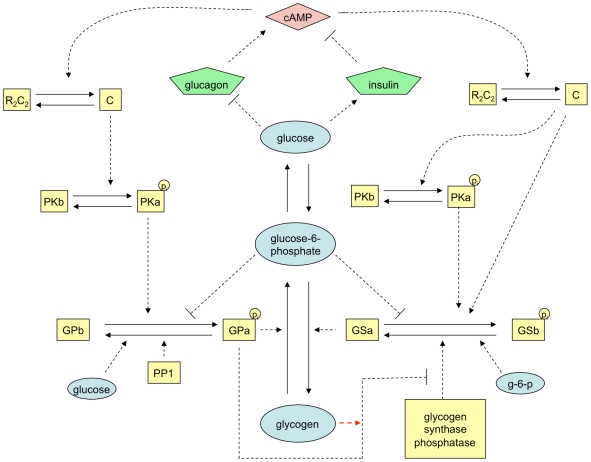
“Note that GP can be inhibited directly by high levels of glucose [10] as indicated in Figure 4.”
BackgroundRoach, P. (2002) · Current Molecular Medicine · doi:10.2174/1566524024605761 · Cited by 468 · cited 2×
“drives the synthesis of glycogen, with its activity regulated through multiple mechanisms including allosteric activation, covalent modification, as well as enzymatic translocation [6–8].”
BackgroundThe Control of Glycogen Metabolism in the Liver
Hers, H. G. (1976) · Annual Review of Biochemistry · doi:10.1146/annurev.bi.45.070176.001123 · Cited by 448
Insulin regulation of glucose uptake: a complex interplay of intracellular signalling pathways
A., K., & J., P. (2002) · Diabetologia · doi:10.1007/s00125-002-0974-7 · Cited by 438 · cited 1×
“. Insulin is a key regulator for carbohydrate and fat metabolism in the body. It enhances blood glucose uptake to form triglycerides and glycogen and suppresses pathways such as gluconeogensis and glycogenolysis”
BackgroundThe Edinburgh human metabolic network reconstruction and its functional analysis
Ma, H., Sorokin, A., Mazein, A., Selkov, A., Selkov, E., Demin, O., & Goryanin, I. (2007) · Molecular Systems Biology · doi:10.1038/msb4100177 · Cited by 435 · cited 1×
“In addition, large-scale reconstructions of metabolism, typically based on flux or constraint-based models, have recently been developed for multiple organ systems including the liver [17–21].”
BackgroundThe control of glycogen metabolism in the liver
Hers, H. G., De Wulf, H., & Stalmans, W. (1970) · FEBS Letters · doi:10.1016/0014-5793(70)80569-5 · Cited by 414
Jerby, L., Shlomi, T., & Ruppin, E. (2010) · Molecular Systems Biology · doi:10.1038/msb.2010.56 · Cited by 368
Hue, L., Bontemps, F., & Hers, H. (1975) · Biochemical Journal · doi:10.1042/bj1520105 · Cited by 356
The energy-less red blood cell is lost: erythrocyte enzyme abnormalities of glycolysis
van Wijk, R., & van Solinge, W. W. (2005) · Blood · doi:10.1182/blood-2005-04-1622 · Cited by 352
Hepatocytes: critical for glucose homeostasis
Klover, P. J., & Mooney, R. A. (2004) · The International Journal of Biochemistry & Cell Biology · doi:10.1016/j.biocel.2003.10.002 · Cited by 345 · cited 1×
“Insulin and glucagon are mutually antagonistic with respect to many aspects of intermediary metabolism and their effects on bioenergetics [25,34].”
BackgroundThe role of dietary carbohydrates in muscle glycogen resynthesis after strenuous running
Costill, D. L., Sherman, W. M., Fink, W. J., Maresh, C., Witten, M., & Miller, J. M. (1981) · The American Journal of Clinical Nutrition · doi:10.1093/ajcn/34.9.1831 · Cited by 309
Gille, C., Bölling, C., Hoppe, A., Bulik, S., Hoffmann, S., Hübner, K., Karlstädt, A., Ganeshan, R., König, M., Rother, K., et al. (2010) · Molecular Systems Biology · doi:10.1038/msb.2010.62 · Cited by 285 · cited 1×
“In addition, large-scale reconstructions of metabolism, typically based on flux or constraint-based models, have recently been developed for multiple organ systems including the liver [17–21].”
Magistretti, P. J., & Pellerin, L. (1996) · Cerebral Cortex · doi:10.1093/cercor/6.1.50 · Cited by 243 · cited 1×
“In tissues such as the heart and muscle, a number of factors regulate the use of alternative energy sources in order to spare blood glucose for use by erythrocytes (which depends solely on blood glucose [38]) and the brain (which mainly depends on blood glucose but can use ketone bodies as an alternative during fastin…”
BackgroundStalmans, W., De Wulf, H., Hue, L., & Hers, H. (1974) · European Journal of Biochemistry · doi:10.1111/j.1432-1033.1974.tb03252.x · Cited by 210
Sletten, K., & Husby, G. (1974) · European Journal of Biochemistry · doi:10.1111/j.1432-1033.1974.tb03251.x · Cited by 208
Predicting metabolic adaptation, body weight change, and energy intake in humans
Hall, K. D. (2010) · American Journal of Physiology-Endocrinology and Metabolism · doi:10.1152/ajpendo.00559.2009 · Cited by 204
Hepatic glucose metabolism in humans—its role in health and disease
Roden, M., & Bernroider, E. (2003) · Best Practice & Research Clinical Endocrinology & Metabolism · doi:10.1016/s1521-690x(03)00031-9 · Cited by 201
Effect of different post-exercise sugar diets on the rate of muscle glycogen synthesis
BLOM, P. C. S., H??STMARK, A. T., VAAGE, O., KARDEL, K. R., & M??HLUM, S. (1987) · Medicine & Science in Sports & Exercise · doi:10.1249/00005768-198710000-00012 · Cited by 198 · cited 1×
“Numerous studies have been carried out to investigate the relationship between the amount and type of carbohydrate ingestion and the maximum glycogen resynthesis rate [59–61].”
BackgroundGreenberg, C. C., Jurczak, M. J., Danos, A. M., & Brady, M. J. (2006) · American Journal of Physiology-Endocrinology and Metabolism · doi:10.1152/ajpendo.00652.2005 · Cited by 183 · cited 2×
“drives the synthesis of glycogen, with its activity regulated through multiple mechanisms including allosteric activation, covalent modification, as well as enzymatic translocation [6–8].”
BackgroundParsons, P. A. (2005) · Biological Reviews · doi:10.1017/s1464793105006822 · Cited by 162 · cited 1×
“Optimization of energy storage is essential during competition for sparse food supplies, while rapid delivery of these energy supplies during hasty retreat from predators can mean the difference between life and death [2].”
BackgroundNutritional Systems Biology Modeling: From Molecular Mechanisms to Physiology
de Graaf, A. A., Freidig, A. P., De Roos, B., Jamshidi, N., Heinemann, M., Rullmann, J. A. C., Hall, K. D., Adiels, M., & van Ommen, B. (2009) · PLoS Computational Biology · doi:10.1371/journal.pcbi.1000554 · Cited by 153 · cited 2×
“The number of mathematical models of hepatic energy metabolism, as it relates to hepatic glycogen storage, has been slowly increasing in response to interest in the impact of exercise on energetics in the case of diabetes [14], diet [15] and athletic training [16].”
BackgroundNutrition in pediatrics: basic science and clinical applications.
Duggan, C., Watkins, J. B., & Walker, W. A. (2008) · B.C. Decker eBooks · Cited by 131
An introduction to systems biology design principles of biological circuits
Alon, U. (2007) · Cited by 117
Keizer, H., Kuipers, H., van Kranenburg, G., & Geurten, P. (1987) · International Journal of Sports Medicine · doi:10.1055/s-2008-1025649 · Cited by 100
Substrate cycles: their role in improving sensitivity in metabolic control
Newsholme, E. A., Challiss, R. A. J., & Crabtree, B. (1984) · Trends in Biochemical Sciences · doi:10.1016/0968-0004(84)90165-8 · Cited by 91 · cited 1×
“It has long been suggested that substrate cycling is a generic mechanism that can potentially improve such properties as sensitivity and system response time, allowing net synthesis when there is a small offset in the substrate concentrations [7,10–13].”
BackgroundMetabolic responses to substrate futile cycling in Escherichia coli.
Chao, Y. P., & Liao, J. C. (1994) · Journal of Biological Chemistry · doi:10.1016/s0021-9258(17)37663-9 · Cited by 84 · cited 1×
“It has long been suggested that substrate cycling is a generic mechanism that can potentially improve such properties as sensitivity and system response time, allowing net synthesis when there is a small offset in the substrate concentrations [7,10–13].”
BackgroundARMSTRONG, C. G., DOHERTY, M. J., & COHEN, P. T. W. (1998) · Biochemical Journal · doi:10.1042/bj3360699 · Cited by 83
Influence of fasting on glycogen depletion in rats during exercise
Dohm, G. L., Tapscott, E. B., Barakat, H. A., & Kasperek, G. J. (1983) · Journal of Applied Physiology · doi:10.1152/jappl.1983.55.3.830 · Cited by 80
Regulation of peripheral insulin/glucagon levels by rat liver
BALKS, H.-J., & JUNGERMANN, K. (1984) · European Journal of Biochemistry · doi:10.1111/j.1432-1033.1984.tb08240.x · Cited by 79 · cited 1×
“are in the range of 1⁄27|10,1:3|10 mM and 1⁄23|10, 5|10 mM, taken from physiologically relevant ranges determined from rodent studies [27].”
BackgroundContinuous Glucose Monitoring in Normal Mice and Mice with Prediabetes and Diabetes
Klueh, U., Liu, Z., Cho, B., Ouyang, T., Feldman, B., Henning, T. P., Kaur, M., & Kreutzer, D. (2006) · Diabetes Technology & Therapeutics · doi:10.1089/dia.2006.8.402 · Cited by 62 · cited 1×
“rodents [27,44–46].”
Demonstration of a Glycogen/Glucose 1-Phosphate Cycle in Hepatocytes from Fasted Rats
Massillon, D., Bollen, M., WULF, H. D., Overloop, K., Vanstapel, F. J. L. A., Hecke, P. V., & Stalmans, W. (1995) · Journal of Biological Chemistry · doi:10.1074/jbc.270.33.19351 · Cited by 59
Feedback theory and Darwinian evolution
Robertson, D. S. (1991) · Journal of Theoretical Biology · doi:10.1016/s0022-5193(05)80393-5 · Cited by 54 · cited 1×
“Negative feedback loops underpin the majority of the balances of nature, from predator-prey relationships to biochemical networks, and are clearly subjected to evolutionary pressures [52].”
BackgroundHow Do Control-Based Approaches Enter into Biology?
LeDuc, P. R., Messner, W. C., & Wikswo, J. P. (2011) · Annual Review of Biomedical Engineering · doi:10.1146/annurev-bioeng-071910-124651 · Cited by 53 · cited 1×
“The cells, tissues, organs, bodies and populations of all living organisms are in a constant state of sensing and response to numerous external and self-generated stimuli [51].”
BackgroundLiver uptake of amino acids and carbohydrates during a single circulatory passage
Pardridge, W. M., & Jefferson, L. (1975) · American Journal of Physiology-Legacy Content · doi:10.1152/ajplegacy.1975.228.4.1155 · Cited by 50 · cited 1×
“After a meal, the liver switches to a glucose consuming state, capturing nearly 26% of the glucose presented to it by the portal system during the first passage [3].”
BackgroundDynamics and Control of the Central Carbon Metabolism in Hepatoma Cells
Maier, K., Hofmann, U., Reuss, M., & Mauch, K. (2010) · BMC Systems Biology · doi:10.1186/1752-0509-4-54 · Cited by 44 · cited 1×
“In addition, large-scale reconstructions of metabolism, typically based on flux or constraint-based models, have recently been developed for multiple organ systems including the liver [17–21].”
BackgroundSimple and complex carbohydrate-rich diets and muscle glycogen content of marathon runners
Roberts, K. M., Noble, E. G., Hayden, D. B., & Taylor, A. W. (1988) · European Journal of Applied Physiology and Occupational Physiology · doi:10.1007/bf00691241 · Cited by 43
Kelsall, I. R., Rosenzweig, D., & Cohen, P. T. W. (2009) · Cellular Signalling · doi:10.1016/j.cellsig.2009.03.001 · Cited by 38 · cited 1×
“rodents [27,44–46].”
Mvumbi, L., & Stalmans, W. (1987) · Biochemical Journal · doi:10.1042/bj2460367 · Cited by 34
Feeding, fasting and starvation: factors affecting fuel utilization
MacDonald, I. A., & Webber, J. (1995) · Proceedings of the Nutrition Society · doi:10.1079/pns19950053 · Cited by 32 · cited 2×
“When the physiological system enters the fasting state, blood glucose concentration drops, flipping a reciprocal switch with respect to plasma insulin and glucagon concentrations [28,36].”
BackgroundClinical Diabetes Research: Methods and Techniques
Ravikumar, B. (2008) · Diabetic Medicine · doi:10.1111/j.1464-5491.2008.02488.x · Cited by 31
Control and Regulation of Integrated Mitochondrial Function in Metabolic and Transport Networks
Cortassa, S. C., O'Rourke, B. P., Winslow, R. L., & Aon, M. A. (2009) · International Journal of Molecular Sciences · doi:10.3390/ijms10041500 · Cited by 27 · cited 1×
“For instance, it is known that bioenergetics is regulated by a number of mechanisms including push-pull [50] and negative feedback, the latter being an integral component of our whole-body and glycogen-specific models.”
BackgroundLiver Glycogen Synthase in Rats with a Glycogen‐Storage Disorder
WATTS, C., & MALTHUS, R. S. (1980) · European Journal of Biochemistry · doi:10.1111/j.1432-1033.1980.tb04697.x · Cited by 26
(2007) · Wiley eBooks · doi:10.1002/9780470513095 · Cited by 25
Influence of prior exercise and liver glycogen content on the sensitivity of the liver to glucagon
Bonjorn, V. M., Latour, M. G., Bélanger, P., & Lavoie, J.-M. (2002) · Journal of Applied Physiology · doi:10.1152/jappl.2002.92.1.188 · Cited by 19
Relation between the glycogen content of the liver and liver weight, and its meaning for enzymology
Otter, W. D., & van Boxtel, A. B. T. G. (1971) · Cellular and Molecular Life Sciences · doi:10.1007/bf02136680 · Cited by 18 · cited 1×
“Nearly 10–15% [4,5] of liver weight is comprised of glycogen stores when filled.”
BackgroundMutalik, V. K., & Venkatesh, K. V. (2005) · Theoretical Biology and Medical Modelling · doi:10.1186/1742-4682-2-19 · Cited by 16
Integration of substrate flow in vivo: some insights intometabolic control
Frayn, K. N. (1997) · Clinical Nutrition · doi:10.1016/s0261-5614(97)80012-x · Cited by 11
Sun, L., & Becskei, A. (2010) · Nature · doi:10.1038/467163a · Cited by 11 · cited 1×
“In contrast to stabilizing activity, in the presence of sufficient time delays, negative feedback can have destabilizing effect and generate overshooting and random oscillations, rendering noise a challenging issue in the modeling of biochemical networks [54].”
BackgroundModeling and Control Studies of an Integrated Biological Wastewater Treatment System
Zhang, X., Hoo, K. A., & Overland, D. (2005) · SAE technical papers on CD-ROM/SAE technical paper series · doi:10.4271/2005-01-2963 · Cited by 6 · cited 1×
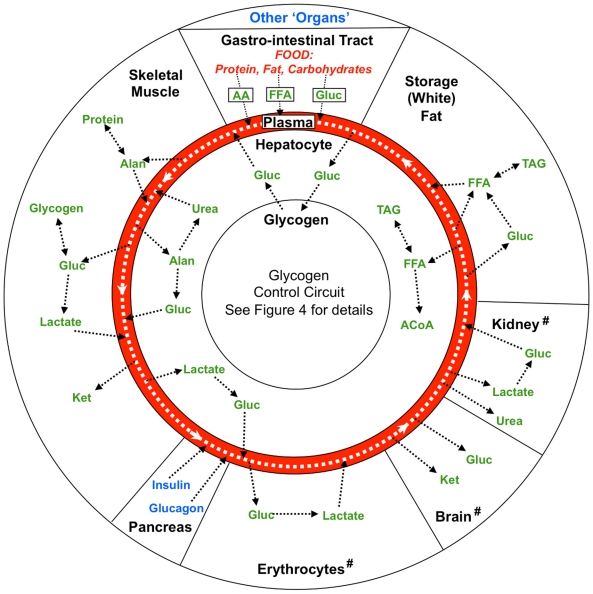
“The outer general bioenergetics model (outer ring of Figure 2) was created as a ‘‘test bed’’ [56,57] for the glycogen circuit, which permits simulation of the glycogen regulatory circuitry in response to physiological changes that mimic the effects of fasting and feeding on whole-body energetics.”
Method“FUTILE CYCLING” IN PHYSIOLOGIC CONTROL SYSTEMS: A PRICE PAID FOR FINE CONTROL
Aishwarya, K., Rachana, K., & Prakash, E. S. (2005) · AJP Advances in Physiology Education · doi:10.1152/advan.00010.2005 · Cited by 4 · cited 1×
“It has long been suggested that substrate cycling is a generic mechanism that can potentially improve such properties as sensitivity and system response time, allowing net synthesis when there is a small offset in the substrate concentrations [7,10–13].”
BackgroundInclusion of a glycogen regulation mathematical model into a contextual metabolic framework
Todd, A. J. (2019) · Carolina Digital Repository (University of North Carolina at Chapel Hill) · doi:10.17615/g6q4-ky27 · Cited by 4
Process Control for Advanced Life Support, Biological Test Bed
Ciskowski, M. A., Overland, D., & Hoo, K. A. (2006) · SAE technical papers on CD-ROM/SAE technical paper series · doi:10.4271/2006-01-2124 · Cited by 2
Cited by
Physiology of Proglucagon Peptides: Role of Glucagon and GLP-1 in Health and Disease
Sandoval, D. A., & D'Alessio, D. A. (2015) · Physiological Reviews · doi:10.1152/physrev.00013.2014 · Cited by 498
Mechanisms of muscle insulin resistance and the cross‐talk with liver and adipose tissue
Silva Rosa, S. C., Nayak, N., Caymo, A. M., & Gordon, J. W. (2020) · Physiological Reports · doi:10.14814/phy2.14607 · Cited by 240
“Key examples of this cross-talk include the Cori cycle (lactate-glucose cycle), the Cahill cycle (glucose-alanine cycle), as well as gluconeogenic consumption of glycerol and glutamine (Sharma et al., 2019; Xu et al., 2011).”
BackgroundKönig, M., Bulik, S., & Holzhütter, H.-G. (2012) · PLoS Computational Biology · doi:10.1371/journal.pcbi.1002577 · Cited by 202
Glucose-6 Phosphate, a Central Hub for Liver Carbohydrate Metabolism
Rajas, F., Gautier‐Stein, A., & Mithieux, G. (2019) · Metabolites · doi:10.3390/metabo9120282 · Cited by 173
“Indeed, hepatic glycogen stores are depleted after a 12h-fasting in mice and an overnight fasting period in Humans [12,13].”
BackgroundInsulin: a review of analytical methods
Shen, Y., Prinyawiwatkul, W., & Xu, Z. (2019) · The Analyst · doi:10.1039/c9an00112c · Cited by 108
Metadata
- Authors
- Xu, K., Morgan, K. T., Todd Gehris, A., Elston, T. C., & Gomez, S. M.
- Affiliations
- University of North Carolina at Chapel Hill (US)
- Corresponding author
- Elston, Timothy C.
- Gomez, Shawn M.
- Venue
- PLoS Computational Biology
- Publisher
- Public Library of Science (PLoS)
- Published
- 2011-12-01
- Volume
- 7
- Issue
- 12
- Pages
- e1002272
- ISSN
- 1553-734X (ISSN-L)
- 1553-7358
- PMC
- PMC3233304
- OpenAlex
- W2032920633
- Cited by
- 34
- References
- 69
- Citations by year
- 2025: 1 · 2024: 3 · 2023: 1 · 2022: 2 · 2021: 3 · 2020: 3 · 2019: 5 · 2018: 2 · 2017: 2 · 2016: 3 · 2015: 3 · 2014: 3 · 2013: 1 · 2012: 2
- FWCI
- 0.78
- Type
- journal article
- Language
- en
- Open access
- gold
- doi.org
- Locations
- PLoS Computational Biology (publishedVersion, cc-by)
- Europe PMC (PubMed Central) (publishedVersion, cc-by)
- PubMed Central (publishedVersion, cc-by)
- PubMed (publishedVersion)
- Carolina Digital Repository (University of North Carolina at Chapel Hill) (submittedVersion)
- DOAJ (DOAJ: Directory of Open Access Journals) (submittedVersion, cc-by-sa)
- Figshare (submittedVersion, cc-by)
- UNC Libraries
- Funders
- U.S. Environmental Protection Agency
- Topics
- Life Sciences › Biochemistry, Genetics and Molecular Biology › Molecular Biology › Metabolism, Diabetes, and Cancer
- Life Sciences › Biochemistry, Genetics and Molecular Biology › Molecular Biology › Gene Regulatory Network Analysis
- Life Sciences › Biochemistry, Genetics and Molecular Biology › Biochemistry › Glycogen Storage Diseases and Myoclonus
- Keywords
- blood glucose homeostasis, glycogen phosphorylase a, glycogen synthase phosphatase, substrate cycling, futile cycling, gluconeogenesis, energy homeostasis
- MeSH terms
- Blood Glucose, Computer Simulation, Glycogen Synthase, Homeostasis, Liver Glycogen, Substrate Cycling, Glycogen Phosphorylase
About these checks
Registry, retraction, Cites and statistics results are computed, not judged, with one exception: a printed reference that no index lists is read once by a model before it counts as a citation error. Claims are extracted by a model and kept only when their quote appears verbatim in the text; each cited source is then checked, with a model’s help, for whether it says what the claim relies on. Those verdicts can be wrong — read the claim’s quote and the cited source before relying on one.
Statistics and arithmetic are recomputed, not judged.
Confidence bands are shown only for fields calibrated on our annotated test set. None is calibrated yet, so no band is shown.
What counts as a claim ›How we measure confidence ›How we check this ›
Are you an author, or do you see a problem with this page? Request a review
Data sources
Bibliographic data: Semantic Scholar, OpenAlex, Crossref.
Contains information from the Semantic Scholar Academic Graph Datasets, made available under the ODC Attribution License (ODC-BY 1.0).
Semantic Scholar’s data is described in: Kinney, R., et al. (2023). The Semantic Scholar Open Data Platform. arXiv:2301.10140.
