

Bayesian Computation Emerges in Generic Cortical Microcircuits through Spike-Timing-Dependent Plasticity
Open accessThe DOI matches its Crossref record; 122 of the 122 references it cites were found in a registry or an index.
Abstract
The principles by which networks of neurons compute, and how spike-timing dependent plasticity (STDP) of synaptic weights generates and maintains their computational function, are unknown. Preceding work has shown that soft winner-take-all (WTA) circuits, where pyramidal neurons inhibit each other via interneurons, are a common motif of cortical microcircuits. We show through theoretical analysis and computer simulations that Bayesian computation is induced in these network motifs through STDP in combination with activity-dependent changes in the excitability of neurons. The fundamental components of this emergent Bayesian computation are priors that result from adaptation of neuronal excitability and implicit generative models for hidden causes that are created in the synaptic weights through STDP. In fact, a surprising result is that STDP is able to approximate a powerful principle for fitting such implicit generative models to high-dimensional spike inputs: Expectation Maximization. Our results suggest that the experimentally observed spontaneous activity and trial-to-trial variability of cortical neurons are essential features of their information processing capability, since their functional role is to represent probability distributions rather than static neural codes. Furthermore it suggests networks of Bayesian computation modules as a new model for distributed information processing in the cortex.
Overview
The claims and statistics of this paper haven’t been checked yet.
Free: it reads the open-access text and checks the first 5 claims that cite a source we can check. Create a free account to check every claim.
Integrity signals
Registry
Cites
Statistics
Figures
Verification
Claims the paper makes
The claims and statistics of this paper haven’t been checked yet.
Free: it reads the open-access text and checks the first 5 claims that cite a source we can check. Create a free account to check every claim.
Claims other papers make about this one
Each is checked against this paper’s own text: does it say what the citing paper says it does?
The source backs part of the claim, not all of it — or backs it for a different population, condition or comparison.
In the citing paper
“The EM algorithm that is used for learning is a local update mechanism analogous to spike timing–dependent plasticity (24, 25).”
From Space is a latent sequence: A theory of the hippocampus (2024) · cites this paper as [24]
Experimental — accuracy not yet measured
Self-check
Percentages, sums and reported differences re-computed from the paper’s own numbers.
The self-check needs the paper’s full text.
Citations
Cites
Gradient-based learning applied to document recognition
Lecun, Y., Bottou, L., Bengio, Y., & Haffner, P. (1998) · Proceedings of the IEEE · doi:10.1109/5.726791 · Cited by 58,805 · cited 1×
“6 through an application to a computational task that is substantially more difficult than previously considered tasks for networks of spiking neurons: We show that a simple network of spiking neurons can learn without any supervision to discriminate handwritten digits from the MNIST benchmark dataset [64] consisting…”
BackgroundMaximum Likelihood from Incomplete Data Via the EM Algorithm
Dempster, A. P., Laird, N. M., & Rubin, D. B. (1977) · Journal of the Royal Statistical Society Series B: Statistical Methodology · doi:10.1111/j.2517-6161.1977.tb01600.x · Cited by 50,444 · cited 4×
“The fact that STDP approximates EM is remarkable, since it is known from machine learning that EM can solve a fundamental chicken-and-egg problem of unsupervised learning systems [31]: To detect - without a teacher - hidden causes for complex input data, and to induce separate learning agents to specialize each on one…”
BackgroundMethodInfluentialBook Review: Pattern Recognition and Machine Learning
Nasrabadi, N. M. (2007) · Journal of Electronic Imaging · doi:10.1117/1.2819119 · Cited by 22,066
Advances in neural information processing systems 7
Cios, K., & Shields, M. (1997) · Neurocomputing · doi:10.1016/s0925-2312(97)90018-7 · Cited by 22,059
Reducing the dimensionality of data with neural networks
Hinton, G. E., & Salakhutdinov, R. R. (2006) · Science · doi:10.1126/science.1127647 · Cited by 20,928
A fast learning algorithm for deep belief nets
Hinton, G. E., Osindero, S., & Teh, Y.-W. (2006) · Neural Computation · doi:10.1162/neco.2006.18.7.1527 · Cited by 16,336 · cited 2×
“or semi-supervised machine learning algorithms [27,65], or to evaluate unsupervised feature learning approaches [66,67].”
BackgroundA model of saliency-based visual attention for rapid scene analysis
Itti, L., Koch, C., & Niebur, E. (1998) · IEEE Transactions on Pattern Analysis and Machine Intelligence · doi:10.1109/34.730558 · Cited by 11,271 · cited 1×
“These ubiquitous network motifs were called soft winner-take-all (WTA) circuits, and have been suggested as neural network models for implementing functions like non-linear selection [16,17], normalization [18], selective attention [19], decision making [20,21], or as primitives for general purpose computation [22,23].”
BackgroundHebb, D. O. (2005) · doi:10.4324/9781410612403 · Cited by 9,825
Pattern Recognition and Machine Learning
(2006) · doi:10.1007/978-0-387-45528-0 · Cited by 9,824
Emergence of simple-cell receptive field properties by learning a sparse code for natural images
Olshausen, B. A., & Field, D. J. (1996) · Nature · doi:10.1038/381607a0 · Cited by 5,694 · cited 2×
“Our model shows that a WTA circuit could learn orientation selectivity from such simple bar-like inputs, but does not provide an alternative explanation to the results of studies like [61] using natural image stimuli.”
BackgroundResult
Research works printed but not linked: 1
- Celeux G, Diebolt J (1985) The SEM algorithm: A probabilistic teacher algorithm derived from the EM algorithm for the mixture problem. Comput Statist Quater 2: 73– 82.
Cited by
Items 201–279 of 279
Shin, Y., Son, J., Jeon, J., Ryu, S., Cho, K., & Kim, S. (2024) · Advanced Electronic Materials · doi:10.1002/aelm.202300764 · Cited by 3
Hasnin, E. A. H. (2025) · Journal of Ecohumanism · doi:10.62754/joe.v4i2.5913 · Cited by 4
A Hebbian Approach to Non-Spatial Prelinguistic Reasoning
Aguilar-Canto, F. J., & Calvo, H. (2022) · Brain Sciences · doi:10.3390/brainsci12020281 · Cited by 3
“Some properties of STDP in SNNs have been revealed, which is the case of [42], showing the emergence of Bayesian computation with STDP.”
MethodHagiwara, N., Kunimi, T., Ando, K., Akai‐Kasaya, M., & Asai, T. (2023) · Nonlinear Theory and Its Applications IEICE · doi:10.1587/nolta.15.107 · Cited by 3
“This is consistent with recent (cid:12)ndings in neurocomputational models, which suggest that the local learning of synaptic weights through STDP approximates the expectation{ maximization algorithm, resulting in the minimization of VFE [11].”
Learning binary or real-valued time-series via spike-timing dependent plasticityPreprint
Osogami, T. (2016) · arXiv (Cornell University) · doi:10.48550/arxiv.1612.04897 · Cited by 3
“For example, Nessler et al. show that STDP can be understood as approximating the expectation maximization (EM) algorithm [12].”
BackgroundOne-time learning in a biologically-inspired Salience-affected Artificial Neural Network (SANN)Preprint
Remmelzwaal, L. A., Ellis, G., & Tapson, J. C. (2019) · bioRxiv (Cold Spring Harbor Laboratory) · doi:10.1101/726331 · Cited by 3
“This 385 dataset has been widely used in conjunction with supervised and unsupervised neural 386 networks models [12] [42] [58], to provide a realistic dataset for simulations of 387 biologically-inspired models, similar to the one we present in this paper.”
MethodBiologically-inspired Salience Affected Artificial Neural Network (SANN)Preprint
Remmelzwaal, L. A., Ellis, G., Tapson, J. C., & Mishra, A. K. (2019) · arXiv (Cornell University) · doi:10.48550/arxiv.1908.03532 · Cited by 4
“This 385 dataset has been widely used in conjunction with supervised and unsupervised neural 386 networks models [12] [42] [58], to provide a realistic dataset for simulations of 387 biologically-inspired models, similar to the one we present in this paper.”
MethodA synapse-centric account of the free energy principlePreprint
Kappel, D., & Tetzlaff, C. (2021) · arXiv (Cornell University) · doi:10.48550/arxiv.2103.12649 · Cited by 2
Predictive learning rules generate a cortical-like replay of probabilistic sensory experiencesPreprint
Asabuki, T., & Fukai, T. (2025) · eLife · doi:10.7554/elife.92712 · Cited by 7
Fast agreement-driven device-calibrated local learning paradigms for spiking neural networks
Bej, S., Muhammed Sahad, E., Gouri Lakshmi, S., Kumar, H., Kar, P., & Das, B. C. (2026) · Neural Networks · doi:10.1016/j.neunet.2026.108809 · Cited by 3
Neural sampling from cognitive maps enables goal-directed imagination and planning
Lin, H., Yang, Y., Zhao, R. J., Pezzulo, G., & Maass, W. (2026) · Nature Machine Intelligence · doi:10.1038/s42256-026-01254-4 · Cited by 7
“It can be approximated by a simple neural circuit with lateral inhibition 71 .”
Self-citationStochastic Spin‐Orbit‐Torque Synapse and its Application in Uncertainty Quantification
Wang, C., Zeng, G., Wen, X., He, Y., Luo, W., Chen, S., Yang, X., Liang, S., & Zhang, Y. (2024) · Advanced Electronic Materials · doi:10.1002/aelm.202300805 · Cited by 3
Liu, W., & Pan, X. (2024) · IEEE Access · doi:10.1109/access.2024.3450551 · Cited by 3
“To explore how the neural circuit implements functions, the winner-take-all (WTA) neural spiking networks have been proposed [16], [21], [22], [25], [26].”
Grytskyy, D., Diesmann, M., & Helias, M. (2016) · Physical review. E · doi:10.1103/physreve.93.062303 · Cited by 3
Building wireless sensor networks with biological cultures: components and integration challenges
Christophe, F., Laukkarinen, T., Mikkonen, T., Massera, J., & Andalibi, V. (2016) · International Journal of Parallel Emergent and Distributed Systems · doi:10.1080/17445760.2016.1145220 · Cited by 2
“For the same task, Nessler et al. obtain a performance of 80.14% with Bayesian computation on a model of cortical microcircuits [40].”
InfluentialLearning the values of the hyperparameters of a dynamic Boltzmann machine
Osogami, T., & Dasgupta, S. (2017) · IBM Journal of Research and Development · doi:10.1147/jrd.2017.2709186 · Cited by 2
Learning aquatic locomotion with animats
Wilson, D. G., Disset, J., Cussat‐Blanc, S., Duthen, Y., & Luga, H. (2017) · European Conference on Artificial Life · doi:10.1162/isal_a_092 · Cited by 2
Discrete scaling and criticality in a chain of adaptive excitable integrators
Martinez‐Saito, M. (2022) · Chaos Solitons & Fractals · doi:10.1016/j.chaos.2022.112574 · Cited by 3
Unsupervised end-to-end training with a self-defined target
Liu, D., Laydevant, J., Pontlevy, A., Querlioz, D., & Grollier, J. (2024) · Neuromorphic Computing and Engineering · doi:10.1088/2634-4386/ad8c78 · Cited by 2
Sinha, N., Heckman, C. J., & Yang, Y. (2020) · Journal of Theoretical Biology · doi:10.1016/j.jtbi.2020.110509 · Cited by 2
“The relative timing of firing has been shown to be an important computational property in neuronal assemblies for a diverse set of functions like distributed information processing in cortical microcircuits [4], pattern recognition [5–8], encoding of behaviorally relevant information in the somatosensory and auditory…”
BackgroundRavichandran, N. B., Lansner, A., & Herman, P. A. (2024) · SSRN Electronic Journal · doi:10.2139/ssrn.4895532 · Cited by 2
Fluid Construction Grammar in the Brain
Fernando, C. (2012) · Lecture notes in computer science · doi:10.1007/978-3-642-34120-5_13 · Cited by 1
Draft: Deep Learning in Neural Networks: An Overview
Idsia, L. (2014) · Cited by 3
Mininni, C. J., & Zanutto, B. S. (2017) · PLoS ONE · doi:10.1371/journal.pone.0186959 · Cited by 2
Noise Helps Optimization Escape From Saddle Points in the Synaptic Plasticity
Fang, Y. G., Yu, Z., & Chen, F. (2020) · Frontiers in Neuroscience · doi:10.3389/fnins.2020.00343 · Cited by 5
“of likelihood differential term is a simplified version of STDP (spike timing-dependent plasticity) (Habenschuss et al., 2013; Nessler et al., 2013).”
BackgroundResultProbabilistic modeling and numerical simulation of neural circuits for multisensory integration
Xu, L., & Liu, X. (2023) · Highlights in Science Engineering and Technology · doi:10.54097/hset.v70i.13946 · Cited by 1
“…between neurons, when the presynaptic neuron fires before the postsynaptic neuron, a long-term potentiation (LTP) effect occurs in the synaptic connection between these two neurons, whereas firing in the reverse order results in long-term depression (LTD) of the synaptic connection [16].”
BackgroundInfluentialGrinin, L. E., Леонидович, Г. А., & Леонидович, Г. И. (2023) · Философия и общество · doi:10.30884/jfio/2023.04.01 · Cited by 4
Statistical Machine-Learning Methods to Model Brain Plasticity
Robles-Granda, P., Barbey, A. K., & Koyejo, S. (2025) · Oxford University Press eBooks · doi:10.1093/oxfordhb/9780197677131.013.15 · Cited by 1
Exploring the Architectural Biases of the Cortical Microcircuit
Balwani, A., Cho, S., & Choi, H. (2025) · Neural Computation · doi:10.1162/neco.a.23 · Cited by 1
Xin, W. (2016) · Scholar Works (Boise State University) · Cited by 1
Pattern recognition of a spiking neural network based on visual motion model
Yi, H., Li, X., Xu, W., Deng, Z., & Yang, J. (2019) · International Symposium on Autonomous Systems (ISAS) · doi:10.1109/isass.2019.8757738 · Cited by 1
An Ultra-Low Power Spintronic Stochastic Spiking Neuron with Self-Adaptive Discrete Sampling
Sheikhfaal, S., Pyle, S. D., Salehi, S., & DeMara, R. F. (2019) · IEEE International Midwest Symposium on Circuits and Systems (MWSCAS) · doi:10.1109/mwscas.2019.8884915 · Cited by 1
“tool for realizing generative models, which is key for unsupervised learning [17], [18].”
MethodKwak, M., & Kim, Y. (2022) · IEEE International Conference on Computer Design: VLSI in Computers and Processors (ICCD) · doi:10.1109/iccd56317.2022.00069 · Cited by 1
“where η+/− are the constant parameters to control the intensity of a change for LTP/LTD, respectively, Δt is a time difference between pre- and post-synaptic spikes, and τ+/− are the time constants for LTP/LTD, respectively [28], [29].”
BackgroundThe Hamiltonian BrainPreprint
Aitchison, L., & Lengyel, M. (2014) · arXiv (Cornell University) · Cited by 1
Grytskyy, D., & Jolivet, R. (2021) · arXiv (Cornell University) · doi:10.48550/arxiv.2103.06562 · Cited by 2
“Another possible implementation could be the existence of intermediate inhibitory neurons in the network in a manner described in [24], but this will require further studies.”
BackgroundResultSpintronic Neuromorphic Devices
Zhang, D., Li, S., Wang, X., Du, A., Kang, W., Zeng, L., & Zhao, W. S. (2021) · Wiley eBooks · doi:10.1002/9783527835317.ch2 · Cited by 1
Few-shot pattern detection by transient boosting of somato-dendritic couplingPreprint
Sivori, G., & Fukai, T. (2024) · bioRxiv (Cold Spring Harbor Laboratory) · doi:10.1101/2024.01.16.575776 · Cited by 1
Exploring the Architectural Biases of the Canonical Cortical MicrocircuitPreprint
Balwani, A., Cho, S., & Choi, H. (2024) · bioRxiv (Cold Spring Harbor Laboratory) · doi:10.1101/2024.05.23.595629 · Cited by 1
“…evidence for prediction-related computations in various cortical layers and areas (19; 20; 21), as well as considering in an abstract sense the theoretical underpinnings of predictive coding (22; 23), their normative formulations (24), and how they might arise in a Bayesian framework (25; 26).”
BackgroundHäusler, S., & Maass, W. (2017) · bioRxiv (Cold Spring Harbor Laboratory) · doi:10.1101/228759 · Cited by 1
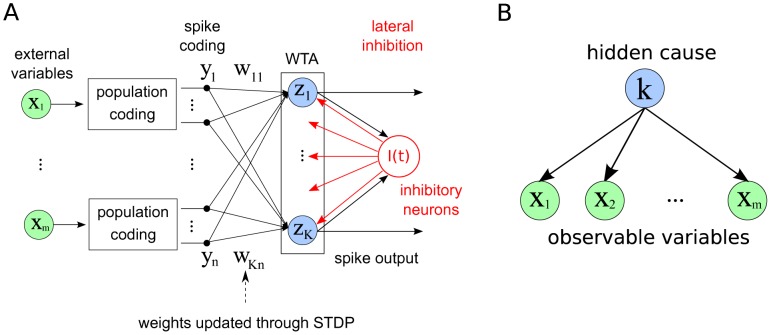
“The inhibitory potential I ( t ) implements global lateral inhibition that is modeled in (Habenschuss et al., 2012; Nessler et al., 2013) as an ideal and symbolic term This term instantaneously normalizes the total firing rates of all PCs in the WTA network.”
BackgroundSelf-citationBiologically Plausible Sequence Learning with Spiking Neural Networks
Liu, Z., Chotibut, T., Hillar, C. J., & Lin, S. (2020) · Proceedings of the AAAI Conference on Artificial Intelligence · doi:10.1609/aaai.v34i02.5487
“For example, variational inference and re-inforcement learning unveil SNN architectures that perform probabilistic inference consistent with STDP rules (Nessler et al. 2013; Pecevski and Maass 2016; Rezende, Wierstra, and Gerstner 2011).”
MethodRacing to Learn: Statistical Inference and Learning in a Single Spiking Neuron.Preprint
Afshar, S., George, L., Tapson, J. C., André, V. S., & Hamilton, T. J. (2014) · arXiv (Cornell University)
Teramae, J.-N., & Wakamiya, N. (2015) · IEICE Transactions on Communications · doi:10.1587/transcom.e98.b.153
“Enhancing causal relationships between neurons, STDP can induce Bayesian computation to the network [40].”
BackgroundDynamics and Statistics of Poisson-Driven LIF Neurons
Petrovici, M. A. (2016) · Springer theses · doi:10.1007/978-3-319-39552-4_4
Probabilistic Inference in Neural Networks
Petrovici, M. A. (2016) · Springer theses · doi:10.1007/978-3-319-39552-4_6
Brain-inspired Stochastic Models and Implementations
Al-Shedivat, M. (2015) · King Abdullah University of Science and Technology Repository (King Abdullah University of Science and Technology) · doi:10.25781/kaust-5szyj
“It was shown in [24], that if synapses obey this rules, the WTA network will be optimizing the loglikelihood of the data it sees under the mixture model it implements (Figure 2.”
BackgroundMethodResultInfluentialTheoretical Analysis of Spike-Timing-Dependent Plasticity Learning with Memristive Devices
Querlioz, D., Bichler, O., Vincent, A. F., & Gamrat, C. (2017) · Cognitive systems monographs · doi:10.1007/978-81-322-3703-7_10 · Cited by 1
Reinterpretation of Magnetic Tunnel Junctions as Stochastic Memristive Devices
Vincent, A. F., Locatelli, N., & Querlioz, D. (2017) · Cognitive systems monographs · doi:10.1007/978-81-322-3703-7_5 · Cited by 1
Learning spike time codes through supervised and unsupervised structural plasticity
Roy, S. (2016) · DR-NTU (Nanyang Technological University) · doi:10.32657/10356/67327
Hiratani, N., & Fukai, T. (2017) · Elsevier eBooks · doi:10.1016/b978-0-12-803784-3.00013-5 · Cited by 1
Mininni, C. J., & Zanutto, B. S. (2017) · bioRxiv (Cold Spring Harbor Laboratory) · doi:10.1101/163725
Towards Training Probabilistic Topic Models on Neuromorphic Multi-Chip Systems
Xiao, Z., Chen, J., & Zhu, J. (2018) · Proceedings of the AAAI Conference on Artificial Intelligence · doi:10.1609/aaai.v32i1.12117
Plasticity in large-scale neuromorphic models of the neocortex
Knight, J. C. (2017) · Research Explorer (The University of Manchester) · Cited by 3
Pyle, S. D. (2019) · STARS (University of Central Florida)
Structured Mean-field Variational Inference and Learning in Winner-take-all Spiking Neural NetworksPreprint
Shukla, S., Shimazaki, H., & Ganguly, U. (2019) · arXiv (Cornell University) · doi:10.48550/arxiv.1911.05943
“Nessler et al. [8] extended this work by incorporating an STDP learning rule to perform Expectation-Maximization on simple Bayesian models where the exact posterior is computationally tractable.”
BackgroundMethodInfluentialEmergence of Probabilistic Representation in the Neural Network of Primary Visual CortexPreprint
Li, A. A., Wang, F., Zhang, X., & Wu, S. (2021) · bioRxiv (Cold Spring Harbor Laboratory) · doi:10.1101/2021.02.06.429971
“We aim to address this question by examining the development of a canonical microcircuit that has been proposed as the building block for predictive coding (Bastos et al., 2012) and Bayesian inference (Darlington et al., 2018; Nessler et al., 2013).”
BackgroundMethodInfluentialSelecting and Optimizing threshold switching materials and devices for stochastic neuron
Wang, K., Hu, Q., Lin, Q., Zhang, D., He, Y., Tong, H., & Miao, X. S. (2021) · IEEE Electron Devices Technology & Manufacturing Conference (EDTM) · doi:10.1109/edtm50988.2021.9420998
“Moreover, it fulfills the required response of soft-threshold neuron in probabilistic SNN described in [1, 2].”
BackgroundBioLeaF: A Bio-plausible Learning Framework for Training of Spiking Neural NetworksPreprint
Yang, Y., & Li, P. (2021) · arXiv (Cornell University) · doi:10.48550/arxiv.2111.13188 · Cited by 3
“Due to the existence of the positive feedback loop, one needs to introduce additional tricks to stabilize the learning process - such as winner-takes-all (WTA) (Nessler et al., 2013; Diehl & Cook, 2015; Kheradpisheh et al., 2018; Saunders et al., 2018), weights normalization (Ferré et al.”
BackgroundPlebe, A., & Cruz, V. M. D. L. (2016) · Studies in brain and mind · doi:10.1007/978-3-319-28552-8_3
A Study on the Low-Power Operation of the Spike Neural Network Using the Sensory Adaptation Method
Jeon, M., Kang, T., Lee, J., & Lee, W. (2022) · Mathematics · doi:10.3390/math10224191
Learning rules for cortical-like spontaneous replay of an internal modelPreprint
Asabuki, T., & Fukai, T. (2023) · Research Square · doi:10.21203/rs.3.rs-2599451/v1
Baysian Synaptic Plasticity for Data Efficient Learning in the Brain
Hiratani, N. (2023) · The Brain & Neural Networks · doi:10.3902/jnns.30.84
A theory of inference and learning in cortex with spiking neurons and dendritic error computation
Mikulasch, F. A. (2023) · eDiss (Georg-August-Universität Göttingen) · doi:10.53846/goediss-10168 · Cited by 1
Qu, H., Luo, X., & Zhang, Y. (2024) · Elsevier eBooks · doi:10.1016/b978-0-44-332820-6.00008-2
Asabuki, T., & Fukai, T. (2024) · eLife · doi:10.7554/elife.92712.1.sa0
Predictive learning rules generate a cortical-like replay of probabilistic sensory experiencesPreprint
Asabuki, T., & Fukai, T. (2024) · eLife · doi:10.7554/elife.92712.1 · Cited by 1
Predictive learning rules generate a cortical-like replay of probabilistic sensory experiencesPreprint
Asabuki, T., & Fukai, T. (2024) · eLife · doi:10.7554/elife.92712.2
Design and evaluation of analog predictive coding networks based on the free-energy principle
Kunimi, T., Ando, K., Marukame, T., & Asai, T. (2025) · Nonlinear Theory and Its Applications IEICE · doi:10.1587/nolta.16.271
Incremental self-organization of spatio-temporal spike pattern detection
Dehghani-Habibabadi, M., Müller, L., & Pawelzik, K. R. (2025) · Scientific Reports · doi:10.1038/s41598-025-21460-1
Spiking neural networks with uncertainty model of stochastic sampling for circuit yield enhancement
Huang, Z., Xiao, W., Ruan, H., He, S., & Guo, D. (2025) · Engineering Applications of Artificial Intelligence · doi:10.1016/j.engappai.2025.112523
Transient boosting of action potential backpropagation for few-shot temporal pattern learning
Sivori, G., & Fukai, T. (2025) · PLoS Computational Biology · doi:10.1371/journal.pcbi.1013777 · Cited by 2
“For instance, using experimentally tuned parameters for STDP in an unsupervised neuron model can show how these models become near-optimal in detecting coincidences [9,13,25].”
InfluentialSynergistic Short-Term Synaptic Plasticity Mechanisms for Working Memory
Fiebig, F., Chrysanthidis, N., Lansner, A., & Herman, P. A. (2026) · Journal of Cognitive Neuroscience · doi:10.1162/jocn.a.2582
Computational methods for event-based signals and applications
Lagorce, X. (2015) · theses.fr (ABES) · doi:10.70675/e22a50cbzc561z4039z91bfzab749eb47002 · Cited by 1
“[84] and [85] have proven that this can be implemented in spiking neural networks, using a soft WTA circuit to compute the E-step, and an STDP learning rule to implement the M-step.”
MethodLocal learning with highly analog memory devices
Bennett, C. H. (2018) · theses.fr (ABES) · doi:10.70675/e49026a5z4027z44f2za795z67ee03a38150
“Interestingly, STDP may also approximate Bayesian computation [113, 114].”
BackgroundNeuro-Inspired Energy-Efficient Computing Platforms
Causo, M. (2017) · theses.fr (ABES) · doi:10.70675/0368b25fz8da5z44e2za6b7zadd451c023e2
Deep learning in event-based neuromorphic systems
Thiele, J. (2019) · theses.fr (ABES) · doi:10.70675/32a83d65z43ebz4318zab2dzb1e874da36d6 · Cited by 2
Precise timing and computationally efficient learning in neuromorphic systems
Oubari, O. (2020) · theses.fr (ABES) · doi:10.70675/ba1f9a8fza871z408azacf1z929ff13989bd · Cited by 1
Unsupervised Learning to Hash with a Soft Winner-Take-All Mechanism
Zhang, Q., Dou, C., & Chua, Y. (2026) · IEEE International Conference on Acoustics Speech and Signal Processing · doi:10.1109/icassp55912.2026.11461356
Redefining spiking neural networks through the lens of dynamical superspace
Chen, G., Qi, J. G., Liu, X., Fan, Q., Gao, Z., Xu, S., Wang, X. G., Wu, Y., Yang, D., Zhou, D., et al. (2026) · Cognitive Neurodynamics · doi:10.1007/s11571-026-10470-y
“…linearizes the neuron’s response and enables probabilistic inference via precise integration windows (Wehr and Zador 2003; Gabernet et al. 2005; Nessler et al. 2013; Buesing et al. 2011; Kappel et al. 2014; Jonke et al. 2017), allowing the network to continuously explore loss landscapes and…”
S2E: Spatio-temporal filtering of spike streams for motion-selective event generation
Zheng, L., Zheng, Y., Rui, Z., & Huang, T. (2026) · Neural Networks · doi:10.1016/j.neunet.2026.109191
Metadata
- Authors
- Nessler, B., Pfeiffer, M., Buesing, L., & Maass, W.
- Affiliations
- Graz University of Technology (AT)
- University of Zurich (CH)
- Corresponding author
- Nessler, Bernhard
- Venue
- PLoS Computational Biology
- Publisher
- Public Library of Science (PLoS)
- Published
- 2013-04-25
- Volume
- 9
- Issue
- 4
- Pages
- e1003037
- ISSN
- 1553-734X (ISSN-L)
- 1553-7358
- PMC
- PMC3636028
- OpenAlex
- W2003400208
- Semantic Scholar
- 24d54b44151bc1161f66249f75d049a88f22e0c7
- Cited by
- 281
- References
- 121
- Citations by year
- 2026: 6 · 2025: 11 · 2024: 18 · 2023: 17 · 2022: 16 · 2021: 25 · 2020: 18 · 2019: 21 · 2018: 25 · 2017: 35 · 2016: 37 · 2015: 28 · 2014: 18 · 2013: 5
- FWCI
- 16.02
- Type
- journal article
- Language
- en
- Open access
- gold
- doi.org
- Locations
- PLoS Computational Biology (publishedVersion, cc-by)
- Europe PMC (PubMed Central) (publishedVersion, cc-by)
- PubMed Central (publishedVersion, cc-by)
- PubMed (publishedVersion)
- Zurich Open Repository and Archive (University of Zurich) (acceptedVersion, cc-by)
- RePEc: Research Papers in Economics (submittedVersion)
- DOAJ (DOAJ: Directory of Open Access Journals) (submittedVersion, cc-by-sa)
- Repository for Publications and Research Data (ETH Zurich) (submittedVersion, cc-by)
- Zurich Open Repository and Archive (University of Zurich) (submittedVersion, cc-by)
- ETH Zürich Research Collection (cc-by)
- Zurich Open Repository and Archive (University of Zurich)
- Funders
- Samsung Advanced Institute of Technology
- European Commission (269921, 243914, 506778, 216593)
- Universität Zürich
- Samsung
- Topics
- Life Sciences › Neuroscience › Cognitive Neuroscience › Neural dynamics and brain function
- Life Sciences › Neuroscience › Cellular and Molecular Neuroscience › Neuroscience and Neuropharmacology Research
- Life Sciences › Neuroscience › Cognitive Neuroscience › Memory and Neural Mechanisms
- Keywords
- Bayesian computation, spike-timing-dependent plasticity, cortical microcircuits, winner-take-all circuit, implicit generative models, expectation-maximization algorithm, spontaneous activity, trial-to-trial variability, distributed information processing, pyramidal neurons, interneurons
- MeSH terms
- Action Potentials, Animals, Bayes Theorem, Brain, Computer Simulation, Humans, Models, Neurological, Nerve Net, Synaptic Transmission, Neuronal Plasticity, Neurons, Probability, Synapses, Computational Biology
About these checks
Registry, retraction, Cites and statistics results are computed, not judged, with one exception: a printed reference that no index lists is read once by a model before it counts as a citation error. Claims are extracted by a model and kept only when their quote appears verbatim in the text; each cited source is then checked, with a model’s help, for whether it says what the claim relies on. Those verdicts can be wrong — read the claim’s quote and the cited source before relying on one.
Statistics and arithmetic are recomputed, not judged.
Confidence bands are shown only for fields calibrated on our annotated test set. None is calibrated yet, so no band is shown.
What counts as a claim ›How we measure confidence ›How we check this ›
Are you an author, or do you see a problem with this page? Request a review
Data sources
Bibliographic data: Semantic Scholar, OpenAlex, Crossref.
Contains information from the Semantic Scholar Academic Graph Datasets, made available under the ODC Attribution License (ODC-BY 1.0).
Semantic Scholar’s data is described in: Kinney, R., et al. (2023). The Semantic Scholar Open Data Platform. arXiv:2301.10140.
