

The DOI matches its Crossref record; 78 of the 78 references it cites were found in a registry or an index.
Untangling Brain-Wide Dynamics in Consciousness by Cross-Embedding
Open accessAbstract
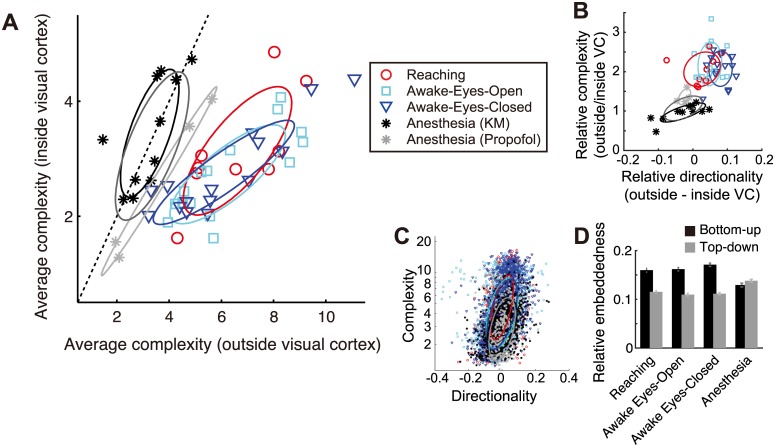
Brain-wide interactions generating complex neural dynamics are considered crucial for emergent cognitive functions. However, the irreducible nature of nonlinear and high-dimensional dynamical interactions challenges conventional reductionist approaches. We introduce a model-free method, based on embedding theorems in nonlinear state-space reconstruction, that permits a simultaneous characterization of complexity in local dynamics, directed interactions between brain areas, and how the complexity is produced by the interactions. We demonstrate this method in large-scale electrophysiological recordings from awake and anesthetized monkeys. The cross-embedding method captures structured interaction underlying cortex-wide dynamics that may be missed by conventional correlation-based analysis, demonstrating a critical role of time-series analysis in characterizing brain state. The method reveals a consciousness-related hierarchy of cortical areas, where dynamical complexity increases along with cross-area information flow. These findings demonstrate the advantages of the cross-embedding method in deciphering large-scale and heterogeneous neuronal systems, suggesting a crucial contribution by sensory-frontoparietal interactions to the emergence of complex brain dynamics during consciousness.
Overview
The claims and statistics of this paper haven’t been checked yet.
Free: it reads the open-access text and checks the first 5 claims that cite a source we can check. Create a free account to check every claim.
Integrity signals
Registry
Cites
Statistics
Figures




Verification
Claims the paper makes
The claims and statistics of this paper haven’t been checked yet.
Free: it reads the open-access text and checks the first 5 claims that cite a source we can check. Create a free account to check every claim.
Claims other papers make about this one
Each is checked against this paper’s own text: does it say what the citing paper says it does?
The check wasn’t confident either way, so it gives no verdict — never disputed.
In the citing paper
“IIT’s Φ cannot be easily computed from large-scale data, making it difficult to test the theory (for attempts, see Oizumi et al., 2016 and Tajima et al., 2015).”
From Conscious Processing and the Global Neuronal Workspace Hypothesis (2020) · cites this paper as Tajima et al., 2015
Experimental — accuracy not yet measured
Self-check
Percentages, sums and reported differences re-computed from the paper’s own numbers.
The self-check needs the paper’s full text.
Citations
Cites
Investigating causal relations by econometric models and cross-spectral methods
Granger, C. W. J. (1969) · Econometrica · doi:10.2307/1912791 · Cited by 22,989
A neural substrate of prediction and reward
Schultz, W., Dayan, P., & Montague, P. R. (1997) · Science · doi:10.1126/science.275.5306.1593 · Cited by 9,388 · cited 1×
“Embedding describes the observability of information in one brain area by another area, fulfilling a prerequisite for the actor-critic models of brain systems [58].”
BackgroundPermutation Entropy: A Natural Complexity Measure for Time Series
Bandt, C., & Pompe, B. (2002) · Physical Review Letters · doi:10.1103/physrevlett.88.174102 · Cited by 4,867 · cited 1×
“We compared the present complexitymeasure to the five other related measures (Materials and Methods): (i) correlation dimension [29], (ii) dimensionality derived from principle component analysis (PCA), (iii) permutation entropy [30,31], (iv) algorithmic (KolmogorovChaitin) complexity [32,33], and (v) the optimal embe…”
MethodCharacterization of Strange Attractors
Grassberger, P., & Procaccia, I. (1983) · Physical Review Letters · doi:10.1103/physrevlett.50.346 · Cited by 4,857 · cited 2×
“The correlation dimension was computed with the algorithm proposed by [29]; the PCA dimension was quantified by the number of dimension explaining 90% of the all variance; the permutation entropy was derived using the algorithm proposed by [31]; the algorithmic complexity was derived with the method proposed by [75];…”
MethodInvestigating Causal Relations by Econometric Models and Cross-Spectral Methods
Granger, C. W. J. (2010) · Essays in Econometrics · doi:10.1017/cbo9780511753978.002 · Cited by 4,762
Measuring Information Transfer
Schreiber, T. (2000) · Physical Review Letters · doi:10.1103/physrevlett.85.461 · Cited by 4,530 · cited 1×
“It is worth noting that detecting a clear causal relationship by Transfer entropy [69,70], Granger causality [71] or spectral Granger causality [72,73] is not straightforward unless the system’s dynamical properties are well known, due to the confounding effects of phase delay [74] or self-predictability in determinis…”
BackgroundDetermining embedding dimension for phase-space reconstruction using a geometrical construction
Kennel, M. B., Brown, R., & Abarbanel, H. D. I. (1992) · Physical Review A · doi:10.1103/physreva.45.3403 · Cited by 3,776 · cited 2×
“The complexity of dynamics concerning pairwise interaction was quantified using minimum embedding dimension d that yielded 95% of optimal estimation accuracy maxd ry;ŷðxt dÞ, which is an extension of the false-neighbor method [27,28,68] to the present cross-embedding.”
BackgroundMethodThalamocortical oscillations in the sleeping and aroused brain
Steriade, M., McCormick, D. A., & Sejnowski, T. J. (1993) · Science · doi:10.1126/science.8235588 · Cited by 3,564
Experimental and theoretical approaches to conscious processing
Dehaene, S., & Changeux, J.-P. (2011) · Neuron · doi:10.1016/j.neuron.2011.03.018 · Cited by 2,573
Detecting Causality in Complex Ecosystems
Sugihara, G., May, R., Ye, H., Hsieh, C.-H., Deyle, E., Fogarty, M., & Munch, S. (2012) · Science · doi:10.1126/science.1227079 · Cited by 2,539 · cited 10×
“However, the directionality of causality between as pair of nodes should be detected by a node asking the other node whether there is any asymmetry of observability (conditional entropy) of a node by the other node [21], even under some stochasticity due to system noise (S4 Fig).”
BackgroundMethodInfluential
Research works printed but not linked: 2
- M Riedl, 2013, Practical considerations of permutation entropy, Eur Phys J, 222, 249
- AN Kolmogorov, 1965, Three approaches to the definition of the concept of quantity of information, IEEE Trans Inf Theory, 14, 662
Cited by
Conscious Processing and the Global Neuronal Workspace Hypothesis
Mashour, G. A., Roelfsema, P., Changeux, J.-P., & Dehaene, S. (2020) · Neuron · doi:10.1016/j.neuron.2020.01.026 · Cited by 1,164
“IIT’s F cannot be easily computed from large-scale data, making it difficult to test the theory (for attempts, see Oizumi et al., 2016 and Tajima et al., 2015).”
MethodSocial Influence as Intrinsic Motivation for Multi-Agent Deep Reinforcement Learning
Jaques, N., Lazaridou, A., Hughes, E., Gülçehre, Ç., Ortega, P. A., Strouse, D., Leibo, J. Z., & de Freitas, N. (2018) · arXiv (Cornell University) · doi:10.48550/arxiv.1810.08647 · Cited by 241
“The limitation of this approach is that CCM estimates of causality are known to degrade in the presence of stochastic effects (Tajima et al., 2015).”
BackgroundGordon, N., Tsuchiya, N., Koenig‐Robert, R., & Hohwy, J. (2019) · PLoS Biology · doi:10.1371/journal.pbio.3000233 · Cited by 86
Consciousness & Brain Functional Complexity in Propofol Anaesthesia
Varley, T. F., Luppi, A. I., Pappas, I., Naçi, L., Ram, A., Owen, A. M., Menon, D. K., & Stamatakis, E. A. (2020) · Scientific Reports · doi:10.1038/s41598-020-57695-3 · Cited by 93
Recent developments in empirical dynamic modelling
Munch, S. B., Rogers, T. L., & Sugihara, G. (2022) · Methods in Ecology and Evolution · doi:10.1111/2041-210x.13983 · Cited by 98
“Alternatively, the time- scale problem can be circumvented using an ensemble of randomly generated delay vectors (see e.g. Tajima et al., 2015).”
Method
Metadata
- Authors
- Tajima, S., Yanagawa, T., Fujii, N., & Toyoizumi, T.
- Affiliations
- University of Geneva (CH)
- RIKEN Center for Brain Science (JP)
- Tokyo Institute of Technology (JP)
- Corresponding author
- Tajima, Satohiro
- Yanagawa, Toru
- Fujii, Naotaka
- Toyoizumi, Taro
- Venue
- PLOS Computational Biology
- Publisher
- Public Library of Science (PLoS)
- Published
- 2015-11-19
- Volume
- 11
- Issue
- 11
- Pages
- e1004537
- ISSN
- 1553-734X (ISSN-L)
- 1553-7358
- PMC
- PMC4652869
- OpenAlex
- W2173362524
- Cited by
- 76
- References
- 78
- Citations by year
- 2026: 2 · 2025: 5 · 2024: 8 · 2023: 9 · 2022: 8 · 2021: 5 · 2020: 12 · 2019: 7 · 2018: 6 · 2017: 11 · 2016: 2 · 2015: 1
- FWCI
- 4.01
- Type
- journal article
- Language
- en
- Open access
- gold
- doi.org
- Licence
- Locations
- PLoS Computational Biology (publishedVersion, cc-by)
- Europe PMC (PubMed Central) (publishedVersion, cc-by)
- PubMed Central (publishedVersion, cc-by)
- PubMed (publishedVersion)
- RePEc: Research Papers in Economics (submittedVersion)
- DOAJ (DOAJ: Directory of Open Access Journals) (submittedVersion, cc-by-sa)
- Figshare (submittedVersion, cc-by)
- Funders
- Japan Agency for Medical Research and Development
- Japan Society for the Promotion of Science
- RIKEN
- RIKEN Brain Science Institute
- Topics
- Life Sciences › Neuroscience › Cognitive Neuroscience › Neural dynamics and brain function
- Life Sciences › Neuroscience › Cognitive Neuroscience › Functional Brain Connectivity Studies
- Physical Sciences › Physics and Astronomy › Statistical and Nonlinear Physics › Chaos control and synchronization
- Keywords
- consciousness, dynamical complexity, cortical hierarchy, information flow, electrophysiological recording, model-independent analysis
- MeSH terms
- Algorithms, Animals, Brain, Consciousness, Electroencephalography, Macaca, Wakefulness, Computational Biology
About these checks
Registry, retraction, Cites and statistics results are computed, not judged, with one exception: a printed reference that no index lists is read once by a model before it counts as a citation error. Claims are extracted by a model and kept only when their quote appears verbatim in the text; each cited source is then checked, with a model’s help, for whether it says what the claim relies on. Those verdicts can be wrong — read the claim’s quote and the cited source before relying on one.
Statistics and arithmetic are recomputed, not judged.
Confidence bands are shown only for fields calibrated on our annotated test set. None is calibrated yet, so no band is shown.
What counts as a claim ›How we measure confidence ›How we check this ›
Are you an author, or do you see a problem with this page? Request a review
How to cite
Cite CoChat for the checks on this page, and the paper for its own findings.
- This page
- CoChat. (2026). Citation check: Untangling Brain-Wide Dynamics in Consciousness by Cross-Embedding. https://app.cochat.ai/papers/10.1371/journal.pcbi.1004537
- The paper
- Tajima, S., Yanagawa, T., Fujii, N., & Toyoizumi, T. (2015). Untangling Brain-Wide Dynamics in Consciousness by Cross-Embedding. PLOS Computational Biology. https://doi.org/10.1371/journal.pcbi.1004537
Data sources
Bibliographic data: Semantic Scholar, OpenAlex, Crossref.
Contains information from the Semantic Scholar Academic Graph Datasets, made available under the ODC Attribution License (ODC-BY 1.0).
Semantic Scholar’s data is described in: Kinney, R., et al. (2023). The Semantic Scholar Open Data Platform. arXiv:2301.10140.
