

The DOI matches its Crossref record; 54 of the 54 references it cites were found in a registry or an index.
Qualitative Dynamical Modelling Can Formally Explain Mesoderm Specification and Predict Novel Developmental Phenotypes
Abstract
Given the complexity of developmental networks, it is often difficult to predict the effect of genetic perturbations, even within coding genes. Regulatory factors generally have pleiotropic effects, exhibit partially redundant roles, and regulate highly interconnected pathways with ample cross-talk. Here, we delineate a logical model encompassing 48 components and 82 regulatory interactions involved in mesoderm specification during Drosophila development, thereby providing a formal integration of all available genetic information from the literature. The four main tissues derived from mesoderm correspond to alternative stable states. We demonstrate that the model can predict known mutant phenotypes and use it to systematically predict the effects of over 300 new, often non-intuitive, loss- and gain-of-function mutations, and combinations thereof. We further validated several novel predictions experimentally, thereby demonstrating the robustness of model. Logical modelling can thus contribute to formally explain and predict regulatory outcomes underlying cell fate decisions.
Overview
The claims and statistics of this paper haven’t been checked yet.
Run the check — free, no account needed. It reads the open-access text and checks the sources it cites.
Integrity signals
Registry
Cites
Statistics
Figures
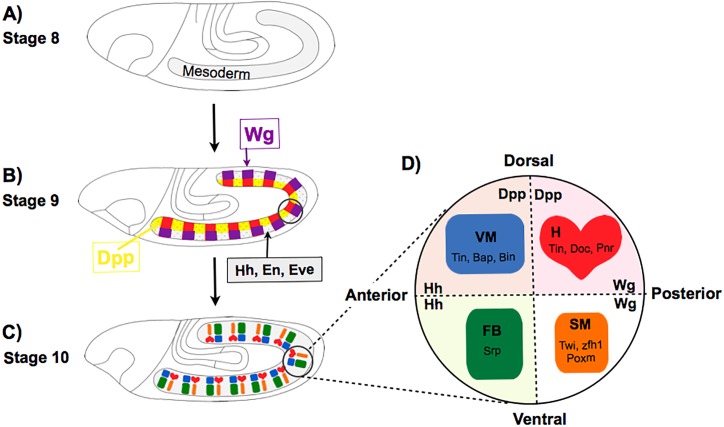
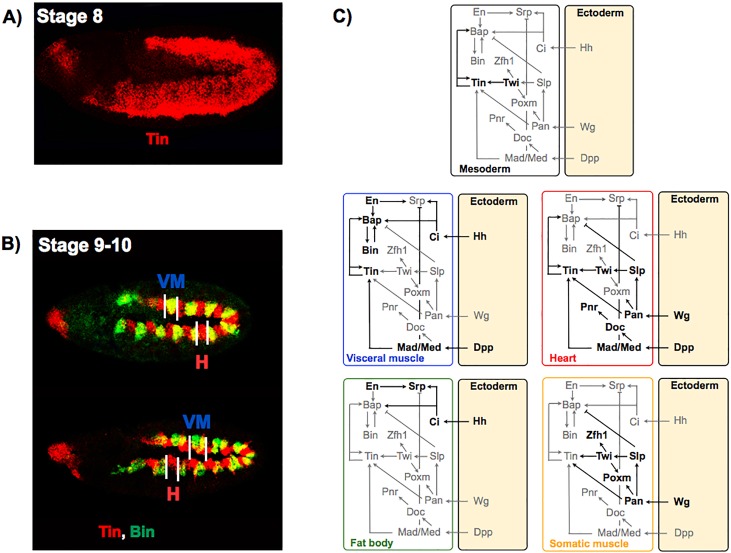
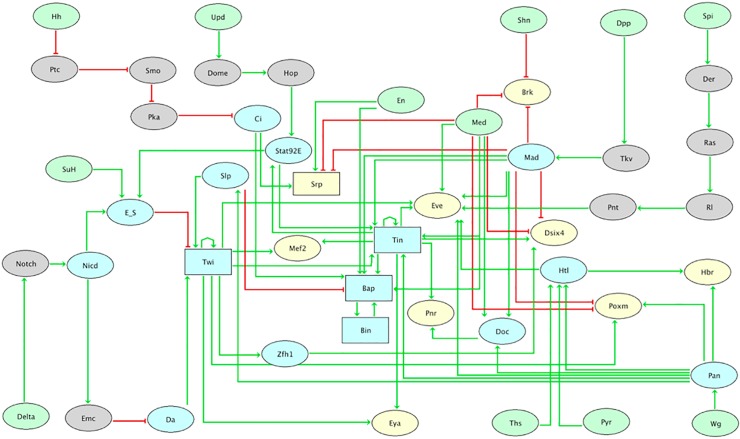
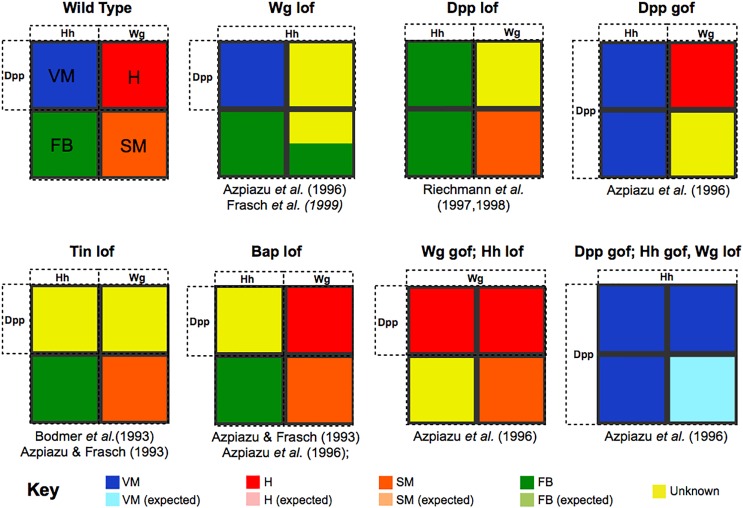
Verification
Claims the paper makes
The claims and statistics of this paper haven’t been checked yet.
Run the check — free, no account needed. It reads the open-access text and checks the sources it cites.
Claims other papers make about this one
Each is checked against this paper’s own text: does it say what the citing paper says it does?
In the citing paper
“As a point of contrast, more dramatic expression changes are seen in early development (16, 17, 30), where transcriptomes first establish cell lineages that will give rise to a vast diversity of tissues of the body.”
From Behavior-related gene regulatory networks: A new level of organization in the brain (2020) · cites this paper as [30]
Self-check
Percentages, sums and reported differences re-computed from the paper’s own numbers.
The self-check needs the paper’s full text.
Citations
Cites
The segment polarity network is a robust developmental module
von Dassow, G., Meir, E., Munro, E. M., & Odell, G. M. (2000) · Nature · doi:10.1038/35018085 · Cited by 1,144
Albert, R., & Othmer, H. G. (2003) · Journal of Theoretical Biology · doi:10.1016/s0022-5193(03)00035-3 · Cited by 944
The gene tinman is required for specification of the heart and visceral muscles in Drosophila
Bodmer, R. (1993) · Development · doi:10.1242/dev.118.3.719 · Cited by 810
Azpiazu, N., & Frasch, M. (1993) · Genes & Development · doi:10.1101/gad.7.7b.1325 · Cited by 719
Thomas, R., Thieffry, D., & Kaufman, M. (1995) · Bulletin of Mathematical Biology · doi:10.1007/bf02460618 · Cited by 490
Self-citationInduction of visceral and cardiac mesoderm by ectodermal Dpp in the early Drosophila embryo
Frasch, M. (1995) · Nature · doi:10.1038/374464a0 · Cited by 414
Combinatorial binding predicts spatio-temporal cis-regulatory activity
Zinzen, R. P., Girardot, C., Gagneur, J., Braun, M., & Furlong, E. E. M. (2009) · Nature · doi:10.1038/nature08531 · Cited by 395
Self-citationtwist : A Myogenic Switch in Drosophila
Baylies, M. K., & Bate, M. (1996) · Science · doi:10.1126/science.272.5267.1481 · Cited by 342
Logic-Based Models for the Analysis of Cell Signaling Networks
Morris, M. K., Saez-Rodriguez, J., Sorger, P. K., & Lauffenburger, D. A. (2010) · Biochemistry · doi:10.1021/bi902202q · Cited by 332
TGF-β Family Signal Transduction in Drosophila Development: From Mad to Smads
Raftery, L. A., & Sutherland, D. J. (1999) · Developmental Biology · doi:10.1006/dbio.1999.9282 · Cited by 321
Cited by
Behavior-related gene regulatory networks: A new level of organization in the brain
Sinha, S., Jones, B. M., Traniello, I. M., Bukhari, S. A., Halfon, M. S., Hofmann, H. A., Huang, S., Katz, P. S., Keagy, J., Lynch, V. J., et al. (2020) · Proceedings of the National Academy of Sciences · doi:10.1073/pnas.1921625117 · Cited by 85
Metadata
- Authors
- Mbodj, A., Gustafson, E. H., Ciglar, L., Junion, G., Gonzalez, A., Girardot, C., Perrin, L., Furlong, E. E. M., & Thieffry, D.
- ORCID
- Mbodj, Abibatou
- Venue
- PLOS Computational Biology
- Publisher
- Public Library of Science (PLoS)
- Published
- 2016-09-06
- Volume
- 12
- Issue
- 9
- Pages
- e1005073
- ISSN
- 1553-7358
- PMC
- PMC5012701
- Cited by
- 12
- References
- 54
- Language
- en
- Funders
- DFG (FU 750/1-2)
- EraSysBio (ModHeart)
About these checks
Registry, retraction, Cites and statistics results are computed, not judged, with one exception: a printed reference that no index lists is read once by a model before it counts as a citation error. Claims are extracted by a model and kept only when their quote appears verbatim in the text; each cited source is then checked, with a model’s help, for whether it says what the claim relies on. Those verdicts can be wrong — read the claim’s quote and the cited source before relying on one.
Statistics and arithmetic are recomputed, not judged.
Confidence bands are shown only for fields calibrated on our annotated test set. None is calibrated yet, so no band is shown.
What counts as a claim ›How we measure confidence ›How we check this ›
Are you an author, or do you see a problem with this page? Request a review
Data sources
Bibliographic data: Semantic Scholar, OpenAlex, Crossref.
Contains information from the Semantic Scholar Academic Graph Datasets, made available under the ODC Attribution License (ODC-BY 1.0).
Semantic Scholar’s data is described in: Kinney, R., et al. (2023). The Semantic Scholar Open Data Platform. arXiv:2301.10140.
