Cited by 10

The DOI matches its Crossref record; 1 of the 1 references it cites were found in a registry or an index.

miRWoods: Enhanced precursor detection and stacked random forests for the sensitive detection of microRNAs

Bell, Jimmy, Larson, Maureen, Kutzler, Michelle, Bionaz, Massimo, Löhr, Christiane V., Hendrix, David·2019·PLOS Computational Biology

Overview

The claims and statistics of this paper haven’t been checked yet.

Run the check — free, no account needed. It reads the open-access text and checks the sources it cites.

A few free checks a day · papers already verified open instantly · results are public

Integrity signals

Registry

Crossref · 10.1371/journal.pcbi.1007309

Cites

1 of 1 references verified0 citation errors · 0 not checkable

Statistics

Figures

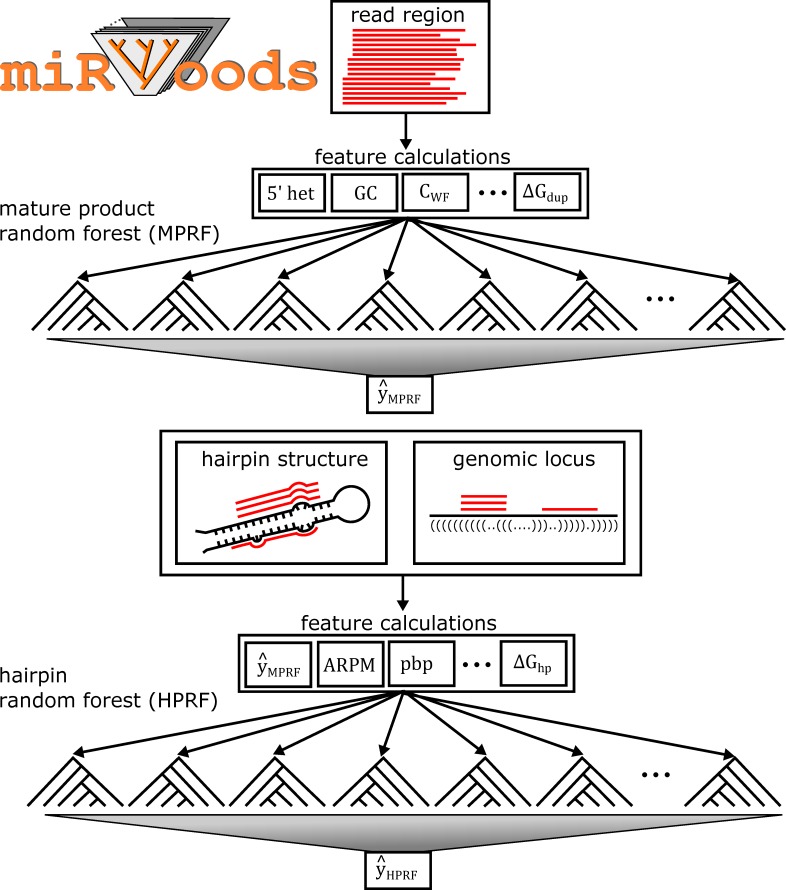
Fig 1 Outline of miRWoods Pipeline. After aligning to the genome, overlapping reads are grouped together to form read stacks. Read stacks are scored used Mature Product Random Forest (MPRF), to predict a set of putative mature microRNAs. Products which meet the minimum threshold score for the MPRF are combined with the surrounding region to form hairpins and each hairpin is folded. Hairpins are scored using the Hairpin Random Forest (HPRF) and a set of final predictions are generated which meet the minimum threshold for the HPRF score.
Fig 1 Outline of miRWoods Pipeline. After aligning to the genome, overlapping reads are grouped together to form read stacks. Read stacks are scored used Mature Product Random Forest (MPRF), to predict a set of putative mature microRNAs. Products which meet the minimum threshold score for the MPRF are combined with the surrounding region to form hairpins and each hairpin is folded. Hairpins are scored using the Hairpin Random Forest (HPRF) and a set of final predictions are generated which meet the minimum threshold for the HPRF score.CC BY · PubMed Central
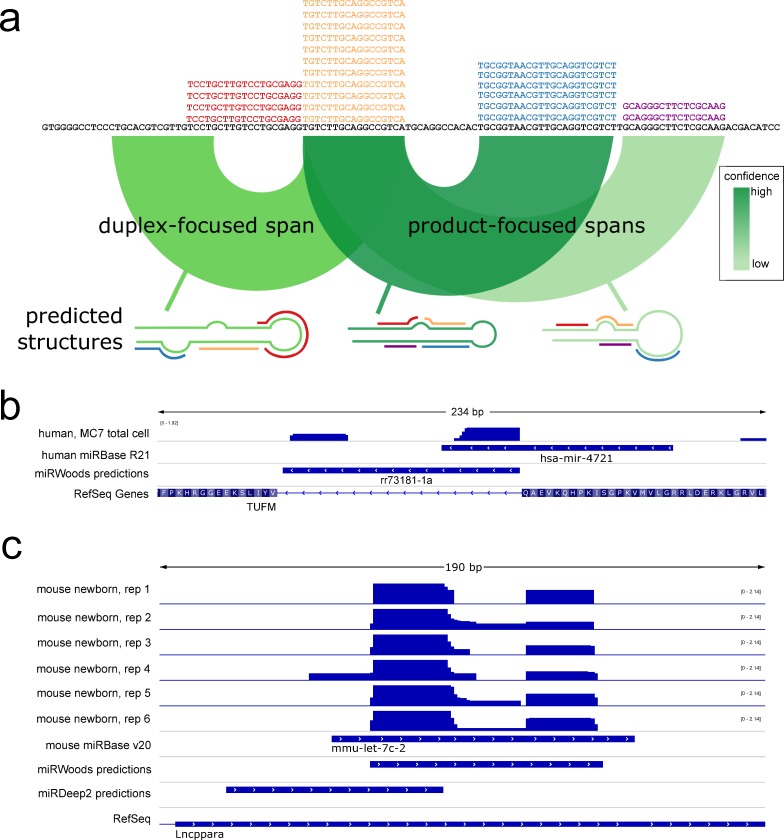
Fig 2 Improved hairpin precursor Span identification. a miRWoods generates several potential hairpin precursor spans from each product that passes through the MPRF. Duplex-focused spans take the region between the product and the optimal duplex and product-focused spans take the region between the product and other products greater than 4 nt away. Hairpins are selected based on HPRF score. b The miRBase annotation for hsa-mir-4721 crosses over an intron boundary. miRWoods corrects the annotation by recognizing a second read stack and produce precursor span that perfectly matches an intron, suggesting mir-4721 is a mirtron. c The miRWoods prediction for mmu-let-7c-2 in mouse is consistent with the miRBase annotation, while the best miRDeep2 prediction, albeit below the default signal-to-noise threshold, only partially overlap with the miRBase annotation.
Fig 2 Improved hairpin precursor Span identification. a miRWoods generates several potential hairpin precursor spans from each product that passes through the MPRF. Duplex-focused spans take the region between the product and the optimal duplex and product-focused spans take the region between the product and other products greater than 4 nt away. Hairpins are selected based on HPRF score. b The miRBase annotation for hsa-mir-4721 crosses over an intron boundary. miRWoods corrects the annotation by recognizing a second read stack and produce precursor span that perfectly matches an intron, suggesting mir-4721 is a mirtron. c The miRWoods prediction for mmu-let-7c-2 in mouse is consistent with the miRBase annotation, while the best miRDeep2 prediction, albeit below the default signal-to-noise threshold, only partially overlap with the miRBase annotation.CC BY · PubMed Central
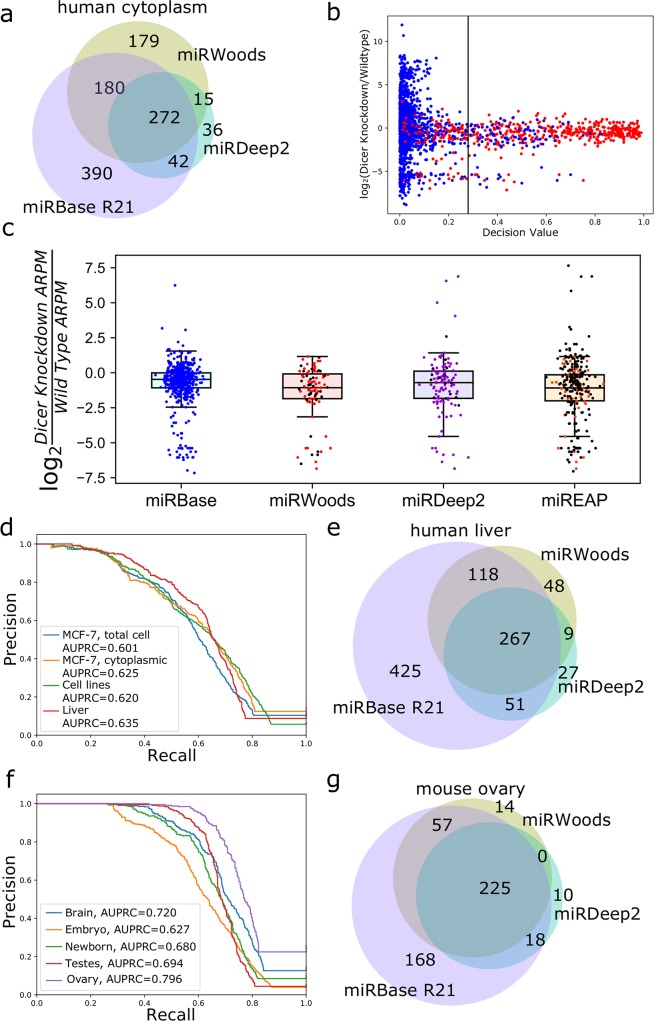
Fig 3 Evaluation of miRWoods performance. a Euler diagrams comparing predictions from miRWoods and miRDeep with annotations from miRBase for human MCF-7 cytoplasmic extract b A scatterplot comparing the miRWoods decision value to the log fold change in Dicer knockdown cells compared to wild-type cells. c Scatter-boxplot comparing the log fold change for Dicer knockout to wild type for unprocessed read regions, miRBase annotations, and predictions from miRWoods, miRDeep, and miReap for MCF-7 (cytoplasmic fraction). Black dots indicate predictions that are unique to this method. d Precision-recall (PR) Curve and AUPRC of miRWoods predictions for human including MCF-7 (total cell content), MCF-7 (cytoplasmic fraction), cell lines, and liver. e Euler Diagrams comparing predictions from miRWoods and miRDeep with annotations from miRBase for human liver. f Precision Recall Curve and AUPRC of miRWoods predictions for mouse tissues including brain, embryo, newborn, testes, and ovaries sets. g Euler Diagrams comparing predictions from miRWoods and miRDeep2 with annotations from miRBase for mouse ovary.
Fig 3 Evaluation of miRWoods performance. a Euler diagrams comparing predictions from miRWoods and miRDeep with annotations from miRBase for human MCF-7 cytoplasmic extract b A scatterplot comparing the miRWoods decision value to the log fold change in Dicer knockdown cells compared to wild-type cells. c Scatter-boxplot comparing the log fold change for Dicer knockout to wild type for unprocessed read regions, miRBase annotations, and predictions from miRWoods, miRDeep, and miReap for MCF-7 (cytoplasmic fraction). Black dots indicate predictions that are unique to this method. d Precision-recall (PR) Curve and AUPRC of miRWoods predictions for human including MCF-7 (total cell content), MCF-7 (cytoplasmic fraction), cell lines, and liver. e Euler Diagrams comparing predictions from miRWoods and miRDeep with annotations from miRBase for human liver. f Precision Recall Curve and AUPRC of miRWoods predictions for mouse tissues including brain, embryo, newborn, testes, and ovaries sets. g Euler Diagrams comparing predictions from miRWoods and miRDeep2 with annotations from miRBase for mouse ovary.CC BY · PubMed Central
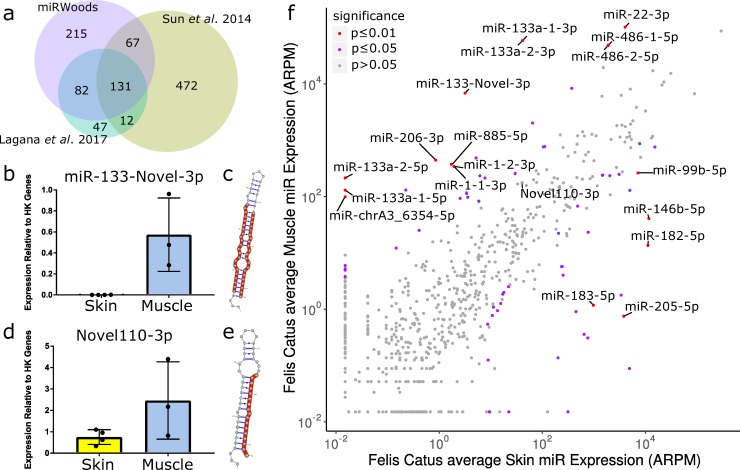
Fig 4 miRWoods predictions in the feline genome. a Euler diagram of the predictions from miRWoods with predictions from Sun et al. (2014) and Lagana et al. (2017). b The expression in skin and muscle for miR-133-Novel-3p c Hairpin for mir-133-Novel precursor. d The expression in skin and muscle for Novel110-3p. e Hairpin for Novel110 precursor. f Scatterplot of average muscle expression vs average skin expression for each mature microRNA.
Fig 4 miRWoods predictions in the feline genome. a Euler diagram of the predictions from miRWoods with predictions from Sun et al. (2014) and Lagana et al. (2017). b The expression in skin and muscle for miR-133-Novel-3p c Hairpin for mir-133-Novel precursor. d The expression in skin and muscle for Novel110-3p. e Hairpin for Novel110 precursor. f Scatterplot of average muscle expression vs average skin expression for each mature microRNA.CC BY · PubMed Central
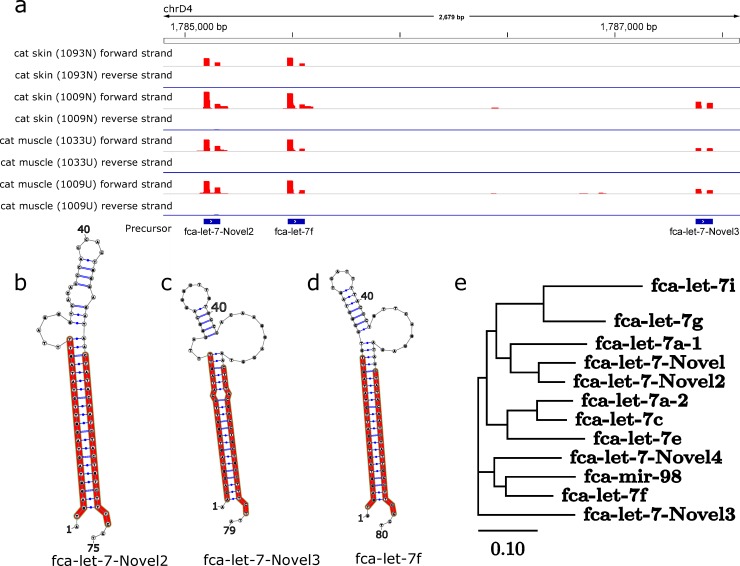
Fig 5 Novel let-7 microRNAs in the feline genome. a RNA-seq of cluster containing fca-let7-Novel2, fca-let7f, and fca-let7-Novel3 for each skin and muscle sample from Felis catus. b Hairpin structures for fca-let7-Novel2, c fca-let7-Novel3, and d fca-let7f. e Phylogenetic tree of let-7 miRs including those previously found by Lagana et al. (2017).
Fig 5 Novel let-7 microRNAs in the feline genome. a RNA-seq of cluster containing fca-let7-Novel2, fca-let7f, and fca-let7-Novel3 for each skin and muscle sample from Felis catus. b Hairpin structures for fca-let7-Novel2, c fca-let7-Novel3, and d fca-let7f. e Phylogenetic tree of let-7 miRs including those previously found by Lagana et al. (2017).CC BY · PubMed Central
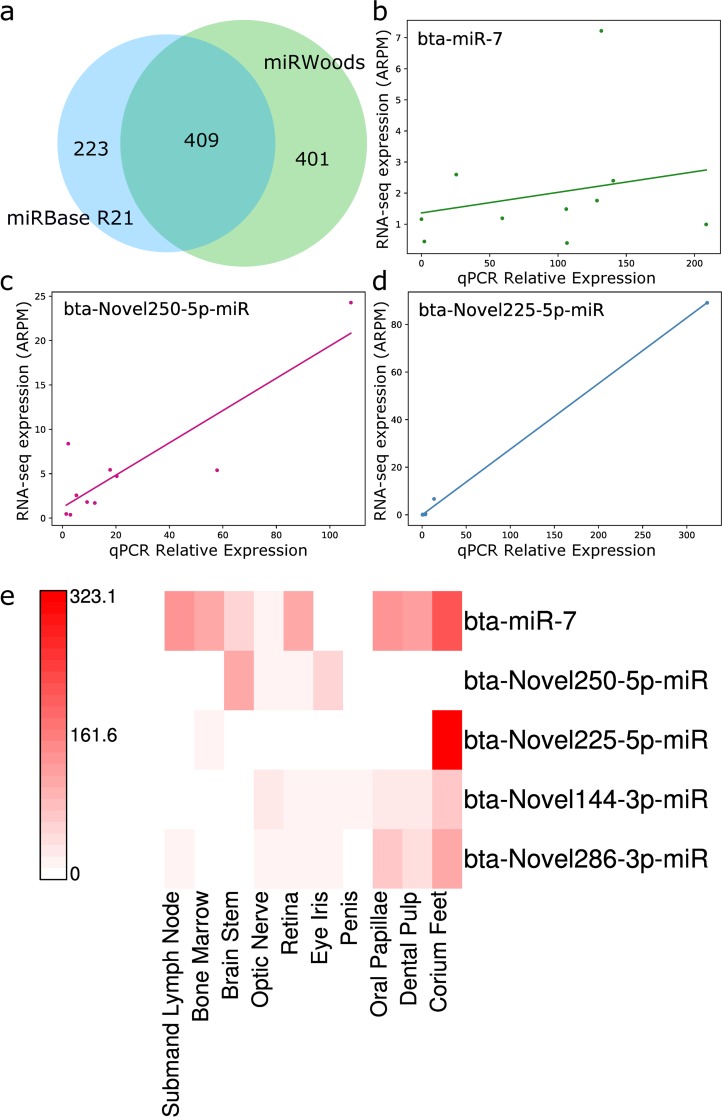
Fig 6 Novel microRNA predictions in the bovine genome. a Euler diagram comparing miRWoods predictions in the cow genome with miRBase annotations. b Scatterplot and best fit line comparing the normalized RT-qPCR expression and RNA-seq for the control miR bta-miR-7. c Scatterplot and best fit line comparing the normalized RT-qPCR expression and RNA-seq for a novel predicted miR with enriched expression in brain stem. d Scatterplot and best fit line comparing the normalized RT-qPCR expression and RNA-seq for a novel predicted miR with enriched expression in corium feet. e Heat map of RT-qPCR expression expression values over tissues examined.
Fig 6 Novel microRNA predictions in the bovine genome. a Euler diagram comparing miRWoods predictions in the cow genome with miRBase annotations. b Scatterplot and best fit line comparing the normalized RT-qPCR expression and RNA-seq for the control miR bta-miR-7. c Scatterplot and best fit line comparing the normalized RT-qPCR expression and RNA-seq for a novel predicted miR with enriched expression in brain stem. d Scatterplot and best fit line comparing the normalized RT-qPCR expression and RNA-seq for a novel predicted miR with enriched expression in corium feet. e Heat map of RT-qPCR expression expression values over tissues examined.CC BY · PubMed Central
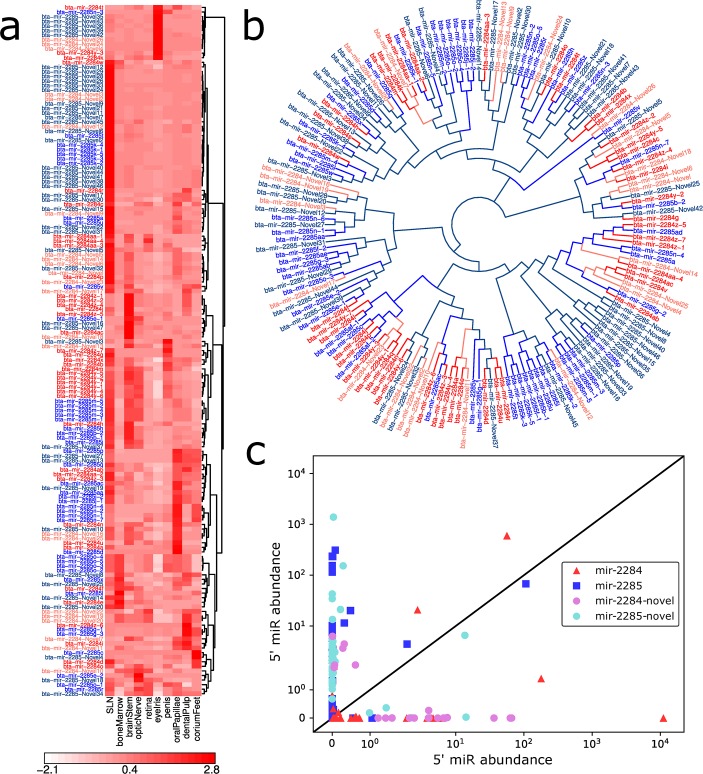
Fig 7 mir-2284/mir-2285 family miRs in Bos taurus. a A heat map for the expression of annotated and novel mir-2284/mir-2285 family miRs. b A phylogenetic tree for the bta-2284/bta-2285 family. Variants of bta-mir-2284 appear in red and variants of bta-mir-2285 appear in blue. Colors for novel predictions appear lighter than those for annotated predictions. c Abundance of miRs for the 5′ and 3′ sides of the mir-2284/mir-2285 family. The 5′ product tends to show greater expression in the mir-2284 family while the 3′ product shows greater expression in the mir-2285 family.
Fig 7 mir-2284/mir-2285 family miRs in Bos taurus. a A heat map for the expression of annotated and novel mir-2284/mir-2285 family miRs. b A phylogenetic tree for the bta-2284/bta-2285 family. Variants of bta-mir-2284 appear in red and variants of bta-mir-2285 appear in blue. Colors for novel predictions appear lighter than those for annotated predictions. c Abundance of miRs for the 5′ and 3′ sides of the mir-2284/mir-2285 family. The 5′ product tends to show greater expression in the mir-2284 family while the 3′ product shows greater expression in the mir-2285 family.CC BY · PubMed Central
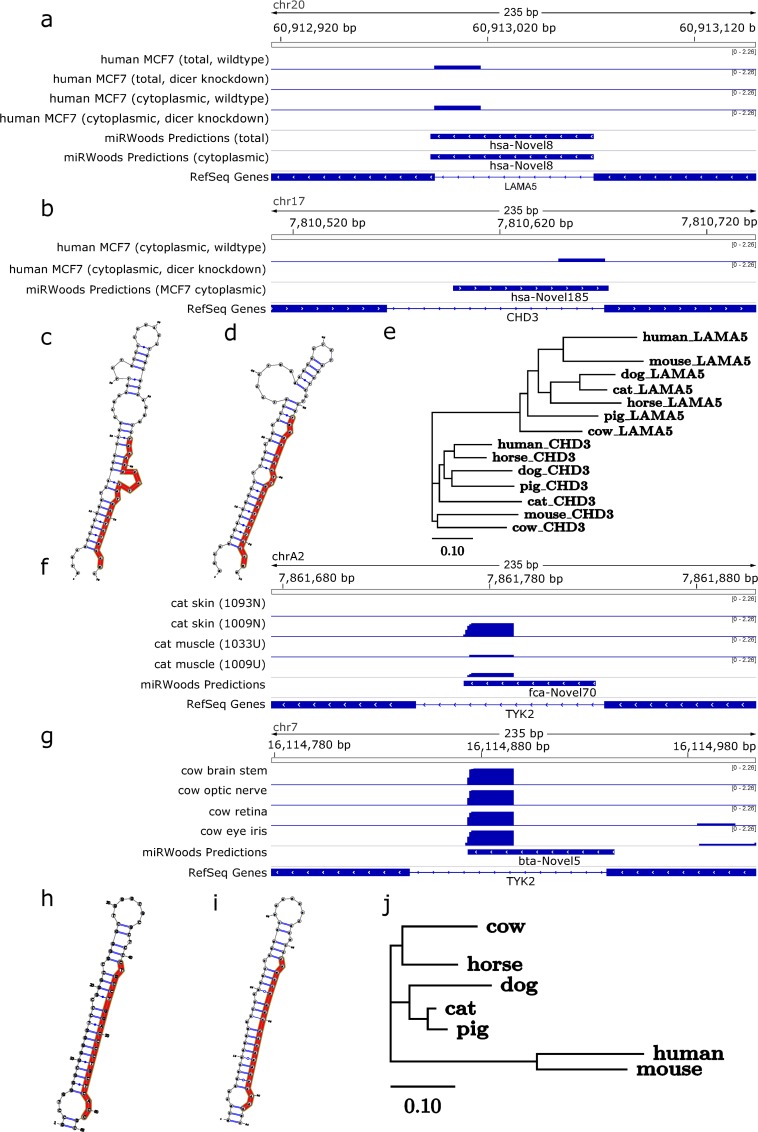
Fig 8 Novel microRNA families identified by miRWoods. a hsa-novel-8 is a mirtron predicted for both MCF-7 sets where expression was decreased in the Dicer knockdown sets. b hsa-Novel-185 is a mirtron predicted within the human cell lines set and the MCF-7 (cytoplasmic fraction) set. It also shows reduced expression in the Dicer knockdown version of the MCF-7 set. c The structure of hsa-novel-8. d The structure of hsa-Novel-185. e Phylogeny comparing the LAMA5 intron and CHD3 intron for several mammals. f Novel miR predicted in bovine genome in an intron of TYK2. g novel predicted miR in the feline genome in the same intron of TYK2 h structure of novel feline miR. i structure of novel bovine miR. Eight nucleoties were removed from the 5' end, and two were added to the 3' end to match the feline hairpin precursor boundaries. j A phylogeny comparing the TYK2 intron in several mammals.
Fig 8 Novel microRNA families identified by miRWoods. a hsa-novel-8 is a mirtron predicted for both MCF-7 sets where expression was decreased in the Dicer knockdown sets. b hsa-Novel-185 is a mirtron predicted within the human cell lines set and the MCF-7 (cytoplasmic fraction) set. It also shows reduced expression in the Dicer knockdown version of the MCF-7 set. c The structure of hsa-novel-8. d The structure of hsa-Novel-185. e Phylogeny comparing the LAMA5 intron and CHD3 intron for several mammals. f Novel miR predicted in bovine genome in an intron of TYK2. g novel predicted miR in the feline genome in the same intron of TYK2 h structure of novel feline miR. i structure of novel bovine miR. Eight nucleoties were removed from the 5' end, and two were added to the 3' end to match the feline hairpin precursor boundaries. j A phylogeny comparing the TYK2 intron in several mammals.CC BY · PubMed Central

Verification

Claims the paper makes

The claims and statistics of this paper haven’t been checked yet.

Run the check — free, no account needed. It reads the open-access text and checks the sources it cites.

A few free checks a day · papers already verified open instantly · results are public

Claims other papers make about this one

Each is checked against this paper’s own text: does it say what the citing paper says it does?

Self-check

Percentages, sums and reported differences re-computed from the paper’s own numbers.

The self-check needs the paper’s full text.

Citations

Cites

Show all 1 references

Research works printed but not linked: 39

  1. Y Lee, 2003, The nuclear RNase III Drosha initiates microRNA processing, Nature, 425, 415, 10.1038/nature01957 · DOI
  2. V Ambros, 2004, The functions of animal microRNAs, Nature, 431, 350, 10.1038/nature02871 · DOI · Paper page
  3. W Shi, 2009, A distinct class of small RNAs arises from pre-miRNA–proximal regions in a simple chordate, Nature structural & molecular biology, 16, 183, 10.1038/nsmb.1536 · DOI
  4. D Hendrix, 2010, miRTRAP, a computational method for the systematic identification of miRNAs from high throughput sequencing data, Genome biology, 11, R39, 10.1186/gb-2010-11-4-r39 · DOI
  5. MR Friedländer, 2008, Discovering microRNAs from deep sequencing data using miRDeep, Nature biotechnology, 26, 407, 10.1038/nbt1394 · DOI
  6. MR Friedländer, 2011, miRDeep2 accurately identifies known and hundreds of novel microRNA genes in seven animal clades, Nucleic acids research, 40, 37, 10.1093/nar/gkr688 · DOI · Paper page
  7. X Yang, 2011, miRDeep-P: a computational tool for analyzing the microRNA transcriptome in plants, Bioinformatics, 27, 2614, 10.1093/bioinformatics/btr430 · DOI
  8. J An, 2012, miRDeep*: an integrated application tool for miRNA identification from RNA sequencing data, Nucleic acids research, 41, 727, 10.1093/nar/gks1187 · DOI
  9. X Chen, 2009, Identification and characterization of novel amphioxus microRNAs by Solexa sequencing, Genome biology, 10, R78, 10.1186/gb-2009-10-7-r78 · DOI
  10. M Hackenberg, 2009, miRanalyzer: a microRNA detection and analysis tool for next-generation sequencing experiments, Nucleic acids research, 37, W68, 10.1093/nar/gkp347 · DOI
  11. Y Sheng, 2007, Mammalian microRNA prediction through a support vector machine model of sequence and structure, PloS one, 2, e946, 10.1371/journal.pone.0000946 · DOI
  12. S Tempel, 2015, miRBoost: boosting support vector machines for microRNA precursor classification, RNA, 21, 775, 10.1261/rna.043612.113 · DOI
  13. A Mathelier, 2010, MIReNA: finding microRNAs with high accuracy and no learning at genome scale and from deep sequencing data, Bioinformatics, 26, 2226, 10.1093/bioinformatics/btq329 · DOI
  14. P Jiang, 2007, MiPred: classification of real and pseudo microRNA precursors using random forest prediction model with combined features, Nucleic acids research, 35, W339, 10.1093/nar/gkm368 · DOI
  15. T Barrett, 2010, NCBI GEO: archive for functional genomics data sets—10 years on, Nucleic acids research, 39, D1005
  16. V Raghavan, 1989, A critical investigation of recall and precision as measures of retrieval system performance, ACM Transactions on Information Systems (TOIS), 7, 205, 10.1145/65943.65945 · DOI
  17. Davis J, Goadrich M, editors. The relationship between Precision-Recall and ROC curves. Proceedings of the 23rd international conference on Machine learning; 2006: ACM. · DOI · Paper page
  18. J-z Sun, 2014, MicroRNA miR-320a and miR-140 inhibit mink enteritis virus infection by repression of its receptor, feline transferrin receptor, Virology journal, 11, 210, 10.1186/s12985-014-0210-3 · DOI
  19. A Laganà, 2017, Discovery and characterization of the feline miRNAome, Scientific Reports, 7, 9263, 10.1038/s41598-017-10164-w · DOI
  20. CW Law, 2014, voom: Precision weights unlock linear model analysis tools for RNA-seq read counts, Genome biology, 15, R29, 10.1186/gb-2014-15-2-r29 · DOI · Paper page
  21. N Lawless, 2014, The role of microRNAs in bovine infection and immunity, Frontiers in immunology, 5, 611, 10.3389/fimmu.2014.00611 · DOI
  22. N Lawless, 2013, Next generation sequencing reveals the expression of a unique miRNA profile in response to a gram-positive bacterial infection, PloS one, 8, e57543, 10.1371/journal.pone.0057543 · DOI
  23. D Sakurai, 2018, Immunosuppressive property of submandibular lymph nodes in patients with head and neck tumors: differential distribution of regulatory T cells, BMC research notes, 11, 479, 10.1186/s13104-018-3587-z · DOI
  24. S Gu, 2011, Thermodynamic stability of small hairpin RNAs highly influences the loading process of different mammalian Argonautes, Proceedings of the National Academy of Sciences, 108, 9208, 10.1073/pnas.1018023108 · DOI
  25. H Bao, 2013, Expansion of ruminant-specific microRNAs shapes target gene expression divergence between ruminant and non-ruminant species, BMC genomics, 14, 609, 10.1186/1471-2164-14-609 · DOI
  26. M Martin, 2011, Cutadapt removes adapter sequences from high-throughput sequencing reads, EMBnet journal, 17, 10, 10.14806/ej.17.1.200 · DOI · Paper page
  27. B Langmead, 2009, Ultrafast and memory-efficient alignment of short DNA sequences to the human genome, Genome biology, 10, R25, 10.1186/gb-2009-10-3-r25 · DOI · Paper page
  28. H Li, 2009, The sequence alignment/map format and SAMtools, Bioinformatics, 25, 2078, 10.1093/bioinformatics/btp352 · DOI · Paper page
  29. JC Wootton, 1996, Methods in enzymology, 554
  30. RD Morin, 2008, Application of massively parallel sequencing to microRNA profiling and discovery in human embryonic stem cells, Genome research, 18, 610, 10.1101/gr.7179508 · DOI · Paper page
  31. M Zuker, 1981, Optimal computer folding of large RNA sequences using thermodynamics and auxiliary information, Nucleic acids research, 9, 133, 10.1093/nar/9.1.133 · DOI
  32. R Lorenz, 2011, ViennaRNA Package 2.0, Algorithms for Molecular Biology, 6, 26, 10.1186/1748-7188-6-26 · DOI · Paper page
  33. JG Ruby, 2007, Evolution, biogenesis, expression, and target predictions of a substantially expanded set of Drosophila microRNAs, Genome research, 17
  34. H Ma, 2016, A sliding-bulge structure at the Dicer processing site of pre-miRNAs regulates alternative Dicer processing to generate 5′-isomiRs, Heliyon, 2, e00148, 10.1016/j.heliyon.2016.e00148 · DOI
  35. A Kozomara, 2013, miRBase: annotating high confidence microRNAs using deep sequencing data, Nucleic acids research, 42, D68, 10.1093/nar/gkt1181 · DOI · Paper page
  36. SA Bustin, 2010, MIQE precis: Practical implementation of minimum standard guidelines for fluorescence-based quantitative real-time PCR experiments, BioMed Central
  37. HJ Peltier, 2008, Normalization of microRNA expression levels in quantitative RT-PCR assays: identification of suitable reference RNA targets in normal and cancerous human solid tissues, Rna, 14, 844, 10.1261/rna.939908 · DOI · Paper page
  38. J Ruijter, 2009, Amplification efficiency: linking baseline and bias in the analysis of quantitative PCR data, Nucleic acids research, 37, e45, 10.1093/nar/gkp045 · DOI · Paper page
  39. J Vandesompele, 2002, Accurate normalization of real-time quantitative RT-PCR data by geometric averaging of multiple internal control genes, Genome biology, 3, research0034, 10.1186/gb-2002-3-7-research0034 · DOI · Paper page

Cited by

Sorted by citations

Metadata

Authors
Bell, J., Larson, M., Kutzler, M., Bionaz, M., Löhr, C. V., & Hendrix, D.
Venue
PLOS Computational Biology
Published
2019-10-09
Volume
15
Issue
10
Pages
e1007309
ISSN
1553-7358
Cited by
10
References
1
Language
en
Funders
  • National Institutes of Health (R56 AG053460, R01 AG061406)
  • Medical Research Foundation of Oregon (1414)
  • Oregon State University (Start-up funds)

About these checks

Registry, retraction, Cites and statistics results are computed, not judged, with one exception: a printed reference that no index lists is read once by a model before it counts as a citation error. Claims are extracted by a model and kept only when their quote appears verbatim in the text; each cited source is then checked, with a model’s help, for whether it says what the claim relies on. Those verdicts can be wrong — read the claim’s quote and the cited source before relying on one.

Statistics and arithmetic are recomputed, not judged.

Confidence bands are shown only for fields calibrated on our annotated test set. None is calibrated yet, so no band is shown.

What counts as a claim ›How we measure confidence ›How we check this ›

Are you an author, or do you see a problem with this page? Request a review