

The DOI matches its Crossref record; 30 of the 30 references it cites were found in a registry or an index.
gmxapi: A GROMACS-native Python interface for molecular dynamics with ensemble and plugin support
Open accessPublished version of a preprint
Abstract
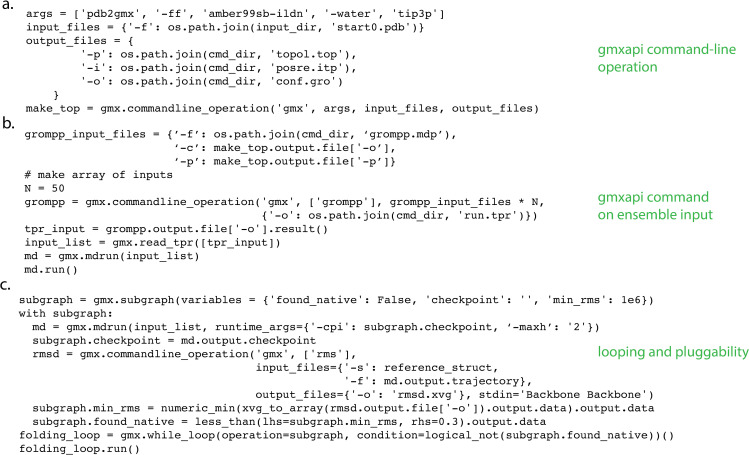
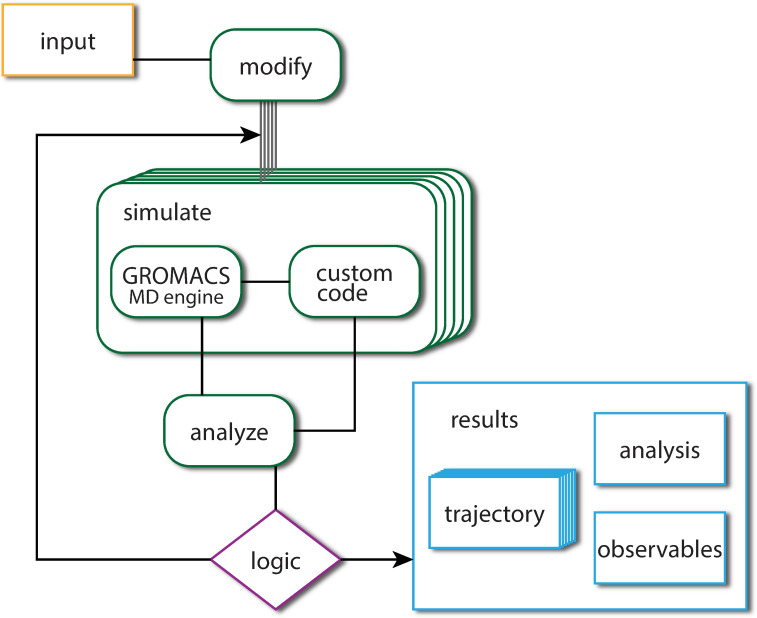
Gmxapi provides an integrated, native Python API for both standard and advanced molecular dynamics simulations in GROMACS. The Python interface permits multiple levels of integration with the core GROMACS libraries, and legacy support is provided via an interface that mimics the command-line syntax, so that all GROMACS commands are fully available. Gmxapi has been officially supported since the GROMACS 2019 release and is enabled by default in current versions of the software. Here we describe gmxapi 0.3 and later. Beyond simply wrapping GROMACS library operations, the API permits several advanced operations that are not feasible using the prior command-line interface. First, the API allows custom user plugin code within the molecular dynamics force calculations, so users can execute custom algorithms without modifying the GROMACS source. Second, the Python interface allows tasks to be dynamically defined, so high-level algorithms for molecular dynamics simulation and analysis can be coordinated with loop and conditional operations. Gmxapi makes GROMACS more accessible to custom Python scripting while also providing support for high-level data-flow simulation algorithms that were previously feasible only in external packages.
Overview
The claims and statistics of this paper haven’t been checked yet.
Run the check — free, no account needed. It reads the open-access text and checks the sources it cites.
Integrity signals
Registry
Cites
Statistics
Figures
Verification
Claims the paper makes
The claims and statistics of this paper haven’t been checked yet.
Run the check — free, no account needed. It reads the open-access text and checks the sources it cites.
Self-check
Percentages, sums and reported differences re-computed from the paper’s own numbers.
The self-check needs the paper’s full text.
Citations
Cites
Abraham, M. J., Murtola, T., Schulz, R., Páll, S., Smith, J. C., Hess, B., & Lindahl, E. (2015) · SoftwareX · doi:10.1016/j.softx.2015.06.001 · Cited by 27,190
GROMACS 4.5: a high-throughput and highly parallel open source molecular simulation toolkit
Pronk, S., Páll, S., Schulz, R., Larsson, P., Bjelkmar, P., Apostolov, R., Shirts, M. R., Smith, J. C., Kasson, P. M., van der Spoel, D., et al. (2013) · Bioinformatics · doi:10.1093/bioinformatics/btt055 · Cited by 7,473
Self-citationPLUMED 2: New feathers for an old bird
Tribello, G. A., Bonomi, M., Branduardi, D., Camilloni, C., & Bussi, G. (2014) · Computer Physics Communications · doi:10.1016/j.cpc.2013.09.018 · Cited by 3,479
Goecks, J., Nekrutenko, A., Taylor, J., & The Galaxy Team (2010) · Genome Biology · doi:10.1186/gb-2010-11-8-r86 · Cited by 3,453
Scientific workflow management and the Kepler system
Ludäscher, B., Altıntaş, İ., Berkley, C., Higgins, D., Jaeger-Frank, E., Jones, M. B., Lee, E. A., Tao, J., & Zhao, Y. (2005) · Concurrency and Computation Practice and Experience · doi:10.1002/cpe.994 · Cited by 1,719
Pegasus: A Framework for Mapping Complex Scientific Workflows onto Distributed Systems
Deelman, E., Singh, G., Su, M.-H., Blythe, J., Gil, Y., Kesselman, C., Mehta, G., Vahi, K., Berriman, G. B., Good, J., et al. (2005) · Scientific Programming · doi:10.1155/2005/128026 · Cited by 1,222
Markov state models of biomolecular conformational dynamics
Chodera, J. D., & Noé, F. (2014) · Current Opinion in Structural Biology · doi:10.1016/j.sbi.2014.04.002 · Cited by 776
Wolstencroft, K., Haines, R., Fellows, D., Williams, A., Withers, D., Owen, S., Soiland-Reyes, S., Dunlop, I., Nenadic, A., Fisher, P., et al. (2013) · Nucleic Acids Research · doi:10.1093/nar/gkt328 · Cited by 677
FireWorks: a dynamic workflow system designed for high‐throughput applications
Jain, A., Ong, S. P., Chen, W., Medasani, B., Qu, X., Kocher, M., Brafman, M., Petretto, G., Rignanese, G., Hautier, G., et al. (2015) · Concurrency and Computation: Practice and Experience · doi:10.1002/cpe.3505 · Cited by 547
Swift: A language for distributed parallel scripting
Wilde, M., Hategan, M., Wozniak, J. M., Clifford, B., Katz, D. S., & Foster, I. (2011) · Parallel Computing · doi:10.1016/j.parco.2011.05.005 · Cited by 402
Metadata
- Authors
- Irrgang, M. E., Davis, C., & Kasson, P. M.
- Affiliations
- University of Virginia (US)
- Uppsala University (SE)
- Corresponding author
- Kasson, Peter M.
- Venue
- PLOS Computational Biology
- Publisher
- Public Library of Science (PLoS)
- Published
- 2022-02-14
- Volume
- 18
- Issue
- 2
- Pages
- e1009835
- ISSN
- 1553-734X (ISSN-L)
- 1553-7358
- PMC
- PMC8880871
- OpenAlex
- W4221099088
- Cited by
- 25
- References
- 30
- Citations by year
- 2026: 7 · 2025: 11 · 2024: 4 · 2023: 3
- FWCI
- 1.47
- Type
- journal article
- Language
- en
- Update notices
- new_version (2022-02-25)
- Open access
- gold
- doi.org
- Licence
- Locations
- PLoS Computational Biology (publishedVersion, cc-by)
- bioRxiv (Cold Spring Harbor Laboratory) (acceptedVersion, cc-by-nc-nd)
- PubMed Central (publishedVersion, cc-by)
- PubMed (publishedVersion)
- Uppsala University Publications (Uppsala University) (submittedVersion, other-oa)
- RePEc: Research Papers in Economics (submittedVersion)
- DOAJ (DOAJ: Directory of Open Access Journals) (submittedVersion, cc-by-sa)
- Funders
- national institute of general medical sciences (R01 GM115790)
- national science foundation (OAC-1835780, ACI-1547580, LRAC MCB20006)
- Topics
- Life Sciences › Biochemistry, Genetics and Molecular Biology › Molecular Biology › Protein Structure and Dynamics
- Physical Sciences › Computer Science › Software › Computational Physics and Python Applications
- Physical Sciences › Chemistry › Physical and Theoretical Chemistry › Advanced Physical and Chemical Molecular Interactions
- Keywords
- GROMACS, Python interface, molecular dynamics simulation, ensemble simulation, Python scripting
- MeSH terms
- Algorithms, Software, Molecular Dynamics Simulation
About these checks
Registry, retraction, Cites and statistics results are computed, not judged, with one exception: a printed reference that no index lists is read once by a model before it counts as a citation error. Claims are extracted by a model and kept only when their quote appears verbatim in the text; each cited source is then checked, with a model’s help, for whether it says what the claim relies on. Those verdicts can be wrong — read the claim’s quote and the cited source before relying on one.
Statistics and arithmetic are recomputed, not judged.
Confidence bands are shown only for fields calibrated on our annotated test set. None is calibrated yet, so no band is shown.
What counts as a claim ›How we measure confidence ›How we check this ›
Are you an author, or do you see a problem with this page? Request a review
How to cite
Cite CoChat for the checks on this page, and the paper for its own findings.
- This page
- CoChat. (2026). Citation check: gmxapi: A GROMACS-native Python interface for molecular dynamics with ensemble and plugin support. https://app.cochat.ai/papers/10.1371/journal.pcbi.1009835
- The paper
- Irrgang, M. E., Davis, C., & Kasson, P. M. (2022). gmxapi: A GROMACS-native Python interface for molecular dynamics with ensemble and plugin support. PLOS Computational Biology. https://doi.org/10.1371/journal.pcbi.1009835
Data sources
Bibliographic data: Semantic Scholar, OpenAlex, Crossref.
Contains information from the Semantic Scholar Academic Graph Datasets, made available under the ODC Attribution License (ODC-BY 1.0).
Semantic Scholar’s data is described in: Kinney, R., et al. (2023). The Semantic Scholar Open Data Platform. arXiv:2301.10140.
