

The DOI matches its Crossref record; 61 of the 61 references it cites were found in a registry or an index.
Ig-VAE: Generative modeling of protein structure by direct 3D coordinate generation
Open accessPublished version of a preprint
Abstract
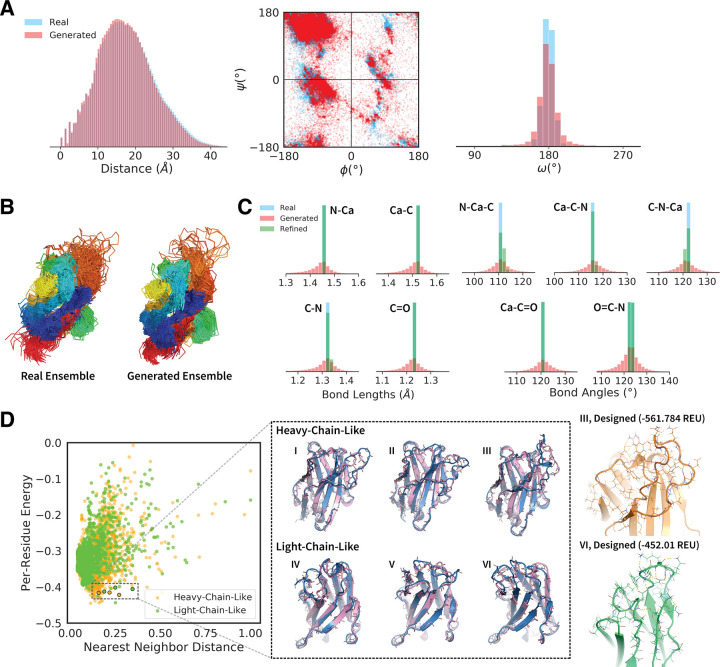
While deep learning models have seen increasing applications in protein science, few have been implemented for protein backbone generation—an important task in structure-based problems such as active site and interface design. We present a new approach to building class-specific backbones, using a variational auto-encoder to directly generate the 3D coordinates of immunoglobulins. Our model is torsion- and distance-aware, learns a high-resolution embedding of the dataset, and generates novel, high-quality structures compatible with existing design tools. We show that the Ig-VAE can be used with Rosetta to create a computational model of a SARS-CoV2-RBD binder via latent space sampling. We further demonstrate that the model’s generative prior is a powerful tool for guiding computational protein design, motivating a new paradigm under which backbone design is solved as constrained optimization problem in the latent space of a generative model.
Overview
The claims and statistics of this paper haven’t been checked yet.
Free: it reads the open-access text and checks the first 5 claims that cite a source we can check. Create a free account to check every claim.
Integrity signals
Registry
Cites
Statistics
Figures




Verification
Claims the paper makes
The claims and statistics of this paper haven’t been checked yet.
Free: it reads the open-access text and checks the first 5 claims that cite a source we can check. Create a free account to check every claim.
Claims other papers make about this one
Each is checked against this paper’s own text: does it say what the citing paper says it does?
The cited source says what the claim attributes to it.
In the citing paper
“There has been progress towards this goal and there exist approaches that address subsets of the components of this problem [53][54][55][56][63][64][65][68][69][70].”
From Computational and artificial intelligence-based methods for antibody development (2023) · cites this paper as [53]
In the citing paper
“For example, the IG-VAE model [53], which builds on previous work from the Huang group [54], generates complete backbones including all 3D coordinates by implementing a variational autoencoder trained to accurately reconstruct 3D coordinates, torsional angles, and distance maps from a learned latent space.”
From Computational and artificial intelligence-based methods for antibody development (2023) · cites this paper as [53]
Self-check
Percentages, sums and reported differences re-computed from the paper’s own numbers.
The self-check needs the paper’s full text.
Citations
Cites
(2008) · Journal of Machine Learning Research · Cited by 33,051
Auto-Encoding Variational Bayes
Kingma, D. P., & Welling, M. (2013) · arXiv · doi:10.48550/arxiv.1312.6114 · Cited by 20,067
Advances in neural information processing systems 7
(1996) · Computers & Mathematics with Applications · doi:10.1016/s0898-1221(96)90463-0 · Cited by 14,281
LIII. On lines and planes of closest fit to systems of points in space
Pearson, K. (1901) · The London, Edinburgh, and Dublin Philosophical Magazine and Journal of Science · doi:10.1080/14786440109462720 · Cited by 11,934
Improved protein structure prediction using potentials from deep learning
Senior, A. W., Evans, R., Jumper, J., Kirkpatrick, J., Sifre, L., Green, T., Qin, C., Žídek, A., Nelson, A. W. R., Bridgland, A., et al. (2020) · Nature · doi:10.1038/s41586-019-1923-7 · Cited by 3,378
PatchDock and SymmDock: servers for rigid and symmetric docking
Schneidman-Duhovny, D., Inbar, Y., Nussinov, R., & Wolfson, H. J. (2005) · Nucleic Acids Research · doi:10.1093/nar/gki481 · Cited by 3,018
Leaver-Fay (2011) · doi:10.1016/b978-0-12-381270-4.00019-6 · Cited by 1,904 · cited 2×
“All structures were idealized and relaxed under the Rosetta energy function with constraints to starting coordinates [10].”
MethodThe Rosetta All-Atom Energy Function for Macromolecular Modeling and Design
Alford, R. F., Leaver-Fay, A., Jeliazkov, J. R., O’Meara, M. J., DiMaio, F. P., Park, H., Shapovalov, M. V., Renfrew, P. D., Mulligan, V. K., Kappel, K., et al. (2017) · Journal of Chemical Theory and Computation · doi:10.1021/acs.jctc.7b00125 · Cited by 1,532
The coming of age of de novo protein design
Huang, P.-S., Boyken, S. E., & Baker, D. (2016) · Nature · doi:10.1038/nature19946 · Cited by 1,478
Self-citationImproved protein structure prediction using predicted interresidue orientations
Yang, J., Anishchenko, I., Park, H., Peng, Z., Ovchinnikov, S., & Baker, D. (2020) · Proceedings of the National Academy of Sciences · doi:10.1073/pnas.1914677117 · Cited by 1,421
Research works printed but not linked: 1
- A Riesselman, 2019, Accelerating Protein Design Using Autoregressive Generative Models., bioRxiv.
Cited by
Items 101–142 of 142
RecVAE-GBRT: Memory-Fused XGBoost for Time-Series Forecasting
Zheng, X., Bagloee, S. A., & Sarvi, M. (2024) · International Joint Conference on Neural Networks (IJCNN) · doi:10.1109/ijcnn60899.2024.10650508 · Cited by 5
Ratcliff, J. (2024) · NAR Genomics and Bioinformatics · doi:10.1093/nargab/lqae129 · Cited by 7
Echidna: integrated simulations of single-cell immune receptor repertoires and transcriptomes
Han, J., Masserey, S., Shlesinger, D., Kuhn, R., Papadopoulou, C., Agrafiotis, A., Kreiner, V., Dizerens, R., Hong, K., Weber, C. R., et al. (2022) · Bioinformatics Advances · doi:10.1093/bioadv/vbac062 · Cited by 6
PeTriBERT : Augmenting BERT with tridimensional encoding for inverse protein folding and designPreprint
Dumortier, B., Antoine Liutkus, A., Carré, C., & Krouk, G. (2022) · bioRxiv (Cold Spring Harbor Laboratory) · doi:10.1101/2022.08.10.503344 · Cited by 6
Protein Language Model Supervised Precise and Efficient Protein Backbone Design MethodPreprint
Zhang, B., Liu, K., Zheng, Z., Liu, Y., Mu, J., Wei, T., & Chen, H. (2023) · bioRxiv (Cold Spring Harbor Laboratory) · doi:10.1101/2023.10.26.564121 · Cited by 6
A comprehensive survey on artificial intelligence for biomolecule design
Yang, G., Li, J., Wang, Q., Wu, L., Chen, Z., Zhao, P.-C., Wang, H., Wang, Q., Wen, B., Song, C., et al. (2026) · The Innovation Life · doi:10.59717/j.xinn-life.2026.100196 · Cited by 5
Contrastive learning enables epitope overlap predictions for targeted antibody discovery
Holt, C., Janke, A. K., Amlashi, P., Jamieson, P. J., Marinov, T. M., & Georgiev, I. S. (2025) · Patterns · doi:10.1016/j.patter.2025.101419 · Cited by 6
Slabodkin, A., Sollid, L. M., Sandve, G. K., Robert, P. A., & Greiff, V. (2023) · bioRxiv (Cold Spring Harbor Laboratory) · doi:10.1101/2023.09.24.558823 · Cited by 3
Tpgen: a language model for stable protein design with a specific topology structure
Min, X., Yang, C., Xie, J. H., Huang, Y., Liu, N., Jin, X., Wang, T., Kong, Z., Lu, X., Ge, S., et al. (2024) · BMC Bioinformatics · doi:10.1186/s12859-024-05637-5 · Cited by 3
Liu, Y., Chen, L.-H., & Liu, H. (2022) · bioRxiv (Cold Spring Harbor Laboratory) · doi:10.1101/2022.12.17.520847 · Cited by 4
Kohout, P., Vasina, M., Majerova, M., Novakova, V., Damborský, J., Bednář, D., Marek, M., Prokop, Z., & Mazurenko, S. (2023) · ChemRxiv · doi:10.26434/chemrxiv-2023-jcds7 · Cited by 3
Feng, H., Qiu, P., Zhang, M.-C., Tao, Y., Fan, Y., Xu, J., & Póczos, B. (2025) · bioRxiv (Cold Spring Harbor Laboratory) · doi:10.1101/2025.08.02.668313 · Cited by 4
From evolution to rational design: AI-driven engineering of safe and highly efficient food enzymes
Wu, X., Yuan, Y., Wang, F., Lu, F., & Liu, F. (2026) · Biotechnology Advances · doi:10.1016/j.biotechadv.2026.108901 · Cited by 2
PB-GPT: An innovative GPT-based model for protein backbone generation
Min, X., Liao, Y., Chen, X., Yang, Q., Ying, J., Zou, J., Yang, C., Zhang, J., Ge, S., & Xia, N. (2024) · Structure · doi:10.1016/j.str.2024.07.016 · Cited by 2
DiffTopo: Fold exploration using coarse grained protein topology representationsPreprint
Miao, Y., & Correia, B. E. (2024) · bioRxiv (Cold Spring Harbor Laboratory) · doi:10.1101/2024.02.01.578456 · Cited by 4
Highly Accurate Protein Structure Classification and Prediction
Saha, A., & Sarkar, I. (2023) · International Conference on Computational Systems and Communication (ICCSC) · doi:10.1109/iccsc56913.2023.10142975 · Cited by 1
Kotel'nikov, D. D., Tatarinova, K. S., & Zhdanov, D. D. (2025) · International Journal of Molecular Sciences · doi:10.3390/ijms26199262 · Cited by 1
Shen, R., Zhao, M., Wang, W., & Dong, H. (2026) · The Journal of Physical Chemistry Letters · doi:10.1021/acs.jpclett.6c00485 · Cited by 1
Duan, B., & Sun, Y. (2021) · International Conference on Biological Information and Biomedical Engineering (BIBE) · doi:10.1145/3469678.3469685 · Cited by 1
Protein hydrogels: structure, characteristics, and applications
Hromić‐Jahjefendić, A., Golzardi, M., & Uversky, V. N. (2024) · Elsevier eBooks · doi:10.1016/b978-0-443-21809-5.00002-8 · Cited by 2
Application of Artificial Intelligence and Computational Biology in Protein Drug Development
Jiang, J., Li, W., Huang, W., Lou, X., Shi, X., Guo, C., Yu, X., Tursumamat, N., Wu, G., Liu, Q., et al. (2025) · Pharmaceutical Fronts · doi:10.1055/a-2520-3833 · Cited by 1
Deep Multi-attribute Graph Representation Learning on Protein StructuresPreprint
Xia, T., & Ku, W. (2020) · arXiv (Cornell University) · doi:10.48550/arxiv.2012.11762 · Cited by 2
TopoDiff: Improving Protein Backbone Generation with Topology-aware Latent EncodingPreprint
Zhang, Y., Ma, Z., & Gong, H. (2023) · bioRxiv (Cold Spring Harbor Laboratory) · doi:10.1101/2023.12.13.571602 · Cited by 1
Artificial Intelligence and Machine Learning in Bioinformatics
O’Brien, M. J., Sng, L. M. F., Ramarao-Milne, P., Didi, K., & Bauer, D. C. (2024) · Elsevier eBooks · doi:10.1016/b978-0-323-95502-7.00108-1 · Cited by 1
Okuda, S. L., Minami, A., Aiko, M., Uetsuka, K., Miyazaki, K., Ohtake, K., & Kiga, D. (2025) · bioRxiv (Cold Spring Harbor Laboratory) · doi:10.64898/2025.12.31.697150 · Cited by 1
Protein Manufacture: Protein Design Assisted by Machine Learning from Backbone to Sequence
Xu, M. K., Luo, Y., Jiang, J., Cui, Z., & Wu, H. (2024) · Lecture notes in computer science · doi:10.1007/978-981-97-5692-6_30
How deep can we decipher protein evolution with deep learning models
Fu, X. (2024) · Patterns · doi:10.1016/j.patter.2024.101043
ϑ-Spiral Discovery Reveals a New Class of Biological Building BlockPreprint
Garton, M. (2024) · Research Square · doi:10.21203/rs.3.rs-4850060/v1
Liu, S., & Liu, Z. (2025) · Chinese Science Bulletin (Chinese Version) · doi:10.1360/tb-2024-1178
Xie, J., Lü, Q., & Bian, W. (2025) · Chemistry - Methods · doi:10.1002/cmtd.202500004 · Cited by 1
Clustering Diffusion Model for Improving Protein Structure Prediction Performance
Zhong, W., Zhang, X., & Yu, N. (2025) · International Conference on Artificial Intelligence and Big Data (ICAIBD) · doi:10.1109/icaibd64986.2025.11082075
Deep learning in protein structure prediction
Wu, J. (2025) · Elsevier eBooks · doi:10.1016/b978-0-44-332908-1.00023-4
Constrained Diffusion for Protein Design with Hard Structural ConstraintsPreprint
Christopher, J. K., Seamann, A., Cui, J., Khare, S. D., & Fioretto, F. (2025) · bioRxiv (Cold Spring Harbor Laboratory) · doi:10.1101/2025.10.15.682365 · Cited by 4
ADAPT-M: a workflow for rapid, quantitative in vitro measurements of enriched protein libraries
Perez, C. P., DelRosso, N. V., Noland, C. L., Parekh, U., Choe, C. A., Eguchi, R. R., Wen, Q., Fordyce, P. M., & Huang, P. (2026) · Nature Communications · doi:10.1038/s41467-026-75463-1 · Cited by 3
Self-citationWei, S., Zhang, J., Chen, Y., Tang, C., & Tan, J. (2026) · Bioinformatics · doi:10.1093/bioinformatics/btag042 · Cited by 3
Guan, Q., & Cai, Y. (2026) · Journal of Chemical Theory and Computation · doi:10.1021/acs.jctc.6c00987
Experimental immunologists in the era of artificial intelligence
Wang, Y., Ouyang, W. O., Wang, C., Nourmohammad, A., Liu, G., & Wu, N. C. (2026) · Trends in Immunology · doi:10.1016/j.it.2026.01.003
AI-Driven BCR Modeling for Precision Immunology
Liu, T., Zhao, X., & Yang, F. (2026) · International Journal of Molecular Sciences · doi:10.3390/ijms27073296
STGAT : A Novel Spatiotemporal Graph Attention Approach for Dynamical Trajectory Prediction
Tong, H., Zhang, N., Lu, Z., Wei, T., & Chen, H. (2026) · Chemical Biology & Drug Design · doi:10.1111/cbdd.70319
Szataniak, I., & Packi, K. (2026) · Antibodies · doi:10.3390/antib15050081
Jiang, H., Bi, X., Ma, W., Huang, X., Nie, J., Wei, Z., & Zhang, S. (2026) · Pattern Recognition · doi:10.1016/j.patcog.2026.114908
Biotechnological applications of engineered proteins: advancements and challenges
Pusala, B., Sharma, B., Agarwal, S., Gulati, K., & Poluri, K. M. (2026) · Elsevier eBooks · doi:10.1016/b978-0-443-44536-1.00015-8
Metadata
- Authors
- Eguchi, R. R., Choe, C. A., & Huang, P.-S.
- Affiliations
- Stanford University (US)
- Corresponding author
- Eguchi, Raphael R.
- Choe, Christian A.
- Huang, Po-Ssu
- Venue
- PLOS Computational Biology
- Publisher
- Public Library of Science (PLoS)
- Published
- 2022-06-27
- Volume
- 18
- Issue
- 6
- Pages
- e1010271
- ISSN
- 1553-734X (ISSN-L)
- 1553-7358
- PMC
- PMC9269947
- OpenAlex
- W4283588088
- Cited by
- 141
- References
- 60
- Citations by year
- 2026: 14 · 2025: 21 · 2024: 35 · 2023: 31 · 2022: 20
- FWCI
- 8.74
- Type
- journal article
- Language
- en
- Update notices
- new_version (2022-07-08)
- Open access
- gold
- doi.org
- Licence
- Locations
- PLoS Computational Biology (publishedVersion, cc-by)
- bioRxiv (Cold Spring Harbor Laboratory) (acceptedVersion)
- PubMed Central (publishedVersion, cc-by)
- PubMed (publishedVersion)
- RePEc: Research Papers in Economics (submittedVersion)
- DOAJ (DOAJ: Directory of Open Access Journals) (submittedVersion)
- OSTI OAI (U.S. Department of Energy Office of Scientific and Technical Information) (submittedVersion)
- Funders
- School of Medicine, Stanford University
- Advanced Scientific Computing Research (SciDAC)
- Chemistry, Engineering and Medicine for Human Health, Stanford University (ChEM-H)
- National Institute of General Medical Sciences (T32GM120007.)
- Topics
- Life Sciences › Biochemistry, Genetics and Molecular Biology › Molecular Biology › Protein Structure and Dynamics
- Life Sciences › Pharmacology, Toxicology and Pharmaceutics › Drug Discovery › Computational Drug Discovery Methods
- Life Sciences › Biochemistry, Genetics and Molecular Biology › Structural Biology › Enzyme Structure and Function
- Keywords
- immunoglobulins, variational autoencoder, latent space sampling, protein design, active site design, interface design, Rosetta
- MeSH terms
- COVID-19, SARS-CoV-2, Humans, Immunoglobulins, Proteins, RNA, Viral
About these checks
Registry, retraction, Cites and statistics results are computed, not judged, with one exception: a printed reference that no index lists is read once by a model before it counts as a citation error. Claims are extracted by a model and kept only when their quote appears verbatim in the text; each cited source is then checked, with a model’s help, for whether it says what the claim relies on. Those verdicts can be wrong — read the claim’s quote and the cited source before relying on one.
Statistics and arithmetic are recomputed, not judged.
Confidence bands are shown only for fields calibrated on our annotated test set. None is calibrated yet, so no band is shown.
What counts as a claim ›How we measure confidence ›How we check this ›
Are you an author, or do you see a problem with this page? Request a review
Data sources
Bibliographic data: Semantic Scholar, OpenAlex, Crossref.
Contains information from the Semantic Scholar Academic Graph Datasets, made available under the ODC Attribution License (ODC-BY 1.0).
Semantic Scholar’s data is described in: Kinney, R., et al. (2023). The Semantic Scholar Open Data Platform. arXiv:2301.10140.
