

Ig-VAE: Generative modeling of protein structure by direct 3D coordinate generation
Open accessPublished version of a preprint
The DOI matches its Crossref record; 61 of the 61 references it cites were found in a registry or an index.
Abstract
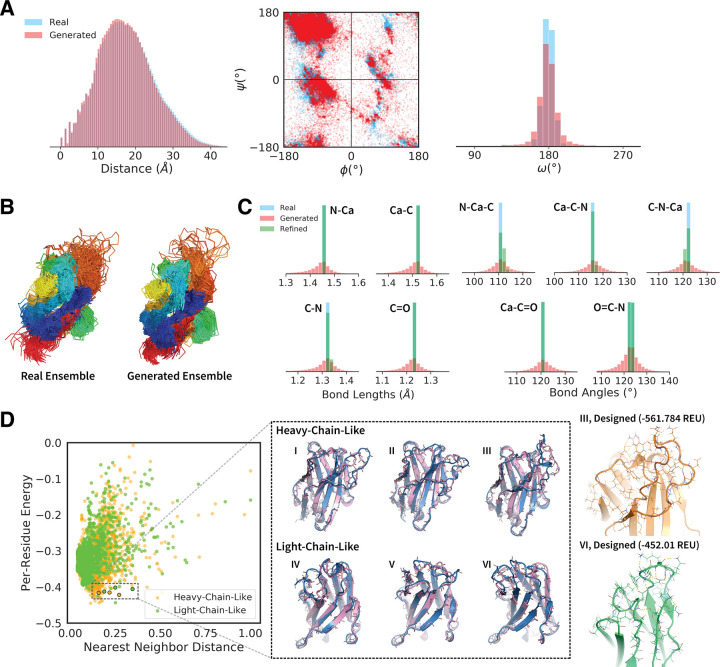
While deep learning models have seen increasing applications in protein science, few have been implemented for protein backbone generation—an important task in structure-based problems such as active site and interface design. We present a new approach to building class-specific backbones, using a variational auto-encoder to directly generate the 3D coordinates of immunoglobulins. Our model is torsion- and distance-aware, learns a high-resolution embedding of the dataset, and generates novel, high-quality structures compatible with existing design tools. We show that the Ig-VAE can be used with Rosetta to create a computational model of a SARS-CoV2-RBD binder via latent space sampling. We further demonstrate that the model’s generative prior is a powerful tool for guiding computational protein design, motivating a new paradigm under which backbone design is solved as constrained optimization problem in the latent space of a generative model.
Overview
The claims and statistics of this paper haven’t been checked yet.
Free: it reads the open-access text and checks the first 5 claims that cite a source we can check. Create a free account to check every claim.
Integrity signals
Registry
Cites
Statistics
Figures




Verification
Claims the paper makes
The claims and statistics of this paper haven’t been checked yet.
Free: it reads the open-access text and checks the first 5 claims that cite a source we can check. Create a free account to check every claim.
Claims other papers make about this one
Each is checked against this paper’s own text: does it say what the citing paper says it does?
The cited source says what the claim attributes to it.
In the citing paper
“There has been progress towards this goal and there exist approaches that address subsets of the components of this problem [53][54][55][56][63][64][65][68][69][70].”
From Computational and artificial intelligence-based methods for antibody development (2023) · cites this paper as [53]
In the citing paper
“For example, the IG-VAE model [53], which builds on previous work from the Huang group [54], generates complete backbones including all 3D coordinates by implementing a variational autoencoder trained to accurately reconstruct 3D coordinates, torsional angles, and distance maps from a learned latent space.”
From Computational and artificial intelligence-based methods for antibody development (2023) · cites this paper as [53]
Self-check
Percentages, sums and reported differences re-computed from the paper’s own numbers.
The self-check needs the paper’s full text.
Citations
Cites
(2008) · Journal of Machine Learning Research · Cited by 33,051
Auto-Encoding Variational Bayes
Kingma, D. P., & Welling, M. (2013) · arXiv · doi:10.48550/arxiv.1312.6114 · Cited by 20,067
Advances in neural information processing systems 7
(1996) · Computers & Mathematics with Applications · doi:10.1016/s0898-1221(96)90463-0 · Cited by 14,281
LIII. On lines and planes of closest fit to systems of points in space
Pearson, K. (1901) · The London, Edinburgh, and Dublin Philosophical Magazine and Journal of Science · doi:10.1080/14786440109462720 · Cited by 11,934
Improved protein structure prediction using potentials from deep learning
Senior, A. W., Evans, R., Jumper, J., Kirkpatrick, J., Sifre, L., Green, T., Qin, C., Žídek, A., Nelson, A. W. R., Bridgland, A., et al. (2020) · Nature · doi:10.1038/s41586-019-1923-7 · Cited by 3,378
PatchDock and SymmDock: servers for rigid and symmetric docking
Schneidman-Duhovny, D., Inbar, Y., Nussinov, R., & Wolfson, H. J. (2005) · Nucleic Acids Research · doi:10.1093/nar/gki481 · Cited by 3,018
Leaver-Fay (2011) · doi:10.1016/b978-0-12-381270-4.00019-6 · Cited by 1,904 · cited 2×
“All structures were idealized and relaxed under the Rosetta energy function with constraints to starting coordinates [10].”
MethodThe Rosetta All-Atom Energy Function for Macromolecular Modeling and Design
Alford, R. F., Leaver-Fay, A., Jeliazkov, J. R., O’Meara, M. J., DiMaio, F. P., Park, H., Shapovalov, M. V., Renfrew, P. D., Mulligan, V. K., Kappel, K., et al. (2017) · Journal of Chemical Theory and Computation · doi:10.1021/acs.jctc.7b00125 · Cited by 1,532
The coming of age of de novo protein design
Huang, P.-S., Boyken, S. E., & Baker, D. (2016) · Nature · doi:10.1038/nature19946 · Cited by 1,478
Self-citationImproved protein structure prediction using predicted interresidue orientations
Yang, J., Anishchenko, I., Park, H., Peng, Z., Ovchinnikov, S., & Baker, D. (2020) · Proceedings of the National Academy of Sciences · doi:10.1073/pnas.1914677117 · Cited by 1,421
Research works printed but not linked: 1
- A Riesselman, 2019, Accelerating Protein Design Using Autoregressive Generative Models., bioRxiv.
Cited by
De novo protein design by deep network hallucination
Anishchenko, I., Chidyausiku, T. M., Ovchinnikov, S., Pellock, S. J., & Baker, D. (2020) · doi:10.1101/2020.07.22.211482 · Cited by 629
Scaffolding protein functional sites using deep learning
Wang, J., Lisanza, S., Juergens, D., Tischer, D., Watson, J. L., Castro, K. M., Ragotte, R., Saragovi, A., Milles, L. F., Baek, M., et al. (2022) · Science · doi:10.1126/science.abn2100 · Cited by 487
Illuminating protein space with a programmable generative model
Ingraham, J. B., Baranov, M., Costello, Z., Barber, K. W., Wang, W., Ismail, A., Frappier, V., Lord, D. M., Ng-Thow-Hing, C., Van Vlack, E. R., et al. (2023) · Nature · doi:10.1038/s41586-023-06728-8 · Cited by 444
“22 and Supplementary Appendix L).”
Learning inverse folding from millions of predicted structures
Hsu, C., Verkuil, R., Liu, J., Lin, Z., Hie, B., Sercu, T., Lerer, A., & Rives, A. (2022) · bioRxiv (Cold Spring Harbor Laboratory) · doi:10.1101/2022.04.10.487779 · Cited by 416
Machine learning for functional protein design
Notin, P., Rollins, N., Gal, Y., Sander, C., & Marks, D. (2024) · Nature Biotechnology · doi:10.1038/s41587-024-02127-0 · Cited by 270
Recent advances in de novo protein design: Principles, methods, and applications
Pan, X., & Kortemme, T. (2021) · Journal of Biological Chemistry · doi:10.1016/j.jbc.2021.100558 · Cited by 228
Deep Learning in Protein Structural Modeling and Design
Gao, W., Mahajan, S. P., Sulam, J., & Gray, J. J. (2020) · Patterns · doi:10.1016/j.patter.2020.100142 · Cited by 227
Learning functional properties of proteins with language models
Unsal, S., Atas, H., Albayrak, M., Turhan, K., Acar, A. C., & Doğan, T. (2022) · Nature Machine Intelligence · doi:10.1038/s42256-022-00457-9 · Cited by 202
Protein structure generation via folding diffusion
Wu, K. E., Yang, K. K., van den Berg, R., Alamdari, S., Zou, J. Y., Lu, A. X., & Amini, A. P. (2024) · Nature Communications · doi:10.1038/s41467-024-45051-2 · Cited by 178
Protein structure generation via folding diffusion
Wu, K. E., Yang, K. K., Berg, R. V. D., Zou, J. Y., Lu, A. X., & Amini, A. P. (2022) · arXiv · doi:10.48550/arxiv.2209.15611 · Cited by 193
Opportunities and challenges in design and optimization of protein function
Listov, D., Goverde, C. A., Correia, B. E., & Fleishman, S. J. (2024) · Nature Reviews Molecular Cell Biology · doi:10.1038/s41580-024-00718-y · Cited by 180
Computational and artificial intelligence-based methods for antibody development
Kim, J., McFee, M., Fang, Q., Abdin, O., & Kim, P. M. (2023) · Trends in Pharmacological Sciences · doi:10.1016/j.tips.2022.12.005 · Cited by 178
Protein sequence design with a learned potential
Anand, N., Eguchi, R., Mathews, I. I., Perez, C. P., Derry, A., Altman, R. B., & Huang, P.-S. (2022) · Nature Communications · doi:10.1038/s41467-022-28313-9 · Cited by 171
Self-citationAnimal immunization, in vitro display technologies, and machine learning for antibody discovery
Laustsen, A. H., Greiff, V., Karatt-Vellatt, A., Muyldermans, S., & Jenkins, T. P. (2021) · Trends in Biotechnology · doi:10.1016/j.tibtech.2021.03.003 · Cited by 147
Diffusion models in bioinformatics and computational biology
Guo, Z., Liu, J., Wang, Y., Chen, M., Wang, D., Xu, D., & Cheng, J. (2023) · Nature Reviews Bioengineering · doi:10.1038/s44222-023-00114-9 · Cited by 139
Artificial Intelligence in Pharmaceutical Sciences
Lu, M., Yin, J., Zhu, Q., Lin, G., Mou, M., Liu, F., Pan, Z., You, N., Lian, X., Li, F., et al. (2023) · Engineering · doi:10.1016/j.eng.2023.01.014 · Cited by 157
From sequence to function through structure: Deep learning for protein design
(2022) · doi:10.1016/j.csbj.2022.11.014 · Cited by 124
Deep generative modeling for protein design
Strokach, A., & Kim, P. M. (2022) · Current Opinion in Structural Biology · doi:10.1016/j.sbi.2021.11.008 · Cited by 115
Sparks of function by de novo protein design
Chu, A. E., Lu, T., & Huang, P.-S. (2024) · Nature Biotechnology · doi:10.1038/s41587-024-02133-2 · Cited by 114
Self-citationA new age in protein design empowered by deep learning
Khakzad, H., Igashov, I., Schneuing, A., Goverde, C. A., Bronstein, M. M., & Correia, B. E. (2023) · Cell Systems · doi:10.1016/j.cels.2023.10.006 · Cited by 142
Ghafarollahi, A., & Buehler, M. J. (2024) · Digital Discovery · doi:10.1039/d4dd00013g · Cited by 106
Machine learning to navigate fitness landscapes for protein engineering
Freschlin, C. R., Fahlberg, S. A., & Romero, P. A. (2022) · Current Opinion in Biotechnology · doi:10.1016/j.copbio.2022.102713 · Cited by 107
De novo protein design by inversion of the AlphaFold structure prediction network
Goverde, C. A., Wolf, B., Khakzad, H., Rosset, S., & Correia, B. E. (2023) · Protein Science · doi:10.1002/pro.4653 · Cited by 103
“, 2022) and Variational Auto-Encoders (VAEs) (Eguchi et al., 2022; Guo et al., 2021).”
MethodGeometric deep learning for drug discovery
Liu, M., Li, C., Chen, R., Cao, D., & Zeng, X. (2023) · Expert Systems with Applications · doi:10.1016/j.eswa.2023.122498 · Cited by 107
Structure-based protein design with deep learning
Ovchinnikov, S., & Huang, P.-S. (2021) · Current Opinion in Chemical Biology · doi:10.1016/j.cbpa.2021.08.004 · Cited by 93
Self-citationAn all-atom protein generative model
Chu, A. E., Kim, J., Cheng, L., Nesr, G. E., Xu, M., Shuai, R. W., & Huang, P. (2024) · Proceedings of the National Academy of Sciences · doi:10.1073/pnas.2311500121 · Cited by 136
Self-citationGreiff, V., Yaari, G., & Cowell, L. G. (2020) · Current Opinion in Systems Biology · doi:10.1016/j.coisb.2020.10.010 · Cited by 89
Generative adversarial networks and diffusion models in material discovery
Alverson, M., Baird, S. G., Murdock, R., Ho, S.-H. E., Johnson, J. A., & Sparks, T. D. (2023) · Digital Discovery · doi:10.1039/d3dd00137g · Cited by 104
Protein-Based Hydrogels and Their Biomedical Applications
Lee, K. Z., Jeon, J., Jiang, B., Subramani, S. V., Li, J., & Zhang, F. (2023) · Molecules · doi:10.3390/molecules28134988 · Cited by 98
Khuat, T. T., Bassett, R., Otte, E. A., Grevis-James, A., & Gabryś, B. (2024) · Computers & Chemical Engineering · doi:10.1016/j.compchemeng.2024.108585 · Cited by 108
In silico proof of principle of machine learning-based antibody design at unconstrained scale
Akbar, R., Robert, P. A., Weber, C. R., Widrich, M., Frank, R., Pavlović, M., Scheffer, L., Chernigovskaya, M., Snapkov, I., Slabodkin, A., et al. (2022) · mAbs · doi:10.1080/19420862.2022.2031482 · Cited by 94
Illuminating protein space with a programmable generative model
Ingraham, J., Baranov, M., Costello, Z., Frappier, V., Ismail, A., Tie, S., Wang, W., Xue, V., Obermeyer, F., Beam, A., et al. (2022) · doi:10.1101/2022.12.01.518682 · Cited by 83
Unlocking de novo antibody design with generative artificial intelligencePreprint
Shanehsazzadeh, A., McPartlon, M., Kasun, G. W., Steiger, A. K., Sutton, J. M., Yassine, E., McCloskey, C. M., Haile, R. G., Shuai, R. W., Alverio, J., et al. (2023) · bioRxiv (Cold Spring Harbor Laboratory) · doi:10.1101/2023.01.08.523187 · Cited by 145
Wilman, W., Wróbel, S., Bielska, W., Deszynski, P., Dudzic, P., Jaszczyszyn, I., Kaniewski, J., Młokosiewicz, J., Rouyan, A., Satława, T., et al. (2022) · Briefings in Bioinformatics · doi:10.1093/bib/bbac267 · Cited by 79
Guarra, F., & Colombo, G. (2023) · Journal of Chemical Theory and Computation · doi:10.1021/acs.jctc.3c00513 · Cited by 87
Robert, P. A., Akbar, R., Frank, R., Pavlović, M., Widrich, M., Snapkov, I., Slabodkin, A., Chernigovskaya, M., Scheffer, L., Smorodina, E., et al. (2022) · Nature Computational Science · doi:10.1038/s43588-022-00372-4 · Cited by 76
Biosensor and machine learning-aided engineering of an amaryllidaceae enzyme
d’Oelsnitz, S., Diaz, D. J., Kim, W., Acosta, D. J., Dangerfield, T. L., Schechter, M. W., Minus, M. B., Howard, J. R., Do, H., Loy, J. M., et al. (2024) · Nature Communications · doi:10.1038/s41467-024-46356-y · Cited by 58
Dewaker, V., Morya, V. K., Kim, Y. H., Park, S. T., Kim, H. S., & Koh, Y. H. (2025) · Biomarker Research · doi:10.1186/s40364-025-00764-4 · Cited by 63
Antibody design using deep learning: from sequence and structure design to affinity maturation
Joubbi, S., Micheli, A., Milazzo, P., Maccari, G., Ciano, G., Cardamone, D., & Medini, D. (2024) · Briefings in Bioinformatics · doi:10.1093/bib/bbae307 · Cited by 67
Protein Ensemble Generation Through Variational Autoencoder Latent Space Sampling
Mansoor, S., Baek, M., Park, H., Lee, G. R., & Baker, D. A. (2024) · Journal of Chemical Theory and Computation · doi:10.1021/acs.jctc.3c01057 · Cited by 52
The RESP AI model accelerates the identification of tight-binding antibodies
Parkinson, J., Hard, R. L., & Wang, W. (2023) · Nature Communications · doi:10.1038/s41467-023-36028-8 · Cited by 57
Toward real-world automated antibody design with combinatorial Bayesian optimization
Khan, A. A., Cowen-Rivers, A. I., Grosnit, A., Deik, D.-G.-X., Robert, P. A., Greiff, V., Smorodina, E., Rawat, P., Akbar, R., Dreczkowski, K., et al. (2023) · Cell Reports Methods · doi:10.1016/j.crmeth.2022.100374 · Cited by 95
Liu, Y., Wang, S., Dong, J., Chen, L.-H., Wang, X., Wang, L., Li, F., Wang, C., Zhang, J., Wang, Y., et al. (2024) · Nature Methods · doi:10.1038/s41592-024-02437-w · Cited by 61
What is missing in autonomous discovery: open challenges for the community
Maffettone, P. M., Friederich, P., Baird, S. G., Blaiszik, B. J., Brown, K. A., Campbell, S. I., Cohen, O., Davis, R. L., Foster, I. T., Haghmoradi, N., et al. (2023) · Digital Discovery · doi:10.1039/d3dd00143a · Cited by 52
Protein Design with Deep Learning
Defresne, M., Barbe, S., & Schiex, T. (2021) · International Journal of Molecular Sciences · doi:10.3390/ijms222111741 · Cited by 59
Protein sequence‐to‐structure learning: Is this the end(‐to‐end revolution)?
Laine, E., Eismann, S., Elofsson, A., & Grudinin, S. (2021) · Proteins: Structure, Function, and Bioinformatics · doi:10.1002/prot.26235 · Cited by 44
Yin, S. (2025) · Biosensors · doi:10.3390/bios15100656 · Cited by 50
Protein Sequence Design with a Learned PotentialPreprint
Anand, N., Eguchi, R. R., Mathews, I. I., Perez, C. P., Derry, A., Altman, R. B., & Huang, P. (2020) · bioRxiv (Cold Spring Harbor Laboratory) · doi:10.1101/2020.01.06.895466 · Cited by 40
Self-citationDesign of proteins presenting discontinuous functional sites using deep learning
Tischer, D., Lisanza, S., Wang, J., Dong, R., Anishchenko, I., Milles, L. F., Ovchinnikov, S., & Baker, D. (2020) · bioRxiv (Cold Spring Harbor Laboratory) · doi:10.1101/2020.11.29.402743 · Cited by 36
Wang, J., Watson, J. L., & Lisanza, S. L. (2024) · Cold Spring Harbor Perspectives in Biology · doi:10.1101/cshperspect.a041472 · Cited by 48
Kim, D. N., McNaughton, A. D., & Kumar, N. (2024) · Bioengineering · doi:10.3390/bioengineering11020185 · Cited by 39
Applications of Artificial Intelligence in Biotech Drug Discovery and Product Development
Liu, Y., Zhang, L., Jiang, Z., Tian, X., Li, P., Wu, P., Du, W., Yuan, B., Xie, C., Bu, G., et al. (2025) · MedComm · doi:10.1002/mco2.70317 · Cited by 50
Generative deep learning for macromolecular structure and dynamics
Hoseini, P., Zhao, L., & Shehu, A. (2020) · Current Opinion in Structural Biology · doi:10.1016/j.sbi.2020.11.012 · Cited by 37
Geometric Graph Representation Learning on Protein Structure Prediction
Xia, T., & Ku, W. (2021) · ACM SIGKDD Conference on Knowledge Discovery and Data Mining (KDD) · doi:10.1145/3447548.3467323 · Cited by 48
Generative models for protein structures and sequences
Hsu, C., Fannjiang, C., & Listgarten, J. (2024) · Nature Biotechnology · doi:10.1038/s41587-023-02115-w · Cited by 38
Accelerating the Discovery and Design of Antimicrobial Peptides with Artificial Intelligence
Aguilera‐Puga, M. D. C., Cancelarich, N. L., Marani, M. M., de la Fuente‐Núñez, C., & Plisson, F. (2023) · Methods in molecular biology · doi:10.1007/978-1-0716-3441-7_18 · Cited by 35
Artificial intelligence-driven computational methods for antibody design and optimization
Vecchietti, L. F., Wijaya, B. N., Armanuly, A., Hangeldiyev, B., Jung, H., Lee, S., Cha, M., & Kim, H. M. (2025) · mAbs · doi:10.1080/19420862.2025.2528902 · Cited by 37
HelixGAN a deep-learning methodology for conditional de novo design of α-helix structures
Xie, X., Valiente, P. A., & Kim, P. M. (2023) · Bioinformatics · doi:10.1093/bioinformatics/btad036 · Cited by 32
Zhu, J.-J., Zhang, N.-J., Wei, T., & Chen, H. (2023) · International Journal of Molecular Sciences · doi:10.3390/ijms24086896 · Cited by 28
How can we discover developable antibody-based biotherapeutics?
Bauer, J., Rajagopal, N., Gupta, P., Gupta, P. K., Nixon, A. E., & Kumar, S. (2023) · Frontiers in Molecular Biosciences · doi:10.3389/fmolb.2023.1221626 · Cited by 29
AI-driven antibody design with generative diffusion models: current insights and future directions
He, X., Li, J.-R., Xu, J., Shan, H., Shen, S.-Y., Gao, S.-H., & Xu, H. E. (2024) · Acta Pharmacologica Sinica · doi:10.1038/s41401-024-01380-y · Cited by 35
AI-driven innovation in antibody-drug conjugate design
Noriega, H. A., & Wang, X. S. (2025) · Frontiers in Drug Discovery · doi:10.3389/fddsv.2025.1628789 · Cited by 30
Generative AI for the Design of Molecules: Advances and Challenges
Sun, Y., Chen, L., Jing, Z., Li, Y. Y., Kim, D., Gao, J.-Y., Noroozi, R., Yi, G. Y., Feugmo, C. G. T., Klinkova, A., et al. (2025) · Journal of Chemical Information and Modeling · doi:10.1021/acs.jcim.5c02234 · Cited by 39
Jaszczyszyn, I., Bielska, W., Gawłowski, T., Dudzic, P., Satława, T., Kończak, J., Wilman, W., Janusz, B., Wróbel, S., Chomicz, D., et al. (2023) · Frontiers in Molecular Biosciences · doi:10.3389/fmolb.2023.1214424 · Cited by 26
Deep learning in preclinical antibody drug discovery and development
Zhou, Y., Huang, Z., Li, W., Wei, J., Jiang, Q., Yang, W., & Huang, J. H. (2023) · Methods · doi:10.1016/j.ymeth.2023.07.003 · Cited by 26
Sabban, S., & Markovsky, M. (2020) · F1000Research · doi:10.12688/f1000research.22907.1 · Cited by 44
Hallucinating structure-conditioned antibody libraries for target-specific binders
Mahajan, S. P., Ruffolo, J. A., Frick, R., & Gray, J. J. (2022) · Frontiers in Immunology · doi:10.3389/fimmu.2022.999034 · Cited by 20
Zhu, J., Li, Z., Tong, H., Lu, Z., Zhang, N.-J., Wei, T., & Chen, H. (2023) · Briefings in Bioinformatics · doi:10.1093/bib/bbad429 · Cited by 23
Extracellular vesicles for developing targeted hearing loss therapy
Pan, X., Li, Y., Huang, P., Staecker, H., & He, M. (2024) · Journal of Controlled Release · doi:10.1016/j.jconrel.2023.12.050 · Cited by 25
Self-citationFunction-guided protein design by deep manifold samplingPreprint
Gligorijević, V., Berenberg, D., Ra, S., Watkins, A. M., Kelow, S. P., Cho, K., & Bonneau, R. (2021) · bioRxiv (Cold Spring Harbor Laboratory) · doi:10.1101/2021.12.22.473759 · Cited by 25
Defining and Studying B Cell Receptor and TCR Interactions
Rappazzo, C. G., Fernández‐Quintero, M. L., Mayer, A., Wu, N. C., Greiff, V., & Guthmiller, J. J. (2023) · The Journal of Immunology · doi:10.4049/jimmunol.2300136 · Cited by 21
Soleymani, F., Paquet, E., Viktor, H. L., & Michalowski, W. (2024) · Computational and Structural Biotechnology Journal · doi:10.1016/j.csbj.2024.06.021 · Cited by 19
Deep learning in template-free de novo biosynthetic pathway design of natural products
Xie, X., Gui, L., Qiao, B., Wang, G., Huang, S., Zhao, Y., & Sun, S. (2024) · Briefings in Bioinformatics · doi:10.1093/bib/bbae495 · Cited by 21
Assessing Generative Model Coverage of Protein Structures with SHAPES
Lu, T., Liu, M., Chen, Y., Kim, J., & Huang, P. (2025) · Cell Systems · doi:10.1016/j.cels.2025.101347 · Cited by 32
Self-citationXu, M., Huang, W., Xu, M., Lei, J., & Chen, H. (2022) · Molecules · doi:10.3390/molecules28010321 · Cited by 18
Deep Generative Design of Epitope-Specific Binding Proteins by Latent Conformation OptimizationPreprint
Eguchi, R. R., Choe, C. A., Parekh, U., Khalek, I. S., Ward, M. D., Vithani, N., Bowman, G. R., Jardine, J. G., & Huang, P. (2022) · bioRxiv (Cold Spring Harbor Laboratory) · doi:10.1101/2022.12.22.521698 · Cited by 20
Self-citationHow artificial intelligence is reengineering protein engineering
Listgarten, J., & Jiang, H. (2026) · Science · doi:10.1126/science.aec8444 · Cited by 31
Generative adversarial networks in protein and ligand structure generation: a case study
Faizi, S. A. A., Singh, N. K., Kamal, A., & Raza, K. (2024) · Elsevier eBooks · doi:10.1016/b978-0-443-22299-3.00014-1 · Cited by 16
Barghout, R. A., Xu, Z.-Q. J., Betala, S., & Mahadevan, R. (2023) · Current Opinion in Biotechnology · doi:10.1016/j.copbio.2023.103007 · Cited by 17
A comprehensive overview of recent advances in generative models for antibodies
Meng, F., Zhou, N., Guangchun, H., Liu, R., Zhang, Y., Jing, M., & Hou, Q. (2024) · Computational and Structural Biotechnology Journal · doi:10.1016/j.csbj.2024.06.016 · Cited by 19
(2025) · doi:10.1021/jacsau.4c01101 · Cited by 14
Bielska, W., Jaszczyszyn, I., Dudzic, P., Janusz, B., Chomicz, D., Wrobel, S., Greiff, V., Feehan, R., Adolf‐Bryfogle, J., & Krawczyk, K. (2025) · Frontiers in Immunology · doi:10.3389/fimmu.2025.1571371 · Cited by 21
Deep learning approaches for conformational flexibility and switching properties in protein design
Rudden, L. S. P., Hijazi, M., & Barth, P. (2022) · Frontiers in Molecular Biosciences · doi:10.3389/fmolb.2022.928534 · Cited by 14
AbFlex: designing antibody complementarity determining regions with flexible CDR definition
Jeon, W., & Kim, D. (2024) · Bioinformatics · doi:10.1093/bioinformatics/btae122 · Cited by 14
End-to-End deep structure generative model for protein designPreprint
Lai, B., McPartlon, M., & Xu, J. (2022) · bioRxiv (Cold Spring Harbor Laboratory) · doi:10.1101/2022.07.09.499440 · Cited by 15
Villegas-Morcillo, A., Weber, J. M., & Reinders, M. J. T. (2024) · PRX Life · doi:10.1103/prxlife.2.033012 · Cited by 14
Deep learning-based design and experimental validation of a medicine-like human antibody library
Rajagopal, N., Choudhary, U., Tsang, K., Martin, K., Karadag, M., Chen, H.-T., Kwon, N.-Y., Mozdzierz, J., Horspool, A. M., Li, L., et al. (2024) · Briefings in Bioinformatics · doi:10.1093/bib/bbaf023 · Cited by 15
Computational protein design with data‐driven approaches: Recent developments and perspectives
Liu, H., & Chen, Q. (2022) · Wiley Interdisciplinary Reviews Computational Molecular Science · doi:10.1002/wcms.1646 · Cited by 14
Mulligan, V. K. (2021) · Expert Opinion on Drug Discovery · doi:10.1080/17460441.2021.1918097 · Cited by 13
Zero-shot design of drug-binding proteins via neural iterative selection−expansion
Fry, B. N., Slaw, K., & Polizzi, N. F. (2026) · Nature · doi:10.1038/s41586-026-10670-w · Cited by 31
Three-dimensional lumbar spine generation using variational autoencoder
Huang, K., & Zhang, J. (2023) · Medical Engineering & Physics · doi:10.1016/j.medengphy.2023.104046 · Cited by 9
Improving diffusion-based protein backbone generation with global-geometry-aware latent encoding
(2025) · doi:10.1038/s42256-025-01059-x · Cited by 7
Evaluation of Methods for Protein Representation Learning: A Quantitative AnalysisPreprint
Ünsal, S., Ataş, H., Albayrak, M., Turhan, K., Acar, A. C., & Doğan, T. (2020) · bioRxiv (Cold Spring Harbor Laboratory) · doi:10.1101/2020.10.28.359828 · Cited by 7
Zero-shot design of drug-binding proteins via neural selection-expansionPreprint
Fry, B. N., Slaw, K., & Polizzi, N. F. (2025) · bioRxiv (Cold Spring Harbor Laboratory) · doi:10.1101/2025.04.22.649862 · Cited by 7
Antibody-SGM, a Score-Based Generative Model for Antibody Heavy-Chain Design
Xie, X., Valiente, P. A., Lee, J. S., Kim, J., & Kim, P. M. (2024) · Journal of Chemical Information and Modeling · doi:10.1021/acs.jcim.4c00711 · Cited by 8
Neural-powered unit disk graph embedding: qubits connectivity for some QUBO problems
Vercellino, C., Viviani, P., Vitali, G., Scionti, A., Scarabosio, A., Terzo, O., Giusto, E., & Montrucchio, B. (2022) · IEEE International Conference on Quantum Computing and Engineering (QCE) · doi:10.1109/qce53715.2022.00038 · Cited by 13
Zero-shot denoising of microscopy images recorded at high-resolution limits
Salwig, S., Drefs, J., & Lücke, J. (2024) · PLoS Computational Biology · doi:10.1371/journal.pcbi.1012192 · Cited by 7
G-VAE, a Geometric Convolutional VAE for ProteinStructure GenerationPreprint
Huang, H., Amor, B. B., Lin, X., Zhu, F., & Fang, Y. (2021) · arXiv (Cornell University) · doi:10.48550/arxiv.2106.11920 · Cited by 10
Kończak, J., Janusz, B., Młokosiewicz, J., Satława, T., Wróbel, S., Dudzic, P., & Krawczyk, K. (2023) · ImmunoInformatics · doi:10.1016/j.immuno.2023.100028 · Cited by 5
Transformer-based tool recommendation system in Galaxy
Kumar, A., Grüning, B. A., & Backofen, R. (2023) · BMC Bioinformatics · doi:10.1186/s12859-023-05573-w · Cited by 7
Metadata
- Authors
- Eguchi, R. R., Choe, C. A., & Huang, P.-S.
- Affiliations
- Stanford University (US)
- Corresponding author
- Eguchi, Raphael R.
- Choe, Christian A.
- Huang, Po-Ssu
- Venue
- PLOS Computational Biology
- Publisher
- Public Library of Science (PLoS)
- Published
- 2022-06-27
- Volume
- 18
- Issue
- 6
- Pages
- e1010271
- ISSN
- 1553-734X (ISSN-L)
- 1553-7358
- PMC
- PMC9269947
- OpenAlex
- W4283588088
- Cited by
- 141
- References
- 60
- Citations by year
- 2026: 14 · 2025: 21 · 2024: 35 · 2023: 31 · 2022: 20
- FWCI
- 8.74
- Type
- journal article
- Language
- en
- Update notices
- new_version (2022-07-08)
- Open access
- gold
- doi.org
- Licence
- Locations
- PLoS Computational Biology (publishedVersion, cc-by)
- bioRxiv (Cold Spring Harbor Laboratory) (acceptedVersion)
- PubMed Central (publishedVersion, cc-by)
- PubMed (publishedVersion)
- RePEc: Research Papers in Economics (submittedVersion)
- DOAJ (DOAJ: Directory of Open Access Journals) (submittedVersion)
- OSTI OAI (U.S. Department of Energy Office of Scientific and Technical Information) (submittedVersion)
- Funders
- School of Medicine, Stanford University
- Advanced Scientific Computing Research (SciDAC)
- Chemistry, Engineering and Medicine for Human Health, Stanford University (ChEM-H)
- National Institute of General Medical Sciences (T32GM120007.)
- Topics
- Life Sciences › Biochemistry, Genetics and Molecular Biology › Molecular Biology › Protein Structure and Dynamics
- Life Sciences › Pharmacology, Toxicology and Pharmaceutics › Drug Discovery › Computational Drug Discovery Methods
- Life Sciences › Biochemistry, Genetics and Molecular Biology › Structural Biology › Enzyme Structure and Function
- Keywords
- immunoglobulins, variational autoencoder, latent space sampling, protein design, active site design, interface design, Rosetta
- MeSH terms
- COVID-19, SARS-CoV-2, Humans, Immunoglobulins, Proteins, RNA, Viral
About these checks
Registry, retraction, Cites and statistics results are computed, not judged, with one exception: a printed reference that no index lists is read once by a model before it counts as a citation error. Claims are extracted by a model and kept only when their quote appears verbatim in the text; each cited source is then checked, with a model’s help, for whether it says what the claim relies on. Those verdicts can be wrong — read the claim’s quote and the cited source before relying on one.
Statistics and arithmetic are recomputed, not judged.
Confidence bands are shown only for fields calibrated on our annotated test set. None is calibrated yet, so no band is shown.
What counts as a claim ›How we measure confidence ›How we check this ›
Are you an author, or do you see a problem with this page? Request a review
Data sources
Bibliographic data: Semantic Scholar, OpenAlex, Crossref.
Contains information from the Semantic Scholar Academic Graph Datasets, made available under the ODC Attribution License (ODC-BY 1.0).
Semantic Scholar’s data is described in: Kinney, R., et al. (2023). The Semantic Scholar Open Data Platform. arXiv:2301.10140.
