

The DOI matches its Crossref record; 33 of the 33 references it cites were found in a registry or an index.
Consistent Association of Type 2 Diabetes Risk Variants Found in Europeans in Diverse Racial and Ethnic Groups
Open accessAbstract
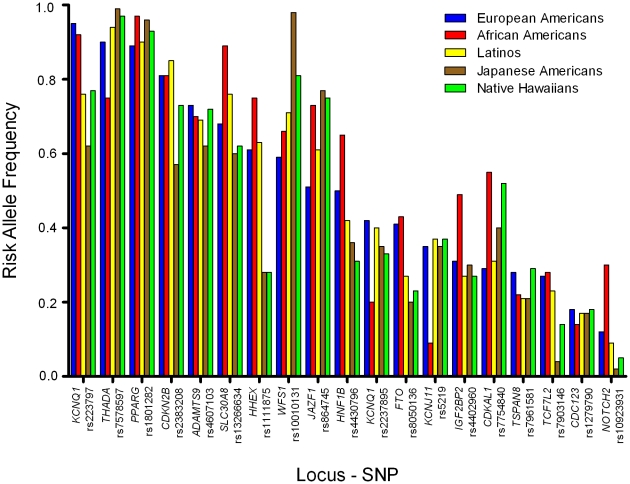
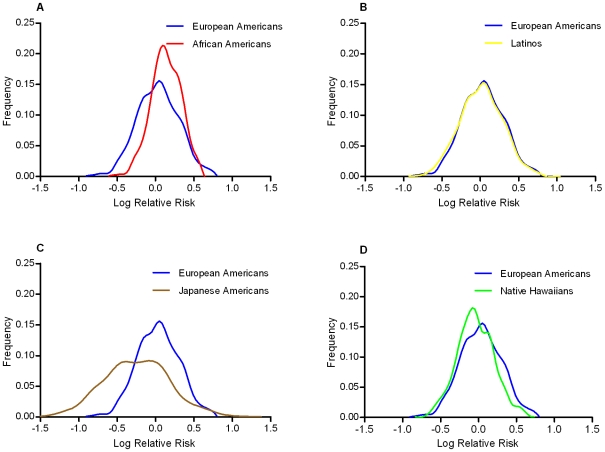
It has been recently hypothesized that many of the signals detected in genome-wide association studies (GWAS) to T2D and other diseases, despite being observed to common variants, might in fact result from causal mutations that are rare. One prediction of this hypothesis is that the allelic associations should be population-specific, as the causal mutations arose after the migrations that established different populations around the world. We selected 19 common variants found to be reproducibly associated to T2D risk in European populations and studied them in a large multiethnic case-control study (6,142 cases and 7,403 controls) among men and women from 5 racial/ethnic groups (European Americans, African Americans, Latinos, Japanese Americans, and Native Hawaiians). In analysis pooled across ethnic groups, the allelic associations were in the same direction as the original report for all 19 variants, and 14 of the 19 were significantly associated with risk. In summing the number of risk alleles for each individual, the per-allele associations were highly statistically significant (P<10(-4)) and similar in all populations (odds ratios 1.09-1.12) except in Japanese Americans the estimated effect per allele was larger than in the other populations (1.20; P(het) = 3.8×10(-4)). We did not observe ethnic differences in the distribution of risk that would explain the increased prevalence of type 2 diabetes in these groups as compared to European Americans. The consistency of allelic associations in diverse racial/ethnic groups is not predicted under the hypothesis of Goldstein regarding "synthetic associations" of rare mutations in T2D.
Overview
The claims and statistics of this paper haven’t been checked yet.
Run the check — free, no account needed. It reads the open-access text and checks the sources it cites.
Integrity signals
Registry
Cites
Statistics
Figures
Verification
Claims the paper makes
The claims and statistics of this paper haven’t been checked yet.
Run the check — free, no account needed. It reads the open-access text and checks the sources it cites.
Claims other papers make about this one
Each is checked against this paper’s own text: does it say what the citing paper says it does?
The source backs part of the claim, not all of it — or backs it for a different population, condition or comparison.
In the citing paper
“These LD differences in turn drive differences in effect size estimates (i.e. predictors) from GWAS across populations in proportion to LD between tagging and causal SNP pairs, even when causal effects are the same35,37–40 (Supplementary Note).”
From Clinical use of current polygenic risk scores may exacerbate health disparities (2019) · cites this paper as [39]
Experimental — accuracy not yet measuredThe source backs part of the claim, not all of it — or backs it for a different population, condition or comparison.
In the citing paper
“2) linkage disequilibrium (LD) differentiates marginal effect size estimates for polygenic traits across populations, even when causal variants are the same;”
From Clinical use of current polygenic risk scores may exacerbate health disparities (2019) · cites this paper as [39]
Experimental — accuracy not yet measuredIn the citing paper
“common variants are often consistent across populations — such as between Caucasians and Asians — despite differences in allele frequencies65,66.”
From Rare and common variants: twenty arguments (2012) · cites this paper as [65]
In the citing paper
“For example, T2DM and breast cancer loci identified in European samples tend to replicate in samples of East Asian ancestry. 150,151”
From Genetic architectures of psychiatric disorders: the emerging picture and its implications (2012) · cites this paper as [151]
Self-check
Percentages, sums and reported differences re-computed from the paper’s own numbers.
The self-check needs the paper’s full text.
Citations
Cites
A genome-wide association study identifies novel risk loci for type 2 diabetes
Sladek, R., Rocheleau, G., Rung, J., Dina, C., Shen, L., Serre, D., Boutin, P., Vincent, D., Belisle, A., Hadjadj, S., et al. (2007) · Nature · doi:10.1038/nature05616 · Cited by 2,993
Genome-wide association analysis identifies loci for type 2 diabetes and triglyceride levels
Saxena, R., Voight, B. F., Lyssenko, V., Burtt, N. P., de Bakker, P. I. W., Chen, H., Roix, J. J., Kathiresan, S., Hirschhorn, J. N., Daly, M. J., et al. (2007) · Science · doi:10.1126/science.1142358 · Cited by 2,843
Self-citationA genome-wide association study of type 2 diabetes in Finns detects multiple susceptibility variants
Scott, L. J., Mohlke, K. L., Bonnycastle, L. L., Willer, C. J., Li, Y., Duren, W. L., Erdos, M. R., Stringham, H. M., Chines, P. S., Jackson, A. U., et al. (2007) · Science · doi:10.1126/science.1142382 · Cited by 2,753
Variant of transcription factor 7-like 2 (TCF7L2) gene confers risk of type 2 diabetes
Grant, S. F. A., Thorleifsson, G., Reynisdottir, I., Benediktsson, R., Manolescu, A., Sainz, J., Helgason, A., Stefansson, H., Emilsson, V., Helgadottir, A., et al. (2006) · Nature Genetics · doi:10.1038/ng1732 · Cited by 2,287
Replication of Genome-Wide Association Signals in UK Samples Reveals Risk Loci for Type 2 Diabetes
Zeggini, E., Weedon, M. N., Lindgren, C. M., Frayling, T. M., Elliott, K. S., Lango, H., Timpson, N. J., Perry, J. R. B., Rayner, N. W., Freathy, R. M., et al. (2007) · Science · doi:10.1126/science.1142364 · Cited by 2,194
Wellcome Trust Case Control Consortium, Zeggini, E., Scott, L. J., Saxena, R., Voight, B. F., Marchini, J. L., Hu, T., de Bakker, P. I., Abecasis, G. R., Almgren, P., et al. (2008) · Nature Genetics · doi:10.1038/ng.120 · Cited by 1,864
Self-citationThe common PPARγ Pro12Ala polymorphism is associated with decreased risk of type 2 diabetes
Altshuler, D., Hirschhorn, J. N., Klannemark, M., Lindgren, C. M., Vohl, M.-C., Nemesh, J., Lane, C. R., Schaffner, S. F., Bolk, S., Brewer, C., et al. (2000) · Nature Genetics · doi:10.1038/79216 · Cited by 1,766
Self-citationA variant in CDKAL1 influences insulin response and risk of type 2 diabetes
Steinthorsdottir, V., Thorleifsson, G., Reynisdottir, I., Benediktsson, R., Jonsdottir, T., Walters, G. B., Styrkarsdottir, U., Gretarsdottir, S., Emilsson, V., Ghosh, S., et al. (2007) · Nature Genetics · doi:10.1038/ng2043 · Cited by 1,072
A Multiethnic Cohort in Hawaii and Los Angeles: Baseline Characteristics
Kolonel, L. N., Henderson, B. E., Hankin, J. H., Nomura, A. M. Y., Wilkens, L. R., Pike, M. C., Stram, D. O., Monroe, K. R., Earle, M. E., & Nagamine, F. S. (2000) · American Journal of Epidemiology · doi:10.1093/oxfordjournals.aje.a010213 · Cited by 1,024
Self-citationCommon Genetic Variation and Human Traits
Goldstein, D. B. (2009) · New England Journal of Medicine · doi:10.1056/nejmp0806284 · Cited by 918
Cited by
Sorted by citations
10 Years of GWAS Discovery: Biology, Function, and Translation
Visscher, P. M., Wray, N. R., Zhang, Q., Sklar, P., McCarthy, M. I., Brown, M. A., & Yang, J. (2017) · The American Journal of Human Genetics · doi:10.1016/j.ajhg.2017.06.005 · Cited by 3,719
Clinical use of current polygenic risk scores may exacerbate health disparities
Martin, A. R., Kanai, M., Kamatani, Y., Okada, Y., Neale, B. M., & Daly, M. J. (2019) · Nature Genetics · doi:10.1038/s41588-019-0379-x · Cited by 2,821
the DIAbetes Genetics Replication And Meta-analysis (DIAGRAM) Consortium, Morris, A. P., Voight, B. F., Teslovich, T. M., Ferreira, T., Segrè, A. V., Steinthorsdottir, V., Strawbridge, R. J., Khan, H., Grallert, H., et al. (2012) · Nature Genetics · doi:10.1038/ng.2383 · Cited by 1,912
Human Demographic History Impacts Genetic Risk Prediction across Diverse Populations
Martin, A. R., Gignoux, C. R., Walters, R. K., Wojcik, G. L., Neale, B. M., Gravel, S., Daly, M. J., Bustamante, C. D., & Kenny, E. E. (2017) · The American Journal of Human Genetics · doi:10.1016/j.ajhg.2017.03.004 · Cited by 1,391
Rare and common variants: twenty arguments
Gibson, G. (2012) · Nature Reviews Genetics · doi:10.1038/nrg3118 · Cited by 1,278
Metadata
- Authors
- Waters, K. M., Stram, D. O., Hassanein, M. T., Le Marchand, L., Wilkens, L. R., Maskarinec, G., Monroe, K. R., Kolonel, L. N., Altshuler, D., Henderson, B. E., & Haiman, C. A.
- Affiliations
- University of Southern California (US)
- USC Norris Comprehensive Cancer Center (US)
- University of Hawaiʻi at Mānoa (US)
- Broad Institute (US)
- Corresponding author
- Waters, Kevin M.
- Haiman, Christopher A.
- ORCID
- Venue
- PLoS Genetics
- Publisher
- Public Library of Science (PLoS)
- Published
- 2010-08-26
- Volume
- 6
- Issue
- 8
- Pages
- e1001078
- ISSN
- 1553-7390 (ISSN-L)
- 1553-7404
- PMC
- PMC2928808
- OpenAlex
- W2145604455
- Cited by
- 191
- References
- 33
- Citations by year
- 2026: 6 · 2025: 2 · 2024: 7 · 2023: 9 · 2022: 8 · 2021: 8 · 2020: 3 · 2019: 10 · 2018: 7 · 2017: 10 · 2016: 16 · 2015: 7 · 2014: 23 · 2013: 18 · 2012: 33
- FWCI
- 13.30
- Type
- journal article
- Language
- en
- Open access
- gold
- doi.org
- Locations
- PLoS Genetics (publishedVersion, cc-by)
- PubMed Central (publishedVersion, cc-by)
- PubMed (publishedVersion)
- Digital Access to Scholarship at Harvard (DASH) (Harvard University) (submittedVersion, cc-by)
- DOAJ (DOAJ: Directory of Open Access Journals) (submittedVersion)
- Figshare (submittedVersion, cc-by)
- Funders
- National Human Genome Research Institute (U01HG004802)
- National Cancer Institute (CA63464, U01CA063464, R37CA054281, R01CA054281, R01CA063464, CA 54281)
- Topics
- Life Sciences › Biochemistry, Genetics and Molecular Biology › Genetics › Genetic Associations and Epidemiology
- Life Sciences › Biochemistry, Genetics and Molecular Biology › Genetics › Genetic Mapping and Diversity in Plants and Animals
- Life Sciences › Biochemistry, Genetics and Molecular Biology › Genetics › Forensic and Genetic Research
- Keywords
- type 2 diabetes, genetic risk variants, common genetic variants, European Americans, African Americans, Hispanic Americans, Japanese Americans, Native Hawaiians, ethnic differences in diabetes risk
- MeSH terms
- Adult, Aged, Alleles, Diabetes Mellitus, Type 2, Ethnicity, Europe, Female, Humans, Male, Middle Aged, Genetic Variation, Case-Control Studies, Genetic Predisposition to Disease, Genome-Wide Association Study
About these checks
Registry, retraction, Cites and statistics results are computed, not judged, with one exception: a printed reference that no index lists is read once by a model before it counts as a citation error. Claims are extracted by a model and kept only when their quote appears verbatim in the text; each cited source is then checked, with a model’s help, for whether it says what the claim relies on. Those verdicts can be wrong — read the claim’s quote and the cited source before relying on one.
Statistics and arithmetic are recomputed, not judged.
Confidence bands are shown only for fields calibrated on our annotated test set. None is calibrated yet, so no band is shown.
What counts as a claim ›How we measure confidence ›How we check this ›
Are you an author, or do you see a problem with this page? Request a review
