

The DOI matches its Crossref record; 67 of the 67 references it cites were found in a registry or an index.
Transferability of Type 2 Diabetes Implicated Loci in Multi-Ethnic Cohorts from Southeast Asia
Open accessAbstract
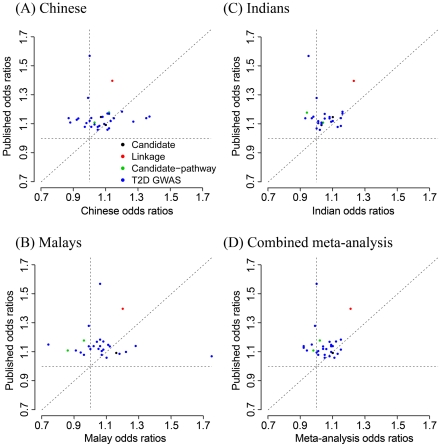
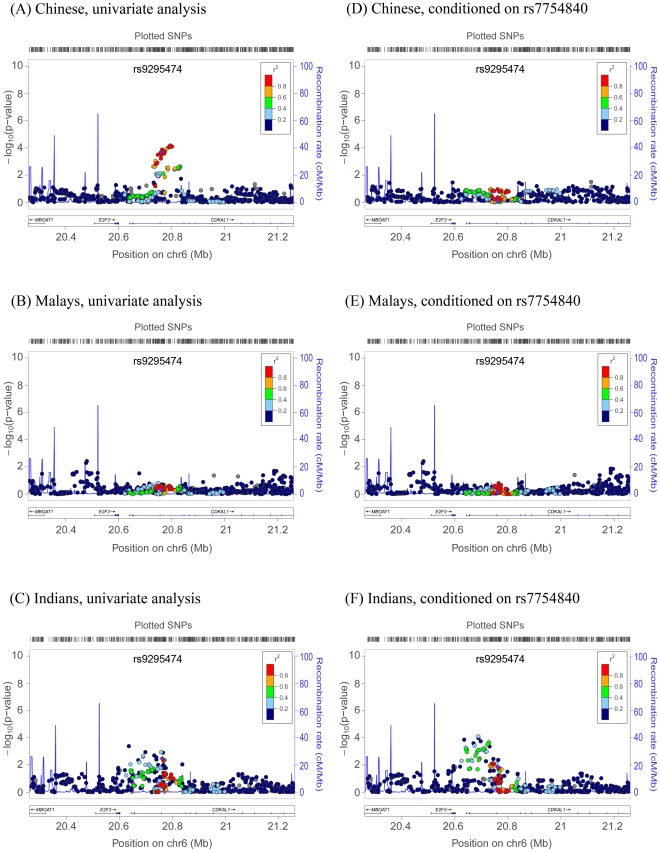
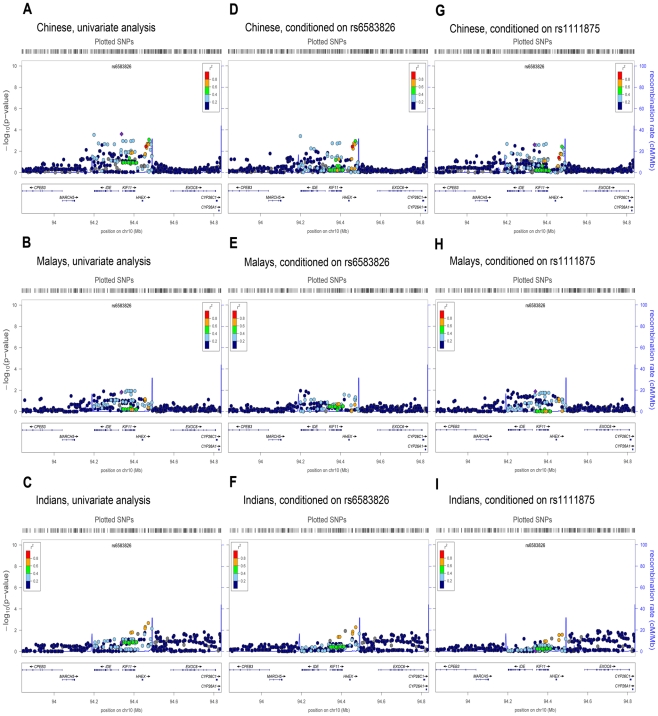
Recent large genome-wide association studies (GWAS) have identified multiple loci which harbor genetic variants associated with type 2 diabetes mellitus (T2D), many of which encode proteins not previously suspected to be involved in the pathogenesis of T2D. Most GWAS for T2D have focused on populations of European descent, and GWAS conducted in other populations with different ancestry offer a unique opportunity to study the genetic architecture of T2D. We performed genome-wide association scans for T2D in 3,955 Chinese (2,010 cases, 1,945 controls), 2,034 Malays (794 cases, 1,240 controls), and 2,146 Asian Indians (977 cases, 1,169 controls). In addition to the search for novel variants implicated in T2D, these multi-ethnic cohorts serve to assess the transferability and relevance of the previous findings from European descent populations in the three major ethnic populations of Asia, comprising half of the world's population. Of the SNPs associated with T2D in previous GWAS, only variants at CDKAL1 and HHEX/IDE/KIF11 showed the strongest association with T2D in the meta-analysis including all three ethnic groups. However, consistent direction of effect was observed for many of the other SNPs in our study and in those carried out in European populations. Close examination of the associations at both the CDKAL1 and HHEX/IDE/KIF11 loci provided some evidence of locus and allelic heterogeneity in relation to the associations with T2D. We also detected variation in linkage disequilibrium between populations for most of these loci that have been previously identified. These factors, combined with limited statistical power, may contribute to the failure to detect associations across populations of diverse ethnicity. These findings highlight the value of surveying across diverse racial/ethnic groups towards the fine-mapping efforts for the casual variants and also of the search for variants, which may be population-specific.
Overview
The claims and statistics of this paper haven’t been checked yet.
Run the check — free, no account needed. It reads the open-access text and checks the sources it cites.
Integrity signals
Registry
Cites
Statistics
Figures
Verification
Claims the paper makes
The claims and statistics of this paper haven’t been checked yet.
Run the check — free, no account needed. It reads the open-access text and checks the sources it cites.
Claims other papers make about this one
Each is checked against this paper’s own text: does it say what the citing paper says it does?
In the citing paper
“Under a mutation-selection balance model, it may be possible for different novel rare variants to have effects in each population, and fine mapping studies sometimes reveal subtle differences in the patterns of association [eg.67,68.”
From Rare and common variants: twenty arguments (2012) · cites this paper as [67]
Self-check
Percentages, sums and reported differences re-computed from the paper’s own numbers.
The self-check needs the paper’s full text.
Citations
Cites
Principal components analysis corrects for stratification in genome-wide association studies
Price, A. L., Patterson, N. J., Plenge, R. M., Weinblatt, M. E., Shadick, N. A., & Reich, D. (2006) · Nature Genetics · doi:10.1038/ng1847 · Cited by 10,248 · cited 6×
“Population structure ascertainment was carried out using principal components analysis (PCA) [59] with 4 panels from International Hapmap [60] and the Singapore Genome Variation Project [61] (http://www.nus-cme. org.sg/SGVP/) which includes 96 Chinese, 89 Malays and 83 Asian Indians from Singapore.”
MethodInfluentialGenome-wide association study of 14,000 cases of seven common diseases and 3,000 shared controls
The Wellcome Trust Case Control Consortium, Management Committee, Burton, P. R., Clayton, D. G., Cardon, L. R., Craddock, N., Deloukas, P., Duncanson, A., Kwiatkowski, D. P., McCarthy, M. I., et al. (2007) · Nature · doi:10.1038/nature05911 · Cited by 9,442
A second generation human haplotype map of over 3.1 million SNPs
The International HapMap Consortium (2007) · Nature · doi:10.1038/nature06258 · Cited by 4,438 · cited 3×
“Population structure ascertainment was carried out using principal components analysis (PCA) [59] with 4 panels from International Hapmap [60] and the Singapore Genome Variation Project [61] (http://www.nus-cme. org.sg/SGVP/) which includes 96 Chinese, 89 Malays and 83 Asian Indians from Singapore.”
MethodHowie, B. N., Donnelly, P., & Marchini, J. (2009) · PLoS Genetics · doi:10.1371/journal.pgen.1000529 · Cited by 3,928 · cited 1×
“2 [63], incorporating population-specific genotypes from SGVP.”
International Expert Committee report on the role of the A1c assay in the diagnosis of diabetes
The International Expert Committee (2009) · Diabetes Care · doi:10.2337/dc09-9033 · Cited by 3,185
Prevalence of Diabetes among Men and Women in China
Yang, W., Lu, J., Weng, J., Jia, W., Ji, L., Xiao, J., Shan, Z., Liu, J., Tian, H., Ji, Q., et al. (2010) · New England Journal of Medicine · doi:10.1056/nejmoa0908292 · Cited by 3,031 · cited 1×
“million people with T2D [3].”
Self-citationA genome-wide association study identifies novel risk loci for type 2 diabetes
Sladek, R., Rocheleau, G., Rung, J., Dina, C., Shen, L., Serre, D., Boutin, P., Vincent, D., Belisle, A., Hadjadj, S., et al. (2007) · Nature · doi:10.1038/nature05616 · Cited by 2,993 · cited 2×
“These genome-wide association studies (GWAS) have identified a number of novel loci harboring common variants that are associated with an increased risk of T2D [4–11], adding to the loci previously identified by candidate gene studies (PPARG [12], KCNJ11 [13–14], WFS1 [15–16]) and linkage studies TCF7L2 [17–19]).”
BackgroundResultGenome-wide association analysis identifies loci for type 2 diabetes and triglyceride levels
Saxena, R., Voight, B. F., Lyssenko, V., Burtt, N. P., de Bakker, P. I. W., Chen, H., Roix, J. J., Kathiresan, S., Hirschhorn, J. N., Daly, M. J., et al. (2007) · Science · doi:10.1126/science.1142358 · Cited by 2,843
A genome-wide association study of type 2 diabetes in Finns detects multiple susceptibility variants
Scott, L. J., Mohlke, K. L., Bonnycastle, L. L., Willer, C. J., Li, Y., Duren, W. L., Erdos, M. R., Stringham, H. M., Chines, P. S., Jackson, A. U., et al. (2007) · Science · doi:10.1126/science.1142382 · Cited by 2,753
Self-citationThe Wellcome Trust Case Control Consortium, U.K.
Mossman, K. (2008) · Scientific American · doi:10.1038/scientificamerican0108-42a · Cited by 2,714
Cited by
Sorted by citations
Rare and common variants: twenty arguments
Gibson, G. (2012) · Nature Reviews Genetics · doi:10.1038/nrg3118 · Cited by 1,278
The genetic architecture of type 2 diabetes
Fuchsberger, C., Flannick, J., Teslovich, T. M., Mahajan, A., Agarwala, V., Gaulton, K. J., Ma, C., Fontanillas, P., Moutsianas, L., McCarthy, D. J., et al. (2016) · Nature · doi:10.1038/nature18642 · Cited by 1,051
Self-citationGenetics of Type 2 Diabetes—Pitfalls and Possibilities
Prasad, R., & Groop, L. (2015) · Genes · doi:10.3390/genes6010087 · Cited by 458
Volgman, A. S., Palaniappan, L. S., Aggarwal, N. T., Gupta, M., Khandelwal, A., Krishnan, A. V., Lichtman, J. H., Mehta, L. S., Patel, H. N., Shah, K. S., et al. (2018) · Circulation · doi:10.1161/cir.0000000000000580 · Cited by 552
Epidemiology and determinants of type 2 diabetes in south Asia
Hills, A. P., Arena, R., Khunti, K., Yajnik, C. S., Jayawardena, R., Henry, C. J., Street, S. J., Soares, M. J., & Misra, A. (2018) · The Lancet Diabetes & Endocrinology · doi:10.1016/s2213-8587(18)30204-3 · Cited by 290
Metadata
- Authors
- Sim, X., Ong, R. T.-H., Suo, C., Tay, W.-T., Liu, J., Ng, D. P.-K., Boehnke, M., Chia, K.-S., Wong, T.-Y., Seielstad, M., Teo, Y.-Y., & Tai, E.-S.
- Affiliations
- National University of Singapore (SG)
- Agency for Science, Technology and Research (SG)
- Singapore National Eye Center (SG)
- University of Michigan (US)
- The University of Melbourne (AU)
- Corresponding author
- Teo, Yik-Ying
- Tai, E-Shyong
- ORCID
- Venue
- PLoS Genetics
- Publisher
- Public Library of Science (PLoS)
- Published
- 2011-04-07
- Volume
- 7
- Issue
- 4
- Pages
- e1001363
- ISSN
- 1553-7390 (ISSN-L)
- 1553-7404
- PMC
- PMC3072366
- OpenAlex
- W2025086473
- Cited by
- 152
- References
- 67
- Citations by year
- 2026: 2 · 2025: 3 · 2024: 4 · 2023: 3 · 2022: 6 · 2021: 9 · 2020: 9 · 2019: 5 · 2018: 14 · 2017: 9 · 2016: 15 · 2015: 12 · 2014: 19 · 2013: 19 · 2012: 17
- FWCI
- 12.17
- Type
- journal article
- Language
- en
- Open access
- gold
- doi.org
- Licence
- cc-by
- Locations
- PLoS Genetics (publishedVersion, cc-by)
- Europe PMC (PubMed Central) (publishedVersion, cc-by)
- PubMed Central (publishedVersion, cc-by)
- PubMed (publishedVersion)
- National University of Singapore (submittedVersion)
- RePEc: Research Papers in Economics (submittedVersion)
- DOAJ (DOAJ: Directory of Open Access Journals) (submittedVersion, cc-by-sa)
- eScholarship (California Digital Library) (submittedVersion)
- eScholarship (California Digital Library) (submittedVersion, cc-by)
- Figshare (submittedVersion, cc-by)
- Minerva Access (University of Melbourne) (submittedVersion, cc-by)
- Funders
- National Research Foundation (03/1/27/18/216)
- National University of Singapore
- National Research Foundation Singapore (NRF-RF-2010-05)
- Genome Institute of Singapore
- Medical Research Council
- National Medical Research Council (09/1/35/19/616, NMRC/STaR/0003/2008, 03/1/27/18/216, 08/1/35/19/550, 0796/2003, STAR/0003/2008)
- Biomedical Research Council (08/1/35/19/550, 03/1/27/18/216, 0796/2003, 09/1/35/19/616)
- National Human Genome Research Institute (R56HG000376, R01HG000376)
- Topics
- Life Sciences › Biochemistry, Genetics and Molecular Biology › Genetics › Genetic Associations and Epidemiology
- Life Sciences › Biochemistry, Genetics and Molecular Biology › Genetics › Genetic Mapping and Diversity in Plants and Animals
- Life Sciences › Biochemistry, Genetics and Molecular Biology › Genetics › Diabetes and associated disorders
- Keywords
- type 2 diabetes, genetic susceptibility loci, multi-ethnic cohort, Chinese, Malay language, Asian Indians, CDKAL1, population-specific variants, allelic heterogeneity, linkage disequilibrium, fine mapping, genetic architecture
- MeSH terms
- Adult, Aged, Asia, Southeastern, Diabetes Mellitus, Type 2, Female, Humans, Male, Middle Aged, tRNA Methyltransferases, Linkage Disequilibrium, Case-Control Studies, Kinesins, Genetic Predisposition to Disease, Polymorphism, Single Nucleotide, Cyclin-Dependent Kinase 5, Genome-Wide Association Study, Genetic Loci
About these checks
Registry, retraction, Cites and statistics results are computed, not judged, with one exception: a printed reference that no index lists is read once by a model before it counts as a citation error. Claims are extracted by a model and kept only when their quote appears verbatim in the text; each cited source is then checked, with a model’s help, for whether it says what the claim relies on. Those verdicts can be wrong — read the claim’s quote and the cited source before relying on one.
Statistics and arithmetic are recomputed, not judged.
Confidence bands are shown only for fields calibrated on our annotated test set. None is calibrated yet, so no band is shown.
What counts as a claim ›How we measure confidence ›How we check this ›
Are you an author, or do you see a problem with this page? Request a review
