

Mechanisms Employed by Escherichia coli to Prevent Ribonucleotide Incorporation into Genomic DNA by Pol V
Open accessThe DOI matches its Crossref record; 64 of the 64 references it cites were found in a registry or an index.
Abstract
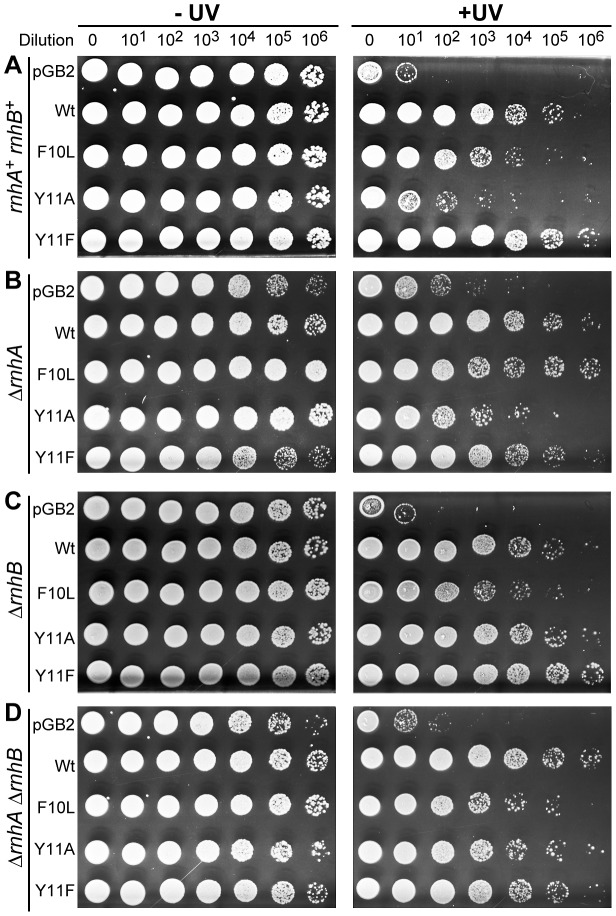
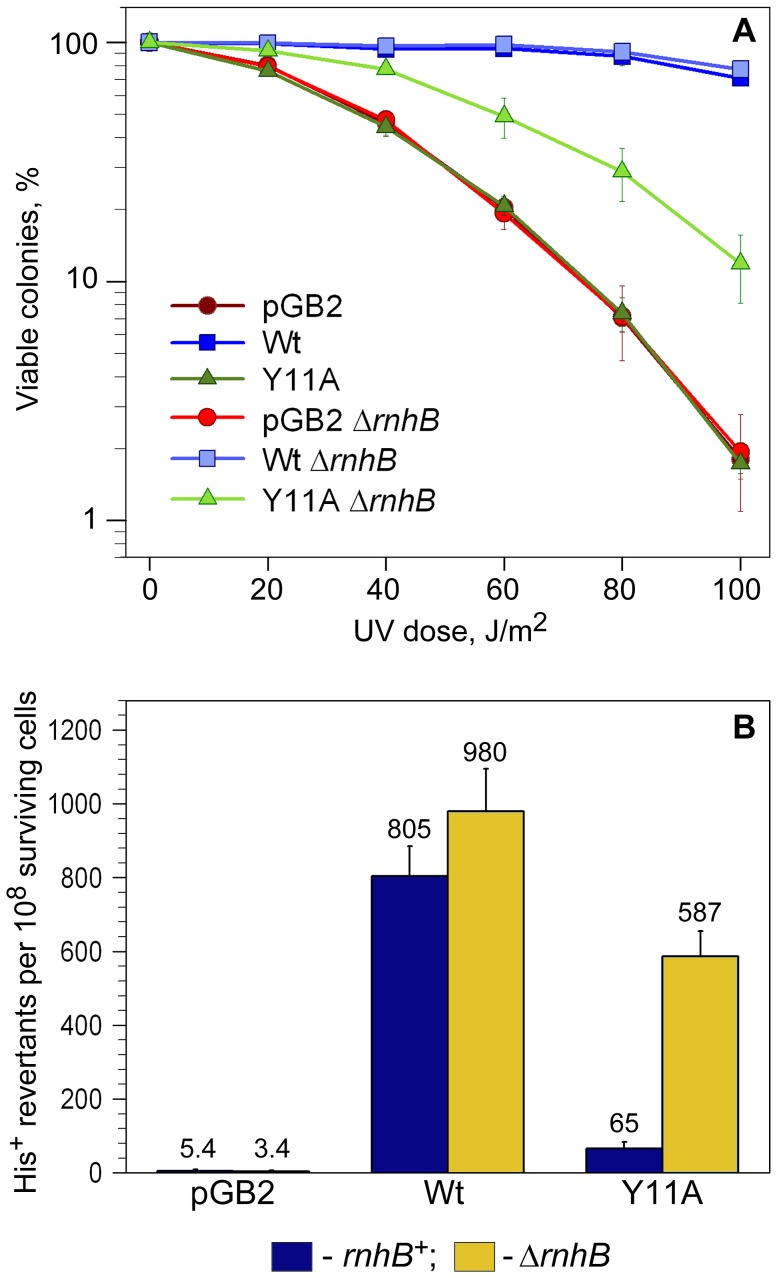
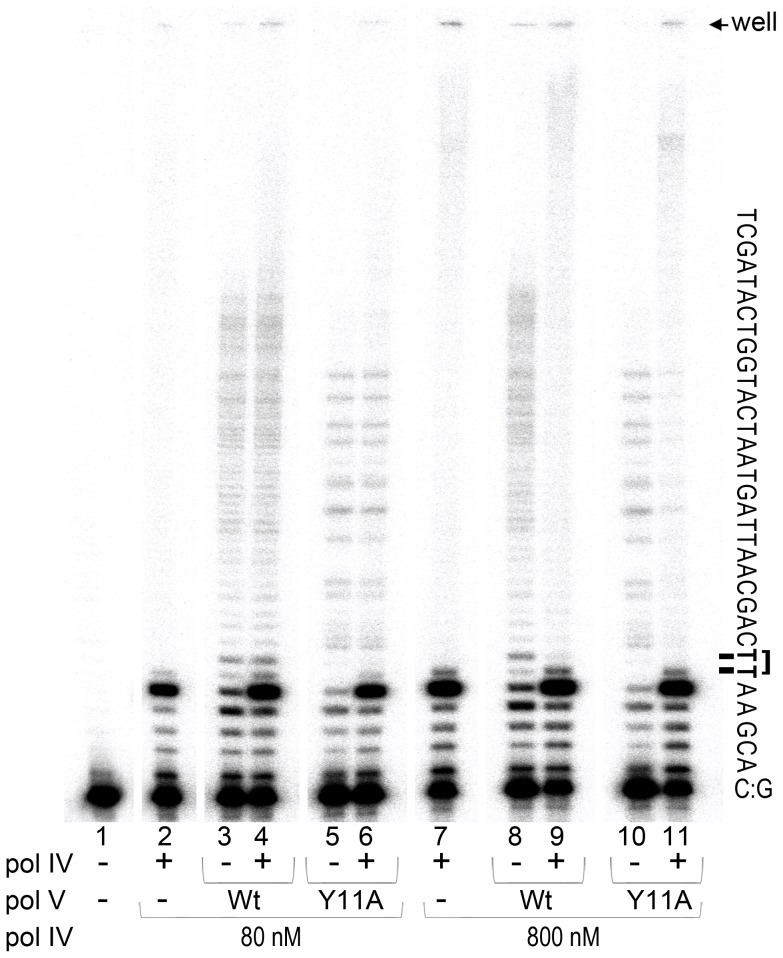
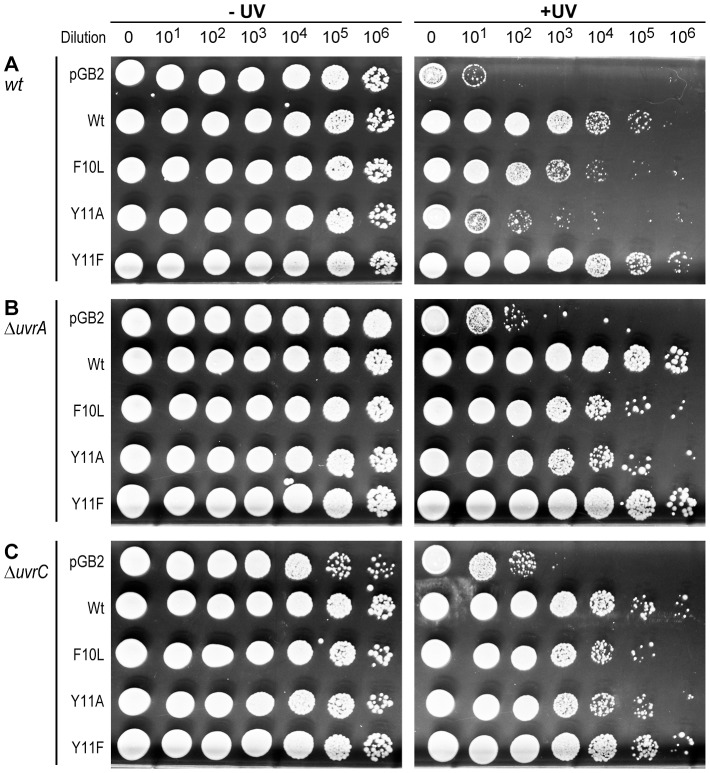
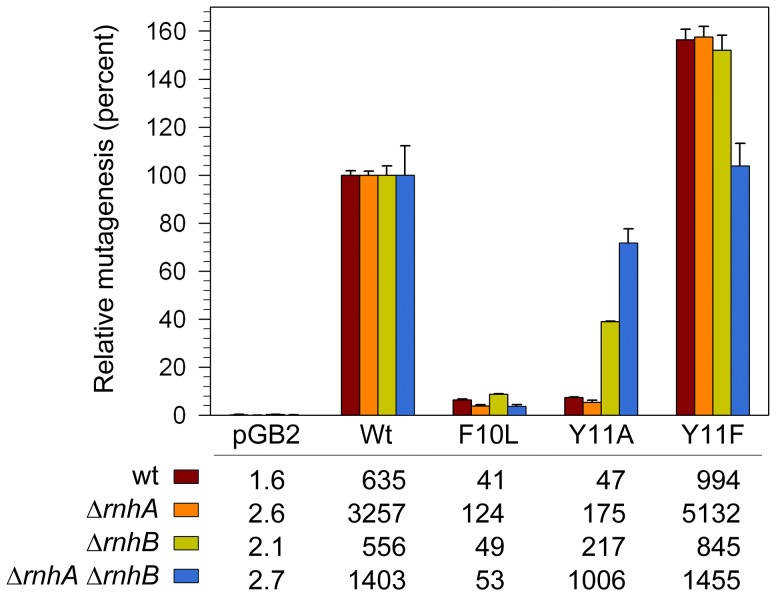
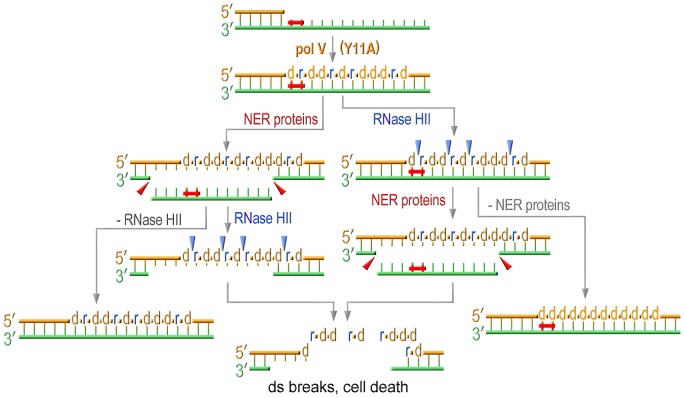
Escherichia coli pol V (UmuD'(2)C), the main translesion DNA polymerase, ensures continued nascent strand extension when the cellular replicase is blocked by unrepaired DNA lesions. Pol V is characterized by low sugar selectivity, which can be further reduced by a Y11A "steric-gate" substitution in UmuC that enables pol V to preferentially incorporate rNTPs over dNTPs in vitro. Despite efficient error-prone translesion synthesis catalyzed by UmuC_Y11A in vitro, strains expressing umuC_Y11A exhibit low UV mutability and UV resistance. Here, we show that these phenotypes result from the concomitant dual actions of Ribonuclease HII (RNase HII) initiating removal of rNMPs from the nascent DNA strand and nucleotide excision repair (NER) removing UV lesions from the parental strand. In the absence of either repair pathway, UV resistance and mutagenesis conferred by umuC_Y11A is significantly enhanced, suggesting that the combined actions of RNase HII and NER lead to double-strand breaks that result in reduced cell viability. We present evidence that the Y11A-specific UV phenotype is tempered by pol IV in vivo. At physiological ratios of the two polymerases, pol IV inhibits pol V-catalyzed translesion synthesis (TLS) past UV lesions and significantly reduces the number of Y11A-incorporated rNTPs by limiting the length of the pol V-dependent TLS tract generated during lesion bypass in vitro. In a recA730 lexA(Def) ΔumuDC ΔdinB strain, plasmid-encoded wild-type pol V promotes high levels of spontaneous mutagenesis. However, umuC_Y11A-dependent spontaneous mutagenesis is only ~7% of that observed with wild-type pol V, but increases to ~39% of wild-type levels in an isogenic ΔrnhB strain and ~72% of wild-type levels in a ΔrnhA ΔrnhB double mutant. Our observations suggest that errant ribonucleotides incorporated by pol V can be tolerated in the E. coli genome, but at the cost of higher levels of cellular mutagenesis.
Overview
The claims and statistics of this paper haven’t been checked yet.
Free: it reads the open-access text and checks the first 5 claims that cite a source we can check. Create a free account to check every claim.
Integrity signals
Registry
Cites
Statistics
Figures
Verification
Claims the paper makes
The claims and statistics of this paper haven’t been checked yet.
Free: it reads the open-access text and checks the first 5 claims that cite a source we can check. Create a free account to check every claim.
Self-check
Percentages, sums and reported differences re-computed from the paper’s own numbers.
The self-check needs the paper’s full text.
Citations
Cites
Molecular Cloning: A Laboratory Manual
Sambrook, J., Fritsch, E., & Maniatis, T. (1989) · UCLA - Biblioteca de Ciencias de la Salud · Cited by 133,589
Construction of Escherichia coli K‐12 in‐frame, single‐gene knockout mutants: the Keio collection
Baba, T., Ara, T., Hasegawa, M., Takai, Y., Okumura, Y., Baba, M., Datsenko, K. A., Tomita, M., Wanner, B. L., & Mori, H. (2006) · Molecular Systems Biology · doi:10.1038/msb4100050 · Cited by 7,858 · cited 1×
“The various alleles were selected by conferring resistance to spectinomycin (20 mg/ml), zeocin (25 mg/ml), chloramphenicol (20 mg/ml) and kanamycin (50 mg/ml) respectively and subsequently confirmed by PCR [54–56].”
Friedberg, E. C., Walker, G. C., Siede, W., Wood, R. D., Schultz, R. A., & Ellenberger, T. (2005) · doi:10.1128/9781555816704 · Cited by 5,683
MUTANTS OF ESCHERICHIA COLI REQUIRING METHIONINE OR VITAMIN B 12
Davis, B. D., & Mingioli, E. S. (1950) · Journal of Bacteriology · doi:10.1128/jb.60.1.17-28.1950 · Cited by 2,881 · cited 1×
“To determine the number of spontaneously arising histidine mutants on the plate, as well as UV-induced mutants, the unirradiated cell culture was seeded on the Davis and Mingioli minimal agar plates [59] plus glucose (0.”
Miller, J. H. (1992) · Medical Entomology and Zoology · Cited by 2,488
Stillman, B. (1995) · Molecular Medicine · doi:10.1007/bf03401885 · Cited by 1,025
Identification of additional genes belonging to the LexA regulon in Escherichia coli
Fernández de Henestrosa, A. R., Ogi, T., Aoyagi, S., Chafin, D., Hayes, J. J., Ohmori, H., & Woodgate, R. (2000) · Molecular Microbiology · doi:10.1046/j.1365-2958.2000.01826.x · Cited by 570 · cited 2×
“The strains employed here carry the lexA51(Def) allele which has a frameshift mutation in the C-terminus of LexA [40], that leads to constitutive expression of all LexA-regulated genes [41], including all three TLS polymerases, pol II, pol IV and pol V.”
Self-citationKato, T., & Shinoura, Y. (1977) · Molecular and General Genetics MGG · doi:10.1007/bf00283484 · Cited by 568 · cited 2×
“Y-family polymerases, pol IV, encoded by the dinB gene [4,5], and pol V, the product of the umuC and umuD genes [6], are devoid of exonucleolytic proofreading and are characterized by lowfidelity DNA synthesis on undamaged DNA [7,8].”
The dinB Gene Encodes a Novel E. coli DNA Polymerase, DNA Pol IV, Involved in Mutagenesis
Wagner, J., Gruz, P., Kim, S.-R., Yamada, M., Matsui, K., Fuchs, R. P. P., & Nohmi, T. (1999) · Molecular Cell · doi:10.1016/s1097-2765(00)80376-7 · Cited by 474
Roles of E. coli DNA polymerases IV and V in lesion-targeted and untargeted SOS mutagenesis
Tang, M., Pham, P., Shen, X., Taylor, J.-S., O'Donnell, M., Woodgate, R., & Goodman, M. F. (2000) · Nature · doi:10.1038/35010020 · Cited by 443 · cited 2×
“The major reaction product observed was located immediately adjacent to the 39 base of the CPD, with a very small band corresponding to nucleotide incorporation opposite the 39T of CPD, as previously reported [18].”
Self-citation
Cited by
Ribonucleotides in DNA: Origins, repair and consequences
Williams, J. S., & Kunkel, T. A. (2014) · DNA Repair · doi:10.1016/j.dnarep.2014.03.029 · Cited by 169
“Tyrosine 11 is the steric gate residue in the active site of Pol V that limits ribonucleotide incorporation, such that the Y11A variant is highly promiscuous for ribonucleotide incorporation in vitro, so much so that it can incorporate multiple consecutive ribonucleotides [69].”
BackgroundRibose-seq: global mapping of ribonucleotides embedded in genomic DNA
Koh, K. D., Balachander, S., Hesselberth, J. R., & Storici, F. (2015) · Nature Methods · doi:10.1038/nmeth.3259 · Cited by 122
Aprataxin resolves adenylated RNA–DNA junctions to maintain genome integrity
Tumbale, P., Williams, J. S., Schellenberg, M. J., Kunkel, T. A., & Williams, R. S. (2014) · Nature · doi:10.1038/nature12824 · Cited by 109
Vaisman, A., McDonald, J. P., Huston, D., Kuban, W., Liu, L., Van Houten, B., & Woodgate, R. (2013) · PLoS Genetics · doi:10.1371/journal.pgen.1003878 · Cited by 70
“umuC_Y11A-dependent spontaneous mutagenesis increased significantly in a DrnhB background and to a much larger extent when both rnhB and rnhA were inactivated [11] (Fig.”
InfluentialSelf-citationRNA intrusions change DNA elastic properties and structure
Chiu, H.-C., Koh, K. D., Evich, M., Lesiak, A. L., Germann, M. W., Bongiorno, A., Riedo, E., & Storici, F. (2014) · Nanoscale · doi:10.1039/c4nr01794c · Cited by 56
Metadata
- Authors
- McDonald, J. P., Vaisman, A., Kuban, W., Goodman, M. F., & Woodgate, R.
- Affiliations
- National Institutes of Health (US)
- University of Southern California (US)
- Corresponding author
- Woodgate, Roger
- Venue
- PLoS Genetics
- Publisher
- Public Library of Science (PLoS)
- Published
- 2012-11-08
- Volume
- 8
- Issue
- 11
- Pages
- e1003030
- ISSN
- 1553-7390 (ISSN-L)
- 1553-7404
- PMC
- PMC3493448
- OpenAlex
- W1979994225
- Cited by
- 38
- References
- 64
- Citations by year
- 2026: 1 · 2024: 1 · 2023: 1 · 2022: 1 · 2021: 4 · 2020: 3 · 2019: 5 · 2018: 1 · 2017: 3 · 2015: 5 · 2014: 9 · 2013: 4
- FWCI
- 2.32
- Type
- journal article
- Language
- en
- Open access
- gold
- doi.org
- Licence
- Locations
- PLoS Genetics (publishedVersion, public-domain)
- Europe PMC (PubMed Central) (publishedVersion, public-domain)
- PubMed Central (publishedVersion, public-domain)
- PubMed (publishedVersion)
- DOAJ (DOAJ: Directory of Open Access Journals) (submittedVersion, cc-by-sa)
- Figshare (submittedVersion, cc-by)
- Funders
- National Institutes of Health (ESO12259, GM21422)
- U.S. Public Health Service (ESO12259)
- National Institute of General Medical Sciences (GM 21422, R37GM021422, R01GM021422)
- National Institute of Child Health and Human Development
- Topics
- Life Sciences › Biochemistry, Genetics and Molecular Biology › Molecular Biology › DNA Repair Mechanisms
- Life Sciences › Biochemistry, Genetics and Molecular Biology › Genetics › Bacterial Genetics and Biotechnology
- Life Sciences › Biochemistry, Genetics and Molecular Biology › Molecular Biology › DNA and Nucleic Acid Chemistry
- Keywords
- Escherichia coli, DNA polymerase V, UmuC, translesion synthesis, ribonucleotide incorporation, nucleotide excision repair, UV mutagenesis, UV resistance, DNA polymerase IV, spontaneous mutagenesis, DNA damage bypass, DNA double-strand breaks, RecA
- MeSH terms
- DNA-Directed DNA Polymerase, DNA Repair, DNA, Bacterial, Escherichia coli, Ribonucleotides, Ultraviolet Rays, Mutagenesis, Genome, Bacterial, Ribonuclease H, Escherichia coli Proteins
About these checks
Registry, retraction, Cites and statistics results are computed, not judged, with one exception: a printed reference that no index lists is read once by a model before it counts as a citation error. Claims are extracted by a model and kept only when their quote appears verbatim in the text; each cited source is then checked, with a model’s help, for whether it says what the claim relies on. Those verdicts can be wrong — read the claim’s quote and the cited source before relying on one.
Statistics and arithmetic are recomputed, not judged.
Confidence bands are shown only for fields calibrated on our annotated test set. None is calibrated yet, so no band is shown.
What counts as a claim ›How we measure confidence ›How we check this ›
Are you an author, or do you see a problem with this page? Request a review
How to cite
Cite CoChat for the checks on this page, and the paper for its own findings.
- This page
- CoChat. (2026). Citation check: Mechanisms Employed by Escherichia coli to Prevent Ribonucleotide Incorporation into Genomic DNA by Pol V. https://app.cochat.ai/papers/10.1371/journal.pgen.1003030
- The paper
- McDonald, J. P., Vaisman, A., Kuban, W., Goodman, M. F., & Woodgate, R. (2012). Mechanisms Employed by Escherichia coli to Prevent Ribonucleotide Incorporation into Genomic DNA by Pol V. PLoS Genetics. https://doi.org/10.1371/journal.pgen.1003030
Data sources
Bibliographic data: Semantic Scholar, OpenAlex, Crossref.
Contains information from the Semantic Scholar Academic Graph Datasets, made available under the ODC Attribution License (ODC-BY 1.0).
Semantic Scholar’s data is described in: Kinney, R., et al. (2023). The Semantic Scholar Open Data Platform. arXiv:2301.10140.
