

Biochemical Diversification through Foreign Gene Expression in Bdelloid Rotifers
Open accessThe DOI matches its Crossref record; 50 of the 50 references it cites were found in a registry or an index.
Abstract
Bdelloid rotifers are microinvertebrates with unique characteristics: they have survived tens of millions of years without sexual reproduction; they withstand extreme desiccation by undergoing anhydrobiosis; and they tolerate very high levels of ionizing radiation. Recent evidence suggests that subtelomeric regions of the bdelloid genome contain sequences originating from other organisms by horizontal gene transfer (HGT), of which some are known to be transcribed. However, the extent to which foreign gene expression plays a role in bdelloid physiology is unknown. We address this in the first large scale analysis of the transcriptome of the bdelloid Adineta ricciae: cDNA libraries from hydrated and desiccated bdelloids were subjected to massively parallel sequencing and assembled transcripts compared against the UniProtKB database by blastx to identify their putative products. Of ~29,000 matched transcripts, ~10% were inferred from blastx matches to be horizontally acquired, mainly from eubacteria but also from fungi, protists, and algae. After allowing for possible sources of error, the rate of HGT is at least 8%-9%, a level significantly higher than other invertebrates. We verified their foreign nature by phylogenetic analysis and by demonstrating linkage of foreign genes with metazoan genes in the bdelloid genome. Approximately 80% of horizontally acquired genes expressed in bdelloids code for enzymes, and these represent 39% of enzymes in identified pathways. Many enzymes encoded by foreign genes enhance biochemistry in bdelloids compared to other metazoans, for example, by potentiating toxin degradation or generation of antioxidants and key metabolites. They also supplement, and occasionally potentially replace, existing metazoan functions. Bdelloid rotifers therefore express horizontally acquired genes on a scale unprecedented in animals, and foreign genes make a profound contribution to their metabolism. This represents a potential mechanism for ancient asexuals to adapt rapidly to changing environments and thereby persist over long evolutionary time periods in the absence of sex.
Overview
The claims and statistics of this paper haven’t been checked yet.
Free: it reads the open-access text and checks the first 5 claims that cite a source we can check. Create a free account to check every claim.
Integrity signals
Registry
Cites
Statistics
Figures
Verification
Claims the paper makes
The claims and statistics of this paper haven’t been checked yet.
Free: it reads the open-access text and checks the first 5 claims that cite a source we can check. Create a free account to check every claim.
Claims other papers make about this one
Each is checked against this paper’s own text: does it say what the citing paper says it does?
The cited source says what the claim attributes to it.
In the citing paper
“Among the 19,521 tardigrade proteins, 10,957 proteins (56.1%) had similar proteins below the threshold (E-value≤10−5) used to estimate HGT in rotifers17.”
From Extremotolerant tardigrade genome and improved radiotolerance of human cultured cells by tardigrade-unique protein (2016) · cites this paper as [17]
The cited source says what the claim attributes to it.
In the citing paper
“Only 234 proteins (1.2%) had HGT scores higher than the previously defined threshold (≥30)1017 and were classified as putative HGT genes (Fig. 1c and Supplementary Data 2).”
From Extremotolerant tardigrade genome and improved radiotolerance of human cultured cells by tardigrade-unique protein (2016) · cites this paper as [17]
Self-check
Percentages, sums and reported differences re-computed from the paper’s own numbers.
The self-check needs the paper’s full text.
Citations
Cites
Basic local alignment search tool
Altschul, S. F., Gish, W., Miller, W., Myers, E. W., & Lipman, D. J. (1990) · Journal of Molecular Biology · doi:10.1006/jmbi.1990.9999 · Cited by 98,669
A Simple, Fast, and Accurate Algorithm to Estimate Large Phylogenies by Maximum Likelihood
Guindon, S., & Gascuel, O. (2003) · Systematic Biology · doi:10.1080/10635150390235520 · Cited by 16,806 · cited 1×
“0 [47].”
The rapid generation of mutation data matrices from protein sequences
Jones, D. T., Taylor, W. R., & Thornton, J. M. (1992) · Bioinformatics · doi:10.1093/bioinformatics/8.3.275 · Cited by 6,947 · cited 1×
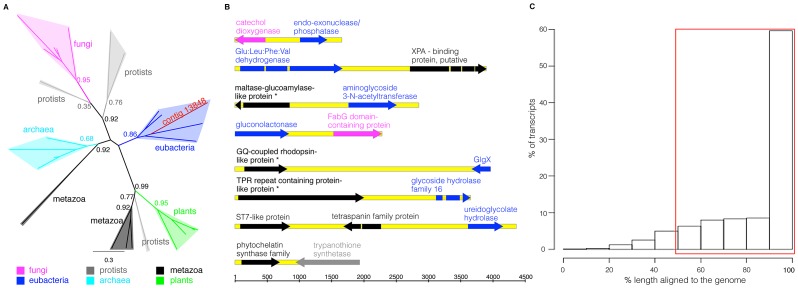
“Each alignment was then trimmed to exclude regions where only one of the sequences was present, and phylogenetic trees were built in PhyML from amino-acids sequences using a JTT model [15]; branch support was calculated with the aLRT (approximate Likelihood-Ratio Test) method.”
MethodCAP3: A DNA Sequence Assembly Program
Huang, X., & Madan, A. (1999) · Genome Research · doi:10.1101/gr.9.9.868 · Cited by 5,261 · cited 2×
“plicatilis, ESTs with accession numbers FM897377–FM945301 [48] were first assembled with CAP3 [49] into 16024 contigs, which became 9685 contigs after filtering for a blastx Evalue#10(25).”
MethodThe Masterpiece of Nature: The Evolution and Genetics of Sexuality
Bell, G. (1981) · Cited by 1,654
Horizontal gene transfer in eukaryotic evolution
Keeling, P. J., & Palmer, J. D. (2008) · Nature Reviews Genetics · doi:10.1038/nrg2386 · Cited by 1,355 · cited 4×
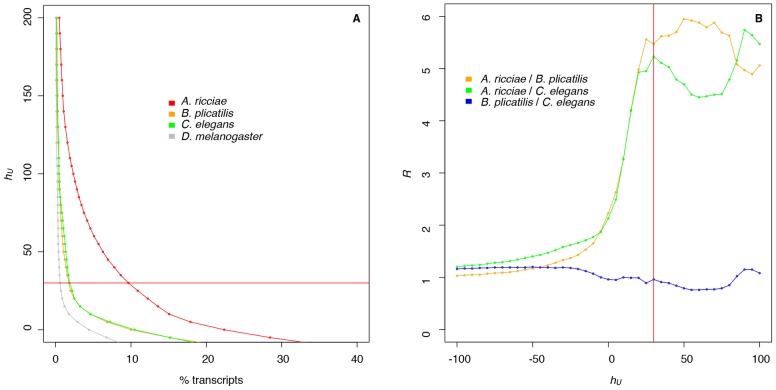
“horizontally acquired sequences [14] and this can be performed meaningfully where contigs with hU$30 have a significant (Evalue#10(25)) blast match to at least one metazoan sequence, allowing a phylogenetic tree to be constructed.”
BackgroundMethodInfluentialMayr, E., & White, M. J. D. (1978) · Systematic Zoology · doi:10.2307/2412932 · Cited by 1,246
Horizontal gene transfer among genomes: The complexity hypothesis
Jain, R., Rivera, M. C., & Lake, J. A. (1999) · Proceedings of the National Academy of Sciences · doi:10.1073/pnas.96.7.3801 · Cited by 1,165 · cited 2×
“This supports the complexity hypothesis, which states that genes whose products are involved in relatively few protein-protein interactions, such as those specifying enzymes, are more likely to be horizontally transferred than those with a higher degree of connectivity, like transcription factor genes [17,39,40].”
BackgroundWu, M., Sun, L. V., Vamathevan, J., Riegler, M., Deboy, R., Brownlie, J. C., McGraw, E. A., Martin, W., Esser, C., Ahmadinejad, N., et al. (2004) · PLoS Biology · doi:10.1371/journal.pbio.0020069 · Cited by 851 · cited 1×
“melanogaster, has not acquired the Wolbachia genome [32,33].”
BackgroundWidespread Lateral Gene Transfer from Intracellular Bacteria to Multicellular Eukaryotes
Hotopp, J. C. D., Clark, M. E., Oliveira, D. C. S. G., Foster, J. M., Fischer, P., Torres, M. C. M., Giebel, J. D., Kumar, N., Ishmael, N., Wang, S., et al. (2007) · Science · doi:10.1126/science.1142490 · Cited by 817 · cited 1×
“melanogaster, has not acquired the Wolbachia genome [32,33].”
Background
Research works printed but not linked: 1
- McGee B (2006) Hydrophilic proteins in the anhydrobiosis of bdelloid rotifers. PhD Thesis: University of Cambridge.
Cited by
Horizontal gene transfer: building the web of life
Soucy, S. M., Huang, J., & Gogarten, J. P. (2015) · Nature Reviews Genetics · doi:10.1038/nrg3962 · Cited by 1,449
Mallet, J., Besansky, N., & Hahn, M. W. (2016) · BioEssays · doi:10.1002/bies.201500149 · Cited by 586
“Lateral transfer is common in some multicellular groups [36], such as bdelloid rotifers, which, interestingly, lack meiotic sex [38, 39].”
BackgroundFunctional horizontal gene transfer from bacteria to eukaryotes
Husnik, F., & McCutcheon, J. P. (2018) · Nature Reviews Microbiology · doi:10.1038/nrmicro.2017.137 · Cited by 480
Hashimoto, T., Horikawa, D. D., Saito, Y., Kuwahara, H., Kozuka-Hata, H., Shin-I, T., Minakuchi, Y., Ohishi, K., Motoyama, A., Aizu, T., et al. (2016) · Nature Communications · doi:10.1038/ncomms12808 · Cited by 394
Ancient and modern environmental DNA
Pedersen, M. W., Overballe-Petersen, S., Ermini, L., Sarkissian, C. D., Haile, J., Hellstrom, M., Spens, J., Thomsen, P. F., Bohmann, K., Cappellini, E., et al. (2015) · Philosophical Transactions of the Royal Society B: Biological Sciences · doi:10.1098/rstb.2013.0383 · Cited by 329
“and even a eukaryotic group of micro-invertebrates, the bdelloid rotifers [48–51].”
Background
Metadata
- Authors
- Boschetti, C., Carr, A., Crisp, A., Eyres, I., Wang-Koh, Y., Lubzens, E., Barraclough, T. G., Micklem, G., & Tunnacliffe, A.
- Affiliations
- University of Cambridge (GB)
- Imperial College London (GB)
- Corresponding author
- Micklem, Gos
- Tunnacliffe, Alan
- ORCID
- Venue
- PLoS Genetics
- Publisher
- Public Library of Science (PLoS)
- Published
- 2012-11-15
- Volume
- 8
- Issue
- 11
- Pages
- e1003035
- ISSN
- 1553-7390 (ISSN-L)
- 1553-7404
- PMC
- PMC3499245
- OpenAlex
- W2070409482
- Cited by
- 171
- References
- 49
- Citations by year
- 2026: 4 · 2025: 5 · 2024: 8 · 2023: 10 · 2022: 6 · 2021: 10 · 2020: 9 · 2019: 22 · 2018: 15 · 2017: 8 · 2016: 20 · 2015: 20 · 2014: 13 · 2013: 19 · 2012: 1
- FWCI
- 6.81
- Type
- journal article
- Language
- en
- Open access
- gold
- doi.org
- Locations
- PLoS Genetics (publishedVersion, cc-by)
- Europe PMC (PubMed Central) (publishedVersion, cc-by)
- PubMed Central (publishedVersion, cc-by)
- PubMed (publishedVersion)
- White Rose Research Online (University of Leeds, The University of Sheffield, University of York) (acceptedVersion)
- DOAJ (DOAJ: Directory of Open Access Journals) (submittedVersion, cc-by-sa)
- Figshare (submittedVersion, cc-by)
- Funders
- Università degli Studi di Milano
- Directorate for Biological Sciences
- Biotechnology and Biological Sciences Research Council (BB/F020562/1, BB/F020856/1)
- Natural Environment Research Council
- FP7 Ideas: European Research Council (233232)
- Topics
- Life Sciences › Biochemistry, Genetics and Molecular Biology › Molecular Biology › Genomics and Phylogenetic Studies
- Life Sciences › Biochemistry, Genetics and Molecular Biology › Genetics › Chromosomal and Genetic Variations
- Life Sciences › Agricultural and Biological Sciences › Ecology, Evolution, Behavior and Systematics › Invertebrate Taxonomy and Ecology
- Keywords
- bdelloid rotifers, horizontal gene transfer, foreign gene expression, transcriptome, anhydrobiosis, desiccation tolerance, subtelomeric regions, enzyme evolution, toxin degradation, antioxidant metabolism, asexual reproduction
- MeSH terms
- Animals, Desiccation, Phylogeny, Radiation, Ionizing, Rotifera, Gene Library, Gene Expression, Gene Transfer, Horizontal, Metabolic Networks and Pathways, Transcriptome
About these checks
Registry, retraction, Cites and statistics results are computed, not judged, with one exception: a printed reference that no index lists is read once by a model before it counts as a citation error. Claims are extracted by a model and kept only when their quote appears verbatim in the text; each cited source is then checked, with a model’s help, for whether it says what the claim relies on. Those verdicts can be wrong — read the claim’s quote and the cited source before relying on one.
Statistics and arithmetic are recomputed, not judged.
Confidence bands are shown only for fields calibrated on our annotated test set. None is calibrated yet, so no band is shown.
What counts as a claim ›How we measure confidence ›How we check this ›
Are you an author, or do you see a problem with this page? Request a review
Data sources
Bibliographic data: Semantic Scholar, OpenAlex, Crossref.
Contains information from the Semantic Scholar Academic Graph Datasets, made available under the ODC Attribution License (ODC-BY 1.0).
Semantic Scholar’s data is described in: Kinney, R., et al. (2023). The Semantic Scholar Open Data Platform. arXiv:2301.10140.
