

The DOI matches its Crossref record; 58 of the 58 references it cites were found in a registry or an index; none of the 37 sources its claims cite is checked for support yet.
Meta-analysis of SHANK Mutations in Autism Spectrum Disorders: A Gradient of Severity in Cognitive Impairments
Open accessAbstract
SHANK genes code for scaffold proteins located at the post-synaptic density of glutamatergic synapses. In neurons, SHANK2 and SHANK3 have a positive effect on the induction and maturation of dendritic spines, whereas SHANK1 induces the enlargement of spine heads. Mutations in SHANK genes have been associated with autism spectrum disorders (ASD), but their prevalence and clinical relevance remain to be determined. Here, we performed a new screen and a meta-analysis of SHANK copy-number and coding-sequence variants in ASD. Copy-number variants were analyzed in 5,657 patients and 19,163 controls, coding-sequence variants were ascertained in 760 to 2,147 patients and 492 to 1,090 controls (depending on the gene), and, individuals carrying de novo or truncating SHANK mutations underwent an extensive clinical investigation. Copy-number variants and truncating mutations in SHANK genes were present in ∼1% of patients with ASD: mutations in SHANK1 were rare (0.04%) and present in males with normal IQ and autism; mutations in SHANK2 were present in 0.17% of patients with ASD and mild intellectual disability; mutations in SHANK3 were present in 0.69% of patients with ASD and up to 2.12% of the cases with moderate to profound intellectual disability. In summary, mutations of the SHANK genes were detected in the whole spectrum of autism with a gradient of severity in cognitive impairment. Given the rare frequency of SHANK1 and SHANK2 deleterious mutations, the clinical relevance of these genes remains to be ascertained. In contrast, the frequency and the penetrance of SHANK3 mutations in individuals with ASD and intellectual disability-more than 1 in 50-warrant its consideration for mutation screening in clinical practice.
Overview
AI snapshot
Written from the paper’s full text.
TL;DR
This meta-analysis plus new screening found SHANK copy-number and truncating coding-sequence variants in ~1% of patients with ASD, with a gene-specific gradient of cognitive severity: SHANK1 in normal-IQ autism, SHANK2 in mild ID, and SHANK3 in moderate-to-profound ID. SHANK3 mutations were the most frequent and clinically relevant, accounting for more than 1 in 50 cases with ASD plus intellectual disability.
Key findings
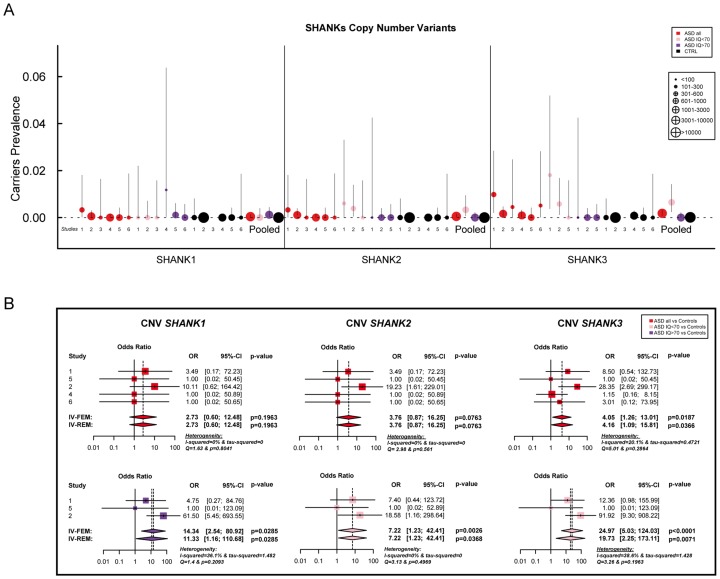
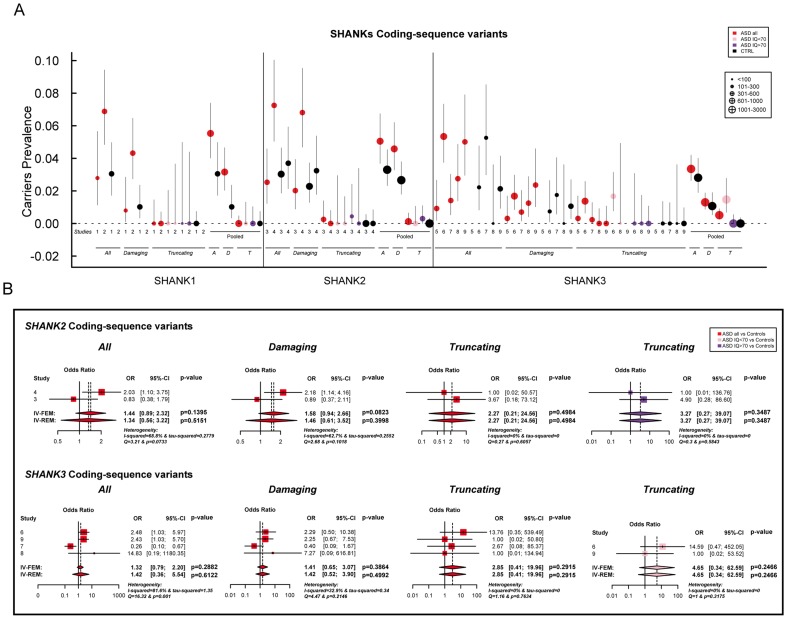
- SHANK1 mutations were rare: CNVs in 0.04% of ASD cases (2/5,657) versus 0/19,163 controls (meta-analysis fixed-effect P=0.19, OR=2.73, 95% CI 0.60–12.48), and no truncating coding-sequence variants were found (0/760 ASD, 0/492 controls). Damaging missense variants were more frequent in ASD (3.16% vs 1.02%, P=0.012, OR=3.17), but this did not survive Bonferroni correction; carriers had normal IQ (mean IQ=107) and ASD.
- SHANK2 mutations were associated with mild ID: CNVs in 0.05% of ASD cases (3/5,657) versus 0/19,163 controls (P=0.076, OR=3.76), truncating coding-sequence variants in 0.12% (1/851 ASD vs 0/1,090 controls), and damaging missense variants in 4.58% vs 2.66% (P=0.025, OR=1.76). Carriers had mild to moderate ID (mean IQ=62±17).
- SHANK3 mutations were most frequent and severe: CNVs in 0.18% of ASD cases (10/5,657) versus 0.01% of controls (2/19,163; P=0.019, OR=4.05), and truncating coding-sequence variants in 0.51% (11/2,147 ASD vs 0/1,031 controls; P=0.29, OR=2.85). In ASD with ID (IQ<70), de novo or truncating SHANK3 mutations reached 2.12% (CNVs 6/917=0.65%; coding-sequence 9/611=1.47%), versus 0% in ASD without ID and 0.01% in controls; carriers had moderate to severe/profound ID (mean IQ=31±8).
- Across genes, truncating/CNV mutations were present in ~1% of ASD cases: SHANK1 0.04%, SHANK2 0.17%, SHANK3 0.69%, with a gradient from normal IQ (SHANK1) to mild ID (SHANK2) to moderate-to-profound ID (SHANK3).
Methods
- Meta-analysis of SHANK copy-number variants (5,657 ASD cases and 19,163 controls from 11 studies, including this one) and coding-sequence variants (760–2,147 ASD cases and 492–1,090 controls depending on gene, from 10 studies, including this one). New screening included 46 ASD cases/454 controls for CNVs, 251 ASD cases/492 controls for SHANK1 exons, and 429 ASD cases/80 controls added to SHANK3 coding-sequence screening; de novo or truncating mutation carriers underwent extended clinical investigation.
- ASD diagnosis used ADI-R, and in some cases ADOS or DISCO-10; IQ was measured with age-appropriate Wechsler scales, Raven’s Standard Progressive Matrices, or PPVT, plus systematic physical examination for dysmorphic and neurological features.
- Statistical analysis used two-sided Fisher’s exact tests, Bonferroni correction for 12 tests (corrected α=0.0042), inverse-variance fixed- and random-effects meta-analysis, heterogeneity statistics (Q, I², Tau²), and power calculations; SHANK2 and SHANK3 reference sequences were corrected before screening.
Limitations
- The paper states that inherited SHANK1 and SHANK2 variant associations did not survive Bonferroni correction, and the study was underpowered for low-effect-size inherited variants: power to detect an OR of 1.5 for SHANK1, SHANK2, and SHANK3 missense inherited damaging variants was 8%, 34%, and 17%, respectively; larger IQ-stratified cohorts are needed.
- The paper notes that only non-synonymous mutations in known exons were screened; splicing isoforms, synonymous mutations, and regulatory variants were rarely reported, and whole-exome sequencing studies were excluded because of very low SHANK3 coverage. Some father DNA was unavailable for two SHANK3 truncating cases, two SHANK2 deletion patients were not included in prevalence calculations because the exact number screened was unavailable, and two unvalidated SHANK3 control deletions should be interpreted with caution.
- Evident from the text: the meta-analysis relied on combining heterogeneous published cohorts, and although the authors contacted corresponding authors to avoid overlapping samples, control data for SHANK1 coding variants were incomplete in one prior study and were excluded from that analysis.
Model-written summary. Check it against the paper before relying on it.
Integrity signals
Registry
Cites
Statistics
Figures
Verification
Claims the paper makes
53 Own result · 26 Not checked yet · 15 Own interpretation · 11 Own method · 4 No basis given
A result the paper reports from its own data — it cites no other source for it, so there is none to check. The quote shows it is in the paper.
In the paper
“mutations in SHANK3 were present in 0.69% of patients with ASD and up to 2.12% of the cases with moderate to profound intellectual disability”
§ Meta-analysis of SHANK Mutations in Autism Spectrum Disorders: A Gradient of Severity in Cognitive Impairments > Abstract
plaincorrelational- Asserted: passes — The authors put it forward as true.
- Checkable: passes — It can be checked against evidence.
- Load-bearing: passes — The paper’s conclusions depend on it.
- Based: passes — The paper gives a reason why it holds.
A result the paper reports from its own data — it cites no other source for it, so there is none to check. The quote shows it is in the paper.
In the paper
“we observed rare coding-sequence variants predicted as damaging in 4.58% of the patients with ASD compared with 2.66% of the controls (Fisher's exact test two-sided, P = 0.025, OR = 1.76, 95% CI = 1.05–2.97).”
§ Meta-analysis of SHANK Mutations in Autism Spectrum Disorders: A Gradient of Severity in Cognitive Impairments > Results > SHANK2 in ASD
plaincorrelational- Asserted: passes — The authors put it forward as true.
- Checkable: passes — It can be checked against evidence.
- Load-bearing: passes — The paper’s conclusions depend on it.
- Based: passes — The paper gives a reason why it holds.
- Rests on an assumption: Rare coding-sequence variants predicted as damaging by polyphen-2 are functionally deleterious.
A result the paper reports from its own data — it cites no other source for it, so there is none to check. The quote shows it is in the paper.
In the paper
“SHANK2 deletions were found in 0.05% (n = 3/5 657) of patients with ASD, and never in controls (n = 0/19 163; Meta-analysis – Inverse variance method - fixed effect model, P = 0.076, OR = 3.76, 95% CI = 0.87–16.25)”
§ Meta-analysis of SHANK Mutations in Autism Spectrum Disorders: A Gradient of Severity in Cognitive Impairments > Results > SHANK2 in ASD
plainn = 3- Asserted: passes — The authors put it forward as true.
- Checkable: passes — It can be checked against evidence.
- Load-bearing: unclear — It is unclear whether the paper’s conclusions depend on it.
- Based: passes — The paper gives a reason why it holds.
A result the paper reports from its own data — it cites no other source for it, so there is none to check. The quote shows it is in the paper.
In the paper
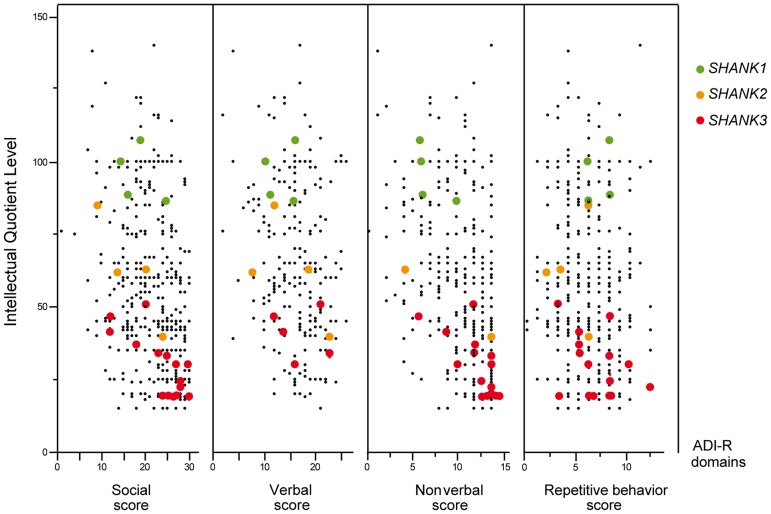
“The individuals carrying a SHANK2 de novo deletion were diagnosed with autistic disorder or pervasive developmental disorder not otherwise specified (PDD-NOS) in combination with mild to moderate ID (mean IQ = 62±17)”
§ Meta-analysis of SHANK Mutations in Autism Spectrum Disorders: A Gradient of Severity in Cognitive Impairments > Results > SHANK2 in ASD
plaincorrelational- Asserted: passes — The authors put it forward as true.
- Checkable: passes — It can be checked against evidence.
- Load-bearing: passes — The paper’s conclusions depend on it.
- Based: passes — The paper gives a reason why it holds.
- Rests on an assumption: Patients carrying de novo or truncating SHANK mutations who underwent clinical investigation are representative of all individuals with such mutations.
A result the paper reports from its own data — it cites no other source for it, so there is none to check. The quote shows it is in the paper.
In the paper
“We observed an enrichment of truncating mutations in exon 21a of SHANK3.”
§ Meta-analysis of SHANK Mutations in Autism Spectrum Disorders: A Gradient of Severity in Cognitive Impairments > Results > SHANK3 in ASD
plaincorrelationaln = 8- Asserted: passes — The authors put it forward as true.
- Checkable: passes — It can be checked against evidence.
- Load-bearing: passes — The paper’s conclusions depend on it.
- Based: passes — The paper gives a reason why it holds.
A result the paper reports from its own data — it cites no other source for it, so there is none to check. The quote shows it is in the paper.
In the paper
“Copy-number variants and truncating mutations in SHANK genes were present in ∼1% of patients with ASD: mutations in SHANK1 were rare (0.04%) and present in males with normal IQ and autism; mutations in SHANK2 were present in 0.17% of patients with ASD and mild intellectual disability; mutations in SHANK3 were present in 0.69% of patients with ASD and up to 2.12% of the cases with moderate to prof”
§ Meta-analysis of SHANK Mutations in Autism Spectrum Disorders: A Gradient of Severity in Cognitive Impairments > Abstract
plainn = 5,657- Asserted: passes — The authors put it forward as true.
- Checkable: passes — It can be checked against evidence.
- Load-bearing: passes — The paper’s conclusions depend on it.
- Based: passes — The paper gives a reason why it holds.
- Rests on an assumption: The published studies included in the meta-analysis used comparable methods for detecting SHANK variants and comparable ASD/control ascertainment.
In the paper
“In the Canadian family, the elder sister carrying the SHANK3 duplication was diagnosed with attention-deficit/hyperactivity disorder (ADHD) and developmental delay [13].”
§ Meta-analysis of SHANK Mutations in Autism Spectrum Disorders: A Gradient of Severity in Cognitive Impairments > Results > SHANK3 in ASD
What the sources say
- Not checked yetcites [13] R Moessner, 2007, Contribution of SHANK3 mutations to autism spectrum disorder, Am J Hum Genet source
plainSingle case- Asserted: passes — The authors put it forward as true.
- Checkable: passes — It can be checked against evidence.
- Load-bearing: unclear — It is unclear whether the paper’s conclusions depend on it.
- Based: passes — The paper gives a reason why it holds.
A result the paper reports from its own data — it cites no other source for it, so there is none to check. The quote shows it is in the paper.
In the paper
“The rare variants observed in patients with ASD were not observed in an additional sample of 500 control chromosomes.”
§ Meta-analysis of SHANK Mutations in Autism Spectrum Disorders: A Gradient of Severity in Cognitive Impairments > Results > SHANK1 in ASD
plainn = 500- Asserted: passes — The authors put it forward as true.
- Checkable: passes — It can be checked against evidence.
- Load-bearing: passes — The paper’s conclusions depend on it.
- Based: passes — The paper gives a reason why it holds.
A result the paper reports from its own data — it cites no other source for it, so there is none to check. The quote shows it is in the paper.
In the paper
“In a screen of 160 additional patients with ASD and ID using Multiplex Ligation-dependent Probe Amplification (MLPA) analysis, we observed two patients carrying a de novo deletion altering SHANK3”
§ Meta-analysis of SHANK Mutations in Autism Spectrum Disorders: A Gradient of Severity in Cognitive Impairments > Results > SHANK3 in ASD
plainn = 2- Asserted: passes — The authors put it forward as true.
- Checkable: passes — It can be checked against evidence.
- Load-bearing: unclear — It is unclear whether the paper’s conclusions depend on it.
- Based: passes — The paper gives a reason why it holds.
A result the paper reports from its own data — it cites no other source for it, so there is none to check. The quote shows it is in the paper.
In the paper
“mutations in SHANK3 were present in 0.69% of patients with ASD and up to 2.12% of the cases with moderate to profound intellectual disability”
§ Meta-analysis of SHANK Mutations in Autism Spectrum Disorders: A Gradient of Severity in Cognitive Impairments > Abstract
plain- Asserted: passes — The authors put it forward as true.
- Checkable: passes — It can be checked against evidence.
- Load-bearing: passes — The paper’s conclusions depend on it.
- Based: passes — The paper gives a reason why it holds.
- Probably not a substantial claim. 26
- It may state two separate claims as one. 26
- The quote only partly states this claim. 2
A result the paper reports from its own data — it cites no other source for it, so there is none to check. The quote shows it is in the paper.
In the paper
“we identified one patient (AU029) carrying a de novo SHANK3 deletion of 1.5 Mb (Figure S4).”
§ Meta-analysis of SHANK Mutations in Autism Spectrum Disorders: A Gradient of Severity in Cognitive Impairments > Results > SHANK3 in ASD
plainSingle case- Asserted: passes — The authors put it forward as true.
- Checkable: passes — It can be checked against evidence.
- Load-bearing: fails — The paper’s conclusions may not depend on it.
- Based: passes — The paper gives a reason why it holds.
Probably not a substantial claim. The paper’s conclusions may not depend on it.
A result the paper reports from its own data — it cites no other source for it, so there is none to check. The quote shows it is in the paper.
In the paper
“They also displayed minor signs of dysmorphism (broad nasal bridge, thin upper lip, pointed chin, clinodactyly) and abnormal neurological examination (Table 2).”
§ Meta-analysis of SHANK Mutations in Autism Spectrum Disorders: A Gradient of Severity in Cognitive Impairments > Results > SHANK2 in ASD
plaincorrelational- Asserted: passes — The authors put it forward as true.
- Checkable: passes — It can be checked against evidence.
- Load-bearing: unclear — It is unclear whether the paper’s conclusions depend on it.
- Based: passes — The paper gives a reason why it holds.
It may state two separate claims as one.
- Rests on an assumption: Patients carrying de novo or truncating SHANK mutations who underwent clinical investigation are representative of all individuals with such mutations.
A result the paper reports from its own data — it cites no other source for it, so there is none to check. The quote shows it is in the paper.
In the paper
“the prevalence of truncating SHANK2 coding-sequence variants was 0.12% in patients with ASD (n = 1/851), and such variants were not found in any of the 1 090 controls”
§ Meta-analysis of SHANK Mutations in Autism Spectrum Disorders: A Gradient of Severity in Cognitive Impairments > Results > SHANK2 in ASD
plainSingle case- Asserted: passes — The authors put it forward as true.
- Checkable: passes — It can be checked against evidence.
- Load-bearing: passes — The paper’s conclusions depend on it.
- Based: passes — The paper gives a reason why it holds.
It may state two separate claims as one.
A result the paper reports from its own data — it cites no other source for it, so there is none to check. The quote shows it is in the paper.
In the paper
“The second patient (RDB_30769) carried a de novo deletion of 1.8 Mb encompassing SHANK2.”
§ Meta-analysis of SHANK Mutations in Autism Spectrum Disorders: A Gradient of Severity in Cognitive Impairments > Results > SHANK2 in ASD
plainSingle case- Asserted: passes — The authors put it forward as true.
- Checkable: passes — It can be checked against evidence.
- Load-bearing: fails — The paper’s conclusions may not depend on it.
- Based: passes — The paper gives a reason why it holds.
Probably not a substantial claim. The paper’s conclusions may not depend on it.
A result the paper reports from its own data — it cites no other source for it, so there is none to check. The quote shows it is in the paper.
In the paper
“They displayed early signs of developmental delay, mild motor delay and significant language delay.”
§ Meta-analysis of SHANK Mutations in Autism Spectrum Disorders: A Gradient of Severity in Cognitive Impairments > Results > SHANK2 in ASD
plaincorrelational- Asserted: passes — The authors put it forward as true.
- Checkable: passes — It can be checked against evidence.
- Load-bearing: unclear — It is unclear whether the paper’s conclusions depend on it.
- Based: passes — The paper gives a reason why it holds.
It may state two separate claims as one.
- Rests on an assumption: Patients carrying de novo or truncating SHANK mutations who underwent clinical investigation are representative of all individuals with such mutations.
A result the paper reports from its own data — it cites no other source for it, so there is none to check. The quote shows it is in the paper.
In the paper
“The individual carrying the de novo truncating mutation R841X (SK 0441-003) had a normal IQ and diagnosed with ASD without any developmental delays or dysmorphic features.”
§ Meta-analysis of SHANK Mutations in Autism Spectrum Disorders: A Gradient of Severity in Cognitive Impairments > Results > SHANK2 in ASD
plainSingle case- Asserted: passes — The authors put it forward as true.
- Checkable: passes — It can be checked against evidence.
- Load-bearing: unclear — It is unclear whether the paper’s conclusions depend on it.
- Based: passes — The paper gives a reason why it holds.
It may state two separate claims as one.
A result the paper reports from its own data — it cites no other source for it, so there is none to check. The quote shows it is in the paper.
In the paper
“mutations in SHANK1 were rare (0.04%) and present in males with normal IQ and autism”
- Also stated in: § SHANK1 in ASD · plain
“deletions disrupting SHANK1 were detected in 0.04% (n = 2/5 657) of patients with ASD and were never found in 19 163 controls (Meta-analysis – Inverse variance method - fixed effect model P = 0.19, OR = 2.73, 95% CI = 0.60–12.48)”
§ Meta-analysis of SHANK Mutations in Autism Spectrum Disorders: A Gradient of Severity in Cognitive Impairments > Abstract
plainn = 2- Asserted: passes — The authors put it forward as true.
- Checkable: passes — It can be checked against evidence.
- Load-bearing: passes — The paper’s conclusions depend on it.
- Based: passes — The paper gives a reason why it holds.
It may state two separate claims as one.
- Also stated in: § SHANK1 in ASD · plain
A result the paper reports from its own data — it cites no other source for it, so there is none to check. The quote shows it is in the paper.
In the paper
“When all mutation screenings were included, truncating SHANK3 coding-sequence variants were found in 0.51% of the patients (n = 11/2 147) and were not found in 1031 controls (meta-analysis – inverse variance method - fixed effect model, P = 0.29, OR = 2.85, 95% CI = 0.41–19.96)”
§ Meta-analysis of SHANK Mutations in Autism Spectrum Disorders: A Gradient of Severity in Cognitive Impairments > Results > SHANK3 in ASD
plainn = 11- Asserted: passes — The authors put it forward as true.
- Checkable: passes — It can be checked against evidence.
- Load-bearing: passes — The paper’s conclusions depend on it.
- Based: passes — The paper gives a reason why it holds.
It may state two separate claims as one.
None of the sources cited for this claim have been checked yet.
In the paper
“As for the SHANK1 mutation screening by Sato et al. (2012), no de novo truncating mutation sequences were identified.”
§ Meta-analysis of SHANK Mutations in Autism Spectrum Disorders: A Gradient of Severity in Cognitive Impairments > Results > SHANK1 in ASD
plain- Asserted: passes — The authors put it forward as true.
- Checkable: passes — It can be checked against evidence.
- Load-bearing: fails — The paper’s conclusions may not depend on it.
- Based: passes — The paper gives a reason why it holds.
Probably not a substantial claim. The paper’s conclusions may not depend on it.
None of the sources cited for this claim have been checked yet.
In the paper
“In three families from France and Canada, the SHANK3 deletions originated from a balanced translocation present in a healthy parent [6], [13].”
§ Meta-analysis of SHANK Mutations in Autism Spectrum Disorders: A Gradient of Severity in Cognitive Impairments > Results > SHANK3 in ASD
What the sources say
- Not checked yetcites [6] CM Durand, 2007, Mutations in the gene encoding the synaptic scaffolding protein SHANK3 are associated with autism spectrum disorders, Nat Genet source
- Not checked yetcites [13] R Moessner, 2007, Contribution of SHANK3 mutations to autism spectrum disorder, Am J Hum Genet source
plaindirectn = 3- Asserted: passes — The authors put it forward as true.
- Checkable: passes — It can be checked against evidence.
- Load-bearing: fails — The paper’s conclusions may not depend on it.
- Based: passes — The paper gives a reason why it holds.
Probably not a substantial claim. The paper’s conclusions may not depend on it.
A result the paper reports from its own data — it cites no other source for it, so there is none to check. The quote shows it is in the paper.
In the paper
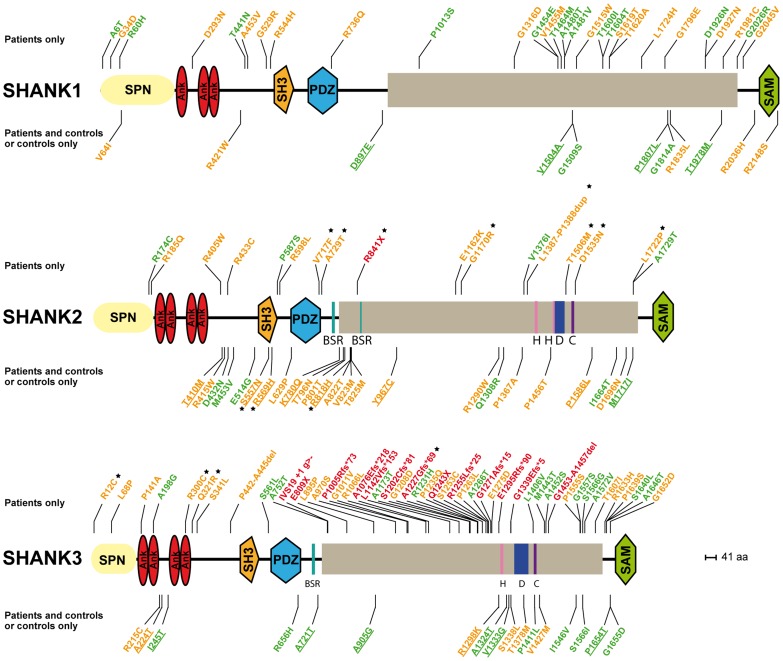
“For example, the boy carrying the L1142Vfs*153 mutation was non-verbal, showed a global developmental delay with neonatal hypotonia and typical dysmorphic features of Phelan-McDermid syndrome, including wide nasal bridge, pointed chin, deep-set eyes, flat mid-face, large ears, long eyelashes, bulbous nose, and high-arched palate (Table 2). He also developed generalized epilepsy at the age of 10 y”
§ Meta-analysis of SHANK Mutations in Autism Spectrum Disorders: A Gradient of Severity in Cognitive Impairments > Results > SHANK3 in ASD
plainSingle case- Asserted: passes — The authors put it forward as true.
- Checkable: passes — It can be checked against evidence.
- Load-bearing: unclear — It is unclear whether the paper’s conclusions depend on it.
- Based: passes — The paper gives a reason why it holds.
It may state two separate claims as one.
None of the sources cited for this claim have been checked yet.
In the paper
“Interestingly, in two families, a sibling carried the reciprocal SHANK3 duplication.”
§ Meta-analysis of SHANK Mutations in Autism Spectrum Disorders: A Gradient of Severity in Cognitive Impairments > Results > SHANK3 in ASD
What the sources say
- Not checked yetcites [6] CM Durand, 2007, Mutations in the gene encoding the synaptic scaffolding protein SHANK3 are associated with autism spectrum disorders, Nat Genet source
- Not checked yetcites [13] R Moessner, 2007, Contribution of SHANK3 mutations to autism spectrum disorder, Am J Hum Genet source
plainn = 2- Asserted: passes — The authors put it forward as true.
- Checkable: passes — It can be checked against evidence.
- Load-bearing: fails — The paper’s conclusions may not depend on it.
- Based: passes — The paper gives a reason why it holds.
Probably not a substantial claim. The paper’s conclusions may not depend on it.
A result the paper reports from its own data — it cites no other source for it, so there is none to check. The quote shows it is in the paper.
In the paper
“mutations in SHANK2 were present in 0.17% of patients with ASD and mild intellectual disability”
§ Meta-analysis of SHANK Mutations in Autism Spectrum Disorders: A Gradient of Severity in Cognitive Impairments > Abstract
plain- Asserted: passes — The authors put it forward as true.
- Checkable: passes — It can be checked against evidence.
- Load-bearing: passes — The paper’s conclusions depend on it.
- Based: passes — The paper gives a reason why it holds.
The quote only partly states this claim.
A result the paper reports from its own data — it cites no other source for it, so there is none to check. The quote shows it is in the paper.
In the paper
“In the damaging missense category, two SHANK3 (P141A & Q321R) were de novo.”
§ Meta-analysis of SHANK Mutations in Autism Spectrum Disorders: A Gradient of Severity in Cognitive Impairments > Results > Cohorts used for the meta-analysis of SHANK mutations
plain- Asserted: passes — The authors put it forward as true.
- Checkable: passes — It can be checked against evidence.
- Load-bearing: fails — The paper’s conclusions may not depend on it.
- Based: passes — The paper gives a reason why it holds.
Probably not a substantial claim. The paper’s conclusions may not depend on it.
A result the paper reports from its own data — it cites no other source for it, so there is none to check. The quote shows it is in the paper.
In the paper
“For patient AUN_006, the deletion breakpoint is located within intron 8 of SHANK3 and leads to the loss of SHANK3 (exons 9 to 22), ACR and RABL2B.”
§ Meta-analysis of SHANK Mutations in Autism Spectrum Disorders: A Gradient of Severity in Cognitive Impairments > Results > SHANK3 in ASD
plaindirectSingle case- Asserted: passes — The authors put it forward as true.
- Checkable: passes — It can be checked against evidence.
- Load-bearing: fails — The paper’s conclusions may not depend on it.
- Based: passes — The paper gives a reason why it holds.
Probably not a substantial claim. The paper’s conclusions may not depend on it.
A result the paper reports from its own data — it cites no other source for it, so there is none to check. The quote shows it is in the paper.
In the paper
“No SHANK1 duplications were found.”
§ Meta-analysis of SHANK Mutations in Autism Spectrum Disorders: A Gradient of Severity in Cognitive Impairments > Results > SHANK1 in ASD
plain- Asserted: passes — The authors put it forward as true.
- Checkable: passes — It can be checked against evidence.
- Load-bearing: fails — The paper’s conclusions may not depend on it.
- Based: passes — The paper gives a reason why it holds.
Probably not a substantial claim. The paper’s conclusions may not depend on it.
The paper states this without a source or data behind it here, so there is nothing to check it against. The quote shows it is in the paper.
In the paper
“All truncating SHANK variants were de novo (for three, the DNA of one parent was not available).”
§ Meta-analysis of SHANK Mutations in Autism Spectrum Disorders: A Gradient of Severity in Cognitive Impairments > Results > Cohorts used for the meta-analysis of SHANK mutations
plain- Asserted: passes — The authors put it forward as true.
- Checkable: passes — It can be checked against evidence.
- Load-bearing: unclear — It is unclear whether the paper’s conclusions depend on it.
- Based: passes — The paper gives a reason why it holds.
It may state two separate claims as one.
A result the paper reports from its own data — it cites no other source for it, so there is none to check. The quote shows it is in the paper.
In the paper
“No SHANK2 duplications were reported.”
§ Meta-analysis of SHANK Mutations in Autism Spectrum Disorders: A Gradient of Severity in Cognitive Impairments > Results > SHANK2 in ASD
plain- Asserted: passes — The authors put it forward as true.
- Checkable: passes — It can be checked against evidence.
- Load-bearing: fails — The paper’s conclusions may not depend on it.
- Based: passes — The paper gives a reason why it holds.
Probably not a substantial claim. The paper’s conclusions may not depend on it.
A result the paper reports from its own data — it cites no other source for it, so there is none to check. The quote shows it is in the paper.
In the paper
“For the second patient AUN_007, the deletion covers the exon 22 of SHANK3 and exons 1 to 3 of ACR.”
§ Meta-analysis of SHANK Mutations in Autism Spectrum Disorders: A Gradient of Severity in Cognitive Impairments > Results > SHANK3 in ASD
plainSingle case- Asserted: passes — The authors put it forward as true.
- Checkable: passes — It can be checked against evidence.
- Load-bearing: fails — The paper’s conclusions may not depend on it.
- Based: passes — The paper gives a reason why it holds.
Probably not a substantial claim. The paper’s conclusions may not depend on it.
A result the paper reports from its own data — it cites no other source for it, so there is none to check. The quote shows it is in the paper.
In the paper
“We identified two patients with a SHANK2 de novo deletion (Table 2).”
§ Meta-analysis of SHANK Mutations in Autism Spectrum Disorders: A Gradient of Severity in Cognitive Impairments > Results > SHANK2 in ASD
plainn = 2- Asserted: passes — The authors put it forward as true.
- Checkable: passes — It can be checked against evidence.
- Load-bearing: fails — The paper’s conclusions may not depend on it.
- Based: passes — The paper gives a reason why it holds.
Probably not a substantial claim. The paper’s conclusions may not depend on it.
A result the paper reports from its own data — it cites no other source for it, so there is none to check. The quote shows it is in the paper.
In the paper
“All deletions were de novo and disrupted coding exons.”
§ Meta-analysis of SHANK Mutations in Autism Spectrum Disorders: A Gradient of Severity in Cognitive Impairments > Results > SHANK2 in ASD
plainn = 3- Asserted: passes — The authors put it forward as true.
- Checkable: passes — It can be checked against evidence.
- Load-bearing: unclear — It is unclear whether the paper’s conclusions depend on it.
- Based: passes — The paper gives a reason why it holds.
It may state two separate claims as one.
The paper states this without a source or data behind it here, so there is nothing to check it against. The quote shows it is in the paper.
In the paper
“By contrast, the boy carrying the de novo truncating mutation S1202Cfs*81 was verbal and had moderate ID. Although reduced in quality by the opposition of the patient, the clinical examination was considered in the normal range with no significant dysmorphic features.”
§ Meta-analysis of SHANK Mutations in Autism Spectrum Disorders: A Gradient of Severity in Cognitive Impairments > Results > SHANK3 in ASD
plainSingle case- Asserted: passes — The authors put it forward as true.
- Checkable: passes — It can be checked against evidence.
- Load-bearing: unclear — It is unclear whether the paper’s conclusions depend on it.
- Based: passes — The paper gives a reason why it holds.
It may state two separate claims as one.
A result the paper reports from its own data — it cites no other source for it, so there is none to check. The quote shows it is in the paper.
In the paper
“We screened 429 patients with ASD for all coding exons of SHANK3 and found 8 patients carrying heterozygous truncating mutations (Figure 1 and 3, Figure S5, Table 1, Table S4, S5, S6, S7 and Table S11), including 6 that appeared de novo in the probands.”
§ Meta-analysis of SHANK Mutations in Autism Spectrum Disorders: A Gradient of Severity in Cognitive Impairments > Results > SHANK3 in ASD
plainn = 429- Asserted: passes — The authors put it forward as true.
- Checkable: passes — It can be checked against evidence.
- Load-bearing: passes — The paper’s conclusions depend on it.
- Based: passes — The paper gives a reason why it holds.
It may state two separate claims as one.
A result the paper reports from its own data — it cites no other source for it, so there is none to check. The quote shows it is in the paper.
In the paper
“Mutations of the SHANK genes were detected in the whole spectrum of ASD with a gradient of severity in cognitive impairment.”
§ Meta-analysis of SHANK Mutations in Autism Spectrum Disorders: A Gradient of Severity in Cognitive Impairments > Discussion
plaincorrelational- Asserted: passes — The authors put it forward as true.
- Checkable: passes — It can be checked against evidence.
- Load-bearing: passes — The paper’s conclusions depend on it.
- Based: passes — The paper gives a reason why it holds.
It may state two separate claims as one.
- Rests on an assumption: The cohorts included in the meta-analysis are representative of the whole ASD population.
A result the paper reports from its own data — it cites no other source for it, so there is none to check. The quote shows it is in the paper.
In the paper
“Taken together, a total of 760–2 147 patients and 492–1 090 controls were included in the analysis (SHANK1: 760 patients and 492 controls; SHANK2: 851 patients and 1 090 controls; SHANK3: 2 147 patients and 1 031 controls).”
§ Meta-analysis of SHANK Mutations in Autism Spectrum Disorders: A Gradient of Severity in Cognitive Impairments > Materials and Methods > SHANK copy-number and coding-sequence variants in ASD
plainn = 2,147- Asserted: passes — The authors put it forward as true.
- Checkable: passes — It can be checked against evidence.
- Load-bearing: passes — The paper’s conclusions depend on it.
- Based: passes — The paper gives a reason why it holds.
It may state two separate claims as one.
A result the paper reports from its own data — it cites no other source for it, so there is none to check. The quote shows it is in the paper.
In the paper
“The number of non-overlapping samples from these five studies was 1 866 patients with ASD and 15 122 controls, and the total number of non-overlapping samples used in the meta-analysis was 5 657 patients with ASD and 19 163 controls.”
§ Meta-analysis of SHANK Mutations in Autism Spectrum Disorders: A Gradient of Severity in Cognitive Impairments > Materials and Methods > SHANK copy-number and coding-sequence variants in ASD
plainn = 5,657- Asserted: passes — The authors put it forward as true.
- Checkable: passes — It can be checked against evidence.
- Load-bearing: passes — The paper’s conclusions depend on it.
- Based: passes — The paper gives a reason why it holds.
It may state two separate claims as one.
A result the paper reports from its own data — it cites no other source for it, so there is none to check. The quote shows it is in the paper.
In the paper
“In our cohort, we did not find synonymous mutations located at alternative splicing sites”
§ Meta-analysis of SHANK Mutations in Autism Spectrum Disorders: A Gradient of Severity in Cognitive Impairments > Discussion
plain- Asserted: passes — The authors put it forward as true.
- Checkable: passes — It can be checked against evidence.
- Load-bearing: fails — The paper’s conclusions may not depend on it.
- Based: passes — The paper gives a reason why it holds.
Probably not a substantial claim. The paper’s conclusions may not depend on it.
A result the paper reports from its own data — it cites no other source for it, so there is none to check. The quote shows it is in the paper.
In the paper
“the majority of the mutations detected in our study were located in the exonic region of SHANK3 showing a very low coverage (Figure S3)”
§ Meta-analysis of SHANK Mutations in Autism Spectrum Disorders: A Gradient of Severity in Cognitive Impairments > Discussion
plain- Asserted: passes — The authors put it forward as true.
- Checkable: passes — It can be checked against evidence.
- Load-bearing: passes — The paper’s conclusions depend on it.
- Based: passes — The paper gives a reason why it holds.
It may state two separate claims as one.
In the paper
“Interestingly, sex differences might modulate the phenotype since females carrying an inherited SHANK1 deletion exhibited anxiety and shyness, but did not fulfill criteria for ASD [19].”
§ Meta-analysis of SHANK Mutations in Autism Spectrum Disorders: A Gradient of Severity in Cognitive Impairments > Results > SHANK1 in ASD
What the sources say
- Not checked yetcites [19] D Sato, 2012, SHANK1 Deletions in Males with Autism Spectrum Disorder, Am J Hum Genet source
hedgedconditional- Asserted: passes — The authors put it forward as true.
- Checkable: passes — It can be checked against evidence.
- Load-bearing: fails — The paper’s conclusions may not depend on it.
- Based: passes — The paper gives a reason why it holds.
Probably not a substantial claim. The paper’s conclusions may not depend on it. It may state two separate claims as one.
A conclusion the paper draws from its own results — it cites no other source for it, so there is none to check. The quote shows it is in the paper.
In the paper
“In summary, mutations of the SHANK genes were detected in the whole spectrum of autism with a gradient of severity in cognitive impairment.”
- Also stated in: § Cohorts used for the meta-analysis of SHANK mutations · plain
“Mutations in SHANK1-3 are associated with a gradient of severity in cognitive impairment.”
§ Meta-analysis of SHANK Mutations in Autism Spectrum Disorders: A Gradient of Severity in Cognitive Impairments > Abstract
plaincorrelationaln = 5,657- Asserted: passes — The authors put it forward as true.
- Checkable: passes — It can be checked against evidence.
- Load-bearing: passes — The paper’s conclusions depend on it.
- Based: passes — The paper gives a reason why it holds.
It may state two separate claims as one.
- Rests on an assumption: The clinical phenotype associated with SHANK mutations is primarily attributable to the SHANK gene affected rather than to other genetic or environmental factors.
- Also stated in: § Cohorts used for the meta-analysis of SHANK mutations · plain
What the paper did — it cites no source for this, so there is none to check. The quote shows it is in the paper.
In the paper
“The power achieved to observe the statistical difference between patients and controls for SHANK1 and SHANK2 damaging missense variants was 69% and 59%.”
§ Meta-analysis of SHANK Mutations in Autism Spectrum Disorders: A Gradient of Severity in Cognitive Impairments > Results > Cohorts used for the meta-analysis of SHANK mutations
plain- Asserted: passes — The authors put it forward as true.
- Checkable: passes — It can be checked against evidence.
- Load-bearing: unclear — It is unclear whether the paper’s conclusions depend on it.
- Based: passes — The paper gives a reason why it holds.
It may state two separate claims as one.
In the paper
“Here, we focused on the three SHANK genes, which code for large synaptic scaffold proteins of the post-synaptic density [12].”
§ Meta-analysis of SHANK Mutations in Autism Spectrum Disorders: A Gradient of Severity in Cognitive Impairments > Introduction
What the sources say
- Not checked yetcites [12] AM Grabrucker, 2011, Postsynaptic ProSAP/Shank scaffolds in the cross-hair of synaptopathies, Trends Cell Biol source
plain- Asserted: passes — The authors put it forward as true.
- Checkable: passes — It can be checked against evidence.
- Load-bearing: fails — The paper’s conclusions may not depend on it.
- Based: passes — The paper gives a reason why it holds.
Probably not a substantial claim. The paper’s conclusions may not depend on it.
A conclusion the paper draws from its own results — it cites no other source for it, so there is none to check. The quote shows it is in the paper.
In the paper
“mutations in SHANK2 were present in 0.17% of patients with ASD and mild intellectual disability”
§ Meta-analysis of SHANK Mutations in Autism Spectrum Disorders: A Gradient of Severity in Cognitive Impairments > Abstract
plaincorrelational- Asserted: passes — The authors put it forward as true.
- Checkable: passes — It can be checked against evidence.
- Load-bearing: passes — The paper’s conclusions depend on it.
- Based: passes — The paper gives a reason why it holds.
The quote only partly states this claim.
In the paper
“male individuals carrying SHANK1 deletions do not present with language delay or ID and are diagnosed with normal IQ ASD or Asperger syndrome [19].”
§ Meta-analysis of SHANK Mutations in Autism Spectrum Disorders: A Gradient of Severity in Cognitive Impairments > Discussion
What the sources say
- Not checked yetcites [19] D Sato, 2012, SHANK1 Deletions in Males with Autism Spectrum Disorder, Am J Hum Genet source
plain- Asserted: passes — The authors put it forward as true.
- Checkable: passes — It can be checked against evidence.
- Load-bearing: passes — The paper’s conclusions depend on it.
- Based: passes — The paper gives a reason why it holds.
It may state two separate claims as one.
A conclusion the paper draws from its own results — it cites no other source for it, so there is none to check. The quote shows it is in the paper.
In the paper
“For SHANK2 and SHANK3 mutations, it is expected that affected neurons will have a reduced total number of dendritic spines and synapses.”
§ Meta-analysis of SHANK Mutations in Autism Spectrum Disorders: A Gradient of Severity in Cognitive Impairments > Discussion
hedgedconditional- Asserted: passes — The authors put it forward as true.
- Checkable: passes — It can be checked against evidence.
- Load-bearing: passes — The paper’s conclusions depend on it.
- Based: fails — The paper may give no reason why it holds.
Probably not a substantial claim. The paper may give no reason why it holds.
A conclusion the paper draws from its own results — it cites no other source for it, so there is none to check. The quote shows it is in the paper.
In the paper
“SHANK1 mutations might rather lead to an immature neuronal network with a reduced number of large spine heads.”
§ Meta-analysis of SHANK Mutations in Autism Spectrum Disorders: A Gradient of Severity in Cognitive Impairments > Discussion
hedgedconditional- Asserted: passes — The authors put it forward as true.
- Checkable: passes — It can be checked against evidence.
- Load-bearing: fails — The paper’s conclusions may not depend on it.
- Based: passes — The paper gives a reason why it holds.
Probably not a substantial claim. The paper’s conclusions may not depend on it.
A conclusion the paper draws from its own results — it cites no other source for it, so there is none to check. The quote shows it is in the paper.
In the paper
“The reduction in mature glutamatergic synapses is expected to affect cognitive functions.”
§ Meta-analysis of SHANK Mutations in Autism Spectrum Disorders: A Gradient of Severity in Cognitive Impairments > Discussion
hedgedconditional- Asserted: passes — The authors put it forward as true.
- Checkable: passes — It can be checked against evidence.
- Load-bearing: passes — The paper’s conclusions depend on it.
- Based: passes — The paper gives a reason why it holds.
Probably not a substantial claim.
A conclusion the paper draws from its own results — it cites no other source for it, so there is none to check. The quote shows it is in the paper.
In the paper
“This difference in severity of cognitive impairment is in agreement with the observation that SHANK3 mutations are highly penetrant (to our knowledge only one validated SHANK3 deletion has been reported to be inherited from a mother with moderate ID [45]), while for SHANK2, additional genetic/epigenetic factors might be necessary to develop ASD [18], [19], [46].”
§ Meta-analysis of SHANK Mutations in Autism Spectrum Disorders: A Gradient of Severity in Cognitive Impairments > Discussion
hedgedcorrelational- Asserted: passes — The authors put it forward as true.
- Checkable: passes — It can be checked against evidence.
- Load-bearing: passes — The paper’s conclusions depend on it.
- Based: passes — The paper gives a reason why it holds.
It may state two separate claims as one.
None of the sources cited for this claim have been checked yet.
In the paper
“Previous functional studies have shown that inherited variants are associated with a statistically significant reduction in the density of synapses, although not as severe as the reduction caused by the de novo or truncating mutations [6], [18], [42]–[44].”
§ Meta-analysis of SHANK Mutations in Autism Spectrum Disorders: A Gradient of Severity in Cognitive Impairments > Discussion
What the sources say
- Not checked yetcites [6] CM Durand, 2007, Mutations in the gene encoding the synaptic scaffolding protein SHANK3 are associated with autism spectrum disorders, Nat Genet source
- Not checked yetcites [18] CS Leblond, 2012, Genetic and functional analyses of SHANK2 mutations suggest a multiple hit model of autism spectrum disorders, PLoS Genet source
- Not checked yetcites [42]–[44]
plaincorrelational- Asserted: passes — The authors put it forward as true.
- Checkable: passes — It can be checked against evidence.
- Load-bearing: passes — The paper’s conclusions depend on it.
- Based: passes — The paper gives a reason why it holds.
It may state two separate claims as one.
In the paper
“The two SHANK3 deletions reported by Glessner et al. (2009) [34] in control subjects have not been validated and should be interpreted with caution.”
§ Meta-analysis of SHANK Mutations in Autism Spectrum Disorders: A Gradient of Severity in Cognitive Impairments > Results > Cohorts used for the meta-analysis of SHANK mutations
What the sources say
- Not checked yetcites [34] JT Glessner, 2009, Autism genome-wide copy number variation reveals ubiquitin and neuronal genes, Nature source
plain- Asserted: passes — The authors put it forward as true.
- Checkable: passes — It can be checked against evidence.
- Load-bearing: unclear — It is unclear whether the paper’s conclusions depend on it.
- Based: passes — The paper gives a reason why it holds.
It may state two separate claims as one.
What the paper did — it cites no source for this, so there is none to check. The quote shows it is in the paper.
In the paper
“To ensure that the cohorts were constituted of independent and unrelated cases and controls, we contacted the corresponding authors of each study.”
§ Meta-analysis of SHANK Mutations in Autism Spectrum Disorders: A Gradient of Severity in Cognitive Impairments > Materials and Methods > SHANK copy-number and coding-sequence variants in ASD
plaindirect- Asserted: passes — The authors put it forward as true.
- Checkable: passes — It can be checked against evidence.
- Load-bearing: passes — The paper’s conclusions depend on it.
- Based: passes — The paper gives a reason why it holds.
Probably not a substantial claim.
A conclusion the paper draws from its own results — it cites no other source for it, so there is none to check. The quote shows it is in the paper.
In the paper
“Together, these genetic and functional data suggest that, although present in healthy parents, some inherited SHANK mutations might contribute to the development of ASD.”
§ Meta-analysis of SHANK Mutations in Autism Spectrum Disorders: A Gradient of Severity in Cognitive Impairments > Discussion
hedgedconditional- Asserted: passes — The authors put it forward as true.
- Checkable: passes — It can be checked against evidence.
- Load-bearing: passes — The paper’s conclusions depend on it.
- Based: passes — The paper gives a reason why it holds.
It may state two separate claims as one.
A conclusion the paper draws from its own results — it cites no other source for it, so there is none to check. The quote shows it is in the paper.
In the paper
“In summary, our genetic and clinical findings provide additional support for considering SHANK mutations in a broad spectrum of patients with ASD.”
§ Meta-analysis of SHANK Mutations in Autism Spectrum Disorders: A Gradient of Severity in Cognitive Impairments > Discussion
plaincorrelational- Asserted: passes — The authors put it forward as true.
- Checkable: fails — It may be too vague to check against evidence.
- Load-bearing: passes — The paper’s conclusions depend on it.
- Based: passes — The paper gives a reason why it holds.
Probably not a substantial claim. It may be too vague to check against evidence.
- Rests on an assumption: The cohorts included in the meta-analysis are representative of the whole ASD population.
A conclusion the paper draws from its own results — it cites no other source for it, so there is none to check. The quote shows it is in the paper.
In the paper
“females who are carrier of a SHANK1 deletion seem to be protected against ASD suggesting that X-linked genes escaping the X-inactivation process and/or hormonal factors could buffer this type of synaptic alterations.”
§ Meta-analysis of SHANK Mutations in Autism Spectrum Disorders: A Gradient of Severity in Cognitive Impairments > Discussion
hedgedconditional- Asserted: passes — The authors put it forward as true.
- Checkable: passes — It can be checked against evidence.
- Load-bearing: unclear — It is unclear whether the paper’s conclusions depend on it.
- Based: unclear — It is unclear why the paper says it holds.
It may state two separate claims as one.
What the paper did — it cites no source for this, so there is none to check. The quote shows it is in the paper.
In the paper
“To avoid population stratification bias in the calculation of the odds ratio (OR), studies without a control group were excluded (i.e. Boccuto et al. 2012 and Bremer et al. 2012) (Figure 2, 3, and Table 1).”
§ Meta-analysis of SHANK Mutations in Autism Spectrum Disorders: A Gradient of Severity in Cognitive Impairments > Materials and Methods > Statistics
plaindirect- Asserted: passes — The authors put it forward as true.
- Checkable: passes — It can be checked against evidence.
- Load-bearing: passes — The paper’s conclusions depend on it.
- Based: passes — The paper gives a reason why it holds.
Probably not a substantial claim.
In the paper
“It has been proposed that abnormal SHANK levels at the synapse might result in the mislocalization, de-clustering and/or functional impairment of several other crucial synaptic proteins such as cytoskeletal regulators and/or neurotransmitter receptors [12] (Table 3).”
§ Meta-analysis of SHANK Mutations in Autism Spectrum Disorders: A Gradient of Severity in Cognitive Impairments > Discussion
What the sources say
- Not checked yetcites [12] AM Grabrucker, 2011, Postsynaptic ProSAP/Shank scaffolds in the cross-hair of synaptopathies, Trends Cell Biol source
hedgedconditional- Asserted: passes — The authors put it forward as true.
- Checkable: passes — It can be checked against evidence.
- Load-bearing: fails — The paper’s conclusions may not depend on it.
- Based: passes — The paper gives a reason why it holds.
Probably not a substantial claim. The paper’s conclusions may not depend on it.
In the paper
“For SHANK1, there are two studies (Sato et al. (2012) [19] and this study), but Sato et al. (2012) [19] did not screen for all SHANK1 exons in the controls. Therefore these controls were not included here.”
§ Meta-analysis of SHANK Mutations in Autism Spectrum Disorders: A Gradient of Severity in Cognitive Impairments > Results > Cohorts used for the meta-analysis of SHANK mutations
What the sources say
- Not checked yetcites [19] D Sato, 2012, SHANK1 Deletions in Males with Autism Spectrum Disorder, Am J Hum Genet source
plaindirect- Asserted: passes — The authors put it forward as true.
- Checkable: passes — It can be checked against evidence.
- Load-bearing: passes — The paper’s conclusions depend on it.
- Based: passes — The paper gives a reason why it holds.
It may state two separate claims as one.
A conclusion the paper draws from its own results — it cites no other source for it, so there is none to check. The quote shows it is in the paper.
In the paper
“For SHANK1 mutations, it is expected that the number of dendrites and glutamatergic synapses will not be dramatically affected (if at all).”
§ Meta-analysis of SHANK Mutations in Autism Spectrum Disorders: A Gradient of Severity in Cognitive Impairments > Discussion
hedged- Asserted: passes — The authors put it forward as true.
- Checkable: passes — It can be checked against evidence.
- Load-bearing: passes — The paper’s conclusions depend on it.
- Based: fails — The paper may give no reason why it holds.
Probably not a substantial claim. The paper may give no reason why it holds.
In the paper
“other genes involved in the same synaptic pathway, including neurexin and neuroligin genes, appear to be associated with a variety of neuropsychiatric disorders [11].”
§ Meta-analysis of SHANK Mutations in Autism Spectrum Disorders: A Gradient of Severity in Cognitive Impairments > Discussion
What the sources say
- Not checked yetcites [11] TC Sudhof, 2008, Neuroligins and neurexins link synaptic function to cognitive disease, Nature source
hedgedcorrelational- Asserted: passes — The authors put it forward as true.
- Checkable: passes — It can be checked against evidence.
- Load-bearing: fails — The paper’s conclusions may not depend on it.
- Based: passes — The paper gives a reason why it holds.
Probably not a substantial claim. The paper’s conclusions may not depend on it.
What the paper did — it cites no source for this, so there is none to check. The quote shows it is in the paper.
In the paper
“The frequencies of SHANK mutations have been calculated including only unrelated cases and controls.”
§ Meta-analysis of SHANK Mutations in Autism Spectrum Disorders: A Gradient of Severity in Cognitive Impairments > Results > Cohorts used for the meta-analysis of SHANK mutations
plain- Asserted: passes — The authors put it forward as true.
- Checkable: passes — It can be checked against evidence.
- Load-bearing: fails — The paper’s conclusions may not depend on it.
- Based: passes — The paper gives a reason why it holds.
Probably not a substantial claim. The paper’s conclusions may not depend on it.
What the paper did — it cites no source for this, so there is none to check. The quote shows it is in the paper.
In the paper
“Because of the very low coverage of whole exome sequencing (Figure S3 and Text S1), we excluded mutation screening performed using this approach.”
§ Meta-analysis of SHANK Mutations in Autism Spectrum Disorders: A Gradient of Severity in Cognitive Impairments > Materials and Methods > SHANK copy-number and coding-sequence variants in ASD
plaindirect- Asserted: passes — The authors put it forward as true.
- Checkable: passes — It can be checked against evidence.
- Load-bearing: passes — The paper’s conclusions depend on it.
- Based: passes — The paper gives a reason why it holds.
Probably not a substantial claim.
In the paper
“For controls, the two SHANK3 deletions reported by Glessner et al. (2009) among 2 519 individuals, were not validated and thus should be regarded with caution.”
§ Meta-analysis of SHANK Mutations in Autism Spectrum Disorders: A Gradient of Severity in Cognitive Impairments > Materials and Methods > SHANK copy-number and coding-sequence variants in ASD
What the sources say
- Not checked yetcites Glessner et al. (2009) source
plainn = 2,519- Asserted: passes — The authors put it forward as true.
- Checkable: passes — It can be checked against evidence.
- Load-bearing: unclear — It is unclear whether the paper’s conclusions depend on it.
- Based: passes — The paper gives a reason why it holds.
It may state two separate claims as one.
What the paper did — it cites no source for this, so there is none to check. The quote shows it is in the paper.
In the paper
“For patients with ASD, only copy-number variants validated by an independent method were included in the analysis.”
§ Meta-analysis of SHANK Mutations in Autism Spectrum Disorders: A Gradient of Severity in Cognitive Impairments > Materials and Methods > SHANK copy-number and coding-sequence variants in ASD
plainn = 657- Asserted: passes — The authors put it forward as true.
- Checkable: passes — It can be checked against evidence.
- Load-bearing: passes — The paper’s conclusions depend on it.
- Based: passes — The paper gives a reason why it holds.
Probably not a substantial claim.
The paper relies on this without support.
The published studies included in the meta-analysis used comparable methods for detecting SHANK variants and comparable ASD/control ascertainment.
“This meta-analysis included the published data from 14 studies in addition to a new screening of SHANK copy-number variants and coding sequence variants.”
The paper relies on this without support.
Rare coding-sequence variants predicted as damaging by polyphen-2 are functionally deleterious.
“rare inherited coding-sequence variants predicted as damaging were, however, more frequent in patients with ASD than in controls”
The paper relies on this without support.
The clinical phenotype associated with SHANK mutations is primarily attributable to the SHANK gene affected rather than to other genetic or environmental factors.
“Mutations in SHANK1-3 are associated with a gradient of severity in cognitive impairment.”
The paper relies on this without support.
Patients carrying de novo or truncating SHANK mutations who underwent clinical investigation are representative of all individuals with such mutations.
“When possible, the patients carrying truncating mutations altering SHANK genes underwent further clinical investigations (Table 2 & S7).”
The paper relies on this without support.
The cohorts included in the meta-analysis are representative of the whole ASD population.
“In the whole spectrum of ASD, we estimated that 0.04%, 0.17% and 0.69% of cases with ASD had heterozygous truncating mutations in SHANK1, SHANK2 or SHANK3, respectively (Table 1).”
The paper relies on this without support.
The control groups included in the meta-analysis are representative of the general population without ASD.
“0.01% in controls”
The paper relies on this without support.
The SHANK mutations classified as truncating or damaging are pathogenic.
“we estimated that 0.04%, 0.17% and 0.69% of cases with ASD had heterozygous truncating mutations in SHANK1, SHANK2 or SHANK3, respectively (Table 1).”
Claims other papers make about this one
Each is checked against this paper’s own text: does it say what the citing paper says it does?
In the citing paper
“One of the most important gene families mutated in ASD is the SHANK gene family [9]”
In the citing paper
“Shank1-/- and Shank3B-/- mice, covering the extremes of the spectrum with a gradient in severity in mental retardation.”
In the citing paper
“The selection among the many ASD mouse models available was based on the fact that more than 900 patients with genetic alterations in SHANK genes were identified, with the SHANK gene family being the primary gene family implicated in ASD [9].”
In the citing paper
“Shank1 and Shank3 mouse models were selected to cover both extremes of the spectrum, namely SHANK1 mutations found in individuals with ASD and normal intelligence and SHANK3 mutations associated with severe mental retardation [9].”
Citations
Cites
Measuring inconsistency in meta-analyses
Higgins, J. P. T., Thompson, S. G., Deeks, J. J., & Altman, D. G. (2003) · BMJ · doi:10.1136/bmj.327.7414.557 · Cited by 63,139 · cited 1×
“The Q statistic is a chisquare test for heterogeneity, and the I(2) and Tau(2) are the proportion of observed variance in effect sizes across studies for fixed effect model and random effect model, respectively [55].”
MethodLord, C., Rutter, M., & Le Couteur, A. (1994) · Journal of Autism and Developmental Disorders · doi:10.1007/bf02172145 · Cited by 9,065 · cited 4×
“In Sweden, in few cases, the Diagnostic Interview for Social and Communication Disorders (DISCO-10) [50] was used instead of the ADI-R.”
MethodInfluentialLord, C., Risi, S., Lambrecht, L., Cook, E. H., Leventhal, B. L., DiLavore, P. C., Pickles, A., & Rutter, M. (2000) · Journal of Autism and Developmental Disorders · doi:10.1023/a:1005592401947 · Cited by 7,520 · cited 1×
“The autism-spectrum diagnosis was based on the Autism Diagnostic Interview – Revised (ADI-R) [48] and for some of the patients, the Autism Diagnostic Observation Schedule (ADOS) [49].”
MethodTHE USE OF CONFIDENCE OR FIDUCIAL LIMITS ILLUSTRATED IN THE CASE OF THE BINOMIAL
Clopper, C. J., & Pearson, E. S. (1934) · Biometrika · doi:10.1093/biomet/26.4.404 · Cited by 5,327 · cited 1×
“Prevalence and confidence intervals of single studies were evaluated using Clopper and Pearson method [54].”
MethodStrong association of de novo copy number mutations with autism
Sebat, J., Lakshmi, B., Malhotra, D., Troge, J., Lese-Martin, C., Walsh, T., Yamrom, B., Yoon, S., Krasnitz, A., Kendall, J., et al. (2007) · Science · doi:10.1126/science.1138659 · Cited by 2,795 · cited 1×
“For the second patient AUN_007, the deletion covers the exon 22 of SHANK3 and exons 1 to 3 of ACR .”
BackgroundSporadic autism exomes reveal a highly interconnected protein network of de novo mutations
O’Roak, B. J., Vives, L., Girirajan, S., Karakoc, E., Krumm, N., Coe, B. P., Levy, R., Ko, A., Lee, C., Smith, J. D., et al. (2012) · Nature · doi:10.1038/nature10989 · Cited by 2,165 · cited 1×
“[32,36,37] and no truncating coding-sequence variation within SHANK1 and SHANK3.”
BackgroundDe novo mutations revealed by whole-exome sequencing are strongly associated with autism
Sanders, S. J., Murtha, M. T., Gupta, A. R., Murdoch, J. D., Raubeson, M. J., Willsey, A. J., Ercan-Sencicek, A. G., DiLullo, N. M., Parikshak, N. N., Stein, J. L., et al. (2012) · Nature · doi:10.1038/nature10945 · Cited by 2,084 · cited 2×
“[32,36,37] and no truncating coding-sequence variation within SHANK1 and SHANK3.”
BackgroundResultFunctional impact of global rare copy number variation in autism spectrum disorders
Pinto, D., Pagnamenta, A. T., Klei, L., Anney, R., Merico, D., Regan, R., Conroy, J., Magalhaes, T. R., Correia, C., Abrahams, B. S., et al. (2010) · Nature · doi:10.1038/nature09146 · Cited by 2,013 · cited 2×
“SHANK copy-number and coding-sequence variants in ASD SHANK copy-number variants were detected with the Illumina Human 1M-Duo BeadChip, and validated by quantitative PCR as previously described [8,18].”
MethodSelf-citationMutations of the X-linked genes encoding neuroligins NLGN3 and NLGN4 are associated with autism
Study, P. A. R. I. S., Jamain, S., Quach, H., Betancur, C., Råstam, M., Colineaux, C., Gillberg, I. C., Soderstrom, H., Giros, B., Leboyer, M., et al. (2003) · Nature Genetics · doi:10.1038/ng1136 · Cited by 1,851 · cited 1×
“In particular, mutations in genes coding for synaptic cell adhesion molecules and scaffold proteins — such as neuroligins, neurexins and SHANK — have been repeatedly reported in individuals with ASD [5–10].”
BackgroundSelf-citationNeuroligins and neurexins link synaptic function to cognitive disease
Südhof, T. C. (2008) · Nature · doi:10.1038/nature07456 · Cited by 1,849 · cited 2×
“These proteins play a crucial role in the formation and stabilization of synapses [11,12].”
Background
Cited by
Sorted by citations
Items 601–634 of 634
Cervera‐Juanes, R. P., Zimmerman, K. D., Wilhelm, L., Lowe, C. C., Gonzales, S. W., Carlson, T., HITZEMANN, R. J., Ferguson, B. M., & Grant, K. A. (2024) · Research Square · doi:10.21203/rs.3.rs-5406434/v1
Pan, X. H., Qian, G., Liu, L., et al. (2025) · SSRN Electronic Journal · doi:10.2139/ssrn.5105307
Amjad, E., & Sokouti, B. (2025) · Springer eBooks · doi:10.1007/978-3-031-40858-8_389-1
Sánta, A., Kálmán, Z. E., Nagy‐Kanta, E., Jakab, B., Gáspári, Z., & Péterfia, B. F. (2025) · bioRxiv (Cold Spring Harbor Laboratory) · doi:10.1101/2025.07.03.662971
Otani, Y., Goodall, E., Srinivasan, V., Ball, N. J., Barnett, S. F. H., Zech, T., Saarikangas, J., & Goult, B. T. (2025) · bioRxiv (Cold Spring Harbor Laboratory) · doi:10.1101/2025.08.27.672337
WBSCR Locus: At the Crossroads of Human Behavioral Disorders and Domestication of Animals
Shepelev, M. V., Skobel, O. I., Glazko, T. T., Popov, D. V., Vysotskii, D. E., Georgiev, P. G., Maksimenko, O. G., Kosovsky, G. Y., & Silaeva, Y. Y. (2025) · International Journal of Molecular Sciences · doi:10.3390/ijms26178549
DeLisi, L. E. (2025) · Psychiatry Research · doi:10.1016/j.psychres.2025.116790 · Cited by 1
Genetically Modified Primate Models for Brain Disorder Research
Yang, Y., Lin, J., Li, M., Yang, L., Lu, Z., & Yan, T. (2025) · Neuroscience Bulletin · doi:10.1007/s12264-025-01529-7
Marsal-García, L., Choi, J.-H., Peraldi, E., Wu, P. Y., Dang, C. L., McKinney, R. A., Gantois, I., & Sonenberg, N. (2025) · Neurobiology of Disease · doi:10.1016/j.nbd.2025.107217 · Cited by 1
Anderson, A., & Leaf, J. B. (2025) · Autism and child psychopathology series · doi:10.1007/978-3-032-01237-1_2
Anderson, A., & Leaf, J. B. (2026) · Autism and child psychopathology series · doi:10.1007/978-3-032-11141-8_3
Ahn, S., Oh, J.-H., Kang, Y. G., Oh, D. E., Lee, T., Kim, S., Hyun, Y., Sung, C. O., & Kim, H.-W. (2026) · Progress in Neuro-Psychopharmacology and Biological Psychiatry · doi:10.1016/j.pnpbp.2026.111655
Saitovitch, A. (2014) · theses.fr (ABES) · doi:10.70675/ddd5f246z0fe4z4134z8a28z27d0a24aed40
Modélisation computationelle de l'épilepsie avec crises focales migrantes du nourrisson
Kuchenbuch, M. (2019) · theses.fr (ABES) · doi:10.70675/779e5812zee01z4df0zaf02zfe0d335d2b10
Trognon, A. (2022) · theses.fr (ABES) · doi:10.70675/a61baf2dz0493z4668z80b0za8538881eb16 · Cited by 1
Using molecular biology to predict the outcome in psychotic disorders
Jiao, C. (2024) · theses.fr (ABES) · doi:10.70675/6961021bzd548z4deez833dz14bbf25987d8
Kohli, S., Schaffer, E., Savino, J., Thinakaran, A. A., Cai, S., Halpern, D. B., Zweifach, J., Sancimino, C., Siper, P. M., Buxbaum, J. D., et al. (2026) · bioRxiv (Cold Spring Harbor Laboratory) · doi:10.64898/2026.04.10.715308
Sušienková, P., Szabó, J., Filo, J., Borbélyová, V., Ostatníková, D., Celec, P., & Renczés, E. (2026) · Hormones and Behavior · doi:10.1016/j.yhbeh.2026.105935
Beker, S., Kohli, S., Schaffer, E., Savino, J., Thinakaran, A. A., Cai, S., Halpern, D. B., Zweifach, J., Sancimino, C., Siper, P. M., et al. (2026) · Research Square · doi:10.21203/rs.3.rs-9456375/v1
Nakagawa, T., & Nakagawa, M. (2026) · Genes · doi:10.3390/genes17050553
TAKABA, S., Banda, N., Doya, R., Soe, N. C., Ogasawara, K., Hirai, A., Ikenaka, Y., Ishizuka, M., & Nakayama, S. M. M. (2026) · Journal of Veterinary Medical Science · doi:10.1292/jvms.25-0549
Folkes, O. M., Donahue, M., Perez, R. E., Minier-Toribio, A. M., Negrón-Moreno, P. N., Picciotto, M. R., & Jiang, Y.-H. (2026) · bioRxiv (Cold Spring Harbor Laboratory) · doi:10.64898/2026.06.04.730003
Brain MRI evidence of distinct contiguous gene syndrome in 22q13 deletion-related disordersPreprint
Aljabali, K., Fabre, A., Philippe, A., Boisgontier, J., Fillon, L., Saitovitch, A., Cabet, S., Dangouloff‐Ros, V., Rio, M., Cormier‐Daire, V., et al. (2026) · Research Square · doi:10.21203/rs.3.rs-9779696/v1
Peyre, H., Madieu, E., Audoyer, P., et al. (2026) · Psychopathology · doi:10.1159/000553133
Self-citationFaghihi, F., Amani, J., Gholami, M., & Salahshourifar, I. (2026) · Iranian journal of pharmaceutical research · doi:10.5812/ijpr-172311
Emerging gene-edited dog models for autism spectrum disorder
Yuan, S., Shi, Q., Zhao, H., Guo, K., Jiang, Y., & Zhang, Y. (2026) · Genomic psychiatry : · doi:10.61373/gp026p.0036
Li, R., Wang, B., Ren, H., An, Y., Li, X. Z., Zhang, J., Xue, Q., & Cao, X. (2026) · Neuropharmacology · doi:10.1016/j.neuropharm.2026.111107
Lu, S., Chen, Z., Wang, Y., Bian, H., Yu, S., & Huang, L. (2026) · Brain Sciences · doi:10.3390/brainsci16080828
Du, Q., 周群英, Yu, L., Ye, Y., & Wu, X. (2026) · Frontiers in Behavioral Neuroscience · doi:10.3389/fnbeh.2026.1944510
Metadata
- Authors
- Leblond, C. S., Nava, C., Polge, A., Gauthier, J., Huguet, G., Lumbroso, S., Giuliano, F., Stordeur, C., Depienne, C., Mouzat, K., Pinto, D., Howe, J., Lemière, N., Durand, C. M., Guibert, J., Ey, E., Toro, R., Peyre, H., Mathieu, A., Amsellem, F., Rastam, M., Gillberg, I. C., Rappold, G. A., Holt, R., Monaco, A. P., Maestrini, E., Galan, P., Heron, D., Jacquette, A., Afenjar, A., Rastetter, A., Brice, A., Devillard, F., Assouline, B., Laffargue, F., Lespinasse, J., Chiesa, J., Rivier, F., Bonneau, D., Regnault, B., Zelenika, D., Delepine, M., Lathrop, M., Sanlaville, D., Schluth-Bolard, C., Edery, P., Perrin, L., Tabet, A. C., Schmeisser, M. J., Boeckers, T. M., Coleman, M., Sato, D., Szatmari, P., Scherer, S. W., Rouleau, G. A., Betancur, C., Leboyer, M., Gillberg, C., Delorme, R., & Bourgeron, T.
- Affiliations
- Centre National de la Recherche Scientifique (FR)
- Centre Hospitalier Universitaire de Nîmes (FR)
- Centre Hospitalier Universitaire Sainte-Justine (CA)
- Centre Hospitalier Universitaire de Nice (FR)
- Icahn School of Medicine at Mount Sinai (US)
- University of Toronto (CA)
- Institut Pasteur (FR)
- University of Gothenburg (SE)
- Heidelberg University (DE)
- Centre for Human Genetics (GB)
- University of Bologna (IT)
- Conservatoire National des Arts et Métiers (FR)
- Assistance Publique – Hôpitaux de Paris (FR)
- Hôpital Armand-Trousseau (FR)
- Hôpital Couple Enfant (FR)
- Centre Hospitalier Universitaire de Clermont-Ferrand (FR)
- Inserm (FR)
- Lyon 1 Université (FR)
- Universität Ulm (DE)
- Montreal Neurological Institute and Hospital (CA)
- University College London (GB)
- Corresponding author
- Bourgeron, Thomas
- ORCID
- Leblond, Claire S.
- Nava, Caroline
- Huguet, Guillaume
- Lumbroso, Serge
- Giuliano, Fabienne
- Depienne, Christel
- Pinto, Dalila
- Durand, Christelle M.
- Ey, Elodie
- Toro, Roberto
- Peyre, Hugo
- Mathieu, Alexandre
- Rappold, Gudrun A.
- Monaco, Anthony P.
- Maestrini, Elena
- Galan, Pilar
- Jacquette, Aurélia
- Afenjar, Alexandra
- Brice, Alexis
- Laffargue, Fanny
- Rivier, François
- Bonneau, Dominique
- Lathrop, Mark
- Sanlaville, Damien
- Edery, Patrick
- Schmeisser, Michael J.
- Boeckers, Tobias M.
- Sato, Daisuke
- Scherer, Stephen W.
- Rouleau, Guy A.
- Betancur, Catalina
- Leboyer, Marion
- Gillberg, Christopher
- Delorme, Richard
- Bourgeron, Thomas
- Venue
- PLoS Genetics
- Publisher
- Public Library of Science (PLoS)
- Published
- 2014-09-04
- Volume
- 10
- Issue
- 9
- Pages
- e1004580
- ISSN
- 1553-7390 (ISSN-L)
- 1553-7404
- PMC
- PMC4154644
- OpenAlex
- W2141041915
- Semantic Scholar
- 765f93019a616c818b4b4525f202bb4aeb20152c
- Cited by
- 630
- References
- 58
- Citations by year
- 2026: 30 · 2025: 38 · 2024: 72 · 2023: 61 · 2022: 65 · 2021: 62 · 2020: 51 · 2019: 50 · 2018: 58 · 2017: 57 · 2016: 43 · 2015: 39 · 2014: 4
- FWCI
- 6.30
- Type
- journal article
- Language
- en
- Open access
- gold
- doi.org
- Locations
- PLoS Genetics (publishedVersion, cc-by)
- Europe PMC (PubMed Central) (publishedVersion, cc-by)
- PubMed Central (publishedVersion, cc-by)
- PubMed (publishedVersion)
- ENLIGHTEN (Jurnal Bimbingan dan Konseling Islam) (acceptedVersion)
- HAL (submittedVersion, other-oa)
- RePEc: Research Papers in Economics (submittedVersion)
- Archivio istituzionale della ricerca (Alma Mater Studiorum Università di Bologna) (submittedVersion)
- DOAJ (DOAJ: Directory of Open Access Journals) (submittedVersion, cc-by-sa)
- eScholarship@McGill (McGill) (submittedVersion)
- Figshare (submittedVersion, cc-by)
- Lund University Publications (Lund University) (submittedVersion, other-oa)
- Funders
- Fondation FondaMental
- Fondation Cognacq-Jay
- Fondation Orange
- Deutsche Forschungsgemeinschaft
- Agence Nationale de la Recherche (ANR-08-MNPS-0037)
- Institut National de la Santé et de la Recherche Médicale
- Centre National de la Recherche Scientifique
- Université Paris Diderot
- Topics
- Life Sciences › Biochemistry, Genetics and Molecular Biology › Genetics › Genetics and Neurodevelopmental Disorders
- Life Sciences › Neuroscience › Cognitive Neuroscience › Autism Spectrum Disorder Research
- Life Sciences › Biochemistry, Genetics and Molecular Biology › Genetics › Genomic variations and chromosomal abnormalities
- Keywords
- autism spectrum disorder, SHANK3, Shank2, Shank1, copy number variation, truncating mutations, intellectual disability, cognitive impairment severity, de novo mutations, postsynaptic density, glutamatergic synapses, dendritic spines, mutation detection
- MeSH terms
- Child, Child Development Disorders, Pervasive, Cognition, Cognition Disorders, Female, Humans, Male, Intellectual Disability, Mutation, Nerve Tissue Proteins, Neurons, Synapses, Case-Control Studies, DNA Copy Number Variations
About these checks
Registry, retraction, Cites and statistics results are computed, not judged, with one exception: a printed reference that no index lists is read once by a model before it counts as a citation error. Claims are extracted by a model and kept only when their quote appears verbatim in the text; each cited source is then checked, with a model’s help, for whether it says what the claim relies on. Those verdicts can be wrong — read the claim’s quote and the cited source before relying on one.
A language model drew the claims from the paper on 2026-10-07, under version 3 of the claim definition (model deepseek-v4.1-flash, prompt extract-v3).
A second model labelled each claim on 2026-10-07 (model jev-1.13-20260917, definition revision gold-guideline-v0.2).
Statistics and arithmetic are recomputed, not judged.
Confidence bands are shown only for fields calibrated on our annotated test set. None is calibrated yet, so no band is shown.
What counts as a claim ›How we measure confidence ›How we check this ›
Are you an author, or do you see a problem with this page? Request a review
