

The DOI matches its Crossref record; 62 of the 62 references it cites were found in a registry or an index.
De Novo Mutations in Moderate or Severe Intellectual Disability
Open accessAbstract
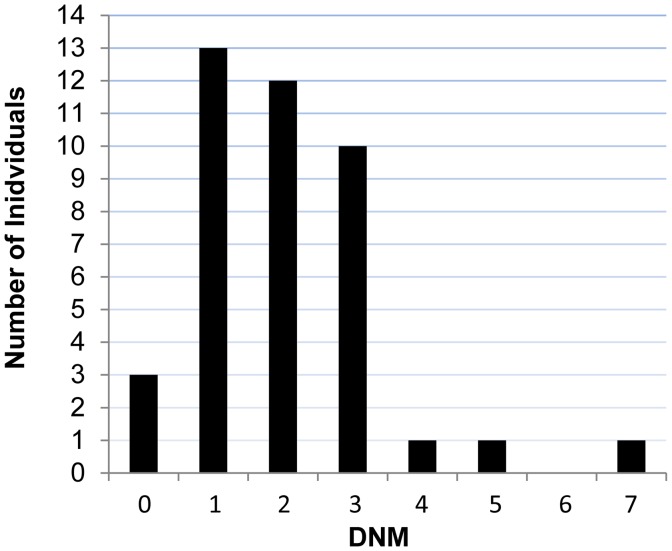
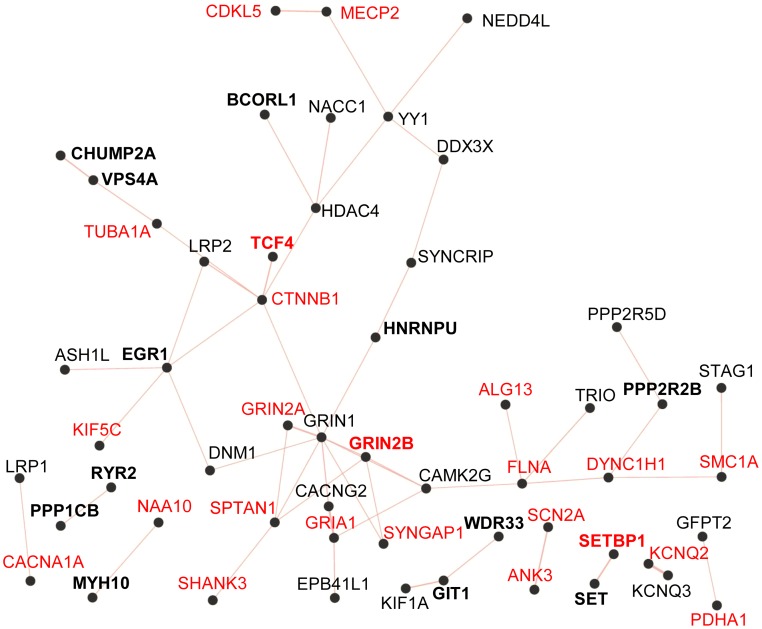
Genetics is believed to have an important role in intellectual disability (ID). Recent studies have emphasized the involvement of de novo mutations (DNMs) in ID but the extent to which they contribute to its pathogenesis and the identity of the corresponding genes remain largely unknown. Here, we report a screen for DNMs in subjects with moderate or severe ID. We sequenced the exomes of 41 probands and their parents, and confirmed 81 DNMs affecting the coding sequence or consensus splice sites (1.98 DNMs/proband). We observed a significant excess of de novo single nucleotide substitutions and loss-of-function mutations in these cases compared to control subjects, suggesting that at least a subset of these variations are pathogenic. A total of 12 likely pathogenic DNMs were identified in genes previously associated with ID (ARID1B, CHD2, FOXG1, GABRB3, GATAD2B, GRIN2B, MBD5, MED13L, SETBP1, TBR1, TCF4, WDR45), resulting in a diagnostic yield of ∼29%. We also identified 12 possibly pathogenic DNMs in genes (HNRNPU, WAC, RYR2, SET, EGR1, MYH10, EIF2C1, COL4A3BP, CHMP2A, PPP1CB, VPS4A, PPP2R2B) that have not previously been causally linked to ID. Interestingly, no case was explained by inherited mutations. Protein network analysis indicated that the products of many of these known and candidate genes interact with each other or with products of other ID-associated genes further supporting their involvement in ID. We conclude that DNMs represent a major cause of moderate or severe ID.
Overview
The claims and statistics of this paper haven’t been checked yet.
Run the check — free, no account needed. It reads the open-access text and checks the sources it cites.
Integrity signals
Registry
Cites
Statistics
Figures
Verification
Claims the paper makes
The claims and statistics of this paper haven’t been checked yet.
Run the check — free, no account needed. It reads the open-access text and checks the sources it cites.
Claims other papers make about this one
Each is checked against this paper’s own text: does it say what the citing paper says it does?
In the citing paper
“Mutations in CHD2 have been detected in individuals with a diagnosis of ASD (22), ID (73) or epilepsy (82,83,87,89)”
From Genetics and genomics of autism spectrum disorder: embracing complexity (2015) · cites this paper as [73]
In the citing paper
“CHD2 has been associated with ASD (22,23), ID (73), epilepsy (82,87) and photosensitivity (83).”
From Genetics and genomics of autism spectrum disorder: embracing complexity (2015) · cites this paper as [73]
Self-check
Percentages, sums and reported differences re-computed from the paper’s own numbers.
The self-check needs the paper’s full text.
Citations
Cites
Robinson, J. T., Thorvaldsdóttir, H., Winckler, W., Guttman, M., Lander, E. S., Getz, G., & Mesirov, J. P. (2011) · Nature Biotechnology · doi:10.1038/nbt.1754 · Cited by 15,390
ANNOVAR: functional annotation of genetic variants from high-throughput sequencing data
Wang, K., Li, M., & Hakonarson, H. H. (2010) · Nucleic Acids Research · doi:10.1093/nar/gkq603 · Cited by 14,724
Sporadic autism exomes reveal a highly interconnected protein network of de novo mutations
O’Roak, B. J., Vives, L., Girirajan, S., Karakoc, E., Krumm, N., Coe, B. P., Levy, R., Ko, A., Lee, C., Smith, J. D., et al. (2012) · Nature · doi:10.1038/nature10989 · Cited by 2,165 · cited 2×
“DNMs in TBR1 have been found in patients with ID and the variable presence of ASD or growth retardation [8,9,21,29,30].”
BackgroundDe novo mutations revealed by whole-exome sequencing are strongly associated with autism
Sanders, S. J., Murtha, M. T., Gupta, A. R., Murdoch, J. D., Raubeson, M. J., Willsey, A. J., Ercan-Sencicek, A. G., DiLullo, N. M., Parikshak, N. N., Stein, J. L., et al. (2012) · Nature · doi:10.1038/nature10945 · Cited by 2,084
Patterns and rates of exonic de novo mutations in autism spectrum disorders
Neale, B. M., Kou, Y., Liu, L., Ma’ayan, A., Samocha, K. E., Sabo, A., Lin, C.-F., Stevens, C., Wang, L.-S., Makarov, V., et al. (2012) · Nature · doi:10.1038/nature11011 · Cited by 1,734
Diagnostic exome sequencing in persons with severe intellectual disability
de Ligt, J., Willemsen, M. H., van Bon, B. W. M., Kleefstra, T., Yntema, H. G., Kroes, T., Vulto-van Silfhout, A. T., Koolen, D. A., de Vries, P., Gilissen, C., et al. (2012) · New England Journal of Medicine · doi:10.1056/nejmoa1206524 · Cited by 1,546
De novo mutations in epileptic encephalopathies
Epi4K Consortium, & Epilepsy Phenome/Genome Project (2013) · Nature · doi:10.1038/nature12439 · Cited by 1,514
De Novo Gene Disruptions in Children on the Autistic Spectrum
Iossifov, I., Ronemus, M., Levy, D., Wang, Z., Hakker, I., Rosenbaum, J., Yamrom, B., Lee, Y.-H., Narzisi, G., Leotta, A., et al. (2012) · Neuron · doi:10.1016/j.neuron.2012.04.009 · Cited by 1,446
Multiplex Targeted Sequencing Identifies Recurrently Mutated Genes in Autism Spectrum Disorders
O’Roak, B. J., Vives, L., Fu, W., Egertson, J. D., Stanaway, I. B., Phelps, I. G., Carvill, G., Kumar, A., Lee, C., Ankenman, K., et al. (2012) · Science · doi:10.1126/science.1227764 · Cited by 1,240
Genome sequencing identifies major causes of severe intellectual disability
Gilissen, C., Hehir-Kwa, J. Y., Thung, D. T., van de Vorst, M., van Bon, B. W. M., Willemsen, M. H., Kwint, M., Janssen, I. M., Hoischen, A., Schenck, A., et al. (2014) · Nature · doi:10.1038/nature13394 · Cited by 1,125
Cited by
Sorted by citations
Items 401–418 of 418
Uncoupling memory impairments from autism-associated behaviors in Chd2 deficient mice
Yoon, S. H., & Hunt, R. F. (2026) · Molecular Psychiatry · doi:10.1038/s41380-026-03539-x
Mediator and NER factors in transcription initiation
Bidon, B. (2017) · theses.fr (ABES) · doi:10.70675/12739e56z4107z424czb63bz452d4c617054
Exploration pangénomique des anomalies du développement de causes rares
Nambot, S. (2019) · theses.fr (ABES) · doi:10.70675/5f188303zeb9ez4c32zafe6zd815b860d1f2
Étude de la dysfonction du RhoGEF TRIO et son implication dans les troubles du neurodéveloppement
Bonnet, M. (2022) · theses.fr (ABES) · doi:10.70675/cab1f541zb97cz4ac7zb1fcz1abc79fd1066
Étude multi-échelle de modèles murins de déficience intellectuelle associée à PAK3
Dobrigna, M. (2024) · theses.fr (ABES) · doi:10.70675/54303e6cz76f9z4529zb556zfc6f07309f89
Mai, J., Ao, L., Zhang, Q., Liu, L., Zeng, Q., Luo, X., Cao, D., Chen, L., & Wen, F. (2026) · Rare Disease and Orphan Drugs Journal · doi:10.20517/rdodj.2025.89
Nishi, E., Yanagi, K., Kaname, T., & Okamoto, N. (2026) · Congenital Anomalies · doi:10.1002/cga.70063
A case of Incontinentia Pigmenti associated with concurrent IKBKG/NEMO and MED13L mutations
Spinosa, E., Rosain, J., Picascia, S., Salvia, M., Pescatore, A., Torella, A., Piluso, G., Nigro, V., Piccolo, V., Diociaiuti, A., et al. (2026) · Frontiers in Medicine · doi:10.3389/fmed.2026.1819035
Shi, Y., Silva, A., Debuy, C., Ghosh, S., McConkey, H., Schot, R., Deng, R., Nikoncuk, A., van Slegtenhorst, M., Hoefsloot, L. H., et al. (2026) · Genetics in Medicine · doi:10.1016/j.gim.2026.102637
Clustered monoallelic mosaicism in twins suggests previously unrecognized path of mutagenesis
Bohnlein, J., Maaß, J. G., Dennig, J., Burkart, S., Kaufmann, L. T., Brehm, M., Göbel, K., Kopp‐Schneider, A., Holland-Letz, T., Sprehe, L. K., et al. (2026) · Human Genetics and Genomics Advances · doi:10.1016/j.xhgg.2026.100636
MECP2 -mutant marmosets exhibit primate-specific phenotypes of Rett syndromePreprint
Kishi, N., Okahara, J., Sato, K., Yoshimaru, D., Kurotaki, Y., Onishi, K., Sanosaka, T., Henry, R., Ito, T., Okuno, M., et al. (2026) · bioRxiv (Cold Spring Harbor Laboratory) · doi:10.64898/2026.06.26.734672 · Cited by 1
Condell, A., Zhang, E., Sikora, T., Massey, S., Bergen, N. J. V., Wang, M., Simons, C., Bell, K. M., Hock, D. H., Stroud, D. A., et al. (2026) · Clinical Genetics · doi:10.1111/cge.70213
Lai, X., & Wen, J. (2026) · Progress in Neuro-Psychopharmacology and Biological Psychiatry · doi:10.1016/j.pnpbp.2026.111835
Ceramide transfer protein regulates G-protein–coupled phospholipase signalling in photoreceptors
Mishra, S., Khan, A., Nath, V. R., Manoj, T., Gangadhar, T. B., Alex, P., Naik, A., Dasgupta, U., & Raghu, P. (2026) · The Journal of Cell Biology · doi:10.1083/jcb.202511193
The Role of the Immunoglobulin Superfamily of Cell Adhesion Molecules in Intellectual Disability
Zaman, N., Bui, K., & Sytnyk, V. (2026) · Cells · doi:10.3390/cells15191801
Metadata
- Authors
- Hamdan, F. F., Srour, M., Capo-Chichi, J.-M., Daoud, H., Nassif, C., Patry, L., Massicotte, C., Ambalavanan, A., Spiegelman, D., Diallo, O., Henrion, E., Dionne-Laporte, A., Fougerat, A., Pshezhetsky, A. V., Venkateswaran, S., Rouleau, G. A., & Michaud, J. L.
- Affiliations
- CHU Sainte-Justine Research Center (CA)
- Montreal Children's Hospital (CA)
- Montreal Neurological Institute and Hospital (CA)
- Children's Hospital of Eastern Ontario (CA)
- Corresponding author
- Michaud, Jacques L.
- ORCID
- Venue
- PLoS Genetics
- Publisher
- Public Library of Science (PLoS)
- Published
- 2014-10-30
- Volume
- 10
- Issue
- 10
- Pages
- e1004772
- ISSN
- 1553-7390 (ISSN-L)
- 1553-7404
- PMC
- PMC4214635
- OpenAlex
- W2058423880
- Cited by
- 419
- References
- 62
- Citations by year
- 2026: 18 · 2025: 27 · 2024: 23 · 2023: 27 · 2022: 39 · 2021: 45 · 2020: 33 · 2019: 43 · 2018: 52 · 2017: 49 · 2016: 43 · 2015: 20
- FWCI
- 24.22
- Type
- journal article
- Language
- en
- Open access
- gold
- doi.org
- Locations
- PLoS Genetics (publishedVersion, cc-by)
- PubMed Central (publishedVersion, cc-by)
- PubMed (publishedVersion)
- HAL (submittedVersion, cc-by)
- DOAJ (DOAJ: Directory of Open Access Journals) (submittedVersion)
- eScholarship@McGill (McGill) (submittedVersion)
- Figshare (submittedVersion, cc-by)
- Funders
- McGill University
- Canadian Institutes of Health Research
- Topics
- Life Sciences › Biochemistry, Genetics and Molecular Biology › Genetics › Genetics and Neurodevelopmental Disorders
- Life Sciences › Biochemistry, Genetics and Molecular Biology › Genetics › Genomics and Rare Diseases
- Life Sciences › Biochemistry, Genetics and Molecular Biology › Genetics › Genomic variations and chromosomal abnormalities
- Keywords
- de novo mutations, intellectual disability, exome sequencing, loss-of-function mutations, single nucleotide substitution, ARID1B, CHD2, FOXG1, GABRB3, NR2B subunit, MBD5, MED13L, SETBP1, Tbr1, TCF4, WDR45, protein network analysis, diagnostic yield, pathogenic variants
- MeSH terms
- Epilepsy, Humans, Intellectual Disability, RNA Splicing, Frameshift Mutation, Point Mutation, Sequence Deletion, Codon, Nonsense, Mutation, Missense, Exome
About these checks
Registry, retraction, Cites and statistics results are computed, not judged, with one exception: a printed reference that no index lists is read once by a model before it counts as a citation error. Claims are extracted by a model and kept only when their quote appears verbatim in the text; each cited source is then checked, with a model’s help, for whether it says what the claim relies on. Those verdicts can be wrong — read the claim’s quote and the cited source before relying on one.
Statistics and arithmetic are recomputed, not judged.
Confidence bands are shown only for fields calibrated on our annotated test set. None is calibrated yet, so no band is shown.
What counts as a claim ›How we measure confidence ›How we check this ›
Are you an author, or do you see a problem with this page? Request a review
