Student or educator? Sign up with your school email and get 6 months of Pro free.
Cited by 14RNA modifications and cancerFungal and yeast genetics researchRNA Research and Splicing

The DOI matches its Crossref record; 61 of the 61 references it cites were found in a registry or an index.

Kar4, the yeast homolog of METTL14, is required for mRNA m6A methylation and meiosis

Open access

Published version of a preprint

Abstract

KAR4 , the yeast homolog of the mammalian mRNA N 6 A-methyltransferase complex component METTL14 , is required for two disparate developmental programs in Saccharomyces cerevisiae : mating and meiosis. To understand KAR4 ’s role in yeast mating and meiosis, we used a genetic screen to isolate 25 function-specific mutant alleles, which map to non-overlapping surfaces on a predicted structure of the Kar4 protein (Kar4p). Most of the mating-specific alleles (Mat - ) abolish Kar4p’s interaction with the transcription factor Ste12p, indicating that Kar4p’s mating function is through Ste12p. In yeast, the mRNA methyltransferase complex was previously defined as comprising Ime4p (Kar4p’s paralog and the homolog of mammalian METTL3), Mum2p (homolog of mammalian WTAP), and Slz1p (MIS), but not Kar4p. During meiosis, Kar4p interacts with Ime4p, Mum2p, and Slz1p. Moreover, cells lacking Kar4p have highly reduced levels of mRNA methylation during meiosis indicating that Kar4p is a key member of the methyltransferase complex, as it is in humans. Analysis of kar4 Δ/Δ and 7 meiosis-specific alleles (Mei - ) revealed that Kar4p is required early in meiosis, before initiation of S-phase and meiotic recombination. High copy expression of the meiotic transcriptional activator IME1 rescued the defect of these Mei- alleles. Surprisingly, Kar4p was also found to be required at a second step for the completion of meiosis and sporulation. Over-expression of IME1 in kar4 Δ/Δ permits pre-meiotic S-phase, but most cells remained arrested with a monopolar spindle. Analysis of the function-specific mutants revealed that roughly half became blocked after premeiotic DNA synthesis and did not sporulate (Spo - ). Loss of Kar4p’s Spo function was suppressed by overexpression of RIM4 , a meiotic translational regulator. Overexpression of IME1 and RIM4 together allowed sporulation of kar4 Δ/Δ cells. Taken together, these data suggest that Kar4p regulates meiosis at multiple steps, presumably reflecting requirements for methylation in different stages of meiotic gene expression.

Overview

The claims and statistics of this paper haven’t been checked yet.

Run the check — free, no account needed. It reads the open-access text and checks the sources it cites.

A few free checks a day · papers already verified open instantly · results are public

Integrity signals

Registry

Crossref · 10.1371/journal.pgen.1010896

Cites

61 of 61 references verified0 citation errors · 0 not checkable

Statistics

Figures

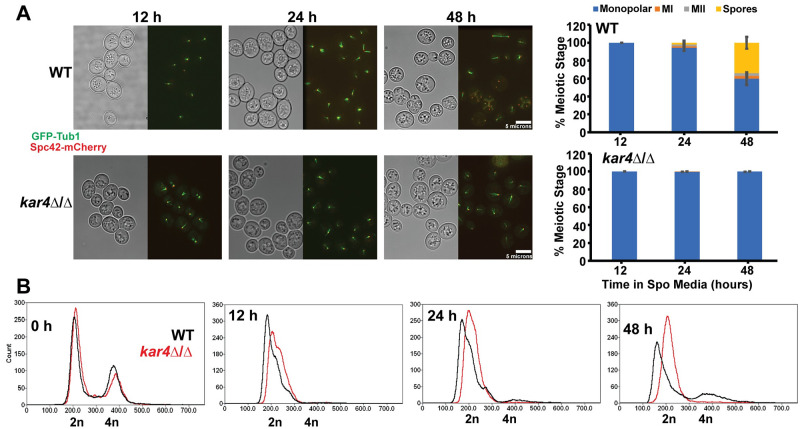
Fig 1 Kar4p is required early in meiosis. (A) Fluorescence microscopy of the spindle pole body (Spc42-mCherry) and microtubules (GFP-Tub1) across a time course of meiosis (12-, 24-, and 48-hours post transfer into sporulation media) in wild type (MY 16294) and kar4Δ/Δ (MY 16295). Graphs are the quantification of the number of cells in different meiotic stages (Monopolar Spindle, Meiosis I, Meiosis II, and Spores). Experiments were run in three biological replicates for each strain and at least 100 cells were counted for each replicate. Error bars represent standard deviation. (B) Flow cytometry analysis of DNA content in wild type (MY 16616) and kar4Δ/Δ (MY 16617) across the same meiotic time course of the microscopy. DNA was stained with SYTOX Green.
Fig 1 Kar4p is required early in meiosis. (A) Fluorescence microscopy of the spindle pole body (Spc42-mCherry) and microtubules (GFP-Tub1) across a time course of meiosis (12-, 24-, and 48-hours post transfer into sporulation media) in wild type (MY 16294) and kar4Δ/Δ (MY 16295). Graphs are the quantification of the number of cells in different meiotic stages (Monopolar Spindle, Meiosis I, Meiosis II, and Spores). Experiments were run in three biological replicates for each strain and at least 100 cells were counted for each replicate. Error bars represent standard deviation. (B) Flow cytometry analysis of DNA content in wild type (MY 16616) and kar4Δ/Δ (MY 16617) across the same meiotic time course of the microscopy. DNA was stained with SYTOX Green.CC BY · PubMed Central
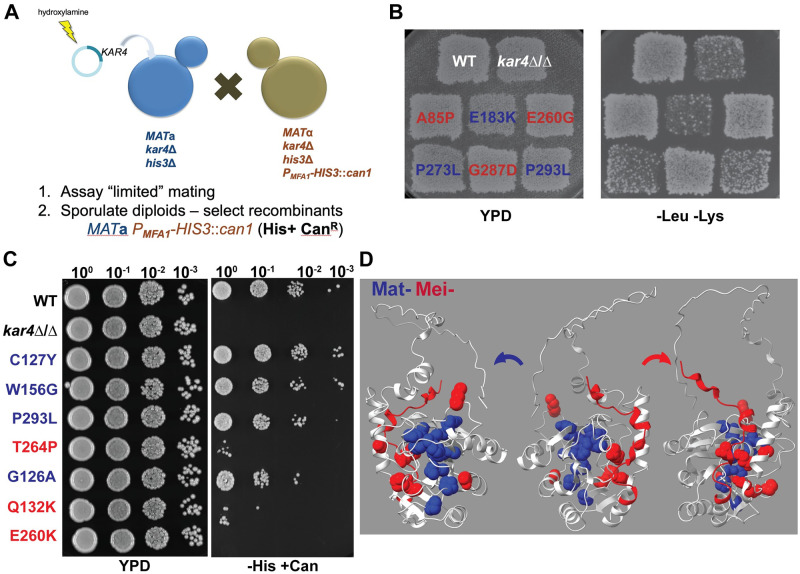
Fig 2 Kar4p has distinct functions in mating and meiosis. (A) Schematic of the screen used to identify separation of function mutants of KAR4. (B) Limited mating assay to determine the ability of the KAR4 alleles to facilitate mating. (Left) Growth on media selective for diploids after a limited mating assay between a strain carrying the indicated KAR4 allele in MY 11297 and kar4Δ (MY 10128). (Right) Growth of strains carrying the indicated KAR4 allele mated to kar4Δ on YPD (non-selective rich media) overnight. (C) Spot assay to assess the ability of diploid strains created in (B) carrying the different KAR4 alleles to initiate meiotic recombination after 24 hours of exposure to meiosis inducing conditions. (Left) Growth of all strains on YPD. (Right) Selection for successful recombination events by selecting for His+ CanR recombinants. Spots are 10-fold serial dilutions of 1 OD of each sample. (D) Mating (blue) and meiotic (red) defective KAR4 alleles threaded onto the AlphaFold predicted structure of Kar4p.
Fig 2 Kar4p has distinct functions in mating and meiosis. (A) Schematic of the screen used to identify separation of function mutants of KAR4. (B) Limited mating assay to determine the ability of the KAR4 alleles to facilitate mating. (Left) Growth on media selective for diploids after a limited mating assay between a strain carrying the indicated KAR4 allele in MY 11297 and kar4Δ (MY 10128). (Right) Growth of strains carrying the indicated KAR4 allele mated to kar4Δ on YPD (non-selective rich media) overnight. (C) Spot assay to assess the ability of diploid strains created in (B) carrying the different KAR4 alleles to initiate meiotic recombination after 24 hours of exposure to meiosis inducing conditions. (Left) Growth of all strains on YPD. (Right) Selection for successful recombination events by selecting for His+ CanR recombinants. Spots are 10-fold serial dilutions of 1 OD of each sample. (D) Mating (blue) and meiotic (red) defective KAR4 alleles threaded onto the AlphaFold predicted structure of Kar4p.CC BY · PubMed Central
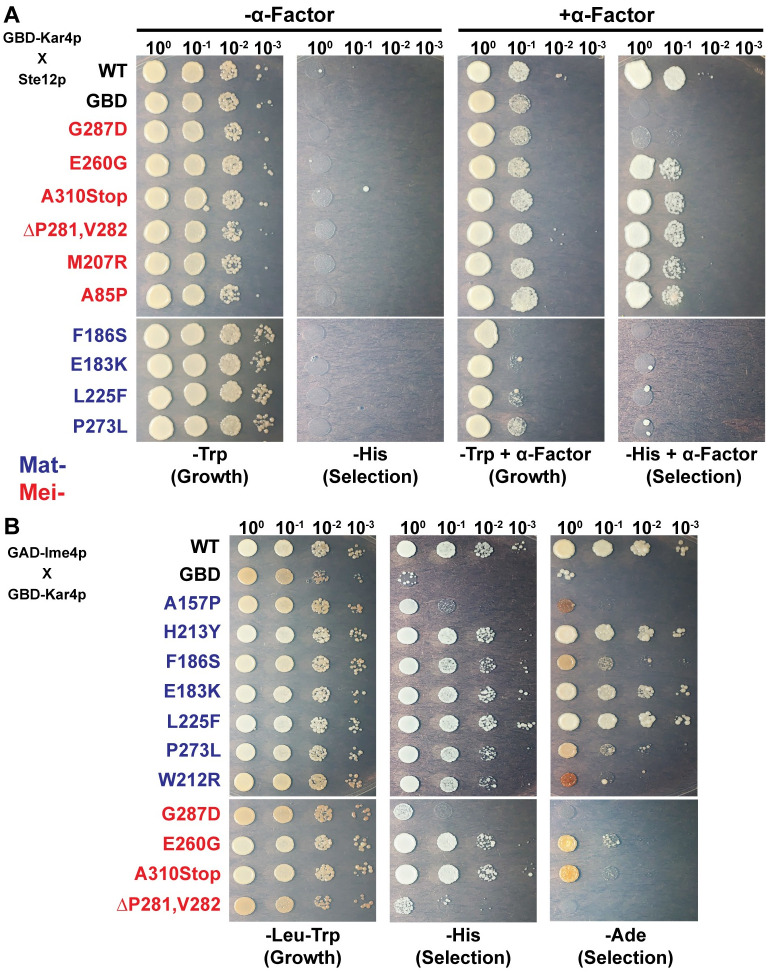
Fig 3 Kar4p engages in a function specific interaction with Ste12p and Ime4p. (A) A one-hybrid assay to determine the ability of the different Kar4p alleles fused to the Gal Binding Domain to interact with Ste12p upon exposure to alpha-factor. Growth on selective or non-selective media both with and without 3 μM alpha-factor. Growth on SC-His media selects for alleles that can maintain an interaction with Ste12p and drive expression of the HIS3 reporter gene. (B) A two-hybrid assay was used to determine the ability of the different Kar4p alleles to interact with Ime4p fused to the Gal Activating Domain after 24 hours of exposure to meiosis inducing conditions. (Left) Growth on non-selective media. (Right) Growth on both SC-HIS and SC-ADE to select for the alleles that can maintain an interaction with Ime4p and drive expression of the two reporter genes HIS3 and ADE2. Spots are 10-fold serial dilutions of 1 OD of each sample. Strains PJ69-4A and PJ69-4@ carrying the different KAR4 alleles were used for these experiments.
Fig 3 Kar4p engages in a function specific interaction with Ste12p and Ime4p. (A) A one-hybrid assay to determine the ability of the different Kar4p alleles fused to the Gal Binding Domain to interact with Ste12p upon exposure to alpha-factor. Growth on selective or non-selective media both with and without 3 μM alpha-factor. Growth on SC-His media selects for alleles that can maintain an interaction with Ste12p and drive expression of the HIS3 reporter gene. (B) A two-hybrid assay was used to determine the ability of the different Kar4p alleles to interact with Ime4p fused to the Gal Activating Domain after 24 hours of exposure to meiosis inducing conditions. (Left) Growth on non-selective media. (Right) Growth on both SC-HIS and SC-ADE to select for the alleles that can maintain an interaction with Ime4p and drive expression of the two reporter genes HIS3 and ADE2. Spots are 10-fold serial dilutions of 1 OD of each sample. Strains PJ69-4A and PJ69-4@ carrying the different KAR4 alleles were used for these experiments.CC BY · PubMed Central
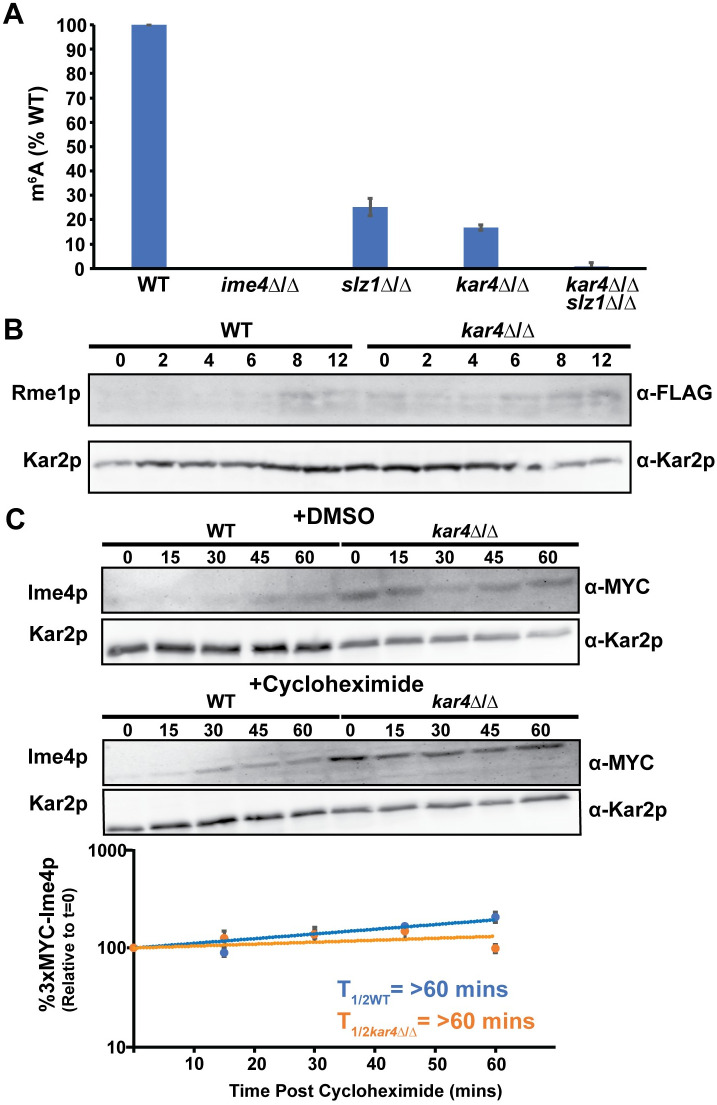
Fig 4 Kar4p is required for mRNA m6A methylation. (A) mRNA m6A levels measured using an ELISA-like assay. The indicated mutations were made in the SK1 strain background (MY 16325, 16326, 16351, 16353, and 16356) and samples were harvested after four hours of exposure to meiosis inducing conditions. Experiments were run in three biological replicates for each strain and error bars represent standard deviation. (B) Western Blot of 3xFLAG-Rme1p in wild type (MY 16563) and kar4Δ/Δ (MY 16569) across a time course of meiosis. Kar2p is used as a loading control. (C) Western blot of 3xMYC-Ime4p after four hours in meiosis inducing media with either 100 μM cycloheximide or an equivalent amount of DMSO in both wild type (Say914) and kar4Δ/Δ (MY 16543). (Top) 3xMYC-Ime4p levels with DMSO. (Middle) 3xMYC-Ime4p levels with cycloheximide. (Bottom) Quantification of three biological replicates of the cycloheximide chase experiment. The strains used are in the SK1 background. Kar2p is used as a loading control.
Fig 4 Kar4p is required for mRNA m6A methylation. (A) mRNA m6A levels measured using an ELISA-like assay. The indicated mutations were made in the SK1 strain background (MY 16325, 16326, 16351, 16353, and 16356) and samples were harvested after four hours of exposure to meiosis inducing conditions. Experiments were run in three biological replicates for each strain and error bars represent standard deviation. (B) Western Blot of 3xFLAG-Rme1p in wild type (MY 16563) and kar4Δ/Δ (MY 16569) across a time course of meiosis. Kar2p is used as a loading control. (C) Western blot of 3xMYC-Ime4p after four hours in meiosis inducing media with either 100 μM cycloheximide or an equivalent amount of DMSO in both wild type (Say914) and kar4Δ/Δ (MY 16543). (Top) 3xMYC-Ime4p levels with DMSO. (Middle) 3xMYC-Ime4p levels with cycloheximide. (Bottom) Quantification of three biological replicates of the cycloheximide chase experiment. The strains used are in the SK1 background. Kar2p is used as a loading control.CC BY · PubMed Central
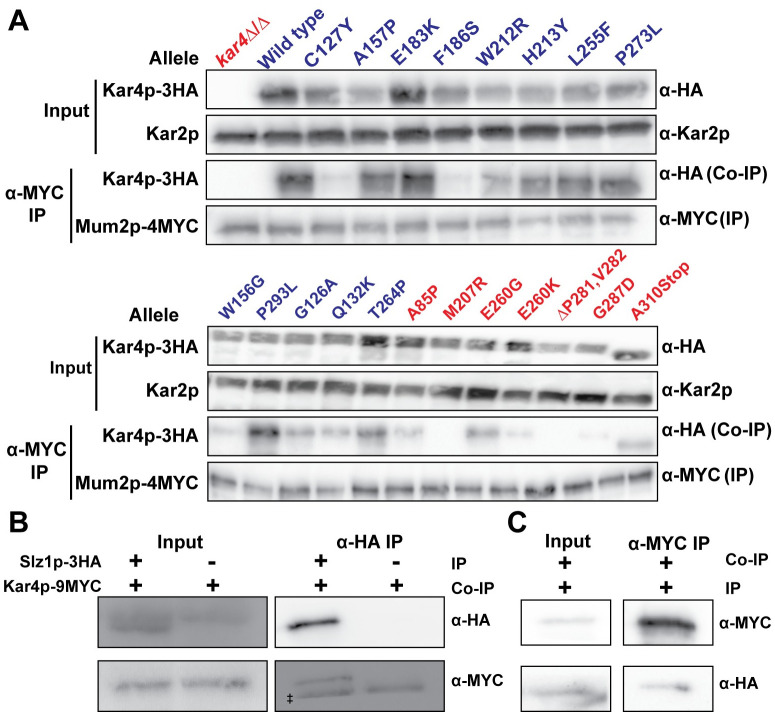
Fig 5 Kar4p interacts with the MIS complex components Mum2p and Slz1p. (A) Western blots of total protein and co-IPs between Mum2p-4MYC and the alleles of Kar4p-3HA. (MY 16256 and 16257) (Top) Total protein samples from the extracts that were used for the Co-IPs. Kar2p is used as a loading control. Alleles proficient for Kar4p’s meiotic function (Mei+) are in blue and alleles in red are defective (Mei-). (Bottom) Co-IPs where Mum2p-4MYC was purified and the co-purification of Kar4p-3HA was assayed. (B) Western blots of total protein and Co-IPs between Slz1p-3HA and Kar4p-9MYC. (MY 16405 and 16409) (Left) Total protein samples from the extracts that were used for the co-IPs. “*” indicates a non-specific band. (Right) Co-IPs where Slz1p-3HA was purified and the co-purification of Kar4p-13MYC was assayed. “‡” indicates the heavy chain of IgG from the anti-HA magnetic beads used for the Co-IP. (C) Western blots of total protein and Co-IPs between Kar4p-9MYC and Slz1p-3HA. (Left) Total protein samples from the extracts that were used for the Co-IPs. (Right) Co-IPs where Kar4p-9MYC was purified and the co-purification of Slz1-3HA was assayed.
Fig 5 Kar4p interacts with the MIS complex components Mum2p and Slz1p. (A) Western blots of total protein and co-IPs between Mum2p-4MYC and the alleles of Kar4p-3HA. (MY 16256 and 16257) (Top) Total protein samples from the extracts that were used for the Co-IPs. Kar2p is used as a loading control. Alleles proficient for Kar4p’s meiotic function (Mei+) are in blue and alleles in red are defective (Mei-). (Bottom) Co-IPs where Mum2p-4MYC was purified and the co-purification of Kar4p-3HA was assayed. (B) Western blots of total protein and Co-IPs between Slz1p-3HA and Kar4p-9MYC. (MY 16405 and 16409) (Left) Total protein samples from the extracts that were used for the co-IPs. “*” indicates a non-specific band. (Right) Co-IPs where Slz1p-3HA was purified and the co-purification of Kar4p-13MYC was assayed. “‡” indicates the heavy chain of IgG from the anti-HA magnetic beads used for the Co-IP. (C) Western blots of total protein and Co-IPs between Kar4p-9MYC and Slz1p-3HA. (Left) Total protein samples from the extracts that were used for the Co-IPs. (Right) Co-IPs where Kar4p-9MYC was purified and the co-purification of Slz1-3HA was assayed.CC BY · PubMed Central
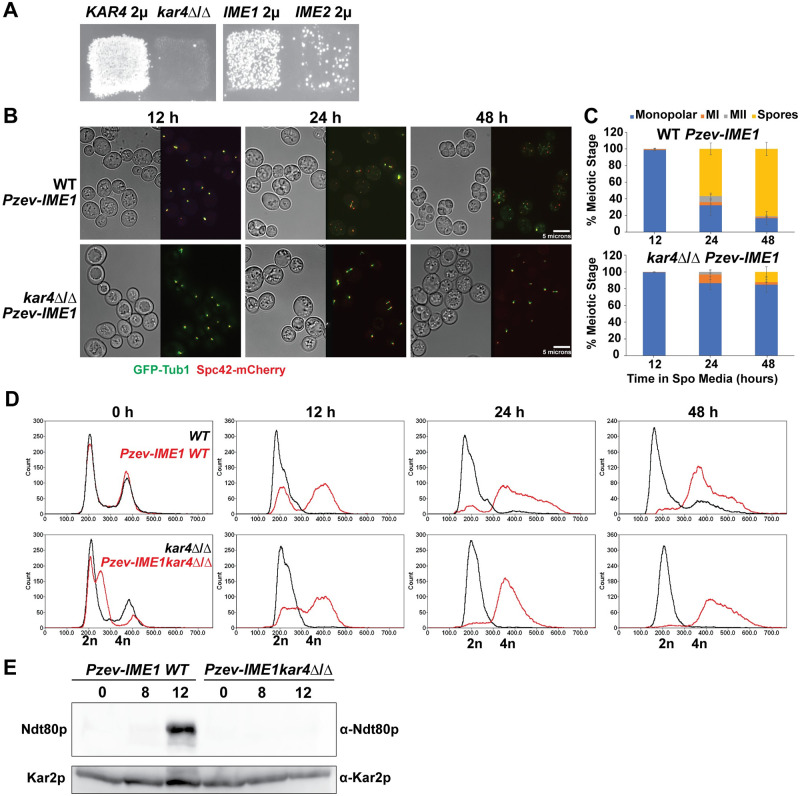
Fig 6 IME1 overexpression partially suppresses the kar4Δ/Δ meiotic defect. (A) Growth of kar4Δ/Δ (MY 10128 crossed to MY 11297) cells on SC-HIS+canavanine to screen for recombination after exposure to meiosis-inducing conditions carrying either KAR4, IME1, or IME2 cloned onto high-copy number 2μ plasmids. (B) Fluorescence microscopy of the spindle pole body (Spc42-mCherry) and microtubules (GFP-Tub1) across a time course of meiosis (12-, 24-, and 48-hours post movement into sporulation media) in wild type (MY 16294) and kar4Δ/Δ (MY 16295) with IME1 overexpressed from an estradiol-inducible promoter. (C) Quantification of the number of cells in different meiotic stages (Monopolar Spindle, Meiosis I, Meiosis II, and Spores) from the microscopy in B. Experiments were run in three biological replicates for each strain and at least 100 cells were counted for each replicate. 1 μM of estradiol was used to induce expression. Error bars represent standard deviation. (D) Flow cytometry analysis of DNA content in wild type (MY 16534) and kar4Δ/Δ (MY 16531) with and without IME1 overexpressed across the same meiotic time course of the microscopy. The no IME1 overexpression control is the same used in Fig 1B. DNA was stained with SYTOX Green. (E) Western blots of Ndt80p in wild type (MY 16534) and kar4Δ/Δ (MY 16531) with IME1 overexpressed. Kar2p is used as a loading control.
Fig 6 IME1 overexpression partially suppresses the kar4Δ/Δ meiotic defect. (A) Growth of kar4Δ/Δ (MY 10128 crossed to MY 11297) cells on SC-HIS+canavanine to screen for recombination after exposure to meiosis-inducing conditions carrying either KAR4, IME1, or IME2 cloned onto high-copy number 2μ plasmids. (B) Fluorescence microscopy of the spindle pole body (Spc42-mCherry) and microtubules (GFP-Tub1) across a time course of meiosis (12-, 24-, and 48-hours post movement into sporulation media) in wild type (MY 16294) and kar4Δ/Δ (MY 16295) with IME1 overexpressed from an estradiol-inducible promoter. (C) Quantification of the number of cells in different meiotic stages (Monopolar Spindle, Meiosis I, Meiosis II, and Spores) from the microscopy in B. Experiments were run in three biological replicates for each strain and at least 100 cells were counted for each replicate. 1 μM of estradiol was used to induce expression. Error bars represent standard deviation. (D) Flow cytometry analysis of DNA content in wild type (MY 16534) and kar4Δ/Δ (MY 16531) with and without IME1 overexpressed across the same meiotic time course of the microscopy. The no IME1 overexpression control is the same used in Fig 1B. DNA was stained with SYTOX Green. (E) Western blots of Ndt80p in wild type (MY 16534) and kar4Δ/Δ (MY 16531) with IME1 overexpressed. Kar2p is used as a loading control.CC BY · PubMed Central
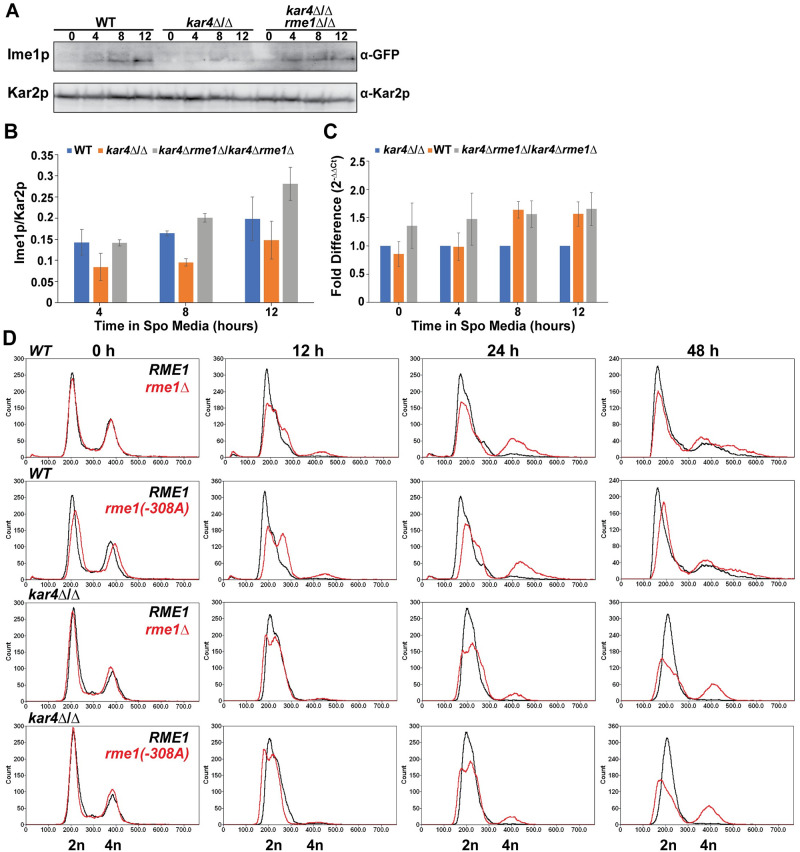
Fig 7 IME1 expression is reduced in kar4Δ/Δ. (A) Western blot showing GFP-Ime1p levels across a time course of meiosis in wild type (MY 16550), kar4Δ/Δ (MY 16570), and kar4Δrme1Δ/ kar4Δrme1Δ (MY 16622). Kar2p is used as a loading control. (B) Quantification of western blots in (A). Error bars represent standard error (1/2 x the range) of two biological replicates. (C) qPCR measuring IME1 transcript levels in wild type, kar4Δ/Δ, and kar4Δrme1Δ/ kar4Δrme1Δ. Data were normalized to levels of PGK1 expression. Error bars represent the standard error of three replicates. (D) Flow cytometry analysis of DNA content in wild type and kar4Δ/Δ carrying either the wild type allele of RME1 (data from Fig 1B), the hypomorphic -308A allele of RME1 (MY 16557 and 16559), or a deletion of RME1 (MY 16456 and 16566). DNA was stained with SYTOX Green.
Fig 7 IME1 expression is reduced in kar4Δ/Δ. (A) Western blot showing GFP-Ime1p levels across a time course of meiosis in wild type (MY 16550), kar4Δ/Δ (MY 16570), and kar4Δrme1Δ/ kar4Δrme1Δ (MY 16622). Kar2p is used as a loading control. (B) Quantification of western blots in (A). Error bars represent standard error (1/2 x the range) of two biological replicates. (C) qPCR measuring IME1 transcript levels in wild type, kar4Δ/Δ, and kar4Δrme1Δ/ kar4Δrme1Δ. Data were normalized to levels of PGK1 expression. Error bars represent the standard error of three replicates. (D) Flow cytometry analysis of DNA content in wild type and kar4Δ/Δ carrying either the wild type allele of RME1 (data from Fig 1B), the hypomorphic -308A allele of RME1 (MY 16557 and 16559), or a deletion of RME1 (MY 16456 and 16566). DNA was stained with SYTOX Green.CC BY · PubMed Central
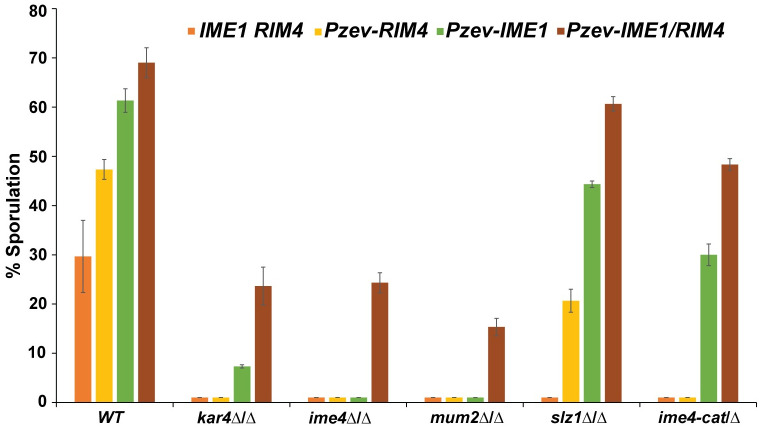
Fig 8 Co-overexpression of IME1 and RIM4 permits sporulation in kar4Δ/Δ. Sporulation of wild type (MY 16616, 16532, 16534, and 16533), kar4Δ/Δ (MY 16617, 16535, 16531, and 16536), mum2Δ/Δ (MY 16619, 16526, 16525, and 16527), ime4Δ/Δ (MY 16631, 16434, 16313, 16435), slz1Δ/Δ (MY 16620, 16537, 16538, and 16539), and ime4-cat/ime4Δ (MY 16621, 16507, 16506, and 16615) with either endogenous expression of IME1 and RIM4, overexpression of RIM4, overexpression of IME1, or overexpression of both IME1 and RIM4. 1 μM of estradiol was used to induce expression. All dyads, triads, and tetrads were counted across three biological replicates for each strain. One hundred cells were counted for each strain at each time point after 48 hours post addition of estradiol. Error bars represent standard error of three biological replicates.
Fig 8 Co-overexpression of IME1 and RIM4 permits sporulation in kar4Δ/Δ. Sporulation of wild type (MY 16616, 16532, 16534, and 16533), kar4Δ/Δ (MY 16617, 16535, 16531, and 16536), mum2Δ/Δ (MY 16619, 16526, 16525, and 16527), ime4Δ/Δ (MY 16631, 16434, 16313, 16435), slz1Δ/Δ (MY 16620, 16537, 16538, and 16539), and ime4-cat/ime4Δ (MY 16621, 16507, 16506, and 16615) with either endogenous expression of IME1 and RIM4, overexpression of RIM4, overexpression of IME1, or overexpression of both IME1 and RIM4. 1 μM of estradiol was used to induce expression. All dyads, triads, and tetrads were counted across three biological replicates for each strain. One hundred cells were counted for each strain at each time point after 48 hours post addition of estradiol. Error bars represent standard error of three biological replicates.CC BY · PubMed Central

Verification

Claims the paper makes

The claims and statistics of this paper haven’t been checked yet.

Run the check — free, no account needed. It reads the open-access text and checks the sources it cites.

A few free checks a day · papers already verified open instantly · results are public

Self-check

Percentages, sums and reported differences re-computed from the paper’s own numbers.

The self-check needs the paper’s full text.

Citations

Cites

Show all 61 references

Research works printed but not linked: 3

  1. SK Morgan, 2006, Mum2 is essential for meiosis and interacts with the methyltransferase homologs Kar4 and Ime4, Genetics: SUNY Stony Brook
  2. Stearns T, Dawson DS. Methods in Yeast Genetics: A Cold Spring Harbor Laboratory Course Manual: Cold Spring Harbor Laboratory Press; 2000.
  3. Rose MD, Winston F, Hieter P. Methods in Yeast Genetics: Cold Spring Harbor Laboratory Press; 1990.

Metadata

Authors
Park, Z. M., Sporer, A. J., Kraft, K., Lum, K. K., Blackman, E., Belnap, E., Yellman, C. M., & Rose, M. D.
Affiliations
  • Georgetown University (US)
  • Princeton University (US)
Corresponding author
Rose, Mark D.
Venue
PLOS Genetics
Published
2023-08-21
Volume
19
Issue
8
Pages
e1010896
ISSN
  • 1553-7390 (ISSN-L)
  • 1553-7404
OpenAlex
W4386022610
Cited by
14
References
61
Citations by year
2026: 3 · 2025: 1 · 2024: 2 · 2023: 8
FWCI
1.24
Type
journal article
Language
en
Open access
Locations
  • PLoS Genetics (publishedVersion, cc-by)
  • bioRxiv (Cold Spring Harbor Laboratory) (acceptedVersion, cc-by-nc-nd)
  • PubMed Central (publishedVersion, cc-by)
  • PubMed (publishedVersion)
  • PubMed Central (submittedVersion, cc-by-nc-nd)
  • DOAJ (DOAJ: Directory of Open Access Journals) (submittedVersion, cc-by-sa)
Funders
National Institute of General Medical Sciences (GM037739, GM126998)
Topics
  • Life Sciences › Biochemistry, Genetics and Molecular Biology › Molecular Biology › RNA modifications and cancer
  • Life Sciences › Biochemistry, Genetics and Molecular Biology › Molecular Biology › Fungal and yeast genetics research
  • Life Sciences › Biochemistry, Genetics and Molecular Biology › Molecular Biology › RNA Research and Splicing
Keywords
METTL14, meiosis, mating, Saccharomyces cerevisiae, IME1, sporulation, meiotic gene expression, methyltransferase complex

About these checks

Registry, retraction, Cites and statistics results are computed, not judged, with one exception: a printed reference that no index lists is read once by a model before it counts as a citation error. Claims are extracted by a model and kept only when their quote appears verbatim in the text; each cited source is then checked, with a model’s help, for whether it says what the claim relies on. Those verdicts can be wrong — read the claim’s quote and the cited source before relying on one.

Statistics and arithmetic are recomputed, not judged.

Confidence bands are shown only for fields calibrated on our annotated test set. None is calibrated yet, so no band is shown.

What counts as a claim ›How we measure confidence ›How we check this ›

Are you an author, or do you see a problem with this page? Request a review

Data sources

Bibliographic data: Semantic Scholar, OpenAlex, Crossref.

Contains information from the Semantic Scholar Academic Graph Datasets, made available under the ODC Attribution License (ODC-BY 1.0).

Semantic Scholar’s data is described in: Kinney, R., et al. (2023). The Semantic Scholar Open Data Platform. arXiv:2301.10140.