

Alcohol reduction outcomes following brief counseling among adults with HIV in Zambia: A sequential mixed methods study
Open accessThe DOI matches its Crossref record; 24 of the 24 references it cites were found in a registry or an index.
Abstract
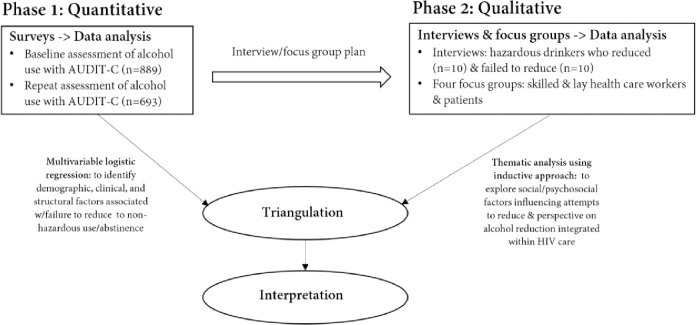
Data from sub-Saharan Africa on the impact of alcohol on the HIV epidemic in sub-Saharan Africa is limited. In this region, it is not well understood how people with HIV (PLWHA) respond to alcohol reduction counseling while they are linked to HIV clinical care. We conducted an explanatory sequential mixed-methods study to understand patterns of alcohol use among adults (18+ years) within a prospective HIV cohort at two urban public-sector clinics in Zambia. At antiretroviral therapy (ART) start and one year later, we measured alcohol use with Alcohol Use Disorders Identification Test-Consumption (AUDIT-C) and those reporting any alcohol use were provided brief counseling. We conducted focus groups at 1 year with participants who had any alcohol use and 20 in-depth interviews among the subgroup with unhealthy use pre-ART and who either reduced or did not reduce their use by 1 year to moderate levels or abstinence. Focus group Discussions (FGDs) (n = 2) were also held with HIV clinic staff. Qualitative data were analyzed using thematic analysis. The data obtained from 693 participants was analyzed (median age 34 years, 45% men), it revealed that unhealthy alcohol use (AUDIT-C >3 for men; >2 for women) was reported among 280 (40.4%) at baseline and 205 (29.6%) at 1 year on ART. Reduction from unhealthy to moderate use or abstinence was more common with older age, female, non-smoking, and at Clinic B (all P<0.05). Qualitative data revealed ineffective alcohol support at clinics, social pressures in the community to consume alcohol, and unaddressed drivers of alcohol use including poverty, poor health status, depression, and HIV stigma. Healthcare workers reported a lack of training in alcohol screening and treatment, which led to mixed messages provided to patients (‘reduce to safe levels’ versus ‘abstain’). In summary, interventions to reduce unhealthy alcohol use are needed within HIV clinics in Zambia as a substantial population have persistent unhealthy use despite current HIV clinical care. A better understanding is needed regarding the implementation challenges related to screening for unhealthy alcohol use integrated with HIV services.
Overview
The claims and statistics of this paper haven’t been checked yet.
Free: it reads the open-access text and checks the first 5 claims that cite a source we can check. Create a free account to check every claim.
Integrity signals
Registry
Cites
Statistics
Figures
Verification
Claims the paper makes
The claims and statistics of this paper haven’t been checked yet.
Free: it reads the open-access text and checks the first 5 claims that cite a source we can check. Create a free account to check every claim.
Claims other papers make about this one
Each is checked against this paper’s own text: does it say what the citing paper says it does?
The source backs part of the claim, not all of it — or backs it for a different population, condition or comparison.
In the citing paper
“Reduction from unhealthy to moderate use or abstinence was more common with older age, female, and non-smoking (all P<0.05)”
From A scoping review of substance use brief interventions in Africa (2024) · cites this paper as [97]
Experimental — accuracy not yet measuredThe cited source says what the claim attributes to it.
In the citing paper
“During the first year on ART the overall prevalence of unhealthy alcohol use in the analysis group reduced significantly from 40.4% to 29.6% (P<0.01).”
From A scoping review of substance use brief interventions in Africa (2024) · cites this paper as [97]
The cited source says what the claim attributes to it.
In the citing paper
“Of the 280 with unhealthy use at baseline, 122 (43.6%) reported a lower degree of alcohol consumption at 1 year.”
From A scoping review of substance use brief interventions in Africa (2024) · cites this paper as [97]
The cited source says what the claim attributes to it.
In the citing paper
“Participants reported ineffective alcohol support at clinics, social pressures in the community to consume alcohol, and unaddressed drivers of alcohol use including poverty, poor health status, depression, and HIV stigma.”
From A scoping review of substance use brief interventions in Africa (2024) · cites this paper as [97]
Self-check
Percentages, sums and reported differences re-computed from the paper’s own numbers.
The self-check needs the paper’s full text.
Citations
Cites
Using thematic analysis in psychology
Braun, V., & Clarke, V. (2006) · Qualitative Research in Psychology · doi:10.1191/1478088706qp063oa · Cited by 194,414 · cited 1×
“Coding and analysis followed a reflexive thematic analysis approach, in which broad coding framework precedes theme development [17, 18].”
MethodBush, K. (1998) · Archives of Internal Medicine · doi:10.1001/archinte.158.16.1789 · Cited by 6,196
Thematic networks: an analytic tool for qualitative research
Attride-Stirling, J. (2001) · Qualitative Research · doi:10.1177/146879410100100307 · Cited by 5,506 · cited 4×
“We used an adapted Andersen’s Behavioral Model as a framework to identify key quantitative and qualitative findings related to unhealthy alcohol use among PLWHA in urban Zambia and the most frequently discussed barriers to alcohol reduction in the contextual environment at patient and healthcare levels (Table 3).”
MethodInfluentialAUDIT‐C as a Brief Screen for Alcohol Misuse in Primary Care
Bradley, K. A., DeBenedetti, A. F., Volk, R. J., Williams, E. C., Frank, D., & Kivlahan, D. R. (2007) · Alcoholism: Clinical and Experimental Research · doi:10.1111/j.1530-0277.2007.00403.x · Cited by 1,632
Associations Between Socioeconomic Factors and Alcohol Outcomes.
Collins, S. E. (2016) · Europe PMC (PubMed Central) · Cited by 573
Williams, E. C., Hahn, J. A., Saitz, R., Bryant, K., Lira, M. C., & Samet, J. H. (2016) · Alcoholism: Clinical and Experimental Research · doi:10.1111/acer.13204 · Cited by 294
Duko, B., Ayalew, M., & Ayano, G. (2019) · Substance Abuse Treatment, Prevention, and Policy · doi:10.1186/s13011-019-0240-3 · Cited by 209
International gender and alcohol research: recent findings and future directions.
Wilsnack, S. C., & Wilsnack, R. W. (2002) · PubMed Central · Cited by 150
Bajunirwe, F., Haberer, J. E., Boum, Y., Hunt, P., Mocello, R., Martin, J. N., Bangsberg, D. R., & Hahn, J. A. (2014) · PLoS ONE · doi:10.1371/journal.pone.0113152 · Cited by 111 · cited 1×
“Our approach in study design, content of interview/focus group guides, and interpretation of data was guided by the adapted Andersen’s Behavioral Model [17], which suggests that determinants of health behaviors include the healthcare environment, patient characteristics, the community, the societal context, and patien…”
MethodHahn, J. A., Emenyonu, N. I., Fatch, R., Muyindike, W. R., Kekiibina, A., Carrico, A. W., Woolf‐King, S., & Shiboski, S. (2016) · Addiction · doi:10.1111/add.13173 · Cited by 97 · cited 1×
“Decline in alcohol use after ART is supported by other research [19] but one report from Uganda, which used biomarkers to supplement self-reports found increasing alcohol use post-ART start [20].”
Result
Cited by
A scoping review of substance use brief interventions in Africa
Jaguga, F., Kiburi, S. K., Temet, E., Aalsma, M. C., Ott, M. A., Maina, R. W., Wachira, J., Mostert, C., Kosgei, G., Tenge, A., et al. (2024) · PLOS Global Public Health · doi:10.1371/journal.pgph.0003340 · Cited by 10
Vinikoor, M. J., Sharma, A., Murray, L. K., Figge, C. J., Bosomprah, S., Chitambi, C., Paul, R., Kanguya, T., Sivile, S., Nghiem, V. T. H., et al. (2023) · Contemporary Clinical Trials · doi:10.1016/j.cct.2023.107116 · Cited by 6
“We previously reported that that ART adherence counseling can have a moderate impact on unhealthy alcohol use [10].”
BackgroundSelf-citationLuo, L., Kapur, R., Armstrong-Hough, M. J., Alvarez, G. G., Moucheraud, C., Purtle, J. P., Namusisi, K. N., Yang, L., Raghavan, R., Lappen, H., et al. (2026) · BMJ Global Health · doi:10.1136/bmjgh-2025-019577 · Cited by 3
Heavy alcohol use and the HIV care continuum in Kenya: a population-based study
Wake, E., & Rosen, J. G. (2024) · AIDS Care · doi:10.1080/09540121.2024.2343587 · Cited by 2
Paniagua-Ávila, A., Kanguya, T., Mwamba, C., Hahn, J. A., Latkin, C. A., Chander, G., Martins, S. S., Munthali, S., McDonell, M. G., Sharma, A., et al. (2025) · medRxiv · doi:10.1101/2025.08.07.25333191
“Despite limited data among adolescents, studies suggest that SBIRT programs may be effective at addressing unhealthy alcohol use in Southern Africa [23–25] .”
Self-citationDoherty, A. M., Bwayla, F., Ravi, P., McNicholas, F., Fenton, F., & Sheehan, J. D. (2025) · Irish Journal of Psychological Medicine · doi:10.1017/ipm.2025.10153
“(Asombang et al., 2022; Chishinga et al., 2011; Hapunda, 2022; van den Heuvel et al., 2013) Global Mental Health has been defined by Collins as: “ an evolving field of research and practice that aims to alleviate mental suffering through the prevention, care and treatment of mental and substance…”
Zyambo, C. M., Somwe, P., Musukuma, M., Mandyata, C., Bwembya, P. A., Phiri, H., Chavula, M. P., Halwindi, H., Zulu, J. M., & Mutale, W. (2026) · PLoS ONE · doi:10.1371/journal.pone.0345368
“In Zambia, there is a scarcity of alcohol consumption [41–43] and tobacco smoking [44,45] studies in PLWH and no published data on alcohol consumption and tobacco smoking and its association with ART adherence in the PLWH with or without co-morbidities such as NCDs.”
Wang, B., MacDonell, K. K., Zulu, J. M., Paul, R., Gerber, B. S., Naar, S., & Menon, J. A. (2026) · JMIR Research Protocols · doi:10.2196/99714
“…(1) living with HIV and aged between 18 years 0 months and 24 years 11 months; (2) visual analog scale showing <80% medication adherence in the last month and unhealthy alcohol use or any drug use in the last month [50]; and (3) able to understand, read, and speak English, Nyanja, or Bemba.”
Metadata
- Authors
- Asombang, M., Helova, A., Chipungu, J., Sharma, A., Wandeler, G., Kane, J. C., Turan, J. M., Smith, H., Vinikoor, M. J., & Africa, F. I. S.
- Affiliations
- Centre for Infectious Disease Research in Zambia (ZM)
- University of Bern (CH)
- Columbia University (US)
- University of Alabama at Birmingham (US)
- Bradford Institute for Health Research (GB)
- Corresponding author
- Asombang, Mah
- ORCID
- Venue
- PLOS Global Public Health
- Publisher
- Public Library of Science (PLoS)
- Published
- 2022-05-25
- Volume
- 2
- Issue
- 5
- Pages
- e0000240
- ISSN
- 2767-3375 (ISSN-L)
- PMC
- PMC10021288
- OpenAlex
- W4281489881
- Cited by
- 8
- References
- 24
- Citations by year
- 2026: 3 · 2025: 2 · 2024: 2 · 2023: 1
- FWCI
- 0.90
- Type
- journal article
- Language
- en
- Open access
- gold
- doi.org
- Licence
- public-domain
- creativecommons.org/publicdomain/zero/1.0/ (vor)
- Locations
- PLOS Global Public Health (publishedVersion, public-domain)
- PubMed Central (publishedVersion, cc-by)
- PubMed (publishedVersion)
- Bern Open Repository and Information System (University of Bern) (submittedVersion, public-domain)
- DOAJ (DOAJ: Directory of Open Access Journals) (submittedVersion)
- DOAJ (DOAJ: Directory of Open Access Journals) (submittedVersion, cc-by-sa)
- Open Access CRIS of the University of Bern
- Funders
- National Institute of Allergy and Infectious Diseases (U01AI069924)
- National Institute on Alcohol Abuse and Alcoholism (K01AA026523)
- Fogarty International Center at the United States National Institutes of Health (K01TW009998)
- The Mary Fisher Foundation, the University of Alabama (UAB) Sparkman Center and Center for AIDS Research
- Topics
- Health Sciences › Medicine › Epidemiology › Substance Abuse Treatment and Outcomes
- Health Sciences › Medicine › Epidemiology › HIV, Drug Use, Sexual Risk
- Health Sciences › Medicine › Infectious Diseases › HIV/AIDS Research and Interventions
- Keywords
- alcohol consumption, HIV, people living with HIV, brief counseling, alcohol consumption reduction, antiretroviral therapy, alcohol screening, HIV stigma, depression, poverty, health professions education, Zambia
About these checks
Registry, retraction, Cites and statistics results are computed, not judged, with one exception: a printed reference that no index lists is read once by a model before it counts as a citation error. Claims are extracted by a model and kept only when their quote appears verbatim in the text; each cited source is then checked, with a model’s help, for whether it says what the claim relies on. Those verdicts can be wrong — read the claim’s quote and the cited source before relying on one.
Statistics and arithmetic are recomputed, not judged.
Confidence bands are shown only for fields calibrated on our annotated test set. None is calibrated yet, so no band is shown.
What counts as a claim ›How we measure confidence ›How we check this ›
Are you an author, or do you see a problem with this page? Request a review
Data sources
Bibliographic data: Semantic Scholar, OpenAlex, Crossref.
Contains information from the Semantic Scholar Academic Graph Datasets, made available under the ODC Attribution License (ODC-BY 1.0).
Semantic Scholar’s data is described in: Kinney, R., et al. (2023). The Semantic Scholar Open Data Platform. arXiv:2301.10140.
