

The DOI matches its Crossref record; 223 of the 240 references it cites were found in a registry or an index, and 16 are not checked yet; none of the 40 sources its claims cite is checked for support yet.
A Systematic Review of the Prevalence of Schizophrenia
Open accessAbstract
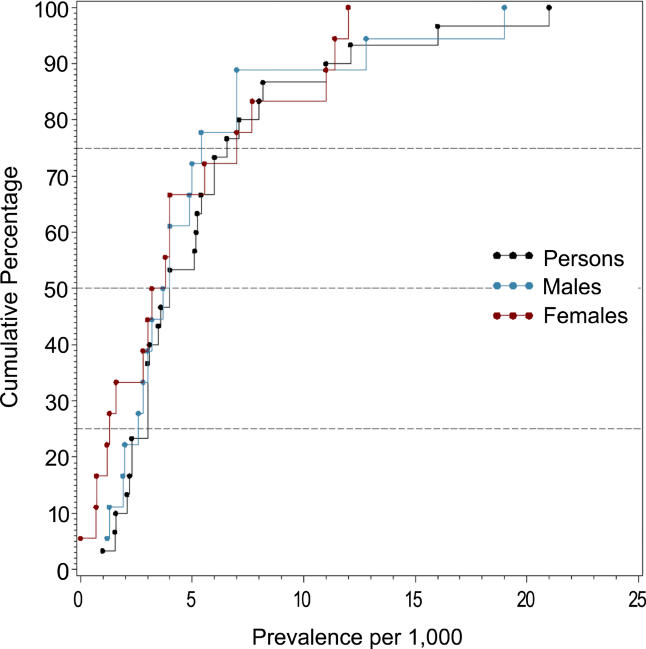
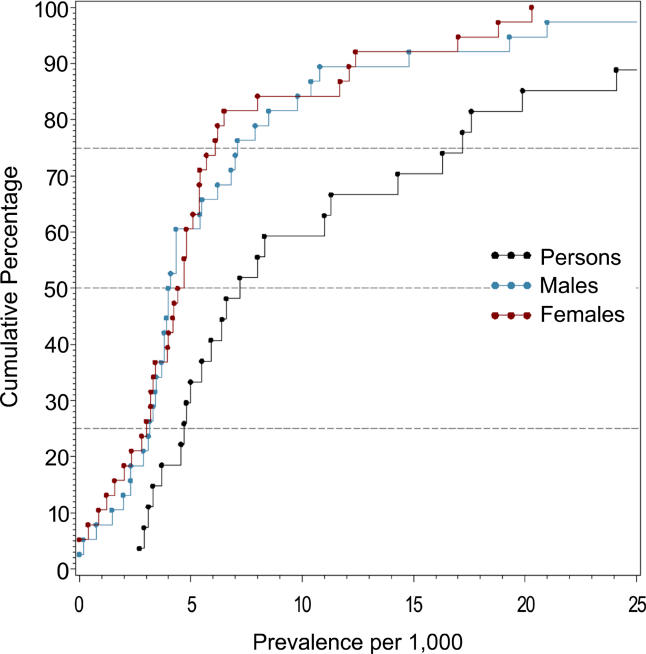
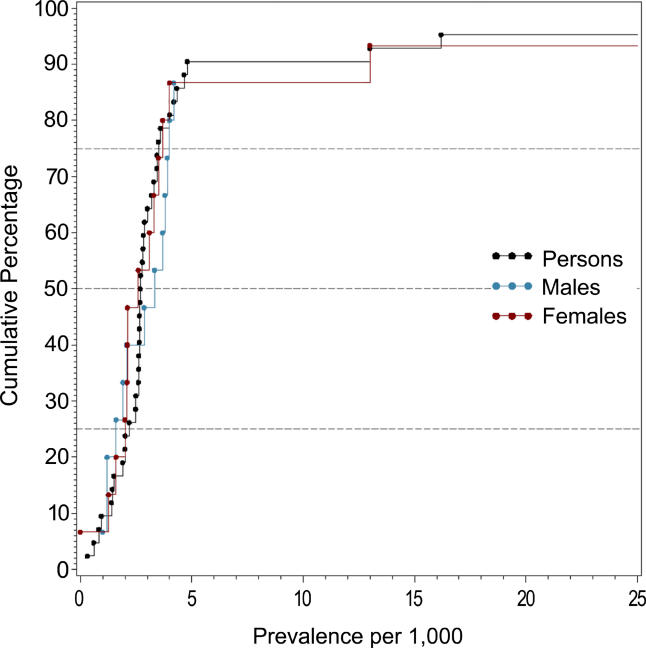
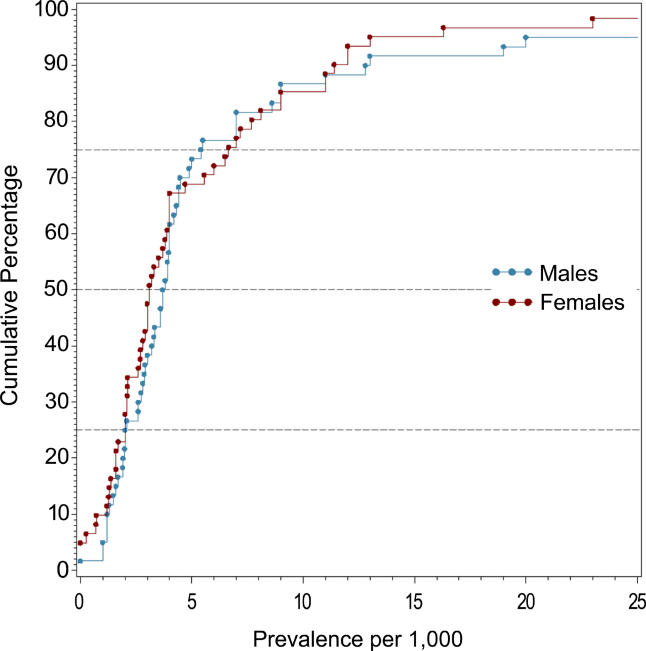
BACKGROUND: Understanding the prevalence of schizophrenia has important implications for both health service planning and risk factor epidemiology. The aims of this review are to systematically identify and collate studies describing the prevalence of schizophrenia, to summarize the findings of these studies, and to explore selected factors that may influence prevalence estimates. METHODS AND FINDINGS: Studies with original data related to the prevalence of schizophrenia (published 1965-2002) were identified via searching electronic databases, reviewing citations, and writing to authors. These studies were divided into "core" studies, "migrant" studies, and studies based on "other special groups." Between- and within-study filters were applied in order to identify discrete prevalence estimates. Cumulative plots of prevalence estimates were made and the distributions described when the underlying estimates were sorted according to prevalence type (point, period, lifetime, and lifetime morbid risk). Based on combined prevalence estimates, the influence of selected key variables was examined (sex, urbanicity, migrant status, country economic index, and study quality). A total of 1,721 prevalence estimates from 188 studies were identified. These estimates were drawn from 46 countries, and were based on an estimated 154,140 potentially overlapping prevalent cases. We identified 132 core studies, 15 migrant studies, and 41 studies based on other special groups. The median values per 1,000 persons (10%-90% quantiles) for the distributions for point, period, lifetime, and lifetime morbid risk were 4.6 (1.9-10.0), 3.3 (1.3-8.2), 4.0 (1.6-12.1), and 7.2 (3.1-27.1), respectively. Based on combined prevalence estimates, we found no significant difference (a) between males and females, or (b) between urban, rural, and mixed sites. The prevalence of schizophrenia in migrants was higher compared to native-born individuals: the migrant-to-native-born ratio median (10%-90% quantile) was 1.8 (0.9-6.4). When sites were grouped by economic status, prevalence estimates from "least developed" countries were significantly lower than those from both "emerging" and "developed" sites (p = 0.04). Studies that scored higher on a quality score had significantly higher prevalence estimates (p = 0.02). CONCLUSIONS: There is a wealth of data about the prevalence of schizophrenia. These gradients, and the variability found in prevalence estimate distributions, can provide direction for future hypothesis-driven research.
Checked 2026-10-06 · 16 references not checked yet
Overview
AI snapshot
Written from the paper’s full text.
TL;DR
This systematic review collated 1,721 prevalence estimates from 188 studies across 46 countries to describe the distribution of schizophrenia prevalence and examine selected moderators. Median prevalence per 1,000 persons was 4.6 for point, 3.3 for period, 4.0 for lifetime, and 7.2 for lifetime morbid risk, with higher estimates in migrants and higher-quality studies and lower estimates in least developed countries.
Key findings
- The review identified 1,721 prevalence estimates from 188 studies drawn from 46 countries, based on an estimated 154,140 potentially overlapping prevalent cases; there were 132 core studies, 15 migrant studies, and 41 studies of other special groups.
- Median prevalence per 1,000 persons was 4.6 for point prevalence (10%–90% quantiles 1.9–10.0), 3.3 for period prevalence (1.3–8.2), 4.0 for lifetime prevalence (1.8–11.6 in the results text), and 7.2 for lifetime morbid risk (3.1–27.1).
- There was no significant difference between males and females (F 1,72 = 0.68, p = 0.41; male:female median ratio 1.11, 10%–90% quantiles 0.50–1.70) or between urban, rural, and mixed sites (F 2,235 = 1.63, p = 0.20).
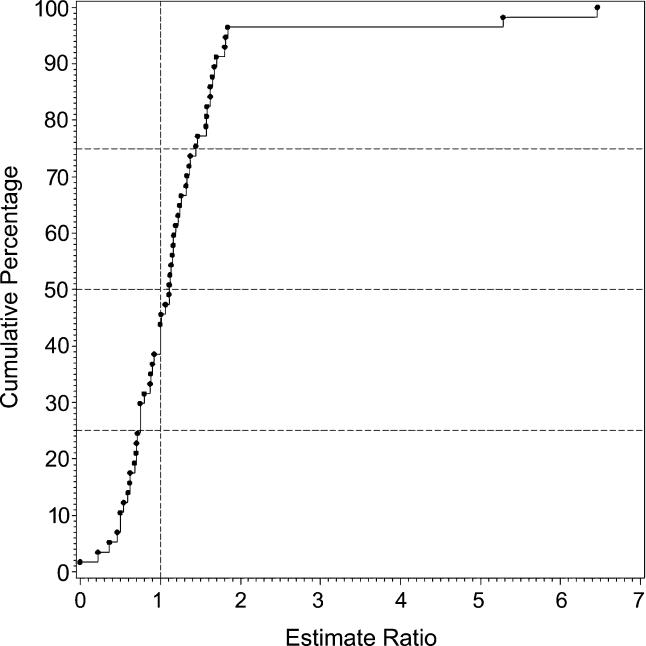
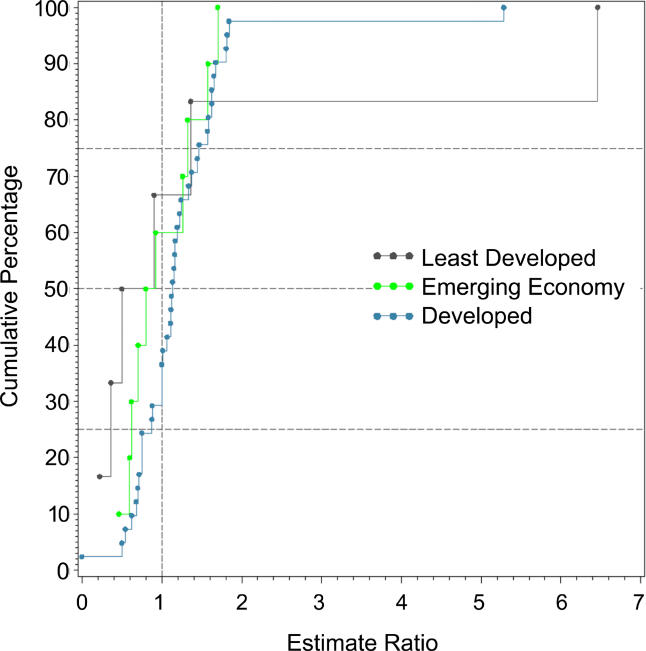
- Migrant status was associated with higher prevalence: median migrant:native-born ratio 1.84 (10%–90% quantiles 0.86–6.41; F 1,2 = 5.57, p = 0.04). Prevalence was significantly lower in “least developed” countries than in “emerging” and “developed” sites (p = 0.04), and higher-quality studies had significantly higher estimates (highest versus lowest quality scores, p = 0.02).
Methods
- Systematic review following MOOSE guidelines; studies with original prevalence data published January 1965–December 2002 were identified by searching MEDLINE, PsychINFO, EMBASE, and LILACS, checking references, and contacting authors; prison/forensic and genetic family studies were excluded.
- Estimates were sorted with sequential filters into core, migrant, and other special groups, and into point, period, lifetime, lifetime morbid risk, not otherwise specified, and inpatient-census-derived types; a “most informative” rule selected discrete estimates from overlapping studies.
- Analyses used cumulative plots and quantiles, with SAS proc univariate and proc mixed to control for within-study variation; combined prevalence estimates were used for planned sensitivity analyses, with Bonferroni correction for post hoc comparisons.
Limitations
- The authors state that they may have missed studies or made data entry errors; filtering and extraction rules were necessarily ad hoc; combined prevalence estimates were not based on discrete data (8 of 94 studies contributed more than one prevalence type); standard errors could be imputed for only 26% of estimates; and the mixed urban/rural category was likely heterogeneous.
- The authors also caution against excessive data analyses and note that contributing studies were not designed to test many hypotheses examined in the review.
- Evident from the text: no formal pooled meta-analysis was performed because of heterogeneity and limited confidence limits, and the migrant analysis was restricted to five papers and 22 prevalence ratios after exclusions.
Model-written summary. Check it against the paper before relying on it.
Integrity signals
Registry
Cites
Statistics
Figures
Verification
Claims the paper makes
57 Own result · 28 Not checked yet · 14 Own interpretation · 10 Own method · 1 No basis given
A result the paper reports from its own data — it cites no other source for it, so there is none to check. The quote shows it is in the paper.
In the paper
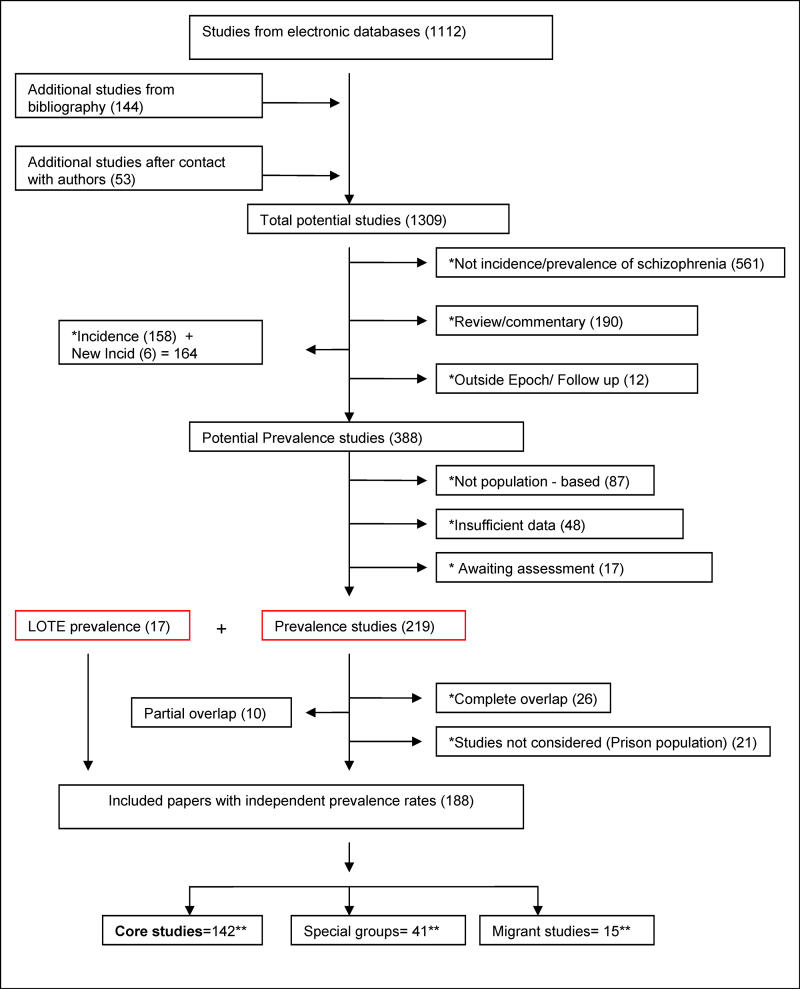
“Of the 132 core studies, we identified 21 studies for point prevalence, 34 studies for period prevalence, and 24 studies for lifetime prevalence.”
§ A Systematic Review of the Prevalence of Schizophrenia > Results > The “Epidemiology” of Prevalence Estimates
plain- Asserted: passes — The authors put it forward as true.
- Checkable: passes — It can be checked against evidence.
- Load-bearing: unclear — It is unclear whether the paper’s conclusions depend on it.
- Based: passes — The paper gives a reason why it holds.
A result the paper reports from its own data — it cites no other source for it, so there is none to check. The quote shows it is in the paper.
In the paper
“The median lifetime prevalence for persons (based on 29 estimates) was 4.0 per 1,000, and the 10% and 90% quantiles ranged from 1.8 to 11.6 per 1,000 (a 6.4-fold difference).”
§ A Systematic Review of the Prevalence of Schizophrenia > Results > The Distribution of Prevalence Estimates
plain- Asserted: passes — The authors put it forward as true.
- Checkable: passes — It can be checked against evidence.
- Load-bearing: passes — The paper’s conclusions depend on it.
- Based: passes — The paper gives a reason why it holds.
A result the paper reports from its own data — it cites no other source for it, so there is none to check. The quote shows it is in the paper.
In the paper
“Four studies [59,120,169,224] reported prevalence only within narrow age strata without providing an overall rate.”
§ A Systematic Review of the Prevalence of Schizophrenia > Results > The “Epidemiology” of Prevalence Estimates
plain- Asserted: passes — The authors put it forward as true.
- Checkable: passes — It can be checked against evidence.
- Load-bearing: unclear — It is unclear whether the paper’s conclusions depend on it.
- Based: passes — The paper gives a reason why it holds.
A result the paper reports from its own data — it cites no other source for it, so there is none to check. The quote shows it is in the paper.
In the paper
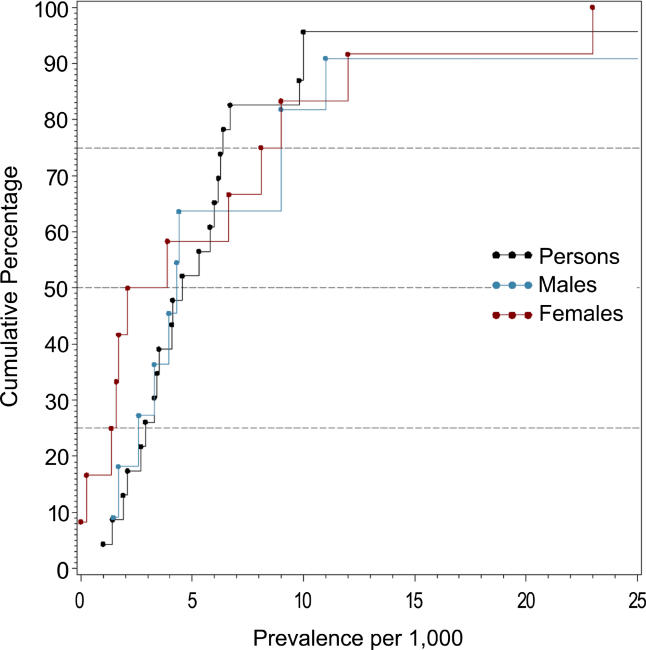
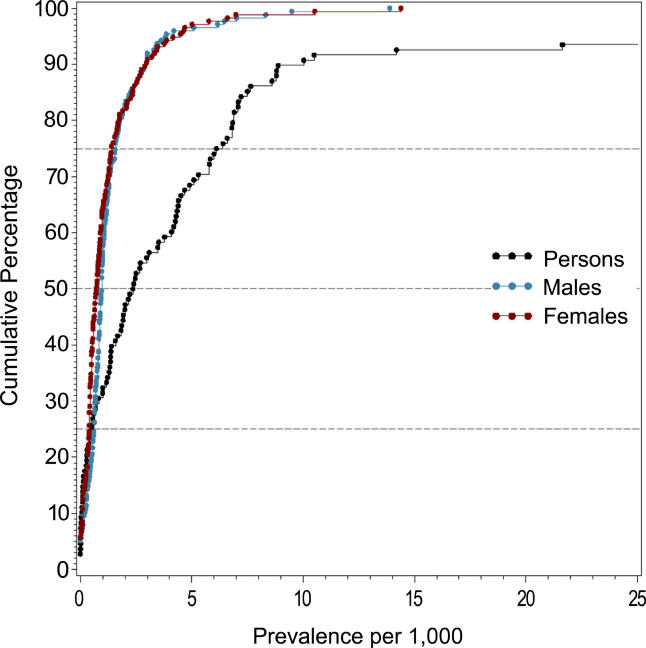
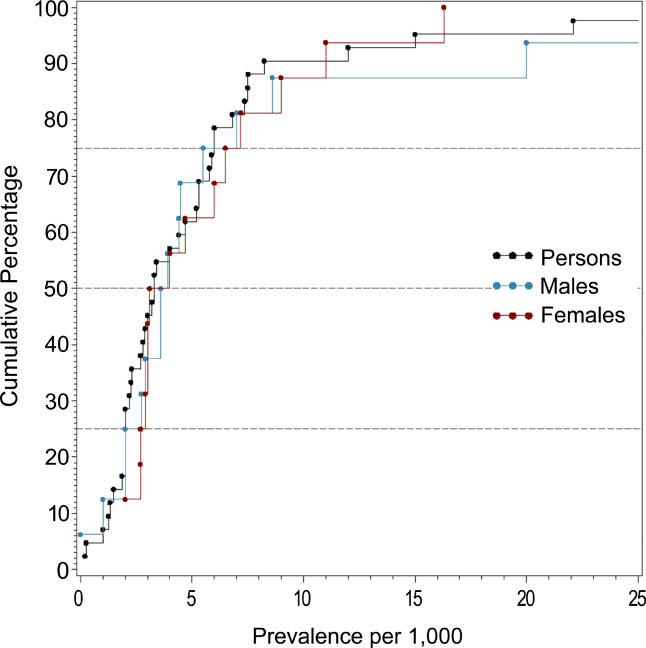
“The median values per 1,000 persons (10%–90% quantiles) for the distributions for point, period, lifetime, and lifetime morbid risk were 4.6 (1.9–10.0), 3.3 (1.3–8.2), 4.0 (1.6–12.1), and 7.2 (3.1–27.1), respectively.”
§ A Systematic Review of the Prevalence of Schizophrenia > Abstract > Methods and Findings
plainn = 154,140- Asserted: passes — The authors put it forward as true.
- Checkable: passes — It can be checked against evidence.
- Load-bearing: passes — The paper’s conclusions depend on it.
- Based: passes — The paper gives a reason why it holds.
In the paper
“One study, which was allocated to “other special groups,” did provide confidence limits [29].”
§ A Systematic Review of the Prevalence of Schizophrenia > Methods > Presentation and Analyses of the Data
What the sources say
- Not checked yetcites [29] Nimgaonkar, 2000, Am J Psychiatry source
plain- Asserted: passes — The authors put it forward as true.
- Checkable: passes — It can be checked against evidence.
- Load-bearing: unclear — It is unclear whether the paper’s conclusions depend on it.
- Based: passes — The paper gives a reason why it holds.
A result the paper reports from its own data — it cites no other source for it, so there is none to check. The quote shows it is in the paper.
In the paper
“These estimates were drawn from 46 countries, and were based on an estimated 154,140 potentially overlapping prevalent cases.”
- Also stated in: § The “Epidemiology” of Prevalence Estimates · plain
“These studies provided 1,721 estimates and were drawn from 46 countries.”
§ A Systematic Review of the Prevalence of Schizophrenia > Abstract > Methods and Findings
plainn = 154,140- Asserted: passes — The authors put it forward as true.
- Checkable: passes — It can be checked against evidence.
- Load-bearing: unclear — It is unclear whether the paper’s conclusions depend on it.
- Based: passes — The paper gives a reason why it holds.
- Also stated in: § The “Epidemiology” of Prevalence Estimates · plain
A result the paper reports from its own data — it cites no other source for it, so there is none to check. The quote shows it is in the paper.
In the paper
“Of the 132 core studies, we identified 21 studies for point prevalence, 34 studies for period prevalence, and 24 studies for lifetime prevalence.”
§ A Systematic Review of the Prevalence of Schizophrenia > Results > The “Epidemiology” of Prevalence Estimates
plain- Asserted: passes — The authors put it forward as true.
- Checkable: passes — It can be checked against evidence.
- Load-bearing: unclear — It is unclear whether the paper’s conclusions depend on it.
- Based: passes — The paper gives a reason why it holds.
A result the paper reports from its own data — it cites no other source for it, so there is none to check. The quote shows it is in the paper.
In the paper
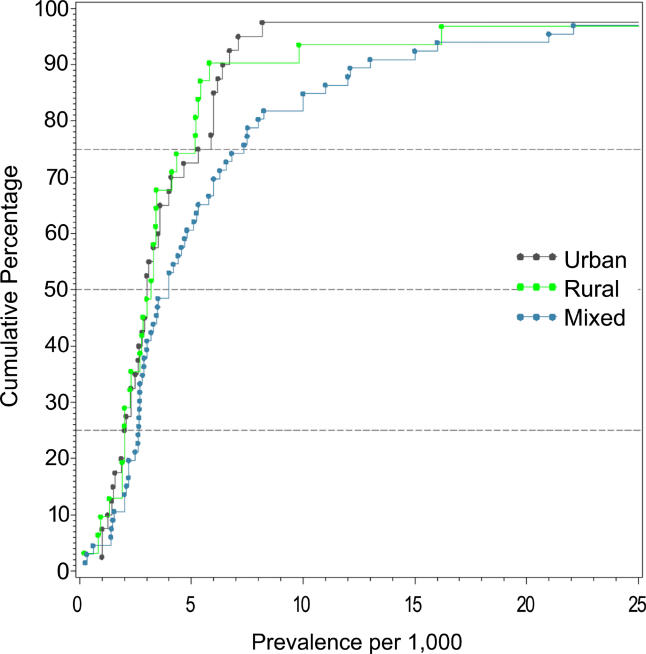
“Based on combined prevalence estimates, we found no significant difference (a) between males and females, or (b) between urban, rural, and mixed sites.”
§ A Systematic Review of the Prevalence of Schizophrenia > Abstract > Methods and Findings
plainn = 154,140- Asserted: passes — The authors put it forward as true.
- Checkable: passes — It can be checked against evidence.
- Load-bearing: passes — The paper’s conclusions depend on it.
- Based: passes — The paper gives a reason why it holds.
A result the paper reports from its own data — it cites no other source for it, so there is none to check. The quote shows it is in the paper.
In the paper
“Studies that scored higher on a quality score had significantly higher prevalence estimates (p = 0.02).”
§ A Systematic Review of the Prevalence of Schizophrenia > Abstract > Methods and Findings
plaincorrelational- Asserted: passes — The authors put it forward as true.
- Checkable: passes — It can be checked against evidence.
- Load-bearing: unclear — It is unclear whether the paper’s conclusions depend on it.
- Based: passes — The paper gives a reason why it holds.
A result the paper reports from its own data — it cites no other source for it, so there is none to check. The quote shows it is in the paper.
In the paper
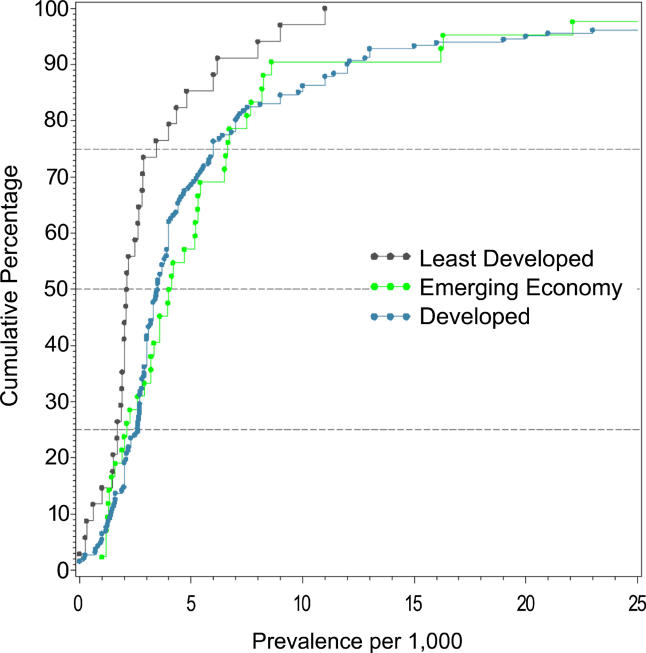
“When sites were grouped by economic status, prevalence estimates from “least developed” countries were significantly lower than those from both “emerging” and “developed” sites (p = 0.04).”
§ A Systematic Review of the Prevalence of Schizophrenia > Abstract > Methods and Findings
plaincorrelationaln = 154,140- Asserted: passes — The authors put it forward as true.
- Checkable: passes — It can be checked against evidence.
- Load-bearing: passes — The paper’s conclusions depend on it.
- Based: passes — The paper gives a reason why it holds.
- Probably not a substantial claim. 29
- It may state two separate claims as one. 21
- The quote only partly states this claim. 1
A result the paper reports from its own data — it cites no other source for it, so there is none to check. The quote shows it is in the paper.
In the paper
“We identified 132 core studies, 15 migrant studies, and 41 studies based on other special groups.”
- Also stated in: § The “Epidemiology” of Prevalence Estimates · plain
“There were 132 core studies, 15 migrant studies (of which three overlap with discrete core), and 41 studies that reported the prevalence of schizophrenia in other special groups.”
§ A Systematic Review of the Prevalence of Schizophrenia > Abstract > Methods and Findings
plain- Asserted: passes — The authors put it forward as true.
- Checkable: passes — It can be checked against evidence.
- Load-bearing: fails — The paper’s conclusions may not depend on it.
- Based: passes — The paper gives a reason why it holds.
Probably not a substantial claim. The paper’s conclusions may not depend on it.
- Also stated in: § The “Epidemiology” of Prevalence Estimates · plain
A result the paper reports from its own data — it cites no other source for it, so there is none to check. The quote shows it is in the paper.
In the paper
“The prevalence of schizophrenia in migrants was higher compared to native-born individuals: the migrant-to-native-born ratio median (10%–90% quantile) was 1.8 (0.9–6.4).”
§ A Systematic Review of the Prevalence of Schizophrenia > Abstract > Methods and Findings
plaincorrelational- Asserted: passes — The authors put it forward as true.
- Checkable: passes — It can be checked against evidence.
- Load-bearing: passes — The paper’s conclusions depend on it.
- Based: passes — The paper gives a reason why it holds.
It may state two separate claims as one.
A result the paper reports from its own data — it cites no other source for it, so there is none to check. The quote shows it is in the paper.
In the paper
“The electronic search identified 1,112 papers (85% of the total papers included in the study), while manual reference checking identified an additional 142 references (11%).”
§ A Systematic Review of the Prevalence of Schizophrenia > Results > The “Epidemiology” of Prevalence Estimates
plain- Asserted: passes — The authors put it forward as true.
- Checkable: passes — It can be checked against evidence.
- Load-bearing: fails — The paper’s conclusions may not depend on it.
- Based: passes — The paper gives a reason why it holds.
Probably not a substantial claim. The paper’s conclusions may not depend on it.
A result the paper reports from its own data — it cites no other source for it, so there is none to check. The quote shows it is in the paper.
In the paper
“These estimates were drawn from 46 countries, and were based on an estimated 154,140 potentially overlapping prevalent cases.”
- Also stated in: § The “Epidemiology” of Prevalence Estimates · hedged
“The prevalence estimates were based on an estimated total of 154,140 potentially overlapping cases.”
§ A Systematic Review of the Prevalence of Schizophrenia > Abstract > Methods and Findings
hedgedn = 154,140- Asserted: passes — The authors put it forward as true.
- Checkable: passes — It can be checked against evidence.
- Load-bearing: fails — The paper’s conclusions may not depend on it.
- Based: passes — The paper gives a reason why it holds.
Probably not a substantial claim. The paper’s conclusions may not depend on it.
- Also stated in: § The “Epidemiology” of Prevalence Estimates · hedged
A result the paper reports from its own data — it cites no other source for it, so there is none to check. The quote shows it is in the paper.
In the paper
“However, we were able to impute standard errors for only 26% of the prevalence estimates, which were drawn from less than half (45%) of the discrete core studies.”
§ A Systematic Review of the Prevalence of Schizophrenia > Methods > Presentation and Analyses of the Data
plain- Asserted: passes — The authors put it forward as true.
- Checkable: passes — It can be checked against evidence.
- Load-bearing: passes — The paper’s conclusions depend on it.
- Based: passes — The paper gives a reason why it holds.
It may state two separate claims as one.
A result the paper reports from its own data — it cites no other source for it, so there is none to check. The quote shows it is in the paper.
In the paper
“We identified 132 core studies, 15 migrant studies, and 41 studies based on other special groups.”
- Also stated in: § The “Epidemiology” of Prevalence Estimates · plain
“There were 132 core studies, 15 migrant studies (of which three overlap with discrete core), and 41 studies that reported the prevalence of schizophrenia in other special groups.”
§ A Systematic Review of the Prevalence of Schizophrenia > Abstract > Methods and Findings
plain- Asserted: passes — The authors put it forward as true.
- Checkable: passes — It can be checked against evidence.
- Load-bearing: fails — The paper’s conclusions may not depend on it.
- Based: passes — The paper gives a reason why it holds.
Probably not a substantial claim. The paper’s conclusions may not depend on it.
- Also stated in: § The “Epidemiology” of Prevalence Estimates · plain
A result the paper reports from its own data — it cites no other source for it, so there is none to check. The quote shows it is in the paper.
In the paper
“The 132 core studies provided from one to 13 prevalence estimates per study.”
§ A Systematic Review of the Prevalence of Schizophrenia > Results > The “Epidemiology” of Prevalence Estimates
plainn = 154,140- Asserted: passes — The authors put it forward as true.
- Checkable: passes — It can be checked against evidence.
- Load-bearing: fails — The paper’s conclusions may not depend on it.
- Based: passes — The paper gives a reason why it holds.
Probably not a substantial claim. The paper’s conclusions may not depend on it.
A result the paper reports from its own data — it cites no other source for it, so there is none to check. The quote shows it is in the paper.
In the paper
“There were nine studies that reported LMR.”
§ A Systematic Review of the Prevalence of Schizophrenia > Results > The “Epidemiology” of Prevalence Estimates
plain- Asserted: passes — The authors put it forward as true.
- Checkable: passes — It can be checked against evidence.
- Load-bearing: fails — The paper’s conclusions may not depend on it.
- Based: passes — The paper gives a reason why it holds.
Probably not a substantial claim. The paper’s conclusions may not depend on it.
A result the paper reports from its own data — it cites no other source for it, so there is none to check. The quote shows it is in the paper.
In the paper
“We identified 98 studies that were published in languages other than English.”
§ A Systematic Review of the Prevalence of Schizophrenia > Results > The “Epidemiology” of Prevalence Estimates
plain- Asserted: passes — The authors put it forward as true.
- Checkable: passes — It can be checked against evidence.
- Load-bearing: fails — The paper’s conclusions may not depend on it.
- Based: passes — The paper gives a reason why it holds.
Probably not a substantial claim. The paper’s conclusions may not depend on it.
A result the paper reports from its own data — it cites no other source for it, so there is none to check. The quote shows it is in the paper.
In the paper
“We received responses from 31 authors (see Acknowledgments for full list), who provided an additional 53 references (4%).”
§ A Systematic Review of the Prevalence of Schizophrenia > Results > The “Epidemiology” of Prevalence Estimates
plain- Asserted: passes — The authors put it forward as true.
- Checkable: passes — It can be checked against evidence.
- Load-bearing: fails — The paper’s conclusions may not depend on it.
- Based: passes — The paper gives a reason why it holds.
Probably not a substantial claim. The paper’s conclusions may not depend on it.
A result the paper reports from its own data — it cites no other source for it, so there is none to check. The quote shows it is in the paper.
In the paper
“The electronic search identified 1,112 papers (85% of the total papers included in the study), while manual reference checking identified an additional 142 references (11%).”
§ A Systematic Review of the Prevalence of Schizophrenia > Results > The “Epidemiology” of Prevalence Estimates
plain- Asserted: passes — The authors put it forward as true.
- Checkable: passes — It can be checked against evidence.
- Load-bearing: fails — The paper’s conclusions may not depend on it.
- Based: passes — The paper gives a reason why it holds.
Probably not a substantial claim. The paper’s conclusions may not depend on it.
A result the paper reports from its own data — it cites no other source for it, so there is none to check. The quote shows it is in the paper.
In the paper
“After translation 17 of these studies were included in this review.”
§ A Systematic Review of the Prevalence of Schizophrenia > Results > The “Epidemiology” of Prevalence Estimates
plain- Asserted: passes — The authors put it forward as true.
- Checkable: passes — It can be checked against evidence.
- Load-bearing: fails — The paper’s conclusions may not depend on it.
- Based: passes — The paper gives a reason why it holds.
Probably not a substantial claim. The paper’s conclusions may not depend on it.
A result the paper reports from its own data — it cites no other source for it, so there is none to check. The quote shows it is in the paper.
In the paper
“The median period prevalence for persons (based on 42 estimates) was 3.3 per 1,000, and the 10% and 90% quantiles ranged from 1.3 to 8.2 per 1,000 (a 6.5-fold difference).”
§ A Systematic Review of the Prevalence of Schizophrenia > Results > The Distribution of Prevalence Estimates
plain- Asserted: passes — The authors put it forward as true.
- Checkable: passes — It can be checked against evidence.
- Load-bearing: passes — The paper’s conclusions depend on it.
- Based: passes — The paper gives a reason why it holds.
It may state two separate claims as one.
A result the paper reports from its own data — it cites no other source for it, so there is none to check. The quote shows it is in the paper.
In the paper
“We identified 132 core studies, 15 migrant studies, and 41 studies based on other special groups.”
- Also stated in: § The “Epidemiology” of Prevalence Estimates · plain
“There were 132 core studies, 15 migrant studies (of which three overlap with discrete core), and 41 studies that reported the prevalence of schizophrenia in other special groups.”
§ A Systematic Review of the Prevalence of Schizophrenia > Abstract > Methods and Findings
plain- Asserted: passes — The authors put it forward as true.
- Checkable: passes — It can be checked against evidence.
- Load-bearing: fails — The paper’s conclusions may not depend on it.
- Based: passes — The paper gives a reason why it holds.
Probably not a substantial claim. The paper’s conclusions may not depend on it.
- Also stated in: § The “Epidemiology” of Prevalence Estimates · plain
A result the paper reports from its own data — it cites no other source for it, so there is none to check. The quote shows it is in the paper.
In the paper
“As predicted, prevalence estimates for migrant groups tend to be higher than estimates for native-born populations.”
§ A Systematic Review of the Prevalence of Schizophrenia > Discussion > Migrant Status and the Prevalence of Schizophrenia
hedgedcorrelational- Asserted: passes — The authors put it forward as true.
- Checkable: passes — It can be checked against evidence.
- Load-bearing: passes — The paper’s conclusions depend on it.
- Based: passes — The paper gives a reason why it holds.
The quote only partly states this claim.
A result the paper reports from its own data — it cites no other source for it, so there is none to check. The quote shows it is in the paper.
In the paper
“Furthermore, the median prevalence estimates for emerging economies are numerically higher than those for the richest countries. While not statistically significant, the results did identify many prevalence studies from the developing world where females outnumbered males.”
§ A Systematic Review of the Prevalence of Schizophrenia > Discussion > Economic Status and Schizophrenia
plain- Asserted: passes — The authors put it forward as true.
- Checkable: passes — It can be checked against evidence.
- Load-bearing: unclear — It is unclear whether the paper’s conclusions depend on it.
- Based: passes — The paper gives a reason why it holds.
It may state two separate claims as one.
The paper states this without a source or data behind it here, so there is nothing to check it against. The quote shows it is in the paper.
In the paper
“Two of the prevalence types (LMR and inpatient-census-derived data) had distributions for persons that were higher than distributions for both males and females separately.”
§ A Systematic Review of the Prevalence of Schizophrenia > Discussion > Caveats
plaincorrelational- Asserted: passes — The authors put it forward as true.
- Checkable: passes — It can be checked against evidence.
- Load-bearing: fails — The paper’s conclusions may not depend on it.
- Based: passes — The paper gives a reason why it holds.
Probably not a substantial claim. The paper’s conclusions may not depend on it.
A result the paper reports from its own data — it cites no other source for it, so there is none to check. The quote shows it is in the paper.
In the paper
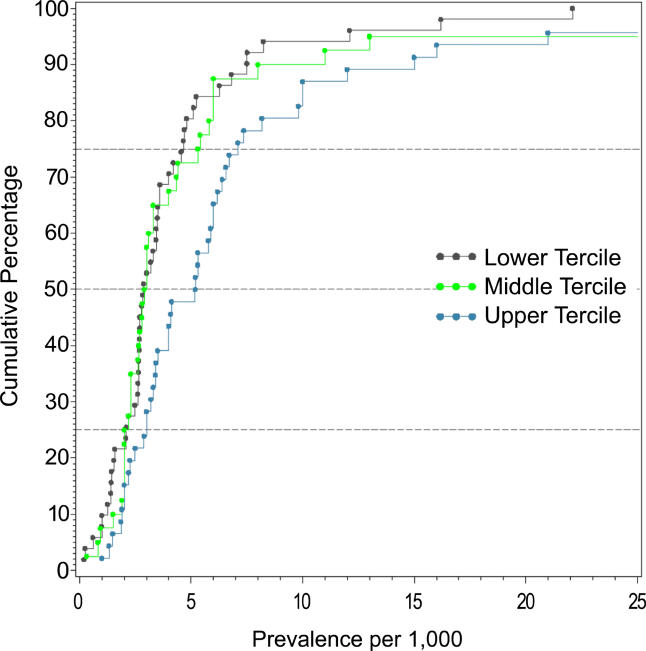
“When the combined prevalence estimates for persons were divided into quality score terciles, the prevalence estimate distributions were significantly different (F 2,105 = 4.79, p = 0.01), with the highest quality studies reporting significantly higher prevalence estimates than the other two terciles (highest versus lowest quality scores, p = 0.02) (Table 13; Figure 14).”
§ A Systematic Review of the Prevalence of Schizophrenia > Results > Quality Score
plaincorrelational- Asserted: passes — The authors put it forward as true.
- Checkable: passes — It can be checked against evidence.
- Load-bearing: unclear — It is unclear whether the paper’s conclusions depend on it.
- Based: passes — The paper gives a reason why it holds.
It may state two separate claims as one.
A result the paper reports from its own data — it cites no other source for it, so there is none to check. The quote shows it is in the paper.
In the paper
“Based on 22 prevalence ratios, the median migrant:native-born prevalence ratio was 1.84 and the 10% and 90% quantiles were 0.86 to 6.41 (approximately a 7.5-fold difference) (see Table 10; Figure 11).”
§ A Systematic Review of the Prevalence of Schizophrenia > Results > Migrant Status
plaincorrelational- Asserted: passes — The authors put it forward as true.
- Checkable: passes — It can be checked against evidence.
- Load-bearing: passes — The paper’s conclusions depend on it.
- Based: passes — The paper gives a reason why it holds.
It may state two separate claims as one.
A result the paper reports from its own data — it cites no other source for it, so there is none to check. The quote shows it is in the paper.
In the paper
“The median LMR for persons (based on 27 estimates) was 7.2 per 1,000, and the 10% and 90% quantiles ranged from 3.1 to 27.1 per 1,000 (a 8.7-fold difference) (see Table 6).”
§ A Systematic Review of the Prevalence of Schizophrenia > Results > The Distribution of Prevalence Estimates
plain- Asserted: passes — The authors put it forward as true.
- Checkable: passes — It can be checked against evidence.
- Load-bearing: unclear — It is unclear whether the paper’s conclusions depend on it.
- Based: passes — The paper gives a reason why it holds.
It may state two separate claims as one.
A result the paper reports from its own data — it cites no other source for it, so there is none to check. The quote shows it is in the paper.
In the paper
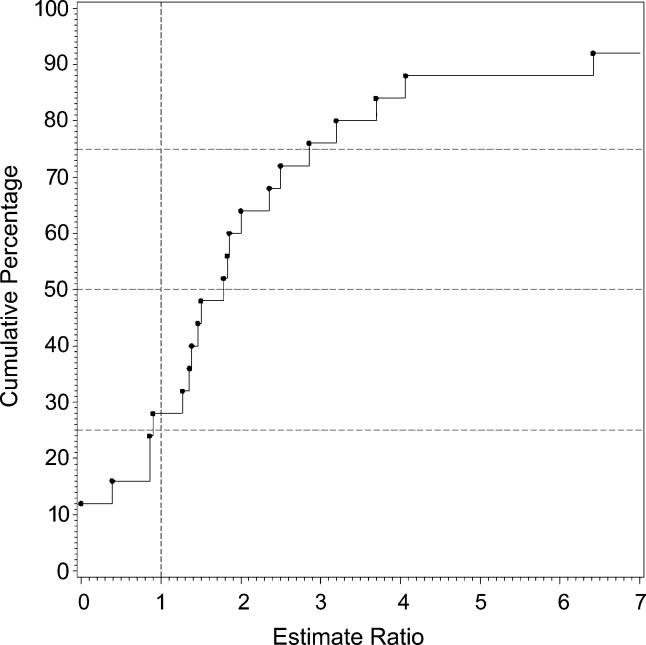
“For the male:female estimate ratio (based on 57 ratios), the median value was 1.11, and the 10% and 90% quantiles were 0.50 to 1.70 (approximately a 3.4-fold difference) (see Figure 9).”
§ A Systematic Review of the Prevalence of Schizophrenia > Results > Male Versus Female Prevalence
plain- Asserted: passes — The authors put it forward as true.
- Checkable: passes — It can be checked against evidence.
- Load-bearing: unclear — It is unclear whether the paper’s conclusions depend on it.
- Based: passes — The paper gives a reason why it holds.
It may state two separate claims as one.
A result the paper reports from its own data — it cites no other source for it, so there is none to check. The quote shows it is in the paper.
In the paper
“When divided by this criterion, the prevalence estimate distributions were significantly different (F 2,85 = 3.57, p = 0.03), with the difference attributed to the lower prevalence estimate distribution for the less developed economies (developed versus least developed, F 1,74 = 6.55, p = 0.04).”
§ A Systematic Review of the Prevalence of Schizophrenia > Results > Economic Status of Sites
plaincorrelational- Asserted: passes — The authors put it forward as true.
- Checkable: passes — It can be checked against evidence.
- Load-bearing: unclear — It is unclear whether the paper’s conclusions depend on it.
- Based: passes — The paper gives a reason why it holds.
It may state two separate claims as one.
A result the paper reports from its own data — it cites no other source for it, so there is none to check. The quote shows it is in the paper.
In the paper
“There is a wealth of data available on the prevalence of schizophrenia—a total of 1,721 estimates from 188 studies were identified in this systematic review. These estimates were drawn from 46 countries, and were based on an estimated 154,140 potentially overlapping prevalent cases.”
§ A Systematic Review of the Prevalence of Schizophrenia > Discussion
hedgedn = 154,140- Asserted: passes — The authors put it forward as true.
- Checkable: passes — It can be checked against evidence.
- Load-bearing: unclear — It is unclear whether the paper’s conclusions depend on it.
- Based: passes — The paper gives a reason why it holds.
It may state two separate claims as one.
A result the paper reports from its own data — it cites no other source for it, so there is none to check. The quote shows it is in the paper.
In the paper
“While the mixed urban/rural estimates were higher than urban and rural rates, this difference was not statistically significant (F 2,235 = 1.63, p = 0.20), nor were urban estimates significantly different from rural estimates (F 1,120 = 0.95, p = 0.33).”
§ A Systematic Review of the Prevalence of Schizophrenia > Results > Urbanicity of Sites
plain- Asserted: passes — The authors put it forward as true.
- Checkable: passes — It can be checked against evidence.
- Load-bearing: unclear — It is unclear whether the paper’s conclusions depend on it.
- Based: passes — The paper gives a reason why it holds.
It may state two separate claims as one.
A result the paper reports from its own data — it cites no other source for it, so there is none to check. The quote shows it is in the paper.
In the paper
“Based on the distribution of these prevalence estimates, the median prevalence was 2.7 per 1,000 for persons, and the 10% and 90% quantiles ranged from 1.4 to 4.8 per 1,000 (a 3.4-fold difference).”
§ A Systematic Review of the Prevalence of Schizophrenia > Results > The Distribution of Prevalence Estimates
plain- Asserted: passes — The authors put it forward as true.
- Checkable: passes — It can be checked against evidence.
- Load-bearing: unclear — It is unclear whether the paper’s conclusions depend on it.
- Based: passes — The paper gives a reason why it holds.
It may state two separate claims as one.
None of the sources cited for this claim have been checked yet.
In the paper
“However, we note that prevalence estimates in some homeless populations were very high—300 per 1,000 persons for Sydney homeless individuals [194] and 131 per 1,000 persons for Los Angeles homeless individuals [118].”
§ A Systematic Review of the Prevalence of Schizophrenia > Results > Other Special Group Studies
What the sources say
plain- Asserted: passes — The authors put it forward as true.
- Checkable: passes — It can be checked against evidence.
- Load-bearing: unclear — It is unclear whether the paper’s conclusions depend on it.
- Based: passes — The paper gives a reason why it holds.
It may state two separate claims as one.
In the paper
“While the incidence of the disorder is relatively low (median value 15.2 per 100,000 persons per year) [1], the condition is one of the major contributors to the global burden of disease [2].”
§ A Systematic Review of the Prevalence of Schizophrenia > Introduction
What the sources say
- Not checked yetcites [1] McGrath, 2004, BMC Med source
plain- Asserted: passes — The authors put it forward as true.
- Checkable: passes — It can be checked against evidence.
- Load-bearing: fails — The paper’s conclusions may not depend on it.
- Based: passes — The paper gives a reason why it holds.
Probably not a substantial claim. The paper’s conclusions may not depend on it.
In the paper
“(c) individuals in urban sites had a higher risk of developing schizophrenia than those in mixed urban/rural sites.”
§ A Systematic Review of the Prevalence of Schizophrenia > Introduction
What the sources say
- Not checked yetcites [1] McGrath, 2004, BMC Med source
plaincorrelational- Asserted: passes — The authors put it forward as true.
- Checkable: passes — It can be checked against evidence.
- Load-bearing: passes — The paper’s conclusions depend on it.
- Based: passes — The paper gives a reason why it holds.
Probably not a substantial claim.
In the paper
“This systematic review conforms to the guidelines outlined by the Meta-Analysis of Observational Studies in Epidemiology (MOOSE) recommendations [26].”
§ A Systematic Review of the Prevalence of Schizophrenia > Methods > Identification of Studies
What the sources say
- Not checked yetcites [26] Stroup, 2000, JAMA source
plain- Asserted: passes — The authors put it forward as true.
- Checkable: passes — It can be checked against evidence.
- Load-bearing: fails — The paper’s conclusions may not depend on it.
- Based: passes — The paper gives a reason why it holds.
Probably not a substantial claim. The paper’s conclusions may not depend on it.
In the paper
“In brief, we found that the incidence of schizophrenia varied widely between sites (persons, median = 15.2 per 100,000; 10%–90% quantiles = 7.7–43.0).”
§ A Systematic Review of the Prevalence of Schizophrenia > Introduction
What the sources say
- Not checked yetcites [1] McGrath, 2004, BMC Med source
plain- Asserted: passes — The authors put it forward as true.
- Checkable: passes — It can be checked against evidence.
- Load-bearing: passes — The paper’s conclusions depend on it.
- Based: passes — The paper gives a reason why it holds.
Probably not a substantial claim.
What the paper did — it cites no source for this, so there is none to check. The quote shows it is in the paper.
In the paper
“Thus, a key feature of this study is the application of sequential filters in order to identify discrete prevalence estimates.”
§ A Systematic Review of the Prevalence of Schizophrenia > Methods > Sorting Prevalence Estimates by the Application of Sequential Filters
plaindirect- Asserted: passes — The authors put it forward as true.
- Checkable: passes — It can be checked against evidence.
- Load-bearing: passes — The paper’s conclusions depend on it.
- Based: passes — The paper gives a reason why it holds.
It may state two separate claims as one.
What the paper did — it cites no source for this, so there is none to check. The quote shows it is in the paper.
In the paper
“When disagreements arose, these were resolved by consensus.”
§ A Systematic Review of the Prevalence of Schizophrenia > Methods > Data Extraction
plain- Asserted: passes — The authors put it forward as true.
- Checkable: passes — It can be checked against evidence.
- Load-bearing: fails — The paper’s conclusions may not depend on it.
- Based: passes — The paper gives a reason why it holds.
Probably not a substantial claim. The paper’s conclusions may not depend on it.
None of the sources cited for this claim have been checked yet.
In the paper
“The reviews of Odegaard [15], and Larsson and Sjogren [16] noted that, for low-incidence disorders such as schizophrenia, summation of age-specific incidence rates gives almost the same result as other more complicated methods of calculation [17].”
§ A Systematic Review of the Prevalence of Schizophrenia > Introduction > Ways to Measure the Prevalence of Schizophrenia
What the sources say
plain- Asserted: passes — The authors put it forward as true.
- Checkable: passes — It can be checked against evidence.
- Load-bearing: fails — The paper’s conclusions may not depend on it.
- Based: passes — The paper gives a reason why it holds.
Probably not a substantial claim. The paper’s conclusions may not depend on it.
What the paper did — it cites no source for this, so there is none to check. The quote shows it is in the paper.
In the paper
“we restricted the analyses to a limited set of planned sensitivity analyses, each with a priori directional hypotheses, and, for post hoc analyses, applied multiple comparison corrections to the nominal significance levels by a Bonferroni correction.”
§ A Systematic Review of the Prevalence of Schizophrenia > Methods > Presentation and Analyses of the Data
plain- Asserted: passes — The authors put it forward as true.
- Checkable: passes — It can be checked against evidence.
- Load-bearing: fails — The paper’s conclusions may not depend on it.
- Based: passes — The paper gives a reason why it holds.
Probably not a substantial claim. The paper’s conclusions may not depend on it. It may state two separate claims as one.
What the paper did — it cites no source for this, so there is none to check. The quote shows it is in the paper.
In the paper
“Two or more of the authors checked all data used in the analysis.”
§ A Systematic Review of the Prevalence of Schizophrenia > Methods > Data Extraction
plain- Asserted: passes — The authors put it forward as true.
- Checkable: passes — It can be checked against evidence.
- Load-bearing: fails — The paper’s conclusions may not depend on it.
- Based: passes — The paper gives a reason why it holds.
Probably not a substantial claim. The paper’s conclusions may not depend on it.
What the paper did — it cites no source for this, so there is none to check. The quote shows it is in the paper.
In the paper
“studies were given “quality points” based on operationalized features related to (a) optimal research design (e.g., higher scores for greater coverage, face-to-face interview versus chart diagnosis, and reliability of instruments), and (b) quality of reporting (e.g., provision of numerator and denominator, and description of diagnostic criteria).”
§ A Systematic Review of the Prevalence of Schizophrenia > Methods > Data Extraction
plain- Asserted: passes — The authors put it forward as true.
- Checkable: passes — It can be checked against evidence.
- Load-bearing: fails — The paper’s conclusions may not depend on it.
- Based: passes — The paper gives a reason why it holds.
Probably not a substantial claim. The paper’s conclusions may not depend on it.
In the paper
“The search methodology for this review was identical to that of our previous review paper on incidence of schizophrenia [1].”
§ A Systematic Review of the Prevalence of Schizophrenia > Methods > Identification of Studies
What the sources say
- Not checked yetcites [1] McGrath, 2004, BMC Med source
plain- Asserted: passes — The authors put it forward as true.
- Checkable: passes — It can be checked against evidence.
- Load-bearing: fails — The paper’s conclusions may not depend on it.
- Based: passes — The paper gives a reason why it holds.
Probably not a substantial claim. The paper’s conclusions may not depend on it.
A conclusion the paper draws from its own results — it cites no other source for it, so there is none to check. The quote shows it is in the paper.
In the paper
“While the incidence of schizophrenia is higher in urban than rural settings, this is not reflected in the overall prevalence data.”
§ A Systematic Review of the Prevalence of Schizophrenia > Discussion > Conclusions
plain- Asserted: passes — The authors put it forward as true.
- Checkable: passes — It can be checked against evidence.
- Load-bearing: passes — The paper’s conclusions depend on it.
- Based: passes — The paper gives a reason why it holds.
It may state two separate claims as one.
A conclusion the paper draws from its own results — it cites no other source for it, so there is none to check. The quote shows it is in the paper.
In the paper
“With respect to the studies included in the category “other special groups,” the estimates are not readily comparable, but it is interesting to note that these studies reported a wide range of prevalence estimates (e.g., high in homeless populations and low in certain religious groups).”
§ A Systematic Review of the Prevalence of Schizophrenia > Discussion > Quality Scores and Other Special Groups
plain- Asserted: passes — The authors put it forward as true.
- Checkable: passes — It can be checked against evidence.
- Load-bearing: unclear — It is unclear whether the paper’s conclusions depend on it.
- Based: passes — The paper gives a reason why it holds.
It may state two separate claims as one.
In the paper
“Our findings lend weight to the commentary by Ran and Yu-Hai Chen [25], drawing attention to the different features of schizophrenia in the developing world.”
§ A Systematic Review of the Prevalence of Schizophrenia > Discussion > Economic Status and Schizophrenia
What the sources say
- Not checked yetcites [25] Ran, 2004, Lancet source
hedgedcorrelational- Asserted: passes — The authors put it forward as true.
- Checkable: fails — It may be too vague to check against evidence.
- Load-bearing: fails — The paper’s conclusions may not depend on it.
- Based: passes — The paper gives a reason why it holds.
Probably not a substantial claim. It may be too vague to check against evidence. The paper’s conclusions may not depend on it.
In the paper
“however, the Diagnostic and Statistical Manual of Mental Disorders, fourth edition (DSM-IV) [3], reported that the lifetime prevalence of schizophrenia is “usually estimated to be between 0.5% and 1%.””
§ A Systematic Review of the Prevalence of Schizophrenia > Discussion
What the sources say
- Not checked yetcites [3]
hedged- Asserted: passes — The authors put it forward as true.
- Checkable: passes — It can be checked against evidence.
- Load-bearing: fails — The paper’s conclusions may not depend on it.
- Based: passes — The paper gives a reason why it holds.
Probably not a substantial claim. The paper’s conclusions may not depend on it.
In the paper
“Recently, a study from China examined whether this unexpected sex ratio was due to differential suicide rates in males with schizophrenia [24]; however, this did not seem to explain the female excess.”
§ A Systematic Review of the Prevalence of Schizophrenia > Discussion > Economic Status and Schizophrenia
What the sources say
- Not checked yetcites [24] Phillips, 2004, Lancet source
hedged- Asserted: passes — The authors put it forward as true.
- Checkable: passes — It can be checked against evidence.
- Load-bearing: unclear — It is unclear whether the paper’s conclusions depend on it.
- Based: passes — The paper gives a reason why it holds.
It may state two separate claims as one.
In the paper
“Because narrative reviews conclude that the course of the illness tends to be more severe in men than in women [235], we assumed that this would be reflected in a higher prevalence in males than females.”
§ A Systematic Review of the Prevalence of Schizophrenia > Discussion > Sex and Schizophrenia
What the sources say
- Not checked yetcites [235] Leung, 2000, Acta Psychiatr Scand Suppl source
hedgedcorrelational- Asserted: passes — The authors put it forward as true.
- Checkable: passes — It can be checked against evidence.
- Load-bearing: passes — The paper’s conclusions depend on it.
- Based: passes — The paper gives a reason why it holds.
Probably not a substantial claim.
What the paper did — it cites no source for this, so there is none to check. The quote shows it is in the paper.
In the paper
“Concerning the analyses for urbanicity, the estimates from mixed urban/rural studies are likely to be very heterogeneous. Indeed, we allocated studies to the mixed category if there was any possibility that rural sectors were included. This bias would have made any true difference between urban versus mixed urban/rural more difficult to detect.”
§ A Systematic Review of the Prevalence of Schizophrenia > Discussion > Caveats
hedgeddirect- Asserted: passes — The authors put it forward as true.
- Checkable: passes — It can be checked against evidence.
- Load-bearing: unclear — It is unclear whether the paper’s conclusions depend on it.
- Based: passes — The paper gives a reason why it holds.
It may state two separate claims as one.
A conclusion the paper draws from its own results — it cites no other source for it, so there is none to check. The quote shows it is in the paper.
In the paper
“The lack of coherence between (a) the sex differences found in the incidence of schizophrenia, (b) the presumed difference in course of illness, and (c) the identified lack of difference in prevalence warrants closer scrutiny.”
§ A Systematic Review of the Prevalence of Schizophrenia > Discussion > Sex and Schizophrenia
plain- Asserted: passes — The authors put it forward as true.
- Checkable: fails — It may be too vague to check against evidence.
- Load-bearing: passes — The paper’s conclusions depend on it.
- Based: passes — The paper gives a reason why it holds.
Probably not a substantial claim. It may be too vague to check against evidence.
None of the sources cited for this claim have been checked yet.
In the paper
“However, one in a hundred is an overestimate—our systematic review agrees with two previous reviews showing that the LMR for schizophrenia is between seven and eight per 1,000.”
§ A Systematic Review of the Prevalence of Schizophrenia > Discussion
What the sources say
- Not checked yetcites [232]
- Not checked yetcites [233]
plain- Asserted: passes — The authors put it forward as true.
- Checkable: passes — It can be checked against evidence.
- Load-bearing: passes — The paper’s conclusions depend on it.
- Based: passes — The paper gives a reason why it holds.
It may state two separate claims as one.
- The authors state this as an assumption: The oft-quoted statistic that schizophrenia affects about one in a hundred derives from LMR data.
What the paper did — it cites no source for this, so there is none to check. The quote shows it is in the paper.
In the paper
“Based on our experience with previous systematic reviews, we acknowledge that we may have missed studies and/or made data entry errors.”
§ A Systematic Review of the Prevalence of Schizophrenia > Discussion > Caveats
hedged- Asserted: passes — The authors put it forward as true.
- Checkable: passes — It can be checked against evidence.
- Load-bearing: fails — The paper’s conclusions may not depend on it.
- Based: passes — The paper gives a reason why it holds.
Probably not a substantial claim. The paper’s conclusions may not depend on it. It may state two separate claims as one.
None of the sources cited for this claim have been checked yet.
In the paper
“Furthermore, in the absence of clear guidelines on how to synthesize descriptive studies [26,237], many of the rules we used to filter studies and extract data were necessarily ad hoc.”
§ A Systematic Review of the Prevalence of Schizophrenia > Discussion > Caveats
What the sources say
plaindirect- Asserted: passes — The authors put it forward as true.
- Checkable: passes — It can be checked against evidence.
- Load-bearing: fails — The paper’s conclusions may not depend on it.
- Based: passes — The paper gives a reason why it holds.
Probably not a substantial claim. The paper’s conclusions may not depend on it.
A conclusion the paper draws from its own results — it cites no other source for it, so there is none to check. The quote shows it is in the paper.
In the paper
“Taken together with estimates on the incidence of schizophrenia (that is, the annual number of new cases), it is also clear that current treatments fail to cure most patients with schizophrenia.”
§ A Systematic Review of the Prevalence of Schizophrenia > Supporting Information > Patient Summary
boosteddirect- Asserted: passes — The authors put it forward as true.
- Checkable: passes — It can be checked against evidence.
- Load-bearing: fails — The paper’s conclusions may not depend on it.
- Based: passes — The paper gives a reason why it holds.
Probably not a substantial claim. The paper’s conclusions may not depend on it.
The authors state this as an assumption.
The course of schizophrenia does not vary according to migrant status.
“Assuming that the course of the illness does not vary according to migrant status, based on combined prevalence estimates for persons, we predicted that the prevalence of schizophrenia would be higher in migrants than in native-born individuals.”
The paper relies on this without support.
Studies that use comprehensive case ascertainment methods identify more cases than those that rely on fewer recruitment sources.
“For example, studies that use comprehensive case ascertainment methods (e.g., “door-knock” surveys, inpatient and outpatient records, general practitioner surveys, and/or surveys based on other community sources), should identify more cases than those that rely on fewer recruitment sources.”
The paper relies on this without support.
Prevalence estimates for a disease are not static across time or place.
“Based on first principles, there is no reason to assume that prevalence estimates for a disease remain static across time or place.”
The authors state this as an assumption.
The oft-quoted statistic that schizophrenia affects about one in a hundred derives from LMR data.
“It is reasonable to assume that the oft-quoted statistic that “schizophrenia affects about one in a hundred” derives from LMR data (see [234]).”
Claims other papers make about this one
Each is checked against this paper’s own text: does it say what the citing paper says it does?
The cited source says what the claim attributes to it.
In the citing paper
“up to 0.8% when only schizophrenia is reported [70]”
From The Prevalence of Mental Disorders among the Homeless in Western Countries: Systematic Review and Meta-Regression Analysis (2008) · cites this paper as [70]
The cited source says what the claim attributes to it.
In the citing paper
“A systematic review by Saha et al. (2005) found a lifetime morbidity risk of 7.2 per 1,000 persons; the 10% and 90% quantiles were 3.1 and 27.1, respectively.”
From Excess early mortality in schizophrenia. (2014) · cites this paper as Saha et al. 2005
In the citing paper
“Schizophrenia, a disease with very high heritability (inferred from twin studies) and for which very few replicated GWAS hits have been identified despite extensive scans, nevertheless shows such demographic influences as whether the parents live in rural or urban areas (disease rates are elevated in children born after migration to cities)62.”
From Rare and common variants: twenty arguments (2012) · cites this paper as [62]
Self-check
Percentages, sums and reported differences re-computed from the paper’s own numbers.
Each contradiction between two passages listed here was confirmed by an independent check.
Rated minor: it would not touch a result — a value no result rests on, a p-value that stays on the same side of the significance level, or a conflict that is clerical, resolved elsewhere in the paper, or outside its own findings.
In the paper
§ A Systematic Review of the Prevalence of Schizophrenia > Abstract > Methods and Findings
“The median values per 1,000 persons (10%–90% quantiles) for the distributions for point, period, lifetime, and lifetime morbid risk were 4.6 (1.9–10.0), 3.3 (1.3–8.2), 4.0 (1.6–12.1), and 7.2 (3.1–27.1), respectively.”
§ A Systematic Review of the Prevalence of Schizophrenia > Results > The Distribution of Prevalence Estimates
“The median lifetime prevalence for persons (based on 29 estimates) was 4.0 per 1,000, and the 10% and 90% quantiles ranged from 1.8 to 11.6 per 1,000 (a 6.4-fold difference).”
Rated minor: it would not touch a result — a value no result rests on, a p-value that stays on the same side of the significance level, or a conflict that is clerical, resolved elsewhere in the paper, or outside its own findings.
In the paper
§ A Systematic Review of the Prevalence of Schizophrenia > Discussion
“the present review found that the different types of prevalence estimates had from 3.4-fold (point) to 4.6-fold (period) variation.”
§ A Systematic Review of the Prevalence of Schizophrenia > Results > The Distribution of Prevalence Estimates
“The median point prevalence for persons (based on 23 estimates) was 4.6 per 1,000, and the 10% and 90% quantiles ranged from 1.9 to 10.0 per 1,000 (a 5-fold difference). The median period prevalence for persons (based on 42 estimates) was 3.3 per 1,000, and the 10% and 90% quantiles ranged from 1.3 to 8.2 per 1,000 (a 6.5-fold difference).”
Rated minor: it would not touch a result — a value no result rests on, a p-value that stays on the same side of the significance level, or a conflict that is clerical, resolved elsewhere in the paper, or outside its own findings.
In the paper
§ A Systematic Review of the Prevalence of Schizophrenia > Results > The “Epidemiology” of Prevalence Estimates
“The systematic review identified 188 studies that provided prevalence estimates [18,29,36–223]. These studies provided 1,721 estimates and were drawn from 46 countries. There were 132 core studies, 15 migrant studies (of which three overlap with discrete core), and 41 studies that reported the prevalence of schizophrenia in other special groups.”
§ A Systematic Review of the Prevalence of Schizophrenia > Results > The “Epidemiology” of Prevalence Estimates
“11 studies provided data for both core and migrant [n = 3] or both core and other special groups [n = 8]”
Rated minor: it would not touch a result — a value no result rests on, a p-value that stays on the same side of the significance level, or a conflict that is clerical, resolved elsewhere in the paper, or outside its own findings.
In the paper
“We identified 41 studies that reported the prevalence of schizophrenia in other special groups. These studies came from 14 countries: Australia (n = 4), Canada (n = 4), Denmark (n = 3), Finland (n = 1), Germany (n = 3), India (n = 2), Israel (n = 1), Japan (n = 3), Romania (n = 1), Spain (n = 1), Sweden (n = 2), Taiwan (n = 1), United Kingdom (n = 2), and United States (n = 5).”
§ A Systematic Review of the Prevalence of Schizophrenia > Results > Other Special Group Studies
Reported 41 · recomputed 33
Citations
Cites
Diagnostic and Statistical Manual of Mental Disorders
Williams, J. B. W., & First, M. B. (2013) · Oxford University Press eBooks · doi:10.1093/acrefore/9780199975839.013.104 · Cited by 109,845
Dermyshi, E., Wang, Y., Yan, C., Hong, W., Qiu, G., Gong, X., & Zhang, T. (2017) · Neonatology · doi:10.1159/000454668 · Cited by 24,586
Meta-analysis of Observational Studies in Epidemiology<SUBTITLE>A Proposal for Reporting</SUBTITLE>
Stroup, D. F. (2000) · JAMA · doi:10.1001/jama.283.15.2008 · Cited by 20,623
(1996) · Cited by 6,884
Cox, D. R., & Oakes, D. (2018) · Chapman & Hall/CRC eBooks · doi:10.1201/9781315137438 · Cited by 6,269
Social Class and Mental Illness
Hunt, R. G., Hollingshead, A. B., & Redlich, F. C. (1959) · The American Journal of Psychology · doi:10.2307/1420236 · Cited by 3,307
Epidemiologic Research: Principles and Quantitative Methods.
Mayer, L. S., Kleinbaum, D. G., Kupper, L. L., & Morgenstern, H. (1984) · Journal of the American Statistical Association · doi:10.2307/2288427 · Cited by 2,905
Meta-analysis: Principles and procedures
Egger, M., Smith, G. D., & Phillips, A. N. (1997) · BMJ · doi:10.1136/bmj.315.7121.1533 · Cited by 2,415
Serious mental disorder in 23 000 prisoners: a systematic review of 62 surveys
Fazel, S., & Danesh, J. (2002) · The Lancet · doi:10.1016/s0140-6736(02)07740-1 · Cited by 2,201
Jablensky, A., Sartorius, N., Ernberg, G., Anker, M., Korten, A., Cooper, J. E., Day, R., & Bertelsen, A. (1992) · Psychological Medicine. Monograph Supplement · doi:10.1017/s0264180100000904 · Cited by 1,769
Research works printed but not linked: 53
- Larsson, 1954, Acta Psychiatr Neurol Scand, 89, 11
- El-Saadi, 2002, Schizophr Res, 53, 32
- Bagley, 1969, Race Today, 1, 170
- Chattopadhyay, 1989, Indian J Public Health, 33, 37
- Chen, 1998, Chin J Psychiatry, 31, 72
- Clare, 1974, J Ir Med Assoc, 67, 20
- Cooper, 1983, Nervenarzt, 54, 239
- Di Marco, 1982, Acta Psiquiat Psicol Amer Lat, 28, 93
- Dourado, 2000, Am J Med Gen, 96, 513
- Fujita, 1991, Nippon Koshu Eisei Zasshi, 38, 233
- Hagnell, 1994, Scand J Soc Med, 50, 1
- Helgason, 1977, Acta Psychiatr Scand Suppl, 1
- Hinterhuber, 1998, Wien Med Wochenschr, 148, 253
- Ichinowatari, 1987, Jpn J Psychiatry Neurol, 41, 629
- Junginger, 1993, Hosp Community Psychiatry, 44, 381
- Kay, 1989, West Indian Med J, 39, 30
- Kracuk, 1965, Zh Nevropatol Psikhiatr Im S S Korsakova, 65, 608
- Magzumova, 2001, World J Biol Psychiatry, 2, 203S
- Mehta, 1985, Indian J Psychiatry, 27, 153
- Moreno-Kustner, 2002, Acta Psychiatr Scand, 105, 24
- Murthy, 1978, Indian J Psychiatry, 20, 143
- Nandi, 1975, Indian J Psychiatry, 17, 87
- Neehall, 1991, West Indian Med J, 40, 16
- Nica-Udangiu, 1983, Neurol Psychiatr (Bucur), 21, 115
- Nilsson, 1983, J Clin Exp Gerontol, 5, 101
- O'Hare, 1972, J Ir Med Assoc, 65, 189
- Ouspersicaya, 1978, Zh Nevropatol Psikhiatr Im S S Korsakova, 78, 742
- Padmavathi, 1988, Indian J Psychiatry, 30, 233
- Pantelis, 1988, Psychiatr Bull R Coll Psychiatr, 12, 98
- Pfeiffer, 1974, Confin Psychiatr, 17, 15
- Reker, 1997, Gesundheitswesen, 59, 79
- Repetto, 1988, Epidemiol Prev, 10, 20
- Rin, 1962, J Ment Sci, 108, 134
- Sachdeva, 1986, Indian J Psychiatry, 28, 317
- Sadoun, 1979, J L'Hopital Sainte-Anne, 5, 1
- Salan, 1992, ASEAN J Psychiatry, 2, 52
- Satija, 1984, Indian J Psychiatry, 26, 147
- Sethi, 1972, Indian J Psychiatry, 14, 183
- Sethi, 1972, Indian J Psychiatry, 14, 115
- Shah, 1980, Indian J Psychiatry, 22, 384
- Shen, 1981, Chin Med J (Engl), 94, 153
- Shmaonova, 1983, Zh Nevropatol Psikhiatr Im S S Korsakova, 83, 707
- Suzuki, 1990, Nippon Koshu Eisei Zasshi, 37, 991
- Tansella, 1991, Psychol Med, 19, 5
- Temkov, 1975, Soc Psihijatr, 3, 111
- Verghese, 1973, Indian J Med Res, 61, 608
- Warthen, 1967, Psychiatr Res Rep Am Psychiatr Assoc, 22, 149
- Xia, 1988, Int J Ment Health, 16, 81
- Xu, 1991, Chung Hua Shen Ching Ching Shen Ko Tsa Chih, 24, 87
- Yang, 1989, Chung Hua Shen Ching Ching Shen Ko Tsa Chih, 22, 366
- Yursinova, 1982, Zh Nevropatol Psikhiatr Im S S Korsakova, 9, 93
- Murray, 1997, The essentials of postgraduate psychiatry, 3rd ed, 281
- Harding, 1987, Hosp Community Psychiatry, 38, 477
Cited by
Sorted by citations
Items 901–1,000 of 1,003
The emerging role of long non-coding RNAs in schizophrenia
Wu, G., Du, X., Li, Z., Du, Y., Lv, J., Li, X., Xu, Y., & Liu, S. (2022) · Frontiers in Psychiatry · doi:10.3389/fpsyt.2022.995956 · Cited by 17
Lunghi, C., Rochette, L., Massamba, V. K., Tardif, I., Ouali, A., & Sirois, C. (2023) · Frontiers in Pharmacology · doi:10.3389/fphar.2023.1080073 · Cited by 15
Dong, R., Chang, D., Luo, Z., Zhang, M., Guan, Q., Shen, C., Chen, Y., Huang, P., & Wang, J. (2023) · BMC Public Health · doi:10.1186/s12889-023-17302-2 · Cited by 15
Guo, L., Ma, J., Cai, M., Zhang, M., Xu, Q., Wang, H., Zhang, Y., Yao, J., Sun, Z., Chen, Y., et al. (2023) · Schizophrenia · doi:10.1038/s41537-023-00422-4 · Cited by 15
Mental and Substance Use Disorders Prevalence Study: Background and Methods
Guyer, H., Ringeisen, H. L., Dever, J. A., Liao, D., Peytchev, A., Carr, C., Geiger, P. J., Stambaugh, L. F., Smith, T., Dixon, L. B., et al. (2024) · International Journal of Methods in Psychiatric Research · doi:10.1002/mpr.2000 · Cited by 15
Miyano, T., Mikkaichi, T., Nakamura, K., Yoshigae, Y., Abernathy, K., Ogura, Y., & Kiyosawa, N. (2024) · International Journal of Molecular Sciences · doi:10.3390/ijms25084291 · Cited by 15
White matter lipidome alterations in the schizophrenia brain
Senko, D., Efimova, O., Osetrova, M., Anikanov, N. A., Boyko, M., Sharaev, M., Morozova, A. Y., Zorkina, Y., Кислов, М. А., Kostyuk, G. P., et al. (2024) · Schizophrenia · doi:10.1038/s41537-024-00542-5 · Cited by 15
Caravaggio, F., Hahn, M., Nakajima, S., Gerretsen, P., Remington, G., & Graff-Guerrero, A. (2015) · Medical Hypotheses · doi:10.1016/j.mehy.2015.06.011 · Cited by 17
Dealberto, M.-J., Middlebro, A., & Farrell, S. (2011) · Psychiatric Services · doi:10.1176/ps.62.10.pss6210_1187 · Cited by 15
Rodger, J., & Steel, Z. (2016) · Cultural studies of science and medicine · doi:10.1007/978-3-319-24424-2_5 · Cited by 15
Ryan, A. E., Mowry, B. J., Kesby, J. P., Scott, J. G., & Greer, J. M. (2019) · Australian & New Zealand Journal of Psychiatry · doi:10.1177/0004867419864438 · Cited by 15
Symptomatic remission affects employment outcomes in schizophrenia patients
Wang, S., Wang, J., Chang, J., Wu, B.-J., Wang, T.-J., & Sun, H.-J. (2020) · BMC Psychiatry · doi:10.1186/s12888-020-02630-z · Cited by 15
Analysis of the early mother-child relationship in schizophrenic patients
Khoshgoftar, M., Khodabakhshi‐Koolaee, A., & Sheikhi, M. R. (2021) · International Journal of Social Psychiatry · doi:10.1177/0020764021991186 · Cited by 15
Harm Reduction Policies for Cannabis
Hall, W., & Degenhardt, L. J. (2014) · Oxford University Press eBooks · doi:10.1093/acprof:oso/9780199662685.003.0039 · Cited by 16
PRODH Polymorphisms, Cortical Volumes and Thickness in Schizophrenia
Ota, V., Bellucco, F. T. D. S., Gadelha, A., Santoro, M. L., Noto, C. D. S., Christofolini, D. M., Assunção-Leme, I. B., Yamada, K. M., Ribeiro‐dos‐Santos, Â., dos Santos, S. E. B., et al. (2014) · PLoS ONE · doi:10.1371/journal.pone.0087686 · Cited by 15
Malalagama, G., Bastiampillai, T. J., & Dhillon, R. (2011) · Australasian Psychiatry · doi:10.3109/10398562.2010.525646 · Cited by 15
A combined study of genetic association and brain imaging on the DAOA gene in schizophrenia
Chen, J., Xu, Y. J., Zhang, J., Liu, Z., Cheng, X., Zhang, K., Shen, Y., & Xu, Q. (2013) · American Journal of Medical Genetics Part B Neuropsychiatric Genetics · doi:10.1002/ajmg.b.32131 · Cited by 15
Yang, B., Huang, X., Ruan, L., Yu, T., Li, X., Jesse, F. F., Cao, Y., Li, X., Liu, B., Yang, F., et al. (2014) · Neuroscience Letters · doi:10.1016/j.neulet.2014.07.004 · Cited by 15
Kadasah, S., Arfin, M., Rizvi, S., Al-Asmari, M. M., & Al-Asmari, A. (2017) · Neuropsychiatric Disease and Treatment · doi:10.2147/ndt.s131144 · Cited by 15
Schizophrenia and gut-flora related epigenetic factors
Zhuo, C., Yao, Y., Xu, Y. J., Liu, C., Chen, M., Ji, F., Li, J., Tian, H., Jiang, D., Lin, C., et al. (2018) · Progress in Neuro-Psychopharmacology and Biological Psychiatry · doi:10.1016/j.pnpbp.2018.11.005 · Cited by 15
Crimes by people with schizophrenia in Korea: comparison with the general population
Kim, A. M. (2019) · BMC Psychiatry · doi:10.1186/s12888-019-2355-5 · Cited by 16
Model-based gene selection shows engrailed 1 is associated with antipsychotic response
Webb, B. T., Sullivan, P. F., Skelly, T. J., & van den Oord, E. J. C. G. (2008) · Pharmacogenetics and Genomics · doi:10.1097/fpc.0b013e32830162bc · Cited by 15
HLA-DRB1 association with schizophrenia in Saudi Arabian patients
Kadasah, S., Arfin, M., & Tariq, M. (2010) · International Journal of Psychiatry in Clinical Practice · doi:10.3109/13651501.2010.533181 · Cited by 15
Veselinović, T., Schorn, H., Vernaleken, I., Schiffl, K., Hiemke, C., Zernig, G., Gur, R. C., & Gründer, G. (2011) · Psychopharmacology · doi:10.1007/s00213-011-2368-3 · Cited by 15
New Perspectives on Migration, Ethnicity and Schizophrenia
Ingleby, D. (2008) · Malmö University Publications (Malmö University) · Cited by 15
Liang, L., Li, S., Huang, Y., Zhou, J., Xiong, D., Li, S., Li, H., Zhu, B., Li, X., Ning, Y., et al. (2024) · NeuroImage Clinical · doi:10.1016/j.nicl.2024.103567 · Cited by 15
Hybrid Classifier for Optimizing Mental Health Prediction: Feature Engineering and Fusion Technique
Yadav, G., & Bokhari, M. U. (2024) · International Journal of Mental Health and Addiction · doi:10.1007/s11469-024-01343-8 · Cited by 14
Giudice, M. D. (2010) · PLoS ONE · doi:10.1371/journal.pone.0016040 · Cited by 14
Further evidence ofVRK2rs2312147 associated with schizophrenia
Chang, H., Zhang, C., Xiao, X., Pu, X., Liu, Z., Wu, L., & Li, M. (2016) · The World Journal of Biological Psychiatry · doi:10.1080/15622975.2016.1200746 · Cited by 14
Cumulative effect of the plasma total homocysteine-related genetic variants on schizophrenia risk
Kinoshita, M., Numata, S., Tajima, A., Nishi, A., Muraki, S., Tsuchiya, A., Umehara, H., Watanabe, S., Imoto, I., & Ohmori, T. (2016) · Psychiatry Research · doi:10.1016/j.psychres.2016.10.017 · Cited by 14
Mäki‐Marttunen, T., Devor, A., Phillips, W. A., Dale, A. M., Andreassen, O. A., & Einevoll, G. T. (2019) · Frontiers in Computational Neuroscience · doi:10.3389/fncom.2019.00066 · Cited by 14
Sancho‐Balsells, A., Brito, V., Fernández, B., Pardo, M., Straccia, M., Ginés, S., Alberch, J., Hernández, I., Arranz, B., Canals, J. M., et al. (2020) · Frontiers in Cellular Neuroscience · doi:10.3389/fncel.2020.00093 · Cited by 14
Stam, N., Taipale, H. T., Tanskanen, A. J., Isphording, L., Okhuijsen‐Pfeifer, C., Schuiling‐Veninga, C. C. M., Bos, J., Bijker, B. J., Tiihonen, J., & Luykx, J. J. (2020) · Clinical and Translational Science · doi:10.1111/cts.12801 · Cited by 14
Niitsu, T., Hata, T., Nishimoto, M., Hosoda, Y., Kimura, A., Oda, Y., Suzuki, M., Takase, N., Seki, R., Fujita, K., et al. (2020) · Asian Journal of Psychiatry · doi:10.1016/j.ajp.2020.102369 · Cited by 14
van der Zeijst, M. C. E., Veling, W., Makhathini, E. M., Mtshemla, S., Mbatha, N. D., Shabalala, S. S., Susser, I. S., Burns, J. K., Susser, E., & Hoek, H. W. (2020) · Transcultural Psychiatry · doi:10.1177/1363461520949672 · Cited by 16
An epidemiological survey of mental disorders 5 years after the Lushan earthquake in Ya’an, China
Gao, R., Chan, S. K. W., Zhang, B.-Z., Lin, J.-X., Peng, S.-R., Yang, C.-G., Tian, G.-J., Bai, J.-Z., Xu, L.-X., Li, Y.-H., et al. (2020) · Social Psychiatry and Psychiatric Epidemiology · doi:10.1007/s00127-020-01974-x · Cited by 14
Challa, F., Seifu, D., Sileshi, M., Getahun, T., Geto, Z., Kassa, D., Alemayehu, M., Mesfin, M., Fekadu, A., & Woldeamanuel, Y. (2021) · BMC Psychiatry · doi:10.1186/s12888-021-03443-4 · Cited by 14
Prevalence of Mental Disorders among High-School Students in Iran: A Systematic Review
Nooraie, R. Y., Farhoudian, A., Amini, H., Mohammadi, M.-R., Mesgarpour, B., Mansouri, N., Sharifi, V., Basirnia, A., & Rahimi‐Movaghar, A. (2009) · DOAJ (DOAJ: Directory of Open Access Journals) · Cited by 14
Wu, J. Y. J., Shadbolt, B., Teoh, N., Blunn, A., To, C., Rodriguez‐Morales, I., Chitturi, S., Kaye, G., Rodrigo, K., & Farrell, G. C. (2014) · Journal of Gastroenterology and Hepatology · doi:10.1111/jgh.12515 · Cited by 14
Fluphenazine (oral) versus atypical antipsychotics for schizophrenia
Sampford, J., Sampson, S. J., Li, B. G., Zhao, S., Xia, J., & Furtado, V. A. (2016) · Cochrane Database of Systematic Reviews · doi:10.1002/14651858.cd010832.pub2 · Cited by 14
Park, M.-H., Han, C., Pae, C., Lee, S.-J., Patkar, A. A., Masand, P. S., & Fleischhacker, W. (2011) · Expert Review of Neurotherapeutics · doi:10.1586/ern.11.151 · Cited by 14
The SWANZDSAJCS Group Per Lindqvist, Taylor, P. J., Dunn, E. J., Ogloff, J. R. P., Skipworth, J., Kramp, P., Kaliski, S., Yoshikawa, K., Gagné, P., & Thomson, L. D. G. (2009) · International Journal of Forensic Mental Health · doi:10.1080/14999010903199233 · Cited by 15
Genetics of schizophrenia from a clinicial perspective
Kukshal, P., Thelma, B. K., Nimgaonkar, V. L., & Deshpande, S. N. (2012) · International Review of Psychiatry · doi:10.3109/09540261.2012.709178 · Cited by 14
Liuhanen, J., Suvisaari, J., Kajantie, E., Miettunen, J., Sarin, A., Järvelin, M., Lönnqvist, J. K., Veijola, J. M., & Paunio, T. (2017) · Psychiatry Research · doi:10.1016/j.psychres.2017.10.020 · Cited by 14
Feng, Y., Shi, J., Wang, L., Zhang, X., Tan, Y., Zhao, J., Ning, Y., Xie, S., Liu, X., Liu, Q., et al. (2019) · Psychiatry and Clinical Neurosciences · doi:10.1111/pcn.12965 · Cited by 14
Chew-Graham, C. A., Gilbody, S. M., Curtis, J., Holt, R. I. G., Taylor, A. K., & Shiers, D. (2021) · British Journal of General Practice · doi:10.3399/bjgp21x716741 · Cited by 14
Molina, J. D. D., Jiménez-González, A. B., Lopez-Munoz, F. J., & Cañas, F. (2012) · Journal of Experimental & Clinical Medicine · doi:10.1016/j.jecm.2012.02.003 · Cited by 14
Bramson, L. M., Rickert, M. E., Class, Q. A., Sariaslan, A., Almqvist, C., Larsson, H., Lichtenstein, P., & D'Onofrio, B. M. (2015) · Psychological Medicine · doi:10.1017/s0033291715002469 · Cited by 14
Jacob, L., Haro, J. M., & Koyanagi, A. (2018) · Schizophrenia Research · doi:10.1016/j.schres.2018.05.026 · Cited by 13
Lespine, L., Bramness, J. G., Pignon, B., Vaïva, G., Thomas, P., Roelandt, J.-L., Benradia, I., Amad, A., Geoffroy, P. A., & Rolland, B. (2022) · Archives of Women s Mental Health · doi:10.1007/s00737-022-01253-5 · Cited by 13
Adolescent neurostimulation of dopamine circuit reverses genetic deficits in frontal cortex function
Mastwal, S. S., Li, X., Stowell, R. D., Manion, M. T. C., Zhang, W., Kim, N., Yoon, K., Song, H., Ming, G., & Wang, K. H. (2023) · eLife · doi:10.7554/elife.87414 · Cited by 14
Salvadé, A., Golay, P., Empson, L. A., Bonnarel, V., Solida, A., Alameda, L., Ramain, J., & Conus, P. (2024) · Schizophrenia Research · doi:10.1016/j.schres.2024.07.046 · Cited by 13
Isaac, M., & Koch, A. (2010) · European Neuropsychopharmacology · doi:10.1016/j.euroneuro.2009.12.002 · Cited by 13
Clinical utility gene card for: 15q13.3 microdeletion syndrome
Tropeano, M., Andrieux, J., Vassos, E., & Collier, D. A. (2014) · European Journal of Human Genetics · doi:10.1038/ejhg.2014.88 · Cited by 13
No association between ZNF804A rs1344706 and schizophrenia in a case-control study of Han Chinese
Wang, J., Zhao, S., Shugart, Y. Y., Zhou, Z., Jin, C., Yuan, J., Wang, G., Wang, D., Cheng, Z., & Zhang, F. (2016) · Neuroscience Letters · doi:10.1016/j.neulet.2016.02.048 · Cited by 13
Spatial distribution of psychotic disorders in an urban area of France: an ecological study
Pignon, B., Schürhoff, F., Baudin, G., Ferchiou, A., Richard, J., Saba, G., Leboyer, M., Kirkbride, J. B., & Szöke, A. (2016) · Scientific Reports · doi:10.1038/srep26190 · Cited by 13
Spatial genome exploration in the context of cognitive and neurological disease
Rajarajan, P., Borrman, T. M., Liao, W., Espeso‐Gil, S., Chandrasekaran, S., Jiang, Y., Weng, Z., Brennand, K., & Akbarian, S. (2019) · Current Opinion in Neurobiology · doi:10.1016/j.conb.2019.05.007 · Cited by 13
Characterization of Single Gene Copy Number Variants in Schizophrenia
Szatkiewicz, J., Fromer, M., Nonneman, R. J., Ancalade, N., Johnson, J., Stahl, E. A., Rees, E., Bergen, S. E., Hultman, C. M., Kirov, G., et al. (2019) · Biological Psychiatry · doi:10.1016/j.biopsych.2019.09.023 · Cited by 13
The Mental and Physical Health of Older Adults With a Genetic Predisposition for Autism
Stewart, G. R., Corbett, A., Ballard, C. G., Creese, B., Aarsland, D., Hampshire, A., Charlton, R. A., & Happe, F. G. E. (2020) · Autism Research · doi:10.1002/aur.2277 · Cited by 15
Jacobs, R., Aylott, L. M. E., Dare, C. R. J., Doran, T., Gilbody, S. M., Goddard, M. K., Gravelle, H. S. E., Gutacker, N., Kasteridis, P., Kendrick, T., et al. (2020) · Health Services and Delivery Research · doi:10.3310/hsdr08250 · Cited by 15
Complex chronic conditions among children born to women with schizophrenia
Toufeili, A., Cohen, E., Ray, J. G., Wilton, A. S., Brown, H. K., Saunders, N. R., Dennis, C., Holloway, A. C., Morrison, K. M., Hanley, G. E., et al. (2022) · Schizophrenia Research · doi:10.1016/j.schres.2021.12.018 · Cited by 13
Association study of GRM7 polymorphisms and schizophrenia in the Chinese Han population
Niu, W., Huang, X., Yu, T., Chen, S., Li, X., Wu, X., Cao, Y., Zhang, R., Bi, Y., Yang, F., et al. (2015) · Neuroscience Letters · doi:10.1016/j.neulet.2015.07.047 · Cited by 14
Drug safety and efficacy evaluation of sertindole for schizophrenia
Karamatskos, E., Lambert, M., Mulert, C., & Naber, D. (2012) · Expert Opinion on Drug Safety · doi:10.1517/14740338.2012.726984 · Cited by 13
Global Issues in Mental Health Across the Life Span: Challenges and Nursing Opportunities
Yearwood, E. L., & Siantz, M. L. D. L. (2010) · Nursing Clinics of North America · doi:10.1016/j.cnur.2010.06.004 · Cited by 13
Synthesis and in Vivo Evaluation of Novel Quinoline Derivatives as Phosphodiesterase 10A Inhibitors
Hamaguchi, W., Masuda, N., Samizu, K., Mihara, T., Takama, K., & Watanabe, T. (2014) · Chemical and Pharmaceutical Bulletin · doi:10.1248/cpb.c14-00509 · Cited by 13
Radoeva, P. D., Fremont, W. P., Antshel, K. M., & Kates, W. R. (2016) · Development and Psychopathology · doi:10.1017/s0954579416000018 · Cited by 13
The impact of IL10 polymorphisms and sHLA-G levels on the risk of schizophrenia
Rajasekaran, A., Shivakumar, V., Kalmady, S. V., Narayanaswamy, J. C., Subbanna, M., Venugopal, D., Amaresha, A. C., Venkatasubramanian, G., & Debnath, M. (2016) · Asian Journal of Psychiatry · doi:10.1016/j.ajp.2016.06.018 · Cited by 13
Radoeva, P. D., Bansal, R., Antshel, K. M., Fremont, W. P., Peterson, B. S., & Kates, W. R. (2016) · Journal of Child Psychology and Psychiatry · doi:10.1111/jcpp.12657 · Cited by 13
Factors that Impact Caregivers of Patients with Schizophrenia.
Strunoiu, L. M., Strunoiu, C. M., Chirita, A., Pîrlog, M. C., & Tica, A. A. (2019) · Europe PMC (PubMed Central) · doi:10.12865/chsj.45.03.09 · Cited by 14
Income, income inequality and schizophrenia in China: a population-based multilevel analysis
Ding, R., Zhang, L., He, P., Song, X., & Zheng, X. (2020) · Journal of Epidemiology & Community Health · doi:10.1136/jech-2019-213049 · Cited by 13
Genomewide Association Studies: History, Rationale, and Prospects for Psychiatric Disorders
Psychiatric GWAS Consortium Coordinating Committee (2010) · FOCUS The Journal of Lifelong Learning in Psychiatry · doi:10.1176/foc.8.3.foc417 · Cited by 13
Higgins, L., Dey‐Ghatak, P., & Davey, G. (2007) · International Journal of Mental Health Nursing · doi:10.1111/j.1447-0349.2006.00440.x · Cited by 15
Kidd, S., Virdee, G., Quinn, S., McKenzie, K., Toole, L. M., & Krupa, T. (2014) · American Journal of Psychiatric Rehabilitation · doi:10.1080/15487768.2013.873371 · Cited by 15
Quetiapine Treatment for Mania Secondary to Brain Injury in 2 Patients
Daniels, J. P., & Felde, A. B. (2008) · The Journal of Clinical Psychiatry · doi:10.4088/jcp.v69n0324a · Cited by 13
Association study between GNB1L and three major mental disorders in Chinese Han populations
Li, Y., Zhao, Q., Wang, T., Liu, J., Li, J., Li, T., Zeng, Z., Feng, G., He, L., & Shi, Y. (2010) · Psychiatry Research · doi:10.1016/j.psychres.2010.04.019 · Cited by 13
Loh, P., Bhatia, G., Gusev, A., Finucane, H. K., Bulik-Sullivan, B. K., Pollack, S. J., de Candia, T. R., Lee, S., Wray, N. R., Kendler, K. S., et al. (2015) · bioRxiv (Cold Spring Harbor Laboratory) · doi:10.1101/016527 · Cited by 13
Zheng, Y., Zhang, Q., Zhou, X., Yao, L., Zhu, Q., & Fu, Z. (2023) · Scientific Reports · doi:10.1038/s41598-023-49206-x · Cited by 12
Disentangling negative and positive symptoms in schizophrenia and autism spectrum disorder
Corbera, S., Wexler, B. E., Bell, M. D., Pittman, B. P., Pelphrey, K. A., Pearlson, G. D., & Assaf, M. (2024) · Schizophrenia Research · doi:10.1016/j.schres.2024.07.002 · Cited by 12
Wang, X., Zhang, X., Chang, Y., Liao, J., Liu, S., & Ming, D. (2025) · Translational Psychiatry · doi:10.1038/s41398-025-03256-z · Cited by 12
Identification of genetic architecture shared between schizophrenia and Alzheimer’s disease
Liu, H., Xie, Y., Ji, Y., Zhou, Y., Xu, J., Tang, J., Liu, N., Ding, H., Qin, W., Liu, F., et al. (2025) · Translational Psychiatry · doi:10.1038/s41398-025-03348-w · Cited by 13
Agarwal, A. B., Christensen, A. J., Feng, C.-Y., Wen, D., Johnson, L. A., & von Bartheld, C. S. (2017) · PeerJ · doi:10.7717/peerj.4214 · Cited by 12
In Search of the Holy Grail: Understanding Research Success.
Grant, J., & Wooding, S. (2012) · PubMed Central · Cited by 12
Salazar, J. V. S., Fresán, A., & Saracco-Álvarez, R. A. (2020) · Salud Mental · doi:10.17711/sm.0185-3325.2020.015 · Cited by 12
Long-term oral blonanserin treatment for schizophrenia: a review of Japanese long-term studies
Murasaki, M., Inoue, Y., Nakamura, H., & Kinoshita, T. (2021) · Annals of General Psychiatry · doi:10.1186/s12991-021-00361-3 · Cited by 12
Endosomal trafficking in schizophrenia
Plooster, M., Brennwald, P., & Gupton, S. L. (2022) · Current Opinion in Neurobiology · doi:10.1016/j.conb.2022.102539 · Cited by 12
Toll-Like Receptor 4 Gene Polymorphisms and Susceptibility to Schizophrenia: A Case-Control Study
Mostafa, M., Elwasify, M., Fathy, A. A., & Abdelsalam, M. (2022) · Immunological Investigations · doi:10.1080/08820139.2022.2093118 · Cited by 12
Kanwal, A., Pardo, J. V., & Naz, S. (2022) · Journal of Psychiatry and Neuroscience · doi:10.1503/jpn.220070 · Cited by 12
Machlitt‐Northen, S., Keers, R., Munroe, P. B., Howard, D. M., & Pluess, M. (2022) · Translational Psychiatry · doi:10.1038/s41398-022-02247-8 · Cited by 12
Guimarães, A. L., Coelho, D. R. A., Scoriels, L., Mambrini, J. V. D. M., Antonelli, L. R. D. V., Henriques, P. M., Teixeira‐Carvalho, A., Martins‐Filho, O. A., Mineo, J. R., Bahia‐Oliveira, L. M. G., et al. (2022) · Schizophrenia · doi:10.1038/s41537-022-00292-2 · Cited by 12
Dong, J., Chen, W., Liu, N., Chang, S., Zhu, W., & Kang, J. (2022) · Cell Death Discovery · doi:10.1038/s41420-022-01271-3 · Cited by 12
Nita, I.-B., Ilie, O., Ciobica, A. S., Hrițcu, L. D., Dobrin, I., Doroftei, B., & Dobrin, R. (2022) · International Journal of Molecular Sciences · doi:10.3390/ijms232416129 · Cited by 12
Beyond the Binary: Gender Inclusivity in Schizophrenia Research
Nolan, C. J., Roepke, T. A., & Perreault, M. L. (2023) · Biological Psychiatry · doi:10.1016/j.biopsych.2023.03.018 · Cited by 14
Kirchebner, J., Lau, S., & Machetanz, L. (2023) · Frontiers in Psychiatry · doi:10.3389/fpsyt.2023.1145644 · Cited by 12
Mayfield, K., Siskind, D. J., Winckel, K., Hollingworth, S., Kisely, S. R., & Russell, A. W. (2015) · BJPsych Open · doi:10.1192/bjpo.bp.115.001073 · Cited by 12
The Sertindole Cohort Prospective (SCoP) study: rationale, design and methodology
Peuskens, J., Tanghøj, P., & Mittoux, A. (2008) · Pharmacoepidemiology and Drug Safety · doi:10.1002/pds.1594 · Cited by 12
Wulf Rössler, A., Hengartner, M. P., Ajdacic‐Gross, V., Haker, H., & Angst, J. (2012) · European Psychiatry · doi:10.1016/j.eurpsy.2012.05.001 · Cited by 12
Smith, G. R. (2014) · Preventive Veterinary Medicine · doi:10.1016/j.prevetmed.2014.10.009 · Cited by 12
Erickson, J. A., & Cho, M. K. (2011) · AJOB Primary Research · doi:10.1080/21507716.2011.628958 · Cited by 12
Oliveros, A., Heckman, M. G., Corena-McLeod, M. D. P., Williams, K., Boules, M., & Richelson, E. (2010) · Journal of Experimental Biology · doi:10.1242/jeb.046318 · Cited by 12
Horticultural therapy for schizophrenia
Roberts, S., & Bradley, A. J. (2011) · Cochrane Database of Systematic Reviews · doi:10.1002/14651858.cd009413 · Cited by 4
Metadata
- Authors
- Saha, S., Chant, D., Welham, J., & McGrath, J.
- Affiliations
- Park Centre for Mental Health (AU)
- The University of Queensland (AU)
- Corresponding author
- McGrath, John
- Venue
- PLoS Medicine
- Publisher
- Public Library of Science (PLoS)
- Published
- 2005-05-31
- Volume
- 2
- Issue
- 5
- Pages
- e141
- ISSN
- 1549-1277 (ISSN-L)
- 1549-1676
- PMC
- PMC1140952
- OpenAlex
- W2113758182
- Semantic Scholar
- b75013fbff8cc614ea7c3e41ec1aac57ad4efc20
- Cited by
- 2,168
- References
- 240
- Citations by year
- 2026: 82 · 2025: 94 · 2024: 120 · 2023: 139 · 2022: 134 · 2021: 132 · 2020: 137 · 2019: 128 · 2018: 108 · 2017: 114 · 2016: 126 · 2015: 128 · 2014: 122 · 2013: 117 · 2012: 111
- FWCI
- 6.37
- Type
- journal article
- Language
- en
- Open access
- gold
- doi.org
- Locations
- PLoS Medicine (publishedVersion, cc-by)
- Europe PMC (PubMed Central) (publishedVersion, cc-by)
- PubMed Central (publishedVersion, cc-by)
- PubMed (publishedVersion)
- RePEc: Research Papers in Economics (submittedVersion)
- DOAJ (DOAJ: Directory of Open Access Journals) (submittedVersion, cc-by-sa)
- Figshare (submittedVersion, cc-by)
- Griffith Research Online (submittedVersion, cc-by)
- Funders
- Stanley Medical Research Institute
- Topics
- Health Sciences › Medicine › Psychiatry and Mental health › Schizophrenia research and treatment
- Health Sciences › Medicine › Psychiatry and Mental health › Mental Health Treatment and Access
- Social Sciences › Arts and Humanities › Philosophy › Mental Health and Psychiatry
- Keywords
- schizophrenia, prevalence, lifetime prevalence, point prevalence, period prevalence, migrants, urban-rural differences, sex differences, study quality, risk factors, health planning, risk factor epidemiology
- MeSH terms
- Female, Humans, Male, Rural Population, Schizophrenia, Sex Factors, Social Class, Urban Population, Prevalence, Epidemiologic Studies, Needs Assessment
About these checks
Registry, retraction, Cites and statistics results are computed, not judged, with one exception: a printed reference that no index lists is read once by a model before it counts as a citation error. Claims are extracted by a model and kept only when their quote appears verbatim in the text; each cited source is then checked, with a model’s help, for whether it says what the claim relies on. Those verdicts can be wrong — read the claim’s quote and the cited source before relying on one.
A language model drew the claims from the paper on 2026-10-06, under version 3 of the claim definition (model deepseek-v4.1-flash, prompt extract-v3).
A second model labelled each claim on 2026-10-06 (model jev-1.13-20260917, definition revision gold-guideline-v0.2).
Statistics and arithmetic are recomputed, not judged.
Confidence bands are shown only for fields calibrated on our annotated test set. None is calibrated yet, so no band is shown.
What counts as a claim ›How we measure confidence ›How we check this ›
Are you an author, or do you see a problem with this page? Request a review
