

The DOI matches its Crossref record; 223 of the 240 references it cites were found in a registry or an index, and 16 are not checked yet; none of the 40 sources its claims cite is checked for support yet.
A Systematic Review of the Prevalence of Schizophrenia
Open accessAbstract
BACKGROUND: Understanding the prevalence of schizophrenia has important implications for both health service planning and risk factor epidemiology. The aims of this review are to systematically identify and collate studies describing the prevalence of schizophrenia, to summarize the findings of these studies, and to explore selected factors that may influence prevalence estimates. METHODS AND FINDINGS: Studies with original data related to the prevalence of schizophrenia (published 1965-2002) were identified via searching electronic databases, reviewing citations, and writing to authors. These studies were divided into "core" studies, "migrant" studies, and studies based on "other special groups." Between- and within-study filters were applied in order to identify discrete prevalence estimates. Cumulative plots of prevalence estimates were made and the distributions described when the underlying estimates were sorted according to prevalence type (point, period, lifetime, and lifetime morbid risk). Based on combined prevalence estimates, the influence of selected key variables was examined (sex, urbanicity, migrant status, country economic index, and study quality). A total of 1,721 prevalence estimates from 188 studies were identified. These estimates were drawn from 46 countries, and were based on an estimated 154,140 potentially overlapping prevalent cases. We identified 132 core studies, 15 migrant studies, and 41 studies based on other special groups. The median values per 1,000 persons (10%-90% quantiles) for the distributions for point, period, lifetime, and lifetime morbid risk were 4.6 (1.9-10.0), 3.3 (1.3-8.2), 4.0 (1.6-12.1), and 7.2 (3.1-27.1), respectively. Based on combined prevalence estimates, we found no significant difference (a) between males and females, or (b) between urban, rural, and mixed sites. The prevalence of schizophrenia in migrants was higher compared to native-born individuals: the migrant-to-native-born ratio median (10%-90% quantile) was 1.8 (0.9-6.4). When sites were grouped by economic status, prevalence estimates from "least developed" countries were significantly lower than those from both "emerging" and "developed" sites (p = 0.04). Studies that scored higher on a quality score had significantly higher prevalence estimates (p = 0.02). CONCLUSIONS: There is a wealth of data about the prevalence of schizophrenia. These gradients, and the variability found in prevalence estimate distributions, can provide direction for future hypothesis-driven research.
Checked 2026-10-06 · 16 references not checked yet
Overview
AI snapshot
Written from the paper’s full text.
TL;DR
This systematic review collated 1,721 prevalence estimates from 188 studies across 46 countries to describe the distribution of schizophrenia prevalence and examine selected moderators. Median prevalence per 1,000 persons was 4.6 for point, 3.3 for period, 4.0 for lifetime, and 7.2 for lifetime morbid risk, with higher estimates in migrants and higher-quality studies and lower estimates in least developed countries.
Key findings
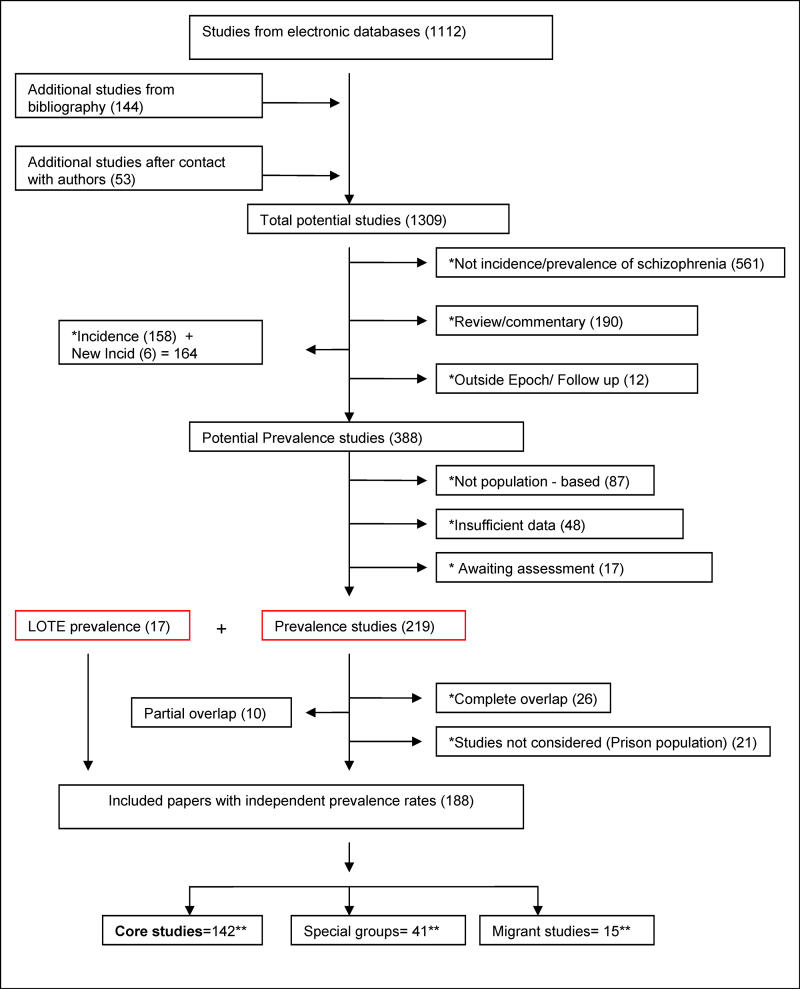
- The review identified 1,721 prevalence estimates from 188 studies drawn from 46 countries, based on an estimated 154,140 potentially overlapping prevalent cases; there were 132 core studies, 15 migrant studies, and 41 studies of other special groups.
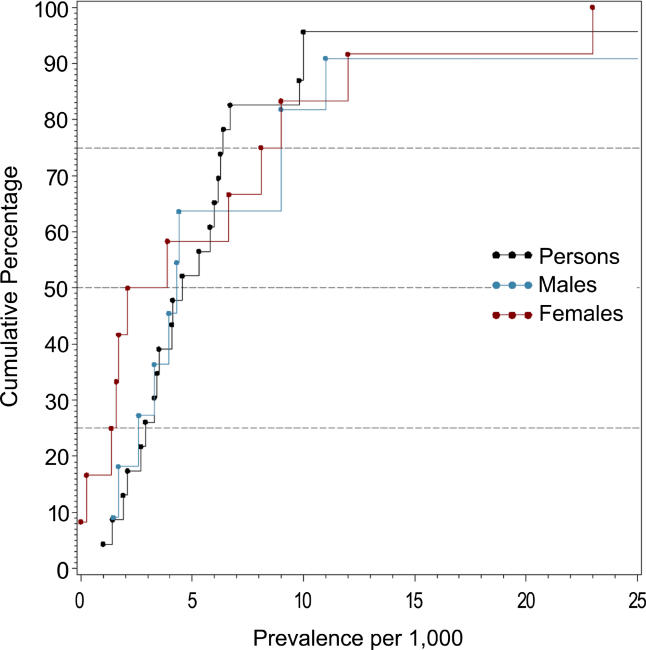
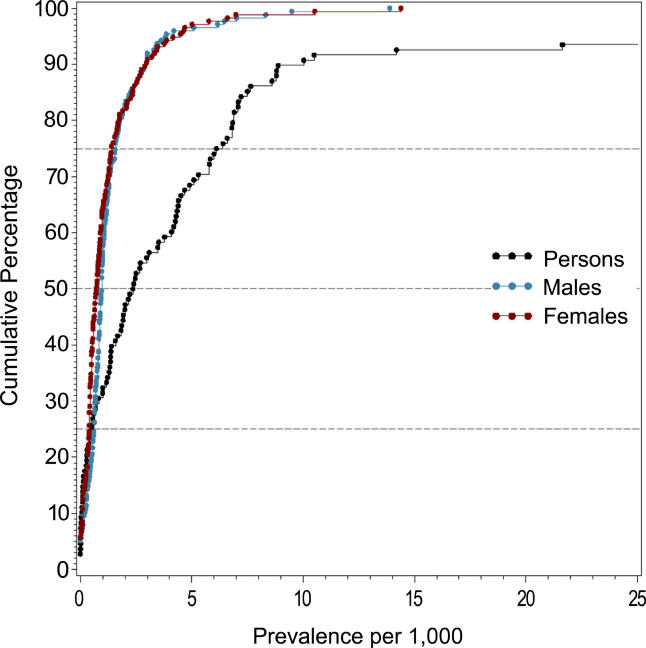
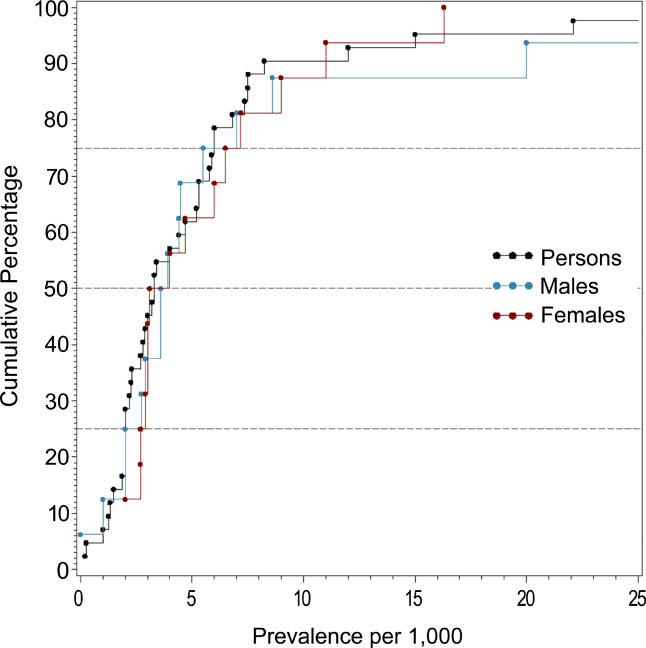
- Median prevalence per 1,000 persons was 4.6 for point prevalence (10%–90% quantiles 1.9–10.0), 3.3 for period prevalence (1.3–8.2), 4.0 for lifetime prevalence (1.8–11.6 in the results text), and 7.2 for lifetime morbid risk (3.1–27.1).
- There was no significant difference between males and females (F 1,72 = 0.68, p = 0.41; male:female median ratio 1.11, 10%–90% quantiles 0.50–1.70) or between urban, rural, and mixed sites (F 2,235 = 1.63, p = 0.20).
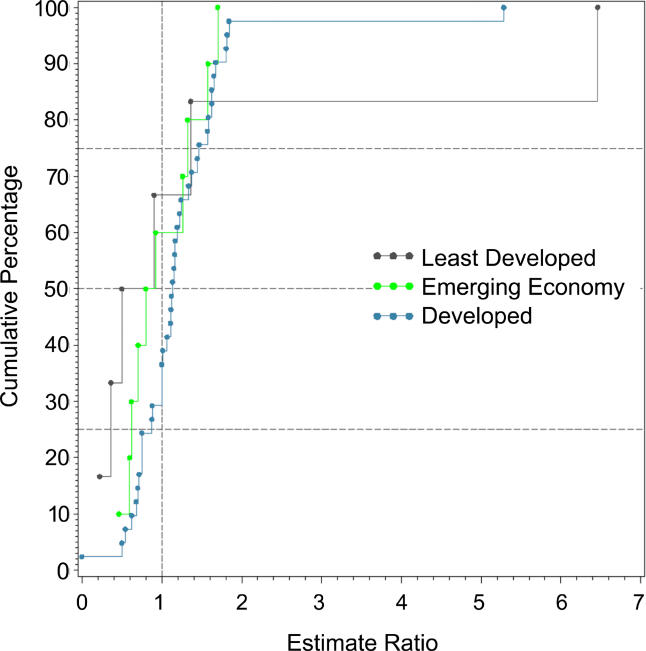
- Migrant status was associated with higher prevalence: median migrant:native-born ratio 1.84 (10%–90% quantiles 0.86–6.41; F 1,2 = 5.57, p = 0.04). Prevalence was significantly lower in “least developed” countries than in “emerging” and “developed” sites (p = 0.04), and higher-quality studies had significantly higher estimates (highest versus lowest quality scores, p = 0.02).
Methods
- Systematic review following MOOSE guidelines; studies with original prevalence data published January 1965–December 2002 were identified by searching MEDLINE, PsychINFO, EMBASE, and LILACS, checking references, and contacting authors; prison/forensic and genetic family studies were excluded.
- Estimates were sorted with sequential filters into core, migrant, and other special groups, and into point, period, lifetime, lifetime morbid risk, not otherwise specified, and inpatient-census-derived types; a “most informative” rule selected discrete estimates from overlapping studies.
- Analyses used cumulative plots and quantiles, with SAS proc univariate and proc mixed to control for within-study variation; combined prevalence estimates were used for planned sensitivity analyses, with Bonferroni correction for post hoc comparisons.
Limitations
- The authors state that they may have missed studies or made data entry errors; filtering and extraction rules were necessarily ad hoc; combined prevalence estimates were not based on discrete data (8 of 94 studies contributed more than one prevalence type); standard errors could be imputed for only 26% of estimates; and the mixed urban/rural category was likely heterogeneous.
- The authors also caution against excessive data analyses and note that contributing studies were not designed to test many hypotheses examined in the review.
- Evident from the text: no formal pooled meta-analysis was performed because of heterogeneity and limited confidence limits, and the migrant analysis was restricted to five papers and 22 prevalence ratios after exclusions.
Model-written summary. Check it against the paper before relying on it.
Integrity signals
Registry
Cites
Statistics
Figures
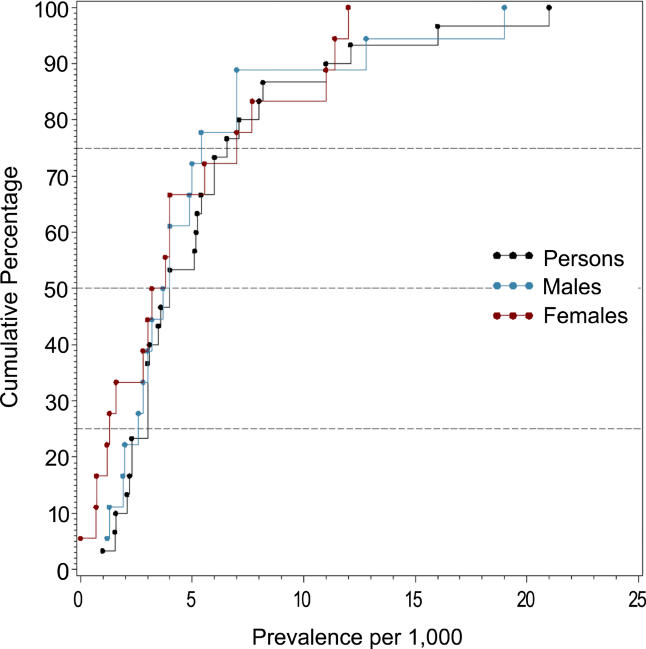
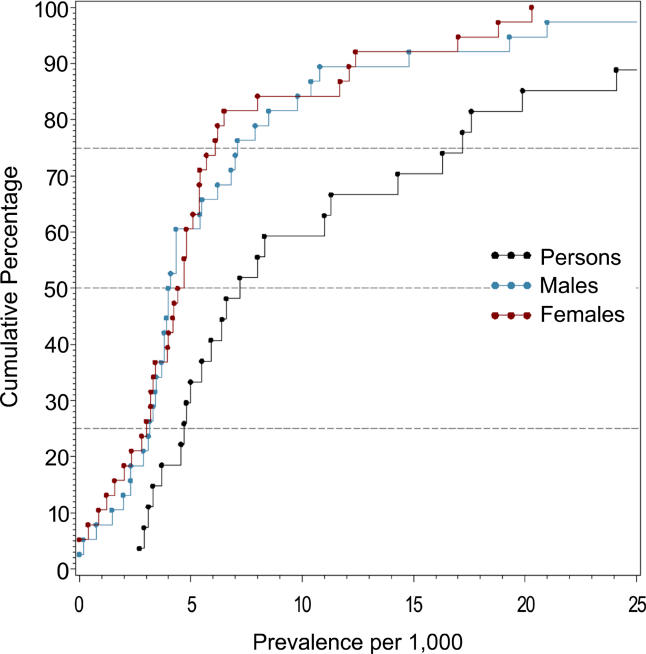
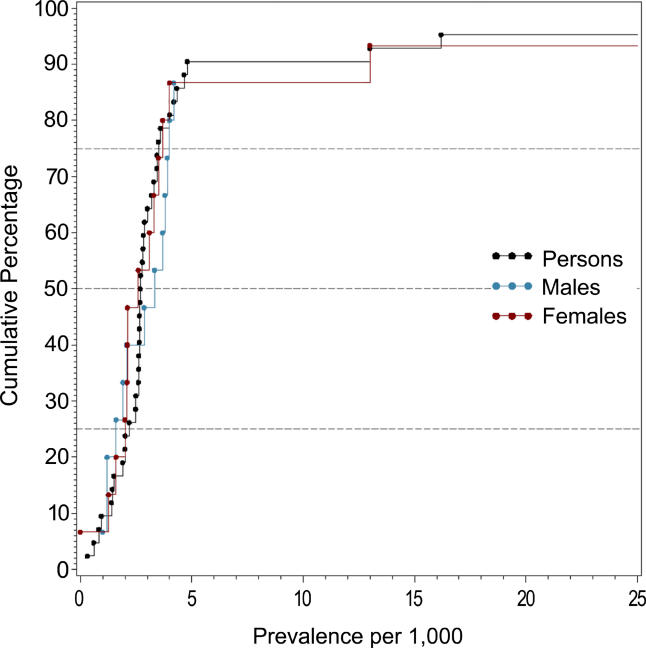
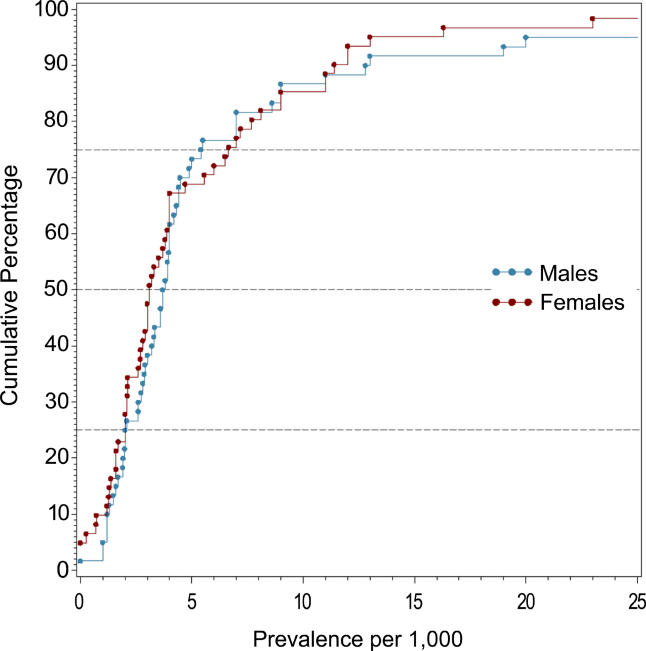
Verification
Claims the paper makes
57 Own result · 28 Not checked yet · 14 Own interpretation · 10 Own method · 1 No basis given
A result the paper reports from its own data — it cites no other source for it, so there is none to check. The quote shows it is in the paper.
In the paper
“Of the 132 core studies, we identified 21 studies for point prevalence, 34 studies for period prevalence, and 24 studies for lifetime prevalence.”
§ A Systematic Review of the Prevalence of Schizophrenia > Results > The “Epidemiology” of Prevalence Estimates
plain- Asserted: passes — The authors put it forward as true.
- Checkable: passes — It can be checked against evidence.
- Load-bearing: unclear — It is unclear whether the paper’s conclusions depend on it.
- Based: passes — The paper gives a reason why it holds.
A result the paper reports from its own data — it cites no other source for it, so there is none to check. The quote shows it is in the paper.
In the paper
“The median lifetime prevalence for persons (based on 29 estimates) was 4.0 per 1,000, and the 10% and 90% quantiles ranged from 1.8 to 11.6 per 1,000 (a 6.4-fold difference).”
§ A Systematic Review of the Prevalence of Schizophrenia > Results > The Distribution of Prevalence Estimates
plain- Asserted: passes — The authors put it forward as true.
- Checkable: passes — It can be checked against evidence.
- Load-bearing: passes — The paper’s conclusions depend on it.
- Based: passes — The paper gives a reason why it holds.
A result the paper reports from its own data — it cites no other source for it, so there is none to check. The quote shows it is in the paper.
In the paper
“Four studies [59,120,169,224] reported prevalence only within narrow age strata without providing an overall rate.”
§ A Systematic Review of the Prevalence of Schizophrenia > Results > The “Epidemiology” of Prevalence Estimates
plain- Asserted: passes — The authors put it forward as true.
- Checkable: passes — It can be checked against evidence.
- Load-bearing: unclear — It is unclear whether the paper’s conclusions depend on it.
- Based: passes — The paper gives a reason why it holds.
A result the paper reports from its own data — it cites no other source for it, so there is none to check. The quote shows it is in the paper.
In the paper
“The median values per 1,000 persons (10%–90% quantiles) for the distributions for point, period, lifetime, and lifetime morbid risk were 4.6 (1.9–10.0), 3.3 (1.3–8.2), 4.0 (1.6–12.1), and 7.2 (3.1–27.1), respectively.”
§ A Systematic Review of the Prevalence of Schizophrenia > Abstract > Methods and Findings
plainn = 154,140- Asserted: passes — The authors put it forward as true.
- Checkable: passes — It can be checked against evidence.
- Load-bearing: passes — The paper’s conclusions depend on it.
- Based: passes — The paper gives a reason why it holds.
In the paper
“One study, which was allocated to “other special groups,” did provide confidence limits [29].”
§ A Systematic Review of the Prevalence of Schizophrenia > Methods > Presentation and Analyses of the Data
What the sources say
- Not checked yetcites [29] Nimgaonkar, 2000, Am J Psychiatry source
plain- Asserted: passes — The authors put it forward as true.
- Checkable: passes — It can be checked against evidence.
- Load-bearing: unclear — It is unclear whether the paper’s conclusions depend on it.
- Based: passes — The paper gives a reason why it holds.
A result the paper reports from its own data — it cites no other source for it, so there is none to check. The quote shows it is in the paper.
In the paper
“These estimates were drawn from 46 countries, and were based on an estimated 154,140 potentially overlapping prevalent cases.”
- Also stated in: § The “Epidemiology” of Prevalence Estimates · plain
“These studies provided 1,721 estimates and were drawn from 46 countries.”
§ A Systematic Review of the Prevalence of Schizophrenia > Abstract > Methods and Findings
plainn = 154,140- Asserted: passes — The authors put it forward as true.
- Checkable: passes — It can be checked against evidence.
- Load-bearing: unclear — It is unclear whether the paper’s conclusions depend on it.
- Based: passes — The paper gives a reason why it holds.
- Also stated in: § The “Epidemiology” of Prevalence Estimates · plain
A result the paper reports from its own data — it cites no other source for it, so there is none to check. The quote shows it is in the paper.
In the paper
“Of the 132 core studies, we identified 21 studies for point prevalence, 34 studies for period prevalence, and 24 studies for lifetime prevalence.”
§ A Systematic Review of the Prevalence of Schizophrenia > Results > The “Epidemiology” of Prevalence Estimates
plain- Asserted: passes — The authors put it forward as true.
- Checkable: passes — It can be checked against evidence.
- Load-bearing: unclear — It is unclear whether the paper’s conclusions depend on it.
- Based: passes — The paper gives a reason why it holds.
A result the paper reports from its own data — it cites no other source for it, so there is none to check. The quote shows it is in the paper.
In the paper
“Based on combined prevalence estimates, we found no significant difference (a) between males and females, or (b) between urban, rural, and mixed sites.”
§ A Systematic Review of the Prevalence of Schizophrenia > Abstract > Methods and Findings
plainn = 154,140- Asserted: passes — The authors put it forward as true.
- Checkable: passes — It can be checked against evidence.
- Load-bearing: passes — The paper’s conclusions depend on it.
- Based: passes — The paper gives a reason why it holds.
A result the paper reports from its own data — it cites no other source for it, so there is none to check. The quote shows it is in the paper.
In the paper
“Studies that scored higher on a quality score had significantly higher prevalence estimates (p = 0.02).”
§ A Systematic Review of the Prevalence of Schizophrenia > Abstract > Methods and Findings
plaincorrelational- Asserted: passes — The authors put it forward as true.
- Checkable: passes — It can be checked against evidence.
- Load-bearing: unclear — It is unclear whether the paper’s conclusions depend on it.
- Based: passes — The paper gives a reason why it holds.
A result the paper reports from its own data — it cites no other source for it, so there is none to check. The quote shows it is in the paper.
In the paper
“When sites were grouped by economic status, prevalence estimates from “least developed” countries were significantly lower than those from both “emerging” and “developed” sites (p = 0.04).”
§ A Systematic Review of the Prevalence of Schizophrenia > Abstract > Methods and Findings
plaincorrelationaln = 154,140- Asserted: passes — The authors put it forward as true.
- Checkable: passes — It can be checked against evidence.
- Load-bearing: passes — The paper’s conclusions depend on it.
- Based: passes — The paper gives a reason why it holds.
- Probably not a substantial claim. 29
- It may state two separate claims as one. 21
- The quote only partly states this claim. 1
A result the paper reports from its own data — it cites no other source for it, so there is none to check. The quote shows it is in the paper.
In the paper
“We identified 132 core studies, 15 migrant studies, and 41 studies based on other special groups.”
- Also stated in: § The “Epidemiology” of Prevalence Estimates · plain
“There were 132 core studies, 15 migrant studies (of which three overlap with discrete core), and 41 studies that reported the prevalence of schizophrenia in other special groups.”
§ A Systematic Review of the Prevalence of Schizophrenia > Abstract > Methods and Findings
plain- Asserted: passes — The authors put it forward as true.
- Checkable: passes — It can be checked against evidence.
- Load-bearing: fails — The paper’s conclusions may not depend on it.
- Based: passes — The paper gives a reason why it holds.
Probably not a substantial claim. The paper’s conclusions may not depend on it.
- Also stated in: § The “Epidemiology” of Prevalence Estimates · plain
A result the paper reports from its own data — it cites no other source for it, so there is none to check. The quote shows it is in the paper.
In the paper
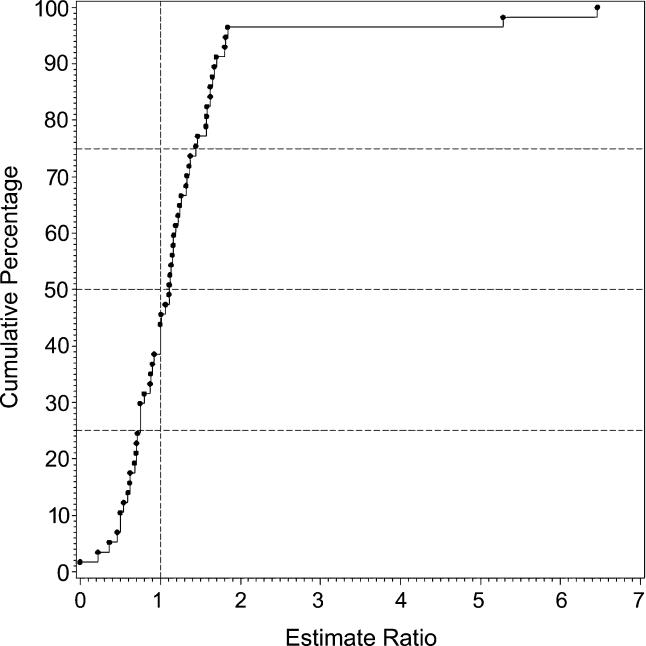
“The prevalence of schizophrenia in migrants was higher compared to native-born individuals: the migrant-to-native-born ratio median (10%–90% quantile) was 1.8 (0.9–6.4).”
§ A Systematic Review of the Prevalence of Schizophrenia > Abstract > Methods and Findings
plaincorrelational- Asserted: passes — The authors put it forward as true.
- Checkable: passes — It can be checked against evidence.
- Load-bearing: passes — The paper’s conclusions depend on it.
- Based: passes — The paper gives a reason why it holds.
It may state two separate claims as one.
A result the paper reports from its own data — it cites no other source for it, so there is none to check. The quote shows it is in the paper.
In the paper
“The electronic search identified 1,112 papers (85% of the total papers included in the study), while manual reference checking identified an additional 142 references (11%).”
§ A Systematic Review of the Prevalence of Schizophrenia > Results > The “Epidemiology” of Prevalence Estimates
plain- Asserted: passes — The authors put it forward as true.
- Checkable: passes — It can be checked against evidence.
- Load-bearing: fails — The paper’s conclusions may not depend on it.
- Based: passes — The paper gives a reason why it holds.
Probably not a substantial claim. The paper’s conclusions may not depend on it.
A result the paper reports from its own data — it cites no other source for it, so there is none to check. The quote shows it is in the paper.
In the paper
“These estimates were drawn from 46 countries, and were based on an estimated 154,140 potentially overlapping prevalent cases.”
- Also stated in: § The “Epidemiology” of Prevalence Estimates · hedged
“The prevalence estimates were based on an estimated total of 154,140 potentially overlapping cases.”
§ A Systematic Review of the Prevalence of Schizophrenia > Abstract > Methods and Findings
hedgedn = 154,140- Asserted: passes — The authors put it forward as true.
- Checkable: passes — It can be checked against evidence.
- Load-bearing: fails — The paper’s conclusions may not depend on it.
- Based: passes — The paper gives a reason why it holds.
Probably not a substantial claim. The paper’s conclusions may not depend on it.
- Also stated in: § The “Epidemiology” of Prevalence Estimates · hedged
A result the paper reports from its own data — it cites no other source for it, so there is none to check. The quote shows it is in the paper.
In the paper
“However, we were able to impute standard errors for only 26% of the prevalence estimates, which were drawn from less than half (45%) of the discrete core studies.”
§ A Systematic Review of the Prevalence of Schizophrenia > Methods > Presentation and Analyses of the Data
plain- Asserted: passes — The authors put it forward as true.
- Checkable: passes — It can be checked against evidence.
- Load-bearing: passes — The paper’s conclusions depend on it.
- Based: passes — The paper gives a reason why it holds.
It may state two separate claims as one.
A result the paper reports from its own data — it cites no other source for it, so there is none to check. The quote shows it is in the paper.
In the paper
“We identified 132 core studies, 15 migrant studies, and 41 studies based on other special groups.”
- Also stated in: § The “Epidemiology” of Prevalence Estimates · plain
“There were 132 core studies, 15 migrant studies (of which three overlap with discrete core), and 41 studies that reported the prevalence of schizophrenia in other special groups.”
§ A Systematic Review of the Prevalence of Schizophrenia > Abstract > Methods and Findings
plain- Asserted: passes — The authors put it forward as true.
- Checkable: passes — It can be checked against evidence.
- Load-bearing: fails — The paper’s conclusions may not depend on it.
- Based: passes — The paper gives a reason why it holds.
Probably not a substantial claim. The paper’s conclusions may not depend on it.
- Also stated in: § The “Epidemiology” of Prevalence Estimates · plain
A result the paper reports from its own data — it cites no other source for it, so there is none to check. The quote shows it is in the paper.
In the paper
“The 132 core studies provided from one to 13 prevalence estimates per study.”
§ A Systematic Review of the Prevalence of Schizophrenia > Results > The “Epidemiology” of Prevalence Estimates
plainn = 154,140- Asserted: passes — The authors put it forward as true.
- Checkable: passes — It can be checked against evidence.
- Load-bearing: fails — The paper’s conclusions may not depend on it.
- Based: passes — The paper gives a reason why it holds.
Probably not a substantial claim. The paper’s conclusions may not depend on it.
A result the paper reports from its own data — it cites no other source for it, so there is none to check. The quote shows it is in the paper.
In the paper
“There were nine studies that reported LMR.”
§ A Systematic Review of the Prevalence of Schizophrenia > Results > The “Epidemiology” of Prevalence Estimates
plain- Asserted: passes — The authors put it forward as true.
- Checkable: passes — It can be checked against evidence.
- Load-bearing: fails — The paper’s conclusions may not depend on it.
- Based: passes — The paper gives a reason why it holds.
Probably not a substantial claim. The paper’s conclusions may not depend on it.
A result the paper reports from its own data — it cites no other source for it, so there is none to check. The quote shows it is in the paper.
In the paper
“We identified 98 studies that were published in languages other than English.”
§ A Systematic Review of the Prevalence of Schizophrenia > Results > The “Epidemiology” of Prevalence Estimates
plain- Asserted: passes — The authors put it forward as true.
- Checkable: passes — It can be checked against evidence.
- Load-bearing: fails — The paper’s conclusions may not depend on it.
- Based: passes — The paper gives a reason why it holds.
Probably not a substantial claim. The paper’s conclusions may not depend on it.
A result the paper reports from its own data — it cites no other source for it, so there is none to check. The quote shows it is in the paper.
In the paper
“We received responses from 31 authors (see Acknowledgments for full list), who provided an additional 53 references (4%).”
§ A Systematic Review of the Prevalence of Schizophrenia > Results > The “Epidemiology” of Prevalence Estimates
plain- Asserted: passes — The authors put it forward as true.
- Checkable: passes — It can be checked against evidence.
- Load-bearing: fails — The paper’s conclusions may not depend on it.
- Based: passes — The paper gives a reason why it holds.
Probably not a substantial claim. The paper’s conclusions may not depend on it.
A result the paper reports from its own data — it cites no other source for it, so there is none to check. The quote shows it is in the paper.
In the paper
“The electronic search identified 1,112 papers (85% of the total papers included in the study), while manual reference checking identified an additional 142 references (11%).”
§ A Systematic Review of the Prevalence of Schizophrenia > Results > The “Epidemiology” of Prevalence Estimates
plain- Asserted: passes — The authors put it forward as true.
- Checkable: passes — It can be checked against evidence.
- Load-bearing: fails — The paper’s conclusions may not depend on it.
- Based: passes — The paper gives a reason why it holds.
Probably not a substantial claim. The paper’s conclusions may not depend on it.
A result the paper reports from its own data — it cites no other source for it, so there is none to check. The quote shows it is in the paper.
In the paper
“After translation 17 of these studies were included in this review.”
§ A Systematic Review of the Prevalence of Schizophrenia > Results > The “Epidemiology” of Prevalence Estimates
plain- Asserted: passes — The authors put it forward as true.
- Checkable: passes — It can be checked against evidence.
- Load-bearing: fails — The paper’s conclusions may not depend on it.
- Based: passes — The paper gives a reason why it holds.
Probably not a substantial claim. The paper’s conclusions may not depend on it.
A result the paper reports from its own data — it cites no other source for it, so there is none to check. The quote shows it is in the paper.
In the paper
“The median period prevalence for persons (based on 42 estimates) was 3.3 per 1,000, and the 10% and 90% quantiles ranged from 1.3 to 8.2 per 1,000 (a 6.5-fold difference).”
§ A Systematic Review of the Prevalence of Schizophrenia > Results > The Distribution of Prevalence Estimates
plain- Asserted: passes — The authors put it forward as true.
- Checkable: passes — It can be checked against evidence.
- Load-bearing: passes — The paper’s conclusions depend on it.
- Based: passes — The paper gives a reason why it holds.
It may state two separate claims as one.
A result the paper reports from its own data — it cites no other source for it, so there is none to check. The quote shows it is in the paper.
In the paper
“We identified 132 core studies, 15 migrant studies, and 41 studies based on other special groups.”
- Also stated in: § The “Epidemiology” of Prevalence Estimates · plain
“There were 132 core studies, 15 migrant studies (of which three overlap with discrete core), and 41 studies that reported the prevalence of schizophrenia in other special groups.”
§ A Systematic Review of the Prevalence of Schizophrenia > Abstract > Methods and Findings
plain- Asserted: passes — The authors put it forward as true.
- Checkable: passes — It can be checked against evidence.
- Load-bearing: fails — The paper’s conclusions may not depend on it.
- Based: passes — The paper gives a reason why it holds.
Probably not a substantial claim. The paper’s conclusions may not depend on it.
- Also stated in: § The “Epidemiology” of Prevalence Estimates · plain
A result the paper reports from its own data — it cites no other source for it, so there is none to check. The quote shows it is in the paper.
In the paper
“As predicted, prevalence estimates for migrant groups tend to be higher than estimates for native-born populations.”
§ A Systematic Review of the Prevalence of Schizophrenia > Discussion > Migrant Status and the Prevalence of Schizophrenia
hedgedcorrelational- Asserted: passes — The authors put it forward as true.
- Checkable: passes — It can be checked against evidence.
- Load-bearing: passes — The paper’s conclusions depend on it.
- Based: passes — The paper gives a reason why it holds.
The quote only partly states this claim.
A result the paper reports from its own data — it cites no other source for it, so there is none to check. The quote shows it is in the paper.
In the paper
“Furthermore, the median prevalence estimates for emerging economies are numerically higher than those for the richest countries. While not statistically significant, the results did identify many prevalence studies from the developing world where females outnumbered males.”
§ A Systematic Review of the Prevalence of Schizophrenia > Discussion > Economic Status and Schizophrenia
plain- Asserted: passes — The authors put it forward as true.
- Checkable: passes — It can be checked against evidence.
- Load-bearing: unclear — It is unclear whether the paper’s conclusions depend on it.
- Based: passes — The paper gives a reason why it holds.
It may state two separate claims as one.
The paper states this without a source or data behind it here, so there is nothing to check it against. The quote shows it is in the paper.
In the paper
“Two of the prevalence types (LMR and inpatient-census-derived data) had distributions for persons that were higher than distributions for both males and females separately.”
§ A Systematic Review of the Prevalence of Schizophrenia > Discussion > Caveats
plaincorrelational- Asserted: passes — The authors put it forward as true.
- Checkable: passes — It can be checked against evidence.
- Load-bearing: fails — The paper’s conclusions may not depend on it.
- Based: passes — The paper gives a reason why it holds.
Probably not a substantial claim. The paper’s conclusions may not depend on it.
A result the paper reports from its own data — it cites no other source for it, so there is none to check. The quote shows it is in the paper.
In the paper
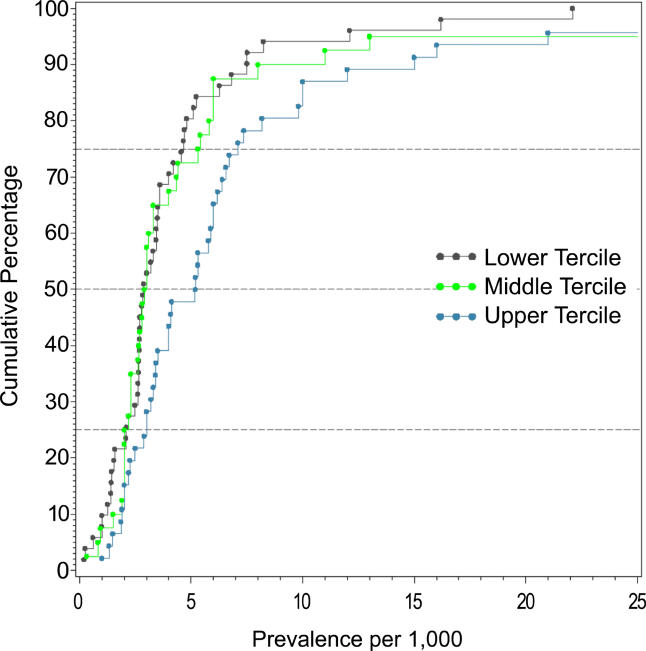
“When the combined prevalence estimates for persons were divided into quality score terciles, the prevalence estimate distributions were significantly different (F 2,105 = 4.79, p = 0.01), with the highest quality studies reporting significantly higher prevalence estimates than the other two terciles (highest versus lowest quality scores, p = 0.02) (Table 13; Figure 14).”
§ A Systematic Review of the Prevalence of Schizophrenia > Results > Quality Score
plaincorrelational- Asserted: passes — The authors put it forward as true.
- Checkable: passes — It can be checked against evidence.
- Load-bearing: unclear — It is unclear whether the paper’s conclusions depend on it.
- Based: passes — The paper gives a reason why it holds.
It may state two separate claims as one.
A result the paper reports from its own data — it cites no other source for it, so there is none to check. The quote shows it is in the paper.
In the paper
“Based on 22 prevalence ratios, the median migrant:native-born prevalence ratio was 1.84 and the 10% and 90% quantiles were 0.86 to 6.41 (approximately a 7.5-fold difference) (see Table 10; Figure 11).”
§ A Systematic Review of the Prevalence of Schizophrenia > Results > Migrant Status
plaincorrelational- Asserted: passes — The authors put it forward as true.
- Checkable: passes — It can be checked against evidence.
- Load-bearing: passes — The paper’s conclusions depend on it.
- Based: passes — The paper gives a reason why it holds.
It may state two separate claims as one.
A result the paper reports from its own data — it cites no other source for it, so there is none to check. The quote shows it is in the paper.
In the paper
“The median LMR for persons (based on 27 estimates) was 7.2 per 1,000, and the 10% and 90% quantiles ranged from 3.1 to 27.1 per 1,000 (a 8.7-fold difference) (see Table 6).”
§ A Systematic Review of the Prevalence of Schizophrenia > Results > The Distribution of Prevalence Estimates
plain- Asserted: passes — The authors put it forward as true.
- Checkable: passes — It can be checked against evidence.
- Load-bearing: unclear — It is unclear whether the paper’s conclusions depend on it.
- Based: passes — The paper gives a reason why it holds.
It may state two separate claims as one.
A result the paper reports from its own data — it cites no other source for it, so there is none to check. The quote shows it is in the paper.
In the paper
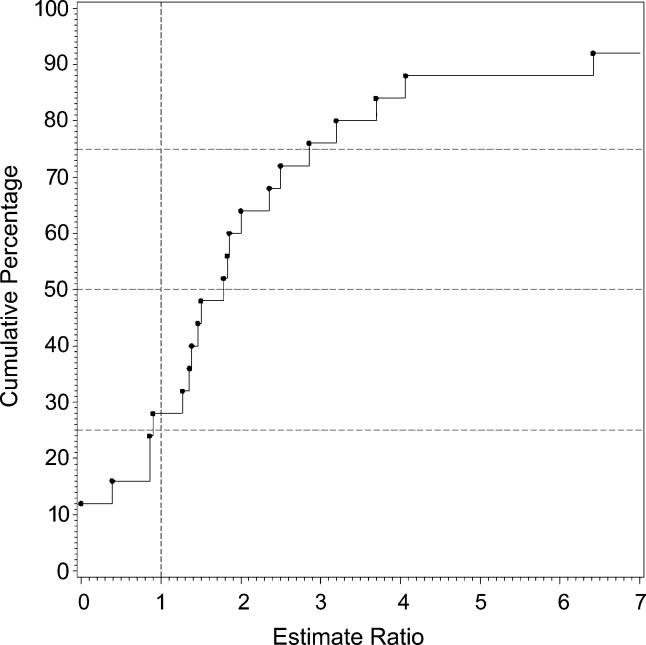
“For the male:female estimate ratio (based on 57 ratios), the median value was 1.11, and the 10% and 90% quantiles were 0.50 to 1.70 (approximately a 3.4-fold difference) (see Figure 9).”
§ A Systematic Review of the Prevalence of Schizophrenia > Results > Male Versus Female Prevalence
plain- Asserted: passes — The authors put it forward as true.
- Checkable: passes — It can be checked against evidence.
- Load-bearing: unclear — It is unclear whether the paper’s conclusions depend on it.
- Based: passes — The paper gives a reason why it holds.
It may state two separate claims as one.
A result the paper reports from its own data — it cites no other source for it, so there is none to check. The quote shows it is in the paper.
In the paper
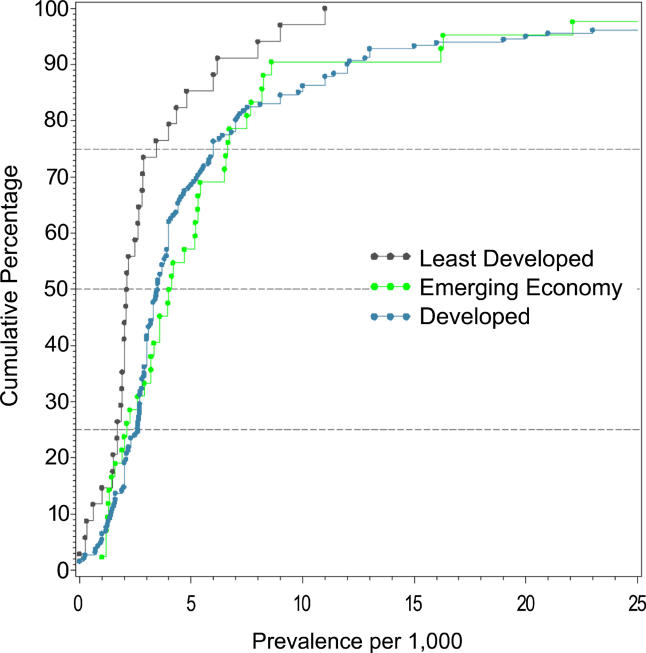
“When divided by this criterion, the prevalence estimate distributions were significantly different (F 2,85 = 3.57, p = 0.03), with the difference attributed to the lower prevalence estimate distribution for the less developed economies (developed versus least developed, F 1,74 = 6.55, p = 0.04).”
§ A Systematic Review of the Prevalence of Schizophrenia > Results > Economic Status of Sites
plaincorrelational- Asserted: passes — The authors put it forward as true.
- Checkable: passes — It can be checked against evidence.
- Load-bearing: unclear — It is unclear whether the paper’s conclusions depend on it.
- Based: passes — The paper gives a reason why it holds.
It may state two separate claims as one.
A result the paper reports from its own data — it cites no other source for it, so there is none to check. The quote shows it is in the paper.
In the paper
“There is a wealth of data available on the prevalence of schizophrenia—a total of 1,721 estimates from 188 studies were identified in this systematic review. These estimates were drawn from 46 countries, and were based on an estimated 154,140 potentially overlapping prevalent cases.”
§ A Systematic Review of the Prevalence of Schizophrenia > Discussion
hedgedn = 154,140- Asserted: passes — The authors put it forward as true.
- Checkable: passes — It can be checked against evidence.
- Load-bearing: unclear — It is unclear whether the paper’s conclusions depend on it.
- Based: passes — The paper gives a reason why it holds.
It may state two separate claims as one.
A result the paper reports from its own data — it cites no other source for it, so there is none to check. The quote shows it is in the paper.
In the paper
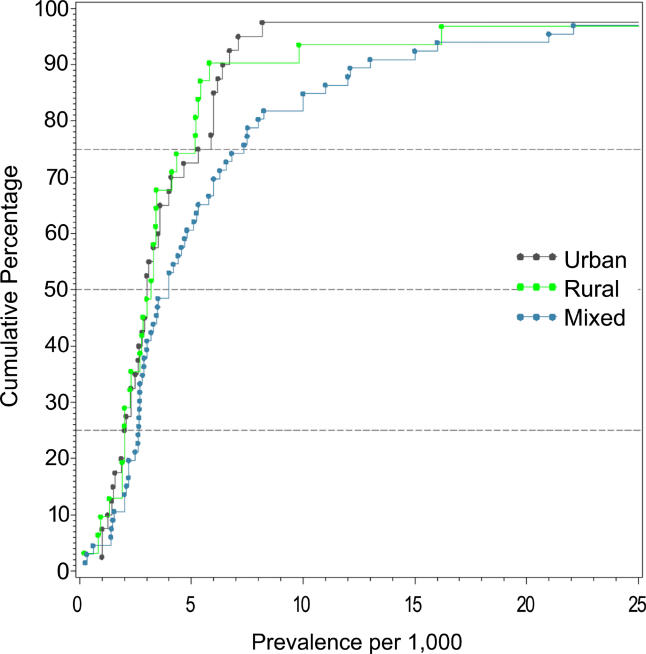
“While the mixed urban/rural estimates were higher than urban and rural rates, this difference was not statistically significant (F 2,235 = 1.63, p = 0.20), nor were urban estimates significantly different from rural estimates (F 1,120 = 0.95, p = 0.33).”
§ A Systematic Review of the Prevalence of Schizophrenia > Results > Urbanicity of Sites
plain- Asserted: passes — The authors put it forward as true.
- Checkable: passes — It can be checked against evidence.
- Load-bearing: unclear — It is unclear whether the paper’s conclusions depend on it.
- Based: passes — The paper gives a reason why it holds.
It may state two separate claims as one.
A result the paper reports from its own data — it cites no other source for it, so there is none to check. The quote shows it is in the paper.
In the paper
“Based on the distribution of these prevalence estimates, the median prevalence was 2.7 per 1,000 for persons, and the 10% and 90% quantiles ranged from 1.4 to 4.8 per 1,000 (a 3.4-fold difference).”
§ A Systematic Review of the Prevalence of Schizophrenia > Results > The Distribution of Prevalence Estimates
plain- Asserted: passes — The authors put it forward as true.
- Checkable: passes — It can be checked against evidence.
- Load-bearing: unclear — It is unclear whether the paper’s conclusions depend on it.
- Based: passes — The paper gives a reason why it holds.
It may state two separate claims as one.
None of the sources cited for this claim have been checked yet.
In the paper
“However, we note that prevalence estimates in some homeless populations were very high—300 per 1,000 persons for Sydney homeless individuals [194] and 131 per 1,000 persons for Los Angeles homeless individuals [118].”
§ A Systematic Review of the Prevalence of Schizophrenia > Results > Other Special Group Studies
What the sources say
plain- Asserted: passes — The authors put it forward as true.
- Checkable: passes — It can be checked against evidence.
- Load-bearing: unclear — It is unclear whether the paper’s conclusions depend on it.
- Based: passes — The paper gives a reason why it holds.
It may state two separate claims as one.
In the paper
“While the incidence of the disorder is relatively low (median value 15.2 per 100,000 persons per year) [1], the condition is one of the major contributors to the global burden of disease [2].”
§ A Systematic Review of the Prevalence of Schizophrenia > Introduction
What the sources say
- Not checked yetcites [1] McGrath, 2004, BMC Med source
plain- Asserted: passes — The authors put it forward as true.
- Checkable: passes — It can be checked against evidence.
- Load-bearing: fails — The paper’s conclusions may not depend on it.
- Based: passes — The paper gives a reason why it holds.
Probably not a substantial claim. The paper’s conclusions may not depend on it.
In the paper
“(c) individuals in urban sites had a higher risk of developing schizophrenia than those in mixed urban/rural sites.”
§ A Systematic Review of the Prevalence of Schizophrenia > Introduction
What the sources say
- Not checked yetcites [1] McGrath, 2004, BMC Med source
plaincorrelational- Asserted: passes — The authors put it forward as true.
- Checkable: passes — It can be checked against evidence.
- Load-bearing: passes — The paper’s conclusions depend on it.
- Based: passes — The paper gives a reason why it holds.
Probably not a substantial claim.
In the paper
“This systematic review conforms to the guidelines outlined by the Meta-Analysis of Observational Studies in Epidemiology (MOOSE) recommendations [26].”
§ A Systematic Review of the Prevalence of Schizophrenia > Methods > Identification of Studies
What the sources say
- Not checked yetcites [26] Stroup, 2000, JAMA source
plain- Asserted: passes — The authors put it forward as true.
- Checkable: passes — It can be checked against evidence.
- Load-bearing: fails — The paper’s conclusions may not depend on it.
- Based: passes — The paper gives a reason why it holds.
Probably not a substantial claim. The paper’s conclusions may not depend on it.
In the paper
“In brief, we found that the incidence of schizophrenia varied widely between sites (persons, median = 15.2 per 100,000; 10%–90% quantiles = 7.7–43.0).”
§ A Systematic Review of the Prevalence of Schizophrenia > Introduction
What the sources say
- Not checked yetcites [1] McGrath, 2004, BMC Med source
plain- Asserted: passes — The authors put it forward as true.
- Checkable: passes — It can be checked against evidence.
- Load-bearing: passes — The paper’s conclusions depend on it.
- Based: passes — The paper gives a reason why it holds.
Probably not a substantial claim.
What the paper did — it cites no source for this, so there is none to check. The quote shows it is in the paper.
In the paper
“Thus, a key feature of this study is the application of sequential filters in order to identify discrete prevalence estimates.”
§ A Systematic Review of the Prevalence of Schizophrenia > Methods > Sorting Prevalence Estimates by the Application of Sequential Filters
plaindirect- Asserted: passes — The authors put it forward as true.
- Checkable: passes — It can be checked against evidence.
- Load-bearing: passes — The paper’s conclusions depend on it.
- Based: passes — The paper gives a reason why it holds.
It may state two separate claims as one.
What the paper did — it cites no source for this, so there is none to check. The quote shows it is in the paper.
In the paper
“When disagreements arose, these were resolved by consensus.”
§ A Systematic Review of the Prevalence of Schizophrenia > Methods > Data Extraction
plain- Asserted: passes — The authors put it forward as true.
- Checkable: passes — It can be checked against evidence.
- Load-bearing: fails — The paper’s conclusions may not depend on it.
- Based: passes — The paper gives a reason why it holds.
Probably not a substantial claim. The paper’s conclusions may not depend on it.
None of the sources cited for this claim have been checked yet.
In the paper
“The reviews of Odegaard [15], and Larsson and Sjogren [16] noted that, for low-incidence disorders such as schizophrenia, summation of age-specific incidence rates gives almost the same result as other more complicated methods of calculation [17].”
§ A Systematic Review of the Prevalence of Schizophrenia > Introduction > Ways to Measure the Prevalence of Schizophrenia
What the sources say
plain- Asserted: passes — The authors put it forward as true.
- Checkable: passes — It can be checked against evidence.
- Load-bearing: fails — The paper’s conclusions may not depend on it.
- Based: passes — The paper gives a reason why it holds.
Probably not a substantial claim. The paper’s conclusions may not depend on it.
What the paper did — it cites no source for this, so there is none to check. The quote shows it is in the paper.
In the paper
“we restricted the analyses to a limited set of planned sensitivity analyses, each with a priori directional hypotheses, and, for post hoc analyses, applied multiple comparison corrections to the nominal significance levels by a Bonferroni correction.”
§ A Systematic Review of the Prevalence of Schizophrenia > Methods > Presentation and Analyses of the Data
plain- Asserted: passes — The authors put it forward as true.
- Checkable: passes — It can be checked against evidence.
- Load-bearing: fails — The paper’s conclusions may not depend on it.
- Based: passes — The paper gives a reason why it holds.
Probably not a substantial claim. The paper’s conclusions may not depend on it. It may state two separate claims as one.
What the paper did — it cites no source for this, so there is none to check. The quote shows it is in the paper.
In the paper
“Two or more of the authors checked all data used in the analysis.”
§ A Systematic Review of the Prevalence of Schizophrenia > Methods > Data Extraction
plain- Asserted: passes — The authors put it forward as true.
- Checkable: passes — It can be checked against evidence.
- Load-bearing: fails — The paper’s conclusions may not depend on it.
- Based: passes — The paper gives a reason why it holds.
Probably not a substantial claim. The paper’s conclusions may not depend on it.
What the paper did — it cites no source for this, so there is none to check. The quote shows it is in the paper.
In the paper
“studies were given “quality points” based on operationalized features related to (a) optimal research design (e.g., higher scores for greater coverage, face-to-face interview versus chart diagnosis, and reliability of instruments), and (b) quality of reporting (e.g., provision of numerator and denominator, and description of diagnostic criteria).”
§ A Systematic Review of the Prevalence of Schizophrenia > Methods > Data Extraction
plain- Asserted: passes — The authors put it forward as true.
- Checkable: passes — It can be checked against evidence.
- Load-bearing: fails — The paper’s conclusions may not depend on it.
- Based: passes — The paper gives a reason why it holds.
Probably not a substantial claim. The paper’s conclusions may not depend on it.
In the paper
“The search methodology for this review was identical to that of our previous review paper on incidence of schizophrenia [1].”
§ A Systematic Review of the Prevalence of Schizophrenia > Methods > Identification of Studies
What the sources say
- Not checked yetcites [1] McGrath, 2004, BMC Med source
plain- Asserted: passes — The authors put it forward as true.
- Checkable: passes — It can be checked against evidence.
- Load-bearing: fails — The paper’s conclusions may not depend on it.
- Based: passes — The paper gives a reason why it holds.
Probably not a substantial claim. The paper’s conclusions may not depend on it.
A conclusion the paper draws from its own results — it cites no other source for it, so there is none to check. The quote shows it is in the paper.
In the paper
“While the incidence of schizophrenia is higher in urban than rural settings, this is not reflected in the overall prevalence data.”
§ A Systematic Review of the Prevalence of Schizophrenia > Discussion > Conclusions
plain- Asserted: passes — The authors put it forward as true.
- Checkable: passes — It can be checked against evidence.
- Load-bearing: passes — The paper’s conclusions depend on it.
- Based: passes — The paper gives a reason why it holds.
It may state two separate claims as one.
A conclusion the paper draws from its own results — it cites no other source for it, so there is none to check. The quote shows it is in the paper.
In the paper
“With respect to the studies included in the category “other special groups,” the estimates are not readily comparable, but it is interesting to note that these studies reported a wide range of prevalence estimates (e.g., high in homeless populations and low in certain religious groups).”
§ A Systematic Review of the Prevalence of Schizophrenia > Discussion > Quality Scores and Other Special Groups
plain- Asserted: passes — The authors put it forward as true.
- Checkable: passes — It can be checked against evidence.
- Load-bearing: unclear — It is unclear whether the paper’s conclusions depend on it.
- Based: passes — The paper gives a reason why it holds.
It may state two separate claims as one.
In the paper
“Our findings lend weight to the commentary by Ran and Yu-Hai Chen [25], drawing attention to the different features of schizophrenia in the developing world.”
§ A Systematic Review of the Prevalence of Schizophrenia > Discussion > Economic Status and Schizophrenia
What the sources say
- Not checked yetcites [25] Ran, 2004, Lancet source
hedgedcorrelational- Asserted: passes — The authors put it forward as true.
- Checkable: fails — It may be too vague to check against evidence.
- Load-bearing: fails — The paper’s conclusions may not depend on it.
- Based: passes — The paper gives a reason why it holds.
Probably not a substantial claim. It may be too vague to check against evidence. The paper’s conclusions may not depend on it.
In the paper
“however, the Diagnostic and Statistical Manual of Mental Disorders, fourth edition (DSM-IV) [3], reported that the lifetime prevalence of schizophrenia is “usually estimated to be between 0.5% and 1%.””
§ A Systematic Review of the Prevalence of Schizophrenia > Discussion
What the sources say
- Not checked yetcites [3]
hedged- Asserted: passes — The authors put it forward as true.
- Checkable: passes — It can be checked against evidence.
- Load-bearing: fails — The paper’s conclusions may not depend on it.
- Based: passes — The paper gives a reason why it holds.
Probably not a substantial claim. The paper’s conclusions may not depend on it.
In the paper
“Recently, a study from China examined whether this unexpected sex ratio was due to differential suicide rates in males with schizophrenia [24]; however, this did not seem to explain the female excess.”
§ A Systematic Review of the Prevalence of Schizophrenia > Discussion > Economic Status and Schizophrenia
What the sources say
- Not checked yetcites [24] Phillips, 2004, Lancet source
hedged- Asserted: passes — The authors put it forward as true.
- Checkable: passes — It can be checked against evidence.
- Load-bearing: unclear — It is unclear whether the paper’s conclusions depend on it.
- Based: passes — The paper gives a reason why it holds.
It may state two separate claims as one.
In the paper
“Because narrative reviews conclude that the course of the illness tends to be more severe in men than in women [235], we assumed that this would be reflected in a higher prevalence in males than females.”
§ A Systematic Review of the Prevalence of Schizophrenia > Discussion > Sex and Schizophrenia
What the sources say
- Not checked yetcites [235] Leung, 2000, Acta Psychiatr Scand Suppl source
hedgedcorrelational- Asserted: passes — The authors put it forward as true.
- Checkable: passes — It can be checked against evidence.
- Load-bearing: passes — The paper’s conclusions depend on it.
- Based: passes — The paper gives a reason why it holds.
Probably not a substantial claim.
What the paper did — it cites no source for this, so there is none to check. The quote shows it is in the paper.
In the paper
“Concerning the analyses for urbanicity, the estimates from mixed urban/rural studies are likely to be very heterogeneous. Indeed, we allocated studies to the mixed category if there was any possibility that rural sectors were included. This bias would have made any true difference between urban versus mixed urban/rural more difficult to detect.”
§ A Systematic Review of the Prevalence of Schizophrenia > Discussion > Caveats
hedgeddirect- Asserted: passes — The authors put it forward as true.
- Checkable: passes — It can be checked against evidence.
- Load-bearing: unclear — It is unclear whether the paper’s conclusions depend on it.
- Based: passes — The paper gives a reason why it holds.
It may state two separate claims as one.
A conclusion the paper draws from its own results — it cites no other source for it, so there is none to check. The quote shows it is in the paper.
In the paper
“The lack of coherence between (a) the sex differences found in the incidence of schizophrenia, (b) the presumed difference in course of illness, and (c) the identified lack of difference in prevalence warrants closer scrutiny.”
§ A Systematic Review of the Prevalence of Schizophrenia > Discussion > Sex and Schizophrenia
plain- Asserted: passes — The authors put it forward as true.
- Checkable: fails — It may be too vague to check against evidence.
- Load-bearing: passes — The paper’s conclusions depend on it.
- Based: passes — The paper gives a reason why it holds.
Probably not a substantial claim. It may be too vague to check against evidence.
None of the sources cited for this claim have been checked yet.
In the paper
“However, one in a hundred is an overestimate—our systematic review agrees with two previous reviews showing that the LMR for schizophrenia is between seven and eight per 1,000.”
§ A Systematic Review of the Prevalence of Schizophrenia > Discussion
What the sources say
- Not checked yetcites [232]
- Not checked yetcites [233]
plain- Asserted: passes — The authors put it forward as true.
- Checkable: passes — It can be checked against evidence.
- Load-bearing: passes — The paper’s conclusions depend on it.
- Based: passes — The paper gives a reason why it holds.
It may state two separate claims as one.
- The authors state this as an assumption: The oft-quoted statistic that schizophrenia affects about one in a hundred derives from LMR data.
What the paper did — it cites no source for this, so there is none to check. The quote shows it is in the paper.
In the paper
“Based on our experience with previous systematic reviews, we acknowledge that we may have missed studies and/or made data entry errors.”
§ A Systematic Review of the Prevalence of Schizophrenia > Discussion > Caveats
hedged- Asserted: passes — The authors put it forward as true.
- Checkable: passes — It can be checked against evidence.
- Load-bearing: fails — The paper’s conclusions may not depend on it.
- Based: passes — The paper gives a reason why it holds.
Probably not a substantial claim. The paper’s conclusions may not depend on it. It may state two separate claims as one.
None of the sources cited for this claim have been checked yet.
In the paper
“Furthermore, in the absence of clear guidelines on how to synthesize descriptive studies [26,237], many of the rules we used to filter studies and extract data were necessarily ad hoc.”
§ A Systematic Review of the Prevalence of Schizophrenia > Discussion > Caveats
What the sources say
plaindirect- Asserted: passes — The authors put it forward as true.
- Checkable: passes — It can be checked against evidence.
- Load-bearing: fails — The paper’s conclusions may not depend on it.
- Based: passes — The paper gives a reason why it holds.
Probably not a substantial claim. The paper’s conclusions may not depend on it.
A conclusion the paper draws from its own results — it cites no other source for it, so there is none to check. The quote shows it is in the paper.
In the paper
“Taken together with estimates on the incidence of schizophrenia (that is, the annual number of new cases), it is also clear that current treatments fail to cure most patients with schizophrenia.”
§ A Systematic Review of the Prevalence of Schizophrenia > Supporting Information > Patient Summary
boosteddirect- Asserted: passes — The authors put it forward as true.
- Checkable: passes — It can be checked against evidence.
- Load-bearing: fails — The paper’s conclusions may not depend on it.
- Based: passes — The paper gives a reason why it holds.
Probably not a substantial claim. The paper’s conclusions may not depend on it.
The authors state this as an assumption.
The course of schizophrenia does not vary according to migrant status.
“Assuming that the course of the illness does not vary according to migrant status, based on combined prevalence estimates for persons, we predicted that the prevalence of schizophrenia would be higher in migrants than in native-born individuals.”
The paper relies on this without support.
Studies that use comprehensive case ascertainment methods identify more cases than those that rely on fewer recruitment sources.
“For example, studies that use comprehensive case ascertainment methods (e.g., “door-knock” surveys, inpatient and outpatient records, general practitioner surveys, and/or surveys based on other community sources), should identify more cases than those that rely on fewer recruitment sources.”
The paper relies on this without support.
Prevalence estimates for a disease are not static across time or place.
“Based on first principles, there is no reason to assume that prevalence estimates for a disease remain static across time or place.”
The authors state this as an assumption.
The oft-quoted statistic that schizophrenia affects about one in a hundred derives from LMR data.
“It is reasonable to assume that the oft-quoted statistic that “schizophrenia affects about one in a hundred” derives from LMR data (see [234]).”
Claims other papers make about this one
Each is checked against this paper’s own text: does it say what the citing paper says it does?
The cited source says what the claim attributes to it.
In the citing paper
“up to 0.8% when only schizophrenia is reported [70]”
From The Prevalence of Mental Disorders among the Homeless in Western Countries: Systematic Review and Meta-Regression Analysis (2008) · cites this paper as [70]
The cited source says what the claim attributes to it.
In the citing paper
“A systematic review by Saha et al. (2005) found a lifetime morbidity risk of 7.2 per 1,000 persons; the 10% and 90% quantiles were 3.1 and 27.1, respectively.”
From Excess early mortality in schizophrenia. (2014) · cites this paper as Saha et al. 2005
In the citing paper
“Schizophrenia, a disease with very high heritability (inferred from twin studies) and for which very few replicated GWAS hits have been identified despite extensive scans, nevertheless shows such demographic influences as whether the parents live in rural or urban areas (disease rates are elevated in children born after migration to cities)62.”
From Rare and common variants: twenty arguments (2012) · cites this paper as [62]
Self-check
Percentages, sums and reported differences re-computed from the paper’s own numbers.
Each contradiction between two passages listed here was confirmed by an independent check.
Rated minor: it would not touch a result — a value no result rests on, a p-value that stays on the same side of the significance level, or a conflict that is clerical, resolved elsewhere in the paper, or outside its own findings.
In the paper
§ A Systematic Review of the Prevalence of Schizophrenia > Abstract > Methods and Findings
“The median values per 1,000 persons (10%–90% quantiles) for the distributions for point, period, lifetime, and lifetime morbid risk were 4.6 (1.9–10.0), 3.3 (1.3–8.2), 4.0 (1.6–12.1), and 7.2 (3.1–27.1), respectively.”
§ A Systematic Review of the Prevalence of Schizophrenia > Results > The Distribution of Prevalence Estimates
“The median lifetime prevalence for persons (based on 29 estimates) was 4.0 per 1,000, and the 10% and 90% quantiles ranged from 1.8 to 11.6 per 1,000 (a 6.4-fold difference).”
Rated minor: it would not touch a result — a value no result rests on, a p-value that stays on the same side of the significance level, or a conflict that is clerical, resolved elsewhere in the paper, or outside its own findings.
In the paper
§ A Systematic Review of the Prevalence of Schizophrenia > Discussion
“the present review found that the different types of prevalence estimates had from 3.4-fold (point) to 4.6-fold (period) variation.”
§ A Systematic Review of the Prevalence of Schizophrenia > Results > The Distribution of Prevalence Estimates
“The median point prevalence for persons (based on 23 estimates) was 4.6 per 1,000, and the 10% and 90% quantiles ranged from 1.9 to 10.0 per 1,000 (a 5-fold difference). The median period prevalence for persons (based on 42 estimates) was 3.3 per 1,000, and the 10% and 90% quantiles ranged from 1.3 to 8.2 per 1,000 (a 6.5-fold difference).”
Rated minor: it would not touch a result — a value no result rests on, a p-value that stays on the same side of the significance level, or a conflict that is clerical, resolved elsewhere in the paper, or outside its own findings.
In the paper
§ A Systematic Review of the Prevalence of Schizophrenia > Results > The “Epidemiology” of Prevalence Estimates
“The systematic review identified 188 studies that provided prevalence estimates [18,29,36–223]. These studies provided 1,721 estimates and were drawn from 46 countries. There were 132 core studies, 15 migrant studies (of which three overlap with discrete core), and 41 studies that reported the prevalence of schizophrenia in other special groups.”
§ A Systematic Review of the Prevalence of Schizophrenia > Results > The “Epidemiology” of Prevalence Estimates
“11 studies provided data for both core and migrant [n = 3] or both core and other special groups [n = 8]”
Rated minor: it would not touch a result — a value no result rests on, a p-value that stays on the same side of the significance level, or a conflict that is clerical, resolved elsewhere in the paper, or outside its own findings.
In the paper
“We identified 41 studies that reported the prevalence of schizophrenia in other special groups. These studies came from 14 countries: Australia (n = 4), Canada (n = 4), Denmark (n = 3), Finland (n = 1), Germany (n = 3), India (n = 2), Israel (n = 1), Japan (n = 3), Romania (n = 1), Spain (n = 1), Sweden (n = 2), Taiwan (n = 1), United Kingdom (n = 2), and United States (n = 5).”
§ A Systematic Review of the Prevalence of Schizophrenia > Results > Other Special Group Studies
Reported 41 · recomputed 33
Citations
Cites
Diagnostic and Statistical Manual of Mental Disorders
Williams, J. B. W., & First, M. B. (2013) · Oxford University Press eBooks · doi:10.1093/acrefore/9780199975839.013.104 · Cited by 109,845
Dermyshi, E., Wang, Y., Yan, C., Hong, W., Qiu, G., Gong, X., & Zhang, T. (2017) · Neonatology · doi:10.1159/000454668 · Cited by 24,586
Meta-analysis of Observational Studies in Epidemiology<SUBTITLE>A Proposal for Reporting</SUBTITLE>
Stroup, D. F. (2000) · JAMA · doi:10.1001/jama.283.15.2008 · Cited by 20,623
(1996) · Cited by 6,884
Cox, D. R., & Oakes, D. (2018) · Chapman & Hall/CRC eBooks · doi:10.1201/9781315137438 · Cited by 6,269
Social Class and Mental Illness
Hunt, R. G., Hollingshead, A. B., & Redlich, F. C. (1959) · The American Journal of Psychology · doi:10.2307/1420236 · Cited by 3,307
Epidemiologic Research: Principles and Quantitative Methods.
Mayer, L. S., Kleinbaum, D. G., Kupper, L. L., & Morgenstern, H. (1984) · Journal of the American Statistical Association · doi:10.2307/2288427 · Cited by 2,905
Meta-analysis: Principles and procedures
Egger, M., Smith, G. D., & Phillips, A. N. (1997) · BMJ · doi:10.1136/bmj.315.7121.1533 · Cited by 2,415
Serious mental disorder in 23 000 prisoners: a systematic review of 62 surveys
Fazel, S., & Danesh, J. (2002) · The Lancet · doi:10.1016/s0140-6736(02)07740-1 · Cited by 2,201
Jablensky, A., Sartorius, N., Ernberg, G., Anker, M., Korten, A., Cooper, J. E., Day, R., & Bertelsen, A. (1992) · Psychological Medicine. Monograph Supplement · doi:10.1017/s0264180100000904 · Cited by 1,769
Psychiatric disorders in America
Robins, L. N. (1991) · Medical Entomology and Zoology · Cited by 1,567
Schizophrenia and migration: A meta-analysis and review
Cantor-Graae, E., & Selten, J.-P. (2005) · American Journal of Psychiatry · doi:10.1176/appi.ajp.162.1.12 · Cited by 1,237
Bijl, R. V., Ravelli, A., & van Zessen, G. (1998) · Social Psychiatry and Psychiatric Epidemiology · doi:10.1007/s001270050098 · Cited by 1,216
Bhugra, D. (2004) · Acta Psychiatrica Scandinavica · doi:10.1046/j.0001-690x.2003.00246.x · Cited by 1,196
The Prodromal Phase of First-episode Psychosis: Past and Current Conceptualizations
Yung, A. R., & McGorry, P. D. (1996) · Schizophrenia Bulletin · doi:10.1093/schbul/22.2.353 · Cited by 1,168 · cited 1×
“], this is another example where the research community needs to review their belief systems in the face of data. It is reasonable to assume that lifetime prevalence estimates for schizophrenia would be higher than point estimates. Surprisingly, the data in this review do not support this assumption. While outside the…”
McGrath, J., Saha, S., Welham, J., El Saadi, O., MacCauley, C., & Chant, D. (2004) · BMC Medicine · doi:10.1186/1741-7015-2-13 · Cited by 1,072
Self-citationSartorius, N., Jablensky, A., Korten, A., Ernberg, G., Anker, M., Cooper, J. E., & Day, R. (1986) · Psychological Medicine · doi:10.1017/s0033291700011910 · Cited by 959
Sex Differences in the Risk of Schizophrenia: Evidence From Meta-analysis
Aleman, A., Kahn, R. S., & Selten, J.-P. (2003) · Archives of General Psychiatry · doi:10.1001/archpsyc.60.6.565 · Cited by 818
Sex differences in schizophrenia, a review of the literature
Dr. Alice Leung, M. D., & Psych., P. C. M. R. C. (2000) · Acta Psychiatrica Scandinavica · doi:10.1111/j.0065-1591.2000.0ap25.x · Cited by 761
Kendler, K. S. (1996) · Archives of General Psychiatry · doi:10.1001/archpsyc.1996.01830110060007 · Cited by 676
Meta-analysis: Potentials and promise
Egger, M., & Smith, G. D. (1997) · BMJ · doi:10.1136/bmj.315.7119.1371 · Cited by 646
Andrews, G., Issakidis, C., Sanderson, K., Corry, J., & Lapsley, H. (2004) · British Journal of Psychiatry · doi:10.1192/bjp.184.6.526 · Cited by 560 · cited 1×
“In a utopian world, even if unlimited funding were available, three-quarters of the burden of schizophrenia would remain unavoidable [240].”
The Prevalence of Specific Psychiatric Disorders in Puerto Rico
CANINO, G. J. (1987) · Archives of General Psychiatry · doi:10.1001/archpsyc.1987.01800200053008 · Cited by 474
Prevalence of psychiatric disorders in Taiwan defined by the Chinese Diagnostic Interview Schedule
Hwu, H., Yeh, E., & Chang, L. ‐. (1989) · Acta Psychiatrica Scandinavica · doi:10.1111/j.1600-0447.1989.tb08581.x · Cited by 472
Recovery from schizophrenia: psychiatry and political economy
(1995) · Choice Reviews Online · doi:10.5860/choice.33-0599 · Cited by 464
Schizophrenia and Social Class
Goldberg, E. M., & Morrison, S. L. (1963) · The British Journal of Psychiatry · doi:10.1192/bjp.109.463.785 · Cited by 456
The Genetic Epidemiology of Schizophrenia in a Finnish Twin Cohort
Cannon, T. D., Kaprio, J. A., Lönnqvist, J. K., HUTTUNEN, M. O., & Koskenvuo, M. J. (1998) · Archives of General Psychiatry · doi:10.1001/archpsyc.55.1.67 · Cited by 456
Lifetime and six-month prevalence of mental disorders in the Munich follow-up study
Wïttchen, H., Essau, C. A., Zerssen, D. V., Krieg, J.-C., & Zaudig, M. (1992) · European Archives of Psychiatry and Clinical Neuroscience · doi:10.1007/bf02190261 · Cited by 439
Koegel, P. (1988) · Archives of General Psychiatry · doi:10.1001/archpsyc.1988.01800360033005 · Cited by 389
LIFETIME PREVALENCE OF PSYCHIATRIC DISORDERS IN EDMONTON
Bland, R. C., Orn, H., & Newman, S. C. (1988) · Acta Psychiatrica Scandinavica · doi:10.1111/j.1600-0447.1988.tb08544.x · Cited by 355
Prevalence and Incidence Studies of Schizophrenic Disorders: A Systematic Review of the Literature
Goldner, E. M., Hsu, L., Waraich, P. S., & Somers, J. M. (2002) · The Canadian Journal of Psychiatry · doi:10.1177/070674370204700904 · Cited by 340
Wells, J. E., Bushnell, J., Hornblow, A. R., Joyce, P. R., & Browne, M. A. O. (1989) · Australian & New Zealand Journal of Psychiatry · doi:10.3109/00048678909068289 · Cited by 335
Burnam, M. A. (1987) · Archives of General Psychiatry · doi:10.1001/archpsyc.1987.01800200013003 · Cited by 325
The Shatin Community Mental Health Survey in Hong Kong
Chen, C.-N. (1993) · Archives of General Psychiatry · doi:10.1001/archpsyc.1993.01820140051005 · Cited by 300
Amish Study, I: Affective disorders among the Amish, 1976-1980
Egeland, J. A., & Hostetter, A. M. (1983) · American Journal of Psychiatry · doi:10.1176/ajp.140.1.56 · Cited by 291
Comprehensive Textbook of Psychiatry/III.
(1981) · Annals of Internal Medicine · doi:10.7326/0003-4819-95-4-535_1 · Cited by 288
The Epidemiology of Schizophrenia
Abstract, E. F. T. (2002) · Cambridge University Press eBooks · doi:10.1017/cbo9780511544118 · Cited by 275
Chronicity in Schizophrenia: Fact, Partial Fact, or Artifact?
Harding, C. M., Zubin, J., & Strauss, J. S. (1987) · Psychiatric Services · doi:10.1176/ps.38.5.477 · Cited by 261
Prevalence Studies in Schizophrenia
Torrey, E. F. (1987) · British Journal of Psychiatry · doi:10.1192/bjp.150.5.598 · Cited by 239
Mental hospital admission rates of immigrants to England: A comparison of 1971 and 1981
Cochrane, R., & Bal, S. S. (1989) · Social Psychiatry and Psychiatric Epidemiology · doi:10.1007/bf01788193 · Cited by 229
Psychiatric disorders in a U.S. urban community: 1975-1976
Weissman, M. M., Myers, J. K., & HARDING, P. S. (1978) · American Journal of Psychiatry · doi:10.1176/ajp.135.4.459 · Cited by 216
Mental illness in immigrants to England and Wales: An analysis of mental hospital admissions, 1971
Cochrane, R. (1977) · Social Psychiatry and Psychiatric Epidemiology · doi:10.1007/bf00578979 · Cited by 211
Beyond Economic Growth: An Introduction to Sustainable Development
Soubbotina, T. P. (2004) · Cited by 206
EPIDEMIOLOGY OF SCHIZOPHRENIA1
EATON, W. W. (1985) · Epidemiologic Reviews · doi:10.1093/oxfordjournals.epirev.a036278 · Cited by 194
Invited commentary: benefits of heterogeneity in meta-analysis of data from epidemiologic studies
Berlin, J. A. (1995) · American Journal of Epidemiology · doi:10.1093/oxfordjournals.aje.a117645 · Cited by 191
Patterns of Mental Disorders among the Elderly Residents of Eastern Baltimore
Kramer, M., German, P. S., Anthony, J. C., Korff, M. V., & Skinner, E. A. (1985) · Journal of the American Geriatrics Society · doi:10.1111/j.1532-5415.1985.tb07110.x · Cited by 188
Ethnic characteristics of mental disorders in five U.S. communities.
Zhang, A. Y., & Snowden, L. R. (1999) · Cultural Diversity & Ethnic Minority Psychology · doi:10.1037/1099-9809.5.2.134 · Cited by 186
Mills, J. L. (1993) · New England Journal of Medicine · doi:10.1056/nejm199310143291613 · Cited by 181
Browne, M. A. O., Joyce, P. R., Wells, J. E., Bushnell, J., & Hornblow, A. R. (1989) · Australian & New Zealand Journal of Psychiatry · doi:10.3109/00048678909068290 · Cited by 180
Early detection and intervention of schizophrenia: rationale and research
McGlashan, T. H. (1998) · The British Journal of Psychiatry · doi:10.1192/s0007125000297584 · Cited by 149
Phillips, M. R., Yang, G., Li, S., & Li, Y. (2004) · The Lancet · doi:10.1016/s0140-6736(04)17061-x · Cited by 147
The epidemiology of schizophrenia
McGrath, J. J. (2003) · The University of Queensland · doi:10.14264/106500 · Cited by 140
Self-citationLehtinen, V., Joukamaa, M. I., Lahtela, K., Raitasalo, R., Jyrkinen, E., Maatela, J., & Aromaa, A. (1990) · Acta Psychiatrica Scandinavica · doi:10.1111/j.1600-0447.1990.tb05474.x · Cited by 139
The New York High-Risk Project
Erlenmeyer‐Kimling, L. (1995) · Archives of General Psychiatry · doi:10.1001/archpsyc.1995.03950220067013 · Cited by 139
Psychiatric Epidemiology in Korea
LEE, C. K., Kwak, Y. S., Yamamoto, J., RHEE, H., Kim, Y. S., Han, J. H., CHOI, J. O., & LEE, Y. H. (1990) · The Journal of Nervous and Mental Disease · doi:10.1097/00005053-199004000-00005 · Cited by 137
Bland, R. C., Newman, S. C., & Orn, H. (1987) · Acta Psychiatrica Scandinavica · doi:10.1111/j.1600-0447.1987.tb02806.x · Cited by 137
Course Types in Schizophrenia: An Analysis of European and American Studies
Harding, C. M. (1988) · Schizophrenia Bulletin · doi:10.1093/schbul/14.4.633 · Cited by 137
The scandal of poor epidemiological research: ***
von Elm, E. B., & Egger, M. (2004) · BMJ · doi:10.1136/bmj.329.7471.868 · Cited by 134
Schizophrenia with childhood and adolescent onset — a nationwide register‐based study
Thomsen, P. H. (1996) · Acta Psychiatrica Scandinavica · doi:10.1111/j.1600-0447.1996.tb09847.x · Cited by 126
An epidemiological study of mental disorders in a 10-year cohort of young adults in Israel
Levav, I., Kohn, R., Dohrenwend, B. P., Shrout, P. E., Skodol, A. E., Schwartz, S., Link, B. G., & Naveh, G. (1993) · Psychological Medicine · doi:10.1017/s0033291700025472 · Cited by 126
Zum Ersatz des Weinbergschen “abgekürzten Verfahrens“
Strömgren, E. (1935) · Zeitschrift für die gesamte Neurologie und Psychiatrie · doi:10.1007/bf02865780 · Cited by 118
Psychiatric Morbidity in a Small Ethiopian Town
Giel, R., & Luijk, J. N. V. (1969) · The British Journal of Psychiatry · doi:10.1192/bjp.115.519.149 · Cited by 117
Copeland, J. R. M., Dewey, M. E., Scott, A., Gilmore, C., Larkin, B. A., Cleave, N., McCracken, C. F. M., & McKibbin, P. E. (1998) · Schizophrenia Bulletin · doi:10.1093/oxfordjournals.schbul.a033307 · Cited by 117
Psychiatric disorders in selected immigrant groups in Camberwell
Bebbington, P., Hurry, J., & Tennant, C. (1981) · Social Psychiatry and Psychiatric Epidemiology · doi:10.1007/bf00578068 · Cited by 113
Mental Illness Among Formosan Aborigines As Compared with the Chinese in Taiwan
Rin, H., & Lin, T.-Y. (1962) · Journal of Mental Science · doi:10.1192/bjp.108.453.134 · Cited by 110
ISSAKIDIS, C., SANDERSON, K., CORRY, J., ANDREWS, G., & LAPSLEY, H. (2004) · Psychological Medicine · doi:10.1017/s003329170300881x · Cited by 110
Low Prevalence of Psychoses Among the Hutterites, an Isolated Religious Community
Nimgaonkar, V. L., Fujiwara, T. M., Dutta, M., Wood, J., Gentry, K., Maendel, S., Morgan, K., & Eaton, J. (2000) · American Journal of Psychiatry · doi:10.1176/appi.ajp.157.7.1065 · Cited by 104
Lifetime prevalence of specific mental disorders among people born in Iceland in 1931
Stefánsson, J. G., Líndal, E., Björnsson, J. K., & Guðomundsdóttir, Á. (1991) · Acta Psychiatrica Scandinavica · doi:10.1111/j.1600-0447.1991.tb03118.x · Cited by 103
Schizophrenic patients who were never treated – a study in an Indian urban community
Padmavathi, R., RAJKUMAR, S., & Srinivasan, T. N. (1998) · Psychological Medicine · doi:10.1017/s0033291798007077 · Cited by 101
Epidemiological aspects of psychiatric disorder in a Dutch health area
Hodiamont, P. P. G., Peer, N., & Syben, N. (1987) · Psychological Medicine · doi:10.1017/s0033291700025058 · Cited by 100
Psychiatric Epidemiology of an Indian Village†
Shore, J. H., Kinzie, J. D., HAMPSON, J. L., & Pattison, Ε. M. (1973) · Psychiatry · doi:10.1080/00332747.1973.11023747 · Cited by 98
Major mental disorders in Butajira, southern Ethiopia
Awas, M., Kebede, D., & Alem, A. (1999) · Acta Psychiatrica Scandinavica · doi:10.1111/j.1600-0447.1999.tb10695.x · Cited by 96
A North Dakota Prevalence Study of Schizophrenia Presenting in Childhood
Burd, L., & Kerbeshian, J. (1987) · Journal of the American Academy of Child & Adolescent Psychiatry · doi:10.1097/00004583-198705000-00012 · Cited by 96
Gender and age at onset in schizophrenia: impact of family history
Gorwood, P. A. P. M., Leboyer, M., Jay, M., Payan, C., & Feingold, J. (1995) · American Journal of Psychiatry · doi:10.1176/ajp.152.2.208 · Cited by 94
Congenital risk factors for schizophrenia
Lewis, S. W. (1989) · Psychological Medicine · doi:10.1017/s0033291700010977 · Cited by 94
Prevalence of psychiatric disorders in Athens
Mavreas, V., Beis, A., Mouyias, A., Rigoni, F., & Lyketsos, G. C. (1986) · Social Psychiatry and Psychiatric Epidemiology · doi:10.1007/bf00583997 · Cited by 91
Prevalence of psychiatric morbidity in the adult population of a rural South African village
Rumble, S., Swartz, L. M., Parry, C. D. H., & Zwarenstein, M. (1996) · Psychological Medicine · doi:10.1017/s0033291700035327 · Cited by 90
Myths and plain truths about schizophrenia epidemiology – the NAPE lecture 2004
McGrath, J. J. (2005) · Acta Psychiatrica Scandinavica · doi:10.1111/j.1600-0447.2004.00467.x · Cited by 90
Self-citationMolecular and cellular genetics of fragile X syndrome
Kaufmann, W. E., & Reiss, A. L. (1999) · American Journal of Medical Genetics · doi:10.1002/(sici)1096-8628(19990205)88:1 · Cited by 88
14‐year outcome in early schizophrenia
Bland, R. C., & Orn, H. (1978) · Acta Psychiatrica Scandinavica · doi:10.1111/j.1600-0447.1978.tb00239.x · Cited by 87
A Methodological, Psychiatric, and Statistical Study of a Large Swedish Rural Population.
Larsson, T. S. W., & SJOGREN, T. (1955) · Archives of Pediatrics and Adolescent Medicine · doi:10.1001/archpedi.1955.04030010478010 · Cited by 87
[Psychiatric disease in an elderly population. An epidemiologic field study in Mannheim].
Cooper, B. K., & Sosna, U. (1983) · PubMed · Cited by 87
Keown, P., Holloway, F. A., & Kuipers, E. (2002) · Social Psychiatry and Psychiatric Epidemiology · doi:10.1007/s00127-002-0533-z · Cited by 84
Cost-effectiveness of current and optimal treatment for schizophrenia
Andrews, G., Sanderson, K., Corry, J., Issakidis, C., & Lapsley, H. (2003) · British Journal of Psychiatry · doi:10.1192/bjp.183.5.427 · Cited by 83 · cited 1×
“Regardless of the exact magnitude and precision of prevalence estimates, the numbers speak to a deeper, human dimension. Many people with schizophrenia have persisting symptoms, despite the best mix of interventions we can offer. This sobering reality has also emerged from research about “best buys” with respect to th…”
Mental health status among Puerto Ricans, Mexican Americans, and Non-Hispanic whites
Shrout, P. E., CANINO, G. J., Bird, H., Rubio‐Stipec, M., Bravo, M., & Burnam, M. A. (1992) · American Journal of Community Psychology · doi:10.1007/bf01312605 · Cited by 82
Dr. Egeland and Dr. Hostetter Reply
EGELAND, J. A., & HOSTETTER, A. M. (1983) · American Journal of Psychiatry · doi:10.1176/ajp.140.9.1264 · Cited by 81
Psychiatric Disorders In A Rural Community In West Bengal An Epidemiological Study
Nandi, D. N., Ajmany, S., Ganguli, H. C., Banerjee, G., Boral, G. C., Ghosh, A., & Sarkar, S. (1975) · Indian Journal of Psychiatry · Cited by 79
Psychiatric Epidemiology of an Indian Village
Kinzie, J. D., Leung, P. K., Boehnlein, J. K., Matsunaga, D., Johnson, R. E., Manson, S. M., Shore, J. H., HEINZ, J., & Williams, M. P. (1992) · The Journal of Nervous and Mental Disease · doi:10.1097/00005053-199201000-00008 · Cited by 74
Mental Health in an Indian Rural Community
Elnagar, M., Maitra, P., & Rao, M. N. (1971) · The British Journal of Psychiatry · doi:10.1192/bjp.118.546.499 · Cited by 73
Weissman, M. M., & Myers, J. K. (1980) · Acta Psychiatrica Scandinavica · doi:10.1111/j.1600-0447.1980.tb00598.x · Cited by 72
Prevalence and Incidence of Schizophrenia Spectrum Disorders: Implications for Prevention
Jablensky, A. V. (2000) · Australian & New Zealand Journal of Psychiatry · doi:10.1080/000486700219 · Cited by 71
The Camden Schizophrenia Surveys
Harvey, C. A., Pantelis, C., Taylor, J., McCabe, P. J., Lefevre, K., Campbell, P. G., & Hirsch, S. R. (1996) · The British Journal of Psychiatry · doi:10.1192/bjp.168.4.418 · Cited by 69
The use of psychiatric services in three urban areas: An international case register study
Wing, L., Wing, J. K., Hailey, A. M., Bahn, A. K., Smith, H. E., & Baldwin, J. A. (1967) · Social Psychiatry and Psychiatric Epidemiology · doi:10.1007/bf00578051 · Cited by 69
Prevalence of Psychopathology in Elderly Persons in Nursing Homes and in the Community
Junginger, J., Phelan, E., Cherry, K. E., & Levy, J. M. (1993) · Psychiatric Services · doi:10.1176/ps.44.4.381 · Cited by 68
Prevalence of mental disorders in the small‐town—rural region of Traunstein (Upper Bavaria)
Dilling, H., & Weyerer, S. B. (1984) · Acta Psychiatrica Scandinavica · doi:10.1111/j.1600-0447.1984.tb04517.x · Cited by 67
A social and psychiatric study of a representative group of families in Vellore town.
Verghese, A., Beig, A., Senseman, L. A., Rao, S. S., & Benjamin, V. (1973) · PubMed · Cited by 65
Vázquez, C., Muñoz, M., & Sanz, J. (1997) · Acta Psychiatrica Scandinavica · doi:10.1111/j.1600-0447.1997.tb10141.x · Cited by 64
The Epidemiology of Schizophrenia in Papua New Guinea
Torrey, E. F., Torrey, B. B., & Burton‐Bradley, B. G. (1974) · American Journal of Psychiatry · doi:10.1176/ajp.131.5.567 · Cited by 62
PREVALENCE OF MENTAL ILLNESS AMONG 70‐YEAR‐OLDS DOMICILED IN NINE COPENHAGEN SUBURBS
Bollerup, T. R. (1975) · Acta Psychiatrica Scandinavica · doi:10.1111/j.1600-0447.1975.tb00012.x · Cited by 60
Prevalence and Course of Schizophrenia in a Chinese Rural Area
Ran, M., Xiang, M., Li, S., Shan, Y.-H., Huang, M., Li, S., Liu, Z., Chen, E. Y. H., & Chan, C. (2003) · Australian & New Zealand Journal of Psychiatry · doi:10.1046/j.1440-1614.2003.01203.x · Cited by 59
Point prevalence of schizophrenia in immigrant groups in Rotterdam: data from outpatient facilities
Schrier, A. C., van de Wetering, B. J. M., Mulder, P. G. H., & Selten, J. (2001) · European Psychiatry · doi:10.1016/s0924-9338(01)00558-2 · Cited by 58
Epidemiology of Schizophrenia in Salford, 1974–84 Changes in an Urban Community over Ten Years
Bamrah, J., Freeman, H. L., & Goldberg, D. P. (1991) · The British Journal of Psychiatry · doi:10.1192/bjp.159.6.802 · Cited by 58
Prevalence of mental disorders in an urban sample examined at 70, 75 and 79 years of age
Nilsson, L. V., & Persson, G. (1984) · Acta Psychiatrica Scandinavica · doi:10.1111/j.1600-0447.1984.tb02526.x · Cited by 58
A statistical investigation of the incidence of mental disorder in Norway
Oedegaard, O. (1945) · Psychiatric Quarterly · doi:10.1007/bf01574330 · Cited by 58
The Hampstead Schizophrenia Survey 1991
Jeffreys, S. E., Harvey, C. A., McNaught, A. S., Quayle, A. S., King, M., & Bird, A. S. (1997) · The British Journal of Psychiatry · doi:10.1192/bjp.170.4.301 · Cited by 57
Evidence for Geographical Variations in the Prevalence of Schizophrenia in Rural Ireland
Youssef, H. A. (1991) · Archives of General Psychiatry · doi:10.1001/archpsyc.1991.01810270066009 · Cited by 57
The Prevalence of Psychiatric Disorders in Elderly Residents of Public Housing
Rabins, P. V., Black, B., German, P., Roca, R., McGuire, M., Brant, L., & Cook, J. (1996) · The Journals of Gerontology Series A: Biological Sciences and Medical Sciences · doi:10.1093/gerona/51a.6.m319 · Cited by 55
An epidemiologic, clinical, and family study of simple schizophrenia in County Roscommon, Ireland
Kendler, K. S., McGuire, M., GRUENBERG, A. M., & Walsh, D. (1994) · American Journal of Psychiatry · doi:10.1176/ajp.151.1.27 · Cited by 55
The lifetime prevalence of mental disorders: estimation, uses and limitations
Kramer, M., Korff, M. V., & Kessler, L. G. (1980) · Psychological Medicine · doi:10.1017/s0033291700047310 · Cited by 53
A Psychiatric Survey Of 500 Rural Families
Sethi, B. B., Gupta, S., Kumar, R., & Kumari, P. (1972) · Indian Journal of Psychiatry · Cited by 52
The prevalence of PSE-CATEGO disorders in a Finnish adult population cohort
Lehtinen, V., Lindholm, T., Veijola, J., & Väisänen, E. (1990) · Social Psychiatry and Psychiatric Epidemiology · doi:10.1007/bf00782960 · Cited by 51
Demographic aspects of functional psychoses in Canada
Bland, R. C. (1977) · Acta Psychiatrica Scandinavica · doi:10.1111/j.1600-0447.1977.tb00182.x · Cited by 51
The Social Aetiology of Schizophrenia in Immigrant Groups
Bagley, C. (1971) · International Journal of Social Psychiatry · doi:10.1177/002076407101700406 · Cited by 51
Prevalence of Treated and Untreated DSM-III Schizophrenia Results of a Two-Stage Community Survey
Korff, M. V., Nestadt, G., Romanoski, A. J., Anthony, J. C., Eaton, W. W., MERCHANT, A., Chahal, R., Kramer, M., Folstein, M. F., & Gruenberg, E. M. (1985) · The Journal of Nervous and Mental Disease · doi:10.1097/00005053-198510000-00001 · Cited by 50
McCreadie, R. G., Leese, M., Tilak-Singh, D., Loftus, L., MacEwan, T., & Thornicroft, G. (1997) · The British Journal of Psychiatry · doi:10.1192/bjp.170.1.31 · Cited by 50
Prevalence of Schizophrenia in an Urban Population
Freeman, H., & Alpert, M. (1986) · The British Journal of Psychiatry · doi:10.1192/bjp.149.5.603 · Cited by 50
Kebede, D., & Alem, A. (1999) · Acta Psychiatrica Scandinavica · doi:10.1111/j.1600-0447.1999.tb10688.x · Cited by 49
The nationwide epidemiological study of mental disorders in korea
Lee, C. K., Kwak, Y. S., Rhee, H., Kim, Y., Han, J., Choi, J., & Lee, Y. H. (1987) · Journal of Korean Medical Science · doi:10.3346/jkms.1987.2.1.19 · Cited by 47
Prevalence of mental disorder in an urban population in central Sweden
Halldin, J. (1984) · Acta Psychiatrica Scandinavica · doi:10.1111/j.1600-0447.1984.tb02525.x · Cited by 47
Goldacre, M. J., Shiwach, R., & Yeates, D. (1994) · Journal of Epidemiology & Community Health · doi:10.1136/jech.48.3.318 · Cited by 46
The Samsø project from 1957 to 1974*
Nielsen, J. (1976) · Acta Psychiatrica Scandinavica · doi:10.1111/j.1600-0447.1976.tb00113.x · Cited by 44
Waddington, J. L., & Youssef, H. A. (1994) · The British Journal of Psychiatry · doi:10.1192/bjp.164.2.171 · Cited by 43
Helgason, L. (1977) · PubMed · Cited by 43
5. Mental Disorders in Taiwan, Fifteen Years Later: A Preliminary Report
Lin, T.-Y., Rin, H., Yeh, E.-K., Hsu, C., & Chu, H. (1969) · University of Hawaii Press eBooks · doi:10.1515/9780824885908-006 · Cited by 43
SELECTED ASPECTS OF THE EPIDEMIOLOGY OF PSYCHOSES IN CROATIA, YUGOSLAVIA
CROCETTI, G. M., Lemkau, P. V., KULˇAR, ˇ., & KESIĆ, B. (1971) · American Journal of Epidemiology · doi:10.1093/oxfordjournals.aje.a121304 · Cited by 42
Aspects of Psychiatric Admissions of Migrants to Hospitals in Perth, Western Australia
Bruxner, G., Burvill, P. W., Fazio, S., & Febbo, S. (1997) · Australian & New Zealand Journal of Psychiatry · doi:10.3109/00048679709065075 · Cited by 41
The Prevalence of Mental Disorders Among Saskatchewan Indians
Roy, C., Choudhuri, A., & Irvine, D. (1970) · Journal of Cross-Cultural Psychology · doi:10.1177/135910457000100410 · Cited by 40
Conducting psychiatric research in the developing world: challenges and rewards
Alem, A., & Kebede, D. (2003) · The British Journal of Psychiatry · doi:10.1192/bjp.182.3.185-b · Cited by 40
Prevalence of schizophrenia in the Pacific Island populations of Micronesia
Dale, P. W. (1981) · Journal of Psychiatric Research · doi:10.1016/0022-3956(81)90025-x · Cited by 39
Nandi, D. N., Mukherjee, S. P., Boral, G. C., Banerjee, G., Ghosh, A., Sarkar, S., & Ajmany, S. (1980) · The British Journal of Psychiatry · doi:10.1192/bjp.136.1.73 · Cited by 38
Prevalence of Psychiatric Disorders in a Southern Baffin Island Eskimo Settlement
Sampath, H. M. (1974) · Canadian Psychiatric Association Journal · doi:10.1177/070674377401900406 · Cited by 36
Hagnell, O., Öjesjö, L., Otterbeck, L., & Rorsman, B. (1994) · PubMed · Cited by 36
The prevalence of schizophrenia in three counties in Ireland
Nuallain, M. N., O'Hare, A., & Walsh, D. (1990) · Acta Psychiatrica Scandinavica · doi:10.1111/j.1600-0447.1990.tb01370.x · Cited by 35
Psychiatric Morbidity in a North Indian Community
Thacore, V. R., Gupta, S., & Suraiya, M. (1975) · The British Journal of Psychiatry · doi:10.1192/bjp.126.4.364 · Cited by 35
Bash, K. W., & Bash-Liechti, J. (1974) · Social Psychiatry and Psychiatric Epidemiology · doi:10.1007/bf00583932 · Cited by 35
Book Review: The World Health Report 2000: Health Systems: Improving Performance
Robbins, A. (2001) · Public Health Reports · doi:10.1016/s0033-3549(04)50043-2 · Cited by 35
Quality of reviews in epidemiology.
Breslow, R. A., Ross, S. A., & Weed, D. L. (1998) · American Journal of Public Health · doi:10.2105/ajph.88.3.475 · Cited by 34
Psychiatric Disorders Among Aborigines of the Australian Western Desert
Kidson, M. A. (1968) · Archives of General Psychiatry · doi:10.1001/archpsyc.1968.01740100029004 · Cited by 34
Psychiatric disorders among aborigines of the Australian Western Desert
Jones, I. H., & Horne, D. J. D. L. (1973) · Social Science & Medicine (1967) · doi:10.1016/0037-7856(73)90087-5 · Cited by 33
Mental illness and admission to general hospitals: a register investigation
Fink, P. (1990) · Acta Psychiatrica Scandinavica · doi:10.1111/j.1600-0447.1990.tb03079.x · Cited by 33
Goodman, A. B., Siegel, C., Craig, T., & Lin, S. P. (1983) · American Journal of Psychiatry · doi:10.1176/ajp.140.2.166 · Cited by 33
Prevalence of psychosis among the Hutterites: a reanalysis of the 1950–1953 study
Torrey, Ε. F. (1995) · Schizophrenia Research · doi:10.1016/0920-9964(95)00042-k · Cited by 32
Schizophrenia in Kosrae, Micronesia: prevalence, gender ratios, and clinical symptomatology
Waldo, M. C. (1999) · Schizophrenia Research · doi:10.1016/s0920-9964(98)00118-2 · Cited by 32
Prevalence and Incidence of Schizophrenic Disorders in Portogruaro
Salvia, D. D., Barbato, A., Salvo, P., & ZADRO, F. (1993) · The Journal of Nervous and Mental Disease · doi:10.1097/00005053-199305000-00001 · Cited by 32
Mapping genes of complex psychiatric diseases in Daghestan genetic isolates
Bulayeva, K., Leal, S. M., Pavlova, T. A., Kurbanov, R. M., Glatt, S. J., Bulayev, O. A., & Tsuang, M. T. (2004) · American Journal of Medical Genetics Part B Neuropsychiatric Genetics · doi:10.1002/ajmg.b.30073 · Cited by 32
An epidemiological study of schizophrenia
Dubé, K. C., & Kumar, N. (1972) · Journal of Biosocial Science · doi:10.1017/s0021932000008488 · Cited by 31
Schizophrenia in Hawaii: Analysis of Cohort Mortality Risk in a Multi-ethnic Population
Weiner, B. P., & Marvit, R. C. (1977) · The British Journal of Psychiatry · doi:10.1192/bjp.131.5.497 · Cited by 31
1. Trends in the provision of psychiatric care 1979–1988
Tansella, M., Balestrieri, M., Meneghelli, G., & Micciolo, R. (1991) · Psychological Medicine Monograph Supplement · doi:10.1017/s0264180100000230 · Cited by 31
Chapter 13: Prevalence of schizophrenia on the island of Bornholm in 1935 and in 1983
Bøjholm, S., & Strömgren, E. (1989) · Acta Psychiatrica Scandinavica · doi:10.1111/j.1600-0447.1989.tb05223.x · Cited by 30
Epidemiology of long‐term functional psychosis in three different areas in Stockholm County
Widerlöv, B., Borgå, P., Cullberg, J., Stefansson, C.-G., & Lindqvist, G. (1989) · Acta Psychiatrica Scandinavica · doi:10.1111/j.1600-0447.1989.tb01298.x · Cited by 29
Prevalence and treatment of mental disorders and epilepsy in Zanzibar
Bondestam, S., Garssen, J., & Abdulwakil, A. I. (1990) · Acta Psychiatrica Scandinavica · doi:10.1111/j.1600-0447.1990.tb05458.x · Cited by 29
Prevalence and Incidence of Schizophrenia Spectrum Disorders: Implications for Prevention
Jablensky, A. V. (2000) · Australian & New Zealand Journal of Psychiatry · doi:10.1177/000486740003401s05 · Cited by 29
Bland, R. C. (1984) · The Canadian Journal of Psychiatry · doi:10.1177/070674378402900310 · Cited by 29
Bresnahan, M. A., Menezes, P. R., Varma, V. K., & Susser, E. (2002) · Cambridge University Press eBooks · doi:10.1017/cbo9780511544118.005 · Cited by 29
Compulsory psychiatric care in Sweden 1979?1993
Kjellin, L. (1997) · Social Psychiatry and Psychiatric Epidemiology · doi:10.1007/bf00788926 · Cited by 27
Psychiatric disorders among Aborigines of the Australian Western Desert (II)
Jones, I. H. (1972) · Social Science & Medicine (1967) · doi:10.1016/0037-7856(72)90032-7 · Cited by 27
Geographical variation in rate of schizophrenia in rural Ireland by place at birth vs place at onset
Youssef, H. A., Scully, P. J., Kinsella, A., & Waddington, J. L. (1999) · Schizophrenia Research · doi:10.1016/s0920-9964(98)00171-6 · Cited by 26
Is Schizophrenia on the Decline in Canada?
Woogh, C. O. L. (2001) · The Canadian Journal of Psychiatry · doi:10.1177/070674370104600109 · Cited by 26
Impact of ethnicity on the prevalence of psychiatric disorders among migrants in germany
Haasen, C., Lambert, M., Maß, R., & Krausz, M. R. (1998) · Ethnicity and Health · doi:10.1080/13557858.1998.9961858 · Cited by 26
Psychiatric morbidity in London's Greek-Cypriot immigrant community
Mavreas, V., & Bebbington, P. (1987) · Social Psychiatry and Psychiatric Epidemiology · doi:10.1007/bf00583849 · Cited by 26
Trends in psychiatric hospitalization in Denmark: a 10‐year register‐based investigation
Munk-Jørgensen, P., Lützhøft, J., Jensen, J., & Strömgren, E. (1992) · Acta Psychiatrica Scandinavica · doi:10.1111/j.1600-0447.1992.tb03231.x · Cited by 25
The Mental Health of Jehovah's Witnesses
Spencer, J. A. (1975) · The British Journal of Psychiatry · doi:10.1192/bjp.126.6.556 · Cited by 25
Chapter 11: The Upper Bavarian Studies
Dilling, H., Weyerer, S. B., & Fichter, M. M. (1989) · Acta Psychiatrica Scandinavica · doi:10.1111/j.1600-0447.1989.tb05221.x · Cited by 25
Psychiatric Service Use in Salford
Wooff, K., Freeman, H. L., & Fryers, T. (1983) · The British Journal of Psychiatry · doi:10.1192/bjp.142.6.588 · Cited by 25
One‐year prevalence of long‐term functional psychosis in three different areas of Uppsala
Widerlöv, B., Lindström, E., & van Kitarring, L. (1997) · Acta Psychiatrica Scandinavica · doi:10.1111/j.1600-0447.1997.tb09947.x · Cited by 23
Changes in utilization of Danish psychiatric institutions II. Census studies 1977 and 1982
Munk‐Jørgensen, P., Weeke, A., Jensen, E. B., DUPONT, A., & Strömgren, E. (1986) · Comprehensive Psychiatry · doi:10.1016/0010-440x(86)90029-5 · Cited by 23
Home and away: the disposition of mentally ill old people in an urban population
Cooper, B. K. (1984) · Social Psychiatry and Psychiatric Epidemiology · doi:10.1007/bf00596784 · Cited by 23
The ICD-10 and DSM-IV diagnostic criteria and the prevalence of schizophrenia
Lindström, E., Widerlöv, B., & von Knorring, L. (1997) · European Psychiatry · doi:10.1016/s0924-9338(97)83295-6 · Cited by 22
An epidemiologic study of psychiatric disorders in a rural area in tamilnadu.
Mehta, P., Joseph, A. M., & Verghese, A. (1985) · PubMed · Cited by 22
The Prevalence of Schizophrenia in a Remote Area of Botswana
Ben-Tovim, D. I., & Cushnie, J. M. (1986) · The British Journal of Psychiatry · doi:10.1192/bjp.148.5.576 · Cited by 22
Survey of psychiatric morbidity in a semi‐urban population in Sri Lanka
Wijesinghe, C. P., Dissanayake, S. A. W., & Dassanayake, P. V. L. N. (1978) · Acta Psychiatrica Scandinavica · doi:10.1111/j.1600-0447.1978.tb03573.x · Cited by 22
Prevalence of schizophrenia in the Labadi District of Ghana
Sikanartey, T., & Eaton, W. W. (1984) · Acta Psychiatrica Scandinavica · doi:10.1111/j.1600-0447.1984.tb02481.x · Cited by 21
Psychiatric morbidity in people born in Ireland
Commander, M., Odell, S. M., Sashidharan, S. P., & Surtees, P. G. (1999) · Social Psychiatry and Psychiatric Epidemiology · doi:10.1007/s001270050176 · Cited by 20
Activities of Irish psychiatric hospitals and units
Moran, R., Walsh, D., & Duffy, A. (1989) · Lenus, The Irish Health Repository (Dr Steevens Hospital Library) · Cited by 20
Differences between Mental Disorders of French Canadians and British Canadians
Murphy, H. B. M. (1974) · Canadian Psychiatric Association Journal · doi:10.1177/070674377401900303 · Cited by 19
Dubé, K. C. (1968) · Social Psychiatry and Psychiatric Epidemiology · doi:10.1007/bf00577944 · Cited by 19
Invited commentary: Gaining traction on the epidemiologic landscape of schizophrenia.
McGrath, J. (2003) · American Journal of Epidemiology · doi:10.1093/aje/kwg119 · Cited by 18
Self-citationPrevalence of schizophrenia in an urban community in madras.
Padmavathi, R., Rajkumar, S., Kumar, N., Manoharan, A., & Kamath, S. (1988) · Europe PMC (PubMed Central) · Cited by 18
Advances in the Neurobiology of Schizophrenia
Waddington, J. L. (1996) · American Journal of Psychiatry · doi:10.1176/ajp.153.10.1360 · Cited by 18
The South Camden Schizophrenia Survey: An experience of community-based research
Pantelis, C., Taylor, J., & Campbell, P. (1988) · Psychiatric Bulletin · doi:10.1192/pb.12.3.98 · Cited by 18
Folnegović, Z., & Folnegović-Šmalc, V. (1992) · Journal of Epidemiology & Community Health · doi:10.1136/jech.46.3.248 · Cited by 15
Schizophrenia in Migrants Living in the Western Region of Melbourne
Wijesinghe, C. P., & Clancy, D. J. (1991) · Australian & New Zealand Journal of Psychiatry · doi:10.3109/00048679109062636 · Cited by 15
Neehall, J. (1991) · PubMed · Cited by 15
Prevalence of psychiatric disorders in ahmedabad (an epidemiological study).
Shah, A., Ua, G., Rc, M., Dc, H., & Bk, S. (1980) · PubMed Central · Cited by 15
Prevalence of Schizophrenia among Women in Refuges for the Homeless
Virgona, A., Buhrich, N., & Teesson, M. (1993) · Australian & New Zealand Journal of Psychiatry · doi:10.3109/00048679309075796 · Cited by 14
Investigation of mental disorders in Beijing suburban district.
Shen, Y. C., Wx, Z., Shu, L., Xl, Y., Yh, C., Zhou, D. F., Shi, H., & Et, S. (1981) · PubMed · Cited by 14
RURAL VAUCLUSE: TWO SURVEYS ON THE PREVALENCE OF MENTAL DISORDERS. SUMMARY OF DATA.
Brunetti, P. M. (1975) · Acta Psychiatrica Scandinavica · doi:10.1111/j.1600-0447.1975.tb02279.x · Cited by 13
An epidemiological study of psychiatric disorders in rural faridkot (punjab).
Sachdeva, J. S., Singh, S. P., Sidhu, B., Goyal, R. K., & Singh, J. (1986) · Europe PMC (PubMed Central) · Cited by 13
Book Review: The World Health Report 2000: Health Systems: Improving Performance
Robbins, A. (2001) · Public Health Reports® · doi:10.1093/phr/116.3.268 · Cited by 12
Suzuki, M., Morita, H., & Kamoshita, S. (1990) · PubMed · Cited by 12
Suicide and schizophrenia in China
Ran, M., & Chen, E. Y. H. (2004) · The Lancet · doi:10.1016/s0140-6736(04)17073-6 · Cited by 11
Genetic aspects in chronic schizophrenia morbidity risks and contributory factors
Alda, M., Dvořáková, M., Zvolský, P., Papežová, H., & Pošmurová, M. (1989) · Schizophrenia Research · doi:10.1016/0920-9964(89)90025-x · Cited by 11
Epidemiological Study of Old Age Mental Disorders in the Two Rural Areas of Japan
Ichinowatari, N., Tatsunuma, T., & Makiya, H. (1987) · Psychiatry and Clinical Neurosciences · doi:10.1111/j.1440-1819.1987.tb00419.x · Cited by 11
Low incidence of schizophrenia in British Columbia coastal Indians.
Bates, C., & van Dam, C. (1984) · Journal of Epidemiology & Community Health · doi:10.1136/jech.38.2.127 · Cited by 10
MENTAL HEALTH AND LIVING CONDITIONS IN A FISHING COMMUNITY IN NORTHERN NORWAY
Fugelli, P. (1975) · Acta Psychiatrica Scandinavica · doi:10.1111/j.1600-0447.1975.tb02283.x · Cited by 10
Mental illness in the Irish emigrant.
Clare, A. W. (1974) · PubMed · Cited by 10
Nakamura, Y., Ojima, T., Oki, I., & Yanagawa, H. (1997) · Journal of Epidemiology · doi:10.2188/jea.7.214 · Cited by 9
4. Mental Health Surveys in Ceylon
Jayasundera, M. (1969) · University of Hawaii Press eBooks · doi:10.1515/9780824885908-005 · Cited by 9
Gråwe, R. W., Pedersen, P. B., & Widén, J. H. (1997) · Nordic Journal of Psychiatry · doi:10.3109/08039489709090709 · Cited by 9
Mapping Genes of Complex Disease in Genetic Isolates of Daghestan
Bulayeva, K., Pavlova, T. A., Kurbanov, R. M., & Bulayev, O. A. (2002) · Russian Journal of Genetics · doi:10.1023/a:1021107429746 · Cited by 8
Research works printed but not linked: 53
- Larsson, 1954, Acta Psychiatr Neurol Scand, 89, 11
- El-Saadi, 2002, Schizophr Res, 53, 32
- Bagley, 1969, Race Today, 1, 170
- Chattopadhyay, 1989, Indian J Public Health, 33, 37
- Chen, 1998, Chin J Psychiatry, 31, 72
- Clare, 1974, J Ir Med Assoc, 67, 20
- Cooper, 1983, Nervenarzt, 54, 239
- Di Marco, 1982, Acta Psiquiat Psicol Amer Lat, 28, 93
- Dourado, 2000, Am J Med Gen, 96, 513
- Fujita, 1991, Nippon Koshu Eisei Zasshi, 38, 233
- Hagnell, 1994, Scand J Soc Med, 50, 1
- Helgason, 1977, Acta Psychiatr Scand Suppl, 1
- Hinterhuber, 1998, Wien Med Wochenschr, 148, 253
- Ichinowatari, 1987, Jpn J Psychiatry Neurol, 41, 629
- Junginger, 1993, Hosp Community Psychiatry, 44, 381
- Kay, 1989, West Indian Med J, 39, 30
- Kracuk, 1965, Zh Nevropatol Psikhiatr Im S S Korsakova, 65, 608
- Magzumova, 2001, World J Biol Psychiatry, 2, 203S
- Mehta, 1985, Indian J Psychiatry, 27, 153
- Moreno-Kustner, 2002, Acta Psychiatr Scand, 105, 24
- Murthy, 1978, Indian J Psychiatry, 20, 143
- Nandi, 1975, Indian J Psychiatry, 17, 87
- Neehall, 1991, West Indian Med J, 40, 16
- Nica-Udangiu, 1983, Neurol Psychiatr (Bucur), 21, 115
- Nilsson, 1983, J Clin Exp Gerontol, 5, 101
- O'Hare, 1972, J Ir Med Assoc, 65, 189
- Ouspersicaya, 1978, Zh Nevropatol Psikhiatr Im S S Korsakova, 78, 742
- Padmavathi, 1988, Indian J Psychiatry, 30, 233
- Pantelis, 1988, Psychiatr Bull R Coll Psychiatr, 12, 98
- Pfeiffer, 1974, Confin Psychiatr, 17, 15
- Reker, 1997, Gesundheitswesen, 59, 79
- Repetto, 1988, Epidemiol Prev, 10, 20
- Rin, 1962, J Ment Sci, 108, 134
- Sachdeva, 1986, Indian J Psychiatry, 28, 317
- Sadoun, 1979, J L'Hopital Sainte-Anne, 5, 1
- Salan, 1992, ASEAN J Psychiatry, 2, 52
- Satija, 1984, Indian J Psychiatry, 26, 147
- Sethi, 1972, Indian J Psychiatry, 14, 183
- Sethi, 1972, Indian J Psychiatry, 14, 115
- Shah, 1980, Indian J Psychiatry, 22, 384
- Shen, 1981, Chin Med J (Engl), 94, 153
- Shmaonova, 1983, Zh Nevropatol Psikhiatr Im S S Korsakova, 83, 707
- Suzuki, 1990, Nippon Koshu Eisei Zasshi, 37, 991
- Tansella, 1991, Psychol Med, 19, 5
- Temkov, 1975, Soc Psihijatr, 3, 111
- Verghese, 1973, Indian J Med Res, 61, 608
- Warthen, 1967, Psychiatr Res Rep Am Psychiatr Assoc, 22, 149
- Xia, 1988, Int J Ment Health, 16, 81
- Xu, 1991, Chung Hua Shen Ching Ching Shen Ko Tsa Chih, 24, 87
- Yang, 1989, Chung Hua Shen Ching Ching Shen Ko Tsa Chih, 22, 366
- Yursinova, 1982, Zh Nevropatol Psikhiatr Im S S Korsakova, 9, 93
- Murray, 1997, The essentials of postgraduate psychiatry, 3rd ed, 281
- Harding, 1987, Hosp Community Psychiatry, 38, 477
Cited by
Sorted by citations
Whiteford, H. A., Degenhardt, L., Rehm, J., Baxter, A. J., Ferrari, A. J., Erskine, H. E., Charlson, F. J., Norman, R. E., Flaxman, A. D., Johns, N., et al. (2013) · The Lancet · doi:10.1016/s0140-6736(13)61611-6 · Cited by 6,006
Schizophrenia: A Concise Overview of Incidence, Prevalence, and Mortality
McGrath, J., Saha, S., Chant, D., & Welham, J. (2008) · Epidemiologic Reviews · doi:10.1093/epirev/mxn001 · Cited by 2,280
Self-citationSaha, S., Chant, D., & McGrath, J. (2007) · Archives of General Psychiatry · doi:10.1001/archpsyc.64.10.1123 · Cited by 2,065
Self-citationAnimal models of neuropsychiatric disorders
Nestler, E. J., & Hyman, S. E. (2010) · Nature Neuroscience · doi:10.1038/nn.2647 · Cited by 2,023
Charlson, F., van Ommeren, M., Flaxman, A., Cornett, J., Whiteford, H., & Saxena, S. (2019) · The Lancet · doi:10.1016/s0140-6736(19)30934-1 · Cited by 1,702
Metadata
- Authors
- Saha, S., Chant, D., Welham, J., & McGrath, J.
- Affiliations
- Park Centre for Mental Health (AU)
- The University of Queensland (AU)
- Corresponding author
- McGrath, John
- Venue
- PLoS Medicine
- Publisher
- Public Library of Science (PLoS)
- Published
- 2005-05-31
- Volume
- 2
- Issue
- 5
- Pages
- e141
- ISSN
- 1549-1277 (ISSN-L)
- 1549-1676
- PMC
- PMC1140952
- OpenAlex
- W2113758182
- Semantic Scholar
- b75013fbff8cc614ea7c3e41ec1aac57ad4efc20
- Cited by
- 2,168
- References
- 240
- Citations by year
- 2026: 82 · 2025: 94 · 2024: 120 · 2023: 139 · 2022: 134 · 2021: 132 · 2020: 137 · 2019: 128 · 2018: 108 · 2017: 114 · 2016: 126 · 2015: 128 · 2014: 122 · 2013: 117 · 2012: 111
- FWCI
- 6.37
- Type
- journal article
- Language
- en
- Open access
- gold
- doi.org
- Locations
- PLoS Medicine (publishedVersion, cc-by)
- Europe PMC (PubMed Central) (publishedVersion, cc-by)
- PubMed Central (publishedVersion, cc-by)
- PubMed (publishedVersion)
- RePEc: Research Papers in Economics (submittedVersion)
- DOAJ (DOAJ: Directory of Open Access Journals) (submittedVersion, cc-by-sa)
- Figshare (submittedVersion, cc-by)
- Griffith Research Online (submittedVersion, cc-by)
- Funders
- Stanley Medical Research Institute
- Topics
- Health Sciences › Medicine › Psychiatry and Mental health › Schizophrenia research and treatment
- Health Sciences › Medicine › Psychiatry and Mental health › Mental Health Treatment and Access
- Social Sciences › Arts and Humanities › Philosophy › Mental Health and Psychiatry
- Keywords
- schizophrenia, prevalence, lifetime prevalence, point prevalence, period prevalence, migrants, urban-rural differences, sex differences, study quality, risk factors, health planning, risk factor epidemiology
- MeSH terms
- Female, Humans, Male, Rural Population, Schizophrenia, Sex Factors, Social Class, Urban Population, Prevalence, Epidemiologic Studies, Needs Assessment
About these checks
Registry, retraction, Cites and statistics results are computed, not judged, with one exception: a printed reference that no index lists is read once by a model before it counts as a citation error. Claims are extracted by a model and kept only when their quote appears verbatim in the text; each cited source is then checked, with a model’s help, for whether it says what the claim relies on. Those verdicts can be wrong — read the claim’s quote and the cited source before relying on one.
A language model drew the claims from the paper on 2026-10-06, under version 3 of the claim definition (model deepseek-v4.1-flash, prompt extract-v3).
A second model labelled each claim on 2026-10-06 (model jev-1.13-20260917, definition revision gold-guideline-v0.2).
Statistics and arithmetic are recomputed, not judged.
Confidence bands are shown only for fields calibrated on our annotated test set. None is calibrated yet, so no band is shown.
What counts as a claim ›How we measure confidence ›How we check this ›
Are you an author, or do you see a problem with this page? Request a review
