

The DOI matches its Crossref record; 21 of the 21 references it cites were found in a registry or an index; none of the 28 sources its claims cite is checked for support yet.
Evaluating eHealth Interventions: The Need for Continuous Systemic Evaluation
Open accessAbstract
This is the first in a monthly series of three articles on evaluating eHealth.The Essay section contains opinion pieces on topics of broad interest to a general medical audience.
Overview
CoChat Summary
TL;DR
This paper argues that eHealth should be evaluated as a health care intervention throughout its lifecycle, not only after deployment. The authors emphasize that benefits are plausible but not yet empirically demonstrated, and that poorly designed systems can waste resources and harm patients.
Key findings
- eHealth is expected to play a substantial role in 21st-century health care, but the paper notes that adoption of ICT in health care is still about 25 to 30 years behind many other sectors.
- The paper argues that eHealth interventions should be evaluated with the same rigor as drugs or treatment programs, because poorly designed systems can fail to deliver benefits and can compromise patient safety.
- Examples of potential harms include erroneous prescribing support from poor decision support software, major access/cybersecurity risks in health portals, and an unexpected increase in mortality after implementation of a commercially sold computerised physician order entry system.
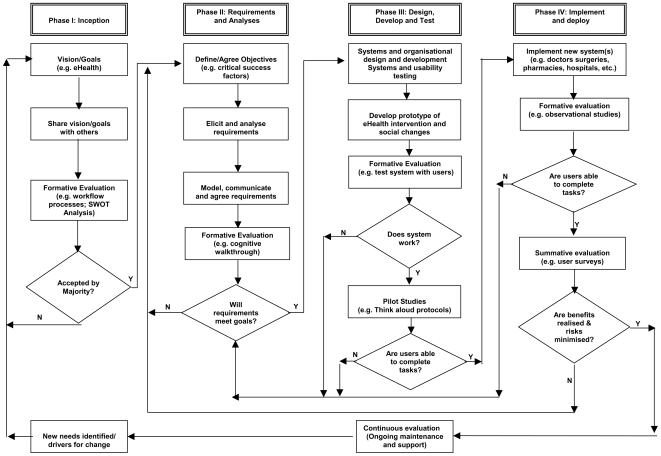
- The authors propose continuous systematic multifaceted evaluations throughout the lifecycle of eHealth interventions, with iterative formative evaluations at four key stages and a final summative evaluation after deployment.
Methods
- This is a conceptual/perspective article, not an empirical study.
- The paper synthesizes prior literature and examples of eHealth implementations, including telemedicine, electronic medical records, health portals, and prescribing software.
- Its main analysis is an argument for a lifecycle-based evaluation model, organized into phases from problem definition through design, testing, deployment, formative evaluation, and summative evaluation.
Limitations
- The paper does not report original data, a sample, or effect estimates; its claims are based on discussion and cited examples rather than direct empirical testing.
- The text itself makes evident that the proposed evaluation approach is not validated in the paper with a study, so its effectiveness is argued rather than demonstrated.
- The paper notes that eHealth definitions and applications are diverse and there is no universal agreement on the term, which limits one-size-fits-all evaluation approaches.
Model-written summary. Check it against the paper before relying on it.
Integrity signals
Registry
Cites
Statistics
Figures
Verification
Claims the paper makes
0 Valid · 0 Not valid · 18 Not checked · 7 Own results and interpretations
None of the sources cited for this claim have been checked yet.
In the paper
“it is of concern that, in this rush, relatively little time, thought, or resources have been devoted to assessing the potential risks associated with eHealth interventions [11]–[13],[33]–[36].”
§ Evaluating eHealth Interventions: The Need for Continuous Systemic Evaluation > Recognising the Risk of Harm
What the sources say
- Not checked yetcites [11] G Mudur, 2004, The great technological divide., BMJ source
- Not checked yetcites [12] E Ammenwerth, 2005, Bad Health Informatics Can Kill – Is Evaluation the Answer? Editorial., Methods Inf Med source
- Not checked yetcites [13] YY Han, 2005, Unexpected increased mortality after implementation of a commercially sold computerized physician order entry system., Pediatrics source
plain- Asserted: passes — The authors put it forward as true.
- Checkable: passes — It can be checked against evidence.
- Load-bearing: passes — The paper’s conclusions depend on it.
- Based: passes — The paper gives a reason why it holds.
In the paper
“Large investments in eHealth may, by diverting resources result in a shortfall in funding for basic infrastructure, equipment, and staffing elsewhere in the system.”
§ Evaluating eHealth Interventions: The Need for Continuous Systemic Evaluation > Recognising the Risk of Harm > Box 2. Examples of problems associated with eHealth projects
What the sources say
- Not checked yetcites [11] G Mudur, 2004, The great technological divide., BMJ source
hedgedstates a possible cause- Asserted: passes — The authors put it forward as true.
- Checkable: passes — It can be checked against evidence.
- Load-bearing: unclear — It is unclear whether the paper’s conclusions depend on it.
- Based: passes — The paper gives a reason why it holds.
In the paper
“Take the example of poorly developed computer decision support functionality, which can result in the issuing of erroneous prescribing support and advice, as was demonstrated by Fernando et al. in their assessment of primary care prescribing software [33].”
§ Evaluating eHealth Interventions: The Need for Continuous Systemic Evaluation > Recognising the Risk of Harm
What the sources say
- Not checked yetcites [33] B Fernando, 2004, Prescribing safety features of general practice computer systems: evaluation using simulated test cases., BMJ source
boostedstates a cause- Asserted: passes — The authors put it forward as true.
- Checkable: passes — It can be checked against evidence.
- Load-bearing: passes — The paper’s conclusions depend on it.
- Based: passes — The paper gives a reason why it holds.
None of the sources cited for this claim have been checked yet.
In the paper
“eHealth may compromise patient safety in a number of ways.”
§ Evaluating eHealth Interventions: The Need for Continuous Systemic Evaluation > Recognising the Risk of Harm
What the sources say
- Not checked yetcites [11] G Mudur, 2004, The great technological divide., BMJ source
- Not checked yetcites [12] E Ammenwerth, 2005, Bad Health Informatics Can Kill – Is Evaluation the Answer? Editorial., Methods Inf Med source
- Not checked yetcites [13] YY Han, 2005, Unexpected increased mortality after implementation of a commercially sold computerized physician order entry system., Pediatrics source
hedgedstates a possible cause- Asserted: passes — The authors put it forward as true.
- Checkable: passes — It can be checked against evidence.
- Load-bearing: passes — The paper’s conclusions depend on it.
- Based: passes — The paper gives a reason why it holds.
In the paper
“Within biomedicine, randomised controlled trials (RCTs) are often seen as the “gold standard” methodological approach, rightly so because of their unique ability to control for the impact of known and unknown confounding factors [16].”
§ Evaluating eHealth Interventions: The Need for Continuous Systemic Evaluation > Implications for Evaluation > Box 3. Suggested seven steps from statement of a problem to definition of a solution [37]
What the sources say
- Not checked yetcites [16] B Kaplan, 2001, Evaluating informatics applications – some alternative approaches: theory, social interactionism, and call for methodological pluralism., Int J Med Inform source
plainstates a cause- Asserted: passes — The authors put it forward as true.
- Checkable: passes — It can be checked against evidence.
- Load-bearing: unclear — It is unclear whether the paper’s conclusions depend on it.
- Based: passes — The paper gives a reason why it holds.
9 more claims
Create a free account to see all 25 claims and to verify the 28 references still open.
- Probably not a substantial claim. 8
- It may state two separate claims as one. 4
Claims other papers make about this one
Each is checked against this paper’s own text: does it say what the citing paper says it does?
The source backs part of the claim, not all of it — or backs it for a different population, condition or comparison.
In the citing paper
“Also of note is that we found virtually no evidence in support of the cost-effectiveness claims (Tables 2– 11) that are frequently being made by policy makers when constructing business cases to raise funding for the large-scale eHealth deployments that are now taking place in many parts of the world [1].”
From The Impact of eHealth on the Quality and Safety of Health Care: A Systematic Overview (2011) · cites this paper as [1]
Experimental — accuracy not yet measuredThe source backs part of the claim, not all of it — or backs it for a different population, condition or comparison.
In the citing paper
“Mock-ups, storyboards, or paper prototypes [101] are created and tested sequentially and iteratively with intended users [23,26,29,48,60] and, as a result, the prototypes are refined.”
From A Holistic Framework to Improve the Uptake and Impact of eHealth Technologies (2011) · cites this paper as [23]
Experimental — accuracy not yet measuredThe cited source says what the claim attributes to it.
In the citing paper
“This is noted in several of the reviewed frameworks [23,29,48,51,60].”
From A Holistic Framework to Improve the Uptake and Impact of eHealth Technologies (2011) · cites this paper as [23]
In the citing paper
“Although there is international pressure for hospitals to implement electronic records, based on the belief that these systems will transform the quality and safety of healthcare [1, 2], there is little empirical evidence to support this.”
From Exploring the implementation of an electronic record into a maternity unit: a qualitative study using Normalisation Process Theory (2017) · cites this paper as [1]
In the citing paper
“IT systems can introduce harms as well as benefits.”
From Evaluating eHealth: How to Make Evaluation More Methodologically Robust (2009) · cites this paper as [1]
Citations
Cites
Han, Y. Y., Carcillo, J. A., Venkataraman, S. T., Clark, R. S. B., Watson, R. S., Nguyen, T. C., Bayir, H., & Orr, R. A. (2005) · Pediatrics · doi:10.1542/peds.2005-1287 · Cited by 1,149
Cognitive and usability engineering methods for the evaluation of clinical information systems.
Kushniruk, A. W., & Patel, V. L. (2004) · Journal of Biomedical Informatics · doi:10.1016/j.jbi.2004.01.003 · Cited by 760
What Is eHealth (4): A Scoping Exercise to Map the Field
Pagliari, C., Sloan, D., Gregor, P., Sullivan, F., Detmer, D., Kahan, J. P., Oortwijn, W., & MacGillivray, S. (2005) · Journal of Medical Internet Research · doi:10.2196/jmir.7.1.e9 · Cited by 479
Kaplan, B. (2001) · International Journal of Medical Informatics · doi:10.1016/s1386-5056(01)00184-8 · Cited by 380
Electronic Health Records: A Systematic Review on Quality Requirements
Ammenwerth, E., & Hoerbst, A. (2010) · Methods of Information in Medicine · doi:10.3414/me10-01-0038 · Cited by 303
Computational Technology for Effective Health Care: Immediate Steps and Strategic Directions
(2009) · National Academies Press eBooks · doi:10.17226/12572 · Cited by 282
The World Bank participation sourcebook.
(1996) · World Bank, Washington, DC eBooks · doi:10.1596/0-8213-3558-8 · Cited by 264
Visions and strategies to improve evaluation of health information systems
Ammenwerth, E., Brender, J., Nykänen, P., Prokosch, H.-U., Rigby, M., & Talmon, J. (2004) · International Journal of Medical Informatics · doi:10.1016/j.ijmedinf.2004.04.004 · Cited by 233
Electronic Medical Records: Privacy, Confidentiality, Liability
Steward, M. (2005) · Journal of Legal Medicine · doi:10.1080/01947640500364762 · Cited by 191
Electronic Medical Records vs. Electronic Health Records:Yes,There Is a Difference
Yang, H. (2007) · Chinese Hospitals · Cited by 174
Cited by
Greenhalgh, T., Wherton, J., Papoutsi, C., Lynch, J., Hughes, G., A'Court, C., Hinder, S., Fahy, N., Procter, R., & Shaw, S. (2017) · Journal of Medical Internet Research · doi:10.2196/jmir.8775 · Cited by 2,887
“Our search for evidence-based approaches to guide our empirical work on the above case studies identified 28 technology implementation frameworks, informed by several theoretical perspectives, which we sorted into a simple taxonomy [13,43,47-72]; see Multimedia Appendix 1.”
The Impact of eHealth on the Quality and Safety of Health Care: A Systematic Overview
Black, A. D., Car, J., Pagliari, C., Anandan, C., Cresswell, K., Bokun, T., McKinstry, B., Procter, R., Majeed, A., & Sheikh, A. (2011) · PLoS Medicine · doi:10.1371/journal.pmed.1000387 · Cited by 1,442
Self-citationA Holistic Framework to Improve the Uptake and Impact of eHealth Technologies
van Gemert-Pijnen, J. E., Nijland, N., van Limburg, M., Ossebaard, H. C., Kelders, S. M., Eysenbach, G., & Seydel, E. R. (2011) · Journal of Medical Internet Research · doi:10.2196/jmir.1672 · Cited by 1,126
A Systematic Review of the Technology Acceptance Model in Health Informatics
Rahimi, B., Nadri, H., Lotfnezhad Afshar, H., & Timpka, T. (2018) · Applied Clinical Informatics · doi:10.1055/s-0038-1668091 · Cited by 688
Avery, A. J., Rodgers, S., Cantrill, J. A., Armstrong, S., Cresswell, K., Eden, M., Elliott, R. A., Howard, R., Kendrick, D., Morris, C. J., et al. (2012) · The Lancet · doi:10.1016/s0140-6736(11)61817-5 · Cited by 454
Self-citation
Metadata
- Authors
- Catwell, L., & Sheikh, A.
- Affiliations
- University of Edinburgh (GB)
- Corresponding author
- Sheikh, Aziz
- ORCID
- Sheikh, Aziz
- Venue
- PLoS Medicine
- Publisher
- Public Library of Science (PLoS)
- Published
- 2009-08-18
- Volume
- 6
- Issue
- 8
- Pages
- e1000126
- ISSN
- 1549-1277 (ISSN-L)
- 1549-1676
- PMC
- PMC2719100
- OpenAlex
- W2052843612
- Cited by
- 307
- References
- 21
- Citations by year
- 2026: 2 · 2025: 10 · 2024: 16 · 2023: 11 · 2022: 25 · 2021: 17 · 2020: 17 · 2019: 22 · 2018: 19 · 2017: 25 · 2016: 19 · 2015: 20 · 2014: 18 · 2013: 32 · 2012: 21
- FWCI
- 31.99
- Type
- journal article
- Language
- en
- Open access
- gold
- doi.org
- Locations
- PLoS Medicine (publishedVersion, cc-by)
- PubMed Central (publishedVersion, cc-by)
- PubMed (publishedVersion)
- RePEc: Research Papers in Economics (submittedVersion)
- DOAJ (DOAJ: Directory of Open Access Journals) (submittedVersion, cc-by-sa)
- Edinburgh Research Explorer (University of Edinburgh) (submittedVersion, cc-by)
- Funders
- British Lung Foundation
- Asthma and Lung UK
- Topics
- Health Sciences › Health Professions › General Health Professions › Mobile Health and mHealth Applications
- Social Sciences › Psychology › Applied Psychology › Digital Mental Health Interventions
- Health Sciences › Medicine › Public Health, Environmental and Occupational Health › Telemedicine and Telehealth Implementation
- Keywords
- digital health interventions, continuous assessment, systemic evaluation, digital health
- MeSH terms
- Evaluation Studies as Topic, Humans, Medical Informatics, Research Design, Telecommunications, Internet
About these checks
Registry, retraction, Cites and statistics results are computed, not judged, with one exception: a printed reference that no index lists is read once by a model before it counts as a citation error. Claims are extracted by a model and kept only when their quote appears verbatim in the text; each cited source is then checked, with a model’s help, for whether it says what the claim relies on. Those verdicts can be wrong — read the claim’s quote and the cited source before relying on one.
A language model drew the claims from the paper on 2026-10-11, under version 3 of the claim definition (model deepseek-v4.1-flash, prompt extract-v3).
A second model labelled each claim on 2026-10-11 (model jev-1.13-20260917, definition revision gold-guideline-v0.2).
Statistics and arithmetic are recomputed, not judged.
Confidence bands are shown only for fields calibrated on our annotated test set. None is calibrated yet, so no band is shown.
What counts as a claim ›How we measure confidence ›How we check this ›
Are you an author, or do you see a problem with this page? Request a review
How to cite
Cite CoChat for the checks on this page, and the paper for its own findings.
- This page
- CoChat. (2026). Citation check: Evaluating eHealth Interventions: The Need for Continuous Systemic Evaluation. https://app.cochat.ai/papers/10.1371/journal.pmed.1000126
- The paper
- Catwell, L., & Sheikh, A. (2009). Evaluating eHealth Interventions: The Need for Continuous Systemic Evaluation. PLoS Medicine. https://doi.org/10.1371/journal.pmed.1000126
Data sources
Bibliographic data: Semantic Scholar, OpenAlex, Crossref.
Contains information from the Semantic Scholar Academic Graph Datasets, made available under the ODC Attribution License (ODC-BY 1.0).
Semantic Scholar’s data is described in: Kinney, R., et al. (2023). The Semantic Scholar Open Data Platform. arXiv:2301.10140.
