

The DOI matches its Crossref record; 53 of the 55 references it cites were found in a registry or an index.
Strategies for Increasing Recruitment to Randomised Controlled Trials: Systematic Review
Open accessAbstract
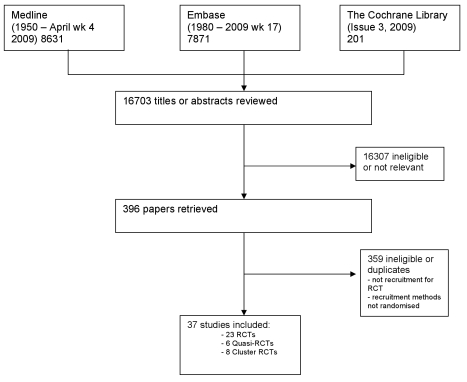
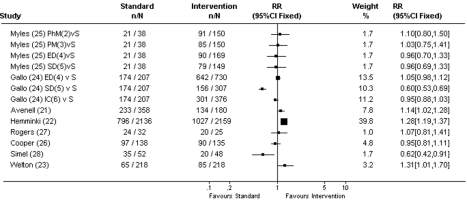
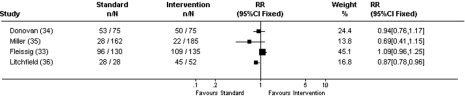
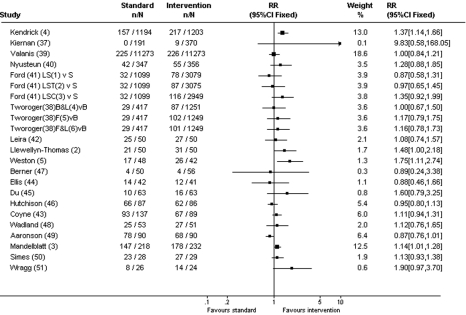
BACKGROUND: Recruitment of participants into randomised controlled trials (RCTs) is critical for successful trial conduct. Although there have been two previous systematic reviews on related topics, the results (which identified specific interventions) were inconclusive and not generalizable. The aim of our study was to evaluate the relative effectiveness of recruitment strategies for participation in RCTs. METHODS AND FINDINGS: A systematic review, using the PRISMA guideline for reporting of systematic reviews, that compared methods of recruiting individual study participants into an actual or mock RCT were included. We searched MEDLINE, Embase, The Cochrane Library, and reference lists of relevant studies. From over 16,000 titles or abstracts reviewed, 396 papers were retrieved and 37 studies were included, in which 18,812 of at least 59,354 people approached agreed to participate in a clinical RCT. Recruitment strategies were broadly divided into four groups: novel trial designs (eight studies), recruiter differences (eight studies), incentives (two studies), and provision of trial information (19 studies). Strategies that increased people's awareness of the health problem being studied (e.g., an interactive computer program [relative risk (RR) 1.48, 95% confidence interval (CI) 1.00-2.18], attendance at an education session [RR 1.14, 95% CI 1.01-1.28], addition of a health questionnaire [RR 1.37, 95% CI 1.14-1.66]), or a video about the health condition (RR 1.75, 95% CI 1.11-2.74), and also monetary incentives (RR1.39, 95% CI 1.13-1.64 to RR 1.53, 95% CI 1.28-1.84) improved recruitment. Increasing patients' understanding of the trial process, recruiter differences, and various methods of randomisation and consent design did not show a difference in recruitment. Consent rates were also higher for nonblinded trial design, but differential loss to follow up between groups may jeopardise the study findings. The study's main limitation was the necessity of modifying the search strategy with subsequent search updates because of changes in MEDLINE definitions. The abstracts of previous versions of this systematic review were published in 2002 and 2007. CONCLUSION: Recruitment strategies that focus on increasing potential participants' awareness of the health problem being studied, its potential impact on their health, and their engagement in the learning process appeared to increase recruitment to clinical studies. Further trials of recruitment strategies that target engaging participants to increase their awareness of the health problems being studied and the potential impact on their health may confirm this hypothesis. Please see later in the article for the Editors' Summary.
Overview
The claims and statistics of this paper haven’t been checked yet.
Run the check — free, no account needed. It reads the open-access text and checks the sources it cites.
Integrity signals
Registry
Cites
Statistics
Figures

Verification
Claims the paper makes
The claims and statistics of this paper haven’t been checked yet.
Run the check — free, no account needed. It reads the open-access text and checks the sources it cites.
Claims other papers make about this one
Each is checked against this paper’s own text: does it say what the citing paper says it does?
In the citing paper
“Different recruitment methods can substantially affect the number and type of trial participants recruited206 309 312 313 and can incur different costs.314 315 316”
From SPIRIT 2025 explanation and elaboration: updated guideline for protocols of randomised trials (2025) · cites this paper as [312]
Self-check
Percentages, sums and reported differences re-computed from the paper’s own numbers.
The self-check needs the paper’s full text.
Citations
Cites
Cochrane Handbook for Systematic Reviews of Interventions: Cochrane Book Series
(2008) · doi:10.1002/9780470712184 · Cited by 25,048
Evidence based medicine: what it is and what it isn't
Sackett, D. L., Rosenberg, W. M. C., Gray, J. A. M., Haynes, R. B., & Richardson, W. S. (1996) · BMJ · doi:10.1136/bmj.312.7023.71 · Cited by 15,769
Health Belief Model and Personal Health Behavior
Becker, M. H. (1976) · Medical Entomology and Zoology · Cited by 3,065
The Health Belief Model and Sick Role Behavior
Becker, M. H. (1974) · Health Education Monographs · doi:10.1177/109019817400200407 · Cited by 2,327
Recruiting Minorities Into Clinical Trials Toward a Participant-Friendly System
Swanson, G. M., & Ward, A. J. (1995) · JNCI Journal of the National Cancer Institute · doi:10.1093/jnci/87.23.1747 · Cited by 558
Recruitment for controlled clinical trials: Literature summary and annotated bibliography
Lovato, L., Hill, K., Hertert, S., Hunninghake, D. B., & Probstfield, J. L. (1997) · Controlled Clinical Trials · doi:10.1016/s0197-2456(96)00236-x · Cited by 400
Which clinical studies provide the best evidence?
Barton, S. (2000) · BMJ · doi:10.1136/bmj.321.7256.255 · Cited by 384
Increasing recruitment to randomised trials: a review of randomised controlled trials
Watson, J. M., & Torgerson, D. J. (2006) · BMC Medical Research Methodology · doi:10.1186/1471-2288-6-34 · Cited by 333
Simes, R. J., Tattersall, M. H. N., Coates, A., Raghavan, D., Solomon, H. J., & Smartt, H. (1986) · BMJ · doi:10.1136/bmj.293.6554.1065 · Cited by 202
Coyne, C. A., Xu, R., Raich, P. C., Plomer, K., Dignan, M., Wenzel, L. B., Fairclough, D. L., Habermann, T. M., Schnell, L., Quella, S. K., et al. (2003) · Journal of Clinical Oncology · doi:10.1200/jco.2003.07.022 · Cited by 198
Research works printed but not linked: 3
- P Caldwell, 2002, Strategies for recruitment to RCTs: a systematic review of controlled trials and observational studies.
- P Caldwell, 2007, Systematic review of strategies for enhancing recruitment of participants for randomised controlled trials.
- E Quinaux, 2003, Impact of monitoring visits on patient recruitment and data quality: case study of a phase IV trial in oncology., Control Clin Trials, 24, 99S
Cited by
Sorted by citations
Items 201–300 of 304
Update: Looking Beyond the 100,000 Genome Project
Haga, S. B. (2017) · Personalized Medicine · doi:10.2217/pme-2016-0101 · Cited by 5
Shou, Y., Yeo, J. E., Pang, A. S., Paterson, D. L., & Mo, Y. (2024) · BMJ Open · doi:10.1136/bmjopen-2023-082096 · Cited by 4
How health equity is reported and analyzed in randomized trials
Petkovic, J., Welch, V. A., Jull, J., Petticrew, M. P., Kristjansson, E., Rader, T., Yoganathan, M., McGowan, J., Lyddiatt, A., Grimshaw, J., et al. (2017) · Cochrane Database of Systematic Reviews · doi:10.1002/14651858.mr000046 · Cited by 5
Warnock, A. C., Kaur, H., Buckman, J. R., Hoenemeyer, T. W., & Demark‐Wahnefried, W. (2021) · Journal of Cancer Survivorship · doi:10.1007/s11764-021-01091-x · Cited by 4
Rash, J. A., Campbell, T. S., Cooper, L., Flusk, D., MacInnes, A. I., Nasr‐Esfahani, M., Mekhael, A. A., Poulin, P. A., Robert, M., & Yi, Y. (2021) · BMJ Open · doi:10.1136/bmjopen-2021-055039 · Cited by 4
Randomized Experiment of Recruitment Letter Design to Maximize Clinical Trial Enrollment
Johansen, N. D., Preiss, D., Mafham, M. M., Loiacono, M. M., Harris, R. C., Claggett, B. L., Solomon, S. D., & Biering‐Sørensen, T. (2025) · JAMA · doi:10.1001/jama.2025.9170 · Cited by 4
An online survey to assess parents' preferences for learning about child health research
Knisley, L., Le, A., & Scott, S. (2020) · Nursing Open · doi:10.1002/nop2.1027 · Cited by 3
Lie, M., McParlin, C., McColl, E., Graham, R. H., & Robson, S. C. (2022) · Pilot and Feasibility Studies · doi:10.1186/s40814-022-01093-1 · Cited by 4
Becker, L., Ganslandt, T., Prokosch, H., & Newe, A. (2020) · JMIR Medical Informatics · doi:10.2196/15749 · Cited by 4
YouTube as a Recruitment Tool? A Reflection on Using Video to Recruit Research Participants
Culshaw, S. (2020) · Video Journal of Education and Pedagogy · doi:10.1163/23644583-00501004 · Cited by 4
Attitudes of small animal practitioners toward participation in veterinary clinical trials
Gruen, M. E., Griffith, E. H., Caney, S., Rishniw, M., & Lascelles, B. D. X. (2016) · Journal of the American Veterinary Medical Association · doi:10.2460/javma.250.1.86 · Cited by 4
Clark, T., Lewko, A., & Calestani, M. (2023) · Physiotherapy Theory and Practice · doi:10.1080/09593985.2023.2236194 · Cited by 3
Sim, A., McNeilage, A. G., Rebbeck, T. J., Sterling, M. M., Nicholas, M. K., Donovan, S. J., Giummarra, M. J., & Ashton-James, C. E. (2024) · Journal of Occupational Rehabilitation · doi:10.1007/s10926-024-10258-z · Cited by 3
Jaffe, K., & Fisher, C. B. (2025) · Substance Abuse Treatment Prevention and Policy · doi:10.1186/s13011-025-00657-7 · Cited by 3
Muldowney, L. A., Hynes, S. M., Oglesby, M. H., & Dwyer, C. P. (2023) · HRB Open Research · doi:10.12688/hrbopenres.13776.1 · Cited by 3
Consentimento por telefone: otimização do recrutamento de participantes de pesquisas
de Paula, L. L. R. J., de Paula, M. F., & Badiglian‐Filho, L. (2021) · Revista Bioética · doi:10.1590/1983-80422021292469 · Cited by 3
Examining self‐affirmation as a tactic for recruiting inactive women into exercise interventions
More, K. R., Phillips, L. A., Green, Z., & Mentzou, A. (2021) · Applied Psychology Health and Well-Being · doi:10.1111/aphw.12303 · Cited by 3
Recruitment for a hospital-based pragmatic clinical trial using volunteer nurses and students
Blewer, A. L., Li, J., Ikeda, D. J., Leary, M., Buckler, D. G., Riegel, B. J., Desai, S. M., Groeneveld, P. W., Putt, M. E., & Abella, B. S. (2016) · Clinical Trials · doi:10.1177/1740774516643265 · Cited by 3
The OMACS-PIL study: a randomised controlled trial within the OMACS observational study
Culliford, L. A., Brierley, R. C. M., Clout, M., Evans, R., Maishman, R., Phillips, D., Tabusa, H., Reeves, B. C., & Rogers, C. A. (2019) · Trials · doi:10.1186/s13063-019-3958-3 · Cited by 3
Maslekar, T., Peat, S., Karim, J., Moriarty, C., Jayne, D. G., & Chapman, S. J. (2021) · Journal of Clinical Epidemiology · doi:10.1016/j.jclinepi.2021.01.002 · Cited by 2
AlHeresh, R. A., Vaughan, M. W., Brenner, I. H., & Keysor, J. J. (2021) · Contemporary Clinical Trials Communications · doi:10.1016/j.conctc.2021.100862 · Cited by 3
Self‐acknowledged limitations in exercise therapy trials for low back pain
Siviter, L. M., Morretta, M., Petosky, T., Klopper, M., Rhon, D. I., & Young, J. L. (2024) · Journal of Evaluation in Clinical Practice · doi:10.1111/jep.14033 · Cited by 2
Yeh, C., Crane, M. M., Daniels, B. T., Lohse, B., Karavolos, K., Olinger, T., Nicklas, J. M., Powell, L. H., & Suzuki, S. (2024) · Trials · doi:10.1186/s13063-024-08703-8 · Cited by 2
Keemink, J. R., Stander, W. J., Montgomery, P., & Schaub, J. (2025) · Social Work Research · doi:10.1093/swr/svaf002 · Cited by 2
Ling, J., Ashley, A., Zahry, N. R., Kao, T. A., Wahman, C. L., Resnicow, K., Robbins, L. B., Kerver, J. M., & Zhang, N. (2025) · School Mental Health · doi:10.1007/s12310-025-09767-w · Cited by 2
Terrell, J. H., & Bugler, D. (2017) · Educational Research and Evaluation · doi:10.1080/13803611.2018.1442724 · Cited by 2
Digital Patient Engagement and Social Media
Sun, V. C.-Y. (2019) · Springer eBooks · doi:10.1007/978-3-030-31471-2_15 · Cited by 2
Reach and Recruitment of Microentrepreneurs: Lessons from a Finnish Health Promotion Intervention
Mäkiniemi, J.-P., Ahola, S., Korkiakangas, E. E., Kaksonen, T., Heikkilä-Tammi, K., Laitinen, J. H., Kekkonen, M., Muhos, M., Oksanen, T., B, H. O.-K. A., et al. (2022) · Nordic Journal of Working Life Studies · doi:10.18291/njwls.132982 · Cited by 2
Compensating patients in trials: Perspectives from an ethical committee versus sponsor
Peyro‐Saint‐Paul, L., Gaillard, C., Paris, A., Gourio, C., Zerger, C., Ficheux, M., Grandazzi, G., Parienti, J., & Morello, R. (2023) · European Journal of Clinical Investigation · doi:10.1111/eci.14044 · Cited by 2
van Lankveld, J. J. D. M., Grauvogl, A., van den Hoek, K., Franke, A., & Evers, S. (2014) · TSG - Tijdschrift voor gezondheidswetenschappen · doi:10.1007/s12508-014-0031-1 · Cited by 2
Yeager, K. A., Bai, J., Gogineni, K., Meisel, J. L., Kweon, J., Bruner, D. W., & Waldrop‐Valverde, D. (2020) · Journal of Cancer Education · doi:10.1007/s13187-020-01826-x · Cited by 2
Jiménez-Rodríguez, R. M., Martín-Gutiérrez, G., Jiménez‐Jorge, S., Rosso-Fernández, C. M., Tallón‐Aguilar, L., Roca-Oporto, C., Padillo, J., Luckey, A., Cano, Á., López-Ruiz, J., et al. (2022) · BMJ Open · doi:10.1136/bmjopen-2021-051187 · Cited by 2
A Framework for Patient Data Management and Analysis in Randomised Clinical Trials
Guzzi, P. H., Larussa, T., Vallelunga, R., Abenavoli, L., Tradigo, G., Luzza, F., & Veltri, P. (2020) · IEEE International Conference on Bioinformatics and Biomedicine (BIBM) · doi:10.1109/bibm49941.2020.9313544 · Cited by 1
Embedding research study recruitment within the patient portal preCheck-in
Leuchter, R. K., Ma, S., Bell, D. S., Hays, R. D., Vidorreta, F. J. S., Binder, S. L., & Sarkisian, C. A. (2023) · Journal of the American Medical Informatics Association · doi:10.1093/jamia/ocad164 · Cited by 1
Pasi, R., & Babu, T. A. (2023) · Pediatric Companion · doi:10.4103/pedc.pedc_4_24 · Cited by 1
Lamoca, M., Rothenberg, S., Czornobil, R., Mamuyac, E., Korfmacher, K. F., Asllani, I., & Deleon, J. (2025) · Alzheimer s & Dementia Translational Research & Clinical Interventions · doi:10.1002/trc2.70168 · Cited by 1
Nygaard, L., Hirani, J. C., Friis-Hansen, M., Davis, D. L., Nohr, E. A., & Pontoppidan, M. (2025) · Healthcare · doi:10.3390/healthcare13131505 · Cited by 1
Brief psychodynamic-interpersonal therapy for adults with a history of self-harm: the SafePIT RCT
Guthrie, E., Copsey, B. J., Wright-Hughes, A. M., Dowse, A., Bojke, C., Mattock, R., Day, F., Horrocks, J. A., Bianco, G., Brennan, C. A., et al. (2025) · Health Technology Assessment · doi:10.3310/tngf8545 · Cited by 1
Hudek, N., Carroll, K. A., Semchishen, S. N., Presseau, J., Gillies, K., Grimshaw, J., Fergusson, D. A., Graham, I. D., Taljaard, M., & Brehaut, J. (2026) · Trials · doi:10.1186/s13063-026-09664-w · Cited by 1
Yang, C. T., Katz, J. N., Selzer, F., Conley, C., Lemaster, N. G., Stone, A. V., Kumara, M. T., Matzkin, E. G., Kim, J. S., Jacobs, C. A., et al. (2025) · Orthopaedic Journal of Sports Medicine · doi:10.1177/23259671241311906 · Cited by 1
Novel Ways to Get Good Trial Data: The UK Experience
MacDonald, T., Mackenzie, I. S., & Wei, L. (2012) · NAM Perspectives · doi:10.31478/201205b · Cited by 1
Path Analysis of RCT Recruitment: Secondary Analysis of Results from a Systematic Review
Jochym, N., Lin, L. Y., & Merz, J. F. (2021) · Journal of Empirical Research on Human Research Ethics · doi:10.1177/15562646211023698 · Cited by 1
Pollock, K. G., Dickerson, C., Kainth, M., Lawton, S., Hurst, M. A., Sugrue, D., Arden, C., Davies, D. W., Martin, A., Sandler, B. C., et al. (2024) · BMC Family Practice · doi:10.1186/s12875-023-02246-8 · Cited by 1
Recruitment for Clinical Trials – A Challenge for Electronic Support?Preprint
Becker, L., Gansland, T., Prokosch, H., & Newe, A. (2019) · Research Square · doi:10.21203/rs.2.385/v1 · Cited by 1
Accrual, Retention, and Adherence
den Broeck, J. V., & Tylleskär, T. (2013) · Springer eBooks · doi:10.1007/978-94-007-5989-3_17
Recruitment and enrollment in a randomized clinical trial of mandibular two-implant overdenture
Lee, J., Kim, M., Kim, H.-Y., & Shin, S. (2013) · The Journal of Advanced Prosthodontics · doi:10.4047/jap.2013.5.2.204
DOCTEUR de l'UNIVERSITE PARIS DESCARTES
Doctorale, É., & Environnement, M. T. C. (2012)
Optimizing enrollment in pediatric obese patients: reflections on recruitment characteristics
Tak, C. R., Yu, T., Sherwin, C. M. T., & Mihalopoulos, N. L. (2016) · International Journal of Adolescent Medicine and Health · doi:10.1515/ijamh-2016-0029
Designing and Optimizing Treatment Trials for Recurrent Pregnancy Loss
van Dijk, M. M., van Wely, M., & Goddijn, M. (2017) · Cambridge University Press eBooks · doi:10.1017/9781139976787.017
Long-term Outcomes of Operatively and Non-operatively Treated Spina Bifida Scoliosis
Khoshbin, A. (2014) · TSpace (University of Toronto)
Mesbah, N. (2019) · Otago University Research Archive (University of Otago)
Gold, P. B., Crane, K. T., Fabian, E. S., & Morris, T. R. (2019) · Journal of Vocational Rehabilitation · doi:10.3233/jvr-191042
Fletcher, K. (2012) · University of Birmingham Institutional Research Archive (University of Birmingham)
Sidani, S., & Braden, C. J. (2021) · Wiley eBooks · doi:10.1002/9781119610113.ch15
Cornu, C., Carle, Q., Poite, M., Erpeldinger, S., Meunier‐Beillard, N., Binquet, C., Ginhoux, T., Saidi, M., Félin, A., Supper, I., et al. (2022) · Research Square · doi:10.21203/rs.3.rs-1905895/v1
Sayegh, C. S., Iverson, E. F., MacDonell, K. K., West, A. E., & Belzer, M. E. (2023) · Contemporary Clinical Trials Communications · doi:10.1016/j.conctc.2023.101121
Sanders, A. (2023) · doi:10.33540/1825
Clinical preparation—subject recruitment
Jones, B. M., Hsieh, K., Dickstein, D. R., & Lehrer, E. J. (2023) · Elsevier eBooks · doi:10.1016/b978-0-323-88423-5.00006-6
Elfghi, M., Jordan, F., Sultan, S., & Tawfick, W. A. (2023) · Trials · doi:10.1186/s13063-023-07727-w
Expanding Patient Access and Engagement
Binik-Thomas, J., Fronczkowski, B., Reinemeyer, K., & Brown, M. (2024) · Journal of Applied Business and Economics · doi:10.33423/jabe.v26i2.7049
Reply - Letter to the Editor - “Quality of life of caregivers of patients on home enteral nutrition”
Folwarski, M., Maciejewska-Cebulak, M., Skonieczna‐Żydecka, K., Sumlet, M., Kupiec, M., Jankowska, B., Kwella, B., Balul, G., Szafrański, W., & Kłęk, S. (2024) · Clinical Nutrition · doi:10.1016/j.clnu.2024.11.019
Letter to the editor “Quality of life of caregivers of patients on home enteral nutrition”
Martins, J. C. D. C., Fernandes, M. S. D. S., & de Souza, R. F. (2024) · Clinical Nutrition · doi:10.1016/j.clnu.2024.12.002
Increasing financial incentives can lower the cost of trial recruitment
Schwartz, A., Weiner, S. J., & Harrod, M. (2024) · Trials · doi:10.1186/s13063-024-08674-w
Optimizing Recruitment in Randomized Controlled Trials
Meena, A., & Getgood, A. M. J. (2024) · Springer eBooks · doi:10.1007/978-3-031-77563-5_6
Andrew, L., Garven, A., Taylor, T., Bates, S. M., Duffett, L. D., Dubois, S., Malinowski, A. K., El‐Chaâr, D., Chan, W., Donnelly, J. C., et al. (2025) · Journal of Thrombosis and Haemostasis · doi:10.1016/j.jtha.2025.02.039
Low Parental Participation in a Randomised Clinical Trial of Video Tutorials: A Qualitative Study
Borch‐Johnsen, L., Folke, F., Frederiksen, M. S., Greisen, G. O., Lund, S. B., Zoffmann, V., Gren, C., Tjørnhøj‐Thomsen, T., & Cortes, D. (2025) · Acta Paediatrica · doi:10.1111/apa.70120
Butler, M., Kaoutzani, L., & Rahimi, S. Y. (2025) · World Neurosurgery · doi:10.1016/j.wneu.2025.124159
Hedin, L., Hagströmer, M., Marcus, C., & Danielsson, P. (2025) · Sage Open Pediatrics · doi:10.1177/30502225251348292
Taxonomy of chronic illness research recruitment: a restricted scoping review
Austin, R. C., Karlsen, B., Richardson, A. M., Elwyn, G. J., Storm, M., Husebø, A. M. L., & Urstad, K. H. (2025) · BMC Health Services Research · doi:10.1186/s12913-025-13115-8
Jeong, A. S. M., Magee, M. R., Gholamrezaei, A., McNeilage, A. G., Sim, A., Glare, P., & Ashton-James, C. E. (2026) · Pain Medicine · doi:10.1101/2025.08.07.25333246
Usage and perceived effectiveness of recruitment techniques among clinical trials recruiters
Watts, J., Kaiser‐Jackson, L., Wong, B. G., Helac, A., Volkmar, M., Berg, J. W., Goldenberg, A. J., Kodish, E. D., Schwan, B., Wolfsfeld, C., et al. (2025) · Journal of Clinical and Translational Science · doi:10.1017/cts.2025.10117
Passa, A.-M. D., Prokop-Millar, S., Yaya, H., Vandehei, E., McIntyre‐Wood, C., Fein, A. J., MacKillop, E., MacKillop, J. M., & Duarte, D. G. G. (2025) · Brazilian Journal of Psychiatry · doi:10.47626/1516-4446-2025-4168
Nielsen, S. S., Christensen, J. R., Tang, L. H., Simonÿ, C., Skejø, S. D., & Skou, S. T. (2025) · Journal of Bodywork and Movement Therapies · doi:10.1016/j.jbmt.2025.09.028
Moffat, K. R., Shi, W., Cannon, P., & Sullivan, F. (2023) · Figshare · doi:10.6084/m9.figshare.22616204
Davies, G., Mills, N., Holcombe, C., & Potter, S. (2020) · Figshare · doi:10.6084/m9.figshare.12096795
Tan, E., Hoare, K., Riley, J., Fernando, K., Haskell, L., McKinlay, C. J., Dalziel, S. R., & Braithwaite, I. (2022) · Figshare · doi:10.6084/m9.figshare.19582239
Pollock, K. G., Dickerson, C., Kainth, M., Lawton, S., Hurst, M., Sugrue, D., Arden, C., Davies, D. W., Martin, A.-C., Sandler, B. C., et al. (2024) · Figshare · doi:10.6084/m9.figshare.24934393
Moffat, K. R., Shi, W., Cannon, P., & Sullivan, F. (2023) · Figshare · doi:10.6084/m9.figshare.22616201
Moffat, K. R., Shi, W., Cannon, P., & Sullivan, F. (2023) · Figshare · doi:10.6084/m9.figshare.22616207
Symons, T. J., Straiton, N., Gagnon, R., Littleford, R. C., Campbell, A. J., Bowen, A. C., Stewart, A. G., Tong, S. Y. C., & Davis, J. S. (2023) · Figshare · doi:10.6084/m9.figshare.22607116
Lie, M. L. S., McParlin, C., McColl, E., Graham, R. H., & Robson, S. C. (2022) · Figshare · doi:10.6084/m9.figshare.20317516
Tan, E., Hoare, K., Riley, J., Fernando, K., Haskell, L., McKinlay, C. J., Dalziel, S. R., & Braithwaite, I. (2022) · Figshare · doi:10.6084/m9.figshare.19582242
Symons, T. J., Straiton, N., Gagnon, R., Littleford, R. C., Campbell, A. J., Bowen, A. C., Stewart, A. G., Tong, S. Y. C., & Davis, J. S. (2023) · Figshare · doi:10.6084/m9.figshare.22607122
Vogel, A., Comteße, H., & Rosner, R. (2020) · Figshare · doi:10.6084/m9.figshare.12144618
Pozarek, G., Strömqvist, B., Ekvall-Hansson, E., & Ahlström, G. (2023) · Figshare · doi:10.6084/m9.figshare.23512505
Tan, E., Hoare, K., Riley, J., Fernando, K., Haskell, L., McKinlay, C. J., Dalziel, S. R., & Braithwaite, I. E. (2022) · Figshare · doi:10.6084/m9.figshare.19582236
Vogel, A., Comteße, H., & Rosner, R. (2020) · Figshare · doi:10.6084/m9.figshare.12144624
Lie, M., McParlin, C., McColl, E., Graham, R. H., & Robson, S. C. (2022) · Figshare · doi:10.6084/m9.figshare.20317519
Moffat, K. R., Shi, W., Cannon, P., & Sullivan, F. (2023) · Figshare · doi:10.6084/m9.figshare.22616213
Moffat, K. R., Shi, W., Cannon, P., & Sullivan, F. (2023) · Figshare · doi:10.6084/m9.figshare.22616222
Moffat, K. R., Shi, W., Cannon, P., & Sullivan, F. (2023) · Figshare · doi:10.6084/m9.figshare.22616210
Moffat, K. R., Shi, W., Cannon, P., & Sullivan, F. (2023) · Figshare · doi:10.6084/m9.figshare.22616219
Symons, T. J., Straiton, N., Gagnon, R., Littleford, R. C., Campbell, A. J., Bowen, A. C., Stewart, A. G., Tong, S. Y. C., & Davis, J. S. (2023) · Figshare · doi:10.6084/m9.figshare.22607119
Davies, G., Mills, N., Holcombe, C., & Potter, S. (2020) · Figshare · doi:10.6084/m9.figshare.12096783
Czwikla, J., Herzberg, A., Kapp, S., Kloep, S., Rothgang, H., Nitschke, I., Haffner, C., & Hoffmann, F. (2022) · Figshare · doi:10.6084/m9.figshare.20279281
Moffat, K. R., Shi, W., Cannon, P., & Sullivan, F. (2023) · Figshare · doi:10.6084/m9.figshare.22616216
Ingram, J. A., Ohan, J. L., Yi‐Frazier, J. P., Taplin, C. E., Harray, A. J., Finlay‐jones, A. L., Jones, T. W., Davis, E. L., & Bebbington, K. R. (2026) · Clinical Practice in Pediatric Psychology · doi:10.1177/21694826261420784
PokeClinicX: Enhancing Recruitment Rate in Clinical Trials through Predictive Modeling
Sharma, A., Yashita, Tripathi, Y., Sharma, C., Sharma, A., & Verma, M. K. (2025) · Global AI Summit - International Conference on Artificial Intelligence and Emerging Technology (AI Summit) · doi:10.1109/aisummit66170.2025.11410905
Sprang, G., Duncan, M. S., Mennicke, A. M., Willard, J., Ray, C. M., Brancato, C. J., Clear, E. R., & Coker, A. L. (2026) · Journal of Human Trafficking · doi:10.1080/23322705.2026.2685670
Metadata
- Authors
- Caldwell, P. H. Y., Hamilton, S., Tan, A., & Craig, J. C.
- Affiliations
- The University of Sydney (AU)
- Children's Hospital at Westmead (AU)
- Corresponding author
- Caldwell, Patrina H. Y.
- Venue
- PLoS Medicine
- Publisher
- Public Library of Science (PLoS)
- Published
- 2010-11-09
- Volume
- 7
- Issue
- 11
- Pages
- e1000368
- ISSN
- 1549-1277 (ISSN-L)
- 1549-1676
- PMC
- PMC2976724
- OpenAlex
- W2121847763
- Cited by
- 307
- References
- 55
- Citations by year
- 2026: 6 · 2025: 19 · 2024: 19 · 2023: 28 · 2022: 24 · 2021: 23 · 2020: 19 · 2019: 18 · 2018: 27 · 2017: 21 · 2016: 18 · 2015: 22 · 2014: 13 · 2013: 22 · 2012: 18
- FWCI
- 2.31
- Type
- journal article
- Language
- en
- Open access
- gold
- doi.org
- Locations
- PLoS Medicine (publishedVersion, cc-by)
- PubMed Central (publishedVersion, cc-by)
- PubMed (publishedVersion)
- RePEc: Research Papers in Economics (publishedVersion)
- DOAJ (DOAJ: Directory of Open Access Journals) (submittedVersion, cc-by-sa)
- Funders
- University of Sydney
- Topics
- Health Sciences › Medicine › Public Health, Environmental and Occupational Health › Ethics in Clinical Research
- Physical Sciences › Mathematics › Statistics and Probability › Statistical Methods in Clinical Trials
- Social Sciences › Decision Sciences › Statistics, Probability and Uncertainty › Meta-analysis and systematic reviews
- Keywords
- randomized controlled trials, clinical trial participation, participant awareness, financial incentives, trial design, informed consent, loss to follow-up, mock trial, health education
- MeSH terms
- Humans, Patient Education as Topic, Randomized Controlled Trials as Topic, Sample Size
About these checks
Registry, retraction, Cites and statistics results are computed, not judged, with one exception: a printed reference that no index lists is read once by a model before it counts as a citation error. Claims are extracted by a model and kept only when their quote appears verbatim in the text; each cited source is then checked, with a model’s help, for whether it says what the claim relies on. Those verdicts can be wrong — read the claim’s quote and the cited source before relying on one.
Statistics and arithmetic are recomputed, not judged.
Confidence bands are shown only for fields calibrated on our annotated test set. None is calibrated yet, so no band is shown.
What counts as a claim ›How we measure confidence ›How we check this ›
Are you an author, or do you see a problem with this page? Request a review
