

Road Trauma in Teenage Male Youth with Childhood Disruptive Behavior Disorders: A Population Based Analysis
Open accessThe DOI matches its Crossref record; 68 of the 69 references it cites were found in a registry or an index.
Abstract
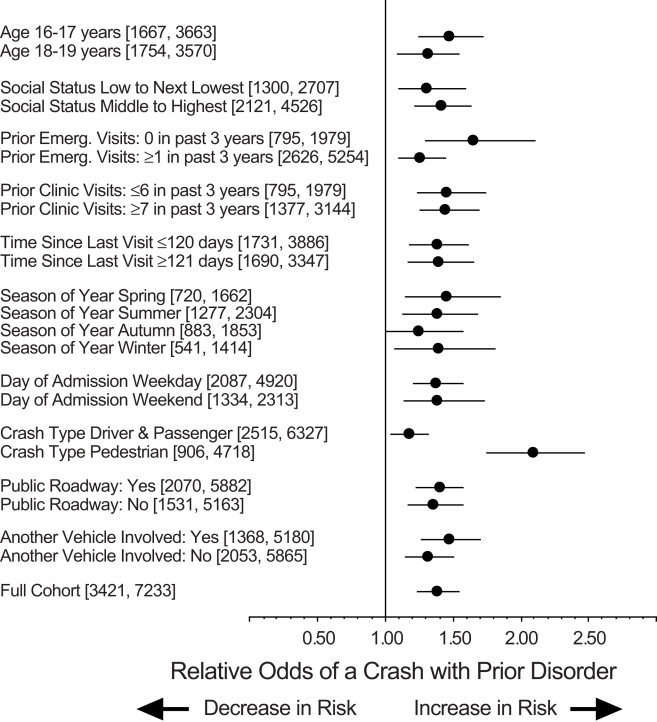
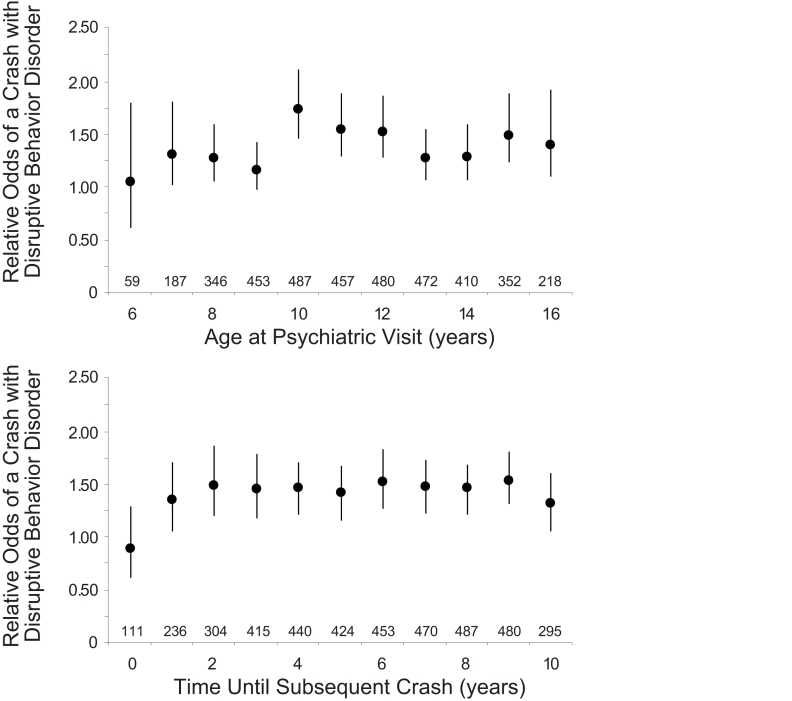
BACKGROUND: Teenage male drivers contribute to a large number of serious road crashes despite low rates of driving and excellent physical health. We examined the amount of road trauma involving teenage male youth that might be explained by prior disruptive behavior disorders (attention deficit hyperactivity disorder, conduct disorder, oppositional defiant disorder). METHODS AND FINDINGS: We conducted a population-based case-control study of consecutive male youth between age 16 and 19 years hospitalized for road trauma (cases) or appendicitis (controls) in Ontario, Canada over 7 years (April 1, 2002 through March 31, 2009). Using universal health care databases, we identified prior psychiatric diagnoses for each individual during the decade before admission. Overall, a total of 3,421 patients were admitted for road trauma (cases) and 3,812 for appendicitis (controls). A history of disruptive behavior disorders was significantly more frequent among trauma patients than controls (767 of 3,421 versus 664 of 3,812), equal to a one-third increase in the relative risk of road trauma (odds ratio = 1.37, 95% confidence interval 1.22-1.54, p<0.001). The risk was evident over a range of settings and after adjustment for measured confounders (odds ratio 1.38, 95% confidence interval 1.21-1.56, p<0.001). The risk explained about one-in-20 crashes, was apparent years before the event, extended to those who died, and persisted among those involved as pedestrians. CONCLUSIONS: Disruptive behavior disorders explain a significant amount of road trauma in teenage male youth. Programs addressing such disorders should be considered to prevent injuries.
Overview
The claims and statistics of this paper haven’t been checked yet.
Free: it reads the open-access text and checks the first 5 claims that cite a source we can check. Create a free account to check every claim.
Integrity signals
Registry
Cites
Statistics
Figures
Verification
Claims the paper makes
The claims and statistics of this paper haven’t been checked yet.
Free: it reads the open-access text and checks the first 5 claims that cite a source we can check. Create a free account to check every claim.
Claims other papers make about this one
Each is checked against this paper’s own text: does it say what the citing paper says it does?
The check wasn’t confident either way, so it gives no verdict — never disputed.
In the citing paper
“symptoms of depression and anxiety can create a barrier to the use of any relevant treatment option for ADHD [10,18,19].”
From A Digital Mental Health Support Program for Depression and Anxiety in Populations With Attention-Deficit/Hyperactivity Disorder: Feasibility and Usability Study (2023) · cites this paper as [10]
Experimental — accuracy not yet measured
Self-check
Percentages, sums and reported differences re-computed from the paper’s own numbers.
The self-check needs the paper’s full text.
Citations
Cites
Kessler, R. C., Adler, L., Barkley, R., Biederman, J., Conners, C. K., Demler, O., Faraone, S. V., Greenhill, L. L., Howes, M. J., Secnik, K., et al. (2006) · American Journal of Psychiatry · doi:10.1176/ajp.2006.163.4.716 · Cited by 3,886 · cited 1×
“The evidence suggests that these disorders are frequent during childhood and adolescence, characterized by impulsivity with rule infringement, and identified in some cases of trauma [25–29].”
BackgroundNegative Controls: A Tool for Detecting Confounding and Bias in Observational Studies
Lipsitch, M., Tchetgen Tchetgen, E., & Cohen, T. (2010) · Epidemiology · doi:10.1097/ede.0b013e3181d61eeb · Cited by 1,583 · cited 1×
“The purpose of these analyses was to check for the absence of an association where no association would be expected [64].”
BackgroundLong-Term Medical and Social Consequences of Preterm Birth
Moster, D., Lie, R. T., & Markestad, T. (2008) · New England Journal of Medicine · doi:10.1056/nejmoa0706475 · Cited by 1,402
Global Status Report on Road Safety: Time for Action
Toroyan, T. (2009) · Cited by 1,392
Mortality among Patients Admitted to Hospitals on Weekends as Compared with Weekdays
Bell, C. M., & Redelmeier, D. A. (2001) · New England Journal of Medicine · doi:10.1056/nejmsa003376 · Cited by 1,070 · cited 1×
“These databases have been validated in past medical research and prior analyses have used these databases to provide measures of relative risks, absolute risk, and attributable risk [41–43].”
MethodSelf-citationRisk taking in adolescence: What changes, and why?
STEINBERG, L. (2004) · Annals of the New York Academy of Sciences · doi:10.1196/annals.1308.005 · Cited by 963 · cited 1×
“Unfortunately, teenage male drivers are often remarkable in risk attitudes and resistant to standard safety advice [9,10].”
BackgroundMORTALITY AMONG PATIENTS ADMITTED TO HOSPITALS ON WEEKENDS AS COMPARED WITH WEEKDAYS
Ell, C., & Edelmeier, A. R. (2001) · Cited by 844
Attention-deficit hyperactivity disorder and hyperkinetic disorder
Swanson, J., Sergeant, J., Taylor, E., Sonuga-Barke, E., Jensen, P., & Cantwell, D. (1998) · The Lancet · doi:10.1016/s0140-6736(97)11450-7 · Cited by 601 · cited 1×
“The specific disorders were attention deficit hyperactivity disorder, conduct disorder, and oppositional defiant disorder (codes 312 to 314) [53–56].”
BackgroundAttention-deficit hyperactivity disorder and hyperkinetic disorder
Swanson, J. M., Sergeant, J. A., Taylor, E., Sonuga-Barke, E. J. S., Jensen, P. S., & Cantwell, D. P. (2001) · Attention Deficit Hyperactivity Disorders · doi:10.4324/9781315054315-2 · Cited by 572
Acute appendicitis in children: Emergency department diagnosis and management
Rothrock, S. G., & Pagane, J. (2000) · Annals of Emergency Medicine · doi:10.1067/mem.2000.105658 · Cited by 415 · cited 1×
“We chose this control condition because it was frequent, clearly coded in hospital records, generally unrelated to traumatic injury, not known to protect against other childhood disorders, and has served as a standard for other research [44–49].”
Result
Research works printed but not linked: 6
- The Joint OECD/ECMT Transport Research Centre 2006 Young drivers: the road to safety. Paris Organisation for Economic Co-operation and Development and European Conference of Ministers of Transport
- Insurance Institute for Highway Safety 2008 Licensing teenagers later reduces their crashes. Status Report 42 1 4
- Canadian Medical Association 2006 Determining medical fitness to operate motor vehicles: CMA driver guide. 7th edition. Ottawa Canadian Medical Association
- Statistics Canada 2007 2006 Census of Population. Ottawa: Statistics Canada. Catalogue 97-551-XCB2006009
- Gordis L 2004 Epidemiology. Philadelphia Elsevier Saunders 181 187
- Gordis L 2004 Epidemiology. Philadelphia Elsevier Saunders 191 196
Cited by
Chang, Z., Lichtenstein, P., D’Onofrio, B. M., Sjölander, A., & Larsson, H. (2014) · JAMA Psychiatry · doi:10.1001/jamapsychiatry.2013.4174 · Cited by 293
Self-harm Emergencies After Bariatric Surgery: A Population-Based Cohort Study
Bhatti, J. A., Nathens, A. B., Thiruchelvam, D., Grantcharov, T., Goldstein, B. I., & Redelmeier, D. A. (2016) · JAMA Surgery · doi:10.1001/jamasurg.2015.3414 · Cited by 170
Self-citationChang, Z., Quinn, P. D., Hur, K., Gibbons, R. D., Sjölander, A., Larsson, H., & D’Onofrio, B. M. (2017) · JAMA Psychiatry · doi:10.1001/jamapsychiatry.2017.0659 · Cited by 166
ADHD and accidents over the life span – A systematic review
Brunkhorst-Kanaan, N., Libutzki, B., Reif, A., Larsson, H., McNeill, R. V., & Kittel-Schneider, S. (2021) · Neuroscience & Biobehavioral Reviews · doi:10.1016/j.neubiorev.2021.02.002 · Cited by 107
“possible mechanisms or risk factors that might explain this association (Jernbro et al., 2020; Avsar et al., 2009; Shilon et al., 2012; Prasad et al., 2018; Rowe et al., 2004; Redelmeier et al., 2010; Hoare and Beattie, 2003).”
BackgroundCurry, A. E., Metzger, K. B., Pfeiffer, M. R., Elliott, M. R., Winston, F. K., & Power, T. J. (2017) · JAMA Pediatrics · doi:10.1001/jamapediatrics.2017.0910 · Cited by 91
“CHOP primary care visits, median (IQR) 19 (10-33) 26 (15-40) 18 (10-31) <.”
Pharmacotherapy of Attention-Deficit Hyperactivity Disorder in Adolescents
Childress, A. C., & Berry, S. A. (2012) · Drugs · doi:10.2165/11599580-000000000-00000 · Cited by 77
“ADHD in adolescent drivers has also been associated with increased risk for motor vehicle injuries.([11]) Teens who have not been previously diagnosed may present with complaints of academic under achievement, low self-esteem, frustration and problems with social relationships.”
BackgroundTraffic Crashes, Violations, and Suspensions Among Young Drivers With ADHD
Curry, A. E., Yerys, B. E., Metzger, K. B., Carey, M. E., & Power, T. J. (2019) · PEDIATRICS · doi:10.1542/peds.2018-2305 · Cited by 72
“Authors of recent population-based studies of more serious crash-related outcomes (ie, hospital visits) reported similar findings.(12,13) However, there have been no studies to examine risk specifically during the newly licensed period (the period of highest lifetime crash risk and thus under the purview of graduated…”
Aduen, P. A., Kofler, M. J., Cox, D. J., Sarver, D. E., & Lunsford, E. (2015) · Journal of Psychiatric Research · doi:10.1016/j.jpsychires.2015.03.009 · Cited by 72
“This finding was unexpected given evidence that disruptive behavior disorders are more common among teenage boys hospitalized for road trauma (Redelmeier et al., 2010).”
BackgroundMental disorders as risk factors: assessing the evidence for the global burden of disease study
Baxter, A. J., Charlson, F. J., Somerville, A. J., & Whiteford, H. A. (2011) · BMC Medicine · doi:10.1186/1741-7015-9-134 · Cited by 58
“Higher rates of accidental injury are reported for people with behavioural disorders such as ADHD [22,23]; however, recall bias increases the chance that cases of ADHD are treated as noncases.”
BackgroundInfluentialPregnancy and the risk of a traffic crash
Redelmeier, D. A., May, S. C., Thiruchelvam, D., & Barrett, J. F. R. (2014) · Canadian Medical Association Journal · doi:10.1503/cmaj.131650 · Cited by 70
Self-citationAduen, P. A., Kofler, M. J., Sarver, D. E., Wells, E. L., Soto, E. F., & Cox, D. J. (2018) · Journal of Psychiatric Research · doi:10.1016/j.jpsychires.2018.02.026 · Cited by 66
Attention deficit/hyperactivity disorder and risk of injuries: a systematic review and meta-analysis
Amiri, S., Sadeghi‐Bazargani, H., Nazari, S., Ranjbar, F., & Abdi, S. (2016) · Journal of Injury and Violence Research · doi:10.5249/jivr.v9i2.858 · Cited by 64
Addressing the lack of studies in attention-deficit/hyperactivity disorder in adults
Ramos‐Quiroga, J. A., Nasillo, V., Fernández‐Aranda, F., & Casas, M. (2014) · Expert Review of Neurotherapeutics · doi:10.1586/14737175.2014.908708 · Cited by 49
“Comorbidity with ADHD within this group includes personality disorders, impulse control disorders and drug use as main contributing factors to increase very significantly the already existent serious problem of undiagnosed ADHD and driving [73].”
BackgroundModern Medicine Is Neglecting Road Traffic Crashes
Redelmeier, D. A., & McLellan, B. A. (2013) · PLoS Medicine · doi:10.1371/journal.pmed.1001463 · Cited by 34
“Many patients, therefore, become immediately debilitated and unable to advocate for their own well-being or activate a philanthropic donor [13].”
BackgroundSelf-citationMedical interventions to reduce motor vehicle collisions
Redelmeier, D. A., & Tien, H. C. N. (2013) · Canadian Medical Association Journal · doi:10.1503/cmaj.122001 · Cited by 25
“Young Canadians, including infants with im properly installed car seats, children engaging in careless behaviour and teenagers with attention deficits, are overrepresented in serious road crashes despite previous contacts with physicians.(63) Adults whose lifestyles include thrillseeking adventures such as off-roading…”
BackgroundSelf-citationThe impact of childhood symptoms of conduct disorder on driver aggression in adulthood
Wickens, C. M., Vingilis, E. R., Mann, R. E., Erickson, P. A., Toplak, M. E., Kolla, N. J., Seeley, J. S., Ialomiteanu, A., Stoduto, G., & Ilie, G. (2015) · Accident Analysis & Prevention · doi:10.1016/j.aap.2015.02.013 · Cited by 16
“Given the impact that probable CD can have on driver aggression, and the likely relationship between CD and collision risk (Begg et al., 1999; Redelmeier et al., 2010), it may be advisable to ensure that special attention within treatment be paid to aggression and outbursts”
BackgroundLange, K. W. (2017) · University of Regensburg Publication Server (University of Regensburg) · doi:10.5283/mnhd.4 · Cited by 17
Tsirmpas, C., Nikolakopoulou, M., Kaplow, S., Andrikopoulos, D., Fatouros, P., Kontoangelos, K., & Papageorgiou, C. (2023) · JMIR Formative Research · doi:10.2196/48362 · Cited by 11
“These measures are of particular relevance to the patient population, which faces a serious disruption to life domains [8-10 ,”
BackgroundTeilnahme am Straßenverkehr und Psychopathologie bei Jugendlichen und jungen Erwachsenen
Fegert, J. M., & Fegert, L. K. (2011) · Zeitschrift für Psychiatrie Psychologie und Psychotherapie · doi:10.1024/1661-4747/a000097 · Cited by 6
Saul, J. P., & Gidding, S. S. (2012) · Circulation · doi:10.1161/circulationaha.112.103994 · Cited by 6
Injury patterns in motor vehicle collision–youth pedestrian deaths
Halari, M. M., Stewart, T. C., McClafferty, K. J., Pellar, A. C., Pickup, M. J., & Shkrum, M. J. (2024) · Traffic Injury Prevention · doi:10.1080/15389588.2024.2351603 · Cited by 5
“Disorders associated with inattention or distraction have been found to contribute to the number of road traffic crashes experienced by male youth, including pedestrians (Redelmeier et al. 2010).”
BackgroundCampbell, I. M., Lundström, S., Larsson, H., Lichtenstein, P., & Lubke, G. H. (2018) · European Child & Adolescent Psychiatry · doi:10.1007/s00787-018-1250-9 · Cited by 6
The association of childhood symptoms of conduct disorder and collision risk in adulthood
Wickens, C. M., Mann, R. E., Ialomiteanu, A., Vingilis, E. R., Seeley, J. S., Erickson, P. A., & Kolla, N. J. (2019) · Journal of Transport & Health · doi:10.1016/j.jth.2019.03.007 · Cited by 5
Tait, R. J., Ivers, R., Marino, J. L., Doherty, D. A., Graham, P. L., Cunich, M. M., Sanci, L. A., Steinbeck, K. S., Straker, L. M., & Skinner, S. R. (2021) · Journal of Epidemiology & Community Health · doi:10.1136/jech-2021-218039 · Cited by 6
Social benefit payments and acute injury among low-income mothers.
Redelmeier, D. A., Chan, W., Mullainathan, S., & Shafir, E. B. (2012) · PubMed Central · Cited by 6
Self-citationRoadway Aggression Among Drivers and Passengers With or Without a History of Traumatic Brain Injury
Ilie, G., Wickens, C. M., Mann, R. E., Ialomiteanu, A., Adlaf, E. M., Hamilton, H. A., Asbridge, M., Rehm, J. T., & Cusimano, M. D. (2017) · Violence and Victims · doi:10.1891/0886-6708.vv-d-16-00027 · Cited by 4
Gambling and Subsequent Road Traffic Injuries: A Longitudinal Cohort Analysis
Bhatti, J. A., Thiruchelvam, D., & Redelmeier, D. A. (2018) · Journal of Addiction Medicine · doi:10.1097/adm.0000000000000465 · Cited by 4
Self-citationChildren's perceptions of injuries: a qualitative study in Sweden.
Dale, R. A., Hasselberg, M., Jakobsson, A., & Hensing, G. K. E. (2013) · PubMed · Cited by 5
The impact of childhood symptoms of conduct disorder on driving after drinking in adulthood
Wickens, C. M., Mann, R. E., Vingilis, E. R., Ialomiteanu, A., Erickson, P. A., Kolla, N. J., Stoduto, G., & van der Maas, M. (2017) · Journal of Transport & Health · doi:10.1016/j.jth.2017.03.002 · Cited by 3
Attention Deficit Hyperactivity Disorder (ADHD)
Binder, M. D., Hirokawa, N., & Windhorst, U. (2008) · Springer eBooks · doi:10.1007/978-3-540-29678-2_417 · Cited by 3
Accidental Physical Trauma in Children and Youth with Special Health Care Needs: A Scoping Review
Lillvis, D. F., Harmon, B., Osei, H., Ribeiro, S., Zrik, A. M., Janjua, V., Assioun, J., Aronoff, N., & Kuo, D. Z. (2024) · Academic Pediatrics · doi:10.1016/j.acap.2024.10.002 · Cited by 1
Cruise, S. M., & O’Reilly, D. (2015) · Social Science & Medicine · doi:10.1016/j.socscimed.2015.02.021 · Cited by 2
Attention Deficit Hyperactivity Disorder (ADHD)
(2016) · CRC Press eBooks · doi:10.1201/9781315374123-15 · Cited by 1
The origins and consequences of attention deficit hyperactivity disorder
Chang, Z. (2013) · Figshare · Cited by 1
Martínez, V. C., Piñeiro, Y. G., Gay, L. P., Puñal, J. M. E., & Rodríguez‐Núñez, A. (2012) · Anales de Pediatría · doi:10.1016/j.anpedi.2012.05.022
Nonfatal injuries in a local context - analysing social structures and perceptions in young people
Dale, R. A. (2012) · Gothenburg University Publications Electronic Archive (Gothenburg University) · Cited by 1
Michel, G., Salla, J., Grondin, O. S., Teymoori, A., Salamon, R., & Galéra, C. (2017) · Neuropsychiatrie de l Enfance et de l Adolescence · doi:10.1016/j.neurenf.2017.09.001
Childress, A. C., Malik, H., & Potenziano, J. (2026) · Advances in Therapy · doi:10.1007/s12325-026-03638-9
Metadata
- Authors
- Redelmeier, D. A., Chan, W. K., & Lu, H.
- Affiliations
- Sunnybrook Health Science Centre (CA)
- University of Toronto (CA)
- Institute for Clinical Evaluative Sciences (CA)
- Corresponding author
- Redelmeier, Donald A.
- Chan, William K.
- Lu, Hong
- Venue
- PLoS Medicine
- Publisher
- Public Library of Science (PLoS)
- Published
- 2010-11-16
- Volume
- 7
- Issue
- 11
- Pages
- e1000369
- ISSN
- 1549-1277 (ISSN-L)
- 1549-1676
- PMC
- PMC2981585
- OpenAlex
- W1983730049
- Cited by
- 39
- References
- 69
- Citations by year
- 2026: 1 · 2024: 2 · 2023: 1 · 2021: 2 · 2019: 2 · 2018: 3 · 2017: 7 · 2016: 2 · 2015: 4 · 2014: 3 · 2013: 4 · 2012: 5
- FWCI
- 11.65
- Type
- journal article
- Language
- en
- Open access
- gold
- doi.org
- Locations
- PLoS Medicine (publishedVersion, cc-by)
- PubMed Central (publishedVersion, cc-by)
- PubMed (publishedVersion)
- DOAJ (DOAJ: Directory of Open Access Journals) (submittedVersion, cc-by-sa)
- Funders
- University of Toronto
- Topics
- Physical Sciences › Engineering › Safety, Risk, Reliability and Quality › Traffic and Road Safety
- Health Sciences › Medicine › Public Health, Environmental and Occupational Health › Injury Epidemiology and Prevention
- Social Sciences › Psychology › Clinical Psychology › Child and Adolescent Psychosocial and Emotional Development
- Keywords
- road trauma, adolescent drivers, disruptive behavior disorders, attention deficit hyperactivity disorder, conduct disorder, oppositional defiant disorder, traffic accidents, injury risk, psychiatric comorbidity, injury prevention, young men
- MeSH terms
- Accidents, Traffic, Adolescent, Attention Deficit Disorder with Hyperactivity, Humans, Male, Case-Control Studies, Conduct Disorder, Attention Deficit and Disruptive Behavior Disorders
About these checks
Registry, retraction, Cites and statistics results are computed, not judged, with one exception: a printed reference that no index lists is read once by a model before it counts as a citation error. Claims are extracted by a model and kept only when their quote appears verbatim in the text; each cited source is then checked, with a model’s help, for whether it says what the claim relies on. Those verdicts can be wrong — read the claim’s quote and the cited source before relying on one.
Statistics and arithmetic are recomputed, not judged.
Confidence bands are shown only for fields calibrated on our annotated test set. None is calibrated yet, so no band is shown.
What counts as a claim ›How we measure confidence ›How we check this ›
Are you an author, or do you see a problem with this page? Request a review
Data sources
Bibliographic data: Semantic Scholar, OpenAlex, Crossref.
Contains information from the Semantic Scholar Academic Graph Datasets, made available under the ODC Attribution License (ODC-BY 1.0).
Semantic Scholar’s data is described in: Kinney, R., et al. (2023). The Semantic Scholar Open Data Platform. arXiv:2301.10140.
