

The DOI matches its Crossref record; 50 of the 50 references it cites were found in a registry or an index.
A Randomized Controlled Trial Comparing the Effects of Counseling and Alarm Device on HAART Adherence and Virologic Outcomes
Open accessAbstract
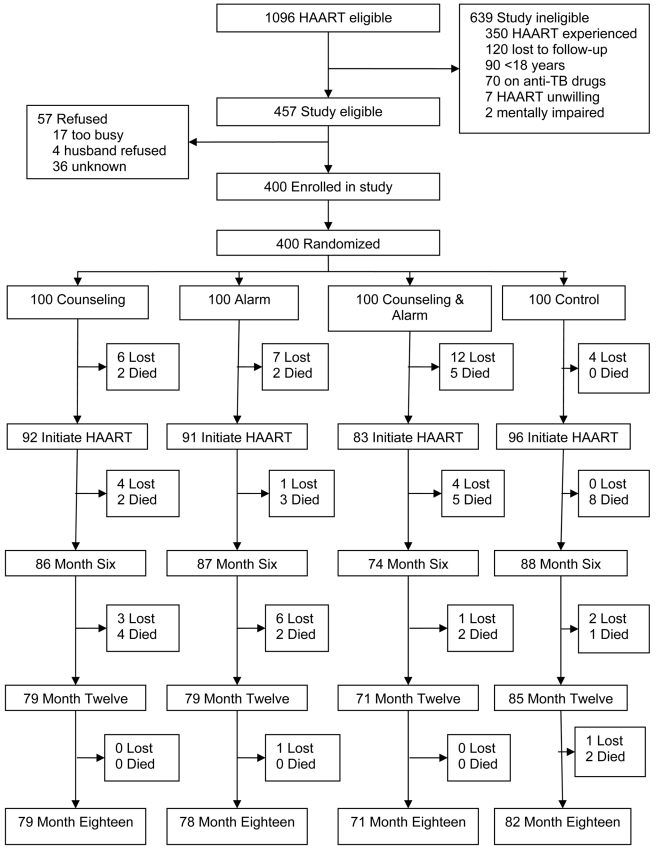
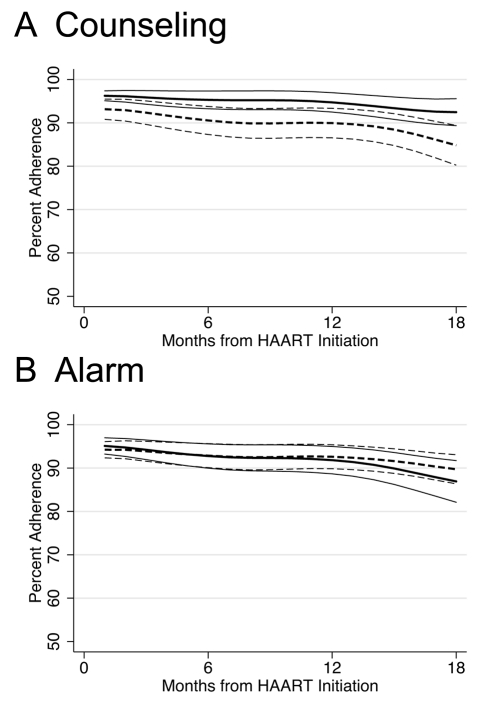
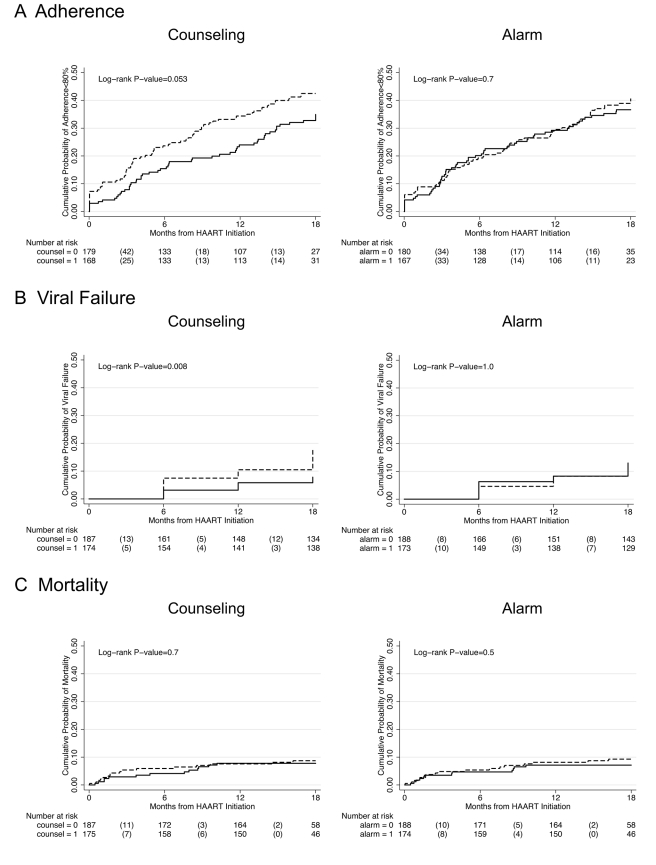
BACKGROUND: Behavioral interventions that promote adherence to antiretroviral medications may decrease HIV treatment failure. Antiretroviral treatment programs in sub-Saharan Africa confront increasing financial constraints to provide comprehensive HIV care, which include adherence interventions. This study compared the impact of counseling and use of an alarm device on adherence and biological outcomes in a resource-limited setting. METHODS AND FINDINGS: A randomized controlled, factorial designed trial was conducted in Nairobi, Kenya. Antiretroviral-naïve individuals initiating free highly active antiretroviral therapy (HAART) in the form of fixed-dose combination pills (d4T, 3TC, and nevirapine) were randomized to one of four arms: counseling (three counseling sessions around HAART initiation), alarm (pocket electronic pill reminder carried for 6 months), counseling plus alarm, and neither counseling nor alarm. Participants were followed for 18 months after HAART initiation. Primary study endpoints included plasma HIV-1 RNA and CD4 count every 6 months, mortality, and adherence measured by monthly pill count. Between May 2006 and September 2008, 400 individuals were enrolled, 362 initiated HAART, and 310 completed follow-up. Participants who received counseling were 29% less likely to have monthly adherence <80% (hazard ratio [HR] = 0.71; 95% confidence interval [CI] 0.49-1.01; p = 0.055) and 59% less likely to experience viral failure (HIV-1 RNA ≥5,000 copies/ml) (HR 0.41; 95% CI 0.21-0.81; p = 0.01) compared to those who received no counseling. There was no significant impact of using an alarm on poor adherence (HR 0.93; 95% CI 0.65-1.32; p = 0.7) or viral failure (HR 0.99; 95% CI 0.53-1.84; p = 1.0) compared to those who did not use an alarm. Neither counseling nor alarm was significantly associated with mortality or rate of immune reconstitution. CONCLUSIONS: Intensive early adherence counseling at HAART initiation resulted in sustained, significant impact on adherence and virologic treatment failure during 18-month follow-up, while use of an alarm device had no effect. As antiretroviral treatment clinics expand to meet an increasing demand for HIV care in sub-Saharan Africa, adherence counseling should be implemented to decrease the development of treatment failure and spread of resistant HIV.
Overview
The claims and statistics of this paper haven’t been checked yet.
Run the check — free, no account needed. It reads the open-access text and checks the sources it cites.
Integrity signals
Registry
Cites
Statistics
Figures
Verification
Claims the paper makes
The claims and statistics of this paper haven’t been checked yet.
Run the check — free, no account needed. It reads the open-access text and checks the sources it cites.
Claims other papers make about this one
Each is checked against this paper’s own text: does it say what the citing paper says it does?
In the citing paper
“For the seven randomised controlled trials testing effects of SMS communication on various health outcomes had reported positive effects [16, 20, 32, 33, 44–49], while the remaining trial showed no effect of mobile alarm devices on treatment adherence for HIV patients [15].”
From Assessing the feasibility of eHealth and mHealth: a systematic review and analysis of initiatives implemented in Kenya (2017) · cites this paper as [15]
Self-check
Percentages, sums and reported differences re-computed from the paper’s own numbers.
The self-check needs the paper’s full text.
Citations
Cites
Osterberg, L., & Blaschke, T. (2005) · New England Journal of Medicine · doi:10.1056/nejmra050100 · Cited by 7,974
Adherence to Protease Inhibitor Therapy and Outcomes in Patients with HIV Infection
Paterson, D. L., Swindells, S., Mohr, J. A., Brester, M., Vergis, E. N., Squier, C. L., Wagener, M. M., & Singh, N. (2000) · Annals of Internal Medicine · doi:10.7326/0003-4819-133-1-200007040-00004 · Cited by 3,289 · cited 1×
“. Adequate adherence defined as taking ≥95% of prescribed pills derives from literature examining regimens containing un-boosted protease inhibitors (PIs)”
Prognosis in HIV-1 Infection Predicted by the Quantity of Virus in Plasma
Mellors, J. W., Rinaldo, C. R., Gupta, P., White, R. M., Todd, J. A., & Kingsley, L. (1996) · Science · doi:10.1126/science.272.5265.1167 · Cited by 2,658 · cited 1×
“. Similarly, use of the alarm device was measured by self-report and was not able to be verified. It is possible that continuous use of the alarm device was overestimated and that the insignificant associations found in this study may have been due to poor participant participation in this intervention. The adherence…”
Toward a theory of motivational interviewing
Miller, W. R., & Rose, G. S. (2009) · American Psychologist · doi:10.1037/a0016830 · Cited by 1,603 · cited 1×
“The study evaluated two interventions based on models of cognitive and behavioral theory to promote adherence to antiretroviral medications: intensive adherence counseling and use of a pocket alarm device [32,33].”
Lester, R. T., Ritvo, P., Mills, E. J., Kariri, A., Karanja, S., Chung, M. H., Jack, W., Habyarimana, J., Sadatsafavi, M., Najafzadeh, M., et al. (2010) · The Lancet · doi:10.1016/s0140-6736(10)61997-6 · Cited by 1,278 · cited 1×
“may be interpreted as less a function of the cell phone as a reminder device but rather as a means to provide regular patient support [47].”
Self-citationPocock, S. J., Assmann, S. E., Enos, L. E., & Kasten, L. E. (2002) · Statistics in Medicine · doi:10.1002/sim.1296 · Cited by 1,077 · cited 2×
“Despite randomization, baseline differences between intervention arms were noted; these were adjusted for in multivariable analyses if they were related to the outcome of interest [36].”
Adherence to Antiretroviral Therapy in Sub-Saharan Africa and North America: A Meta-analysis
Mills, E. J., Nachega, J. B., Buchan, I., Orbinski, J., Attaran, A., Singh, S., Rachlis, B., Wu, P., Cooper, C., Thabane, L., et al. (2006) · JAMA · doi:10.1001/jama.296.6.679 · Cited by 899 · cited 1×
“. In a meta-analysis of 27 cohorts from 12 African countries, adequate adherence was noted in 77% of participants compared to only 55% among 31 North America cohorts”
Rapid Scale-up of Antiretroviral Therapy at Primary Care Sites in Zambia
Stringer, J. S. A., Zulu, I., Levy, J., Stringer, E. M., Mwango, A., Chi, B. H., Mtonga, V., Reid, S. E., Cantrell, R. A., Bulterys, M., et al. (2006) · JAMA · doi:10.1001/jama.296.7.782 · Cited by 664
Bangsberg, D. R. (2006) · Clinical Infectious Diseases · doi:10.1086/507526 · Cited by 536
Mannheimer, S., Friedland, G. H., Matts, J. P., Child, C. C., & Chesney, M. A. (2002) · Clinical Infectious Diseases · doi:10.1086/339074 · Cited by 512 · cited 1×
“Although poor adherence has been associated with plasma HIV-1 viral rebound and development of viral resistance [38,39], few trials have demonstrated an association between an intervention designed to improve adherence and virologic impact [37,40–42].”
Research works printed but not linked: 2
- 2007, Kenya national clinical manual for ART providers: a concise and practical guide to ART provision.2nd edition.
- J Donnelly, 2001, Prevention urged in AIDS fight; Natsios says funds should spend less on HIV treatment., Boston Globe
Cited by
Sorted by citations
Interventions for enhancing medication adherence
Nieuwlaat, R., Wilczynski, N., Navarro, T., Hobson, N., Jeffery, R., Keepanasseril, A., Agoritsas, T., Mistry, N., Iorio, A., Jack, S., et al. (2014) · Cochrane Database of Systematic Reviews · doi:10.1002/14651858.cd000011.pub4 · Cited by 2,945
Motivational Interviewing Improves Medication Adherence: a Systematic Review and Meta-analysis
Palacio, A., Garay, D., Langer, B., Taylor, J., WOOD, B. A., & Tamariz, L. J. (2016) · Journal of General Internal Medicine · doi:10.1007/s11606-016-3685-3 · Cited by 292
Mfinanga, S., Chanda, D. M., Kivuyo, S. L., Guinness, L., Bottomley, C., Simms, V. M., Chijoka, C., Masasi, A., Kimaro, G. D., Ngowi, B. J., et al. (2015) · The Lancet · doi:10.1016/s0140-6736(15)60164-7 · Cited by 250
Kanters, S., Park, J., Chan, K., Socias, M. E., Ford, N. P., Forrest, J. I., Thorlund, K., Nachega, J. B., & Mills, E. J. (2016) · The Lancet HIV · doi:10.1016/s2352-3018(16)30206-5 · Cited by 250
Interventions to improve adherence to antiretroviral therapy
Chaiyachati, K. H., Ogbuoji, O., Price, M., Suthar, A. B., Negussie, E. K., & Bärnighausen, T. (2014) · AIDS · doi:10.1097/qad.0000000000000252 · Cited by 235
Metadata
- Authors
- Chung, M. H., Richardson, B. A., Tapia, K., Benki-Nugent, S., Kiarie, J. N., Simoni, J. M., Overbaugh, J., Attwa, M., & John-Stewart, G. C.
- Affiliations
- University of Washington (US)
- University of Nairobi (KE)
- Fred Hutch Cancer Center (US)
- Corresponding author
- Chung, Michael H.
- ORCID
- Venue
- PLoS Medicine
- Publisher
- Public Library of Science (PLoS)
- Published
- 2011-03-01
- Volume
- 8
- Issue
- 3
- Pages
- e1000422
- ISSN
- 1549-1277 (ISSN-L)
- 1549-1676
- PMC
- PMC3046986
- OpenAlex
- W2160766775
- Cited by
- 109
- References
- 50
- Citations by year
- 2025: 1 · 2024: 2 · 2023: 5 · 2022: 1 · 2021: 5 · 2020: 8 · 2019: 3 · 2018: 11 · 2017: 12 · 2016: 9 · 2015: 8 · 2014: 13 · 2013: 14 · 2012: 13
- FWCI
- 9.54
- Type
- journal article
- Language
- en
- Open access
- gold
- doi.org
- Locations
- PLoS Medicine (publishedVersion, cc-by)
- Europe PMC (PubMed Central) (publishedVersion, cc-by)
- PubMed Central (publishedVersion, cc-by)
- PubMed (publishedVersion)
- DOAJ (DOAJ: Directory of Open Access Journals) (submittedVersion, cc-by-sa)
- Figshare (submittedVersion, cc-by)
- Greater South Information System
- Funders
- University of Washington
- U.S. President’s Emergency Plan for AIDS Relief (U62/CCU024512, U62/CCU024512-04)
- Hope Center for Neurological Disorders
- National Institutes of Health
- Centers for Disease Control and Prevention (U62/CCU024512)
- U.S. Public Health Service (U62/CCU024512-04)
- Center for AIDS Research, University of Washington (P30 AI027757)
- National Institute on Aging
- National Heart, Lung, and Blood Institute
- National Institute of Mental Health
- National Institute on Drug Abuse
- National Cancer Institute
- National Institute of Allergy and Infectious Diseases (K23AI065222, P30AI027757)
- National Center for Complementary and Alternative Medicine
- Eunice Kennedy Shriver National Institute of Child Health and Human Development (K24HD054314)
- Topics
- Health Sciences › Medicine › Infectious Diseases › HIV/AIDS Research and Interventions
- Health Sciences › Medicine › Family Practice › Medication Adherence and Compliance
- Health Sciences › Medicine › Infectious Diseases › HIV/AIDS drug development and treatment
- Keywords
- medication adherence, HIV, highly active antiretroviral therapy, adherence counseling, virological failure, HIV-1 RNA, CD4 count, immune reconstitution, antiretroviral-naive patients, fixed-dose combination antiretroviral therapy, resource-limited settings, sub-Saharan Africa, mortality
- MeSH terms
- Adult, Counseling, Drug Combinations, Female, Humans, Kenya, Male, Memory, Patient Compliance, RNA, Viral, HIV-1, HIV Infections, Proportional Hazards Models, Treatment Outcome, Reminder Systems, CD4 Lymphocyte Count, Antiretroviral Therapy, Highly Active, Anti-Retroviral Agents
About these checks
Registry, retraction, Cites and statistics results are computed, not judged, with one exception: a printed reference that no index lists is read once by a model before it counts as a citation error. Claims are extracted by a model and kept only when their quote appears verbatim in the text; each cited source is then checked, with a model’s help, for whether it says what the claim relies on. Those verdicts can be wrong — read the claim’s quote and the cited source before relying on one.
Statistics and arithmetic are recomputed, not judged.
Confidence bands are shown only for fields calibrated on our annotated test set. None is calibrated yet, so no band is shown.
What counts as a claim ›How we measure confidence ›How we check this ›
Are you an author, or do you see a problem with this page? Request a review
